We are fortunate to live near the Harvard Art Museums, and while visiting recently, I pulled open a drawer and saw one object inside: Joan Miro’s 1937 design for a fundraising stamp entitled “Help Spain” (Aidez L’Espagne). Miro’s handwritten text says, “In the current struggle, I see expired forces on the fascist side; on the other side, the people whose immense creative resources will give Spain a momentum that will astonish the world” (my translation).
Two years after this print was made, the Spanish fascists had won. For that reason, the image caught me short. I had to remind myself: sometimes the people do win; sometimes the creative forces prevail.
On March 25, Vladimir Putin gave a speech to Russian writers and artists that was widely covered because he mentioned Western “cancel culture”–thereby demonstrating a familiarity with US talking points. His speech also reflected a widespread but problematic view of the relationship between nations (or peoples) and cultures. This theory is basic to various forms of nationalism that we would classify as right-wing, such as Hindutva in India, but it also permeates some left-wing discussions of indigenous cultures.
According to this theory, each artists or thinker belongs to one people, and each people can therefore claim a list of cultural figures as primarily its own. The great figures of any nation share definitive characteristics with each other and with their ordinary compatriots; these make them members of the same national culture. Foreigners can enjoy and benefit from the creations of any national culture–but only indirectly and imperfectly, for it is the birthright of the originating culture alone. On the other hand, all ordinary people gain refracted glory from the list of great figures of their own national history.
The world recognizes (or should recognize) cultural excellence, just as it recognizes success in athletics or business. One can therefore compare nations by ranking their great cultural figures. To do this, you don’t need to know much about the content of their thought.
Maya Asha McDonald, a Canadian art historian, dined with Putin in the Kremlin in 2019. “’The President would like to know about your study of Christian art,’” a woman to my left said with an icy smile. “’And what you think of Russia’s rich artistic history.’” Putin proceeded to list famous works in Russian museums. When McDonald ventured an informed remark, Putin acknowledged that she seemed to know “quite a bit for ‘someone from Canada.'” This turned out to be a compliment, because Putin “views North America as having a lesser artistic legacy.” He “fundamentally views the wonders of Russian museums as indisputable evidence of his nation’s superiority.”
In the speech last week, Putin said:
Russian culture has made an invaluable contribution to the development of world civilisation. For centuries, Russian masters of literature, music and fine arts have given humankind new aesthetic traditions and, more importantly, ideals and meanings that have become moral and spiritual guidelines for millions of people and entire generations.
Russian culture is human-centric. The best classical works are focused on the inner life, personal quests and emotional experiences of human beings. They ask relevant questions, help people to think, understand and draw conclusions.
It is not surprising that the Russian mentality is known for taking things to heart. We feel very strongly about other people’s pain and injustice. We are capable of feeling sincere joy about others’ success and helping those who truly need our help.
Russian culture always protected Russia’s national identity. While readily taking in all the best and constructive, it patently rejected anything false or momentary, anything that would disrupt the continuity of our spiritual values, moral principles, and historical memory.
This unique quality reliably protects the Russian people even today, when seemingly eternal concepts and norms are being eroded and undermined in different countries, history is being distorted, and the laws of nature itself are being violated. …
Friends, you belong to different generations and serve in different areas of Russian culture and education. Yet, you are equally loyal to them. You are striving to multiply their rich traditions and bring up new generations of thinking and spiritually rich people who are able to perceive and pass on traditional values, who know and respect the past and present of their homeland, who are the true citizens of Russia.
(I quote Putin from the official English translation on the Kremlin.ru website.)
In my view, most artists (with interesting exceptions) belong uncomfortably to any given national tradition and take inspiration from diverse sources. There is no necessary correlation between the core values of specific artists and the dominant values of the nation at their time or later, nor do artists who are associated with the same nation typically agree with each other.
An individual gains little from just belonging to the same nation as a major thinker. For instance, I have learned virtually nothing from Herman Melville, since I have (unfortunately) not read Moby Dick. It would be foolish for me to feel pride that Melville was American; if anything, I should be mildly embarrassed that I have not read such a major novel. However, we can profit from any works with which we seriously wrestle. In my case, those include some works by Turgenev, Tolstoy, Dostoyevsky, Shostakovich, Nabokov, Akhmatova, and some other Russians.
In that sense, Putin is right that Russians have “given ideals and meanings” to people like me, who are far away. But I did not gain from these authors and composers a glimpse into some ineffable and indestructible Russian soul. I gained a whole range of divergent thoughts from diverse and unruly thinkers. As Putin says, these authors “ask relevant questions, help people to think, understand and draw conclusions.”
But there is no sign that Vladimir Putin has learned to think from the canon of Russian literature. He might align with Solzhenitsyn and with some aspects of Dostoyevsky, but many of the great Russians would hold him in the deepest contempt. Among those would be Shostakovich (a lifelong victim of the KGB), whom Putin mentions as a target of Western cancellations.
(Please pause to consider the irony that former KGB officer Putin is angry that Shostakovich might be “canceled,” when the Soviet state imprisoned and/or shot Shostakovich’s “patron Marshal Tukhachevsky; his brother-in-law, the distinguished physicist Vsevolod Frederiks; his great friend the musicologist Nikolai Zhilyayev; his mother-in-law, the astronomer Sofiya Mikhaylovna Varzar; his uncle Maxim Kostrykin; and his colleagues Boris Kornilov and Adrian Piotrovsky” and came within a hair’s breadth of purging the composer himself.)
Putin’s theory of culture is vary far from the worst thing about him. I would not claim that it explains or motivates his decision to invade Ukraine, which can be better explained in terms of raw power. But it is a bad theory that is widely shared. I would guess that many Americans–when told that Putin ranks Russian culture above theirs–would counter with the names of distinguished American thinkers whom they have never actually read, some of whom are deeply critical of the USA.
That is the wrong path. Culture is not the Olympic Games, with a medal count. Cultured people don’t brag about the number of their countrymen who have won global repute. Cultured people challenge themselves with uncomfortable ideas from diverse sources and treat all other human beings as their fellow citizens of the earth.
Here is what I will call a “top-down” theory of public opinion: Everyone should assess the most important issues of the day. An example might be the federal budget. Individuals are entitled to their personal beliefs or preferences about taxation, spending, and deficits; nevertheless, these three topics have an objective logical structure. If you want lower taxes and no deficits, you must favor spending cuts. If you want more spending, you must support either tax increases or bigger deficits. It is a civic obligation to think through your own complete view of these issues.
Analyzing a nationally representative survey of such matters should reveal that: a) most citizens hold opinions about them, and b) everyone recognizes the same underlying logic, even as they disagree about priorities. Citizens should vote according to their priorities, and the majority should prevail.
If, however, a) and b) are false, then democracy is flawed. Perhaps people should learn more and pay more attention, or the political system should offer greater clarity, or perhaps democracy is simply a false ideal.
Philip Converse’s “The Nature of Belief Systems in Mass Publics” (1964) has been enormously influential (cited more that 11,000 times). He does not employ exactly the framework with which I began this post, but his analysis suggests that democracy is a flawed ideal.
Analyzing surveys of political specialists, such as congressional candidates, Converse finds that these respondents meet both tests mentioned above. Professional politicians and other experts hold opinions on the great issues of the day that fit together in similar ways, even as they debate the contested questions. However, according to Converse, surveys of representative Americans reveal scant opinions and no consistent structure among opinions. Ordinary people are not, therefore, in a position to weigh in on the debates of the day.
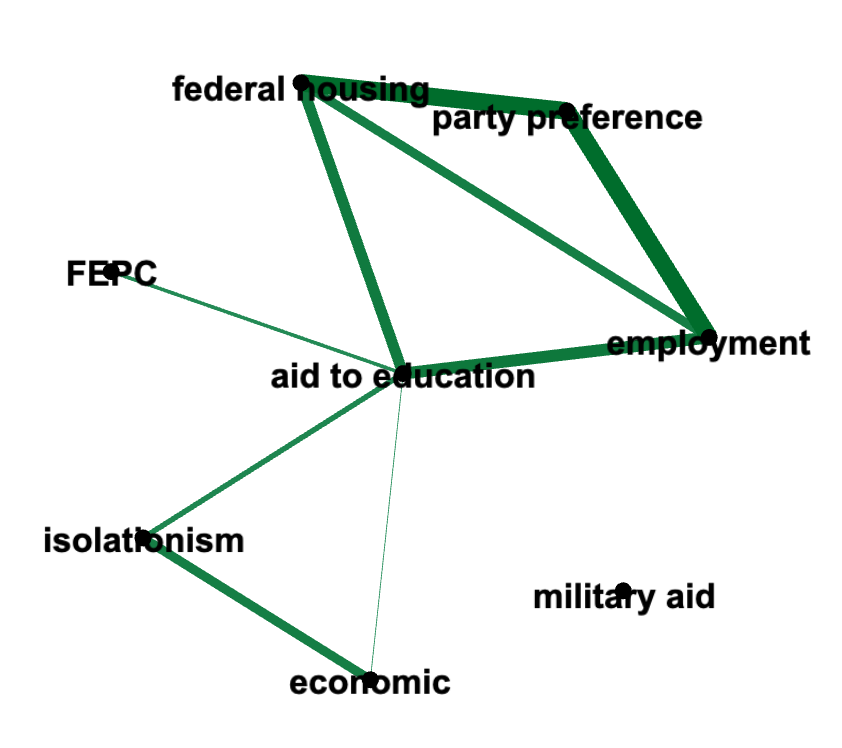
Converse doesn’t use network analysis, but I can convert his core findings into network maps. (For those interested, I turned every tau-gamma coefficient above .05 in Converse’s Table 7 into an edge in these graphs.)
Congressional candidates share the following model of the political debate ca. 1962.
Whether candidates are Democrats or Republicans is strongly related to their views of federal interventions on education, housing, and employment, and those issues are linked together. Military aid to foreign countries is not connected–it stands alone as a topic. (“FEPC” means the proposed Fair Employment Practices Commission.)
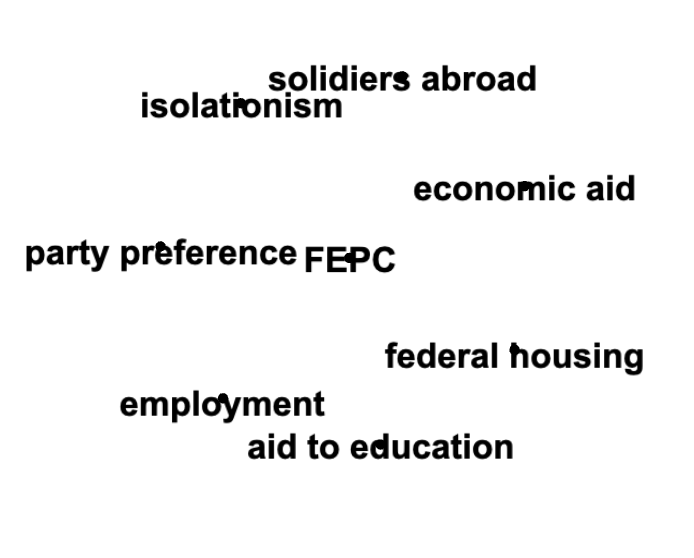
Meanwhile, this is the result of using the same method with Converse’s data from representative adults at the same time:
There are no links at at all among the ideas (meaning no coefficients > .5). Converse suggests that people are not in a position to play the role expected in a “civics class” theory of democracy, assessing and voting on the issues of the day.
Now here is a rival, “bottom up” theory: The social world is enormously complex. Responsible people may hold opinions on myriad issues, and no one can have a view about everything. Even if we focus on a single domain, such as the federal budget, it is highly complex. Federal spending includes funds for many different purposes. Each federal program has a financial cost, but it also has moral significance, behavioral impact, symbolic meaning, likelihood of success, etc. If people are diverse and free, they will naturally form many different structures of opinions about the range of topics that they have considered so far.
Imagine a sample of people, each of whom holds a thoughtful and carefully considered view of public issues and connects each opinion to other opinions in rigorous ways. However, each person holds a unique structure. Then, if researchers contact each person and ask a short list of survey questions (out of the innumerable questions that they could ask), and the aggregate survey data is analyzed using the methods pioneered by Converse, it will reveal no significant links at all. The heterogeneity of individuals’ beliefs will yield very low coefficients at the group level. Their graph will look just like the second graph above–not because they are tuned out of politics or undisciplined in their thinking, but because they differ.
Converse (p. 44) explicitly acknowledges this possibility. He notes that if people’s opinions become “increasingly idiosyncratic” as they move away from the elite, we will find “little aggregative patterning of belief combinations” in their data, because they will not know “what goes with what” (presumably, according to the elites) and will “therefore put belief elements together in a great variety of ways.”
However, Converse counters with a different kind of evidence. According to his analysis of longitudinal data from the American National Election Studies from 1958-60, most people’s opinions on most issues change as if by sheer chance as time passed. This implies that they do not hold “well knit but highly idiosyncratic belief systems” (p. 47). Instead, they have no “meaningful beliefs” at all (p. 51). The exceptions are various small and specialized “issue publics” who hold stable opinions about specific concerns, including many Blacks and some White Southerners on questions of race.
On this point, I would only note that an enormous number of longitudinal studies have been conducted since 1962, and some find stability over time (e.g., Kustov, Laaker & Reller 2021), unexplained–and perhaps random–change (Jaeger, M. M. 2006), or a mix of the two, depending on this issue (Kiley & Vaisey 2020). For instance, according to the last of those studies, the proportion of individuals who change their opinions about abortion is extraordinarily low. Converse’s blanket claim that most people’s opinions on most issues change randomly seems overstated.
I do not assume that all of my fellow Americans (or anyone else) holds complex and rigorous mental models of politics. Some people hardly hold any opinions, or cannot connect their opinions together, or do so in illogical ways. My point is that we cannot tell from aggregate data what proportion of people hold thoughtful views unless we assume that all worthy views must manifest the same structure. Converse uses scare quotes around the word “proper” when he mentions “the sophisticated observer’s assumption of what beliefs go with other beliefs,” but if we seriously doubt that elites understand the “proper” arrangement, then we should expect regular people to exhibit great diversity.
In that case, we should seek to understand the heterogeneous structures of ordinary people’s views. This kind of research has three important purposes:
It may counter the very low assessment of public capacity that is fashionable now in political science, deriving from Converse. That skepticism may prove self-reinforcing, since experts who doubt the public’s ability to reason will not be motivated to defend or improve democracy.
It may yield specific findings about structures of thought shared by sub-groups. Those insights will be invisible as long as we only we ask whether the public shares the structures assumed by political elites.
It offers a perspective on political institutions. Even if many people hold worthy but heterogeneous structures of ideas, we probably still need mass elections to address prominent topics, such as whether to raise or cut taxes. I support that kind of democracy. But it will always be frustrating, because the structure presented by elites will fail to match the reasonable structures in many people’s minds. Fortunately, we can complement mass majoritarian democracy with other forms of participation. Civil society provides an enormous range of specialized groups, and individuals can choose to join the groups that match their personal ideologies, exit ones that don’t, advocate for adjustments within the groups they belong to, and compete for new members. Meanwhile, relatively small and relatively discursive bodies, such as local town meetings or Participatory Budgeting sessions, offer individuals opportunities to share their idiosyncratic views in public. We might understand those venues as opportunities for deliberation that can yield wiser judgments. Or we might understand such venues as places where people can display their uniqueness, as Hannah Arendt advocated. Thus a “bottom up” theory supports decentralization, pluralism, or polycentricity.
Newly in print: Peter Levine, “Putting the US Constitution in Its Place,” in Citizenship and Civic Leadership in America, edited by Carol McNamara and Trevor Shelly (Lanham, MD: Lexington Books, 2022), pp. 281-292.
Abstract:
Almost all American students are required to study the formal structure of the US government, and most perform fairly well on concrete, factual questions about the Constitution. But there is much more for competent citizens to learn. After I explore some valid reasons to include the Constitution in required curricula, I argue that the document provides a poor framework for civics as a whole, giving students a distorted view of the social world and failing to motivate them for ethical civic engagement. I conclude with a sketch of a curriculum in which the US Constitution has a place, but a fairly modest one.
Yesterday, I got to give an International Society for Quantitative Ethnography (ISQE) Webinar on “Moral and Political Discussion and Epistemic Networks.” I really enjoyed the questions and conversation. This is the video of the whole event:
Abstract: An individual holds linked beliefs about political or moral issues, which we can model as a network. How these ideas are linked together influences the person’s actions and opinions. When individuals discuss, they share some portions of their respective networks of which they are conscious at the time. Some network structures are better than others for discussion: overly centralized or scattered networks are problematic. Individuals tend to demonstrate similar network structures on different issues. Thus, relying on certain kinds of networks is a character trait. People, with their respective networks of ideas, are also embedded in social networks. An idea is more likely to spread depending on features of both the social network and the idea networks of the people who interact. As a whole, a population may develop a shared network structure. An idea that is widely shared and frequently central in individuals’ networks becomes a norm. Institutions are partly composed of such norms. A community or a culture is a single network with disagreement. Ultimately, all such networks interconnect. This theory has implications for politics, ethics, and research methodologies.
In The Fall of Robespierre, Colin Jones narrates the dramatic events of July 27, 1794 (9th of Thermidor in Year II, according to the revolutionary calendar) within the city of Paris. He tells the story hour by hour and then by fifteen-minute intervals for portions of the day.
The Ninth of Thermidor was not only a pivotal episode but also probably the best documented 24 hours in human history up to that point, because several security agencies were required to file regular reports, and a huge number of Parisians kept diaries and other records of the event.
In our time, we are obsessed with communications and media technologies, to the extent that we might overestimate their importance. There is more to politics than communications. Nevertheless, Jones’ book reinforces their importance in the French Revolution and suggests certain parallels to the present, when Ukraine and Russia are waging an “information war” alongside their conventional war.
Parisians used a wide range of communications tools to convey ideas about politics. Printing presses produced daily newspapers, posters, proclamations, and even pocket-sized copies of important laws, such as the Law of 14th Frimaire, which had conferred dictatorial power on two committees. Parisians gathered daily in political bodies where they heard speeches. These venues ranged from the National Convention to the two committees that governed each of 48 neighborhood sections, not to mention the Jacobin Club and less formal gatherings. Citizens also frequented theaters, where the performances had political agendas but could be interpreted in many ways. For instance, a play about the tyrannicide Brutus might be intended to celebrate the killing of Louis XVI, yet the audience might think of Robespierre as the tyrant. Trials and daily public executions were also spectacles whose messages were not always interpreted as intended.
The ringing of bells from the buildings formerly known as churches, especially the great bell of the former Notre Dame, as well as the firing of cannons and and the beating of drums all conveyed well-known messages. Riders and pedestrian parties criss-crossed the city with handwritten documents or orders to tell people specific things. Hawkers announced the headlines of newly printed newspapers as they walked about selling them. Even the sashes, cockades, and uniforms that people wore as they moved around with such messages were communicative. For example, 9th Thermidor was first day when members of the National Convention wore elaborate prototype costumes that Jacques-Louis David had designed for them.
Parisians also found creative ways to communicate what they believed despite official censorship. My favorite tool was the fake newspaper correction, a genre of the time. One paper regretted having quoted Robespierre as saying, “It was we who made false denunciations.” According to the correction, this was just a typo, for Robespierre had really said, “It was we who silenced false denunciations.” But the journal had never published the mistake in the first place. The erratum was a way of airing the idea that Robespierre’s denunciations were false.
The events of 9th Thermidor are complex, with many independent actors. The situation crystallizes, however, by the afternoon, once the entire National Convention has voted to condemn Robespierre and his closest associates, while the Parisian city government, the Commune, has declared for Robespierre and even managed to liberate him and bring him to their building, the Hotel de Ville. Paris is essentially in a state of civil war between the national elected legislature and the municipal legislature, with both sides competing for the loyalty of a heavily armed and mobilized population.
The conflict is not ideological in a simple sense, since Robespierre’s allies and enemies alike hold heterogeneous views. In fact, Robespierre has been planning to make a sharp turn from the left to the center and right on this very day. Nor is the conflict defined by social class or other kinds of social background. Mainly, it is a matter of how people assess individuals–which ones are actually traitors?–and where they see their own interests. To turn on Robespierre if he retains power is suicidal, but to stand with him if he falls is just as dangerous.
Basically, the Convention prevails because they win the race to communicate with the most people. One key advantage is access to a large printing press; no press is located near their opponents’ HQ in the Hotel de Ville. The Commune is also frustrated in other ways. They give orders that Notre Dame’s great bell be rung in their cause, but the local assembly that controls the bell tower refuses. Meanwhile–contrary to law–some of the Parisian sections begin sending messages to the 47 other sections, creating a horizontal communications network. The same phrases begin to recur in messages from different sections, indicating that the spread is “viral.”
After the chaotic and unplanned events of the day, the question becomes how to interpret what happened. This, too, is determined by the effective use of communications media. At first, the prevailing interpretation is that Robespierre and a few confederates were caught plotting against the regime. The elected Convention plus the people of Paris stopped this threat. Policies should thus continue as before. Gradually, over the course of the year, the opposite interpretation overtakes this one. According to the new theory, the revolutionary government and the masses of Paris went off the rails until 9th Thermidor. That period is now retrospectively named “The Terror” and regarded as a tragic mistake. Robespierre’s fall along with the destruction of the Parisian Commune is seen as the beginning of a new reactionary phase, in which France must become much less radical and the people must be kept in check.
In many ways, this interpretative victory is what makes 9th Thermidor a pivotal event in French and world history–or so Jones persuasively argues.
Newly available: Levine P. (2022) Social Movements and Stakeholder Engagement. In: Lerner D., Palm M.E., Concannon T.W. (eds) Broadly Engaged Team Science in Clinical and Translational Research. Springer. https://doi.org/10.1007/978-3-030-83028-1_8
Abstract:
Social movements are among the most powerful sources of popular energy in our society. Scientists and health professionals should expect to see them burgeoning and shaping our understanding of medicine and population health, both for better and worse. This chapter describes challenges to the traditional way of thinking about social movements and explains why people who hold positions inside institutions—including medical researchers, clinicians, and health administrators—need to react to movements more analytically and more constructively. A model for assessing movements is presented. This model can help scientists and health professionals understand the strengths and weaknesses of social movements so they can better decide whether and how to engage with them.
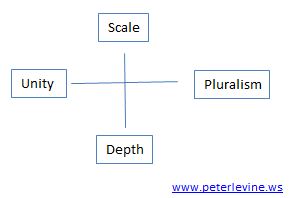
The model is SPUD (scale, pluralism, unity, and depth), which I discuss elsewhere on this blog.
The Center for Educational Equity at Teachers College, Columbia University, invites you to an exciting mini-conference to explore how conservatives and liberals can agree on how schools throughout the country can teach, support, and encourage students to become capable citizens despite our politically polarized culture. (I will moderate the panel discussion.)
Register to join us on March 24th from 1:30 PM – 4:30 PM (EST) on Zoom.
I was truly honored to talk on Monday with Rev. James M. Lawson Jr. and Kent Wong. This is the video of our conversation (introduced by Tisch College Dean Dayna Cunningham).
Rev. Lawson has been a leading teacher and tactician of nonviolent direct action since the late 1950s. As one of the legendary figures in the Freedom Movement, he played key roles in the Freedom Rides, the Nashville sit-ins and the broader desegregation movement there, and the Memphis sanitation strike. While working in Nagpur, India (after having served three years in US prisons for antiwar resistance during the Korean conflict), he read a news article about the Montgomery Bus Boycott and rushed home to serve as one of the most important bridges between Gandhian theory and practice and the Black American movement against white supremacy.
Rev. Lawson has never ceased his effective teaching and activism, mainly as part of worker and immigrant rights movements in Los Angeles. His efforts over the past quarter century could be described as “intersectional,” combining economic, racial, environmental, and feminist issues. His work is deeply interracial and intergenerational. Rev. Lawson often collaborates with Kent Wong, who directs UCLA’s Labor Center. They have co-taught a course on nonviolence for twenty years, and Wong has published books on the labor movement, immigrant rights, and the Asian American community.
Their new book is Revolutionary Nonviolence: Organizing for Freedom (by Lawson, with Michael Honey and Kent Wong). As I say on the video, it is a truly important work. It is clear, eloquent, rigorous, and concise. It is also unique in that Rev. Lawson can comment on recent movements, such as Black Lives Matter (BLM), from his personal experience as a leader in the 1950s and 1960s, while also discussing the Freedom Movement with knowledge of the 2020s. The book will therefore serve as a particularly accessible (and challenging) introduction to radical nonviolence for young people, and I intend to assign it.
I asked both visitors to address the biggest misconceptions about nonviolence. Rev. Lawson emphasized its power and effectiveness, countering the misunderstanding that nonviolence is somehow passive and constrained.
The book also addresses several other misconceptions. For instance, I find that people equate nonviolence with protest—and protest with marching in the streets. Rev. Lawson stresses the other activities that are required to accomplish change. For instance, he attributes the success of the Nashville campaign more to a sustained boycott than to the famous sit-ins. He even writes, “The march may the weakest tactic, not the strongest.”
In the book, Rev. Lawson describes BLM as “one of the largest, most creative nonviolent movements that have captured the imagination of the human family.” To organize literally tens of thousands of peaceful marches and events has required intensive planning, discipline, and training. Yet I observe that BLM is not widely described as nonviolent. Critics definitely don’t acknowledge its nonviolence, which is no surprise. More interestingly to me, BLM leaders and would-be allies don’t typically emphasize its nonviolent philosophy, although BLM co-founder Patrisse Cullors endorses Rev. Lawson’s new book. I asked him to comment, and he offered a tactical critique of BLM that I found somewhat unexpected.
In the book, he notes that there is a lot of activism today: more than during his lifetime except for the late 1960s. He calls the “range” of organizing the greatest he has ever seen. “But people are not developing a thesis of social change that is both personally transforming and transforming of society and of the immediate social environment, and that is part of the power of a nonviolent philosophy and theory.” I asked him to elaborate on that remark, which he did.
I also asked about Ukraine and Russia. In the book, Rev. Lawson mentions that anti-communist dissidents in the former Soviet world read Gandhi and King. I’d add that Polish dissidents invited Bayard Rustin to provide trainings in the 1980s. I have had the privilege of working with pro-democracy organizers in Ukraine since 2015, and I can testify that they deeply appreciate the Black American Freedom Movement. I asked both speakers about the prospects of nonviolent resistance in (possibly) occupied Ukraine and in Russia. Rev. Lawson’s response was interesting. He is a consistent pacifist who has earned a right to that position by making sacrificial commitments to rigorous nonviolence for 75 years. I must admit that I am not so consistent: I think that Ukrainians must oppose the invasion with military force and that we should support them. But Rev. Lawson is certainly right that Putin cannot accomplish his goals with violence and that nonviolent resistance can play an important role in both Ukraine and Russia (and in Belarus). His prophetic voice is essential for that reason, as well as for our struggles in the USA.
I am a steadfast supporter of Ukrainian resistance, and I encourage Ukrainian friends to skip this post if it feels like a distraction from their crisis. Still, those of us in noncombatant countries face subtle ethical questions that arise with all such conflicts. How we resolve these issues probably won’t have an appreciable impact on the war in Ukraine–and if we can affect the outcome, I would be biased in favor of choices that benefit the resistance. Instead, these are mainly questions about our own internal processes and principles.
Consider these cases:
The Metropolitan Opera is one of many cultural institutions that has announced that it will not work with pro-Putin Russian artists. The Met’s ban could affect soprano Anna Netrebko, who had demonstrated active support for the separatists in eastern Ukraine but who has also posted on Instagram that she opposes the war, while adding that “forcing artists, or any public figure, to voice their political opinions in public and to denounce their homeland is not right.” (From Javier C. Hernandez in the New York Times.)
There are calls to ban former German Chancellor Gerhardt Schroeder (a former leader of an EU and NATO country) from entering the UK. Of note: Schroeder is not only close to Putin and unwilling to criticize the invasion of Ukraine, but he was a director of the state-controlled Russian energy company, Rosneft.
“The Russian filmmaker Kirill Sokolov has spent the past week distraught at the horror unfolding in Ukraine. Half his family is Ukrainian, he said in a telephone interview, and as a child he spent summers there, staying with his grandparents. … Yet despite his antiwar stance, Mr. Sokolov on Monday learned that the Glasgow Film Festival in Scotland had dropped his latest movie, ‘No Looking Back.’ A spokeswoman for the festival said in an email that Mr. Sokolov’s film … had received Russian state funding. The decision to exclude the movie was not a reflection on the filmmaker himself, she said.” (From Alex Marshall in the Times.)
The Alliance of Science Organizations in Germany is one of the biggest science funders that has announced a complete ban on grants, events, and collaborations with Russia. Meanwhile, 5,000 people, mostly Russian scientists, including 85 members of the Russian Academy of Sciences, have publicly signed a strong anti-war statement. They will be affected by the German boycott.
Yelena Balanovskaya and her family hold a mortgage on their Moscow apartment that is dominated in US dollars, meaning that they cannot afford their payments and may lose their home. Nothing is said in the article about Ms. Balanovskaya’s political views.
Although I strongly support the sanctions on Russia, I think the ethical issues are complex. We must navigate principles that are in some tension.
First, working with an individual can be a discretionary choice, and it may be appropriate to consider that person’s values. In general, you shouldn’t have to work with a racist–or a Putin-apologist–if you don’t want to. I serve regularly on search committees and would be hard-pressed to give my support to a pro-Putin job candidate, even if the position had nothing to do with politics, just because I wouldn’t want to work with that person. I think a refusal to engage with specific individuals is an exercise of freedom, just like their choice to express their opinions.
On the other hand, when an institution–even a small, private one–decides to include or exclude individuals based on their opinions, several hard problems arise. Suddenly, we are in the business of assessing people’s thoughts, and that can be invasive as well as unreliable. Tyler Cowan asks, “What about performers who may have favored Putin in the more benign times of 2003 and now are skeptical, but have family members still living in Russia? Do they have to speak out? Another question: Who exactly counts as Russian? Ethnic Russians? Russian citizens? Former citizens? Ethnic Russians born in Ukraine?” I would add: What about leftist critics of US imperialism who have justified Putin’s policies to various degrees over time? Would we ban editors of The Nation? And if we apply this screen to Russia/Ukraine, why not to other conflicts and injustices?
Slippery-slope arguments are sometimes classified as fallacies. Just because bad behavior falls on a continuum, it doesn’t follow that we should do nothing about any of it. But when the question is whether to work with individuals, it is morally imperative to employ clear and consistent standards. Such standards are difficult to define and maintain when everyone holds a unique constellation of opinions, and particularly when people may be afraid to say everything they believe.
Another problem with “de-platforming” or “canceling” individuals is the risk of reinforcing polarization. We can easily end up with homogeneously liberal cultural institutions (and even ordinary businesses), which then lose their ability to influence the illiberal people whom they have excluded. This is true of US universities, which risk alienating enough American conservatives that they undermine their influence over the culture. Likewise, do we want to undermine our own soft power in Russia by excluding Russians?
In a confusing time, it may be best to send the simple message that we are an open, pluralist society that does not fear abhorrent views or despise anyone because of their ethnicity–in fact, we oppose ethno-national prejudice of all kinds. To send that message may require continuing to work with some people whose views are actually abhorrent. Plus, there is always something to learn from the bad guys–even if it is only what they are thinking so that you know how to counter it better.
Although I have itemized several arguments against de-platforming people like Anna Netrebko (the soprano with the mixed political record), I am not sure where I ultimately stand on these matters. There is a case for refusing to work with individuals who hold odious views.
At first glance, it seems morally simpler to punish institutions for their odious policies than to punish individuals, such as sopranos, scientists, or Moscow apartment-owners. I have tried to apply this distinction when working with individual scholars from many countries, but not with or for their governments. However, the line between institutions and people is porous. Even a big bank is partly composed of small depositors. Even an individual scholar typically works for a state university. Even a free-thinking artist, like filmmaker Kirill Sokolov, may have taken government grants.
Turning to economic sanctions: they might work in this case, and they have the moral advantage of not directly killing people–as well as a lower risk of escalating to all-out or even nuclear war. However, for sanctions to succeed, they must inflict substantial hardship on a lot of people, including innocent civilians and even active opponents of the regime. It is much easier to rationalize causing economic hardship than using overt violence, even when the economic damage is devastating.
And sanctions may not work. If they don’t, then people like me who support them must take responsibility for the hardship. We mustn’t forget Yelena Balanovskaya and millions like her, including people in noncombatant countries like Afghanistan.
By the way, true dissidents and strong opponents of their own governments’ policies should welcome sanctions that affect themselves, so long as those efforts are likely to work. That may be true for the 85 Russian academicians who have signed the anti-war statement.
One possible solution is to focus as much as possible on the “oligarchs,” the Russian billionaires. They might have more leverage than other people (although the extent of their influence is debated); they are unlikely to suffer even if they lose a lot of money; and on the whole, their wealth has been ill-gotten in the first place. They are part of the problem, regardless of their opinions. Targeting oligarchs is central to the “Progressive Foreign Policy Response to the War in Ukraine,” which I find generally persuasive. As Henry Farrell says, perhaps sanctions that target the oligarchs can “be used to reshape the underlying systems of banking and finance that the current version of globalization relies on.”
But can we really target economic measures so that billionaires bear most of the cost, while also doing enough macroeconomic damage to affect the course of the war? I doubt it. Besides, we would want to influence oligarchs’ behavior, and that might (i suppose) require giving them a way out if they act better. In that case, what must an individual billionaire do to evade sanctions? Does one anti-war remark in English count, if it is hardly seen inside Russia? How about five anti-war social media posts in Russian? We are back to drawing lines across uneven terrain.