does empowering young people in a community boost the community’s economy?

(Los Angeles) We made this announcement today on the CIRCLE homepage:

CIRCLE receives W.T. Grant Foundation Support to Study Social and Economic Effects of Youth Civic Empowerment and Participation

Much research by CIRCLE and others finds that civic activities have social, physical, and economic benefits for the young people who participate. For instance, volunteer service boosts academic success. Meanwhile, a growing body of research finds that the levels of civic engagement in a community as a whole are related to that community’s economic resilience, quality of education, and security.

This body of research has not so far focused on the specific question of whether engaging young people in civic activities improves social and economic outcomes for communities as a whole over time. We hypothesize that young people’s civic engagement is especially important for the economic vitality of their communities, and we will test that hypothesis using data from Chicago neighborhoods and national data for counties.

See also does service boost employment?, the benefits of service for low-income youth,  and against methodological individualism or why neighborhoods are not like broccoli.

why it’s especially important to deliberate in diverse schools

(Washington, DC) In a new article, Kei Kawashima-Ginsberg and I argue that discussing current, controversial issues is an effective way to teach civic skills and raise students’ interest in politics. Such discussions are relatively rare in schools that are “racially pluralistic” (having no racial majority), probably in part because diversity makes teachers and students wary of broaching controversy. Yet the benefits of discussion are strongest in just those schools. That may because the students’ diversity is an asset for good conversations, and also because planned discussions fill a gap in diverse schools that pervasively lack political conversation. Our article assembles the quantitative evidence for controversial issue discussions in racially pluralistic schools and offers tips for teachers and links to helpful organizations. See Kei Kawashima-Ginsberg & Peter Levine, “Challenges and Opportunities for Discussion of Controversial Issues in Racially Pluralistic Schools,” Social Education, vol. 79, no. 5 (Oct. 2105), p. 271-7 (or via Academia.edu.)

Does Twitter “smoosh” the public and private?

In The Atlantic, Robinson Meyer explains why Twitter seems not to be as fun or as socially satisfying as some other networks. He thinks it uncomfortably and unsuccessfully “smooshes” together aspects of oral communication (spontaneity, rapidity, and interactivity) with aspects of written communication (permanence, sharability, and the capacity to reach strangers). Meyer thinks that “the more visual social networks have stayed fun and vibrant even as the text-based ones have not. Vine, Pinterest, and Instagram don’t traffic in words, which can be reduced to identity-based magnum opi [that should actually be magna opera], but in images, which are a little harder to smoosh. Visual conversations have stayed chatty, in other words.”

Meyer’s theorists are Walter Ong and Bonnie Stewart, but there are also hints of Habermas in the article: Ong is quoted on the “human lifeworld,” and Meyer notes ways that the public and the private “get smooshed.”

A core Habermasian insight is that there are different norms appropriate to private and public speech.

In public, you must make arguments that can persuade strangers. You must therefore provide adequate reasons and explanations for everything you say. Since you can’t assume that strangers understand your assumptions and experiences, you must make them evident. You are accountable for your remarks and should be responsive to reasonable critiques. You should (generally) take the same positions when talking to different people. When Mitt Romney complained to donors about the 49% of Americans who were “takers,” but he didn’t want the 49% to hear him, he became one of many public figures who have been caught violating the norms of public speech.

In private, the norms are authenticity, spontaneity, and responsiveness to the concrete other people with whom you have relationships. You should (generally) say what you really feel in the moment, although you are also obligated to care about what the individual who hears you thinks and feels. That may require tact. You need not fully explain your thoughts, and your explanations certainly need not convey entire, self-sufficient arguments to strangers. You are not responsible for treating everyone alike. In fact, you are obligated to favor some people, the ones you love and who love you. You have a right to privacy, so if you are videotaped saying something that you wouldn’t want strangers to hear, that is a violation of your rights.

It is dangerous to confuse these domains, to “smoosh” the public with the private. Often, marketing and political propaganda consists of pretending to have an authentic private conversation while actually influencing strangers. Voters mistakenly choose candidates based on their impressions of politicians’ private lives, which are irrelevant at best and fictional at worst. Meanwhile, powerful people privatize the public sphere by making policy decisions on the basis of personal relationships and inventing spurious justifications or avoiding rationales entirely. Prying journalists and governments violate privacy. And sometimes ordinary people retreat from the public sphere and either take no positions at all or develop irresponsible positions on public matters because they can’t or won’t interact with strangers as if they were real decision-makers.

I am not sure, however, whether Twitter exemplifies the smooshing of public and private that worries Habermas. Twitter is a fairly flexible platform. You can use the 140 characters to address the public, although that will often require embedded links. Or you can use the 140 characters to keep your close friends informed about your social plans. You can develop a persona as a public person or as a private one. The two can be confused, and awkwardness can arise. For instance, as Meyer notes, disclaimers that “RTs do not constitute endorsements” are odd ways of distancing a Tweeter from the content. But it could be that Twitter is a useful vehicle for both public and private conversations, and the feeling of tension simply reflects the parlous condition of our public life, more broadly.

See also: Habermas illustrated by Twitterprotecting authentic human interactionfriendship and politicsOstrom plus Habermas is nearly all we need.

the Ohio marijuana initiative and the corruption of our republic

Ohioans vote tomorrow on the Marijuana Legalization Initiative, Issue 3. It is like a stew composed of horrible aspects of our current politics–not legalizing pot, which is fine with me, but allowing rich people to buy public policy, governments to enable rent-seeking and oligopolies, political professionals to manipulate voters, and special interests to extract private benefits in return for enabling popular reforms to pass.

Issue 3 would legalize marijuana but restrict large-scale cultivation to the ten individuals who bankrolled the referendum. The outcomes for the people of Ohio may be better if Issue 3 passes than under the status quo, because ten may be a good number of licensed producers. Zero legal distributors is too few. Prohibiting marijuana creates an illegal industry that causes huge damage. Also, I am enough of a libertarian to believe that if consenting adults want to do something like smoke pot, the presumption should favor their liberty to do so as long as they follow laws protecting others. On the other hand, if anyone can grow and market marijuana, prices will fall and usage will rise, which will have serious consequences for public health. Licensing ten growers may inflate prices and allow the government to regulate the industry effectively–a good balance.

But the voters are not asked to approve ten licenses that go to the highest bidders. They are presented with the opportunity to give state-mandated monopolies to ten wealthy rent-seekers. It’s like the days when kings gave favored courtiers the royal privilege to manufacture specific items in return for gifts and favors. Only it is worse than that, because it enlists the voters in creating these monopolies. In On Revolution, Hannah Arendt noted that corruption was traditionally a sin of rulers, but with democracy, the people can for the first time be corrupted. Issue 3 is blatant yet typical effort to do that.

To their credit, Ohioans have also proposed Issue 2, which specifically prohibits any state amendment that “grants or creates a monopoly, oligopoly, or cartel, specifies or determines a tax rate, or confers a commercial interest, commercial right, or commercial license that is not available to other similarly situated persons.” If both initiatives pass, interesting litigation will ensue. But even if Issue 2 passes, this is really no way to govern.

See also: bottom-up struggles against corruption: a frontier of democracy and the Supreme Court reflects the “degeneracy of the times”.

Tufts wins the New York Life Civic Engagement Award

The Washington Center for Internships selects the annual New York Life Higher Education Civic Engagement Award, and the 2015 award went to us at Tufts University along with Dominican University, John Carroll University (Ohio), Rutgers University-Camden (N.J.), and Weber State University (Utah).

These institutions are all wonderfully different, and the award emphasizes the many ways that colleges and universities can educate their own students for citizenship and strengthen public life in America.

At Tufts, we have two distinctive advantages.

First, we have elevated civic engagement to a high institutional priority. Unlike a typical school of public policy or public affairs, the Tisch College of Citizenship & Public Service at Tufts is charged with reaching all the students and faculty of the whole university, regardless of their majors, degree programs, and disciplines. And unlike a center for public engagement or service, the college has a dean who serves as a peer with the deans of Arts & Sciences, Medicine, and the other Tufts colleges and thereby influences the direction of the whole university. Tisch College is the epicenter of civic engagement at Tufts, collaborating closely with all the other schools.

Second, since we are a research university, we contribute to civic life by studying it and by conducting high-end research in collaboration with civil society. The award application asked for one example of a civic engagement program at each applicant’s campus, and we cited the Community Assessment of Freeway Exposure and Health (CAFEH) project. I’ve written about CAFEH before, but the essential points are that the idea came from community groups; they worked with Tufts on sophisticated, federally-funded science; and the results include not only more than 20 peer-reviewed articles but also local policies meant to address a really serious health problem (fine particulate pollution from highways). This is just an example, but it well illustrates how a research-intensive university can support civic life.

The blurbs on the other four winners are also inspiring and informative.

why calling Israel democratic increases criticism of Israel

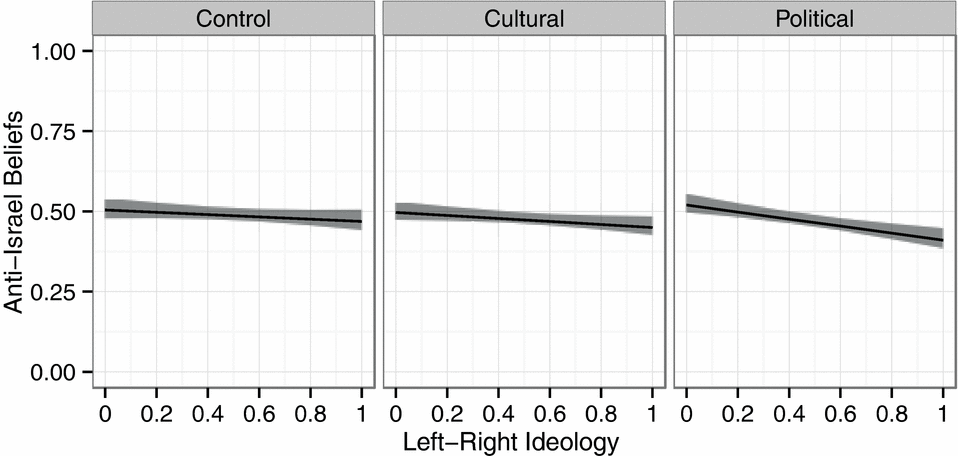
If you tell Dutch people that Israel is a democracy like the Netherlands, Israel’s favorability rises among the conservative respondents but falls among those on the left. That’s according to an experiment by Lelkes, Malka, and Sheets (2015). They asked everyone the same questions about Israel but randomized which news stories the respondents read before they answered. The control group read about Israel’s agricultural and industrial sectors and how they resemble those of the Netherlands. The “cultural” group read about some cultural similarities between the two countries. And the “political” group read about how both nations are democracies. The x-axis shows respondents’ political ideology, from left to right. Note the steeper slope in the “Political” graph.

israel

I visited Israel (and briefly the Occupied Territories) on a trip that was designed to increase our appreciation of Israel by exposing us to the freewheeling democracy of Israel. That meant that visits were arranged for us with Arab legislators and a jurist, the Palestinian Authority, and very liberal journalists, as well as right-wing settlers and others across the spectrum.

I am permanently grateful for this learning opportunity. My views became somewhat more complex, but I think that my overall appraisal of Israel’s policies declined during the trip–compared to a fairly low baseline. So I am like the Dutch left-of-center respondents: less favorable to Israel than my conservative compatriots to start with and prone to become even more critical when someone tried to show me that Israel is a democracy. Why?

First, because using the word “democracy” highlights the gap between rhetoric and reality. The 4.17 million people under Israeli occupation don’t have Israeli political rights. One could reply that all democracies fail to deliver on their principles–the United States, badly so. Indeed, I am angry about a lot of US policies, but that doesn’t make me feel better about Israel. Also, I doubt that we are currently doing anything as undemocratic as Israel is.

Second, democracies should be expected to achieve more justice than other systems do. A dictator will prevent the people from obtaining relevant information and diverse perspectives on issues, let alone acting to improve the world. He (or possibly she) will have very strong incentives and temptations to act unjustly, both towards subjects and outsiders. If benign despots are possible, they are rare. (H.G. Wells: “Amidst the tens of thousands of names of monarchs that crowd the columns of history, their majesties and graciousnesses and serenities and royal highnesses and the like, the name of Ashoka shines, and shines almost alone, a star.”) In democracies, on the other hand, information and deliberative opportunities are available, and the people have mechanisms to make wise and just decisions of they so choose. Israel denies those mechanisms to the people under occupation, but Israelis who are fully enfranchised should be able to act reasonably well. That is both a moral expectation and an actual prediction: it is more likely that a country that is as democratic as Israel is will act justly. So then being told that it is a democracy lowers one’s appreciation of its actual performance.

the changing nature of risk and its relevance to political economy

(Washington, DC) Inspired by the work of the late Ulrich Beck, let’s say that capital and risk are two different issues. Whether you face low or high risk, you may have anywhere from zero to vast amounts of capital.

The more capital you have, the more power you can wield over other people. But the more risk you face, the more vulnerable you are to other people and to nature and fate. Governments and citizen groups can try to make the distributions of capital and of risk more consistent with justice, although the nature of justice is perennially controversial.

I think that companies and big investors have gotten better at handling risk, most individuals are more exposed to risk, and governments are worse at mitigating it.

In (say) 1932, capital was unequally distributed: Daddy Warbucks had a lot more cash than Little Orphan Annie. Risks were also unequally distributed: you were a lot more likely to get black lung disease if you were a miner than a stockbroker. But governments had a toolkit for analyzing, predicting, and remedying both sorts of inequalities. They could use tax and health statistics to see how capital and risk were distributed and could intervene by taxing and spending, by regulating big accumulations of capital (mainly banks and large corporations), and by implementing health and safety regulations. Labor unions also helped to socialize or mitigate risk. Meanwhile, corporations had limited tools to predict the risks that they faced individually, from strikes to earthquakes. And they had lots of sunk capital, such as the vast factories of Detroit. So they shared in the risks faced by their workers and were probably better off when governments mitigated risks for all.

Fast forward to 2012. Risks remain very unequal. With smaller unions and other strong membership associations and with generally less effective regulations, risks tend to be individualized. We also have a strong cultural presumption that risk belongs to the individual. A teenager who gets in trouble is supposed to pay the full price for his mistake.

Entities that have a lot of capital can navigate this environment. A company like Google in 2015 has much less sunk capital than a company like GM in 1932. Google can move investments anywhere in the world. It can fire an employer employee who is not performing or whose skills have become obsolete. The private sector also has sophisticated tools to forecast at least short-term risks and exotic financial instruments to hedge against risk. Overall, a company or an investor with lots of capital and sophistication is better off in a high-risk/high-opportunity economy than in a more predictable environment. To an increasing extent, money can simply purchase protection against risk.

But risk has shifted from capital to labor. Whereas the private sector can use a whole panoply of tools to predict adverse events and to externalize or limit their risks, individual workers have little recourse, and governments do not seem to be able to plan for even the most obvious risks, such as climate change. They choose systematically foolish responses to risks, such as dramatically overreacting to terrorism while ignoring the threat of financial meltdowns. Their unwillingness and incompetence are not inevitable laws of nature. They have been made weaker on purpose. Nevertheless, even a well-intentioned government would now have a long way to go before it possessed an adequate toolkit for understanding and mitigating risk.

more young people voted in ’72 than ’12

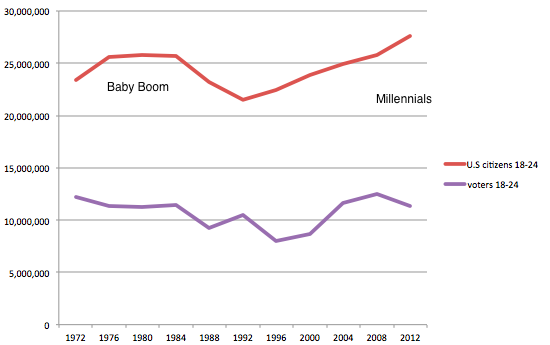
(Washington, DC) This graph shows two trends: the number of US citizens between the ages of 18 and 29, and the number of 18-29s who voted.
voting trend

The number of young voters fell from 122 million 1972 to 114 million in 2012, despite an increase of about four million in the number of eligible citizens under 30. That means that young voters had considerably less clout in 2012 than in 1972. They cast 24% of all votes in 1972 but 19% in 2012.

On the other hand, the comparison would look better if one set 1976 against 2008, because the latter was a stronger year for youth turnout. In 2008, the size of the youth population also surpassed the previous highs of the 1970s, producing record numbers of youth and of young voters. But the youth share was still smaller in 2008 (at 16%) then in had been in the 1970s, because of rapid growth in older generations. And then 2012 saw a fall in turnout.

does the falling homicide clearance rate in big cities promotes violence?

At Tufts on Wednesday, Danielle Allen made the following argument: the war on drugs lowers the chance that the police will solve any given murder by flooding a city with drug-related homicides. Once the homicide closure rate falls, there is a low chance that anyone who commits a murder will be caught. Under those circumstances, if you think someone might shoot you, you “shoot first,” as Allen said.

Right on cue, the New York Times reports from Baltimore: “as more people are being killed here, fewer killers are being caught. The homicide ‘clearance rate,’ the percentage of killings solved by the police, was 45.5 percent last year; today it is 32.8 percent, the police said. Nationally, the rate was 64 percent in 2013, the most recent year for which the Justice Department has statistics.”

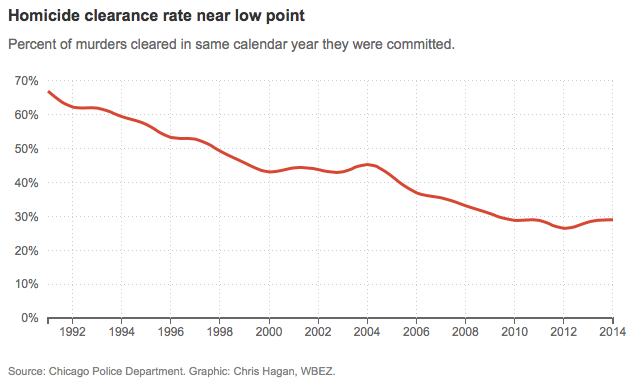
I also found this trend line for Chicago:

Homicide-Clearance-Rate-Chicago-2

These are big declines. In 1992, if you committed homicide in Chicago, the odds were you were going to be prosecuted. In 2012-14, the odds were you would get away with it. That could plausibly change violence rates. If the police can’t protect you against murder, you may feel you have to do it yourself.

Two caveats, however. First, clearance rates are imperfect statistics, subject to being gamed by police departments. Second, even while homicide clearance rates were falling in Chicago, so were homicide rates. So that is not really evidence of a vicious cycle of declining clearance rate leading to growth in violence.

But despite those two caveats, there certainly seems to be a vicious cycle in the last few years in Baltimore and perhaps other big cities, and that is a really serious concern.

protecting authentic human interaction

These are two real-life examples that arose during the recent conference on Responsiveness. (My thanks and apologies to the colleagues who told these stories.)

  1. A recruiter sits all day at the tables near a major airport’s McDonalds restaurant, screening prospective workers. One of her questions: “Is the customer always right?” The correct answer is “yes.” Anyone who says “no” is rejected for the job. The recruiter is screening primarily for a cheerful attitude toward customers.
  2. The philosophers at an urban public university get into arguments with the woman who handles their reimbursements, challenging the fairness or wisdom of the university’s reimbursement policies. She finds the philosophers annoying, or worse.

I understand these as two examples of the same phenomenon. There are settings that encourage and expect authentic human interactions. In such settings, when you’re asked, “Is the customer always right?” you will probably say “No,” because–let’s face it–some customers are wrong. And if you’re asked, “What do you think of the university’s reimbursement policies?” you will say “They’re stupid,” if they are.

But other settings expect people to play instrumental roles within systems. For instance, it is better to treat every McDonalds customer as always right and just give them another hamburger if they have a problem with the one they got. That is best for the company’s bottom line. It follows that it better to say, “The customer is always right” when a recruiter asks you that question in an interview. Likewise, you should recognize that the poor person who has to handle your reimbursement requests is just doing her job and not get into a philosophical argument with her about the rules.

We do need both kinds of settings. If everything were authentic, we couldn’t organize large-scale human interactions. When passing through O’Hare, I am interested in getting my fries quickly, not deliberating with anyone about their quality. A university needs rules for reimbursements; it can’t hold a seminar on everything. I would posit that even in a just society, where power was more equally distributed, there would be instrumental interactions.

But the problem is the deliberate encroachment of the instrumental interactions into the supposedly authentic ones. Chairs and tables are set up outside of an airport McDonalds to make it look like a place where peers or relatives can sit together to talk. But in that space, a recruiter is asking “gotcha” questions to screen employees. The state university advertises itself as a place where people can have free and honest discussions about important matters, but its bureaucratic systems require employees to play circumscribed roles. Even though we need markets and bureaucracies, there is a pervasive danger that business and bureaucrats will take over authentic spaces in order to profit from them.

I have tried to write this whole post without jargon or name-dropping, but I mean it as an almost perfect illustration of Habermas’ thesis that systems are colonizing the lifeworld.

See also: soft skills for the 21st century workplace: empowered teamwork or emotional labor?,  Habermas and critical theory (a primer) and Habermas illustrated by Twitter.