new chapter on generational trends in US politics

(Orlando, FL) I was asked to write a chapter about the US for an international book about “youth disaffection with politics.” I looked at 40-year trends in more than 20 survey questions, ranging from trust in government to support for government programs to turnout. I really did not find evidence of “youth disaffection” in the US. All Americans are pretty alienated, but it isn’t a generational pattern. Most of the trends I looked at aren’t generational at all–they rise and fall with recent news and events.

My chapter is mainly an argument against thinking of alienation from politics and government in generational terms, at least for the US. I even venture that a generational framework is generally problematic. It distracts attention from the most important phenomenon, which is the stubborn replication of the same inequalities from decade to decade. I am for studying and supporting youth, but not because today’s youth are different in some fundamental way from their predecessors. Rather, institutions should finally treat a new generation better so that we begin to see some meaningful differences.

See “Youth Disaffection with Politics: The US Case,” in Pedro Pérez Herrero (ed.) Desaffección política y gobernabilidad: el reto politíco (Madrid: Instituto Universitario de Investigación en Estudios Latinamericanos, 2015), pp. 45-60. See also the Millennials and politics and Letter to a Young Political Reformer.

nonprofit outreach boosts turnout

Yesterday, I wrote that higher education has limited capacity to improve economic mobility in the US, and our greatest contribution is to help understand and promote the policies that would increase justice. Right on cue, my colleagues at CIRCLE announced a new report they helped Nonprofit Vote to write. It shows that nonprofits are effective when they conduct nonpartisan voter registration and get-out-the-vote efforts for the people who come to them seeking services.

Nonprofit Vote calls this strategy “reverse door knocking,” because instead of canvassing highly disadvantaged people, you talk to them about voting when they knock on your organization’s door.

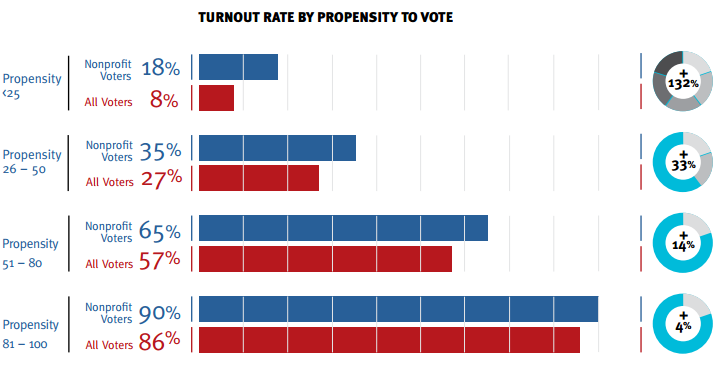
CIRCLE helped to document the positive impact in several different ways. Here is one. The graph shows the turnout (based on actual voting records) of people who were registered at participating nonprofits versus those who were registered in other ways. The categories are different levels of propensity to vote, as calculated by the firm Catalist, which usually advises campaigns on whom to target. If you’re a low-propensity registered voter who was registered through one of the participating nonprofits, you had an 18% chance of actually voting in 2014, ten points higher than if you were a registered voter with the same propensity but you didn’t receive outreach from a nonprofit.

nonprofit

The analysis also shows strong effects on young people.

to what extent can colleges promote upward mobility?

The expectation is widespread that colleges should provide pathways to prosperity and success for individuals–and also make the distribution of wealth and power in the whole society more fair and equitable. Higher education seems to have that potential because it does promote upward mobility for individuals. Even if you are born in the bottom fifth of the income distribution, if you attain a college degree, your chances of staying in the bottom fifth are only 1 in 10.

But the results at the national scale are disappointing. Only a few (14.5%) of children born in the bottom quintile complete a four-year degree. The pressure for higher education to promote economic mobility better comes from various quarters–conservative governors angry that college degrees aren’t aligned with employers’ needs, technocratic liberals in the Obama administration trying to push down college costs, and campus activists demanding that student populations be representative of the national population in terms of race and social class.

The pressure is understandable, and much of it is valid, but we must squarely face the reasons that higher education does not promote mobility if we want to improve results.

College graduates represent the upper strata of society. About 40% of US adults hold college degrees, and they increasingly fill the top 40% of the slots in the whole socioeconomic hierarchy. That is why it is good advice to an individual student to complete college. Four-year colleges intentionally prepare their students to be doctors, lawyers, engineers, business leaders, and teachers, not bus drivers, receptionists, or construction workers. That’s what they offer; that is what they’re for. It means that the alumni body, almost by definition, will not represent the socioeconomic profile of the country.

The alumni could, however, represent the racial and gender diversity of the country if race and class were decoupled. And the alumni could come from economically representative backgrounds. Half of college students could be raised in homes below the median income, even though, as alumni, they would occupy the top 40% of the socioeconomic scale. That would imply a great deal of upward mobility, and it’s one criterion of justice (justice as an equal chance to succeed).

The barriers, however, are serious. One obstacle is that we don’t have an expanding middle class. Adjusted for inflation, the median US family earned $54,000 in 2014, about $4,000 less than in 1999. If families in the middle are becoming worse off, then upward mobility for some implies downward mobility for others.

That zero-sum model is an oversimplification, but there really are only so many jobs for lawyers, doctors, engineers, and corporate executives. Families who already stand in the top 40% will fight tooth and nail to keep their own kids in that tier instead of trading their spot with someone from further down the hierarchy. They will spend whatever they must on housing, k-12 education, and extracurriculars; apply whatever pressure they need on their alma maters; and take full advantage of their social networks to keep their kids ahead of the median. They may value both racial and socieconomic diversity as educational assets, but not to the extent that they are willing to give up a spot at a top college to someone else’s kid. And it is highly implausible that raising their consciousness about injustice will change their behavior. I can think of no comparable outcome in human history. People at the bottom of hierarchies do achieve change by obtaining power, but not by making the people at the top feel bad.

We might think that by investing in human capital, we could expand the middle class and make space for more people above a real income of $54,000. To some extent, that is both possible and important. But my sense is that left-of-center economists are now criticizing the human capital thesis. Yes, individuals who have more valuable skills, more elite social networks, and more cultural capital will beat out the competition for desirable jobs, which is why a college degree predicts high earnings. But raising the proportion of people with college degrees–as we have done–does not make the society more equitable, because other factors are increasing inequality. Prime suspects are deregulation, capital mobility, and monopoly power.

Finally, at the individual level, a person must move a long way from the levels of financial, human, social, and cultural capital available at the bottom of the economic hierarchy to reach the levels that are expected for candidates for great jobs. It is implausible that you can move nearly far enough during four years that start at age 18. To the extent that higher education is a path to upward economic mobility, it is near the last mile of that path. Colleges and universities compete for applicants from relatively disadvantaged backgrounds who have already received unusual support from families, community groups, and k12 schools. Colleges can play a useful role by a) being aggressive about finding these applicants, the ones who are ready to move the last mile, and by b) serving such students well. But they are not going to get disadvantaged kids 80% of the way. They offer too little, too late.

These are reasons that higher education is unlikely to make more than a modest dent in the inequality problem. To address that problem in a serious way, we need different economic policies. In a different political-economic climate, colleges and universities could do their jobs (educating students and producing knowledge) with less injustice. Given the reality, I believe our top priority is to understand the inequality problem better and to make the knowledge that we produce more politically significant. I don’t mean only economic research and policy advocacy but also normative inquiry, cultural critique, social experimentation, public dialogue, and a range of other research-related activities. Meanwhile, we must deal with an unjust context as ethically as we can, which means handling matters like admissions, hiring, and retention thoughtfully  while also acknowledging the inadequacy of these responses to the underlying problem.

[PS: I read later today that “colleges themselves are responsible for about 5 percent of the variation in students’ earnings later in life,” which reinforces my argument here.]

the press loses its leverage

(Dayton, OH) Traditionally, politicians have spoken directly to relatively small numbers of people, and the press has reported their speeches to much larger publics. The intermediary role of the press has given it leverage that it can use for good (to enlighten and hold accountable) or for ill (to distort and influence).

For instance, at the end of the first contested US presidential election, John Adams gave a conciliatory inaugural address to a few score dignitaries assembled in a room, and the partisan opposition newspaper, the Aurora, decided to praise it. Adams, a Federalist, reached many thousands of Republican readers via a Republican publication, although the Aurora quickly turned against him.

The current election is very different. Donald Trump has five million Twitter followers, and Hillary Clinton has 4.83 million. They can reach those people directly. Meanwhile, the single most popular US newspaper, the Wall Street Journal, has 3.78 million subscribers; the most popular cable TV news show, “O’Reilly Factor,” has 2.67 million viewers. Politicians who have millions of followers exchange Tweets, and then newspapers and TV shows report what they have said to smaller numbers of people.

The change in leverage is palpable. Reporters cannot demand access and no longer have much effect when they call out errors, inconsistencies, or even lies.

Certain exceptions just reinforce the rule. For instance, the televised debates have been drawing on the order of 15 million viewers. Trump threatened to boycott the CNN debate unless CNN gave $5 million to charity–showing off his leverage. But then he realized that 15 million viewers are more than 5 million Twitter followers, and he backed down. “‘When you’re leading in the polls, I think it’s too big of a risk to not do the debate,’ [he said.] ‘I don’t think I have the kind of leverage I’d like to have in a deal and I don’t want to take the chance of hurting my campaign. So I’ll do the debate.'”

Still, if any candidate lies flagrantly to the 15 million viewers of the debate, and the next day’s cable news host reveals that lie to an audience of just 2 million, it’s still a win for the candidate.

It’s good that citizens get direct access to politicians’ speech–it’s as if we were right there in the hall with John Adams. And it’s good that presidential primary candidates feel that they must participate in debates, even if they don’t like the host network. But it’s not so great that the press no longer has enough leverage to make candidates pay a serious price for speech that violates basic norms.

network dynamics in conversation

(Dayton, OH) It is in conversations–face-to-face or virtual, oral or written, small or massive, formal or informal–that we form our views of public issues, hold ourselves accountable for our reasons and actions, check our assumptions, expand our horizons, gain the satisfaction of being recognized, display eloquence, and develop enough will to act together.

Some conversations are better than others, and we need to understand more about the differences. I think that mapping conversations as evolving networks is a promising strategy. At least three relevant phenomena can be modeled in network terms:

  1. As we discuss, we collaboratively construct networks of ideas. I say that I favor marriage equality because adults who love and commit to each other should have the protection of law, and because people should be treated equally regardless of sexual orientation. In those sentences, I have put several ideas together into a structure. You can add to my structure by posing other ideas, whether they connect to mine or conflict with mine. The group’s epistemic network expands and changes as we talk.
  2. We also form and change social networks during a discussion. The nodes in a social network are people, and the links between pairs of people can be characterized by knowledge, trust, respect, affection, etc (or their opposites). People who converse may already belong to the same social networks. Their discussions may develop and alter their social networks.
  3. We make “meta” comments about the conversation. For instance, I might ask you to clarify what you meant when you said P. Or I might say I agree with you, or withdraw my comment, or propose that the truth lies between what I said and that you said. These are interesting moments because they are about both the epistemic and the social network that already exists, and they can affect those networks. In an important 1983 article, Berkowitz and Gibbs called them “transacts” and found they led to learning when children used them.

Consider some subtle cases and how they might be modeled in network terms.

  1. Person A only cares about influencing her boss, B, who sits at the head of the table, but she chooses to turn toward everyone else in a meeting and address them. In social network terms, her talk is literally directed at a whole set of peers, but there is a more significant network connection between her and just one other person.
  2. A says P, and B pays no attention because B thinks that A is a fool. C says P, and B agrees with it because B thinks that C is smart. In this case, the social network affects the epistemic network.
  3. A wants B to like her, so she withdraws point P that she had made earlier because B objected to it. With that concession, the social network changes in one way, the epistemic network in a different way. B says, “I appreciate your flexibility, but really, you should insist on what you believe.” B’s meta-comment puts P back on the epistemic map and affects the social network.

In technical terms, I’d measure the epistemic network by representing transcripts of discussions as ideas and links (the links being arguments of various kinds) and probably locating the nodes on a two-dimensional plane that reflect key dimensions of disagreement in the conversation. I’d watch the network change as the participants talk.

I’d measure social networks by asking people to characterize the ties between them and each of the other participants, before and after the discussion.

Finally, I might model the relevant personal beliefs of each participant before and after a discussion as a network of ideas and links, which I would derive from a private interview or short essay. I would be interested in how much of the private network ends up in public and how much the public discussion affects the private network.

The point of all this measurement is to provide data that is useful for evaluative judgment. So the normative questions (“What makes a good discussion?” “How should you participate in discussions?”) are central. I think they deserve more exploration than we have had so far, although philosophers have certainly contributed criteria.

For instance, Jurgen Habermas wrote that in an ideal discussion, “no force except that of the better argument is exercised” (Habermas 1975, p. 108). He would want an epistemic network composed of objectively defensible ideas and links to influence the participants, completely independent of their places in a social network. Just because everyone knows and admires A but dislikes B, it doesn’t mean that people should absorb A’s ideas and ignore B’s ideas.

Another example: Olivia Newman argues that a good discussion in a liberal democracy won’t produce a single hierarchical framework of ideas, but will rather encompass numerous clusters of ideas that are only loosely connected. That shape reflects value pluralism while still allowing mutual learning. Thus a group’s epistemic network should be clustered but not overly centralized.

We might add that good discussants should continue to add new nodes and connections as long as the conversation continues (not repeat points already made); that

See also a method for mapping discussions as networks and assessing a discussion.

thinking like a citizen–about schools

In Education, Justice & Democracy, edited by Danielle S. Allen and Rob Reich, all the chapters address the topic of educational equality in the US. The section headings are “ideals,” “constraints,” and “strategies.” In a longish review essay for Theory & Research in Education, I argue that good citizens explore just these three issues whenever they consider any important topic. In fact, you might define good citizens as people who take  ideals, constraints (or, I would say, “facts”), and strategies seriously and act accordingly. However, the three issues are badly segregated in modern intellectual life, with whole disciplines given over to the assumption that one should seek value-free facts, other disciplines happy to explore values without thinking about strategies, and some professional programs focused on strategies with a narrow conception of ideals. What we call “Civic Studies” is a deliberate effort to reintegrate thinking about social concerns from a citizen’s perspective, which inevitably combines ideals, constrains, and strategies. I chose to review this volume because it exemplifies Civic Studies, although I offer some critical thoughts about parts of the book.

My review is in Theory and Research in Education, July 2015, vol. 13, no. 2, pp. 235-238, or on Academia.edu.

a co-op model for a college

Here is a model for a new kind of college that I think could compete well with the available choices today, put beneficial pressure on the whole market, and avoid the “institutional isomorphism” that makes so many of our colleges and universities similar to each other. In a sentence: It is a co-op college in which the faculty and students jointly produce scholarship and learning at low cost. The college is organized democratically, but not because democratic values are intrinsically superior or identical to intellectual values. (I have argued against those claims here.) Rather, the organization of this college is democratic and participatory because it is a common property regime. That form of economic organization can be highly successful, but only when all participants feel that they have a voice to match their obligations.

I’d suggest these features:

Location: It would be a commuter college (no dorms) in a large metro area with a shortage of high-quality existing slots for undergraduates. Los Angeles is an example. The facilities could be relatively cheaply reconfigured buildings, such as a former school.

Business model: The sticker price would be $11,000. With a student/faculty ratio of 10:1, that yields $110k per professor, which is plenty to cover salaries and benefits plus facilities and a small support staff for maintenance, IT, and accounting. (The mean associate professor’s salary in English is $62,000; in the natural sciences, $67,590). These numbers would compare favorably to UCLA–which I respect deeply–where the average student pays $13,723 and the student/faculty ratio is 17:1. I envision a student body of 1,000 and a faculty of 100.

Professors’ responsibilities: The teaching load would be two courses per semester. Faculty would be expected to be active researchers. They would also populate committees that would fully handle admissions, counseling, curriculum, hiring, tenure and promotion, discipline, and external relations. Especially heavy responsibilities, such as chairing a major committee, might earn a course release. There would be no full-time administrators, but professors would serve elected terms as leaders with titles like president, provost, and dean, and would have limited course loads for the duration. The whole faculty would also meet for deliberations and governance.

Student responsibilities: Students would meet as a kind of legislative body in a bicameral arrangement with the faculty for some decision-making purposes. Some students would also be elected to serve on committees along with faculty and to provide other forms of leadership. For instance, instead of coaches and extramural athletics, there would be strong student-led intramurals and club sports. Although faculty would be involved in counseling of various kinds, students would also play essential roles in helping their peers. Some jobs might be eligible for Federal Work Study, which would reduce the $11k sticker price for those with greater need.

A board of trustees. The faculty and students would elect a board of trustees, including a few of their own number along with prominent outsiders. This board would serve as an accountability and review committee and would be able to lend their blessing to the whole enterprise.

Culture: I would recommend not especially targeting zealous proponents of alternative economics for either the student body or the faculty. I believe groups dominated by people with that kind of motivation tend to devolve into ideological hair-splitting and factional strife. (See Jenny Mansbridge‘s work on 1960s communes–or think of the French Revolution.) Instead, I would be looking for pragmatists with maturity and people-skills, along with academic excellence and diversity of various kinds. I’d recruit the faculty from a generation of talented and dedicated younger scholars who are facing a terrible job market. I’d look for students with a high potential to benefit from the experience–in other words, not necessarily the highest test scores or GPAs, but serious interest in learning in a no-frills environment.

Curriculum: This would be developed and modified by the group, deliberatively over time. It would be disappointing if the results failed to be unusual. That would be a waste of the opportunity to innovate, given the absence of traditional silos and barriers. But it wouldn’t necessarily be wise to create one curriculum for everyone. Diversity and choice are not only intellectual values; they prevent self-governing groups from splintering over matters of principle. Specifically, there is a kind of conversation that goes: “‘X is important, so X should be a required topic of study for all.’ ‘Well, if X is important, so is Y, and why isn’t that required?'” (Repeat endlessly.) I’d expect some coherence and some distinctiveness to emerge in a wholly new college with a democratic process, but if I were in the deliberations, I’d probably be a voice for individual choice.

my political views in 10 minutes

Tufts has created and released this 10-minute video, based on a talk of mine. I found it a good exercise to write, memorize, and present everything that I hold most central for a general audience in that span of time. The presentation ranges from the individual networks of ideas that each of us brings into public life to strategies for enhancing civic engagement at the national level. It proposes a universal definition of good citizenship as well as a diagnostic account of our current condition in the US in 2015 and some suggestions for reforms. It’s my best shot at summarizing all of my life’s work so far (minus some thoughts about methodology in the human sciences and a critical argument about modernity that I have advanced in my books about Nietzsche and Dante). Of course, I have created none of this on my own but owe everything valuable to colleagues and collaborators.

how national policies sucked the power out of local government and disempowered citizens

Phillip Longman makes an extraordinarily important argument in an Atlantic article entitled “Why the Economic Fates of America’s Cities Diverged” (although I would be very curious what economic historians and other relevant experts think about it). Here is my restatement:

  1. When businesses are mostly local, local governments can regulate them. Citizens can also influence them directly by applying social pressure.
  2. When citizens have the experience of influencing economic institutions directly or through representative local governments, they feel empowered and want to act at the state and national levels as well.
  3. Between 1788 and about 1970, federal and state governments and courts instituted a remarkable series of policies explicitly designed to favor local firms. An economic outcome of these policies was a strong convergence of income and prices across the US, as each community captured a lot of its own wealth. Firms were also accountable to local governments, and business owners were highly active in local civic affairs.
  4. Since 1970s, all branches of government have removed those policies. Income and prices have diverged dramatically. Wealth has flowed to the big coastal cities.
  5. Local and state governments have become less capable of regulating businesses. Firms also receive less social pressure because they tend to locate in culturally friendly cities and do their business nationally. Big business leaders are uninvolved in local civic life but increasingly focused on Washington.

Carolyn Bouchard, a diabetic with a slowly healing shoulder fracture, hurried to see her doctor after Matt Bevin was elected governor here this month. Ms. Bouchard, 60, said she was sick of politics and had not bothered voting. But she knew enough about Mr. Bevin, a conservative Republican who rails against the Affordable Care Act, to be nervous about the coverage she gained under the law last year.

“I thought, ‘Before my insurance changes, I’d better go in,’ ” she said as she waited at Family Health Centers, a community clinic here.

Longman summarizes policies enacted to increase local control over business until 1970s–and their repeal since then. Consider, for example, the US Postal Service monopoly (which guaranteed equal prices and service for all addresses), heavy regulation of railroad, telegraph, and television companies, the Clayton Antitrust Act, the Robinson-Patman Act (against chain retail stores), the Miller-Tydings Act (against retail discounting), the Celler-Kefauver Act (antitrust provisions), Brown Shoe Co., Inc. v. United States (blocking a retail merger), and FCC regulations that mandated airline service to smaller markets and equal ticket prices per mile.

These were all policies that restrained national business competition but allowed geographical communities to compete against the big cities of the coasts. Once these rules were gone, capital became more mobile and consumers probably got the benefits of lower prices–but it became impossible to govern at the local level, and citizens were taught to be “sick of politics” because the politicians who were closest to them could no longer achieve much on their behalf.

See also: the Democrats’ problem is social capital; the European city as site of citizenship; and wealth-building strategies for communities.

save the date for Frontiers of Democracy 2016

Please save the date for Frontiers of Democracy: June 23-25, 2016 at Tufts University’s downtown Boston campus.

Frontiers is an annual conference that draws scholars and practitioners who strive to understand and improve people’s engagement with government, with communities, and with each other. The format of Frontiers is highly interactive; most of the concurrent sessions are “learning exchanges” rather than presentations or panels. We welcome proposals for learning exchanges for 2016. Please use this form to submit ideas.

We aim to explore the circumstances of democracy today and a breadth of civic practices that include deliberative democracy, civil and human rights, social justice, community organizing and development, civic learning and political engagement, the role of higher education in democracy, Civic Studies, media reform and citizen media production, civic  technology, civic environmentalism, and common pool resource management. See more about past years here.

You can enter your information here to let us know that you are interested in attending and to ensure that you receive additional information about the agenda and registering for Frontiers.

All are welcome at Frontiers, a public conference that follows immediately after the Summer Institute of Civic Studies, a 2-week seminar for scholars, practitioners, and advanced graduate students. The Summer Institute requires an application, and admissions decisions are usually made in May. Prospective applicants should sign up here for more information.