Krugman evolves

In today’s column, Paul Krugman defends president Obama as “an extremely consequential president, doing more to advance the progressive agenda than anyone since L.B.J.” Krugman challenges “the persistent delusion that a hidden majority of American voters either supports or can be persuaded to support radical policies, if only the right person were to make the case with sufficient fervor.” He rejects the premise that a “sufficiently high-minded leader can conjure up the better angels of America’s nature and persuade the broad public to support a radical overhaul of our institutions.” Obama’s achievements, Krugman says, “have depended at every stage on accepting half loaves as being better than none: health reform that leaves the system largely private, financial reform that seriously restricts Wall Street’s abuses without fully breaking its power, higher taxes on the rich but no full-scale assault on inequality.” And that, Krugman argues, is the only way change happens in our system.

Between 2008 and 2010, I wrote a dozen posts and a Huffington Post piece defending President Obama against Krugman’s persistent critiques from the left. Then Krugman argued that we were in serious trouble because we had been “governed by people with the wrong ideas.” Obama should have challenged Republicans’ ideas with much stronger and more effective rhetoric in order to change public opinion. Instead, the president compromised on his progressive stance, and therefore Americans did not understand their options. Communication was everything for Krugman in those days. One column alone included these phrases: “What Mr. Obama should have said… Mr. Obama could and should be hammering Republicans… There were no catchy slogans, no clear statements of principle.” The president “has the bully pulpit,” but it will be worthless unless he “can find it within himself … to actually take a stand.”

Now Krugman says that it has never worked to try to shift public opinion dramatically to achieve radical policy. “Even F.D.R., who rode the depths of the Great Depression to a huge majority, had to be politically pragmatic, working not just with special interest groups but also with Southern racists.”

I absolutely do not blame Krugman for changing his mind. I am not calling him on an inconsistency here. He is doing what any intelligent person should do: intently studying the unfolding of history and forming and revising his opinions. My views have also changed since 2008, and if they hadn’t, I would be ashamed of my pig-headedness. I call attention to Krugman’s evolved views because they provide a kind of evidence in favor of one view of American politics. A Nobel-laureate economist with a very sharp eye for politics has tried out a couple of hypotheses, and the accumulated evidence as of 2016 leads him to endorse the strategies of Barack Obama ca. 2008-10.

the US frequently bans visitors on the basis of speech and opinions

I think the British Parliament made the right decision when it voted not to ban Donald Trump from entering the UK. During the debate, MPs had the opportunity to call him–and I quote–“poisonous,” “a buffoon,” “crazy,” “wrong,” “stupid,” and a “wazzock.” (The Urban Dictionary suggests, as an example of that last term, “You great useless spawny-eyed parrot-faced wazzock.”)

It’s almost never smart to respond to odious speech by keeping it out. It’s almost always better to respond with confident, reasonable, yet forceful speech on the opposite side.

That said, the British are certainly not the only ones to consider banning people on the basis of speech. Indeed, they have a long, if not spotless, record of accepting radicals and subversives of all stripes; Karl Marx is buried in Highgate Cemetery. And we–meaning the executive branch of our federal government–have a long tradition of barring people because of their speech. E.g.,

  • Gabriel Garcia Marquez: denied tourist visas on multiple occasions for having contributed to (but not belonged to) the Communist Party
  • Michel Foucault, denied a visa to attend a conference on “Knowledge, Power, History: Interdisciplinary Approaches to the Works of Michel Foucault.”
  • Pablo Neruda, 1971 Nobel Laureate in literature, denied a visa but admitted after an appeal by Arthur Miller.
  • Palestinian poet Mahmoud Darwish, unable to attend the PEN conference in New York City in 1985.
  • Andrew Feldman, a Canadian professor, denied entry in 2007, when “a border agent discovered he’d written an academic paper about taking LSD in the Seventies.”
  • Hortensia Bussi De Allende, widow of the former President of Chile, who had been murdered in a CIA-supported coup.
  • Tariq Ramadan: Swiss scholar, banned from 2004–2010 on various grounds, including  for having “endorsed terrorism.”
  • The former Cat Stevens (Yusuf Islam): denied entry from 2004-6.
  • German author Ilija Trojanov: denied entry while boarding a scheduled flight for unexplained reasons; known for his criticism of the NSA.

I omit from this list two heads of state who were banned for reasons that arguably involved action as well as speech. Former Austrian President Kurt Waldheim was barred for his Nazi affiliation in WWII. Before taking his current office as Indian PM, Nerendra Modi was denied a diplomatic visa and his existing visa was revoked for having (per the US government) “directly carried out … particularly severe violations of religious freedom.”

US policy has oscillated. The 1952 McCarren Walter Act aimed to bar anyone whose presence could be “prejudicial to the public interest,” a 1978 amendment reversed that law, and the Patriot Act excludes aliens who “endorse or espouse terrorist activity” (i.e., for speech alone). Despite these vacillations, barring people from entering the US on the basis of their speech has been rather common. If it was an unwise proposal to ban Donald Trump from the UK, we ought to reconsider our own policies.

four tendencies in liberalism

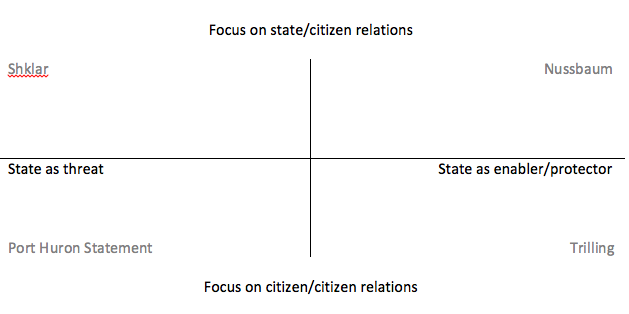
This simple typology might be helpful for distinguishing tendencies within liberal political thought. The x-axis measures attitudes toward the state, ranging from fear to enthusiasm. The y-axis measures the degree to which the state is central to politics. If you are primarily concerned with the state, you belong at the top, and if you focus on horizontal relations among people, you’re at the bottom.

Screen Shot 2016-01-20 at 8.10.05 AM

Judith Shklar exemplifies the top-left quadrant. She is explicit that the question for liberals is how the state treats citizens, and the driving concern is the state’s potential for cruelty and oppression:

Given the inevitability of that inequality of military, police, and persuasive power which is called government, there is evidently always much to be afraid of. And one may, thus, be less inclined to celebrate the blessings of liberty than to consider the dangers of tyranny and war that threaten it. For this liberalism the basic units of political life are not discursive and reflecting persons, nor friends and enemies, nor patriotic soldier-citizens, nor energetic litigants, but the weak and the powerful. And the freedom it wishes to secure is freedom from the abuse of power and intimidation of the defenseless that this difference invites.[1]

Martha Nussbaum exemplifies the top-right. She is also fundamentally concerned with the government, but she emphasizes its potential to enhance human capabilities:

In the end it is government, meaning the society’s basic political structure, that bears the ultimate responsibilities for securing capabilities. [Government] must actively support people’s capabilities, not just fail to set up obstacles. … Fundamental rights are only words unless and until they are made real by government action.[2]

Despite the manifest disagreements between these two authors, both view politics mainly as a set of relationships between the state and citizens.

Down at the bottom right is someone like Lionel Trilling, who thinks that liberalism is about relations among citizens—“discursive and reflecting persons,” in Shklar’s phrase. In a liberal culture, fellow members of a community develop close, responsive relations with one another so that they can enrich their inner lives and develop mutual understanding before they seek to influence the state, their culture, or their community. In passing in The Liberal Imagination, Trilling endorses laws and institutions that enhance freedom and happiness (that puts him on the right side of the spectrum), yet he wishes to “recall liberalism to its first essential imagination of variousness and possibility, which implies the awareness of complexity and difficulty.”[3] For Trilling, sensitive literary criticism is a characteristic liberal act because it involves the recovery of another individual’s thought.

The bottom-left belongs to people who see great importance and positive potential in human beings when they relate appropriately to each other, and who fear the state as a threat to authenticity and creativity. This is at least a thread in the Port Huron Statement, which inaugurated the New Left in America:

Men have unrealized potential for self-cultivation, self-direction, self-understanding, and creativity. It is this potential that we regard as crucial and to which we appeal, not to the human potentiality for violence, unreason, and submission to authority. …  Human relationships should involve fraternity and honesty. Human interdependence is contemporary fact; human brotherhood must be willed however, as a condition of future survival and as the most appropriate form of social relations. Personal links between man and man are needed, especially to go beyond the partial and fragmentary bonds of function that bind men only as worker to worker, employer to employee, teacher to student, American to Russian. … Loneliness, estrangement, isolation describe the vast distance between man and man today. These dominant tendencies cannot be overcome by better personnel management, nor by improved gadgets, but only when a love of man overcomes the idolatrous worship of things by man.

[1] Cf. Judith Shklar, The Liberalism of Fear, reprinted in Nancy L. Rosenblum (ed.), Liberalism and the Moral Life (Cambridge, MA: Harvard University Press, 1989), p. 27.

[2] Martha Nussbaum, Creating Capabilities: The Human Development Approach, pp. 64-5.

[3] Trilling, The Liberal Imagination: Essays on Literature and Society (New York: New York Review of Books, 2008), Preface (1949), p. xxi

the pantomime of the Democratic primary, or the choices that actually confront the next president

The first question in Sunday’s Democratic primary debate was: “President Obama came to office determined to swing for the fences on health care reform. Voters want to know how you would define your presidency? How would you think big? So complete this sentence: in my first 100 days in office, my top three priorities will be — fill in the blank.”

All three candidates answered as they had been encouraged to, by describing grand changes in society that would require legislation to accomplish. None mentioned that conservatives have almost a 100% chance of controlling the House, the judiciary, and most states.

I wouldn’t criticize their approach to answering the question. If they had stuck to politically realistic answers, they would have allowed the other party to narrow the scope of discussion and debate. Also, it was illuminating to understand the differences that emerged when the candidates discussed legislation. For instance, are the Affordable Care Act and Dodd-Frank hard-won and fragile victories to be protected with strongly affirmative rhetoric (Clinton), or mere promissory notes demanding to be redeemed with better laws (Sanders)? Are almost all political dysfunctions traceable to campaign money (Sanders), or could skillful leadership within the current system improve things (Clinton)? Finally, it would have been defeatist for these candidates to offer realistic plans for their first 100 days. That would have undercut progressives’ efforts to win down-ballot races and would have converted a prediction into a self-fulfilling prophesy. In other words, it would have been bad leadership.

And yet, as someone deciding which candidate to choose, I am interested in what each candidate would actually do in office (as well as the more pressing question: Who has a better chance of beating the Republican nominee?). At least in the first two years, they would be able to do virtually none of the things they proposed in the debate. Any of them would veto assaults on the Affordable Care Act and negotiate a budget deal that retains most of the status quo. But some choices would confront them:

What unilateral foreign policy decisions to make. This is the area where Congress has–perhaps unfortunately–the least scope, although the national security apparatus has a great deal of say, and it’s not clear that the president really does decide. Dovish progressives have a hard choice in ’16, because Clinton has a hawkish record and Sanders has no experience managing the military and security agencies.

What legislation to propose to Congress first. Three options to send to the Hill are: 1) Widely popular but small-bore bills that can pass and establish a record of accomplishment. 2) Wedge issues: bills designed to catch the House Republicans between their constituents’ opinions and their party orthodoxy. Or 3) grand visions of alternative health or justice systems. These would fail but could possibly alter the terms of public debate. It’s a hard choice.

What executive orders to issue. Note that President Obama seems intent on using that authority to its full in his final year, and he may not leave a lot of attractive options for his successor.

Whom to nominate for a wide range of offices. Within many domains of policy, a Democrat has genuine choices. For instance, she or he could nominate an education reformer enamored of metrics, accountability, and competition (continuing the status quo) or switch to someone who prefers to give teachers autonomy and resources. There is plenty of room within the legislative framework of the Elementary and Secondary Education Act to push in either direction. In the economic agencies, there is a choice between mollifying Wall Street and the markets or regulating them aggressively.

In making appointments, the president also gets to choose leaders with a range of personal profiles. Any Democratic president will look for racial and gender diversity, but how to weigh ideological, religious, generational, and regional diversity? Should most cabinet secretaries have extensive experience as CEOs of large bureaucracies so that they can run things smoothly, or should they be thinkers and advocates?

I enjoy the debate about long-term directions for progressive politics and the nation, but we should probably ask the candidates how they will resolve the decisions that they will actually face.

if you’ve voted, it’s been noted

(Washington) In Hacking the Electorate: How Campaigns Perceive Voters, Eitan Hersh shows that candidates and campaigns obtain their knowledge of us, the citizenry, by analyzing voter files. They don’t know the truth about us; they know what the voter files say about us.

That means that getting on the voting rolls is a source of power. Once you’re on, the political class becomes interested in you. They measure and model and predict your preferences and behaviors. Your vote may not make a marginal difference in the electoral outcome. After all, most elections are lopsided victories. But even if you are part of a large majority or a small minority, the candidates will pay attention to you if you’re in the voter files, and they won’t even see you if you aren’t.

This is an argument for registering and voting that may not be easy to convey, but it has the advantage of being right.

Don’t campaigns learn what the whole population thinks from polls? The answer is: sometimes. Polls are mainly conducted for high profile races. It’s a pop-culture myth (see “The Good Wife”) that ordinary candidates do any significant polling. Besides, we are in the midst of a data revolution in which companies, governments, and politicians are shifting away from random samples to datasets that track all of the relevant behavior–every purchase on Amazon, every Web search, or every vote. These datasets are far more powerful than surveys for predicting and influencing people. In particular, voting files are powerful because: (1) public policy requires the collection of more data on voters than is strictly necessary to run an election, (2) voter files can be merged with commercial records, and (3) analysis of such data is becoming both more sophisticated and more user-friendly. (I take all of this from Hersh.)

Don’t campaigns learn about the public by talking to people? They used to rely on skillful, experienced neighborhood-level volunteers to provide information about the electorate. That whole infrastructure has been hollowed out by money and technology. Of course, there are still volunteers. But they come forward to work on particular campaigns. Few have deep and accumulated knowledge of local voters. The best way to harvest what they learn during a campaign is to require them to upload their observations about specific citizens to the voter files. Meanwhile, the candidates spend their time talking to donors. The voter file is how the campaign learns who you are–which means that you should make sure you’re on it by voting.

the State of the Union’s peroration on citizenship

The President concluded his final State of the Union address with a rousing statement about citizenship. That was appropriate, because he has done the same thing in almost all of his most important speeches, including the 2004 Democratic Convention speech that launched his national career, his kickoff address announcing his candidacy for president in 2007, and both inaugural addresses. For the record, I past below the fold an anthology of Barack Obama’s strongest statements on the theme of citizenship (1988-2016), culminating with last night’s SOTU. I will be especially interested to hear what he says on this topic once he is out of the Oval Office and beginning the career of nongovernmental citizenship that he hinted at last night.

Writing about community organizing in 1988

Community organizing reveals the “internal productive capacities, both in terms of money and people, that already exist in communities.”  It “enables people to break their crippling isolation from each other, to reshape their mutual values and expectations and rediscover the possibilities of acting collaboratively—the prerequisites of any successful self-help initiative.” For organizers, the process “teaches as nothing else does the beauty and strength of everyday people.”

Launching his candidacy in Springfield, IL on February 10, 2007

“And after a time, I came to understand that our cherished rights of liberty and equality depend on the active participation of an awakened electorate. (Cheers.)” …

That’s why this campaign can’t only be about me. It must be about us. It must be about what we can do together. This campaign must be the occasion, the vehicle of your hopes and your dreams. It will take your time, your energy and your advice to push us forward when we’re doing right and let us know when we’re not.

This campaign has to be about reclaiming the meaning of citizenship, restoring our sense of common purpose, and realizing that few obstacles can withstand the power of millions of voices calling for change. (Cheers.) …

That is our purpose here today. That is why I’m in this race, not just to hold an office but to gather with you to transform a nation. (Cheers.) …

I want us to take up the unfinished business of perfecting our Union and building a better America. (Cheers.) And if you will join with me in this improbable quest, if you feel destiny calling and see, as I see, the future of endless possibilities stretching out before us, if you sense, as I sense, that the time is now to shake off our slumber and slough off our fears and make good on the debt we owe past and future generations, then I am ready to take up the cause and march with you and work with you. (Cheers.) Today, together, we can finish the work that needs to be done and usher in a new birth of freedom on this earth. …

3/19/2007 CNN, Larry King Live, answering a question about Michelle Obama:

“She’s very interested in getting young people involved civically. She ran one of these AmeriCorps programs, called “Public Allies” in Chicago that helped young people connect with public service work and get leadership training. And so, she’s really big on encouraging people to get involved in their communities. And I think that’s something that she would be likely to continue if she were in the White House.

12/05/2007, Mt. Vernon, IA “Obama Issues Call to Serve, Vows to Make National Service Important Cause of His Presidency”

[as a community organizer] I found that you could do your part to see that – in the words of Dr. King – it “bends toward justice.” In church basements and around kitchen tables, block by block, we brought the community together, registered new voters, fought for new jobs, and helped people live lives with some measure of dignity.

Eventually, I realized I wasn’t just helping other people. Through service, I found a community that embraced me; a church to belong to; citizenship that was meaningful; the direction I’d been seeking. Through service, I found that my own improbable story fit into a larger American story.”

From a transcript: “I have no doubt that in the face of impossible odds people who love their country can change it. But I hold no illusions that one man or woman can do this alone. That’s why my campaign has called nearly 400,000 Americans to a common purpose. That’s why I’m reaching out to Democrats, and also to Independents and Republicans. And that is why I won’t just ask for your vote as a candidate; I will ask for your service and your active citizenship when I am President of the United States. This will not be a call issued in one speech or program; this will be a cause of my presidency.”

06/30/2008, Independence, MO, Remarks of Senator Barack Obama:

“In spite of this absence of leadership from Washington, I have seen a new generation of Americans begin to take up the call. I meet them everywhere I go, young people involved in the project of American renewal; not only those who have signed up to fight for our country in distant lands, but those who are fighting for a better America here at home, by teaching in underserved schools, or caring for the sick in understaffed hospitals, or promoting more sustainable energy policies in their local communities.

I believe one of the tasks of the next Administration is to ensure that this movement towards service grows and sustains itself in the years to come. We should expand AmeriCorps and grow the Peace Corps. We should encourage national service by making it part of the requirement for a new college assistance program, even as we strengthen the benefits for those whose sense of duty has already led them to serve in our military.

We must remember, though, that true patriotism cannot be forced or legislated with a mere set of government programs. Instead, it must reside in the hearts of our people, and cultivated in the heart of our culture, and nurtured in the hearts of our children.

As we begin our fourth century as a nation, it is easy to take the extraordinary nature of America for granted. But it is our responsibility as Americans and as parents to instill that history in our children, both at home and at school. The loss of quality civic education from so many of our classrooms has left too many young Americans without the most basic knowledge of who our forefathers are, or what they did, or the significance of the founding documents that bear their names. Too many children are ignorant of the sheer effort, the risks and sacrifices made by previous generations, to ensure that this country survived war and depression; through the great struggles for civil, and social, and worker’s rights.

And it is up to us to teach our children a lesson that those of us in politics too often forget: that patriotism involves not only defending this country against external threat, but also working constantly to make America a better place for future generations.”

09/12/2008 New York, NY:

Every American can give back to their communities and help their fellow citizens through service,” said Senator Obama. “Many Americans serve their nation through military service. Others serve by volunteering in schools, shelters, churches, hospitals, and disaster relief efforts. Still more are firefighters, teachers, or police officers. As a young man, I served as a community organizer on the South Side of Chicago, where I learned ways to create opportunities for other people to achieve their dreams. Our nation faces serious challenges in its neighborhoods and schools, and we must empower Americans with the resources they need to give back and improve their communities. I am proud to support this legislation and I commend Chairman Kennedy for his continued leadership in opening doors for public service opportunities.

04/29/2009 Town Hall Meeting, Arnold, MO:

We’re living through extraordinary times. We didn’t ask for all the challenges that we face, but we’re determined to answer the call to meet them. That’s the spirit I see everywhere I go. That’s the spirit we need to sustain, because the answer to our problems will ultimately be found in the character of the American people. We need soldiers and diplomats, scientists, teachers, workers, entrepreneurs. We need your service. We need your active citizenship.

01/21/2009 Remarks by the President in Welcoming Senior Staff and Cabinet Secretaries to the White House:

Our commitment to openness means more than simply informing the American people about how decisions are made. It means recognizing that government does not have all the answers, and that public officials need to draw on what citizens know. And that’s why, as of today, I’m directing members of my administration to find new ways of tapping the knowledge and experience of ordinary Americans — scientists and civic leaders, educators and entrepreneurs — because the way to solve the problem of our time is — the way to solve the problems of our time, as one nation, is by involving the American people in shaping the policies that affect their lives.

 Memorandum issued the first day in office (2009) “Transparency and Open Government.”

Government should be participatory. Public engagement enhances the Government’s effectiveness and improves the quality of its decisions. … Executive departments and agencies should offer Americans increased opportunities to participate in policymaking and to provide their Government with the benefits of their collective expertise and information. …Government should be collaborative. Collaboration actively engages Americans in the work of their Government. Executive departments and agencies should use innovative tools, methods, and systems to cooperate among themselves, across all levels of Government, and with nonprofit organizations, businesses, and individuals in the private sector.

Accepting the Democratic nomination in 2012

But we also believe in something called citizenship — (cheers, applause) — citizenship, a word at the very heart of our founding, a word at the very essence of our democracy, the idea that this country only works when we accept certain obligations to one another and to future generations.

….

We don’t think the government can solve all of our problems, but we don’t think the government is the source of all of our problems — (cheers, applause) — any more than our welfare recipients or corporations or unions or immigrants or gays or any other group we’re told to blame for our troubles — (cheers, applause) — because — because America, we understand that this democracy is ours.

We, the people — (cheers) — recognize that we have responsibilities as well as rights; that our destinies are bound together; that a freedom which asks only, what’s in it for me, a freedom without a commitment to others, a freedom without love or charity or duty or patriotism, is unworthy of our founding ideals, and those who died in their defense. (Cheers, applause.)

As citizens, we understand that America is not about what can be done for us. It’s about what can be done by us, together — (cheers, applause) — through the hard and frustrating but necessary work of self-government. That’s what we believe.

So you see, the election four years ago wasn’t about me. It was about you. (Cheers, applause.) My fellow citizens — you were the change. (Cheers, applause.)

State of the Union Address, 2014

Tonight, this chamber speaks with one voice to the people we represent: it is you, our citizens, who make the state of our union strong. …

After all, that’s the spirit that has always moved this nation forward.  It’s the spirit of citizenship – the recognition that through hard work and responsibility, we can pursue our individual dreams, but still come together as one American family to make sure the next generation can pursue its dreams as well.

Citizenship means standing up for everyone’s right to vote.  Last year, part of the Voting Rights Act was weakened.  But conservative Republicans and liberal Democrats are working together to strengthen it; and the bipartisan commission I appointed last year has offered reforms so that no one has to wait more than a half hour to vote.  Let’s support these efforts.  It should be the power of our vote, not the size of our bank account, that drives our democracy.

Citizenship means standing up for the lives that gun violence steals from us each day.  I have seen the courage of parents, students, pastors, and police officers all over this country who say “we are not afraid,” and I intend to keep trying, with or without Congress, to help stop more tragedies from visiting innocent Americans in our movie theaters, shopping malls, or schools like Sandy Hook.

Citizenship demands a sense of common cause; participation in the hard work of self-government; an obligation to serve to our communities.  And I know this chamber agrees that few Americans give more to their country than our diplomats and the men and women of the United States Armed Forces.

State of the Union Address, 2016

But democracy does require basic bonds of trust between its citizens. It doesn’t work if we think the people who disagree with us are all motivated by malice, or that our political opponents are unpatriotic. Democracy grinds to a halt without a willingness to compromise; or when even basic facts are contested, and we listen only to those who agree with us. Our public life withers when only the most extreme voices get attention. Most of all, democracy breaks down when the average person feels their voice doesn’t matter; that the system is rigged in favor of the rich or the powerful or some narrow interest.

So, my fellow Americans, whatever you may believe, whether you prefer one party or no party, our collective future depends on your willingness to uphold your obligations as a citizen. To vote. To speak out. To stand up for others, especially the weak, especially the vulnerable, knowing that each of us is only here because somebody, somewhere, stood up for us. To stay active in our public life so it reflects the goodness and decency and optimism that I see in the American people every single day. …

I see them everywhere I travel in this incredible country of ours. I see you. I know you’re there. You’re the reason why I have such incredible confidence in our future. Because I see your quiet, sturdy citizenship all the time.

inequality as viewed from Silicon Valley

Gregory Ferenstein has interviewed Silicon Valley moguls about inequality. He summarizes the results thus:

They believe that a relatively small slice of geniuses advance humanity more than the combined efforts of everyone else, and that economic growth is better at improving the overall quality of life than burdensome redistribution schemes.

And many believe that the best long-term solution to inequality may be a guaranteed basic minimum income, which minimizes regulation on innovation but ensures that the masses are well-off.

Many of his interviewies identify as liberals, but that is probably because of social issues. They are certainly pro-market and see economic growth as the solution to almost all social problems. That assumption aligns them with libertarian conservatives, albeit with a subtle and important difference.

A certain kind of laissez-faire conservative believes that inequality would not be a big problem in a free market because almost all people have significant market value. Anyone can make money who works hard and exercises thrift. Poverty exists because of disincentives to work or because of market distortions. A moderate version of this position adds that universal public education and some regulation is necessary to allow everyone to attain adequate market value. A proponent might also acknowledge that markets yield inequality but argue that that doesn’t matter as long as most workers can attain a reasonable level of welfare. They should be able to do that if labor markets clear, and the ones who can’t (e.g., the sick and old) can be taken care of by small government programs or philanthropy.

The Silicon Valley moguls have a different view of the world. They do not think that most people have much market value. One wrote in Ferenstein’s survey, “Very few are contributing enormous amounts to the greater good, be it by starting important companies or leading important causes.” Another defends MOOCs not because they educate most students well but because they can find the diamonds in the rough who have the potential to produce substantial value. “Most said that the top 10 percent of talent would naturally earn more than 50 percent of the nation’s wealth” if an economy were unregulated.

I think Silicon Valley people make a core distinction between commodities and innovations or “disruptive” technologies. In this framework, a commodity is something that anyone can consume or produce if she can pay the market price. Wheat, for example, is a commodity. You can buy it by the pound. You can also produce it at the market rate. If you don’t have land, water, and seed, you can buy those. If you don’t know how to farm, you can hire a farmer. In contrast, you cannot make a Rembrandt or a MacBook Air. Rembrandt is dead and Apple has patented its design.

This distinction is crucial because profit margins for commodities are low in a competitive economy, and the real money comes from innovations. I think Silicon Valley people sometimes confuse price and value and conclude that social benefits also come from innovation, not from the provision of ordinary commodities. (Some in the Obama Administration hold a similar view, assuming that it is more important for the federal government to be able to fund social innovations than to maintain standard services.)

On this view of the world, the top priority is to support and liberate the few who are in a position to innovate. All the others play a limited role and have limited economic significance. If they are poor, no harm comes from giving them transfer payments so that they can purchase commodities. It’s not necessary to give them incentives to work hard and be thrifty, and it’s benign to make sure they can consume.

In contrast, a classic (Victorian or neoliberal) free-marketer believes that everyone can and should contribute importantly to the common good by working, and transfer payments harm the recipients by reducing their incentives to work. That argument is lost on Silicon Valley entrepreneurs, who don’t think most people’s work is all that valuable, anyway.

I think this fundamental difference cuts through the various pro-market movements that are ascendant today and is worth watching.

(Notes: I recognize that markets aren’t natural but are created by public policy. I recognize that merit–or the capacity to produce value–is constructed, not innate, and that different people would be seen to have merit if we designed society differently. Finally, I recognize a third category apart from commodities and innovations: rents. You can’t actually make as much wheat as you want, because God only made so much land, and you can’t make a MacBook Air, because the government limits your ability to imitate Apple by awarding patents to the company. So both landowners and tech. companies can collect rents. These three points are among many important complications, but I don’t think they challenge my interpretation of the worldview of Silicon Valley neoliberals.)

a blogaversary flashback

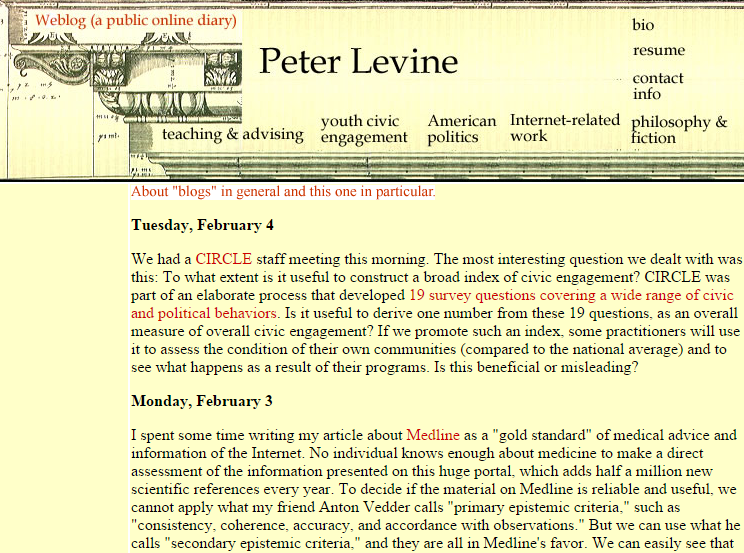
I’ve been blogging since January 2003–for 13 years. I usually note the anniversary with a post about the past year. This year I will illustrate the blogaversary with a screenshot (thanks to the Internet Archive) of the blog as it looked on February 4, 2003:

2003screenshot

The text in those days was simple HTML. In other words, this site was not a database of posts that automatically generated a “front end” view for the reader (as it is now). Back then, I just typed each new entry on top of the previous one. Because blogging was still fairly new, I felt the need to explain at the top of the page that a Weblog was a “public online diary” and I included a link to a statement about “‘blogs’ in general and this one in particular.” I put the word “blog” in quotation marks because it was unfamiliar. In keeping with my definition, I did in fact write a kind of diary. The intro to each of the posts you see above was about what I had done during that day, hooked to some kind of substantive point.

On Feb. 4, 2003, we seem to have talked about creating a “broad index of civic engagement.” The fruits of that discussion include the Civic Health Index, led by the National Conference on Citizenship, which was written into federal law as part of the Kennedy Serve America Act of 2009. We’ve been involved in countless other measurement efforts since then.

The Feb. 3 post is about a form of literacy (in this case, medical literacy) and whether to promote it with better free electronic resources or with public schooling–or both. Even now, in our world of social media, these issues remain important and difficult. I continue to resist piling all responsibilities for boosting every form of “literacy” onto our public schools. I also continue to think that sometimes we can lower the cognitive demands on citizens by simplifying systems, rather than trying to feed everyone ever more information. That strategy seems appealing for law and policy as for medicine and health.

Flashing forward to 2015 (3,119 posts later) … I think the past year was fairly typical, although I intentionally let slip my traditional obsession with posting every single workday. Nowadays, this is not a diary so much as a notebook of argumentative writing, a fair amount of which ends up in articles. For better or worse, the categories that interest me remain basically the same as they were more than a decade ago.

propose sessions for Frontiers of Democracy

The next Frontiers of Democracy conference will take place on June 23-25, 2016 at Tufts University’s downtown Boston campus. The conference schedule is taking shape, and we welcome proposals for concurrent sessions. We call the sessions “learning exchanges” because we do not accept papers or presentations. Instead, we are looking for moderated discussions, workshops, trainings, debates, or other interactive sessions that normally last 90 minutes each and involve up to 20 people. The special conference theme for this year is “Revolt Against the Mainstream?” (thinking not only about the US presidential election but many other examples of “revolts” from around the world.) Session ideas would be welcome that address that theme, but we are open to all kinds of topics related to civic engagement and democracy. Please use this form to submit ideas–for best consideration, by Feb. 29.

the Koch brothers network and the state of American parties

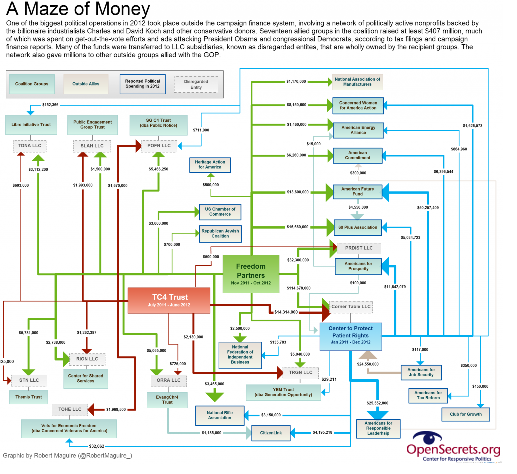
Kenneth Vogel reported recently in Politico that “[Charles] Koch and his brother David Koch have quietly assembled, piece by piece, a privatized political and policy advocacy operation like no other in American history that today includes hundreds of donors and employs 1,200 full-time, year-round staffers in 107 offices nationwide. That’s about 3½ times as many employees as the Republican National Committee and its congressional campaign arms had on their main payrolls last month.” Vogel adds that the Koch network will spend more than twice what the RNC spent in 2012, that it has more staff and funding in some key states than the state’s Republican party has, and that it is the leading provider of voter data and political training/coaching on the right today, supplanting the GOP.

Vogel and some of his quoted sources emphasize that this network is unprecedented in US history, which seems true. I would add that it appears unique in the world. The Varieties of Democracy (V-Dem) Project offers free data on the political systems of 173 countries. They ask so many questions about each country that the dataset includes 15 million data points. (I am one of many coders for the USA.) The V-Dem project asks about all kinds of ways in which political parties may be strong or weak; autonomous or co-opted; free, regulated or banned–but it doesn’t even pose questions about entities that perform the traditional functions of parties without being parties. That seems to be a novel contribution of the US since 2000.

The Koch network stands for an ideology and policies that I mostly disagree with, but that’s not the only reason to worry about this development–which could be replicated on the left. These are the main reasons:

  1. A standard political party is at least somewhat accountable, representative, and deliberative. Here are the extensive Rules of the Republican Party, which are mostly about intra-party elections, offices, procedures, and powers. They create a system in which each grassroots Republican has an independent voice and influence. To be sure, some parties have boasted of their authoritarian internal structures, but they have never been important in the US. More common are parties that fail to live up to their claims of responsiveness. In fact, Robert Michels’ “Iron Law of Oligarchy” (1911) was about the rigid tendency of even social-democratic parties to become internal oligarchies. That is a real worry, but there are limits to it. In competitive systems, parties that present themselves as democratic yet act oligarchically lose members and elections. Party elites are disciplined by voters–imperfectly but inevitably. There is no such mechanism within the Koch brothers’ network. It is officially and thoroughly oligarchical. The 1,200 paid staffers work for the people who pay them, not for voters or members.
  2. A party is also accountable to all the voters because it can obtain power and actually govern, and then the electorate can decide what they think of the results. But the Koch network doesn’t directly govern; it just influences some of the people who do. If the politicians they support turn out to be unpopular, the Koch network can pick new candidates for the next round. It cannot itself be voted out.
  3. A standard political party must be transparent if it seeks to attract and retain members. That’s why the GOP has published rules, leaders, and a platform. I am fully aware of the secrecy in US politics, but secrecy is checked by the need to compete for public support. As far as I can tell, the Koch network doesn’t even have an official name, let alone a set of binding rules that an outsider can assess, let alone a public budget.
  4. A standard political party includes both activists and interest groups and actual office-holders. The office-holders are responsible for performance in government and can’t just spout rhetoric. The activists, on the other hand, have some freedom to speak truth to power. The result is a healthy tension between aspirations and reality. But the Koch network is run by activists/interests groups who influence office-holders. It has no incentive to compromise or to support compromise.
  5. Power within the Koch network is proportional to money and is extraordinarily unequal. Michels taught that all parties are inequitable, even those most passionately committed to equality. Still, parties need citizens to vote and volunteer, and the capacity to do so is pretty evenly distributed across the population. The Koch network is purely and simply driven by money.

Below is the Koch network as depicted by my friends at the Center for Responsive Politics. It does not belong in a civics textbook, although a realistic textbook today should probably include it.

.Koch network