John Stuart Mill, Stoic

I sometimes envy my fellow academics in the humanities who regularly renew their acquaintance with fundamental works that have slipped pretty deep into the well of my own memory because my job is to conduct and administer empirical research about current politics. For just that reason, I am thoroughly enjoying reencountering some major works as I teach first-year undergraduates this semester.

For instance, I now see Mill’s Utilitarianism in an entirely new way thanks to re-reading it with students after our extensive discussions of authors like Epicurus, Buddha, and Emerson. It seems much less an explanation of the utilitarian principle of justice (maximize everyone’s happiness) than I had remembered, and more an exploration of how an individual should pursue happiness. It thus belongs to a genre that Mill knew very well, the tradition of therapeutic philosophy inaugurated by the Hellenistic schools and revived by Montaigne.

In the text of Utiliarianism, Mill refers several times to Epicureanism and Stoicism. For instance: “I do not, indeed, consider the Epicureans to have been by any means faultless in drawing out their scheme of consequences from the utilitarian principle. To do this in any sufficient manner, many Stoic, as well as Christian elements require to be included.” This passage suggests that Mill is interested in constructing the kind of “eclectic” view (drawing from multiple Hellenistic schools) that was popular from the time of Cicero and continued in early Christianity.

Of course, one should expect as much based on the author’s Autobiography. In the chapter on the “Crisis in My Mental History,” Mill recalls how reading Jeremy Bentham in 1821 gave him “an object in life; to be a reformer of the world.” He would apply the classical utilitarian principle of justice to improve the general welfare. “My conception of my own happiness was entirely identified with this object.” He says he was open to experiencing his own pleasures–“I endeavoured to pick up as many flowers as I could by the way”–but the purpose of his life was to achieve social justice, defined in a utilitarian way.

“This did very well for several years, during which the general improvement going on in the world and the idea of myself as engaged with others in struggling to promote it, seemed enough to fill up an interesting and animated existence.” (Note that his personal satisfaction derived from two contingencies: political success and a supportive community.) But at one moment during the autumn of 1826, his satisfaction ended as suddenly as if he had awakened from a dream. He asked himself this question:

“Suppose that all your objects in life were realized; that all the changes in institutions and opinions which you are looking forward to, could be completely effected at this very instant: would this be a great joy and happiness to you?” And an irrepressible self-consciousness distinctly answered, “No!” At this my heart sank within me: the whole foundation on which my life was constructed fell down. All my happiness was to have been found in the continual pursuit of this end. The end had ceased to charm, and how could there ever again be any interest in the means? I seemed to have nothing left to live for.

Mill fell into a deep depression that ended only with his father’s death. A Freudian diagnosis is plausible (young John Stuart found momentary relief while his overbearing father still lived by reading a tragedy in which the fictional father died); but more interesting is Mill’s own explanation. He says that he recovered when he saw that happiness requires special strategies and techniques of mind. For instance, he came to believe that you can’t achieve happiness by pursuing it, only by aiming for some other end and becoming absorbed in that. He also learned that his own “passing susceptibilities needed to be cultivated as well as [his] active capacities, and required to be nourished and enriched as well as guided.” With that in mind, he paid more attention to poetry (especially Wordsworth) and music; “and the maintenance of a due balance among the faculties now seemed to be of primary importance.”

Above all, “I, for the first time, gave its proper place, among the prime necessities of human well-being, to the internal culture of the individual. I ceased to attach almost exclusive importance to the ordering of outward circumstances, and the training of the human being for speculation and for action.”

With that background in mind, it is striking how little his book Utilitarianism says about the “ordering of outward circumstances.” It doesn’t explain what policies would maximize aggregate happiness, how happiness relates to values like liberty and equality in a theory of social justice, or even how individuals should maximize their benefits to others. (No trolley problems at all.) Instead, Mill delves deeply into a theory of individual happiness.

For instance, he thinks that anyone who has achieved a higher grade of existence will prefer it to a lower grade, even though the higher grade permits “more acute suffering.” Evidently, we are not striving to avoid suffering, because then we would prefer a simpler or narrower mental life, less sensitive to pain. Something else must explain our preference for refined experiences, and Mill thinks the right word for that is “dignity.” (He notes that the Stoics called the same impulse “love of liberty,” implying that for them, “liberty” really meant pursuing higher interests rather than being free from constraints.) Thus, according to Mill, we seek at least two different things: happiness and dignity. 

Mill is not very specific about what constitutes a higher grade of experience, and I think the text is compatible with two theories. First, it might be possible to make an objective rank-ordering of experiences, so that not only is poetry better than pushpin, but Wordsworth is better than Leigh Hunt because the former’s verse is superior. Alternatively, the quality of experience might mean the degree to which the individual happens to be stretched, engaged, inspired, etc. It would then be possible that playing an elaborate video game is a higher experience for a particular individual than hearing Beethoven, if the player engages more of his mind and soul in the game. We could objectively rank experiences by assessing the mental state of the participants rather than the activities themselves. Pushpin could beat poetry for champion pushpin-players.

In any case, Mill states that mental experiences are better than bodily experiences, and that active pleasures are higher than passive ones.

He also acknowledges that a person can abandon higher forms of experience due to indolence and selfishness. That scenario poses a challenge for him, because he has defended a distinction between higher and lower pleasures on the basis that anyone who has experienced both will prefer the higher. That argument preserves a thread between Mill’s position and classical utilitarianism (which is all about maximizing subjective preferences), but the thread would break if Mill favored higher pleasures even though some people renounce them voluntarily. He has an answer:

But I do not believe that those who undergo this very common change, voluntarily choose the lower description of pleasures in preference to the higher. I believe that before they devote themselves exclusively to the one, they have already become incapable of the other. Capacity for the nobler feelings is in most natures a very tender plant, easily killed, not only by hostile influences, but by mere want of sustenance; and in the majority of young persons it speedily dies away if the occupations to which their position in life has devoted them, and the society into which it has thrown them, are not favourable to keeping that higher capacity in exercise. Men lose their high aspirations as they lose their intellectual tastes, because they have not time or opportunity for indulging them; and they addict themselves to inferior pleasures, not because they deliberately prefer them, but because they are either the only ones to which they have access, or the only ones which they are any longer capable of enjoying. It may be questioned whether any one who has remained equally susceptible to both classes of pleasures, ever knowingly and calmly preferred the lower; though many, in all ages, have broken down in an ineffectual attempt to combine both.

Another key point is that sacrificing one’s own interests can be good for the individual because it gives her a valuable and absorbing objective. The classical utilitarian would regard sacrifice as a cost, required only if the benefit to others outweighs it. Mill continues to reject the view that “the sacrifice is itself [is] a good.” But sees that some forms of self-sacrifice may constitute happiness for the person who experiences them. In fact, “nothing except [an ability to sacrifice oneself for other] can raise a person above the chances of life … and enables him, like many a Stoic in the worst times of the Roman Empire, to cultivate in tranquillity the sources of satisfaction accessible to him, without concerning himself about the uncertainty of their duration, any more than about their inevitable end.” Mill observes that people who have privileges and yet remain unhappy tend to be those who don’t care for others. Contribution to a community is thus one path to happiness, as Mill himself had found in his early years. But another path is aesthetic experience, and Mill presumably advocates a balance of the two.

Mill also observes that a “continuity of highly pleasurable excitement” is impossible for us. A better objective is tranquility and acceptance, plus occasional excitement. “The happiness which [“the philosophers”] meant was not a life of rapture; but moments of such, in an existence made up of few and transitory pains, many and various pleasures, with a decided predominance of the active over the passive, and having as the foundation of the whole, not to expect more from life than it is capable of bestowing.”

See also: you have a right and a responsibility to attend to your own happinessmust you be good to be happy?on philosophy as a way of life

CIRCLE breaks down the youth vote

When CIRCLE’s Millennial survey was conducted (9/21-10/3), Clinton was beating Trump by 21 points (49% vs. 28%). Clinton may do better when the actual votes are cast, because there seems to be a trend in her favor among youth. That said, the CIRCLE poll allows detailed comparisons between young Americans who were favoring the two candidates at a moment when Trump was drawing one in four.

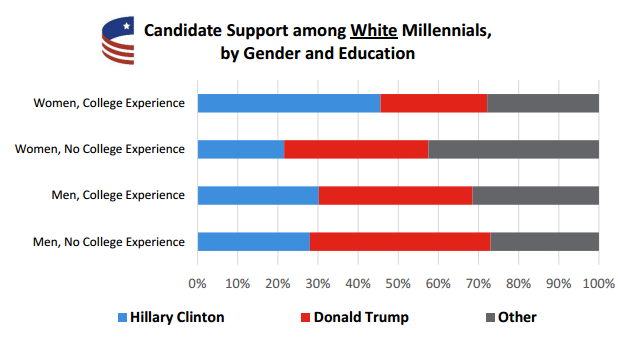
Young Trump and Clinton voters were starkly different people, and today CIRCLE has published an analysis that compares them by demographics and by opinions. For example, this graph shows Trump winning a plurality of non-college-educated men under 30 even as he was losing college-educated young women by almost 2-to-1.

circletrump

A couple of other illustrative findings from the report, which deserves to be read in full:

  • 85% of young Trump voters are dissatisfied with the way things are going for the country, and they are far more likely than Clinton supporters to believe that the country’s best days are behind us.
  • Trump supporters are less experienced with various types of political engagement, and more likely than Clinton supporters to say that they would “never, under any circumstances” do things like volunteer for a campaign or attend a political rally, suggesting that Trump supporters are overall less likely to be politically engaged.

the floating “that”: a linguistic innovation?

(Orlando) “You’ve got to eat those vegetables and do that exercise every day.” “We’re concentrating on those metrics, that whole assessment piece.”

Maybe it’s just me, but I’m noticing this speech pattern lately. People use “that” to intensify a noun. I think they’re mimicking a situation in which you have already talked about an important topic–and perhaps achieved agreement on it–and now you use “that” to refer back to the previous discussion. But in this new linguistic phenomenon, there’s no previous discussion to refer back to. “That” simply stresses the following noun.

No value-judgment implied. People are endlessly inventive; language constantly changes. I just find this new speech pattern interesting. (I wouldn’t use it in written text, however.)

social class does predict Trump support

Some say that Trump has captured the support of working-class Whites who are economically stressed or anxious. Others reply that Trump voters are relatively upscale but motivated by racial resentment alone. The former premise suggests that Democrats must do more to empower the working class, including Whites. The latter suggests that White nationalism is our fundamental problem today. Although I see truth in both positions, I’ve argued for addressing the economic and political vulnerability of the White working class. I present that as a strategy for countering Trumpism, but it’s a misguided strategy for that purpose if Trump voters are relatively affluent.

The raw story is that White people with lower incomes are Trump’s strongest backers.

Presidential Candidate Preference for Whites with Family Income <75K (Reuters)

Presidential Candidate Preference for Whites with Family Income <$75K (Reuters)

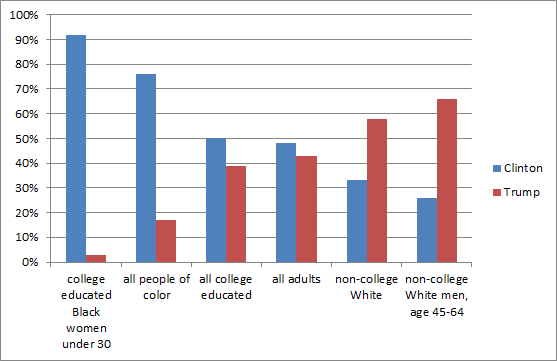
But it’s not just about income and race. Education levels, age, and gender are also strongly related to voters’ preferences in this election, as I illustrate with data from YouGov:

yougov

The question is what to make of those middle-aged White men without college degrees, who are preferring Trump over Clinton by more than two-to-one in the YouGov polls (and by 59%-25% in Reuters). Is it economic anxiety, racial identity, or what?

One of the most widely cited pieces of evidence against the economic-anxiety explanation is Jonathan Rothwell’s paper, “Explaining nationalist political views: The case of Donald Trump.” Rothwell, who works for Gallup, conducted a regression analysis of almost 100,000 Gallup survey responses collected over the year that ended in July (i.e., mostly during the primary season). I have no quarrel with the paper, but I would note that it does not debunk a class analysis of the Trump vote.

Rothwell finds that holding a favorable view of Trump correlates with higher, not lower, income. Nate Silver is also widely cited for his finding that Trump voters during the primary season had higher median incomes than Clinton and Sanders voters (but the same as Cruz voters and lower than Kasich voters).

However, Rothwell also looks at whether household income remains a significant predictor of Trump support once you consider the fact that Trump voters are disproportionately White, male, and older. Using one measure of income, it remains a significant predictor; with a different measure, it ceases to predict Trump support.

At the same time, Rothwell’s model shows that you are more likely, to a statistically significant degree, to favor Trump if you: (1) hold a blue-collar job; (2) did not attend college; and (3) live in a community with high White mortality rates. Those relationships appear in the whole sample but are especially strong when the model is restricted to non-Hispanic Whites. Further, “more subtle measures at the commuting zone level provide evidence that social well-being, measured by longevity and intergenerational mobility, is significantly lower among in the communities of Trump supporters.”

If social class means income, then class is not a strong predictor of Trump support in Rothwell’s model. At least during the primary season, Trump voters were actually wealthier than the mean American voter. But if class means social status, and status involves occupation and education, then Trump voters tend to be downscale Whites in downscale White areas.

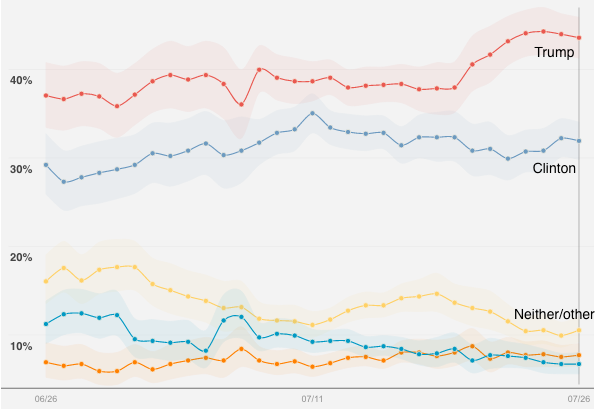
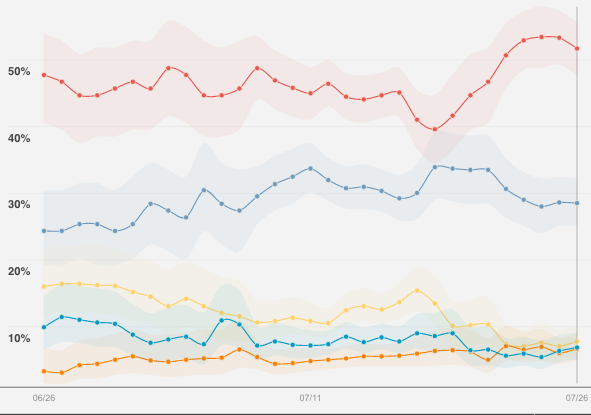
Rothwell’s paper uses a binary outcome of Trump support versus non-Trump support. The non-supporters include Republicans who were still favoring Cruz, Rubio, and others, plus Democrats for Sanders. That makes the analysis a bit dated now that we’re down to Clinton v. Trump. Reuters data suggests that Trump widened his lead among working class White men once he won the nomination.

Presidential Candidate Preference, White Men Without College Degrees (Reuters)

Presidential Candidate Preference, White Men Without College Degrees (Reuters)

Meanwhile, Clinton is now doing very well among the top 1 percent of the income distribution.

In sum, the relationship between working class status (measured by education) and Trump support seems strikingly strong for the White population. This doesn’t mean that class is the only issue. Race/ethnicity and gender are obviously very significant. But it means that there is some truth to the class analysis.

See also why the white working class must organize and it’s hard to talk about tough issues if no organization represents you.

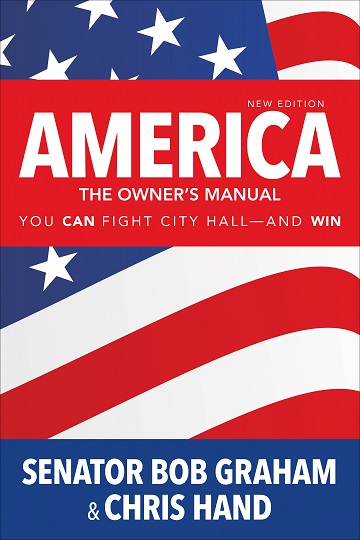
America: The Owner’s Manual

atom-cover-highresI’m delighted to see that the new edition of America: The Owner’s Manual is out. Senator Bob Graham, a truly dedicated leader for civic engagement, has written it with Chris Hand. They take the research, structure, and impact of the book with the utmost seriousness and have worked hard to revise it for a new edition. As I say in my blurb, “America, the Owner’s Manual is the only book that comprehensively explains how to be effective in American politics and civic life, and it does so brilliantly. It’s consistently practical, realistic, accessible, and inspiring. It’s perfect for anyone who wants to improve the world.” It works very well as a textbook, but you can also use it on your own or with a voluntary group.

Buy it here. Follow it on Twitter, @USAownersmanual; on Facebook, USAownersmanual; or use hashtag #ATOMbook.

a definition of “civic”

In phrases like “civic education,” “civic engagement,” “civic technology,” or (as in the name of our college) “civic life,” what does the word “civic” mean?  In conversations and writing about the topic, I detect several definitions. Each definition can be introduced with a different keyword:

  1. Power. Perhaps politics means influencing decisions and institutions to get the outcomes you want–or at least to move them closer to your preferences. In democracies, citizens have tools for increasing their influence, e.g., popular votes, petitions, strikes, and protests. “Civic” activities may mean tools for power and influence that are relatively democratic. That category would include popular votes but not presidential decrees; grassroots petitions but not professional lobbying efforts. Acts like voting and contacting government are often included in official surveys of civic engagement. Note that in this conception, politics is zero-sum (every decision has winners and losers), but what makes a form of politics “civic” is its accessibility to ordinary citizens.
  2. Virtue. The adjective “civic” is often paired with nouns like “virtue,” “character,” or “values.” In this conception, the civic is a subset of the political. It’s the best part, the part that exemplifies classical republic virtues, such as concern for the common good, patriotism or cosmopolitanism, commitment to law and to equity, and perhaps even self-sacrifice.
  3. The commons. Every society needs common resources as well as privately owned ones. Common goods may include natural resources (such as air), institutions (such as law), knowledge (such as general principles of science), and norms (such as trust). The whole commons is the “commonwealth,” a direct translation of the Latin res publica (public thing), from which we derive the word “republic.” The commonwealth can be created, expanded and protected, or exploited and degraded. According to some theorists, the civic is work that contributes to the commons. That would include paid work in for-profit enterprises if it produces public goods directly or as externalities. (Note the direct contrast with #1. There, civic engagement was generally zero-sum. Here, it is defined as win/win.)
  4.  Discourse. In some ancient and still-influential conceptions, the core function of a citizen is to deliberate about what is right and good. Public deliberation creates public opinion, which should influence institutions, such as states, courts, and perhaps firms and markets. Civic discourse is defined by deliberative values, such as genuine openness to what others are saying, commitment to truth, and pursuit of consensus. Classical civic institutions are spaces for discourse: newspapers, coffee shops, legislatures, and (now) the Internet.
  5. Community. People need social bonds: to be cared for and to care for others. Most human beings–and especially vulnerable people like children–thrive much better when they are embedded in an affective community. The norms and habits that form among people in such communities (“social capital”) are also resources that can be used for power, discourse, etc.  To  measure social capital, one typically aggregates behaviors like volunteer service and membership in groups, plus attitudes like trust and care. “The civic” is whatever contributes to such community bonds.
  6. Performance. Some would say that civic life offers spaces for people to perform and to be recognized by others. Life is richer and more satisfying when we can create personas and display them for others, and when others can acknowledge and appreciate who we are. The main purpose of a public debate is not to identify the best policy but to display characters. For instance, in the cabinet battles imagined by Lin-Manuel Miranda, Alexander Hamilton and Thomas Jefferson get to show off who they are, and that’s why it’s so great to be in “the room where it happens.” Debate is only one form of performance; activities like theater, spoken word, gaming, and design also count. On this conception, Augusto Boal’s Theater of the Oppressed might be the pinnacle of the civic.

I value all these things. It’s tempting to say, then, that the right definition of “the civic” is the union of all of them. But that seems a bit ad hoc, a miscellaneous assemblage of desirable behaviors and values. It would be better to have an organized account of how they all fit together. For instance, perhaps we need community to provide people with enough support that they can exercise relatively equal power, but power is best when informed by deliberative discourse. In turn, deliberation encourages attention to the commons, allows performance, and both requires and develops republican virtues.

That is a rather discourse-centered theory; one could instead make the various ideas center on the commonwealth, or on democratic exercises of power. It’s also reasonable to weigh some of these ideas much more heavily than others.

See also: what is the definition of civic engagement? and defining civic engagement, democracy, civic renewal, and related terms

questions about happiness

We discussed the following questions in my first-year philosophy seminar last week, after having read selections from Plato, Nietzsche, Epicurus, Buddha, and Emerson, and before turning to J.S. Mill. They seem valuable prompts for personal reflection, too.

  1. Do we have a right to pay much attention to our own happiness? (Twenty-one children under the age of five die every minute because of preventable causes. Why are we spending 75 minutes talking about happiness in class while 1,575 kids die?) Do we have a duty to pay attention to our own happiness?
  2. To what extent can we affect others’ happiness? Which others? How?
  3. Does happiness require autonomy, or community, or both? (Can you be happy alone?)
  4. Is it best to aim for a high state of well-being (bliss, satisfaction, etc.) or rather strive to avoid bad mental states (suffering, despair)?
  5. Are there other outcomes for ourselves that we should seek instead of, or as well as, happiness? E.g., excellence, authenticity, dignity? (I leave aside justice to others as a whole topic unto itself.)
  6. Do we know whether we are happy? What kind of knowledge is that? Can we be wrong about it?
  7. Can you tell whether someone else is happy? What evidence is relevant? Could you be right and they be wrong?
  8. Is it possible to compare two people’s happiness on one scale?
  9. Should someone else’s happiness affect my happiness? Under what circumstances?
  10. For an individual, is there one scale from suffering to bliss, or are there many different continua?
  11. What are the behavioral consequences of happiness? Does happiness necessarily produce observable outcomes at all? Is happiness that does not produce any good outcomes nevertheless desirable?
  12. Are there beliefs about the world that promote happiness? (E.g., only the present is real; or everything happens for a reason.) Are these beliefs true? Does that matter?
  13. To answer, “What is happiness?” must we answer metaphysical and epistemological questions? (E.g., your view of happiness might be very different if a benign creator has created your immortal soul, as opposed to living in a universe in which life is suffering.) The answer might also be different if I can–or cannot–know whether I am happy.
  14. What is the relationship between truth and happiness? Let’s disaggregate the virtue of truth into sincerity, integrity (truth to who one is), and responsible inquiry. Let’s break down happiness into pleasure, peace, satisfaction, etc. What are the relationships among these things?
  15. Could being good (or just) to others be a path to happiness for ourselves? Is that a reason to be good? Is that the only reason to be good?

state of the youth vote in 2016

CIRCLE has begun to release results from its survey of 1,605 Americans between the ages of 18 and 34. CIRCLE’s headlines are:

  • Most Millennials paying attention to presidential election, but far fewer to congressional elections
  • 30% of Clinton supporters contacted by campaigns, 28% of young Trump supporters contacted, 70% not contacted at all

Contact is important because it gives the recipients information and motivation to vote. These contact rates are disturbing low–and also uneven by region, gender, and party. Young men who live in battleground states have been contacted at nearly twice the rate of young women in “safe” states (38% vs. 20%).

Among likely young voters, Clinton beat Trump by 21 points (49% vs. 28%) in this poll, which was conducted between September 21 and October 3, 2016. USA Today/Rock the Vote released a youth poll yesterday that put the margin at 68%/20%. I’m not sure whether that difference results from methodological choices, such as the way the surveys define likely voters and present third-party candidates; but it is interesting that USA Today/RtV were in the field on October 11-13. The difference could therefore suggest a substantial improvement in Clinton’s margin since September.

The CIRCLE release presents additional information about young people’s attitudes, including this chart that compares the words that Trump supporters and Clinton supporters used to describe their own favored candidate.

to boost youth voting, teach civics and promote electoral competition

I have a short piece in the New York Times’ “Room for Debate” section this morning. It begins:

Once young adults start voting, the habit tends to persist for their whole lives. One way to boost young people’s voting — and their understanding of the political system and current issues — is to teach them civics while they are still in high school. Young adults are more likely to vote if they have experienced interactive civic education, if a teacher specifically taught them about voting, and if they discussed current events while they were teenagers.

After elaborating a bit on the importance of civics, I turn to political competition:

A wealth of experimental evidence also shows that young people respond well to personalized outreach: We have to ask them to vote. The organizations that have the greatest capacity to contact youth are parties and campaigns, and nothing would increase turnout as much as a robust competition for the youth vote.

Another contributor to the forum, Lisa Garcia Bedolla, also argues for personalized outreach, but Alan Gerber provides evidence that it is not hugely effective. I’d argue that outreach is particularly valuable for youth, who gain more than older adults do from information and encouragement, and who begin lasting habits of turnout. Finally, Jan E. Leighley and Jonathan Nagler make the case for being able to register on the same day you vote, which our research also finds beneficial for youth.


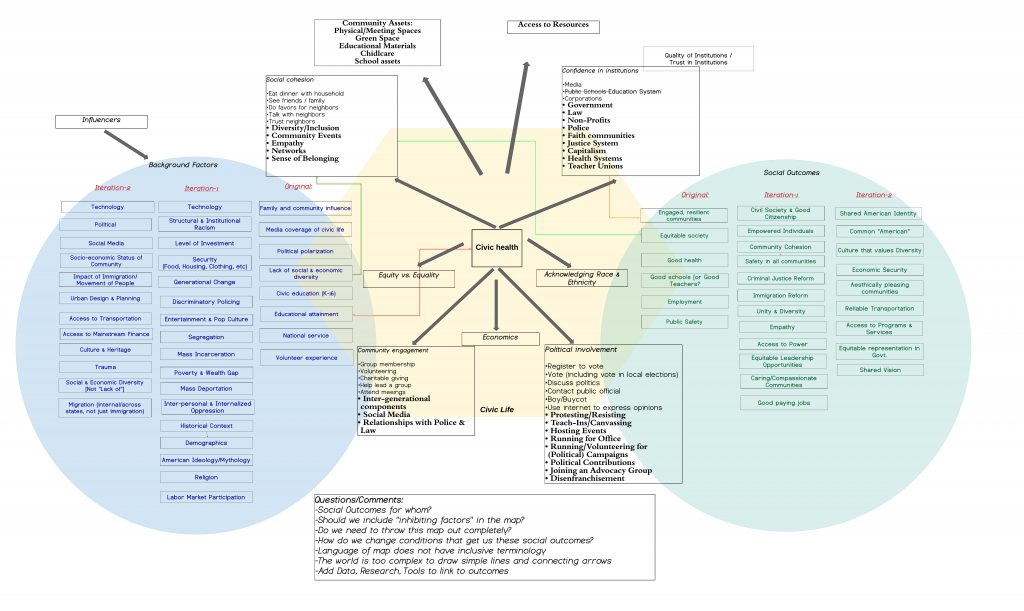
a map of civic renewal

map_it-1

At the National Conference on Citizenship in Washington, DC, 250-300 people are collectively building a model of civic life in America to strategize about civi renewal. Here is the state of the map as of 1:55 pm.

PS: And here’s a larger version as it stood at the end of the day.