why political science dismissed Trump and political theory predicted him, revisited

I’m not sure what’s driving the traffic, but since yesterday, more than 2,500 people have visited my March 3, 2016 post entitled “why political science dismissed Trump and political theory predicted him.” I probably should revisit the topic now that the election is over (especially since I subsequently used standard empirical methods to predict a Clinton victory, thus acting like a political scientist instead of a political theorist).

Last March, I argued that mainstream–empirical or positivist–political science research on “American government” (as the specialty is called) has a vulnerability. Aiming to be a science, it uses data that can be amalgamated to produce models and predictions, such as data from modern US elections. The main method of prediction is to run trend lines from the past into the near future. Although normative assessment is always marginal in positivist social science, most of this research has an implied value-stance: our system works, it follows rules and norms, it’s fairly durable, the players are reasonably competent professionals who support the regime, and you should understand and respect it even you want to reform it. Any reform proposals should be informed by empirical evidence, because otherwise the reforms will have unintended consequences that are likely to be bad. As the great Theodore Lowi wrote, “Realistic political science is a rationalization of the present. The political scientist is not necessarily a defender of the status quo, but the result is too often the same, because those who are trying to describe reality tend to reaffirm it.”

In contrast, political theorists spend their time reading critical reflections on politics written in highly diverse and often tragic circumstances. Hannah Arendt’s writings from Nazi Europe and Frantz Fanon’s analysis of colonial Algeria are just two examples. Political theorists are quick to see that regimes can change, that they can be very bad, that they have debatable normative foundations, and that ideas can be revolutionary.

This means that when Trump arrived on the national scene, positivist political scientists were prone to think that he couldn’t get anywhere in our system–because no one like him had–and political theorists were ready to think that he might take over, because they spend their time considering tyrants, fragile regimes, and the power of xenophobia and authoritarianism. Although there were exceptions in both camps, I think these are reasonable generalizations.

What should we conclude now that Trump is president-elect? It’s tempting to say that the theorists were right. But there’s actually a mainstream positivist account of what just happened. Presidential elections in two-party systems tend to settle at a point where each party has a 50% chance of winning. Given the way nominees are selected in multi-candidate primaries, a smallish faction can capture either party. Its nominee will still have very close to a 50% chance of winning: that’s why Trump got about half the votes, and because of the Electoral College, he won. Furthermore, given the constraints built into the regime as a whole, Trump is likely to govern as a Chamber of Commerce Republican rather than an authoritarian. And if he pushes too far, his party will lose the Congress in two years.

The trouble with political theory is that its predictions can be unmoored from empirical reality. Some political theorists have been predicting catastrophe or revolution throughout my lifetime. The fact that regimes sometimes change does not mean that ours is always about to. I think the odds are still against our regime changing fundamentally in the immediate future.

On the other hand, our political economy is problematic in ways that are not immediately evident from empirical data about the recent past. The Constitution does not fit the present society. The document has fundamental flaws, and the society is evolving toward oligarchy. Although empirical evidence is relevant to those claims, one needs a broader, deeper, and more evaluative stance on the regime as a whole to grasp a crisis such as our present one.

time for civil courage

Post-War Germany teaches the ideal of Zivilcourage, civil courage. The acid test is whether you would stand up to a tyrant rather than standing by as he takes over. Even when a literal tyranny is not imminent, civil courage means holding sacred ground.

It’s what we need today. And that means, please, no jokes about moving to Canada. No thoughts about giving up on the nation you belong to, even if its majority and its institutions anger you. No opting out. You may have suffered grievous injustices at the hands of the United States: many have. In that case, you owe no gratitude or service to the republic. But you have more leverage over the US government than the billions who live beyond our borders and yet face the consequences of our policies. You owe it to them to stand up: here, now.

It may seem that the large, official institutions of the United States are remote and unresponsive to our actions, yours and mine. But the fundamental premise of my whole career is that our formal institutions reflect the ways that we talk and work together in everyday life. My first job out of graduate school was at Common Cause, helping to lobby Congress for institutional reform. But while I worked there (1991-3), the organization’s membership rolls were in steep and prolonged decline. Common Cause evolved from a grassroots movement for good government (solely dependent on 250,000 members in local and state chapters) into a nonprofit organization that employs talented experts and relies heavily on grants and large gifts. As such, it has lost political influence. I began to think that we can’t have decent political institutions without a base of active, responsible, organized citizens. Robert Putnam’s 1995 “Bowling Alone” article struck a chord for that reason, and everything I’ve worked on since then has been in the service of civic renewal.

This means that you are showing civil courage if you are working to strengthen the associations and networks that connect us as fellow citizens. This theory is also a source of optimism. Despite some deterioration, we have a far better civil society than Italy had in 1922, or Germany in 1932. For just that reason, actual tyranny is highly unlikely here. (Radical Paul Ryanesque neoliberalism is much more of a threat.) But our associations and networks are only as robust as we make them.

By the way, the networks and associations that we build must include Trump voters. This is not a matter of showing empathy to them or trying to achieve reconciliation. Instead, a cold, hard look at the situation tells me that Trump voters are unrepresented by accountable organizations, and that makes them dangerous. If they had organizations, I’d be on the opposite side from them on most issues, but we could negotiate. Absent a functioning civil society, they have opted for a celebrity who will give them nothing, even as he harms others.

Speaking of cold, hard analysis: we should be critical, but avoid anger. There’s plenty of blame to go around, and it’s fine to apportion responsibility if that helps to improve the situation. We can critically assess Clinton and her campaign, the Democratic establishment and its ideology, consultants and pollsters, the media, the FBI, Ted Cruz, Bernie Sanders, white voters, old voters, rural voters, men, and anyone else you like. But not in anger, because anger clouds judgment and promotes error. The situation is complex; nothing but a clear-headed, subtle, multifaceted analysis will suffice.

recent commentary by our team

I am not sure I have anything new to offer to the cacophony of Election Day, but I’ll cite some recent summary articles by our team or by reporters who have delved deeply into our research:

Kei Kawashima-Ginsberg, “Climate change could be a unifying cause of millennials, but will they vote?,” The Conversation, Nov. 7.

Peter Levine with Abby Kiesa, “Why American Urgently Needs to Improve K-12 Civic Education,The Conversation, Oct 30, 2016

Noorya Hayat and Felicia Sullivan, “Civic Learning and Primary Sources,” The School Library Connection, Nov. 7.

Peter Levine, “Teach Civic Responsibility to High School Students,” The New York Times (“Room for Debate” feature), Oct. 17, 2016

In the Parent Toolkit, “One Week Away: Why You Should Talk to Your Kid About the Election

Zachary Crockett, “The Case for Allowing 16-Year-Olds to Vote,” Vox, Nov. 7.

Asma Khalid, “Here’s Why Hillary Clinton’s Troubles Aren’t Millennials’ Fault,” NPR News, Nov. 4.

Catherine Rampell, “Parallel Universes, Even Among the Young,” The Washington Post, Oct. 28.

Joseph Schumpeter and the 2016 election

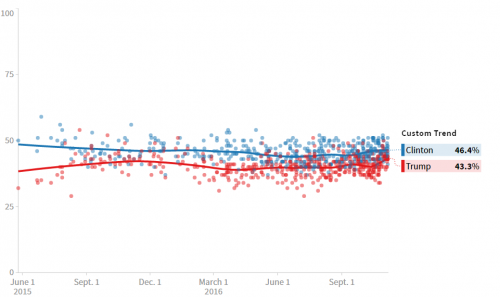
The graph below depicts the 2016 campaign as I see it. When all the polls are displayed on a graph with a y-axis from 0-100% and a fairly strong “smoothing” algorithm is applied, it becomes evident that hardly anything has changed for 18 months. Hillary Clinton has been ahead of Donald Trump by about 4-5 points nationally all along, and she leads by a mean of exactly four points in the major final polls released by this point on the last Monday. The ups and downs revealed by zooming in are best understood as temporary responses to news that may influence who participates in surveys–or who feels enthusiastic on a given day–but very few people have actually changed their minds; and most of those switches have been random and have canceled each other out.

2016-2

I think this means that Clinton is likely to win the national popular vote by about 4 points, although GOTV operations could change result that (in either direction).

It’s hard to know whether different nominees would have performed differently. A reasonable guess is that if both parties had nominated politicians with typical levels of popularity who used typical methods of campaigning, the Republican would have an edge. That implies that Trump v. Clinton costs the GOP maybe 4-6 points, net–but that is not much more than a guess.

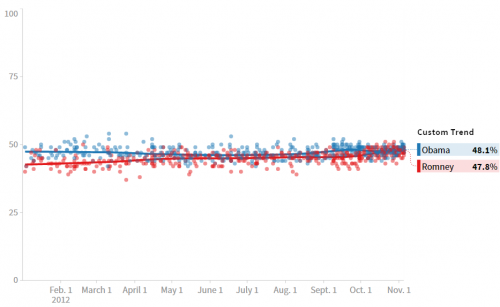
By the way, 2012 looks about the same, except Romney ran closer to Obama all the way along.

2012

But 2008 was different: McCain was ahead at first but slipped behind Obama to lose pretty badly.

For me, the interesting question is what this means about our civic culture and the purpose of campaigns and elections. The presidential candidates have raised about $1.3 billion so far and spent most of that on such activities as advertising, canvassing, and events. The press has spent untold billions on campaign coverage and commentary. All kinds of remarkable events have occurred. As all that has played out, citizens have been exhorted to pay attention and to change their opinions in response to arguments and information. But it looks as if almost everyone already had enough data 18 months ago to make up their minds. That includes me: nothing has transpired since June 2015 that has altered the probability of my voting for Clinton versus Trump by even one thousandth of a percentage point.

I used to subscribe to the view that the actions of candidates and campaigns matter, but they usually cancel each other out because all presidential nominees of major parties are effective campaigners. This year, we have one truly incompetent candidate, yet the trend remains flat. Unless you think that Clinton’s weaknesses cancel out Trump’s incompetence, it looks as if campaigns hardly matter at all. Once citizens know the candidates’ party labels, demographics, and basic facts about their biographies, they are ready to vote.

Perhaps Joseph Schumpeter was right, at least about presidential politics. It’s all about rendering a verdict on the status quo and choosing either the incumbent elites or an outsider. Schumpeter adds:

The reduced sense of responsibility and the absence of effective volition in turn explain the ordinary citizen’s ignorance and lack of judgment in matters of domestic and foreign policy which are if anything more shocking in the case of educated people and of people who are successfully active in non-political walks of life than it is with uneducated people in humble stations. Information is plentiful and readily available. But this does not seem to make any difference. Nor should we wonder at it. … Without the initiative that comes from immediate responsibility, ignorance will persist in the face of masses of information however complete and correct. It persists even in the face of the meritorious efforts that are being made to go beyond presenting information and to teach the use of it by means of lectures, classes, discussion groups. Results are not zero. But they are small. People cannot be carried up the ladder. …

Thus the typical citizen drops down to a lower level of mental performance as soon as he enters the political field. He argues and analyzes in a way which he would readily recognize as infantile within the sphere of his real interests. He becomes a primitive again. His thinking becomes associative and affective.

Since Schumpeter’s view of democracy is unattractive, we must either reform presidential politics or (if that seems impossible) write it off and focus on other aspects of our political system, where more people can show more “immediate responsibility” for collective decisions.

new professorship in health and civic life

The Tufts University Medical School’s Department of Public Health & Community Medicine and the Tisch College of Civic Life seek an Associate Professor or Professor.

We invite applications for a full-time, 12-month joint faculty appointment at the level of Associate Professor or Full Professor.  We seek a candidate with distinguished scholarship on (or highly relevant to) “civic life,” a broad category that encompasses civic engagement, public participation, social capital, civil society, citizenship, the public sphere, and related topics.  The successful candidate is expected to enhance current teaching and mentoring activities at both the masters and doctoral level, as well as develop an independent research program and participate in community and professional service appropriate to a university faculty member.

A successful candidate must also demonstrate a strong record of scholarship within a discipline (medicine, environment, nutrition, etc.) that has a clear public health framing and must emphasize the translation of research into policy and practice. Candidates with research interests and approaches that include community engaged or community based participatory research (CEnR/CBPR); public/community/stakeholder engagement in public health policy; the impacts of civic engagement on health; or the influence of social movements on public health policy; civic life in racial and ethnic minority communities or populations and/or low-income populations are particularly encouraged to apply.  Because Tisch College seeks to strengthen Tufts’ interdisciplinary intellectual community focused on civic life, we will prefer applicants who demonstrate an interest in fundamental questions about civic life that cross disciplinary boundaries, such as the nature of good citizenship or the appropriate role of the public in policymaking.

More information and the application portal is here.

state policies for civics: it’s all about implementation

Just published: Peter Levine & Kei Kawashima-Ginsberg, “State Policies for Civic Education,” in Esther Thorson, Mitchell S. McKinney, and Dhavan Shah, eds., Political Socialization in a Media-Saturated World (New York: Peter Lang, 2016), pp. 113-24.

Abstract: Several large cross-sectional surveys confirm the same patterns: high-quality forms of school-based civic education (such as moderated discussion of controversial current topics) are related to students’ civic knowledge and engagement, but state policies that mandate various forms of civics are not related to civic knowledge or engagement for their young adult populations. We explore the possibilities that: 1) the existing state policies are not satisfactory, 2) state policies cannot reliably influence educational practices, or 3) support for implementation is essential.

I think the last point is most important, and that’s why we have been working closely with Florida Partnership for Civic Learning and the Illinois Civic Mission Coalition to support local stakeholders (district leaders, academics and teacher educators, nonprofits, and state officials) to implement their respective states’ policies for k12 civics. A good law may be necessary, but it is insufficient without continuous attention to implementation: producing a good test every year, supporting current and future civics teachers, selecting and recommending materials, analyzing data from tests, surveys, and interviews to learn what’s working, and using the resulting insights to improve standards, tests, materials, and professional development–in a continuous cycle.

building grassroots power in and beyond the election

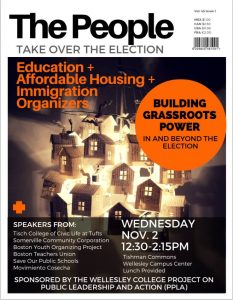
14650129_10208031620332641_5797710429391184777_nI’m speaking today at a Wellesley College event entitled “The People Take Over the Election: Building Grassroots Power in and Beyond the Election.” I think this will be my thesis: We must be organized to have power and to exercise it productively.

Only when you are organized can you seriously ask the question, “What should we do?” Without an organization, you can still ask, “What should I do?” but none of us can do all that much alone. We end up combatting climate change by changing our own lightbulbs, or addressing racism by trying to improve our private thoughts. These are not pointless strategies, but they are badly insufficient.

Without an organization, you can ask, “What should be done?” or “How should things be?” or “What should somebody else–often the government–do?” Those questions are too easy. (Carbon should be taxed; police should be overseen.) The hard part is figuring out how we can make those things happen. A habit of thinking only about what should be done encourages a spectator attitude toward politics.

People without organizations end up being represented by famous individuals–celebrities–who claim to speak for them and who claim mandates on the basis of their popularity. Celebrities have no incentives to address social problems; they gain their fame from their purely critical stance. And they owe no actual accountability to their fans, since no one (not even a passionate fan) expects a celebrity to deliver anything concrete. Donald Trump is unusual in that he has moved from a literal celebrity to a presidential nominee; but he still acts like a celebrity, and presumably he will return to being a pure mouthpiece once the election is over. Meanwhile, back at the grassroots level, a person who feels represented by celebrities is unlikely to talk productively with fellow citizens who disagree.

I mention Trump here because one important fact about his core constituency, White men without college degrees, is that they used to be organized, but that is no longer true. For instance, less than 6 percent of them are in unions. That’s an 80- or 90-percent decline* since the 1950s, and they are now less unionized than college grads are.

If you have no organizations behind you, you’ll typically feel powerless. If that’s how you feel, you are unlikely to want to participate in a difficult conversation, make sacrifices and tradeoffs, acknowledge any unfair advantages, or negotiate. Again, to use Trump voters as an example: they are overwhelmingly White, and it would be appropriate for them to acknowledge White privilege when issues of racial injustice arise. But I think they are very unlikely to acknowledge their own privilege, let alone agree to concessions, as long as their overwhelming experience is one of powerlessness. And I think they are powerless if they are unorganized and represented only by unaccountable celebrities. This implies, by the way, that one of the most important tasks confronting us today is organizing the White working class.

Organizations build what Charles Tilly named WUNC: worthiness, unity, numbers, and commitment. For instance, the protesters now holding ground at Standing Rock are demonstrating that they have a right to be there (worthiness), that they stand together (unity), that there are a lot of them, with a lot of supporters around the world (numbers), and that they are willing to face violence (commitment). WUNC is a scarce but renewable asset for social movements. Poor and marginalized people all over the world have build WUNC and used it to change the world.

It may be that we can do without older forms of organizations, such as unions, grassroots-based political parties, and religious congregations, now that we have digital networks. I think the jury is still out on that question. Loose, voluntary networks of activists brought down the Egyptian government, but once those networked activists confronted the organized Muslim Brotherhood, they lost the election, and once the Muslim Brotherhood confronted the even better organized Army, they lost a bloody struggle for survival.

We need organizations during an election. It might appear that when it’s time to vote, each person can exercise power individually and privately. But that power is actually pretty trivial. Nate Silver currently gives Hillary Clinton a 99.8% chance of winning Massachusetts, which means that each vote here is close to irrelevant. What matters in an election is not your individual vote but your participation in organized efforts to change the whole discussion, the balance of power, and the outcome.

Campaigns are such efforts. The Clinton campaign will spend more than half a billion dollars to build and run an organization. But modern presidential campaigns are problematic organizations because they rely so much on wealthy donors, they spend their cash so heavily on propaganda, and they establish short-lived transactional relationships with their own voters. But they are still organizations, and their power reinforces the importance of building other kinds of organizations as well.

*not percentage-point, by the way.

the ethics of vote swaps

David Iaconangelo writes, “this year is seeing a resurgence of vote-swap websites and apps that pair voters for a major-party candidate – in most cases, Democrats in blue states – with a third-party supporter living in a swing state. … Some find the tactic a little unsettling, even if it isn’t illegal or clearly unethical. ‘I’m a little conflicted,’ says Peter Levine, a political philosopher and associate dean at Tufts University’s College of Civic Life.”

As I say in the article, you’re not supposed to do anything as a quid pro quo for your vote. Swapping would seem to violate that principle. “On the other hand, the president is a national political figure, meaning the allocation of one’s vote across state lines might be considered a matter of personal choice. And if there’s no enforcement involved …, the deal might be little more than two people talking about how they’re going to vote, since the ballot is secret, anyway.”

I also note in the piece that we may have two different theories of what a vote is. On one view, it’s an instrument for getting the outcome you want. The point of our voting laws should be to ensure that everyone has the same influence. The Electoral College introduces inequality because only some states are competitive. If you can coordinate with someone in a different state to remove that obstacle, you are using your instrument more effectively.

On a different view, voting is partly an expressive civic act. Your vote won’t make a tangible difference in a presidential election anyway (with or without the Electoral College). But your vote is one way for you to belong to a community that governs itself–and not only by voting. You should vote in the community that you belong to.

I have a expressed a similarly nuanced opinion about where you should vote if you have a legal right to choose. For example, I support the right of college students to decide whether their residence is their college or their family’s home for the purpose of voting. However, it’s not obvious to me that they should (ethically) make that choice by deciding where their vote will count the most. Quite honestly, the differential impact of where you cast your single vote in a presidential race is microscopic. I think you should decide where you are a citizen in the full sense, and vote there.

evolution, game theory, and the morality of modern human beings

It’s valuable to model the development of phenomena like altruism and spite (harming someone else at a cost to oneself) by combining game theory with evolutionary theory. The results should be seen as predictions to be tested against empirical evidence about actual organisms. My question is what this combination tells us about our situation as human beings in historical time.

The basic assumptions are:

  1. Organisms interact with each other so that each one can win or lose. For instance, a parent feeds its child, a predator eats its prey, a mite hitches a ride on an insect. These interactions can be modeled as games in which each player makes a choice (e.g., kill or don’t kill), and positive or negative outcomes result for each as a joint result of their decisions. (“Choice” is a metaphor, because completely non-sentient organisms can be modeled as players in a game. For instance, a plant can release a chemical or not.)
  2. Changes in how organisms interact in game-like situations arise more or less randomly. As a result of a genetic mutation, an organism may begin to mimic another species. Or, as a result of a change in climate, an organism’s prey may become scarce.
  3. If playing a game in a particular way increases the odds that a species will reproduce, that behavior will become more common. For instance, if mimicking works, it will spread.
  4. This means that the payoffs that matter from game-like interactions among organisms are best measured in terms of evolutionary fitness. Whatever an organism may want or think or feel, what matters is whether its chances of reproducing increase or decrease.
  5. Given the first four assumptions, under certain conditions, behaviors that we might consider proto-moral, such as helping offspring, helping others outside the family lineage, or even sacrificing oneself to punish another for violating a norm, predictably arise. By being altruistic (or punitive) in game-like interactions, an organism may gain evolutionary fitness.
  6. Thus we can explain proto-moral behavior through a combination of game theory and evolutionary theory. The behavior is a consequence of background conditions. This form of explanation applies to homo sapiens, who have cognitive capacities and instinctive drives for things like fairness and punishment because of the conditions that pertained before historical time when we evolved into our current form.

Game theory is part of my own toolkit. I believe it clarifies many situations that confront human beings as we interact with each other and helps us to devise solutions to collective problems. I also acknowledge that we are a biological species that evolved with certain capacities and drives, and that inheritance must be taken into consideration as we diagnose and try to address our problems as a species. However, I tend to believe that Darwinian evolution gave us certain capacities that now fundamentally change the premises described above (points 1-6):

  1. We can design games. The original Prisoner’s Dilemma, for example, is a situation intentionally created by a prosecutor within a legal system. The prosecutor could change the game, or he could be required to change it by a legal reform. A shared pasture is a very different game from a Prisoner’s Dilemma, but it’s also intentionally designed.
  2. We can choose goals. If natural selection determines change in a whole population, then it doesn’t matter what each organism wants; it matters what promotes survival and reproduction. But human beings can choose what we want in specific interactions. Sometimes we want things that reduce our chances to survive and reproduce, but we compensate with other strategies.
  3. We can change our identities. If a person’s main identity is a parent, his impact on his own offspring is central. But he could instead choose to identify primarily with a church, a community, a nation, or other grouping.
  4. We can design and change the groups within which our interactions occur. As an example, the size of a group influences how organisms interact. But we human beings can merge small groups to form vast nations, decentralize governance to small groups, nest communities within states, or place people in multiple overlapping groups. We can intentionally vary not only the size of groups but also their internal diversity, spatial extension, equality of influence, and cost of entry and exit.
  5. We can influence individuals’ predilections to play games in various ways, e.g., to be altruistic, trusting, selfish, spiteful, or punitive. We can influence children in lasting ways by raising and educating them to have certain character traits. We can also influence behavior in local and temporary ways by changing messages and contexts to encourage desired behaviors.
  6. We are influenced in all the above choices by norms, but we disagree about the best ones, and the available norms are the results of deliberate human creativity. In short, we invent and choose norms.

Game theory remains relevant–in fact, it is an especially useful toolkit for a creature that is capable of designing and redesigning its own interactions. I am less sure that evolutionary theory is relevant, except insofar as it explains certain proto-moral tendencies and limitations that now contribute to our challenges.

Notes: Points 1-6 are guided by my Tufts colleague Patrick Farber and specifically his excellent paper “Reciprocal Spite” (with Rory Smead). Points 7-12 are heavily influenced by Elinor Ostrom, who emphasized the diverse outcomes that result when people face collective action problems and the importance of their intentional choices about groups, rules, and norms.

John Stuart Mill, Stoic

I sometimes envy my fellow academics in the humanities who regularly renew their acquaintance with fundamental works that have slipped pretty deep into the well of my own memory because my job is to conduct and administer empirical research about current politics. For just that reason, I am thoroughly enjoying reencountering some major works as I teach first-year undergraduates this semester.

For instance, I now see Mill’s Utilitarianism in an entirely new way thanks to re-reading it with students after our extensive discussions of authors like Epicurus, Buddha, and Emerson. It seems much less an explanation of the utilitarian principle of justice (maximize everyone’s happiness) than I had remembered, and more an exploration of how an individual should pursue happiness. It thus belongs to a genre that Mill knew very well, the tradition of therapeutic philosophy inaugurated by the Hellenistic schools and revived by Montaigne.

In the text of Utiliarianism, Mill refers several times to Epicureanism and Stoicism. For instance: “I do not, indeed, consider the Epicureans to have been by any means faultless in drawing out their scheme of consequences from the utilitarian principle. To do this in any sufficient manner, many Stoic, as well as Christian elements require to be included.” This passage suggests that Mill is interested in constructing the kind of “eclectic” view (drawing from multiple Hellenistic schools) that was popular from the time of Cicero and continued in early Christianity.

Of course, one should expect as much based on the author’s Autobiography. In the chapter on the “Crisis in My Mental History,” Mill recalls how reading Jeremy Bentham in 1821 gave him “an object in life; to be a reformer of the world.” He would apply the classical utilitarian principle of justice to improve the general welfare. “My conception of my own happiness was entirely identified with this object.” He says he was open to experiencing his own pleasures–“I endeavoured to pick up as many flowers as I could by the way”–but the purpose of his life was to achieve social justice, defined in a utilitarian way.

“This did very well for several years, during which the general improvement going on in the world and the idea of myself as engaged with others in struggling to promote it, seemed enough to fill up an interesting and animated existence.” (Note that his personal satisfaction derived from two contingencies: political success and a supportive community.) But at one moment during the autumn of 1826, his satisfaction ended as suddenly as if he had awakened from a dream. He asked himself this question:

“Suppose that all your objects in life were realized; that all the changes in institutions and opinions which you are looking forward to, could be completely effected at this very instant: would this be a great joy and happiness to you?” And an irrepressible self-consciousness distinctly answered, “No!” At this my heart sank within me: the whole foundation on which my life was constructed fell down. All my happiness was to have been found in the continual pursuit of this end. The end had ceased to charm, and how could there ever again be any interest in the means? I seemed to have nothing left to live for.

Mill fell into a deep depression that ended only with his father’s death. A Freudian diagnosis is plausible (young John Stuart found momentary relief while his overbearing father still lived by reading a tragedy in which the fictional father died); but more interesting is Mill’s own explanation. He says that he recovered when he saw that happiness requires special strategies and techniques of mind. For instance, he came to believe that you can’t achieve happiness by pursuing it, only by aiming for some other end and becoming absorbed in that. He also learned that his own “passing susceptibilities needed to be cultivated as well as [his] active capacities, and required to be nourished and enriched as well as guided.” With that in mind, he paid more attention to poetry (especially Wordsworth) and music; “and the maintenance of a due balance among the faculties now seemed to be of primary importance.”

Above all, “I, for the first time, gave its proper place, among the prime necessities of human well-being, to the internal culture of the individual. I ceased to attach almost exclusive importance to the ordering of outward circumstances, and the training of the human being for speculation and for action.”

With that background in mind, it is striking how little his book Utilitarianism says about the “ordering of outward circumstances.” It doesn’t explain what policies would maximize aggregate happiness, how happiness relates to values like liberty and equality in a theory of social justice, or even how individuals should maximize their benefits to others. (No trolley problems at all.) Instead, Mill delves deeply into a theory of individual happiness.

For instance, he thinks that anyone who has achieved a higher grade of existence will prefer it to a lower grade, even though the higher grade permits “more acute suffering.” Evidently, we are not striving to avoid suffering, because then we would prefer a simpler or narrower mental life, less sensitive to pain. Something else must explain our preference for refined experiences, and Mill thinks the right word for that is “dignity.” (He notes that the Stoics called the same impulse “love of liberty,” implying that for them, “liberty” really meant pursuing higher interests rather than being free from constraints.) Thus, according to Mill, we seek at least two different things: happiness and dignity. 

Mill is not very specific about what constitutes a higher grade of experience, and I think the text is compatible with two theories. First, it might be possible to make an objective rank-ordering of experiences, so that not only is poetry better than pushpin, but Wordsworth is better than Leigh Hunt because the former’s verse is superior. Alternatively, the quality of experience might mean the degree to which the individual happens to be stretched, engaged, inspired, etc. It would then be possible that playing an elaborate video game is a higher experience for a particular individual than hearing Beethoven, if the player engages more of his mind and soul in the game. We could objectively rank experiences by assessing the mental state of the participants rather than the activities themselves. Pushpin could beat poetry for champion pushpin-players.

In any case, Mill states that mental experiences are better than bodily experiences, and that active pleasures are higher than passive ones.

He also acknowledges that a person can abandon higher forms of experience due to indolence and selfishness. That scenario poses a challenge for him, because he has defended a distinction between higher and lower pleasures on the basis that anyone who has experienced both will prefer the higher. That argument preserves a thread between Mill’s position and classical utilitarianism (which is all about maximizing subjective preferences), but the thread would break if Mill favored higher pleasures even though some people renounce them voluntarily. He has an answer:

But I do not believe that those who undergo this very common change, voluntarily choose the lower description of pleasures in preference to the higher. I believe that before they devote themselves exclusively to the one, they have already become incapable of the other. Capacity for the nobler feelings is in most natures a very tender plant, easily killed, not only by hostile influences, but by mere want of sustenance; and in the majority of young persons it speedily dies away if the occupations to which their position in life has devoted them, and the society into which it has thrown them, are not favourable to keeping that higher capacity in exercise. Men lose their high aspirations as they lose their intellectual tastes, because they have not time or opportunity for indulging them; and they addict themselves to inferior pleasures, not because they deliberately prefer them, but because they are either the only ones to which they have access, or the only ones which they are any longer capable of enjoying. It may be questioned whether any one who has remained equally susceptible to both classes of pleasures, ever knowingly and calmly preferred the lower; though many, in all ages, have broken down in an ineffectual attempt to combine both.

Another key point is that sacrificing one’s own interests can be good for the individual because it gives her a valuable and absorbing objective. The classical utilitarian would regard sacrifice as a cost, required only if the benefit to others outweighs it. Mill continues to reject the view that “the sacrifice is itself [is] a good.” But sees that some forms of self-sacrifice may constitute happiness for the person who experiences them. In fact, “nothing except [an ability to sacrifice oneself for other] can raise a person above the chances of life … and enables him, like many a Stoic in the worst times of the Roman Empire, to cultivate in tranquillity the sources of satisfaction accessible to him, without concerning himself about the uncertainty of their duration, any more than about their inevitable end.” Mill observes that people who have privileges and yet remain unhappy tend to be those who don’t care for others. Contribution to a community is thus one path to happiness, as Mill himself had found in his early years. But another path is aesthetic experience, and Mill presumably advocates a balance of the two.

Mill also observes that a “continuity of highly pleasurable excitement” is impossible for us. A better objective is tranquility and acceptance, plus occasional excitement. “The happiness which [“the philosophers”] meant was not a life of rapture; but moments of such, in an existence made up of few and transitory pains, many and various pleasures, with a decided predominance of the active over the passive, and having as the foundation of the whole, not to expect more from life than it is capable of bestowing.”

See also: you have a right and a responsibility to attend to your own happinessmust you be good to be happy?on philosophy as a way of life