the public supports women’s rights in US foreign policy

We released a new survey today that finds strong support for gender equity as a foreign policy goal. For instance,

  • 85% rated the rights of women and girls as a very high priority.
  • 74% agreed that the U.S. government should actively work to promote human rights in other countries.
  • When given a choice among the rights that the U.S. should promote, 51% ranked women’s rights as first or second, second only to “free and open elections” and ahead of freedom of religion, freedom of the press, and the rights of workers and unions.
  • Two-thirds agreed that more participation by women would make the world more peaceful.
  • Most respondents would support women’s rights overseas even if that meant less consumer choice from international trade, fewer exports, or more disagreement with America’s friends and allies.

Click for more detail from this survey of 1,000 Americans conducted in early September 2017 by the Department of Political Science and the Tisch College of Civic Life. Credit to my colleagues Professor Richard Eichenberg in the Political Science Department, Dr. Kei Kawashima-Ginsberg and Noorya Hayat of CIRCLE, and student Anna Jacobson.

Tisch Program in Public Humanities

Tisch College has a Program in Public Humanities. As of today, the Program has its own webpage, which I invite you to visit.

The webpage introduces the Program’s director,  Diane O’Donoghue. An art historian, Diane first came to Tisch College as a Faculty Fellow in 2013—working on a Nazi-era restitution project in Vienna—after chairing the Department of Visual and Critical Studies at the School of the Museum of Fine Arts at Tufts.

The page also describes a major exhibition that celebrated a century of printing in Boston’s Chinese community. In addition to serving scholarly and cultural purposes, this exhibition drew attention to the need for a public library in Chinatown. In January 2017, Boston Mayor Martin Walsh announced that library services would be restored to the neighborhood.

On the same page, you can read about our current research on the Pao Arts Center in Chinatown, Diane’s spring course on “Public Amnesias and their Discontents,” and past and future presentations on the public humanities.

I have argued that the humanities and civic life have an intrinsic connection. “Humanist” was originally an informal term for someone who taught rhetoric, history and ethics to future public leaders–in contrast to philosophy and theology, which prepared clergymen. Citizens must make ethical judgments in concrete circumstances, and the humanities are disciplines that combine ethics, judgment, and concreteness with analytic and conceptual rigor. In recent decades, the professional humanities have had a somewhat distant or even fraught relationship with public life, but that is changing, thanks to the kinds of scholars, artists, and practitioners who congregate in Imagining America or in the North Eastern Public Humanities Consortium, of which Tisch College is a charter member.

From the perspective of Tisch College, Public Humanities is one component of Civic Studies, which also encompasses empirical research on civic engagement in the US and abroad, Civic Science, community-based participatory research, civic math, and other strands of research.

See also: what are the humanities? (basic points for non-humanists)the public purposes of the humanities (a brief history)the state humanities councils, connecting the public to scholarship; and “Rethinking the Humanities

Ethan Zuckerman on the #ObamaSummit

I’ve been blogging almost daily since January 2003, and I would normally write reflections on something as interesting as the Obama Summit that took place this week as the kickoff event of the new Obama Foundation. However, my motivation to write is somewhat diminished by the fact that my friend Ethan Zuckerman has said everything I would–and very well–in a piece for Medium. To be sure, Ethan and I are similarly positioned, with similar demographics and job descriptions. I am sure there were other ways to perceive the Summit, but I saw the same event that Ethan did and I recommend his report.

The truth in Hayek

(Washington, DC) You are reading English; I am writing it. English has elaborate rules and conventions. You can break the rules, but that has consequences beyond your control. Mess up your grammar in a job interview and you may not get the position. On the other hand, talk very formally in a dorm hallway and you may come across as a geek.

English also has many limitations. There are things for which we lack words. There are words without rhymes. There are words that sound awkward together. Using the language can be a struggle for people at any level of proficiency. It was a struggle for Shakespeare, as you can sense when you see him trying to convey ideas that had never been said before in his language.

Yet hardly anyone experiences the rules and limitations of English as an infringement on liberty. Why not?

  1. No individual or committee designed the language. Its limitations, therefore, are not the result of anyone’s will. Not being able to express something in English is like not being able to run at 60 miles/hour: a constraint, but not an example of coercion, because no one is coercing you.
  2. No one can change the language wholesale. We can work to change it, one piece at a time. In my lifetime, “man” has ceased to mean “human being.” That change is a result of deliberate argument and advocacy. But it’s a change of one word, and it required lots of voluntary agreement to become a new norm.
  3. Language is predicable. Within any linguistic context, the rules-in-use (not necessarily the official rules written down in grammar books) are quite stable. Change is gradual. Therefore, we can usually predict how a listener will understand a given phrase. Its predictability makes language a tool for intentional agents, something that we can plan to use for our own ends.

Friedrich von Hayek admires emergent systems. They are “complex and orderly and, in a very definite sense, purposive institutions [that] owe very little to design” (Constitution of Liberty, p. 58). Each system is a “self -maintaining whole which is kept going by forces which we cannot replace.” (p. 70). It is “not invented but arose from the actions of many men who did not know what they are doing.” (pp. 58-9). It demonstrates “organic, slow, half-conscious growth” versus “intelligent men coming together for deliberation about how to make the world anew” (pp. 56-7).

Hayek sees an intrinsic link between emergent systems and liberty, for the three reasons numbered above. Another advantage of emergent systems is that they avoid human cognitive limitations. They create complexity without relying on anyone’s brainpower to design the whole system well.

Hayek thinks of markets as emergent systems, and that is why he is associated with the political right. He opposes the idea of “social justice” (p. 65), arguing that to assess a complex system according to your own idea of justice is actually antisocial. You are substituting your opinion for what a whole society has created through emergent processes, such as market exchange.

I disagree with this important strand in Hayek. I view markets as substantially the products of political power and intentional design, in the form of laws that create and structure economic activity. I also view modern markets as the domain of large corporations that are run by (more or less) “intelligent men coming together for deliberation.” For instance, the online marketplace is not just an emergent system but an archipelago of designed islands (Amazon, Google, Facebook, the App Store). Finally, I don’t think that liberty, in Hayek’s sense, is the only important good. So even when markets do meet Hayek’s criteria of emergence and thus generate liberty (in his sense), I’m not satisfied if they are also deeply unequal, destructive, or inhumane. Note that Hayek may agree on this point (p. 18).

Having noted my disagreement with Hayek on the question of markets, I would like to underline the value of his overall view. Even with respect to economics, it is important to recognize the link between markets and liberty in the specifically Hayekian sense. His argument is not that markets offer negative liberty (freedom to do what you want), nor that they guarantee happiness or prosperity. His argument is that markets allow you to form and implement your own plans, which is a form of liberty. There is considerable truth to this position.

Besides, markets are not the only examples of emergent systems, and not the purest or best ones. Consider indigenous human cultures that are deeply embedded in natural ecosystems. The people who admire such examples and want to conserve them against the imperialistic forces of science and the state are typically on the left. Here I am not only talking about hunter-gatherer societies in distant rainforests. Plenty of leftish Americans will regard an elaborate but fragile community, like Boston’s Chinatown, as a valuable emergent system and will strongly oppose planning that disrupts it. So you can be a left-Hayekian.

Another example is the Internet. Today it is dominated by such large designed platforms as Amazon. But I remember when it emerged with very simple, very stable protocols that allowed maximum scope for creativity. The result was beautifully Hayekian, in contrast to the planned network of the telephone company. The fact that it has evolved to be dominated by multi-billion-dollar companies with centrally planned algorithms is an argument against Hayek’s pro-market complacency. The market has undermined Hayekian values. Still, the best response is to make the Internet more of an emergent system through rules like net-neutrality—not to try to design the content of the World Wide Web.

Finally, I tend to agree with Hayek’s view of ethics. Moral rules are, “next to language … the most important instance of an undesigned growth.” We observe them because of their consequences even though we do not know what their consequences will be (p. 67). That makes sense given human fallibility. Hayek rejects the Socratic ideal of questioning everything. “This givenness of the value framework implies that, although we must always strive to improve our institutions, we can never aim to remake them as a whole and that, in our efforts to improve them, we must take for granted much that we do not understand” (p. 63). Habermas uses the word “givenness” in exactly the same way when he also argues for criticizing values one at a time, never wholesale. Here the Austrian School and the Frankfurt School coincide.

[See also:  Lifeworld and System: a primerit’s not just what you think, but how your thoughts are organizedFoucault and neoliberalism]

the online world looks dark

(Chicago) I’m at the #ObamaSummit, much of which can be followed online.

In the opening plenary, several speakers (including President Obama) noted the drawbacks of social media: psychological isolation, manipulation by powerful companies and governments, fake news, balkanization, and deep incivility.

I remember when discussions of civic tech were generally optimistic: people saw the Internet and social media as creative and democratic forces.

I went to the specialized breakout session with “civic media” entrepreneurs and asked them whether they shared the dark picture painted by the plenary speakers. Each gave an interesting and nuanced answer, but in short, they said Yes. The reason they build and use digital tools is basically to combat the larger trends in social media, which for the most part, they see as harmful. Even Adrian Reyna of @ United We Dream, a leader of one of the best social movements that has used online tools, emphasized that relying on civic tech can disempower people and alienate communities.

This is no reason to give up on improving the civic impact of digital media. The work remains as important as ever. It’s just that the atmosphere now feels very sober; the heady days of cyber-optimism have passed, at least for people concerned about politics and civic culture.

[See also democracy in the digital age and four questions about social media and politics]

Kieran Setiya on midlife: reviving philosophy as a way of life

I read Kieran Setiya’s Midlife (Princeton, 2017) not only because I have that condition and am sometimes troubled by its complaints, but also because I appreciate the style of thought that Pierre Hadot named “philosophy as a way of life.” Practitioners of this style acknowledge that it is important to develop and test arguments. The philosophical life is one of critical reason. However, arguments should have a purpose: to improve a life. And we must remember that people are habitual and affective creatures. Therefore, arguments—no matter how valid and rigorous—will not change us. We also need practices or mental disciplines to accompany our arguments. But a mental habit or practice can lead us away from the findings of our critical reason. We may train ourselves to be foolish or selfish. So we need habits that are at least consistent with the best arguments, and, ideally, habits that actually include argumentation.

That is exactly the combination offered by the Hellenistic Schools (Stoicism, Epicureanism, Skepticism) and by the classical Indian traditions. It has been relatively weak in the modern West. Setiya shows that it can be practiced today.

He is a professional philosopher in the Anglophone, analytic tradition. A clue that he is trying something different in Midlife is the book’s grammar. Setiya often writes in the second-person singular: “You should …” (as in “You should not prefer to rewind time, erase your son, and try again.”) He also sometimes uses the first-person singular or plural: “I wish …”; “We think …” Midlife reads like a conversation that reports Setiya’s real efforts to combat his ennui in order to improve your life, too.

Midlife is almost free of jargon. But one person’s jargon is another’s helpful terminology, and Setiya makes occasional use of specialized words. His distinctive stylistic move is not his informal vocabulary but his shift to the second-person, which implies a stringent test that can be applied to each sentence and chapter: would an actual “you” find this text useful?

Another clue that Setiya is working in the tradition of philosophy as a way of life is that he recommends repeated practices, habits, or meditative exercises at the conclusion of each chapter. These are meant to turn the arguments of the chapter into therapies that might change our mental habits.

Many of Setiya’s recommendations are drawn from the history of ethics, not original to Midlife. Of course, that is fine; it is useful to review and revive others’ points. But some of his arguments are novel, and I will mention two.

Living in the Moment

First, Setiya offers a helpful way to think about “living in the moment.” His argument rests on a distinction between telic activities, which we conduct in order to accomplish them, and atelic activities, which we do for their own sake. “Cook[ing] dinner for your kids, help[ing] them finish their homework, and put[ting] them to bed” are “telic activities through and through”: aimed at their accomplishment. On the other hand, “parenting is complete at every instant; it is a process not a project.” You can be doing both at once.

Some people recommend spending more time on purely atelic activities. Retire as soon as you can and play golf. Until then, take time for meditation or a weekly walk in the woods. Such advice is not necessarily practical—or valuable, if it encourages you to lead a life that’s less valuable to the world.

Other texts recommend viewing every activity as purely atelic. Notably, that is what Krishna teaches in the Baghavad Gita: “Motive should never be in the fruits of action, / nor should you cling to inaction. … / Let go of clinging, and let fulfillment / and frustration be the same.” The problem with that advice is that we should aim for good outcomes. It matters what we do, not only our stance toward it.

Setiya’s advice is to combine the telic with the atelic. Strive to get the kids to bed (and do that as well as you can), but also think of yourself as parenting. Attend meetings, write emails, and perform calculations all day, but also see yourself as leading a worthy life. This is an example of a meditative practice that incorporates argument, because it requires redescribing what we are doing in new terms. It may, to quote Wordsworth, have “the power to make / Our noisy years seem moments in the being / Of the eternal Silence.”

Midlife as a Universal Human Circumstance

Second, Setiya disagrees that “midlife” is a stage that we encounter between the ages of (say) 40 and 60—probably most frequently in affluent societies, where some people have the luxury of dreaming of sports cars. Rather, “midlife” is any moment on the journey of our lives when we have already made consequential and irreversible choices, but when we also face a substantial stretch ahead. In that condition, we encounter specific temptations and troubles, such as regretting paths not taken or fearing that the future will basically be more of the same for a long time to come. These could be the thoughts of people who are 12 or 90, living anywhere in the world, at any level of wealth and freedom. They just tend to be more prominent for people in the middle decades of life who have ascended some way up Maslow’s hierarchy of needs. Midlife is a universal circumstance, but its special discontents may not be the most salient for some people at some times.

Setiya argues that midlife’s challenges have been underplayed in the history of philosophy, because the main questions have been “What should I do?” (as in Kant) or “What constitutes a good whole human life?” (as in Aristotle). “Neither the prospective question of what to do nor the external, retrospective question of the good human life captures the predicament of midlife” when you must confront a “meaningful past and a meaningful future,” when “the question is not simply what to do, but what you have done and what you have not done, what to feel and how to think of yourself.”

The Problem of Midlife in Joyce’s “The Dead”

It would take a longer argument and more evidence to make this point, but I believe that James Joyce’s story “The Dead” is a reflection on midlife in just the form that Setiya describes. It is about a character in midlife and also about an art form—the written fictional narrative—that faces a midlife crisis of its own. It’s safe to say “The Dead” is a greater work than Setiya’s Midlife. But there are ways in which I prefer the latter.

Starting with Joyce’s own brother, Stanislaus, many readers have remarked that “The Dead” reads like a ghost story, conveying an uncanny sense that the characters are literally dead already. When the protagonist, Gabriel, first speaks, it’s to note that his wife “takes three mortal hours to dress herself,” and his aunts reply that “she must be perished alive.” He’s already lightly coated with the snow that will bury everything. Language of death or living death echoes throughout.

An exception might be the vivacious nationalist teacher Molly Ivors, who leaves the Christmas party without any explanation and seems to have an unpredictable life still ahead of her. She could be fleeing a party of the undead.

Instead of reading “The Dead” as a ghost story, I’d suggest that its characters have come to see their lives as complete. That is a frame of mind that any adult can adopt while entirely alive, but it is a deathly one. Right at the beginning of Midlife, Setiya quotes the article that coined that word, Elliott Jaques’ “Death and the Mid-Life Crisis” (1965): “Now suddenly I have reached the crest of the hill, and there stretching ahead is the downward slope with the end of the road in sight—far enough away it’s true—but there is death observably present at the end.”

In “The Dead,” the monks of Mount Melleray sleep in their coffins, Aunt Mary Jane explains, “to remind them of their last end.” All the other characters, too, have lives that can be summarized and declared complete. Aunt Julia had a great voice three decades before but no great career, in part because of gender discrimination in the church. Gabriel reflects, “Poor Aunt Julia! She, too, would soon be a shade. … He had caught that haggard look upon her face for a moment when she was singing Arrayed for the Bridal. [She never took the path of marriage herself—surely a regret.] Soon, perhaps, he would be sitting in that same drawing-room, dressed in black, his silk hat on his knees. The blinds would be drawn down and Aunt Kate would be sitting beside him, crying and blowing her nose and telling him how Julia had died.”

Gabriel is called a “young man,” but midlife can happen at any age. In fact, Joyce was also young when he wrote “The Dead.” James Ellman writes, “That Joyce at the age of twenty-five and -six should have written this story should not seem odd. Young writers reach their greatest eloquence in dwelling upon the horrors of middle age and what follows it” (James Joyce, p. 253).

Certainly, Gabriel is dissatisfied with who he is, regretful of certain paths not taken (particularly paths involving Molly), yet skeptical that he can become anything different. These are pitfalls of midlife.

Gabriel does look a little way forward: specifically, to a night in a hotel room with his wife after the party, free from their children. He explicitly and lustfully imagines that immediate future. But his foresight is flawed. Gretta is simultaneously lamenting the story that her life might have taken, had not her youthful suitor Michael Furey tragically died before she met and settled for Gabriel. In this combination of a man who thinks his life is all but done and a woman who mourns for a different existence—neither one understanding the other—we have a dark picture of midlife in just the form that Setiya analyzes it.

Joyce and the Midlife Crisis of Literature

“The Dead” is a fitting coda to the collection of Dubliners, whose stories are arranged in a rough sequence from childhood to the end of life. The story is also an apt conclusion to a whole tradition of English literature, which Joyce sees as complete and without a future–except that it is possible to reflect beautifully on what literature has been, which is a task of Ulysses. In short, “The Dead” is a story about lives seen from the perspective of their ends, and it’s also a story about the end of stories.

One might certainly disagree that literature ended around 1900—haven’t some good books been written since then?—but Modernists thought it was dying, and several Modernists (in addition to Joyce) tried to make art about its conclusion.

For instance, Walter Benjamin wrote in “The Storyteller” (1936, translated by Harry Zohn], “The art of storytelling is reaching its end.” Developments of the modern era, Benjamin thought, have “quite gradually removed narrative from the realm of living speech and at the same time [made] it possible to see new beauty in what is vanishing” [iv]. “The Dead” finds a new kind of beauty in the passing world that it describes and in the literary tradition that it culminates.

Benjamin distinguishes between a traditional “story” (oral, concise, meant to inform and motivate a live audience) and a “novel,” which is a fictional world created in polished writing by an individual author for a solitary reader. One difference is that a story invites the listeners to continue it, to invent a sequel or to reply with another episode, as we might by imagining what happens to Ms. Ivors. In that sense, she is a character in what Benjamin would call a “story” (and she must leave the novelistic space of “The Dead.”) A novel, in contrast, is closed because it depends entirely on the author’s imagination. The novelist is the master of the whole text.

Benjamin writes, “there is no story for which the question how it continued would not be legitimate. The novelist, on the other hand, cannot hope to take the smallest step beyond that limit at which he invites the reader to a divinatory realization of the meaning of life by writing ‘Finis'” (xiv). Joyce doesn’t literally write “The End” on the last page of Dubliners, but the last sentence couldn’t be much more conclusive: “His soul swooned slowly as he heard the snow falling faintly through the universe and faintly falling, like the descent of their last end, upon all the living and the dead.”

Gabriel has left instructions to be awakened at eight, so his story will continue. Once the porter knocks, he will have to face a new day with Gretta and then many more days as a teacher, writer, and parent, probably extending well into the twentieth century. But Joyce’s story ends where it should; to resume after this crisis would be an aesthetic mistake. As a fictional character, Gabriel is done.

Gabriel envies Michael Furey, whose life ended neatly, if sadly, with his early death. “Better pass boldly into that other world, in the full glory of some passion, than fade and wither dismally with age.” Gabriel will have to wither, but we have no interest in following that process. In contrast, it might be interesting to learn how Ms. Ivors fares as Ireland becomes free and women gain opportunity.

Although Benjamin never mentions Joyce or ”The Dead” in this essay, he offers a way of reading the story. “Not only a man’s knowledge or wisdom, but above all his real life—and this is the stuff that stories are made of–first assumes transmissible form at the moment of death. Just as a sequence of images is set in motion inside a man as his life comes to an end—unfolding the views of himself under which he has encountered himself without being aware of it—suddenly in his expressions and looks the unforgettable emerges and imparts to everything that concerned him that authority which even the poorest wretch in dying possesses for the living around him. This authority is at the very source of the story.” (x).

Gabriel doesn’t die—he doesn’t receive that mercy—but he does experience a “sequence of images” that fully summarize the whole story of his life and so concludes it as a meaningful narrative.

Benjamin sees consolation in such a story. “The novel is significant, therefore, not because it presents someone else’s fate to us, perhaps didactically, but because this stranger’s fate by some virtue of the flame which consumes it yields us the warmth which we will never draw from our own fate. What draws the reader to the novel is the hope of warming his shivering life with a death he reads about” [xv].

That is a way of describing the cold consolation of “The Dead,” which gains its power from the author’s awareness of the impasse that confronts his characters, his genre, and himself. Kieran Setiya is a much more cheerful writer and he aims to give assistance. By his own admission, he doesn’t solve anything for us, but he is a helpful companion. Above all, his voice is conversational, while Joyce’s is magisterial. Setiya is trying to make the future go a bit better for you and me; Joyce offers pure elegy.

Philosophy with Other People

As Benjamin noted, novels are written by solitary authors for solitary readers. We do better when we also have peers to share our experience with. Epicurus’ “Letter to Menoeceus” includes a formal argument that we should not fear death. Death is a lack of sensation, so we will feel nothing bad once we’re dead. To have a distressing feeling of fear now, when we are not yet dead, is irrational. The famous conclusion (although Setiya finds it weak) seems to me to follow logically enough: “Death is nothing to us.”

But Epicurus knows that even the best arguments will not alone counteract the ingrained mental habit of fearing death. So he ends his letter by advising Menoeceus “to practice the thought of this and similar things day and night, both alone and with someone who is like you.” The main verb here could be translated as “exercise,” “practice,” or “meditate on.” It is a mental practice that anyone can employ, regardless of her other beliefs and assumptions. Importantly, it should be pursued both singly and as part of a community. Unlike most professional philosophers of the modern era, Setiya writes like a fellow member of “your” community. He is someone who is “like you,” reaching out with some suggestions based on his own experience and reflections, and inviting your response.

In Walden, Thoreau observes, “There are nowadays professors of philosophy, but not philosophers.” He explains, “To be a philosopher is not merely to have subtle thoughts, nor even to found a school, but so to love wisdom as to live according to its dictates. … It is to solve some of the problems of live, not only theoretically, but practically.” Setiya has taken a courageous step in that direction.

[See also: twenty-five years of itthe aspiration curve from youth to old ageto whom it may concern (a midlife poem), on philosophy as a way of life; and my notes on Philip Larkin’s AubadeDonald Justice’s Men at Forty; and Gerard Manley Hopkins’ Spring and Fall.]

working on civic education in Ukraine

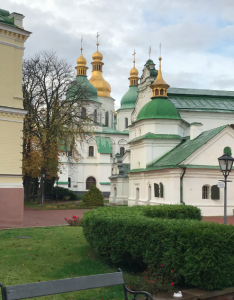
(Kyiv, Ukraine) I am here for just a few days, working with Ukrainian civic educators and my American colleagues at Street Law, Inc. I’ve served on Street Law’s board for more than a decade, but this is my first time directly helping with a project. Ukraine’s plans to revamp democratic education in their primary and secondary schools seem highly promising, and I’m pleased to be able to participate. This effort also connects to another project I’ve done with Ukrainian colleagues since 2014: the European Institute of Civic Studies (which is aimed at adults). Finally, it’s nice to be back in this handsome city as the leaves turn yellow and the air is cool and damp.

the Tisch College initiative on gerrymandering

Gerrymandering displays several features that are typical of 21st century problems. It’s a consequence of deliberate human action that’s not in the public good. It’s highly technical. If you possess the data, the methods, and the authority, you can draw district lines that will give your side enormous advantages. These methods are scarce and monopolized by self-interested actors who have power of various sorts. It’s tempting to imagine a technical solution, such as programming computers to draw electoral districts, but there is no self-evidently best map. Well-intentioned people who draw district lines (or who write algorithms for computers to draw maps) must balance valid goals, such as competitiveness, compactness, and representativeness. Each of these general values can be defined in several reasonable ways. Tension among values under conditions of great technical complexity is typical of our age.

I’m proud, therefore, of Tisch College’s Metric Geometry and Gerrymandering Group, led by Tufts Math Professor Moon Duchin. Her Group conducts advanced research on the math of redistricting, helps develop a more diverse cadre of people who can participate in these debates (including as expert witnesses in litigation), and educates the public. One of their approaches to education is working with k-12 teachers to teach the geometry of district maps.

Moon and I have a new piece in The Conversation drawn from this work: “Rebooting the mathematics behind gerrymandering.

Building Civic Capacity in an Era of Democratic Crisis by Hollie Russon-Gilman and K. Sabeel Rahman

About $3 billion was contributed to influence 2016 federal campaigns. In a new paper entitled “Building Civic Capacity in an Era of Democratic Crisis,” Hollie Russon-Gilman and K. Sabeel Rahman suggest a much better way to spend some of that money.

I realize, by the way, that political donors want candidates to notice their support. It would nevertheless make all the difference if they gave one percent of their $3 billion to activities that strengthen democracy–compensating for irradiating the body politic with polarizing and demoralizing messages. Progressive donors would also build the base for more progressive policy by investing for the longer term.

Russon-Gilman and Rahman argue “that today’s populist moment emphasizes the need to create a genuinely responsive, participatory form of democratic politics in which communities are empowered, rather than alienated.” They advocate investments that “self-consciously strive to build constituencies and identities that are more inclusive and accommodating. Think of this as ‘us’ populism, as opposed to ‘them’ populism.”

That basic stance supports two strategies:

  1. More investment in community organizing, especially the types that build “new bridges across racial, gender, and geographic divides.” Russon-Gilman and Rahman advocate broad-based, long-term organizing instead of mobilizing people around specific issues.
  2. “Reforming our institutions of governance” so that agencies offer citizens more “hooks and levers” to influence power, and so that public sector workers have skills and incentives to engage the public better.

These strategies imply (as the authors note) a broad understanding of democracy. It is not all about elections, nor even about the official government. It’s about how people come together and exercise power.

The paper offers valuable case studies. For instance, under the heading of organizing:

  • “The Center for Rural Strategies (CRS) … based in Whitesburg, Ky. in the central Appalachian coalfields, provides rural communities and nonprofit organizations with resources on innovative media and communications strategies in order to strengthen their work.” CRS provides information, challenges stereotypes about its communities, and lobbies for better access to the physical infrastructure for communications, because both content and conduit matter. (See “Building Democracy in ‘Trump Country’” by Ben Fink for a similar case.)
  • “Coworker.org (Coworker) is a digital platform for workers’ voices founded in response to the decline of formal institutions organizing workers and geared towards building a twenty-first century model of worker power. The organization provides tools directly to workers to self-advocate within the workplace, usually where no labor structure or organizing already exists.” Like CRS, Coworker invests in people who develop as leaders.

Examples under the heading of institutions include:

  • “The Office of Community Wealth Building (OCWB) was established as a permanent city agency in Richmond, Va., in 2015 to provide anti-poverty strategy and policy advice to the mayor and to implement municipal poverty reduction initiatives and systemic changes around housing, education, and economic development.”
  • “The Public Engagement Unit (PEU) is a division in New York’s city government started in 2015 [is] devoted to knocking on doors and making calls to hard-to-reach constituents to enroll them in city services, as well as foster long-term individual relationships with city staff.”

Overall, “Building Civic Capacity in an Era of Democratic Crisis” helps make the case for investments that are less short-term, less oriented to immediate efficiency, less split between government and civil society, but more experimental, more open-ended, and more truly inclusive than we normally see (especially, I would say, on the left).

See also: why the white working class must organizeto beat Trump, invest in organizingfighting Trump’s populism with pluralist populism; and community organizing between Athens and Jerusalem.

new research on “civic deserts”

(Washington, DC) My colleagues Kei Kawashima-Ginsberg and Felicia Sullivan coined the phrase “civic deserts” to name places where there are few or no opportunities to be active and constructive participants in civic life. The analogy is to “food deserts”–geographical communities where there is little or no nutritious food for sale. You can still be an active citizen in a civic desert, just as you can grow vegetables in your back yard; it’s just that the whole burden falls on you.

Today at the National Conference on Citizenship, we are releasing Civic Deserts: America’s Civic Health Challenge by Matthew N. Atwell, John Bridgeland, and me. It’s a 36-page report that documents the declining opportunities for civic engagement in America. John Bridgeland and Robert Putnam also write about it today in a PBS opinion piece.

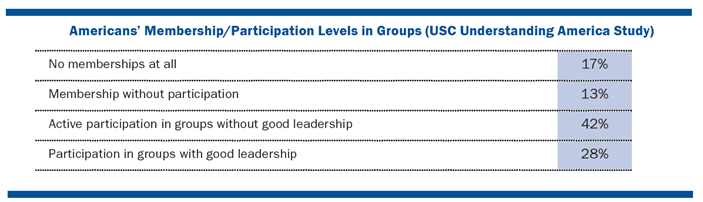
This is an example of a table from the report:

Thanks to friends at USC’s Center for Economic and Social Research, we were able to ask a  large, representative sample of Americans whether they belonged to various kinds of groups; if so, whether they participated actively in any of them; and if so, whether they thought that the group’s leaders (a) usually did what they promised and (b) usually tried to serve and include all the members. It turns out that only 28% of adult Americans actively belong to groups whose leaders are accountable and inclusive. That statistic does not tell us how much geographical space is taken up by civic deserts, but it suggests that they are common. And the historical data implies that civic engagement used to be much more widespread.

I separately formed a hypothesis that lacking direct, personal experience with good leadership would make a person more tolerant of the leadership style of Donald J. Trump, controlling for one’s political ideology. In other words, given two people who agree with Trump on issues, the one without experience of good local leadership would be more supportive of Trump as a leader. This was testable with the USC data, which includes a whole battery of questions about ideology, issues, and Trump. My hypothesis turned out not to be true: partisanship and media choice seem to explain opinions of the current president almost completely, and experience in groups adds no explanatory power. Still, I think there may be a more circuitous story about civic deserts as a cause of Trump’s victory: the decline of civic associations increases the power of partisan heuristics and ideological media. Even if that hypothesis is also false, civic deserts are still a problem, because civic engagement benefits health, economic development, safety, education, and good government.

See also: The Hollowing Out of US Democracy (my blog post for USC); Mitigating the Negative Consequences of Living in Civic Deserts – What Digital Media Can (and have yet to) Do (a new CIRCLE article); America needs big ideas to heal our divides. Here are three by Bridgeland and Putnam; and the power of the NRA in an age of civic deserts.