ambition: pro or con?

How should we think about ambition? Here are four possibilities:

  1. It’s basically a sin. According to the OED, “ambicioun” already appears in 1449 on a list of “vicis” (vices), right between “pride,” and “vein glorie.” It’s the selfish desire to extract credit, regardless of the merit of one’s act. If it motivates good action, then the action is good, but not the motive. It would have been better if the actor had been moved by something else. In that sense, it’s like greed, which can spur people to make valuable products but still discredits the actor.
  2. It’s a natural motivation that human beings just have, to various degrees. There’s not much point moralizing about it. What we should do is figure out how to channel it to good ends. For instance, in a well-functioning republic, people who have political ambitions must persuade the public, and that channels their ambitions to public ends. The analogy is not to “greed” (which is, by definition, a vice) but to ordinary financial motivations. It’s neither good nor bad that people want money; the question is whether the economy rewards good products and services.
  3. It’s not an appropriate category for ethical assessment because it’s really two or more different things. There is the ambition to make the world a better place and be recognized for it, which is honorable. And there’s the ambition just to be famous or powerful, which is pernicious. Much as we can distinguish agape from lust as two of the many forms of love, so we should divide ambition into varieties and then assess them separately.
  4. It’s a good thing. John Adams observed, “Wherever men, women, or children are to be found, whether they be old or young, rich or poor, high or low . . . ignorant or learned, every individual is seen to be strongly actuated by a desire to be seen, heard, talked of, approved and respected by the people about him and within his knowledge.” Hannah Arendt quotes this passage approvingly because, in general, she admires human beings who step into the public sphere to be “seen, heard, talked of, approved and respected.” That is not merely a motivation to do a good job; it is part-and-parcel of being a public figure, which is a worthy way of life. By exercising ambition, you become a persona of history, as in Lin-Manuel Miranda’s Hamilton: 

I may not live to see our glory!
But I will gladly join the fight!
And when our children tell our story…
They’ll tell the story of tonight.

I leave it to anyone who’s interested to choose among these four options or to come up with other ones. I would, however, make a couple of observations.

First, I am generally skeptical about the kind of move made in #3 above, the casuistic division of widely-used concepts into subcategories. The problem is that very often there’s something important left over when you try to make the split. For example, love is not necessarily good. Many cases of love are harmful. But the fact that love is often good (or even wonderful) necessarily colors even the bad cases, and vice-verse. Instead of trying to divide love into sharply distinct forms–romantic love, brotherly love, lust, self-love, etc. and judging each one as a category–it’s better to say that love can always be good or bad, or a bit of both. I delved deeply into this obscure issue in my book on Dante, because Dante envisions the afterworld as a system for categorizing types of love–all the way from Satan to God–yet he also sees the echoes of the good love in the bad.

Second, an anti-democratic prejudice may underlie some of the criticisms of ambition. The word comes from the Latin ambitio, which originally just meant “going around.” According to Lewis and Short’s Latin Dictionary (courtesy of Tufts’ Project Perseus), the word came to mean “the going about of candidates for office in Rome, and the soliciting of individual citizens for their vote, a canvassing, suing for office (by just and lawful means).” From there, it gained the sense of “a striving for one’s favor or good-will; an excessive desire to please, flattery, adulation.”

Ambitio translated the Greek word eritheia, which (per Thayer’s Greek Lexicon) was “used of those who electioneer for office, courting popular applause by trickery and low arts,” AristotlePolitics 5, 3. From there, it came into the Greek New Testament to mean, “courting distinction, a desire to put oneself forward, a partisan and factious spirit which does not disdain low arts; partisanship, factiousness”: James 3:14, 16. No wonder Thomas Nashe (1593) defined the English word ambition as “any puft vp greedy humour of honour or preferment.”

This etymology reflects cynicism about the act of “going around” if you’re looking for votes. But we want people to do that. In ancient times, the main critics of seeking popular support were elitists who preferred rule by aristocrats. Almost by definition, an aristocrat is one who does not have to strive for favor or good-will, because he is just “best.” Neither Aristotle nor the New Testament makes a positive case for democratic politics.

The question is whether this etymology is rooted in a problematic elitism. In that case, we should at least be open to Arendt’s positive view.

See also: Arendt, freedom, TrumpHannah Arendt and Lin-Manuel Mirandataking satisfaction from politics in the face of injustice
article about the Civic Studies major

“Civic Studies Major Begins in the Fall: The new program will combine academics and civic engagement,” by Helene Ragovin in Tufts Now:

Since the university’s founding, civic engagement and rigorous academics have been “deeply embedded in Tufts’ DNA,” says Tisch College’s Peter Levine. Now a new civic studies major in the School of Arts and Sciences continues that tradition.

The faculty of Arts and Sciences in March approved the program, which will begin in the fall 2018 semester. It will combine the experiential component of community internships—a hallmark of the Jonathan M. Tisch College of Civic Life—and the scholarship from the emerging discipline of civic studies. It is believed to be the first program of its kind at a university.

“While a lot of colleges have programs and encourage being civically engaged, there are no majors that are as academically centered as this one,” said Levine, the associate dean for research and Lincoln Filene Professor of Citizenship and Public Affairs at Tisch College. “With civic studies as a major piece of what we offer, it furthers our goal of making Tufts the best in the world for civic education.”

Levine, along with Erin Kelly, associate professor and chair of philosophy, and Ioannis Evrigenis, professor of political science, will teach the introductory course for the subject. Levine said Kelly was a key player in establishing the new program and shepherding it through the approval process. Levine and Kelly will be the program directors.

Civic studies is an interdisciplinary program, and students will be required to take it as a double-major, along with another discipline from Arts and Sciences. The major will require eleven courses, including the introductory course, an internship, and a capstone seminar. The other courses must be distributed among the following themes: thinking about justice; social conflict and violence; civic action and social movements; and civic skills. The courses draw from departments such as political science, history, sociology, psychology, and community health, among others.

The establishment of civic studies as an intellectual movement dates back about a decade, when several scholars issued a framing statement that has since become the blueprint for the discipline, Levine said. This liberal arts perspective marries well with the goals of Tisch College, he said.

“For nearly twenty years, Tisch College has been deeply engaged in trying to educate all Tufts students for civic life. Now our ambitions have become more and more academic, and we are increasingly supporting classroom learning. Civic studies is the next step,” he added. “Civic studies focuses on critical reflection, ethical thinking, and action for social change within and between societies,” he said.

The new major fills the space left by the former peace and justice studies major in A&S, Levine said. There will be an optional peace and justice track within civic studies, and peace and justice will also still be available as an A&S minor. Peace and justice students were consulted as the new major was being developed, Levine said, as were faculty in A&S departments that could be seen as “complementary or competitive” with civic studies. “We didn’t want to have a new major that would compete with something we already have,” Levine said. Other department chairs supported the proposal, he said.

Gandhi on the primacy of means over ends

I don’t think that Gandhi really said, “Be the change you want to see in the world,” but he did hold a challenging view of the relationship between means (or strategies) and ends. “Be the change” could serve as a shorthand for his view, if it’s properly understood. It’s not about individual lifestyle choices but about social and cultural transformation.

Since the 1960s in the English-speaking world, political philosophy has focused on defining justice, understood as an end-state, a goal. Political ethics then involves a set of questions about whether various means (e.g., civil disobedience, misinformation, compromise, or violence) are acceptable–or necessary–when pursuing justice under various circumstances.

A century ago, as Karuna Mantena notes, there was a more vibrant debate about political means.[1] The central question was not what constituted justice but whether and when to use party politics and elections, strikes, boycotts, assassinations, or revolutions, among other options. Mantena reads Gandhi as a participant in that debate who developed and defended nonviolence as a cluster of strategies. Moreover, Gandhi explicitly argued that the best way to think about politics was to determine the right means or strategies, not to pretend to define justice.

“Means are after all everything,” Gandhi wrote, in response to a group of Indian political leaders who had issued an “Appeal to the Nation” in 1924. These leaders had proposed a concrete ideal of justice: the immediate creation of a new, independent “Federated Republic of the United States of India.” They argued that this end justified a wide range of strategies. They wanted to “delete the words ‘by peaceful and legitimate means’ from the Congress creed, so that men holding every shade of opinion may have no difficulty in joining” the independence struggle.

Gandhi replied that these leaders had no right to define an abstract concept of justice, such as “independence,” by themselves. The “only universal definition to give it is ‘that status of India which her people desire at a given moment.’” Furthermore, the means used to pursue swaraj (independence, in its deepest sense) had to be good. “As the means so the end. Violent means will give violent swaraj. That would be a menace to the world and to India herself.”[2]

Drawing on Mantena, I would suggest the following Gandhian reasons to focus on means rather than ends. Human beings are cognitively limited and cannot see justice far beyond our own present circumstances. Human beings are motivationally flawed and highly susceptible to various distorting and destructive impulses. Therefore, we must choose modes of politics that channel our impulses in beneficial rather than harmful directions. Forming too sharp a definition of justice (or any of its components, such as national independence) can simply excuse destructive behavior. Consequences are always difficult to predict and control, and trying to pursue elaborate ends is foolish. Finally, how we participate in politics helps to constitute the world. By acting, we don’t merely bring about a result (usually an unpredictable one); we immediately create a new reality just in virtue of our action.

For example, one of Gandhi’s strategies was the khadi campaign: a mass effort to boycott European cloth, wear only homespun Indian khadi cloth, and enlist everyone–of all classes–in personally spinning and weaving their own clothes. The khadi campaign is widely understood as a means to one of the following ends: political independence from Britain through economic pressure, rural economic development, or spiritual education for those who spun.

Gandhi thought of it differently.[3] It was impossible to know whether khadi would affect British policy, but an India full of people who wove their own clothes in the cause of independence would immediately be a different place. It would be more decentralized, equitable, ruminative, united, and free. “Through khadi we teach people the art of civil obedience to an institution which they have built up for themselves.”[4]  Khadi was educational, but equally important, it represented an institution that the people had built. Education wasn’t an outcome of spinning, as knowledge might be an outcome of schooling. In khadi, the learning was intrinsic to what Gandhi explicitly called the “public work” of building a new system for textile-production. Gandhi described the political work accomplished by a committee and the “constructive work” of weaving in the same passage, as part of the same struggle. Physical production was an essential component because “awareness is possible only through public work and not through talks.”[5]

For Gandhi, “What is justice?” was the wrong question. Our focus should be on forming groups of people who interact in ways that bring out the best in them. He saw a nation of home-weavers as such a group. We could certainly debate his specific vision of a khadi campaign, but the same general approach can take many forms. For example, Jürgen Habermas represents a dramatically different cultural context and political sensibility from Gandhi’s, but he also rejects instrumental, means/ends reasoning in favor of creating groups of people who endlessly make justice by interacting. It’s just that Habermas’ interactive groups are highly critical, explicit, and discursive, whereas Gandhi’s weavers may be literally silent.

See also: notes on the metaphysics of Gandhi and KingHabermas, Ostrom, Gandhi (II)against state-centric political theoryno justice, no peace? (on the relationship between these concepts)the I and the we: civic insights from Christian theologythe right to strike; and the kind of sacrifice required in nonviolence.

Notes

[1] Karuna Mantena, “Gandhi and the Means-Ends Question in Politics,” Institute for Advanced Study School of Social Science Paper 46 (June 2012).
[2] Gandhi, Notes,  May 22, 1924-August 15, 1924, in The Collected Works of Mahatma Gandhi (Electronic Book), New Delhi, Publications Division Government of India, 1999, 98 volumes, vol. 28, pp. 307-310, I owe the reference to Karuna Mantena, “Another Realism, the Politics of Gandhian Nonviolence,” American Political Science Review, vol. 106, no. 2 (May 2012), p. 457
[3] See Mantena, “Gandhi and the Means-Ends Question in Politics,” pp. 9-12.
[4] Gandhi interviewed by Nirmal Kumar Bose, Nov. 9-10, 1934, in The Collected Works, vol. 65, p. 317. I owe the reference to Mantena, “Gandhi and the Means-Ends Question in Politics,” p. 9.
[5] Gandhi, personal note (1925), in The Collected Works, vol. 32, 262-3. I owe this reference to Mantena, “Gandhi and the Means-Ends Question in Politics,” p.11.

the new Two Cultures

In 1959, C.P. Snow thought he observed “two cultures” in universities and intellectual life. “At one pole we have the literary intellectuals, at the other scientists, and as the most representative, the physical scientists. Between the two a gulf of mutual incomprehension.”

As evidence, he cited the fact that humanists would privately decry the “illiteracy of scientists,” yet when Snow asked them to define the Second Law of Thermodynamics, “the response [would be] cold and … also negative. Yet I was asking something which is about the scientific equivalent of: Have you read a work of Shakespeare’s?”

Conjecture: today many humanists and “literary intellectuals” would acknowledge that they have never read Shakespeare–or at least not since a high school English assignment that has no bearing on their interests. This would not be embarrassing. Many people in many disciplines may still have to look up the Second Law of Thermodynamics (now easily done, on their phones). But a different “gulf of mutual incomprehension” runs through the university today.

At one pole are researchers who are generally optimistic that technology (broadly defined) can solve problems. They think that once we’ve found a good technical solution, it should go to market so it can reach many people. Therefore, it’s appropriate for corporations and wealthy individuals to fund research, for research to move from universities to firms, and for the government to support and even to subsidize all of that.

At the opposite pole are scholars who perceive technology as a threat to cultures and nature, who critically assess market capitalism, and who see a government that supports it as the neoliberal state, captured by business.

The first pole is anchored in business schools, engineering schools, and other applied science disciplines, but it has adherents in many fields. The second pole is anchored in the cultural disciplines within the humanities, but it attracts support from some social scientists and pure natural scientists. The gulf runs right through fields such as education and public policy.

And between the two, C.P. Snow’s “mutual incomprehension.” Also, I think, a degree of disapproval is directed in both directions. If you’re at the technology-solves-problems pole, you may think that public-spirited researchers invent tools that help people and make sure that those tools are used. Spending one’s time reading and writing books may seem self-indulgent. If you’re at the opposite pole, you may think that a scholar of integrity is independent and critical of the major institutions of the society.

In one way, though, the situation is asymmetrical. I think that almost everyone realizes that universities produce pharmaceuticals, algorithms, hardware breakthroughs, materials, and a range of other products that ultimately get bought. But the critical end of the pole is sometimes invisible. Some technologists are unaware that there’s a critique of technological capitalism underway in their own universities. And humanists are partly responsible for their own invisibility, because they don’t engage the public debate effectively.

See also: college and the contradictions of capitalismwhat are the humanities? (basic points for non-humanists)the public purposes of the humanities (a brief history)does naturalism make room for the humanities?innovation in technology and the humanities.

getting to 80% voter turnout

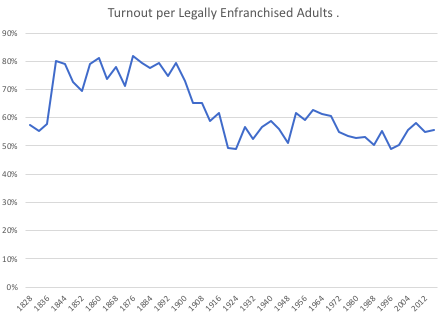
I’m attending “Getting to 80%: A Symposium Advancing Voter Participation,” a discussion of the “moonshot” goal of raising US voter turnout to 80% (It’s at the Harvard Kennedy School.)

The historical context is not easy to find online, so here are two graphs that should be viewed together. The first graph, derived from sources like this, shows votes cast per people who were allowed to vote. In 1840, that meant white men (property restrictions having been dropped in most states by then); just above 80% of them voted. In 2012, that meant every citizen at least 18 years old, except for some people with felony convictions, and just under 60% voted. So the story is one of decline, mostly during the late 1800s and early 1900s. A common explanation is that powerful, identity-based, grassroots parties gave way to expert-driven government with weaker parties and less at stake in most elections. The question is how we can get back to 80% in a new political environment.

The other graph (from here) shows the proportion of the whole population that has cast popular votes for president. It shows dramatic improvement over time, with the expansion of the franchise, albeit with some stagnation in recent years. The question is how we can push the line higher to approach 80% for the first time.

the weakening bond between millennials and the middle class

(New York City) In lieu of a substantive post here today, I’ll link to a post of mine on the Biden Forum (the blog of the Biden Foundation), entitled “the weakening bond between millennials and the middle class.”

I begin:

Americans born between 1985 and 2004, known as “millennials,” are numerous enough that their generation will dominate the electorate for decades to come. Political commentators often depict millennials as egalitarian, activist, and relatively well-educated, and thus poised to support a middle-class economic agenda. But that portrait describes just a minority of the generation. In truth, many millennials are far from reaching the middle class, are skeptical about government, and are disengaged as citizens.

At the Biden Forum, I reflect on what that may mean for politics and policy.

deliberation or simulated deliberation? choices for the classroom

In an article published today (“Deliberation or Simulated Deliberation?” in Democracy and Education, 26, 1, Article 7), I respond to a valuable previous piece by Margaret S. Crocco and her colleagues, “Deliberating Public Policy Issues with Adolescents: Classroom Dynamics and Sociocultural Considerations.” These authors analyze classroom “deliberations” of current events and find disappointing results. Their analysis is rigorous and insightful. One finding particularly caught my eye.

It is interesting that even students at the school with a large immigrant population tended to talk about immigrants as “they” when they deliberated about national policy. They were essentially role-playing the government or perhaps a body of influential citizens of the United States. As Crocco and her colleagues write, “Participating in the public debate about immigration in U.S. classrooms positions one as an insider with all the privileges of excluding outsiders that result from this status” (Crocco et al., 2018). This is evidence that the students experienced the discussion as a kind of role-play.

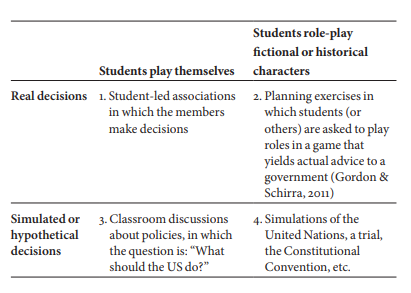
That finding leads me to propose that discussions can vary on two dimensions. Talking can result in an actual decision, or it can be about a simulated or hypothetical decision. And the participants can either speak for themselves or role-play characters. Those distinctions produce four types, all of which can be found in actual classrooms (and in settings for adults, such as community fora.)

I think Crocco et al. provide some grounds for skepticism about simulated decision-making discussions in which the speakers represent themselves (cell 3). When we ask students (or adults) to discuss what “we” should do, where the “we” is actually a vast or distant entity, such as the US government, we position them as insiders even though they know they are outsiders. This disjunction could be fun or interesting, but I think often it just alienates.

The other cells are more promising. It’s better to be able to: (1) govern a real entity, such as a student-led association, (2) give advice to a real decision-maker, or (4) pretend that you hold a decision-making role, such as a Senator in a fictional Congress.

There are benign reasons to turn national issues into topics for small-group discussions. The goal is to make students (or others) feel that the government is theirs. It does belong to them, as a matter of justice, and it’s great if they take away that feeling. But we must be serious about their limited power, or they will perceive the discussion as fake and perhaps draw the conclusion that democracy is fundamentally a false promise. As I write in the article:

The students in these three classes did not actually decide about immigration. At most, they might shift their individual opinions on that topic, and if they encouraged others outside the class to change their opinions in similar ways, that could possibly affect national policy by influencing those people’s votes. But that is a remote form of impact for any citizen to consider, and especially for students who are not old enough to vote themselves. The United States is an “Imagined Community” (Anderson, 1991), not a group of people who literally make decisions. The real group—a classroom full of students—was pretending to deliberate.

That is how I would explain why the results were disappointing.

Trump at the confluence of populism, chauvinism, and celebrity

Donald Trump says many things. Some are innocuous and banal. Quite a few are inconsistent. And some provide evidence that he belongs in these three categories:

  1. A “populist” in the particular sense proposed by Jan-Werner Müller. (I also like to retain more positive definitions of the same word.) For Müller, a populist is someone who believes that the whole authentic people is unified behind a set of values that the populist leader explicitly expresses. Therefore, the opposition is illegitimate. Elections that favor the populist leader are sacrosanct, and anyone who criticizes or strives to reverse these results is an enemy of the people. But elections that challenge the populist must have been rigged or stolen. “A los amigos, justicia y gracia. A los enemigos, la ley a secas.”
  2. A chauvinist, meaning someone who explicitly and apologetically favors an in-group and disparages an out-group. In the United States, racism is a major variety. But in some other countries, the leading chauvinists are inspired by religion or nationality instead of race.
  3. A media personality who projects a combative personality, who disparages opponents, who cultivates “outrage,” who “seem[s] to always react to controversy and even aversion by leaning into it,” and who claims honesty or authenticity on the basis that he says things that give offense or cause pain–except not to his core audience. This style is prevalent on talk radio, certain reaches of cable news–but equally important, in supermarket tabloids, WWF, and reality TV shows like The Apprentice.

These three categories need not intersect. You can be an outrageous media personality who isn’t a populist or a chauvinist, a chauvinist who isn’t a celebrity, etc.

None of these categories is new. White Supremacy has been near the center of American politics since the beginning. Various forms of populism and chauvinism were much more extreme around the world in 1939 than today. But there does seem to be a global boom of unapologetic chauvinist populists who use media effectively.

The right doesn’t own these categories, and the left doesn’t consistently avoid them. I know plenty of people who believe that the Tea Party is pure Astroturf, a creature of right-wing billionaires. That is a populist move in Müller’s sense: it declares a large number of actual Americans to be illegitimate participants in politics. By the way, it’s different if you hate and fear your political opponents. That is partisanship, but not populism, so long as you acknowledge that your opponents are fellow citizens and you must share politics with them.

We’ve seen plenty of examples of these categories, but we have never had a president who fits all three. The combination poses a severe threat to our institutions and world peace.

Insofar as the problem is populism (in Müller’s sense), then I think an electoral shellacking will be the best remedy. Even if Republicans lose the 2018 election badly, the strongest Trump supporters (30-40% of the population) will continue to think that he speaks for the whole genuine American public and the election was rigged. However, Trump can’t govern without conservative and business elites. I think they will abandon him if they see that he is dragging them into the minority.

By the same token, if Republicans do better than expected in ’18, and/or Trump is reelected, we are in for much more populism. And if Trump’s presidency ends for a relatively extraneous reason, such as personal criminality, then the picture will be muddy enough that populism will remain an attractive option. (I often think that we are fortunate in our populist; if he were smarter and more disciplined, we would really be in trouble.)

Apart from elections, we have two other assets in the struggle against Müller-style populism. One is pluralist populism , which portrays “the people” as highly diverse (I discuss that rich tradition here).

The other is genuine conservatism. Real conservative thought is diametrically opposed–in principle–to the idea that any government can ever be authorized by a unitary public. The left/right spectrum originated in the French Revolution, and the Jacobin left was the populist side, in Müller’s sense. Conservatism emerged in reaction to the revolutionaries’ claim to a popular mandate, and great conservative thinkers have always opposed such claims. Many Republican politicians will go along with Trumpian populism as long as it wins elections; but conservatives will denounce it from the rooftops. The question is how many conservatives actually exist.

Insofar as the problem is chauvinism (meaning, in the USA, racism, religious bigotry, and sexism), then it’s the next chapter in a basic American story. Progress is hard-won and tends to have a zigzag pattern. I am a fan of Barack Obama for other reasons than his race, but it is significant that he was the first leader of a majority-white nation to have modern African ancestors–and the first US president in modern times to have a foreign father. That was the zig; Trump is the zag. The struggle continues.

Finally, insofar as the problem is celebrity politics, I am actually optimistic. I believe that Trump came first in a crowded and splintered Republican primary field because his persona appealed to a minority of the US population. He then beat Clinton in the Electoral College because partisan polarization gave him most Republican votes in key states, and she was deeply unpopular. Compared to a generic incumbent president who enjoys a strong economy and who hasn’t actually passed any controversial legislation (other than a tax cut), Trump is remarkably unpopular. And a key reason is his style. So I think acting like a reality TV star exacts a political cost and is not likely to be replicated.

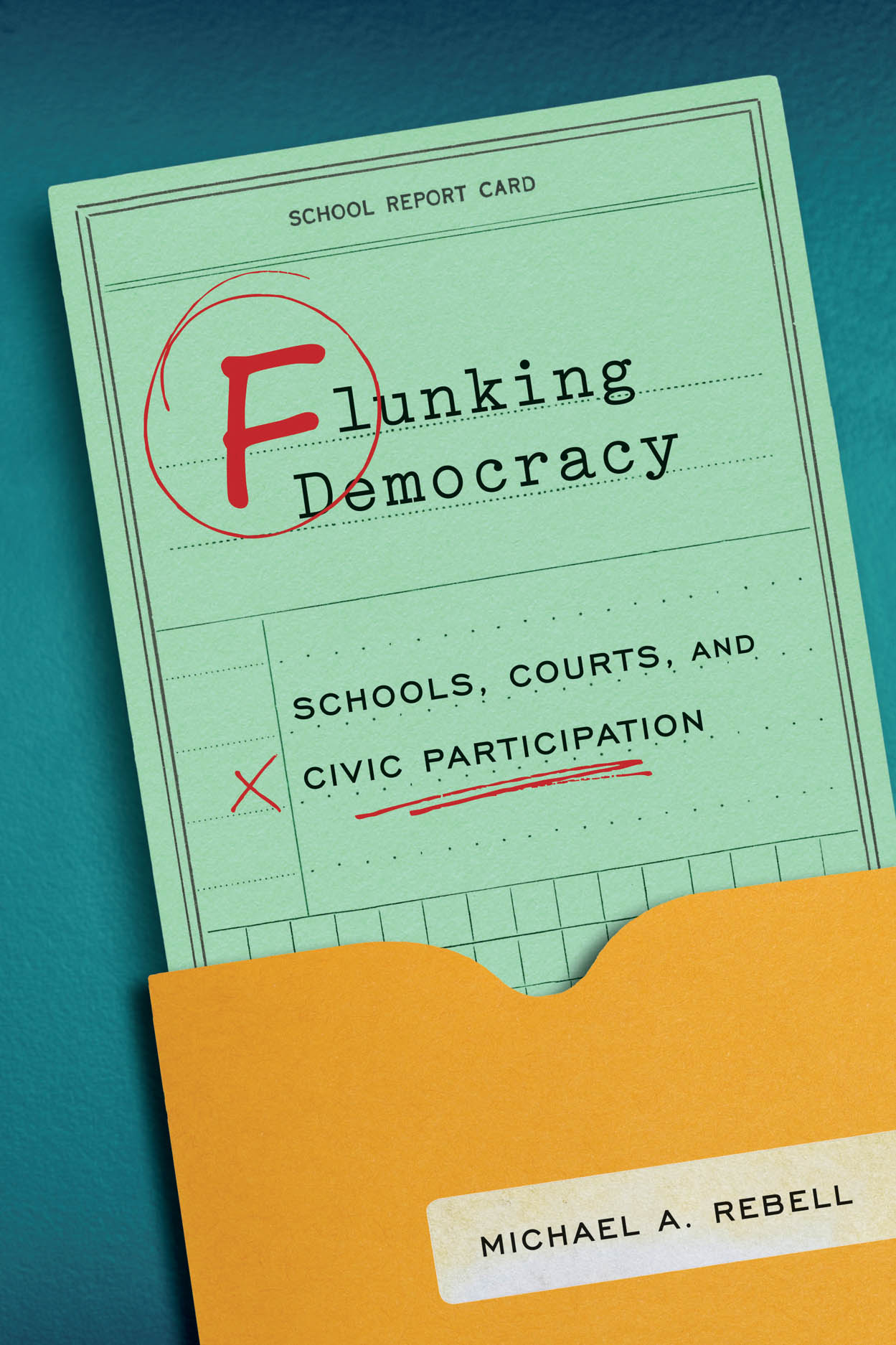
Michael A. Rebell, Flunking Democracy: Schools, Courts, and Civic Participation

This is a very important new book: Michael A. Rebell, Flunking Democracy: Schools, Courts, and Civic Participation (University of Chicago Press, 2018).

My blurb on the back cover says, “Michael Rebell makes a powerful and original case that litigation can and should improve civic education. He skillfully assembles evidence from the existing literature to show that civic education is important for the future of our democracy and requires improvement, then further applies his deep knowledge and experience with education-reform litigation to argue persuasively that courts can and would consider lawsuits requiring states to improve their policies for civic education.”

I’d add that this is one of the best available summaries of the research on civic education. Rebell really does demonstrate that litigation is a plausible strategy for improving civics. One reason is that state constitutions often explicitly cite preparing citizens to vote and serve on juries as the main rationale for establishing a right to education. Finally, Rebell offers sophisticated solutions. In a way, the hardest question is what a state should do if a court orders it to improve its civic education. There are complex debates about the value of policies like tests and required courses, and no single policy will work in every state and for every purpose.* But Rebell explains that courts can require processes that involve deliberation about strategies, experimentation, and assessment. That means that a court wouldn’t have to order a policy but could require a flexible process and then hold the state accountable for making serious efforts.

* See my exchange with Beth Rubin about policy for civicsnew overview of civic education, and state policies for civics: it’s all about implementation.

May 3-4 Conference: Creating Civic Competence: the Critical Challenges

The New Civics Early Career Scholars’ Program & The Civic and Moral Education Initiative in partnership with The Edmond J. Safra Center for Ethics invite you to a conference on Creating Civic Competence: the Critical Challenges. May 3-4 Larsen Hall Harvard Graduate School of Education

Preparing youth to meet growing civic challenges, worldwide, creates new questions for effective civic education. The New Civics Early Career Scholars Program, supported by the Spencer Foundation, trains doctoral students in civic education. This Conference draws on their innovative work with commentaries from distinguished senior scholars in the field.

3:30 PM        KEYNOTE ADDRESS AND CONVERSATION
Larsen Hall Room G08Helen Haste

“Identity, Agency and the Power of Story: Meeting the Civic Challenges?”Helen HasteVisiting Professor of Education, Harvard Graduate School of Education, and Professor Emerita of Psychology, University of Bath

with

Danielle Allen

Danielle Allen
James Bryant Conant University Professor, and Director of the Edmond J. Safra Center for Ethics, Harvard University

Howard Gardner
Howard Gardner
Hobbs Professor of Cognition and Education, Harvard Graduate School of Education
Peter Levine
Peter Levine
Lincoln Filene Professor of Citizenship & Public Affairs, Tisch College, Tufts University
Judith Purta

Judith Torney-Purta
Professor of Human Development, University of Maryland

The Conference also features commentaries from Michelle Bellino, Sarah Dryden-Peterson and Julie Reuben.
Some questions the Conference will address:

  • How do young people become motivated and gain civic identity?
  • How does early experience develop the skills for later civic and moral responsibility?
  • How do digital media reshape civic participation?
  • How can we use art to enlarge and innovate civic education?
  • How involved should higher education be in fixing civic problems?
  • How do cultural narratives and institutional structures, in the US and internationally, frame civic identity, competence and global moral responsibility?
  • How should we sensitively define and measure civic education outcomes in different cultural and social contexts?
  • What can we learn from critical and participatory pedagogy among marginalized, dispossessed and conflict-ridden populations??

Registration:  https://www.eventbrite.com/e/conference-creating-civic-competence-the-critical-challenges-tickets-44990792672

Conference Website:
https://projects.iq.harvard.edu/harvardconference

Conference Program:
https://projects.iq.harvard.edu/harvardconference/program