I will be traveling to Fitchburg State University to give a talk in their Anti-Racism Initiative on “A Culture of Justice,” regarding my latest book.


I will be traveling to Fitchburg State University to give a talk in their Anti-Racism Initiative on “A Culture of Justice,” regarding my latest book.
 On April 9th of 2026, I will meet with Dr. William Barbieri, his colleagues, and students, to talk about “A Culture of Justice: Should a University Have a Creed?” a talk about my latest book, A Culture of Justice. If you’d like to join the meeting via Zoom, you can us this link.
On April 9th of 2026, I will meet with Dr. William Barbieri, his colleagues, and students, to talk about “A Culture of Justice: Should a University Have a Creed?” a talk about my latest book, A Culture of Justice. If you’d like to join the meeting via Zoom, you can us this link.
 I’ll be presenting “Fighting for a Culture of Justice in Dark Times” for the 2026 Honi Haber Memorial Lecture at the University of Colorado Denver on Friday, April 3rd at 3:30 pm.
Abstract
John Dewey held that education is the intelligent transmission of culture between generations, making the question of culture crucial. While liberalism generally resists intrusion into culture, prioritizing the consent of the governed, Eric Weber argues in A Culture of Justice that society shares a public obligation to create and sustain a culture of justice. Recent state and federal actions ban efforts to make education more equitable and inclusive, illustrating the challenge to a culture of justice as well as the reason why efforts must extend beyond the narrow realm of politics. Political actions matter and must continue, but social, moral, and cultural work is equally essential. Weber outlines practical ways individuals and communities can fight against cultural injustice and for more inclusive and fairer educational environments.

For those interested in a copy of A Culture of Justice, the book will be out in paperback for the general public in July of 2026 and I will have a discount code available, which I will share on my social media pages, such as on Facebook, X.com, and LinkedIn.
I’ll be presenting “Fighting for a Culture of Justice in Dark Times” for the 2026 Honi Haber Memorial Lecture at the University of Colorado Denver on Friday, April 3rd at 3:30 pm.
Abstract
John Dewey held that education is the intelligent transmission of culture between generations, making the question of culture crucial. While liberalism generally resists intrusion into culture, prioritizing the consent of the governed, Eric Weber argues in A Culture of Justice that society shares a public obligation to create and sustain a culture of justice. Recent state and federal actions ban efforts to make education more equitable and inclusive, illustrating the challenge to a culture of justice as well as the reason why efforts must extend beyond the narrow realm of politics. Political actions matter and must continue, but social, moral, and cultural work is equally essential. Weber outlines practical ways individuals and communities can fight against cultural injustice and for more inclusive and fairer educational environments.
For those interested in a copy of A Culture of Justice, the book will be out in paperback for the general public in July of 2026 and I will have a discount code available, which I will share on my social media pages, such as on Facebook, X.com, and LinkedIn.
 Argues that there is a shared public obligation to establish and maintain a culture of justice, with implications for education, poverty, free speech, and “PC” culture.
Description
In A Culture of Justice, Eric Thomas Weber shows how culture can enable or inhibit the pursuit of justice. Weber argues that there is a shared, public obligation to establish and maintain a culture of justice. Culture can be employed to threaten people’s self-respect, to diminish their sense of positive power to pursue meaningful life plans. Weber also addresses problems of poverty and stigmatization as well as of racism and threats conveyed by means of public speech and the cultivation of hatred. Advancing John Dewey’s idea that democracy is a way of life, not merely a set of political mechanisms, he draws implications for policies and practices related to poverty, education, free speech, and the inadequately named set of norms that we call “political correctness.” Written in an accessible style, A Culture of Justice offers numerous everyday examples and conflicts for the reader to consider.
Eric Thomas Weber is Professor and Director of Graduate Studies in Educational Policy Studies and Evaluation at the University of Kentucky and serves as Executive Director of the Society of Philosophers in America (SOPHIA). He is the author and editor of several books, including Uniting Mississippi: Democracy and Leadership in the South.
Endorsements
 “A pleasure to read, A Culture of Justice will appeal to a wide audience of social and political philosophers, scholars and practitioners of education, and people thinking about racial justice. Weber makes clear the relevance of the great American pragmatists to addressing current social and political problems such as poverty, hate speech, and racism.”
— Nicholas Tampio, Fordham University
Argues that there is a shared public obligation to establish and maintain a culture of justice, with implications for education, poverty, free speech, and “PC” culture.
Description
In A Culture of Justice, Eric Thomas Weber shows how culture can enable or inhibit the pursuit of justice. Weber argues that there is a shared, public obligation to establish and maintain a culture of justice. Culture can be employed to threaten people’s self-respect, to diminish their sense of positive power to pursue meaningful life plans. Weber also addresses problems of poverty and stigmatization as well as of racism and threats conveyed by means of public speech and the cultivation of hatred. Advancing John Dewey’s idea that democracy is a way of life, not merely a set of political mechanisms, he draws implications for policies and practices related to poverty, education, free speech, and the inadequately named set of norms that we call “political correctness.” Written in an accessible style, A Culture of Justice offers numerous everyday examples and conflicts for the reader to consider.
Eric Thomas Weber is Professor and Director of Graduate Studies in Educational Policy Studies and Evaluation at the University of Kentucky and serves as Executive Director of the Society of Philosophers in America (SOPHIA). He is the author and editor of several books, including Uniting Mississippi: Democracy and Leadership in the South.
Endorsements
“A pleasure to read, A Culture of Justice will appeal to a wide audience of social and political philosophers, scholars and practitioners of education, and people thinking about racial justice. Weber makes clear the relevance of the great American pragmatists to addressing current social and political problems such as poverty, hate speech, and racism.”
— Nicholas Tampio, Fordham University
This page is saved for archiving. My current press kit is available here.
This page is for the press folks looking for a one-stop site for info about my work and my biographical information. I’ve made a 1-page version of this press kit, as well as a 1-page interview resources on my latest book, Uniting Mississippi.
 Table of Contents
Address:
Dr. Eric Thomas Weber
Department of Educational Policy and Evaluation
The University of Kentucky
131 Taylor Education Building
Lexington, KY 40506-0001
Email: eric.t.weber@uky.edu
Office phone: 859.257.1849
Fax: 859.257.4243
Facebook.com/EricThomasWeberAuthor
Twitter.com/erictweber
Web site: EricThomasWeber.org
Publicist:
Courtney McCreary
The University Press of Mississippi
3825 Ridgewood Road
Jackson, MS 39211
Email: cmccreary@mississippi.edu
Office phone: 601.432.6205
Fax: 601.432.6217
Facebook.com/upmiss
Twitter.com/upmiss
Web site:http://www.upress.state.ms.us
Under 100 words:
Eric Thomas Weber, Oxford, Mississippi, is associate professor of public policy leadership at the University of Mississippi and the recipient of the Mississippi Humanities Council’s 2015 Public Scholar Award. He is also affiliated faculty in the School of Law and department of Philosophy, and a contributing columnist for The Clarion Ledger of Jackson, MS. In addition, he serves as executive director of the Society of Philosophers in America and is the author of three books, including Democracy and Leadership: On Pragmatism and Virtue and Uniting Mississippi: Democracy and Leadership in the South.
In under 300:
Dr. Eric Thomas Weber is associate professor of Public Policy Leadership and affiliated faculty member in the School of Law and department of Philosophy at the University of Mississippi. He teaches courses in Ethics and Public Policy, Critical Thinking and Communication, and in the Philosophy of Leadership. The university recognized his teaching with the Cora Lee Graham Award in 2011 and his service to students with the Thomas F. Frist Student Service Award in 2012. He received the Mississippi Humanities Council’s Public Scholar Award in 2015.
Weber earned his bachelor’s degree at Vanderbilt University in Philosophy and Communication Studies. He then earned his master’s and doctoral degrees in Philosophy at Ohio University and then at Southern Illinois University, respectively. He has written four books, including Democracy and Leadership: On Pragmatism and Virtue and Uniting Mississippi: Democracy and Leadership in the South. He is a contributing columnist for The Clarion Ledger of Jackson, MS, a contributing scholar for The Prindle Post at the Prindle Institute for Ethics in Greencastle, IN, and he is a frequent interview guest in opinion pieces for The Tehran Times of Tehran, Iran. He also chaired the American Philosophical Association’s committee on public philosophy from 2011 to 2014. Since 2010 he has served as executive director of the Society of Philosophers in America (SOPHIA).
Weber is also a self-taught and then classically studied guitarist and musician. In 2000, he founded Tempest Records, his music recording and production company in Nashville, TN. He loves to write, talk with his brilliant wife Annie, make some music, and play with his kids. He and his family live in the lovely town of Oxford, Mississippi.
Extended Interview
For more biographical information, you can check out an extended interview I gave for Southern Authors. Don’t miss page 2 of the interview. If for any reason the site is down, you can download an Adobe PDF file I’ve made of both Web pages of the interview (8 pages in all).
Headshots, Vertical and Horizontal







In under 100 words:
Uniting Mississippi applies a new, philosophically informed theory of democratic leadership to Mississippi’s challenges. The book draws on insights from classical and contemporary philosophical outlooks on leadership, which highlight four key social virtues: wisdom, courage, moderation, and justice. Weber brings to bear each of the virtues of democratic leadership on particular problems, with some overarching lessons and values to advance. Governor William F. Winter has written a foreword for the book, supporting its proposals.
In under 300 words:
Uniting Mississippi applies a new, philosophically informed theory of democratic leadership to Mississippi’s challenges. Governor William F. Winter has written a foreword for the book, supporting its proposals.
The book begins with an examination of Mississippi’s apparent Catch‐22, namely the difficulty of addressing problems of poverty without fixing issues in education first, and vice versa. These difficulties can be overcome if we look at their common roots, argues Eric Thomas Weber, and if we practice virtuous democratic leadership. Since the approach to addressing poverty has for so long been unsuccessful, Weber reframes the problem. The challenges of educational failure reveal the extent to which there is a caste system of schooling. Certain groups of people are trapped in schools that are underfunded and failing. The ideals of democracy reject hierarchies of citizenship, and thus, the author contends, these ideals are truly tested in Mississippi. Weber offers theories of effective leadership in general and of democratic leadership in particular to show how Mississippi’s challenges could be addressed with the guidance of common values.
The book draws on insights from classical and contemporary philosophical outlooks on leadership, which highlight four key social virtues: wisdom, courage, moderation, and justice. Within this framework, the author approaches Mississippi’s problems of poverty and educational frustration in a novel way that is applicable in and beyond the rural South. Weber brings to bear each of the virtues of democratic leadership on particular problems, with some overarching lessons and values to advance. The author’s editorial essays are included in the appendix as examples of engaging in public inquiry for the sake of democratic leadership.
 Book Specs
The University Press of Mississippi (www.upress.state.ms.us)
SEPTEMBER 2015, 194 pages (approx.), 5½ x 8½ inches, foreword, appendices, bibliography, index
Paper $20.00T 978‐1‐4968‐0349‐8
Printed casebinding $65.00S 978‐1‐4968‐0331‐3
Ebook available
Cover photo, “We Are One Mississippi Walk and Candlelight Vigil,” November 7, 2012, by Bruce Newman, reproduced with permission. Visit his Web BruceNewmanPhotos.com.
The cover photo was taken the night after the 2012 Presidential Election, when the campus community came together for a candlelight “We Are One Mississippi” unity walk. The walk was the community’s response to some racial tensions that had made headlines the night before, when some students were upset and others happy about President Obama’s reelection.
 Where to Buy
Local:
Local book sellers in and around the South, like Square Books in Oxford, MS, and Wordsworth in Little Rock, Arkansas.
Online:
All the major online booksellers, including Amazon.com and Barnes&Noble.com. It is also available direct from the University Press of Mississippi.
Speaking about the Book
I will be talking about the book around Mississippi, such as in Hattiesburg at the University of Southern Mississippi, and in surrounding states, including in Arkansas and maybe soon also in Tennessee and North Carolina. For more information, check out my Talks and Releases posts. This book has a lot to offer for reading groups, parent teacher associations (PTA’s), community groups, nonprofit organizations, high schools, colleges, and universities, and more. If you are interested in arranging a talk, visit my Speaking and Contact pages.

In under 100 words:
Democracy and Leadership: On Pragmatism and Virtue presents a theory of leadership drawing on insights from Plato’s Republic, while abandoning his authoritarianism in favor of John Dewey’s democratic thought. The book continues the democratic turn for the study of leadership beyond the incorporation of democratic values into old-fashioned views about leading. The completed democratic turn leaves behind the traditional focus on a class of special people. Instead, leadership is understood as a process of judicious yet courageous guidance, infused with democratic values and open to all people.
In under 150 words:
Democracy and Leadership presents a theory of democratic leadership drawing on insights from Plato’s Republic, while abandoning his authoritarianism in favor of John Dewey’s democratic thought. The book continues the democratic turn for the study of leadership beyond the incorporation of democratic values into old-fashioned views about leading. The completed democratic turn leaves behind the traditional focus on a class of special people. Instead, leadership is understood as a process of judicious yet courageous guidance, infused with democratic values and open to all people.
The book proceeds in three parts, beginning with definitions and an understanding of the nature of leadership in general and of democratic leadership in particular. Then, Part II examines four challenges for a democratic theory of leadership. Finally, in Part III, the book tests the theory of democratic leadership in addressing problems of poverty, educational frustration, and racial divides, particularly aggravated in Mississippi.
Specs
Lexington Books of the Rowman and Littlefield Publishing Group (www.rowman.com)
NOVEMBER 2013 hardback, JANUARY 2015 paperback, 330 pages, 9¼ x 6¼ inches, preface, appendices, bibliography, index
Paperback $39.99T ISBN 978-0-7391-5123-5
Printed Hardback $90.00S 978-0-7391-5122-8
Ebook $34.78E 978-0-7391-5124-2
The book’s cover art was painted by the talented Ashley Cecil, who permitted me to use her wonderful piece, “Politician on a Podium.” Visit her Web site, www.AshleyCecil.com.
Where to Buy
Online:
All the major online booksellers, including Amazon.com and Barnes&Noble.com. It is also available direct from Lexington Books.
 Speaking about the Book
I have given talks on the book at a number of colleges and universities (including University of New Orleans, Georgia Tech, Webster University, Bemidji State University, and Northern Arizona University), for community and professional organizations (including the Tupelo Community Foundation’s Leadership institute, the Oxford MS Chamber of Commerce’s Leadership Lafayette institute, the National Society for Collegiate Scholars, and the Mississippi Association of Student Financial Aid Administrators). For more information, check out my Talks and Releases posts, though this Web site is somewhat new, and I need to catch it up, posting photos and info about the talks I’ve given in the past.
Topics:
This book has a lot to offer for leadership development and education programs, community and professional groups, and colleges of arts and sciences. I believe and argue that the humanities have a great deal to offer for thinking about leadership. After all, leadership should be wise. It should be ethical. It should also try to moderate differences through understanding and have the courage to act or the right fears when action would do more harm than good. My field of philosophy and the humanities in general have a tremendous amount of value to offer for cultivating those leadership qualities. If you’d be interested in having me talk more with your group about these topics, visit my Speaking and Contact pages.
For a list and info on all of my books, visit: http://EricThomasWeber.org/books/
Past Live Appearances
Here are a few samples of my appearances on TV (WREG, Sweden National TV, & ESPN commercial) and an academic video blog interview (John Lachs conference).
 I also have some radio experience, including Mississippi Public Broadcasting’s In Legal Terms show, on “Morality and the Law,” July 21, 2015. You can stream it from their site.
Additional Appearances
 TV producers and radio directors are busy people. To make things easier for interviews, I’ve put together these tools, which press people should feel free to use for interviews with me. For convenience, I have also created a 1-page version of these interview resources.
Bio talking points
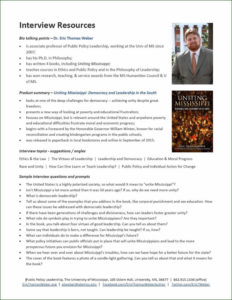 Dr. Eric Thomas Weber:
Product summary
Uniting Mississippi: Democracy and Leadership in the South:
Interview topics – suggestions / angles
Sample interview questions and prompts
To get the word out about the issues I care about, I am encouraging friends, family, and even folks I don’t know to help me share pieces I write for blogs, newspapers, and book publishers. In that effort, there are a few resources that can help, further connecting us and showing mutual concern and care about things that we agree are important to us.
Social Media:
A first set of resources that are helpful are our shared social media tools. If you haven’t already, friends and fans can follow, encourage, and share news, articles, and more via my social media profiles, including on Facebook, Twitter, LinkedIn, Google +, YouTube, and Academia.edu. Please do not underestimate how much this helps. At the same time, it has never been this easy for people to speak up publicly via the Web, but that also means that it has never been harder to get heard in such a noisy world. That’s a line from Michael Hyatt’s book Platform. I am following a lot of his advice in putting this site together.
Want to help spread the word? Here are a few sample tweets of my favorite quotes from Dewey & Plato, and one from my book, Democracy and Leadership, inspired by these thinkers:
“No state is permanently safe except on a foundation of justice.” —John Dewey & James Tufts, Ethics http://t.co/bJdIMoItAn
— Eric Thomas Weber (@erictweber) September 2, 2015
“Our city, if indeed it has been correctly founded, is wise, courageous, moderate, & just.” ~Plato, Republic
— Eric Thomas Weber (@erictweber) September 2, 2015
The greatest punishment for being unwilling to rule is being ruled by someone worse than oneself. ~ Plato, Republic, Book I
— Eric Thomas Weber (@erictweber) September 2, 2015
“The democratic belief in the principle of leadership is a generous one. It is universal.” ~John Dewey, “Creative Democracy”
— Eric Thomas Weber (@erictweber) September 2, 2015
Good leadership is judicious yet courageous guidance. ~ @EricTWeber in ‘Democracy and Leadership’ pic.twitter.com/9w54NnuUDX
— Eric Thomas Weber (@erictweber) September 2, 2015
You know you’re doing things right when unreasonable people don’t want you around. #PublicPhilosophyhttps://twitter.com/erictweber/status/641097482005520384/photo/1
— Eric Thomas Weber (@erictweber) September 7, 2015
Merchandise / Funny Stuff:
When you’re doing public intellectual work right, it isn’t about the author. What matters is the subject and the causes we care about — the issues that are meaningful to a community. Getting heard in a noisy world takes some serious effort, however, and “branding.” I’ve been encouraged to see whether any merchandise could promote good causes, wise words, and my Web site. I’m looking at CafePress for that, which can make custom stuff for just that kind of purpose. Maybe I’ll post here some t-shirts or mugs that have some of my favorite quotes on them from greats like John Dewey or Plato. We’ll see.
 On Uniting Mississippi:
“Rather than being fearful and pessimistic about our future here in Mississippi and in America, I regard this as being the time when we come together and put behind us once and for all the divisive and negative elements that have delayed the fulfillment of our hopes and dreams. This volume contains the blueprint to move us to the achievement of those worthy goals.”
—The Honorable Governor William F. Winter of Mississippi, from the Foreword
“The words ‘philosophy’ and ‘practical’ are rarely used together. Using the challenged state of Mississippi as an example, Professor Weber offers clear guidance on how inspired democratic leadership can bring about needed change. There are pearls of wisdom here for both the scholar and the aspiring leader.”
—Daniel W. Jones, MD, Professor of Physiology and Medicine & Former Chancellor and School of Medicine Dean, University of Mississippi.
 “I am often in conversation with groups and individuals around the state who are working hard to improve the lives of Mississippians. Some of the greatest needs in that work are an understanding of our history, the need for a common language to describe where we are in that history, and the creation of a community of practice that shares best practices and ideas. Dr. Weber’s book is an excellent start for supporting this crucial work.”
—Susan Glisson, executive director of the William Winter Institute for Racial Reconciliation at the University of Mississippi
“This book is the beginning of a desperately needed conversation in Mississippi about the future of the state. It addresses an issue that nearly everyone is aware of–the need for high quality education for Mississippians–with an understanding that it must precede rather than flow from economic growth. Anyone interested in education policy in Mississippi should read and consider the case for education in this book.”
—Robert Mellen, Jr., assistant professor of Political Science and Public Administration and undergraduate coordinator at Mississippi State University
“This superbly researched and written book defines more clearly than anything that I have read in recent years the elements that are essential for a democratic political system to fulfill its proper mission. Coming as it does in a time of diminished public decision-making capability, particularly at the national government level, this volume points the way out of our current malaise. It should be read by every citizen who wants to see our system work as well as it is capable of. As a former governor of Mississippi, I can attest to the value of the wise and pragmatic counsel it contains.”
—The Honorable Governor William F. Winter of Mississippi

“From Plato through today’s college students, Weber’s Democracy and Leadership carefully examines the pedagogy of leadership development. Because the book is so rich in content and style, you can add Weber’s name to a select list of noted southern scholars and writers.”
—James L. “Skip” Rutherford, Dean, University of Arkansas Clinton School of Public Service
“This book will certainly reorient the field of leadership studies, but its impact will extend beyond that field. By connecting leadership with broader issues about participatory democracy, Eric Thomas Weber will find grateful readers across political theory. He strikes a tone of optimistic practicality that especially rings true for pragmatic generation Xers and civic-minded Millennials. This book and its author are positioned as precisely that sort of new public voice capable of leading the next generations as they rise into political power and leadership themselves.”
—John Shook, University at Buffalo, New York
“I cannot urge strongly enough the consideration of this ingenious, well-written study for inclusion in the policy curriculum. We seldom have a book that is both original and practical, and this work is both. We have a major problem in the world today, a shortfall in ethical understanding that is producing dire consequences for every level of government. We need to spark interest in the ethical dimensions of policy studies, and Professor Weber has provided us with both the spark and the tinder. I will make good use of his study, and hope others will too.”
–Dr. Paul Rich, President, Policy Studies Organization, Washington, D.C.

“If there was ever any doubt that philosophy belongs in the real world–in the realm of legislatures and leadership–Weber’s book lays it to rest. By a marvelously rich development of the pragmatic experimental method, the author shows how philosophy can make central contributions to dealing with some of our most vexing moral problems. Lucid thinking and accessible style make the book’s lasting insights unmistakable. A must-read for both philosophers and community leaders.”
–Dr. John Lachs, Centennial Professor of Philosophy at Vanderbilt University, Nashville, TN
“Morality, Leadership, and Public Policy is written in an engaging manner. So filled is it with clear and powerfully compelling ideas and suggestions that one cannot read the book without finding oneself examining one’s habitual ways of approaching difficulties and seeking new possibilities for meaningful collaboration with others in fashioning public policy. Although Weber writes explicitly for philosophers, his work can also be read with benefit by nonphilosophers who are concerned with the moral dimensions of public policy and leadership.”
–Dr. Royce Jones, Capps Professor of Humanities Emeritus, Illinois College, in The Journal of Speculative Philosophy
 On Rawls, Dewey, and Constructivism:
“Eric Thomas Weber’s excellent book raises a constructivist challenge against Rawls’s constructivism…Weber’s Deweyan critique of Rawls’s constructivist conception of justice points to the difficulty in grasping Kantian constructivism. In Rawls’s writings, the reference to Kantian constructivism is so vague as to be essentially meaningless. That is one of the implications of this very useful book.”
— Tom Rockmore, Notre Dame Philosophical Reviews

Lorem ipsum dolor sit amet, consectetur adipiscing elit, sed do eiusmod tempor incididunt ut labore et dolore magna aliqua. Cum sociis natoque penatibus et magnis dis parturient montes nascetur. Accumsan sit amet nulla facilisi morbi tempus iaculis urna.
Lorem ipsum dolor sit amet, consectetur adipiscing elit, sed do eiusmod tempor incididunt ut labore et dolore magna aliqua. Cum sociis natoque penatibus et magnis dis parturient montes nascetur. Accumsan sit amet nulla facilisi morbi tempus iaculis urna.
*By entering your email, you agree to receive marketing emails from Lyra. You can unsubscribe anytime. See our privacy policy.
Testimonials, as authentic endorsements from satisfied customers, serve as potent social proof, significantly inspiring trust in potential consumers.

Testimonials, as authentic endorsements from satisfied customers, serve as potent social proof, significantly inspiring trust in potential consumers.

Testimonials, as authentic endorsements from satisfied customers, serve as potent social proof, significantly inspiring trust in potential consumers.

Testimonials, as authentic endorsements from satisfied customers, serve as potent social proof, significantly inspiring trust in potential consumers.

Lyra Everglen
All rights reserved | Privacy Policy | Terms of Use
Lorem ipsum dolor sit amet, consectetur adipisicing elit. Autem dolore, alias, numquam enim ab voluptate id quam harum ducimus cupiditate similique quisquam et deserunt, recusandae.
