‘Black Banker Ladies’ and the Power of the Informal

Outside of the gaze of formal finance, an often-demonized form of informal social finance flourishes. This finance consists of the regular pooling of money among friends and neighbors. It’s a way for individuals to amass chunks of money for paying for a new (used) car, educational expenses, household emergencies, and other major expenses. The system is relied upon by millions of Black women in Africa, the Caribbean, and North America as a trusted alternative to formal banking systems that often exclude them. 

There are many names for these traditional systems – susu, partner, meeting-turn, box-hand, sol, depending upon the culture in which they arise. But they are generically known as ROSCAs, an acronym for “rotating savings and credit associations.” ROSCAs are a vital way for people of color and modest means to take care of their financial needs when banking systems are unfriendly or unaffordable, often for racialized reasons.

Professor Caroline Shenaz Hossein

Professor Caroline Shenaz Hossein has studied the Black social economy for years, and especially cooperatives and informal economies. She has paid particular attention to ROSCAs as familiar, practical social vehicles for savings and credit.

In my latest Frontiers of Commoning podcast (Episode #18), Professor Hossein and I discuss the largely unknown realities of informal banking and the power of the Black social economy.

Black people have been “so traumatized by formal finance,” said Hossein, “that there are people who are unbanked or they choose to be under-banked. This means they’ll do the most minimal activities [with banks] because of the horror stories they have to endure – racism. Anti-black racism in commercial banking is not a secret anymore,” she said, which explains why many African-American women choose to “avoid those kind of stresses and engage with people who actually value their humanity” – their friends and neighbors.

Hossein is a professor of Global Development at the University of Toronto at Scarborough, in Ontario, Canada. Much of her scholarship aims to decolonize our very conception of “the economy” by showcasing the vital role played by informal, racialized, and feminist systems of commoning in the Solidarity and Social Economies.

For more, see the Diverse Economies Collective website and Hossein's books, such as Politicized Microfinance (2016), The Black Social Economy (editor; 2018), and her forthcoming Community Economies in the Global South (co-edited). 

For generations, Black women in the African diaspora have relied on “do it together” ROSCAs to pay for major expenses and avoid getting implicated in mainstream banking and state regulation. For their troubles, “Black banker ladies” are often harassed by the banking industry and state authorities, who reflexively regard them “terrorists” or drug dealers because they manage large amounts of cash. 

After years of racialized abuse from those very systems, Black banker ladies have little desire to interact with mainstream banks. They turn instead to self-organized groups of ten, twenty, or sometimes dozens of friends, as a more trusted, convivial form of finance.

ROSCAs are more than informal financial institutions. They are forms of personal support and neighborly solidarity. Through casual and flexible means, they perform various types of community development – home improvement, professional training, neighborhood solidarity – that formal banking is not equipped or inclined to perform.

Sometimes, ROSCAs are even sources of seed money for the campaigns of political candidates who wish to be champions for struggling working people. Hossein recalled how ROSCAs have paid for the lawn signs of candidates, for example. It is not surprising that mainstream banking would prefer to neutralize the empowerment that ROSCA-style finance can provide.

Professor Hossein is a big believer in the generative value of informal systems:

“Our primary focus in the West with marginalized groups has been to formalize everyone, and to demonize the concept of the informal. I like to think that Covid has really pushed us to a place where we now understand the value of mutual aid and getting things informally. It’s actually a good thing.  Not everything in the informal is dark and dirty. It is a way for people who have been under persecution to thrive.”

Here is a link to my fascinating conversation with Caroline Shenaz Hossein.

Update: Here is a wonderful profile of ROSCAs and Banker Ladies in The Globe and Mail (Canada), and here is a short piece in Medium by the Post Growth Institute.

Newest Civics in Real Life: Afghanistan: A Return to Yesterday

Good afternoon, friends. The newest Civics in Real Life looks at Afghanistan and the the US presence their over the past 20 years. We apologize for the delay in posting and hope to have it on Florida Citizen this weekend. Hope you find this useful! Click below for this Civics in Real Life resource.

Additional Civics in Real Life readings are available here. We expect to resume posting these there next week.

Why Philosophy of Crime and Punishment, Now?

I am teaching this course again. Every year it changes, and this year I hope it changes a lot. Here’s what I said about this today, our first day of classes:

Any story about crime and punishment is bound to start with a few stylized facts. Until this year, I’ve started with the same number: 2.3 million people are incarcerated in the United States, which is roughly seven times as many people as our peer nations would incarcerate if they had the same population we do. But last year something extraordinary happened: somewhere around 8% of those people were released and not replaced. We can’t be very exact because prisons across the country are not very careful about counting and reporting the number of people they imprison, but any way you slice it the pandemic has started an unprecedented process of decarceration that we’re going to be talking about throughout the semester.

I’m starting with that stat, but I could equally well start with another one: 

The FBI says that—during the first six months of this year—the number of murders in 22 cities increased by 16% compared to the same period in 2020 and by 42% compared to the first six months of 2019.

(cite)

Incarceration is down. Crime is up. Could there be a connection?

First, an interlude: when I taught this course in 2019, I had a student stand up about halfway through class and loudly leave, commenting “I thought this was going to be a course on Dostoevsky’s novel.” That’s a different class. And while I can tell you that there is almost certainly not a connection between decreasing incarceration and increasing violence, that’s not really what this class is about, either.

What we will do together if you continue in this class is somewhat different. I want to remind you about something literally academic: departments and disciplines. This is a philosophy class. And there’s a difference between how we approach a problem like mass incarceration in this department, compared to how it might be approached in a political science class, a psychology class, or a history class. I have colleagues and collaborators in all of those departments—as well as Theology, Linguistics, English, Biology, Sociology, and others—who apply their disciplinary approach to this issue. Meanwhile, we all are truly colleagues and collaborators: we work together, learn from each other, and read each other’s work.

So what I want you to think about—a little bit—is what the specifically philosophical approach to crime and punishment might be. 

One specifically philosophical approach is the analysis of concepts: 

  • What is a crime? What is the relationship between crime and moral obligation? Is crime any violation of the criminal code? Or are some things outlined in the criminal code that shouldn’t be, and some things allowed by the code that ought to be criminal? 
  • Is mens rea always required for something to be criminal? What about all the edge cases in mens rea—mental illness, youth, disability, and addictions—do they excuse otherwise criminal conduct? 
  • What counts as legitimate punishment? Are capital punishment, torture, exile, incarceration, branding, public shaming, all legitimate? 
  • What obligations do we have to those we punish? 
  • What is punishment for, anyway?

I have lots of good things to read on all those questions, and lots of little lectures to give on the history of answers to these questions, and honestly I think we can’t avoid some of them. But I don’t think this is the only right way to do philosophy, and in this class I think it’s more important to start with the real questions we have about these issues and try to weave these questions into them. Maybe in the abstract caning is a potentially legitimate punishment—but in the US, given the strong association between torture and slavery, we can’t endorse it. 

Right now, today, we face multiple crises related to crime and punishment. And I believe we are obligated to think through what we are doing in response to those crises. I believe that sometimes the best philosophy on a specific question is done in some other department or discipline: the historians, psychologists, linguists, and sociologists are usually pretty good at some crucial philosophical steps that philosophers ourselves sometimes miss.

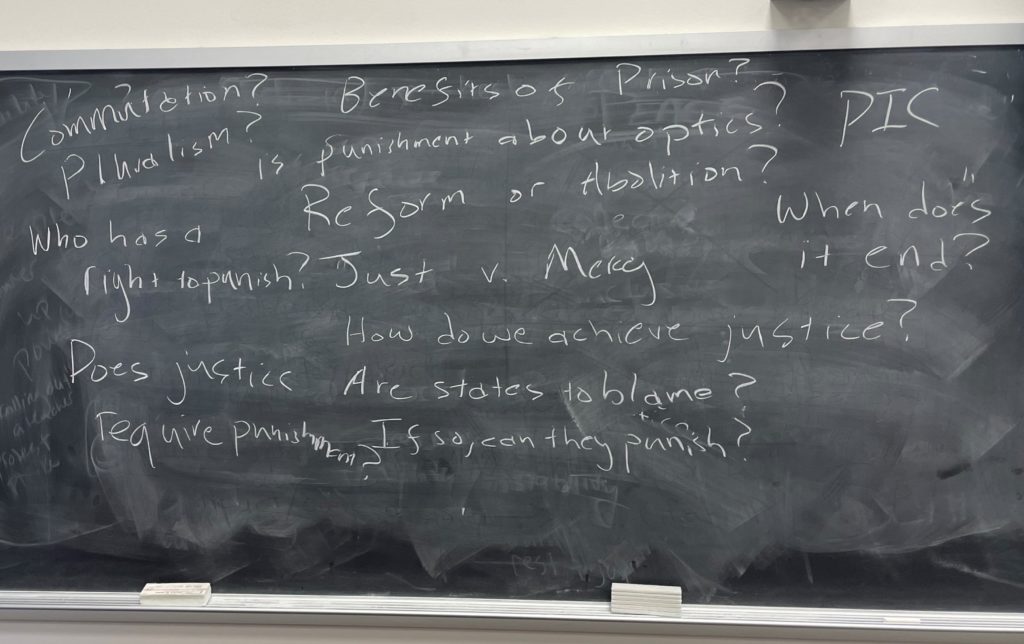
So I ask you: what questions are you bringing to the classroom?

My students’ questions

As you can see, primed with those analytic questions, my students ended up sounding pretty analytic! (Also, my handwriting is atrocious.) My humble observation is that often five groups of questions and themes emerge when I teach this class:

  1. What have we done? What is the current situation with prisons and policing? What are prisons like? What is it like to experience a violent crime? Who experiences that, and what do we do about it? What is it like to be stopped and frisked regularly? Does stopping and frisking millions of people every year reduce violence crime? What is it like to spend a month in prison? A year? The rest of your life?
  2. How did we get here? What is the cause or causes of mass incarceration—in the United States, but also in some other countries? Is it entirely white supremacy? Is it the War of Drugs?
  3. What should we hope for? Should we aim to abolish prisons and policing, or merely reform them? What are the alternatives? How do we enforce norms without an “or else”? What else has to change to change the legal punishment system?
  4. What can we do about it right now? What are the most promising policies and practices for ending mass incarceration in the United States? Do we need legal reforms, mass movements and protest, cultural and spiritual renewal, an end to capitalism, or something else entirely?
  5. What should we do with our anger, rage, and resentment?

Now look: we can’t duck the econometrics of crime and punishment. But we are going to ask some critical and philosophical questions about their methodologies.

I then led the class through some charts and graphs that debunk some of the major myths about mass incarceration in the US.

Next week? Danielle Allen’s Cuz. She’s a philosopher, after all!

Democracy Rising – Call for Contributions

NCDD Member Tom Prugh is working with Resilience.org to launch a blog series on the site, titled “Democracy Rising.” The goal of the blog is to introduce the readership to deliberative democracy. He’s working with some fellow NCDD members already, but is looking to expand the list of contributors. What better way than to reach out to you, the NCDD network!

Below is a description of the series and its purpose from Tom. Read on for more information on how to express your interest.


Democracy Rising will be a series of blog posts for the website Resilience.org that will lay out the basics of deliberative democracy: why it’s powerful, why the time is right for it, how it works, and how to get it going in one’s community. I will curate the series and write some posts myself, as well as reach out to various scholars and practitioners for contributions. I expect to submit a post every week or two for a year or so.

The underlying premise is that our system of democratic governance is in peril. Many top-down tweaks to the system are possible and necessary, but they will not be sufficient. Changes to the machinery of politics can help fix what’s broken at the top—but not what’s broken at the bottom. DD can help with that: it has a proven track record of bridging divides, tapping our collective intelligence, and mitigating political animus. It is possibly the best means of promoting the education into citizenship that makes for strong communities—especially as we approach an era when increasing localization seems likely.

The problem is that while DD is well known among the many scholars, practitioners, and citizens from all over the world who have experience with it, it’s mostly off the public radar. The field doesn’t lack expertise or results—there is a deep well of both within the DD community. But you could scan the mainstream media for years without seeing a single mention of a town meeting, citizens’ council, or technology review panel. The local focus means local obscurity.

DD needs more evangelism—an effort to publicize it to the wider world and build a movement of “democracy preppers” who want to stockpile social and community capital rather than beans and ammunition. The Resilience readership is largely focused on preparing for a post-carbon world–one of lower energy, less economic growth, and rising ecological stresses–and DD has much to offer as a means for communities to weather the turmoil ahead. This is a largely untapped audience that seems primed for the deliberative democracy message. The Resilience website has had 3 million unique visitors.


In addition to posting on Resilience.org, contributors are welcome to post on their own sites, and NCDD will be cross-posting as well. Contributions may be recurring or one-time. Brief author bios appended to each post will allow contributors to reach out to this new audience with information about their professional services and/or scholarship.

Topics should aim to fit into one of five categories, particularly topics 3 and 4:

  1. history and surveys of examples
  2. theory and arguments for DD
  3. handbook-type posts on how to do it; there is a huge amount of info on the NCDD website already that could be adapted for posting
  4. strategies and tactics for seeding it in a community
  5. further research, ongoing musings (further into the project)

If you are interested in exploring this opportunity, please reach out to Tom at PRUGHT@msn.com.

NCDD hopes you will consider contributing your perspective, resources, and research to this project! This is an exciting opportunity to reach more folks and share the opportunities that deliberative democracy can offer us all in working through today’s toughest challenges together.

two dimensions of debate about civics

It is good that Americans disagree about civic education. We are a free and diverse people who care about youth and the future of our republic. Agreement is not to be expected and could even be problematic. The question is whether we can disagree well while also giving our students an appropriate array of choices that they can assess for themselves.

I think there are almost as many ideas about the ideal approach to civics as there are people in the debate, and it is a mistake to assume that the field has polarized into just two or a few camps. Many individuals hold nuanced and complex views.

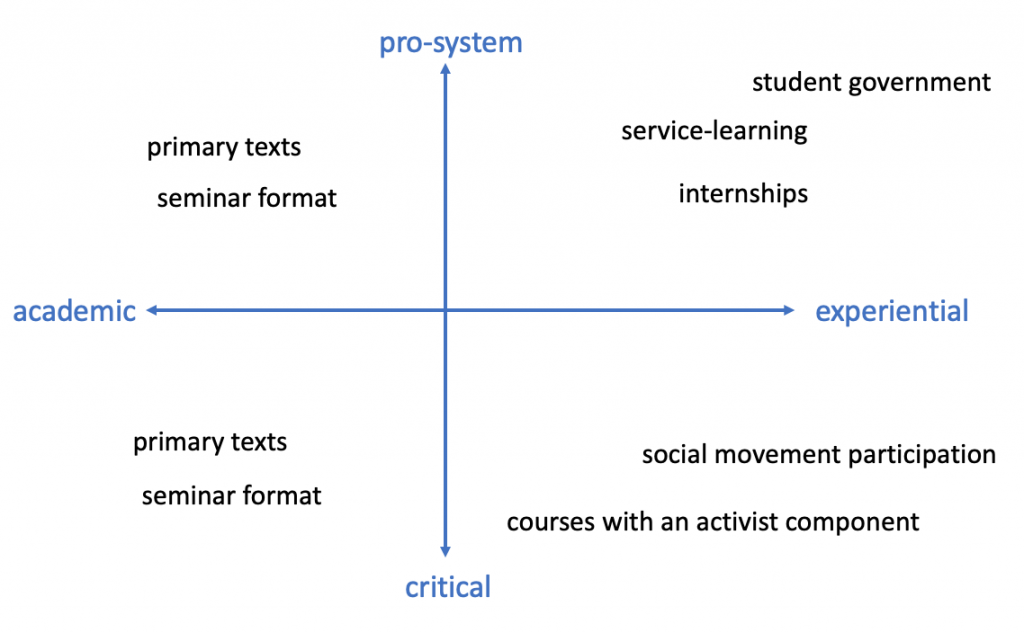
If I had to try to categorize views, I definitely would not use one continuum from left to right. I see two different axes that may help to organize the debate–as long as one remembers that hardly anyone chooses an extreme point on either continuum, and many see value across the whole map.

The vertical axis runs from favorable to critical of the US political system and society. Tennessee Gov. Bill Lee recently tweeted that his state’s schools will teach “unapologetic American exceptionalism.” In this context, “exceptional” doesn’t usually mean atypical; it means better. That places Gov. Lee pretty close to the top of my graph. Someone who wants students to focus on historical and current injustices would fall near the bottom.

The horizontal axis runs from classroom-based work (reading, discussing, and writing about texts) to experiential learning. It may also reflect a debate about whether knowledge or skills are the most important outcomes. Lee added, “By prioritizing civics education in TN schools, we are raising a generation of young people who are knowledgeable in American history and confident in navigating their civic responsibilities.” He seems to be open to engagement as an outcome, so maybe he would support the whole top half of my graph.

These two axes are distinct and orthogonal. The most common forms of experiential civics–approaches like service-learning and student government–are often pro-system. They belong above the middle of the chart. In the Positive Youth Development field, service-learning is understood as “contributing positively to self, family, community, and, ultimately, civil society” (Chung & McBride 2015). Service-learning may also encompass critical reflection about systems (Mitchell 2008), but I think the critical aspect has been rare and often superficial.

On the other hand, if you really want to teach some version of critical theory in a K-12 classroom, you are probably interested in assigning and discussing texts. (That is why it is called “theory.”) So you likely fall the left of the middle of my chart–on the same side as the people who want to assign classical texts that they appreciate. The pedagogy is similar; the debate is about which texts to assign, which topics to discuss, and which interpretive lenses to use. Meanwhile, many of us strive to assign texts with diverse perspectives and cultivate a robust discussion within the classroom.

For what it’s worth, my own emphasis is on learning how to build and manage associations. I’d use an academic pedagogy (reading, writing, and discussing texts, data, and models) for a pragmatic purpose: making civil society work. I’d let the students decide the ultimate objectives of their own associations. This approach implies a canon of texts (Alexis de Tocqueville, Gandhi, Robert Michels, Jane Addams, Mary Parker Follett, Saul Alinsky, Bayard Rustin, Ella Baker, Jenny Mansbridge, Elinor Ostrom …) that is neither pro- nor anti-system, as a whole.

I would never claim that this is the only important approach, but I think it is undersupplied.

See also: NAEd Report on Educating for Civic Reasoning and Discourse; an overview of civic education in the USA and Germany; The Educating for American Democracy Roadmap; etc.

mixed thoughts about the status of science

Science is at the heart of several of our hardest issues, including COVID-19 and global warming. (And even race and policing.) While some Americans display “Science is real” yard signs on their front lawns, Dr. Fauci is the face of oppression for others.

The question of science is not simple.

On one hand …

What individuals think about matters like vaccination and climate change has consequences for everyone else. It can be hard to coexist with people whose beliefs seem fundamentally, even willfully, false.

Some findings are well-substantiated, e.g., that vaccines work and that human beings are causing the climate to heat up dangerously.

For any given question, there are better and worse methods of inquiry. If you want to know whether a vaccine works, a randomized, double-blind, controlled experiment is an excellent method. Google-searching to see what various “influencers” say … is not.

Science is a process of inquiry, not a set of truths. When scientific consensus shifts, that is a sign of learning, not an embarrassment.

The process of learning about COVID-19 has been extraordinarily fast and impressive. It is harder to assess the pace of learning about climate change, but we have learned how to learn a lot better than our ancestors could have done three or four centuries ago.

On the other hand …

No one obtains complex knowledge directly or alone. Science is a collective enterprise, deeply dependent on interpersonal trust. Even if you are an epidemiologist or a virologist, you can’t directly observe truths about COVID-19. You must trust data, instruments, protocols, metrics, and theoretical models that come from other people. For instance, you can only know what you’re seeing through an electron microscope because you trust that device and all the previous science that yielded it.

Science is a set of human institutions that confer power and status on some, while excluding others. Anyone with a doctorate has received a graduate education that cost someone hundreds of thousands of dollars. Americans rank physicians highest in status (7.6) out of hundreds of jobs. Physics professors and college presidents come next. Environmental scientists also rank high (6.5). But many Americans are in no position to obtain these jobs, and many may not want them. By the way, just 5 percent of physicians are Black, and 0.3 percent are Native American.

It is all very well to say “Trust the experts.” But the experts in foreign and defense policy bear responsibility for two disastrous wars since 2001. Experts in urban policy wrecked our cities’ cores by slicing highways through them and forcing people into segregated public housing. Medical experts described homosexuality as a pathology in the DSM until 1973. Some influential nutrition experts insisted that fats were bad and sugar was safe while being financed by the sugar industry.

People like me have deep personal reasons to give scientific institutions the benefit of the doubt. One of these institutions literally pays my comfortable salary. My parents, spouse, sibling, and children have been admitted, supported, and (in many cases) paid by universities. I live in a neighborhood dominated by people who have benefitted from the same institutions; it has good public schools, safe streets, and high property values. Many other people could not get into any of these institutions, or don’t want to get into them, or would not feel comfortable in them, or would not be valued by them. Trusting science comes naturally to me but has no natural appeal for many other human beings.

Partisan and ideological heuristics affect all of us. I find it very comfortable to decry Ron DeSantis’ handling of COVID-19 and to blame him for Florida’s current wave. That fits with what I want to think about Republicans, conservatives, etc. It is a lot less comfortable for me to consider why the highest cumulative per capita COVID rates are in New Jersey, New York, and Massachusetts, while Florida ranks 26th and has (to date) just 62% the cumulative case rate of New Jersey. I don’t think the takeaway is that liberal policies have worsened COVID-19. (For one thing, Mississippi is close behind Massachusetts, and Vermont and Hawaii have done best of all.) But it is no more valid to infer that conservative policies are to blame.

As the last point suggests, there is much that we really do not understand, such as the reasons for the variation in COVID-19 outcomes by state or nation. If we knew the answer to that, it might help us to assess overall social systems. We are deeply divided about what kind of society we should live in, and science has not answered that question. It is not as useful as it could be for public debates, yet it should never provide the solutions, since we must reason about values as well as facts.

There is no such thing as value-neutral data. People always decide what to observe and measure and what to call the results. When I search Google Scholar for “school social distancing COVID,” I see the following keywords in the top results: school closure, workplace non-attendance, school lockdown, mental health, weight gain, nonessential workers, nonessential businesses, epidemic control, and mitigation strategies. Whether these are the most important topics, what is missing (race, for instance), and whether these factors are rightly named–these are value questions, not scientific ones. Besides, in many cases, the data come from mandatory reports, and what we require people to report is a value-judgment.

Finally, the methods that work best for evaluating the effects of a mass-produced chemical compounds, such as vaccines, may not work best for assessing many social, cultural, and moral issues. In many domains, positivist methods are too influential and not enough credibility is accorded to laypeople’s knowledge.

I agree with Jonathan Badger that the most prominent critics of science are not raising subtle points about the soft despotism of scientific institutions or the tension between expertise and democracy. Instead, they are making false statements with great certainty. That is a disgrace, but it doesn’t negate real questions about the role of science.

See also methods for engaged research; we should be debating the big social and political paradigms; what is Civic Science?; “Just teach the facts”; notes on the social role of science; etc.

National Civic Review Summer Ed. – Access Code Included

The National Civic League, an NCDD member organization, released the National Civic Review (NCR) Summer 2021 edition and  NCDD members receive a digital copy of NCR for free! (Find the access code below.). This esteemed quarterly journal offers insights and examples of civic engagement and deliberative governance from around the country. Thanks to Rebecca Trout, NCL’s Program Director for All-America City Award & Communications, for sharing this announcement with the NCDD network!

Friendly reminder that the League is always seeking articles for NCR on community-based examples of civic engagement, public deliberation, co-production, and democratic innovation – more info here.


National Civic Review Summer Edition 2021 – Access Code: NCDD21

The summer issue of the National Civic Review celebrates cities that are making progress on addressing challenges such as racial equity, health equity and community resilience. Review authors offer insightful ideas on measuring the value of public participation, engaging urban residents through block clubs, promoting public trust with better service delivery and digital communication, and the most effective ways of seeking input from youthful residents. Former Missoula Mayor and Speaker of the Montana House of Representatives Dan Kemmis offers his ideas on what a small “d” democratic renewal movement might look like in the 21st Century.

You can access this edition by going directly to the table of contents and entering your access code: NCDD21.

One of the Nation’s Oldest and Most Respected Journals of Civic Affairs
Its cases studies, reports, interviews and essays help communities learn about the latest developments in collaborative problem-solving, civic engagement, local government innovation and democratic governance. Some of the country’s leading doers and thinkers have contributed articles to this invaluable resource for elected officials, public managers, nonprofit leaders, grassroots activists, and public administration scholars seeking to make America’s communities more inclusive, participatory, innovative and successful.

Community Solutions for Advancing Health Equity in NYC

Public Agenda is hosting an upcoming webinar that we encourage you to join – Equitable and Inclusive Engagement: Community Solutions for Advancing Health Equity in NYC on Wednesday, August 18, 2021 from 1:00 PM to 2:15 PM Eastern, 11:00 AM to 12:15 PM Pacific. Thanks to Nicole Cabral, Public Agenda’s Associate Director of NY Engagement Programs, for sharing this announcement with the NCDD network! Learn more below and register here.


Equitable and Inclusive Engagement: Community Solutions for Advancing Health Equity in NYC

Public Agenda would like to invite you to a free webinar on August 18, 2021, led by our Associate Director of NY Engagement Programs, Nicole Cabral. Nicole will be speaking with Dr. Alyson Myers, Medical Director of Inpatient Diabetes at North Shore University Hospital, and community advocate, Lisa Foster, about how health care providers, policymakers, and residents are advancing health equity in New York City.

While this conversation will be focused on health equity in the NYC area, we believe the conversation will resonate in other communities as well. Feel free to share this information with your networks.

We hope you can join us on August 18th – You can register here!

Join three New York-based women of color as they discuss health equity, the social determinants of health, and culturally competent care from the perspective of the doctor, researcher, and patient and caregiver. Nicole Cabral, Associate Director of NY Engagement Programs at Public Agenda, will lead a very important conversation with Dr. Alyson Myers, Medical Director of Inpatient Diabetes at North Shore University Hospital, and Lisa Foster, Community Advocate, on how health care providers, policymakers, and residents are advancing health equity in New York City.

Dr. Alyson Myers is the Medical Director of Inpatient Diabetes at North Shore University Hospital in Manhasset, New York. She also is an Associate Professor at the David and Barbara Zucker School of Medicine at Hofstra/Northwell. Dr. Myers is a sought-after speaker in both academia and her community. In February 2021, she gave Endocrinology Grand Rounds at the Mayo Clinic on the topic of Diabetes and COVID-19: Tales from the Epicenter. Dr. Myers also co-hosts a biweekly webinar, Corona Conversations in the Black and Brown Community, that reaches hundreds of viewers internationally.

Serving as a reviewer for numerous journals including Minerva Endocrinologica, Journal of Affective Disorders and Diabetes Care, she is also an active member of both the Endocrine Society and the American Diabetes Association. In 2021, Dr. Myers was re-elected as a three-year member of the ABIM Endocrinology, Diabetes & Metabolism Board. In 2019 she was awarded as Doctor of the Year by the Professional Organization of Women in Excellence Recognized (POWER) and with the Salzman Award for Quality from the Department of Medicine, Northwell Health. In September 2020, she was recognized by the Department of Medicine for Women in Medicine Month.

Nicole Cabral is the Associate Director for New York Engagement Programs at Public Agenda. She manages the Public Engagement team in the development and execution of projects on a variety of local and national issues.

civically engaged research in political science

Amy Cabrera Rasmussen, Valeria Sinclair-Chapman, and I co-direct the American Political Science Association’s Institute for Civically Engaged Research (ICER). The 2021 Institute took place online, and Political Science Now has published an article about it.

The first cohort assembled in 2019, and members of that group have since edited a symposium on civically engaged research for PS. Some of the symposium articles are starting to appear in “first look” format and will be published together soon. The preface to the symposium is online and open access: Rasmussen, A., Levine, P., Lieberman, R., Sinclair-Chapman, V., & Smith, R. (2021). Preface. PS: Political Science & Politics, 1-4.

Please watch PS for more ambitious articles from the symposium. They review definitions of civically engaged research, critically analyze various motivations for undertaking it, connect engaged research to teaching, and so on.

See also: how to keep political science in touch with politics; methods for engaged research; what must we believe?; civically engaged research in political science; etc.

Lou Frey Institute Fall Webinar Series Starts in September with the National Archives!

Good afternoon, friends and colleagues. We are excited to share that we will be hosting a webinar next month that will feature Dr. Charles Flanagan, our dear friend from the National Archives’ Center for Legislative Archives!

This webinar is open to ANYONE who wishes to learn more about teaching our Founding Documents and the principles embedded within them. You can register here, and please consider sharing the flyer!