Long before white Americans felt like their society had abandoned them, Black Americans knew the feeling. Just like whites do today, some Black Americans responded to earlier superfluousness by “clinging to guns and religion” to use Barack Obama’s famous analysis. (cf. Kinsley gaffe) Here’s James Baldwin, describing the Nation of Islam:
“I’ve come,” said Elijah, “to give you something which can never be taken away from you.” How solemn the table became then, and how great a light rose in the dark faces! This is the message that has spread through streets and tenements and prisons, through the narcotics wards, and past the filth and sadism of mental hospitals to a people from whom everything has been taken away, including, most crucially, their sense of their own worth. People cannot live without this sense; they will do anything whatever to regain it. This is why the most dangerous creation of any society is that man who has nothing to lose. You do not need ten such men—one will do. And Elijah, I should imagine, has had nothing to lose since the day he saw his father’s blood rush out—rush down, and splash, so the legend has it, down through the leaves of a tree, on him. But neither did the other men around the table have anything to lose. –James Baldwin, “Down At The Cross: Letter from a Region in my Mind“
Baldwin was no fan of Elijah Muhammed’s movement, but he tries to understand it and he seems to sympathize. And what he calls out in these lines is an overriding sense of loss–one that can justify any effort or sacrifice to overcome. That loss of worth, which Baldwin wants to depict as something much deeper than “self-esteem,” is tied not to airy questions of recognition but to material harms and embodied injuries: frisks and kicks by “legitimate” authority that go unanswered, murdered fathers that go unmourned by white society.
Baldwin even interprets the turn to Islam as a turn away from Christianity’s whiteness–from the forgiveness that it seems constantly to demand from white supremacy’s victims.
Today I know more Black Muslims than Arab ones, but mostly they’re imprisoned. And that, too, is a form of superfluousness: of the 2.3 million people incarcerated in the US, 40% are Black, even though Blacks make up only 13% of the population.
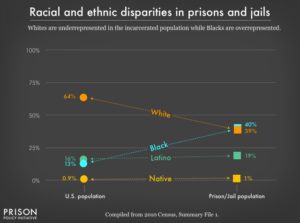
It’s hard not to see imprisonment of African-Americans as primarily a reaction to their enforced superfluousness. Labor market prejudices create a circumstance where unemployment rates for African-Americans are roughly double the rates for whites, at every education level. My students believe (and I agree) that the War on Drugs is largely a war on Black participation in the black labor market. (Recall the Ice Cream truck war of the summer which helps explain how police and the courts can make black markets less or more violent.) It’s an attempt to foreclose available forums for Black entrepreneurship. It’s notable that as marijuana legalization proceeds state-by-state it begins in white places, and the new profits and businesses are primarily white-owned.
To be rendered superfluous is a particularly odd phenomenon, and at least in the formulation I’ve lately been thinking about, it seems uniquely tied to relative deprivations of status and respect. I want to believe that respect and recognition matter less than life or health. We all have things we could lose, and honor is the least of these.
But that’s simply not how people act. Flourishing matters to most people more than survival, and flourishing requires a community of esteem. It requires reputation and character assessments, it requires that the agents of the state give you equal protection and don’t target you as a unique threat.
Some parts of Black America responded to superfluousness by clinging to god and guns, but for the most part African-Americans responded by becoming the center of cultural attention. There’s little argument that Black culture simply is American culture at this point, as almost all of our distinctively American institutions and cultural traditions are shot-through with Blackness even if it is unacknowledged. Baldwin charged that even myths of Black laziness or violence serve an important function in White America: they are our “fixed star” and moving out of their place of subordination would shake our “heaven and earth… to their foundations.”
Yet whites don’t seem to be willing to create their own economies of esteem in this way. Something–perhaps supremacy itself–has rendered them too lazy, too dependent on long-lost tradition and long-gone cultural victories. Consider Katherine Cramer’s formulation: rural Wisconsinites resent that the urban centers have deprived them of “power, money, and respect.” But they’re simply wrong: they’ve seen no real deprivations of power or money compared to Black Americans. It’s certainly true that they receive less respect than they used to get, less deference and less cultural attention. But this is a downfall from absolute supremacy and literal enslavement–enforced by rule of law. We have a long way to go before we aren’t still reaping what WEB Du Bois called “psychic wages” of white supremacy. (I prefer to call them psychic dividends, since it’s important that they are not a reward for work, but rather like a racial trust fund.)
How much should that matter? In my heart, I want to believe that people with a surplus of money, power, and respect should share. And I want to believe that it’s not a finite resource, that more souls can and will produce more of each if they’re not forced into superflousness. I think of Malcolm X, whose industriousness and self-invention could not be halted or stultified by racism or even Elijah Muhammed’s theocratic nonsense, only assassinated. But that’s where my analysis is probably wrong: when people have the money and power, they’re well-placed to demand the respect or punish its absence.



 NCDD is here to support our members and the broader network of people and organizations working to help people come together across divides and make better decisions for our communities. All of the work we do is for the benefit of the field – connecting members to one another at
 We know that 2017 will be a year where dialogue & deliberation are more essential than ever and that it can make a key difference in the direction of our communities and our country. We are so honored and grateful to serve such an amazing network, and NCDD is determined to expand the reach and impact of our individual and collective work in 2017. We ask that you support us in our continued efforts to do so.
 We don’t think hard enough about the metaphysics that underwrites the social sciences. Epstein is more reductionist than he lets on, but this was the book that had me thinking hardest this year.

 Fully-realized far-future worlds, with fascinating characters and an interesting set of mysteries.


