how to think about other people’s interests: Rawls, Buddhism, and empathy

Last week, my colleague Erin Kelly and I taught excerpts from John Rawls’ Theory of Justice along with Emily McRae’s chapter, “Empathy, Compassion, and ‘Exchanging Self and Other’ in Indo-Tibetan Buddhism,” from the Routledge Handbook of Philosophy of Empathy. I then attended a conference on empathy. As a result, I’ve been thinking about Rawls’ famous thought-experiment, Buddhist exercises for moral improvement–and how empathy relates to both.

Rawls argues that to know what justice demands, you should collect all the relevant available information about how the society in general works, but you should then imagine that you don’t know your own position in the society and ask what rules and institutions you would favor–in your own interest–under this “veil of ignorance.”

To make that method seem intuitive, imagine that I am considering (in the light of last week’s scandalous news about college admissions) whether it is desirable for such institutions as Yale University to exist. I should try to understand how Yale functions, today and in the past, in the broader society. But I should try not to be influenced by the fact that I was admitted to Yale and graduated from there. I should ask whether the existence of Yale would be a good thing if I did not know whether I would ever get anywhere near it. Thus general knowledge plus self-interest plus ignorance about my own circumstance equals justice.

We could think of this thought-experiment as a way of modeling justice. Just as we test a model of a new airplane in a wind tunnel, so we test a theory of justice by using Rawls’ veil of ignorance, because that will yield the same results as justice itself would yield if we could know directly what justice says.

Now compare Rawls’ method to those developed in Indo-Tibetan Buddhism. McRae begins her chapter: “Imagine yourself as an old yak … your back weighed down with a load far too heavy, a rope pulling you by the nostrils, your flanks whipped, your ribs bruised by the stirrups.” She is quoting the nineteenth-century Tibetan master Parrul Rinpoche, who offers it as an exercise in empathy.

McRae defines bodhicitta as a “radically altruistic moral orientation that centrally involves cultivating oneself in order to be the kind of person who can reliably, effectively, and wisely benefit others… . The cultivation involved in becoming a person with bodhicitta–a bodhisattva — … includes developing virtues such as patience, generosity, and wisdom, and moral skills such as mindfulness, moral reasoning, responsiveness, and, arguably, empathy. … .Empathy practices [such as imagining that you are a yak] are traditionally presented in the context of cultivating bodhicitta, since empathy triggers both virtuous emotionality (through the Four Immeasurable Qualities practices) and the realization of no-self (through exchanging self and other practices), both of which are necessary for bodhicitta.”

Here are some differences:

  • Rawls tries to make moral reasoning as impersonal as possible, whereas the Indo-Tibetan Buddhist tradition strives for maximum concrete identification with other sentient beings.
  • In the Buddhist tradition, you cultivate empathy. Rawls provides a way of determining justice that does not require empathy–in part because empathy can be biased, manipulated, and otherwise untrustworthy.
  • Rawls treats every person as equal, whereas a stance of “radical altruism” implies that the thinker should count everyone else as more important than herself.
  • Rawls’ theory is limited to “persons” (probably human beings), whereas Buddhism extends to all sentient life.
  • Rawls offers a technique for deciding what justice is, whereas for the Buddhist theorists, the problem is not deciding what is right–they presume that we should be as altruistic as possible–but rather motivating people to act right. “Exchanging self and other is not simply a heuristic for determining the limiting condition on action (“how would you like it if someone did that to you?”) or a mental exercise in perspective taking. It is a transformative practice that uses empathic imaginative projection to chip away at self-clinging by softening the boundaries of self and other.”

And here are some similarities:

  • Both methods are conducted by the thinker alone. Neither is dialogic, involving an actual exchange of opinions. You imagine you’re a yak, but you don’t ask the yak if you got that right.
  • Like the Buddhist teachers, Rawls also softens “the boundaries of self and other,” but he does so by asking you what you’d want if you did not know who you were.

If you happen to find both arguments persuasive, you’re left with an odd proof:

1. Self-interest plus [a specific form of ] ignorance = justice (Rawls)

2. Compassion plus radical altruism = justice [Buddhism]

So

3. Self-interest plus ignorance = Compassion plus radical altruism

True?

See also: empathy, sympathy, compassion, justice; empathy: good or bad?; “Empathy” is a new word. Do we need it?; Owen Flanagan, The Bodhisattva’s Brain: Buddhism Naturalized; the grammar of the four Noble Truths; avoiding the labels of East and West; Philosophy as a Way of Life (on Pierre Hadot)

conservatism as gratitude or humility?

(DCA) Yuval Levin offers this definition (h/t Robert Pondiscio):

To my mind, conservatism is gratitude. Conservatives tend to begin from gratitude for what is good and what works in our society and then strive to build on it, while liberals tend to begin from outrage at what is bad and broken and seek to uproot it.

You need both, because some of what is good about our world is irreplaceable and has to be guarded, while some of what is bad is unacceptable and has to be changed. 

This is a thoughtful effort to describe left and right evenhandedly, but I don’t think it is the best way to define or defend conservatism.

The problem is that people differ greatly in the degree to which they can reasonably be grateful to any particular polity. Consider, as one of several extreme examples, Native Americans. They can adopt any view of the USA that they want, but they have much less objective reason to be grateful to this republic than I have. They may well feel deep gratitude to their own communities. That gratitude is particularistic. Conservatism would then imply a particularistic ideal: a commitment to the specific communities that deserve each person’s gratitude. Some versions of conservatism have in fact been particularistic–but not Levin’s. He wants Americans (all Americans, I presume) to feel grateful to the nation-state:

But we can also never forget what moves us to gratitude, and so what we stand for and defend: the extraordinary cultural inheritance we have; the amazing country built for us by others and defended by our best and bravest; America’s unmatched potential for lifting the poor and the weak; the legacy of freedom—of ordered liberty—built up over centuries of hard work.

In the same essay, Levin suggests a more secure and persuasive core principle for conservatism—humility:

Conservatives often begin from gratitude because we start from modest expectations of human affairs—we know that people are imperfect, and fallen, and weak; that human knowledge and power are not all they’re cracked up to be; and we’re enormously impressed by the institutions that have managed to make something great of this imperfect raw material. So we want to build on them because we don’t imagine we could do better starting from scratch.

This reminder of “modest expectations” is what conservatism valuably contributes to public debates. Because people are “imperfect, and fallen, and weak”–or, we could say, cognitively and motivationally limited and biased–we should always be somewhat skeptical of ambitious reform proposals, of original designs for complex things (cities, welfare programs, markets), and of the likelihood that any person can dramatically improve things for any other person.

Humility, in this sense, is the common thread that unites libertarians (skeptical of central planning), religious conservatives (skeptical of human reason and motivation), and communitarians (skeptical of formal institutions). It also encourages all three types of conservatives to admire complex phenomena that have emerged and that seem to function well enough–“that have managed to make something great of this imperfect raw material.”

Levin argues that humility implies gratitude, but that connection is contingent. It depends on whether what has emerged so far is good enough for you and the people you care most about. Answers to that question will reasonably differ. Humility is the premise; gratitude is a consequent that depends on the circumstances. Humility is something that everyone has a reason to endorse, although everyone should also be open to the possibility of change.

See also: what defines conservatism?; a plea to conservatives; and from classical liberalism to a civic perspective

“Empathy” is a new word. Do we need it?

According to the OED, “empathy” entered the English language in 1895 to mean “a physiological brain-function”–specifically, “a form of psychophysical energy” in the nervous system–that correlated with a feeling.

This meaning is now obsolete, because the underlying theory is. A somewhat more familiar meaning appeared in 1909: “Not only do I see gravity and modesty and pride … but I feel or act them in the mind’s muscles. This is, I suppose, a simple case of empathy, if we may coin that term as a rendering of Einfühlung.” E. B. Titchener Lect. Exper. Psychol. Thought-processes i. 21  (1909).

But this meaning is now also “rare,” says the OED. The word “empathy” gained its mainstream current meaning only in 1946 (in a professional psychology journal):

[Meaning 2b] orig. Psychology. The ability to understand and appreciate another person’s feelings, experience, etc.

1946 Jrnl. Clin. Psychol.2 61/1   A ‘man-to-man’ regard for the client, characterized (ideally) by the understanding of empathy without the erratic quality of identification or the supportiveness of sympathy.

You might think it’s a Greek word, and it parses in Greek: en- (“of the state or condition of”) plus pathos (“an incident, accident; suffering”) = “the state of someone’s [else’s] suffering.” But no such word is listed in my Liddell & Scott Greek-English Lexicon. It is a modern English word built of ancient Greek components. If anything, the origin is the German word Einfühlung (coined in 1873), which needed an English equivalent.

While noting the recent origins of the English word, Emily McRae also argues that it has no direct translation in Sanskrit or other languages that have been used to express the Indo-Tibetan Buddhist tradition. Key words from that tradition are better translated as “compassion” and “sympathetic joy.” McRae derives a theory of empathy from Buddhist texts, but she interprets phrases like “exchanging self and other” rather than any single word that corresponds to “empathy.”*

Since the word “empathy” is recent, and many wise thinkers have done without it, we might ask whether adding it to our vocabulary has done us good. It would be possible to carve up the conceptual space so that “empathy” vanished and we used only “compassion,” “beneficence,” “good will,” “forgiveness,” “responsiveness,” “mirroring,” and other related words.

I am a little worried that “empathy” confuses matters by combining an empirical concept–empathy exists when person A feels an emotion, which causes person B to feel some of that same emotion–with a positive moral valence (it is good to be empathetic). Yet it is not always good to feel the same emotion as someone else in response to that person.

*“Empathy, Compassion, and ‘Exchanging Self and Other’ in Indo-Tibetan Buddhist Ethics” for Handbook of Philosophy of Empathy (Routledge), edited by Heidi Maibom, 2017. See also: empathy, sympathy, compassion, justice; empathy: good or bad?; and my self, your self, ourselves

Talks in Spring 2019

I’m pleased to report on two exciting invitations I’ve had to speak in the spring of 2019. For one of them, the Ron Messerich Distinguished Lecture that I delivered in February, I spoke on “Correcting Political Correctness,” a piece from my book in progress titled A Culture of Justice. On Tuesday, February 26th, I gave the talk at Eastern Kentucky University. While there, I had the pleasure of meeting with students in the journalism program, who interviewed me for Eastern Progress, their television program. I’m quite grateful to Mike Austin for inviting me to deliver this lecture. The attendance was great and the questions and comments offered after my talk were really rich and engaging. Here is the video interview:

If you can’t see this video in your RSS reader or email, then click here.

The next trip I’m taking will be next week, when I’ll be heading to give three talks at Texas State University San Marcos. I’ll be talking at the local library about “Democracy and Public Philosophy,” from 4:30-6pm on Wednesday, March 13th. Then, on Thursday, March 14th, I’ll be talking about “Culture and Self Respect” from 2-3:00pm in the Alkek 250 Theater on campus. Friday morning, March 15th from 9-10am I’ll be talking about “Democracy and Leadership”  in PS3301. More on that as it develops, but it is coming soon.

The post Talks in Spring 2019 first appeared on Eric Thomas Weber.

Habermas, illustrated

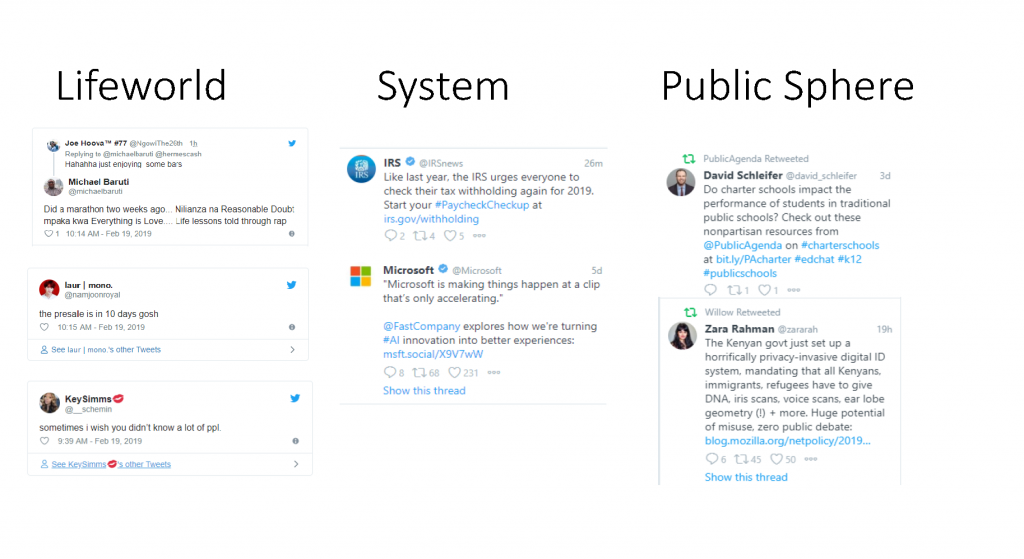
I’ve categorized a bunch of recent tweets by putting them in Jürgen Habermas’ three buckets:

  • In the first column, the tweets are literally legible–I can read them–but I don’t know much about their significance. That is because they are meant for friends, people who share experiences with the authors. Because so much common experience is assumed, these are essentially private messages in a public space. In Habermas’ terminology, they represent the Lifeworlds of the authors and their friends.
  • In the second column, employees of formal organizations are doing their jobs–telling people to file their taxes, encouraging them to buy products. For Habermas, these are Systems. They have pre-determined goals that they are openly pursuing–power and profit.
  • In the third column, people are expressing views to audiences that include strangers about matters of common or public concern. These authors have emerged from their respective Lifeworlds to say something about how Systems should change. Their goal is to educate or influence. This is the Public Sphere.

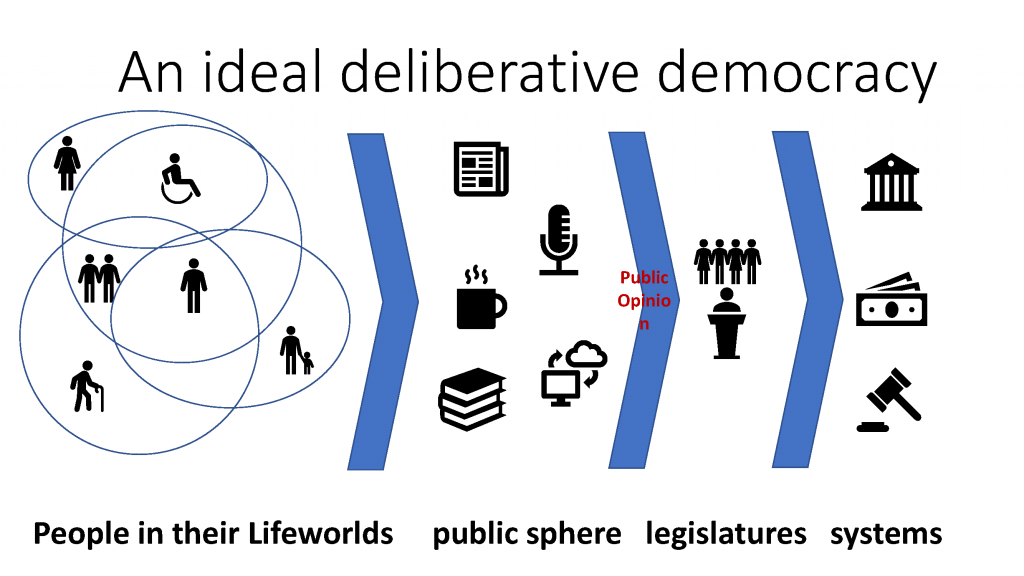
Below is a diagram of how it should work. People should enjoy their Lifeworlds. They have a right to them. I show each person’s horizon of experience and assumptions as unique but overlapping with those of other people, to allow shared meaning.

Individuals should emerge into the public sphere to advocate for changes, addressing other people as free subjects who will respond to good reasons. Together, they create public opinion.

Since opinion always involves disagreement, a deliberative and representative legislature should take their input and make decisions, which should affect the Systems of law, market, and government.

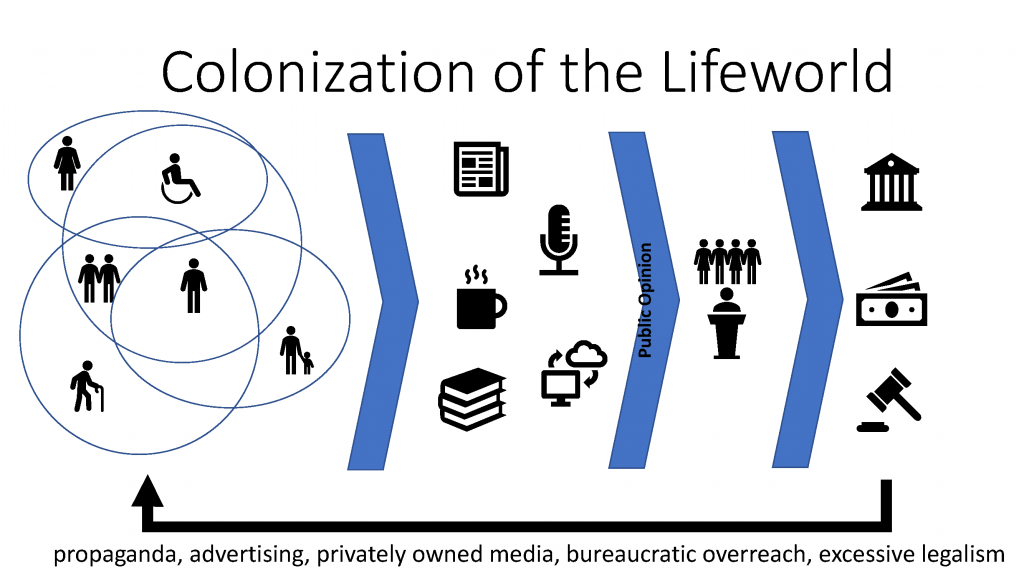
This is how it often actually works:

The systems of money and power influence public opinion by infiltrating people’s Lifeworlds.

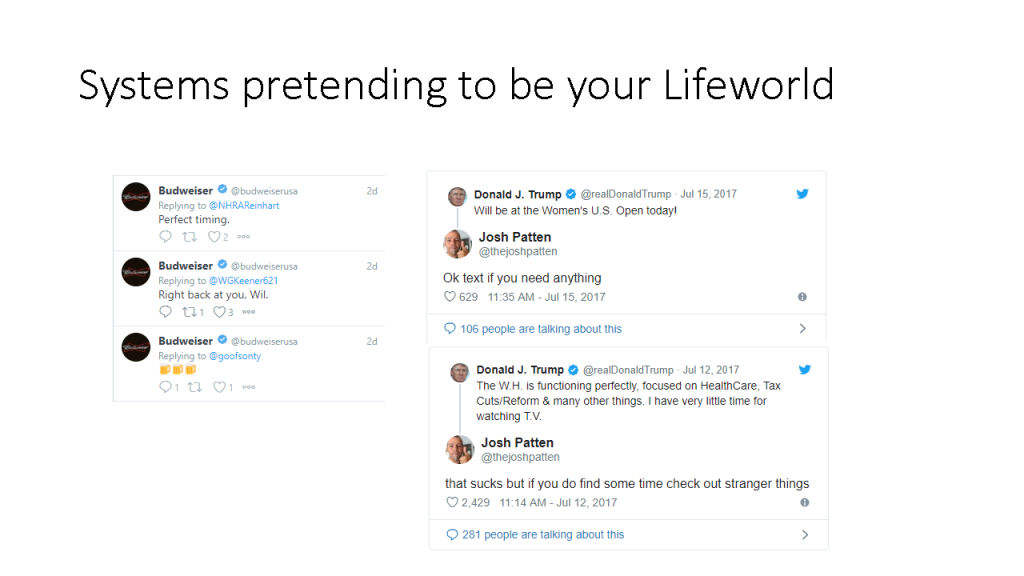
One particular mechanism is a message from a System that pretends to be your friend. Budweiser tweets all day with private individuals who drink its beer. And Donald Trump sends tweets to 58 million people that look like messages from a buddy at loose ends around his house. Josh Patten brilliantly satirizes them by responding in kind.

(These are some slides from today’s lecture in Introduction to Civic Studies. See also Josh Patten’s satire; Lifeworld and System: a primer; protecting authentic human interactionDoes Twitter “smoosh” the public and private?; and Habermas illustrated by Twitter.)

avoiding a sharp distinction between the state and the private sphere

Several political theories and ideologies are invested in distinguishing the state from the private sector (which may encompass the market, families and civil society):

  • For libertarians, the state bears the badge of original sin because it alone claims a legitimate right to coerce violently. That doesn’t mean that we should abolish the state, which plays an essential role in protecting rights, but government requires special controls and constraints because it could not exist without its ultimate power to kill.
  • For strong popular democrats and European-style social democrats, the state alone reflects the people’s will, so it is free from the corrupt influences of money that infect the market and that often spill over into nonprofits. That doesn’t mean abolishing markets, but states should hold the commanding heights and be shielded as much as possible from market influence.
  • For many American constitutional lawyers, the state must be distinguished from voluntary associations because the state alone should be constrained by the First Amendment and committed to neutrality about matters like religion. In contrast, the First Amendment gives voluntary associations the right not to be neutral in their own domains. A university, for instance, may discriminate pervasively in favor of high-quality expression and against poor speech and writing. No one has a First Amendment right to tenure. This constitutional argument fits with certain versions of philosophical liberalism, such as John Rawls’ and Ronald Dworkin’s.

Here is my objection. I don’t think that people experience actual institutions differently depending on whether they belong to the state or the private sector. Phenomenologically, the political and the civil are not sharply distinct.

I had that realization a year or so ago when I was with classical liberals/libertarians in the conference hotel of Michigan State University. I wondered idly whether that was a public or private space. It was not easy to tell, given the complex relationships between a state, its university, and the university’s hotel. But I realized that I had no reason to care. The distinction would make no difference to how I was treated.

I had the same thought again recently in New Haven, the city where I first became politically active three decades ago. We were discussing Ian Shapiro’s fine recent book, Politics Without Domination. I agree with much in it, but not with this distinction on p. 31:

Political institutions are centrally concerned with power. This differentiates them from civil institutions, which, though invariably suffused with power dynamics, are ultimately geared to the pursuit of other goals. … Governments should stay out [of the affairs of civil institutions] unless people’s basic interests are at stake, and even when they are, it is best to seek the least intrusive available means to protect them. But political institutions are different because politics is about power through and through.

Compare a classroom in Shapiro’s university, Yale, with a street nearby in New Haven, and think of the various people who populate these spaces: students, workers, shoppers, professors, salespeople, bosses and administrators in various roles. To students, I think Yale will feel the most like a government, with its centralized authority and formidable power to judge, exclude and punish. New Haven will generally feel more permissive and informal.

If they are activists, students may find themselves working voluntarily with New Haven municipal employees on common goals, like making the city more beautiful or safer. The city employees and the students wear different hats, but they all have complex lives and multiple attachments. A city official is also a parent; a student is also a shopper. The official normally has very limited scope to compel but may have tax dollars to allocate. Those dollars work just the same as the money that students might generate from a fundraiser. Students, other citizens, and workers all contribute to making the city with their bodies, their voices, their purchases, and their choices to stay or to exit.

If we start with a fundamental distinction between the state (with its monopoly on the legitimate use of force) and voluntary civil associations (with their non-political purposes), then we will strive to disentangle hybrid cases–a Yale police officer who carries a gun as a sworn peace officer but gets her paycheck from a private institution; a lab that is funded by the NIH but employs Yale students; a university disciplinary hearing the enforces Title IX; a campus/community event that is funded by the city and philanthropy.

I think such hybridity is not the exception but the norm, because all institutions are composed of people who have multiple identities and objectives. The state is not made up of human beings “centrally concerned with power” but is composed of teachers, accountants, counselors, office managers–just as Yale is. A government or state is not one thing, a leviathan that derives all its powers from its ultimate ability to compel. It is rather a bunch of schools, parks, military units, prisons, welfare offices, scientific labs, deliberative fora, authoritarian fiefdoms, secret agencies, purchasing offices, etc., etc. It is pervasively related to various “private” entities that have similar functions. In New Haven, the Alders have what passes for state sovereignty, but all of them are also mainly other things: business owners, activists, teachers, and one Yale undergrad. When they define and address problems, they probably don’t sharply distinguish their roles.

As Shapiro argues (p. 21), Foucault went too far in seeing every space as equally suffused with domination. A prison is different from a classroom or a clinic. But Shapiro draws the distinction too sharply. A classroom may be no easier to escape than a prison, even if it’s in a private school. Yale may dominate much more thoroughly than New Haven does, and Yale may dominate because of its function as a gatekeeper to a corporate sector that determines what the US government does.

I would propose this alternative view. People are involved with “politics” at all scales, in all sectors, and in a vast variety of forms. “Politics” does mean domination and exclusion, but also deliberation, problem-solving, and co-creation. These are the two sides of the coin, as powerfully illustrated by the Book of Nehemiah.

The venues of politics constantly influence each other, and often those agencies that are officially arms of the state are not the most influential or the most likely to dominate.

We are all subject to domination, prone to dominate others, and capable of improving our shared condition. Our degree of power and vulnerability varies with our social position; to be a just person requires attention to those differences. But there is room for everyone to combat domination, everywhere. And how we manage that task in smaller settings may affect what happens at larger scales. The Tocquevillian argument for the importance of civic culture is that citizens who learn to deliberate, cooperate, and respect each other in associations may be more likely to choose national leaders who do the same.

Elinor Ostrom concluded her presidential address to the American Political Science Association (1996) with a call for a different approach to civic education:

All too many of our textbooks focus exclusively on leaders and, worse, only national-level leaders. Students completing an introductory course on American government, or political science more generally, will not learn that they play an essential role in sustaining democracy. Citizen participation is presented as contacting leaders, organizing interest group and parties, and voting. That citizens need additional skills and knowledge to resolve the social dilemmas they face is left unaddressed. Their moral decisions are not discussed. … It is ordinary persons and citizens who craft and sustain the workability of the institutions of everyday life. We owe an obligation to the next generation to carry forward the best of our knowledge about how individuals solve the multiplicity of social dilemmas- large and small-that they face.

See also polycentricity: the case for a (very) mixed economy; from classical liberalism to a civic perspective; against state-centric political theory; is our constitutional order doomed?the Citizens United decision and the inadequate sociology of the US Constitution; and free speech at a university.

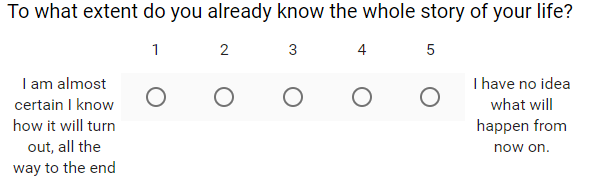
to what extent do you already know the story of your life?

If people were asked this question on a survey, I think the variations in responses would be significant and useful to know:

In general, people would give lower scores as they got older, but not always. The YouthBuild program (which we evaluated) serves disadvantaged adolescents and young adults. Before entering this 9-month program, participants predict that they will live to an average age of 40. Many believe that they already know the outlines of their lives. But upon completing the program, they think they will live to the age of 72: a 32-year increase (Hahn et al 2004). They now foresee decades of life that present unpredictable possibilities.

I agree with Kieran Setiya that “midlife” is best understood not as a span of years–say, ages 35-60–but as a subjective attitude to time that can occur at any age. Inspired by his book but departing a bit, I would measure midlife as a low score on the question shown above. By that definition, adolescents entering YouthBuild are already in midlife and even suffering from midlife crises. But for someone else, that state might never arise, or it might occur for the first time at age 90.

Is it good or bad to score high on this measure? That may depend on how well your life is going. If you expect to continue back-breaking labor for the rest of your life, still shackled to an uncaring partner, and suffering the regular deaths of loved-ones, you certainly would prefer not to be able to predict the rest of your life based on your story so far. But if you have retired in good health to a lovely seaside community, you may want nothing more than to run out the clock without seeing any unexpected changes to yourself or the people you care about. Priam had every reason to think that his life was a happy story until, as a very old man, he had to witness his hero son Hector being dragged dead around his besieged city.

I suspect we also vary in our subjective stances to change. For some people–almost regardless of their objective circumstances–predictability is comforting. But it is horrifying for others.

James Joyce published “The Dead” when he was 32. He had a long, dramatic, and hugely influential life ahead of him and surely couldn’t imagine that he’d become the Zurich-based author of Finnegans Wake by 1941. His protagonist, Gabriel, is also a “young man.” But I think “The Dead” is all about realizing that you know the whole course of your life. This is possible if you are a somewhat average bourgeois Dubliner, like Gabriel, or a budding international literary sensation, like James Joyce. Either way, to think you know your whole life-course is akin to being dead: you might as well just fast-forward to the end. That is the sense in which midlife is a depressing state rather than a comforting one.

I would predict that answers to this question would vary by age (but not in a lockstep correlation), by social circumstance (people with more opportunities will be less likely to think that they know their own futures) and by temperament.

Certain meditative experiences are intended to lower one’s score. For example, momento mori–meditating on death–is meant to remind you that you already know the important part of your story, how it ends. That is supposed to focus you on being pious. But Buddhism often reminds us that life is unpredictable, basically unstable, and that not being able to know the future should drive your attention to current experience. I vote for the latter although I am not very good at it.

Source: Hahn, A., Leavitt, T. D., Horvat, E. M., & Davis, J. E. (2004). Life after YouthBuild: 900 YouthBuild graduates react on their lives, dreams, and experiences. Somerville, MA: YouthBuild USA. See also Kieran Setiya on midlife: reviving philosophy as a way of life; nostalgia for now; rebirth without metaphysics.

was Aristotle right about what we must know to be good citizens?

Let’s posit that a good citizen should be able to a) form ideas about what would improve her community or society, b) understand how decisions about such matters are actually made and who has power to make each decision, c) persuade those people to think and act differently, and d) do all of the above ethically, which means reflecting on right and wrong.

A name for b) is “politics”; for c), “rhetoric”; and for d0, “ethics.” Aristotle wrote a book on each of those topics, and, although he didn’t give titles to any of his books, these are the names that we give them.

The Politics is about how city-states worked, about the pros and cons of various forms of government, and about the role of citizens in these states. The Rhetoric is about persuasion, but especially about “how to generate trust in ways that preserve an audience’s autonomy and accord with the norms of friendship” (Danielle Allen, Talking to Strangers, p. 141). In other words, it’s about persuading responsibly, to the benefit of the listener. And the Nicomachean Ethics is about how to live a good life.

As the founder of a school (the original “Lyceum”), Aristotle meant his works to frame a curriculum. The good citizen should study politics, rhetoric, and ethics.

Was he right? I think largely so, with two caveats.

First, Aristotle had little to say about the actual decisions that confront a community. Ancient Athenians had to decide whether to build a wall or more ships, to invade Sicily or pursue peace with Sparta, to rebuild the Parthenon or use the money for something else. In our day, we must decide what to do about climate change, policing, economic growth and equality, and myriad other issues. Aristotle didn’t address most of the policy questions of his day, let alone those of our time. And he didn’t make “policy analysis” a part of his civic curriculum.

I think one reason was that he didn’t believe that general, theoretical reasoning was helpful for policymaking. Wise collective action was a matter of phronesis, judgment, and it was highly concrete. Citizens should deliberate about whether to build more triremes and should learn from the results. No abstract theory would help them to decide.

The other reason may have been a kind of elitism. Expertise existed about military, architectural, economic, medical, and agricultural matters, but it belonged to tradesmen (broadly defined). Gentlemen-citizens were generalists who lacked such knowledge. Their role was to consult experts when necessary and then to make all-things-considered judgments. A curriculum for gentlemen-citizens was about politics, rhetoric, and ethics, not about policy.

In contrast, we have disciplines such as economics, medicine, law, education, social work, international relations (and many more) that confer the highest social status and that promise knowledge relevant to making decisions. They sometimes even promise to be able to determine the best policies. For instance, if economics works, it should generate answers about questions involving taxes and interest rates. Advanced education for leaders has turned into the study of public policy, largely to the exclusion of rhetoric, ethics, and even politics, in Aristotle’s sense.

We might think that the pendulum has swung too far, because we really do need phronesis to make decisions. There are few algorithms that can determine a better policy. And to exercise judgment, we need ethics, rhetoric, and politics. But we wouldn’t want the pendulum to swing all the way back to Aristotle’s view, which is too disparaging of the study of policy. We should add the social sciences to Aristotle’s curriculum.

The second caveat concerns how we interpret Aristotle’s project and continue it. One type of interpretation emphasizes the consistency of Aristotle’s whole philosophy. He perceives ethics as connected not only to rhetoric and politics but also to logic, metaphysics, and natural science. It’s all part of one coherent universe organized by a small number of principles. A major test of whether a view is right is whether it coheres with this whole system.

If you think of Aristotle’s system as an inspiration, but you want to update it for a new era, you may try to build a new system. You won’t derive your specific views from any social science but from the elaboration of an overall view of the world: a systematic philosophy.

Thomas Aquinas exemplifies this approach. He believes that Aristotle must be updated by adding Christianity, and he writes a new systematic philosophy to that end. He begins with the question of God’s existence and works from there toward all other questions. When Aquinas gets to politics in the second part of the second part, question 58, his topics are: (1) What is justice? (2) Whether justice is always towards another? (3) Whether it is a virtue? (4) Whether it is in the will as its subject? (5) Whether it is a general virtue?; (6) Whether, as a general virtue, it is essentially the same as every virtue? — and so on.

The ornate cathedral of Aquinas’ thought might seem like a mere curiosity, except that the urge to systematize has been common, and Aristotle has often served as a model.

The alternative is to emphasize the Aristotelian idea of phronesis, practical wisdom. What Aristotle offers are some very general guidelines about how to organize political communities in which individuals who strive for personal virtue can argue productively about what to do together. No theory settles how to structure political organizations, how to live, or what policy arguments are right, but Aristotle inaugurates a process of thinking about those three topics together. And they are still more or less the right topics for citizens.

See also against a cerebral view of citizenship; Bent Flyvbjerg’s radical alternative to applied social science; Bent Flyvbjerg and social science as phronesis; on philosophy as a way of life.

A mini-review of Bryan Caplan’s The Case Against Education

“It was not until years afterward that I came upon Tolstoy’s phrase “the snare of preparation,” which he insists we spread before the feet of young people, hopelessly entangling them in a curious inactivity at the very period of life when they are longing to construct the world anew and to conform it to their own ideals.” -Jane Addams, Twenty Years at Hull House

Bryan Caplan has long inspired me. We don’t share a political ideology, but his writing on child-rearing has often come at exactly the right moment for me. (His Selfish Reasons to Have More Kids helped me overcome a brief antinatalism phase, for instance.) His work on borders and immigration is less groundbreaking, but no less true, and in his forthcoming fun comic on the topic he and Zach Weinersmith will bring scholarly rigor and friendly advocacy to new heights. He’s obviously right that immigration restrictions are immoral and self-defeating—but no one is listening in this new age of nationalism. His latest book has fewer concrete ethical consequences—but it deploys evidence from educational psychology that has long puzzled me in service of a policy argument that has almost no chance of uptake, and so cements my view of Bryan as a careful and provocative scholar doing his best to tell the truth even when no one will listen.

Mini-Review

The argument in The Case Against Education is simple: most people don’t learn much of value to employers in their college educations. This is possibly also true even for some parts of K-12 schooling. Education instead is largely a mix of experience high-ability people would seek out on their own and an opportunity to distinguish oneself from other applicants in the resume rat race. The bulk of the book is a response to the various objections that are now forming in your mind.

You’d have to be pretty nerdy to be reading this, so the first step for evaluating the argument is to use a bit of empathy: forget your own experience in school, except the bad parts. I hated high school, but I loved college so much I took it as a career. Even then, I don’t remember a good deal of what I studied outside of my chosen field. And many of my fellow students were much less enthusiastic. So ask yourself:

  1. How much high school Spanish do you remember?
  2. Do you remember the titles—let alone the plots—of all the books you read in 11th grade English?
  3. What is ionization energy?
  4. Remember calculus? Can you solve a parametric equation today?

Perhaps you can answer half of these questions today without Google. That’s not a lot of retention. Whenever I get stuck in conversations on planes with people about the one philosophy class they took in college, they tend not remember much of the content. (“The cave, right?! Brains in vats? Veil of ignorance…. I hated that class.”)

Caplan summarizes well-established but little-known work in educational psychology on learning transfer which seems to show that mostly students don’t learn or retain much. Instead, a lot of education seems to combine three things, in some combination: an accumulation of habits, skills, and knowledge that we can call “human capital,” a costly and difficult signal that distinguishes us to employers, and a kind of consumption that is distinctive of high ability and high-income people.

I won’t say much about signaling as such: for Caplan, education provides future workers with an opportunity to create truthful, hard to fake resumes that demonstrate intelligence, conscientiousness, and conformity. On his view, the time you spent acing classes you’ll never need proves you’re willing to play the game better than any personal statement could ever do. Of course that’s part of it… but how much?

The human capital model is the one we’re all thinking about when we recommend education. Education, we want to believe, makes you smarter, more capable, more knowledgeable, and more effective. Caplan seems to think that this is a relatively small part of what is going on in education. In the book he sometimes says human capital is 20% of education’s contribution to income, though he’ll also say it is 11% of the effect of education.

That’s because education is also fun, and especially fun for people who tend to earn high incomes because they are intelligent, curious, and conscientious. In that sense, education is like other high-class consumption goods: eating good food or taking fancy vacations, for instance.  In fact, the “fun” part of education rivals the signaling element. (He estimates ‘ability bias’ accounts for 45%, and signaling for 44%.) I’ve known many smart, curious people who retire from a successful career and go back to school. They’re not in school to learn and become more effective workers, but rather because education can be an intrinsic good with no instrumental value.

This is likely the case my progressive friends would make: you don’t study philosophy to be a better nurse or accountant or medical doctors—though there are ways that the critical thinking skills you learn may help you—you study philosophy because you’ve got questions about the nature of the universe, existence, death, justice, beauty, and truth. And the smarter and more successful you’ve been, the more you can enjoy learning about philosophy and literature. It’s an end-in-itself. Caplan seems to think that education as a high-ability consumption like backpacking in Europe or kite-surfing in the Caribbean—for kids wealthy enough to afford it on their own or retired adults looking to reflect on it all, but not for that time in your life when you’re trying to figure out your place in the economy.

I think we progressives should take Caplan’s argument seriously. But in some ways we already do: we’ve all read and shared articles like these: “Why American Colleges are Becoming a Force of Inequality,” and “Schools that accept ‘no excuses’ from students are not helping them.” Progressives are coming around to the idea that higher education is not a great leveler, and the segregated K-12 schools are increasingly a pipeline to prison rather than jobs for the least advantaged.

Our counterarguments often play up underfunding of state flagship universities, and so progressives often seek to double down on higher education with Bernie Sanders-style free college guarantees and increased spending. But at the same, we are increasingly aware of efforts to make schooling more regimented, disciplinary, and prison-like. We see that African-American and poor students are being shuttled towards “no excuses” schools while white and wealthy students find get play-based curricula, experiential learning, and above all a kind of caring and loving environment. Those experiences should tell us something.

Look forward to some future posts (or maybe someone will ask me for a real review) using my favorite sources: Michel Foucault, Paolo Freire, Pierre Bourdieu, Elizabeth Anderson, and John Dewey. But I put Jane Addams there at the top for a reason: it’s not just libertarians but one of the founders of progressive pragmatism who holds this view.

A review wouldn’t be complete without some criticisms: Caplan quotes Richard Arum and Jospia Roksa only once, and ignores their findings that the right kind of liberal arts education can increase critical thinking, problem solving, and analytic writing skills. He believes that this can only work for eager students, which are in short supply, and that most of the results of the Collegiate Learning Assessment can be confounded with IQ. His emphasis on IQ means that he also hasn’t properly evaluated the Foucaultian argument that schools produce large amounts of social conformity and conscientiousness, rather than merely measuring it. Finally, there is plenty of evidence that education plays an important signaling role for historically oppressed groups (women, African-Americans, and the formerly incarcerated). In fact, Georgetown’s Center on Education and the Workforce just published this study, which is being reported widely with headlines like this: “Women need one more degree than men to earn the same average salary.”

Still, these objections don’t overcome the overall problems with education as it is currently practiced. Very often we see policy justification switches like the following: when the evidence from Quebec and Tennesse on early childhood education began to countermand the Abecedarian Project’s consensus view that universal pre-K could benefit poor children, advocates switched their arguments from the benefits to children to benefits to mothers’ employment. This kind of motte and bailey argument doesn’t have to be a total fallacy, since after all a policy can have many possible promising effects, some of which end up being disproven. But it’s more evidence against schooling as the accumulation of individual human capital.

(previously: What are the ruling ideas today? Is ‘College For All’; among them?Academically Adrift’s Methodological ShipwreckFor Education, Against Credentialism)

defining equity and equality

You can find authoritative explanations of the differences between “equity” and “equality,” but I think the definitions of these words vary, and there is no objectively correct distinction.

However, we can generalize a bit. To say that something is “equal” does not imply a positive value-judgment. Some people are taller than me. That means that our heights are unequal, but it is not an injustice. Nor does making things more equal always improve justice. Procrustes stretched his prisoners who were too short and lopped the feet off those who were too tall to make all their bodies an equal length. That was not an example of justice. “Equal” has a meaning in mathematics (already attested in Chaucer), and when it’s transported to social and ethical contexts, it retains its mathematical flavor of value-neutrality.

It’s true that the word has long been used as a synonym for fairness. Milton:

… till one shall rise
Of proud ambitious heart; who, not content
With fair equality, fraternal state,
Will arrogate dominion undeserved
Over his brethren, and quite dispossess
Concord and law of nature from the earth …

But Milton has to say “fair equality.” Out of context, without such a modifier, inequality may not imply injustice.

In contrast, the word “equity” has a positive valence, whether in the law (a “court of equity”), in ethics, or in social analysis. If something is equitable, to that extent it is fair. The question becomes: What constitutes fairness? Answers vary depending on people’s philosophical beliefs, social roles, and cultures.

Interaction Institute for Social Change | Artist: Angus Maguire.

In this well-known picture, several things are equal (the heights of the boards that make up the fence, the altitude of the ground at all points, the sizes of the three boxes, the height of all the heads in the second picture). Some things are unequal, especially each person’s body height.

Despite its label, the first situation is not equal in every respect. But it is inequitable according to three reasonable standards of fairness: everyone should get what he or she needs, everyone should have equal opportunities, and everyone should be a full participant in the activity. These standards can diverge–or they may not even apply in some circumstances–but here they converge to rule the first situation unfair.

The second situation, meanwhile, illustrates equality in some respects. All the heads are the same distance above the fence; the fence is level. But that picture also illustrates equity because it meets several reasonable standards of fairness.

In this case, giving everyone an equal upward boost is inequitable, because their needs are different. But that is only one way in which equality can diverge from equity. If one person really deserves or merits more than another, then giving both people the same amount would be equal yet would violate equity. If Procrustes came along and violently made these three people the same height, that would be equal but not at all equitable. And if we hacked a portion of the fence away to let the short kid see, that would be equitable among the viewers but perhaps unfair to the owner of the fence. In fact, we only celebrate the solution in the second picture if we think it is fair to be able to watch a game for free from over a fence.

The main point is that “equity” always requires an account of fairness: what fairness demands in the circumstances. Equality, on the other hand, always requires measurement. Sometimes when a given measure is equal, that demonstrates equity, but sometimes it doesn’t.

See also: we are for social justice, but what is it?trends in egalitarianism and sorting out human welfare, equity and mobility.