
the sublime is social–with notes on Wordsworth’s Lines Above Tintern Abbey

In secular (and probably upscale) reaches of our society, two suggestions are common for restoring mental health and equanimity: we should experience nature and reconnect to our bodies through meditation or exercise.

Of course, prayer is also an option, and activities such as walking in the woods and yoga have roots and analogues in religious traditions. Here, however, I focus on practices that are open to non-believers.

Such experiences are supposed to be authentic, personal, and at least somewhat distinct from the everyday world of conscious thoughts, words, social roles, organizations, and transactions. Although you can have these experiences alongside other people, an important aspect is inward and often literally silent. Something like the pure or raw self is thought to emerge.

This post is a modest contribution to the argument–which others have also made–that it is a mistake to understand such experiences individualistically. Other people are always integrally involved, and it is wise to be maximally conscious of them.

Although practices like hiking and meditation can be routine or even trivial, they bear at least a distant relationship to notions of the sublime. That word has been defined in diverse and incompatible ways–producing an interesting debate–but a common feature seems to be an aesthetic experience that lastingly improves the self and that would be difficult, if not impossible, to convey in ordinary words. Either a sublime experience exceeds human language or else it requires particularly excellent words (such as verse by Homer or Wordsworth) to convey. The natural or religious sublime is sometimes presented as beyond speech, while the literary or rhetorical sublime defines superior speech.

The premise that a sublime experience cannot be shared using ordinary language contains the germ of the conclusion that we do not need other people to experience it. That conclusion is especially problematic in a consumerist culture with relatively loose social ties and high levels of inequality–a society that generates headlines like this one from Wired in 2013, “In Silicon Valley, Meditation Is No Fad. It Could Make Your Career: Meditation and mindfulness are the new rage in Silicon Valley. And it’s not just about inner peace—it’s about getting ahead.”

Most thoughtful analysts are aware that words, conscious thoughts, and other people do not go away when one experiences the sublime. For one thing, we are always morally indebted to other people. We can’t go for a walk in the woods unless someone has preserved that forest and built those trails. In the Americas, the land was previously conquered from indigenous people. The shoes on our feet and the food in our stomach were made by other human beings. In many cases, the aesthetic experience was skillfully shaped by people: landscapers and foresters, yoga instructors, or whoever else is relevant. It is wise to thank those who made the sublime possible, yet empty expressions of thanks can be worse than nothing.

In addition, we acquire our tastes, our aesthetic values, and our ability to process experience from other people. As I wrote in a previous post, “I do not simply see the snow; I see it with things already in my mind, like Christmas decorations, paper snowflakes on second-grade bulletin boards, Ezra Jack Keats’ A Snowy Day, Pieter Bruegel the Elder’s ‘Hunters in the Snow,’ Han-shan’s Cold Mountain lyrics, Robert Frost’s ‘lovely, dark and deep’ woods, Hiroshige’s woodblock prints of wintry Japan, Rosemary Clooney with Bing Crosby. In short, I have been taught to appreciate a winter wonderland, a marshmallow world, and a whipped cream day.” None of us understands all the ways that our experiences have been shaped by our predecessors, but we all absorb the development of our societies as we develop from infants into adults. There is no raw self.

In fact, many have sought to combine explicit records of past human experiences with direct experiences of nature and one’s body. Thoreau says of his time alone at Walden Pond, “My residence was more favorable, not only to thought, but to serious reading, than a university; and though I was beyond the range of the ordinary circulating library, I had more than ever come within the influence of those books which circulate round the world.” And David Morris reminds us, “Whether meditating by the sea, contemplating the night sky, or crossing the Alps, eighteenth-century enthusiasts for nature rarely forgot their reading: the classics were Addison’s guidebook to Italy, while Joseph Warton’s vision of unspoiled nature comes straight from Lucretius and Shaftesbury” (Morris 1972, p. 7).

Whether to combine introspective experience with literature is a personal choice; it is surely not the only path. But I do believe that the current tendency to see the sublime as purely personal is self-centered, in a consumerist way, and we must bring other people in.

With that in mind, let’s consider one of the most famous depictions of a restorative experience in nature, Wordsworth’s “Lines Composed a Few Miles above Tintern Abbey”. The narrator says that his memories of this spot on the Wye River have given him a “gift / Of aspect more sublime,” a “blessed mood” …

In which the heavy and the weary weight
Of all this unintelligible world,
Is lightened:—that serene and blessed mood,
In which the affections gently lead us on,—
Until, the breath of this corporeal frame
And even the motion of our human blood
Almost suspended, we are laid asleep
In body, and become a living soul:
While with an eye made quiet by the power
Of harmony, and the deep power of joy,
We see into the life of things.

This seems like a perfect example of what people nowadays might call self-care through nature.

The story told in the poem is a little complicated. We learn, but not in chronological order, that Wordsworth first came to the Wye River Valley “in the hour / Of thoughtless youth,” when he could still enjoy nature spontaneously, almost as a part of it, “bound[ing] o’er the mountains … wherever nature led” with “animal movements.” In those days, he did not need concepts or words (“a remoter charm, / By thought supplied”) to filter his experience.

Memories of those “boyish days” sustained the narrator while he was busy in the human world of “joyless daylight; when the fretful stir / Unprofitable, and the fever of the world” hung over him. Now he has returned to the same spot and finds that he cannot again feel the “aching joys” and “dizzy raptures” of the place, but he is compensated by a new insight. Now in nature he hears “the still sad music of humanity” and realizes that “the mind of man, a motion and a spirit … rolls through all things.”

At the outset, he is eager to portray what he sees as nature, not as culture. For instance, he mentions “hedge-rows” (which are planted and maintained by human beings) and then corrects himself: “hardly hedge-rows, little lines / Of sportive wood run wild,” as if they were nature’s free creations. But by the midst of the poem, he acknowledges that mind and nature are “deeply interfused.”

And then a third person appears in the poem (counting the narrator as one and the reader as two). This is a “you” who is “with me here upon the banks.” This “dearest Friend” emerges as his sister, Dorothy. The poet’s objective becomes to record her experience of the natural scene so that she can better recall it as her life proceeds, and so that she can vividly remember sharing this experience of nature with her brother. His poem will be a mnemonic (see Rexroth 2021) to give her “healing thoughts” amid the “dreary intercourse of daily life.”

Thus Wordsworth’s sublime is not private or individualistic in a simple sense. But perhaps it is not admirably social, either. In an influential 1986 article, Marjorie Levinson noted that Wordsworth not only chose not to describe Tintern Abbey in this poem (even briefly), but he also omitted many obvious features of the Wye River at that time: “prominent signs of commercial activity” such as “coal mines, transport barges noisily plying the river [and] miners’ hovels.” Tintern was a mining village, and the woods were full of “vagrants” who “lived by charcoal-burning” or begging from tourists (Levinson, pp. 29-30). The abbey was a literal ruin–albeit picturesque to some–because it had been suppressed in the Reformation and sold to landlords who had dispossessed the agricultural population, creating whatever unpopulated vistas one could see in 1798.

Levinson argues that Wordsworth knew all this well, and that “the primary poetic action” of the whole poem “is the suppression of the social.” It “achieves its fiercely private vision by directing a continuous energy toward the nonrepresentation of objects and points of view expressive of a public–we would say, ideological–dimension” (pp. 37-8). The poem is a sign of Wordsworth’s retreat from political engagement in the late 1790s.

Levinson’s 1986 article has provoked some responses in defense of Wordsworth; I have not tried to assess the controversy. For me, these are the key points: Wordsworth exemplifies a currently popular way of addressing discontent or even anguish–enjoying nature–and he is conscious that “humanity,” human language, and human relationships are part of that experience. Yet he is notably apolitical. An analysis of why nature looks as it does–who has profited and suffered from it–is missing from the poem. And this seems to foreshadow many contemporary versions of the sublime.

Sources: Marjorie Levinson, “Insight and Oversight: Reading ‘Tintern Abbey,’” in Wordsworth’s Great Period Poems (1986), pp. 14-57; David B. Morris, The Religious Sublime Christian Poetry and Critical Tradition in 18th Century England (University Press of Kentucky 1972); and Grace Rexroth, “Wordsworth’s Poetic Memoria Technica: What ‘Tintern Abbey’ Remembers,” Studies in Romanticism 60.2 (2021): 153-174. See also the sublime and other people; unhappiness and injustice are different problems; the I and the we: civic insights from Christian theology; Foucault’s spiritual exercises; and when you know, but cannot feel, beauty
a mistaken view of culture

Until the 1800s, culture was not a “count noun,” a noun that can take a plural form. It was a “mass noun,” which identified a quality that could come in degrees. In English, people did not speak of “cultures” but saw individuals as having more or less culture.

Europeans’ awareness of cultural diversity was generally superficial. For instance, they could not perceive their distance from ancient Greeks, Romans, and Israelites, whom they viewed basically as their contemporaries. They disdained non-Europeans because they wanted to exploit them, but their ethnocentrism also fit with their notion that culture referred to a single scale–and they had more culture than other people. A similar linguistic shift also affected the word “religion,” although it became a count noun somewhat before “culture” did.

Since ca. 1800, a new theory has been available and influential. Here are statements of this theory by quite diverse authors:

“Each nation has the center of happiness within itself, as every sphere has its center of gravity.” – Johann Gottfried Herder, “This, Too, a Philosophy of History,” from Herder On World History: An Anthology, edited by Hans Adler and Ernest A. Menze. Armonk, NY: M.E. Sharpe 1774, p. 40

“The constitution of a people, with its religion, with its art and philosophy, or at least with its ideas and thoughts, its education [Bildung] in general (not to mention other external powers, as well as the climate, the neighbors, the state of the world) forms one substance, one spirit [Geist].” – GWF Hegel, Vorlesungen über die Philosophie der Geschichte. Reclam publishing company 1924 (original 1837), p. 25; my trans. I owe the reference to Michael Rosen, The Shadow of God (Harvard 2022).

“Never did one neighbor understand another: his soul always wondered at his neighbor’s madness and evil. A table of values hangs over every people. Behold, it is a table of their overcomings; behold, it is a voice of their will to power.” – Friedrich Nietzsche, “Of the Thousand and One Goals,” from Thus Spoke Zarathustra, 1885. (my trans.)

“A language, with its expression and its evolution, is not the work of scattered units, but of an historical community: only he who has unconsciously grown up within the bond of this community, takes also any share in its creations. But the Jew has stood outside the pale of any such community, stood solitarily with his Jehovah in a splintered, soilless stock, to which all self-sprung evolution must stay denied, just as even the peculiar (Hebraic) language of that stock has been preserved for him merely as a thing defunct.” – Richard Wagner, Judaism in Music, (1850) trans. William Ashton Ellis

“By ‘tradition’ is not meant the dead weight of outlines, of superficial laws and customs–but an inward spirit, the genius of a people, a harmony with the most constant expressions of our country.” – Eugenio Montale, Stile e Tradizione (1925) p. 153 (my trans.)

“[Class struggle is] always specified by the historically concrete forms and circumstances in which it is exercised. It is specified by the forms of the superstructure (the State, the dominant ideology, religion, politically organised movements, and so on); specified by the internal and external historical situation which determines it on the one hand as a function of the national past (completed or ‘relapsed’ bourgeois revolution, feudal exploitation eliminated wholly, partially or not at all, local ‘customs’ specific national traditions, even the ‘etiquette’ of political struggles and behaviour, etc.), and on the other as functions of the existing world context …” Louis Althusser, “Notes for an Investigation,” Part III of “For Marx” (1962) trans. by Ben Brewster

“Human beings differ, their values differ, their understanding of the world differs; and some kind of historical or anthropological explanation of why such differences arise is possible, though their explanation may to some degree reflect the particular concepts and categories of the particular culture to which these students of the subject belong.” – Isaiah Berlin, letter to Beata Polanowska-Sygulska (Feb. 24, 1986), in The New York Review of Books, Sept. 23, 2004, p. 24

“A modern democratic society is characterized … by a plurality of reasonable but incompatible comprehensive doctrines.” “A reasonable doctrine is an exercise of theoretical reason: it covers the major religious, philosophical, and moral aspects of human life in a more or less consistent and coherent manner. It organizes and characterizes recognized values to that they are compatible with each other and express an intelligible view of the world.” – Rawls, Political Liberalism (Columbia, 1993), pp. xvi, 59

I have chosen quotations by thinkers–from the radical left to the radical right, plus two or three liberals–who share the assumption that there are many cultures in the world, and each culture is reasonably coherent and distinct. An individual belongs to a culture in a similar way as a citizen with a passport belongs to a nation-state.

This model of culture (which is, more broadly, a new account of thinking itself) first arose in response to a growing empirical awareness of ancient and foreign ways of life, plus a desire to protect local traditions against universalistic ideologies. These two reasons explain why the most important source of the new model was Germany in the Age of Revolution. Germans were particularly advanced in historical scholarship (ranging from classical philology to Germanic folklore to an early interest in Sanskrit), and they faced the tangible trauma of a French army with universalistic values.

The new (I would say, “modern”) model has advantages. It makes some sense of the actual diversity among humans and sometimes offers insights about specific ideas or works of art. It can inspire new works when creative people believe that they comprehend the inner spirit of their own people and try to communicate it. And it rationalizes struggles for independence and self-determination, which can be appealing, especially when the protagonists are oppressed.

The modern model also has major disadvantages. It implies that boundaries can be drawn between and among peoples, but any actual boundaries must leave minorities at the mercy of local majorities. It overlooks the heterogeneity of individual opinions, which has illiberal implications. It leads liberals like Berlin and Rawls to advocate a government that is neutral among the incompatible cultures within its boundaries, which is probably impossible and blocks worthy policies. It favors national self-determination not only for oppressed and marginalized groups but also for big and powerful populations. It leads to vexed and often unproductive discussions about who has a right to which cultural forms.

The modern model can generate a profound form of skepticism. If all our beliefs about what is true and good are phenomena of our culture, yet other people have other cultures, how can we be correct about anything? As Berlin suggests in the quotation above, how can we even know which other cultures exist, since our disciplines of history and anthropology must themselves reflect our own culture?

Fortunately, the modern model is false as a description of our human world. Culture is not something to which a person belongs. It is not a thing that has causal power. Culture is a large and usually quite heterogeneous set of ideas, beliefs, memories, skills, and values that a person has and can use.

There is a certain tendency to make the beliefs, values, and skills of a given population increasingly coherent. For instance, Catholic theology, baroque architecture, and monarchical government seem to cohere; as do Buddhist philosophy and Japanese aesthetics. People want their various beliefs to be consistent, and they want other people to agree with them. However, successful efforts to make beliefs and values cohere often require violent political force, because they counteract other tendencies that are also pervasive–tendencies to innovate, to borrow from afar, to distinguish oneself from others, and to complicate received ideas. All populations demonstrate some degree of heterogeneity and incoherence.

To be sure, we are all limited by culture. We have finite time and mental capacity to learn things. Besides, some people won’t allow other people to have access to what they know and can do. (For instance, they may deny access to schooling, restrict the curriculum in various ways, or censor certain ideas.) As a result, each of us only knows some things, and what we know helps to explain what we do. In that sense, culture is causal. Even the aspects of culture that we do use often fail to give us what we want, because nature or other people get in our way.

But we all have somewhat different culture. Indeed, the list of any individual’s ideas, beliefs, etc. is constantly changing. In that sense, culture should not actually be a count noun. There is no number of cultures on our planet. There are more than 7 billion people with constantly changing and circulating bodies of culture. People differ–sometimes profoundly–yet they resist classification. And that means that certain implications of the modern model, from relativist skepticism to hyper-nationalism–are wrong and not only bad.

See also: individuals in cultures: the concept of an idiodictuon; everyone unique, all connected; what is cultural appropriation?; and Putin’s cultural nationalism. (This post repeats many points I’ve made before; any added value lies in the list of quotations, which is new.)

a Hegelian meditation

This is a breath: in and out.

That sentence is true; if the mind knows anything, it’s the reality of a breath.

By the time that thought has formed, it is false. This is not a breath—that thing is gone; it does not exist. Perhaps there is a new breath, and the sentence is true again, but it has a new object. It is true and false that “This is a breath.”

The mind turns to an abstraction: breath in general. Surely there are many breaths, all exemplifying one concept. In contemplating that concept, the mind can only think of a breath, and by the time it has that thought, that breath is gone. It is false that this is breath and that there is breath.

Nevertheless, a new breath comes. This one has a certain sound, familiar since the cradle. This breath has a certain feel, swelling the chest. The sound is not the feeling, yet the breath is one thing. Its aspects are distinct because of the nature of the one who perceives them.

The mind perceives the one that hears and feels the breath. It finds a subject that perceives and forms the sentence: “I perceive my breath.” That sentence is false. The ‘I’ is what perceives the breath, but that breath no longer exists. The ‘I’ that perceived the breath is no longer. The ‘I’ that perceived the ‘I’ is no longer. What no longer is, is nothing.

Surely there is a very general concept, thisness, of which this breath and this I are examples. In considering this concept, the mind can only think of this breath and this mind, and the concept that this mind forms of this breath is false by the time it forms it. That mind, too, is gone by then.

The mind conceives a mind in motion, a restless mind, a mind detached from the things it perceives and from itself, yet always compelled back to them. The mind had sought to calm itself by reflecting on its breath, but close inspection of its own experience has opened a whole box of things, none of which stays still when examined separately. Experience has revealed itself as something complicated, which the mind somehow already knew and which it cannot ever quite grasp. It strives to embrace and accept this manifold complexity, of which it is part.

These words are about a mind; a mind has been the subject of many of these sentences. Yet that mind is not the subject that reads these words. That subject is you, the reader. When you read the words “I perceive my breath,” they are not about your breath but somehow about a writer’s thoughts.

What you directly perceive is a string of words. I, the writer, had thoughts that I wanted to convey and had motives for writing them. You are entitled to question my motives. (Self-promotion? Self-indulgence?) But my motives are gone now, and so are your thoughts about my motives, like the words above the ones before your eyes right now.

You may have new thoughts, and they may happen to look identical to your previous thoughts; but they are not the same thoughts, because each thought occurs in time. You can form the idea of thought in general, but the only way you can think of that idea is to form a particular thought, which occurs in time and is then gone. You both have a thought about me and you do not have that thought about me.

I presume that I know who I am and what I think. Since this text is published on a public website, I don’t know who you are and may never have even heard your name. For your part, you know who you are, but not much about what I am thinking, except for whatever these words may mean to you. Yet in reality, I do not know what I think until I express it, trying to make meaningful sentences for a “you” that I envision in vague ways. And you do not know what I have written except insofar as you make your own sense of these sentences.

You may chafe at my control. I chose and arranged the words that might influence your mind. Yet I would not write at all if not in hopes of being read. The writer needs the reader as much as the reverse–as much as the mind needs its objects and the objects need the mind. You know that I need you. I know that you know that I need …

The topic of this text is meditation on the breadth, anapanasati. That practice is widely prescribed to address a restless, unsettled, unhappy mind. If we ask why it is recommended today, one kind of answer cites its effectiveness. Perhaps people teach and practice anapanasati because it works. In that case, the test is to try it, as we do here. The results will depend on what specific thoughts the specific mind generates.

Another kind of answer is a long story that could involve Californian beat poets who turned into Dharma bums after encountering GIs home from Japan, and General Tojo meditating in Zen monasteries while conquering China and attacking Pearl Harbor, and Dosho bringing Chan to Japan as Zen, and Bodhidharma bringing Buddhism to China, and the Buddha teaching breath-mindfulness in the Anapanasati Sutta, and people teaching Siddhartha Gautama the words and ideas that he used as he became the Buddha, and people teaching those people. We know just tiny fragments of this story, to which unsung thousands have contributed, both for good and for evil, yet it is inherent in the fashions of our moment.

Each mind recapitulates the work of countless minds, from which it derives all its words and ideas. A mind without history would be empty. For example, “This is a breath” is a sentence in English with thousands of years of thought embedded in it.

We can say that the Buddha already knew everything under the Bodhi tree, but to say what he knew requires explicating the various schools that have analyzed experience into its components, and then declared the components also to be illusions of the consciousness, and then declared the consciousness to be an illusion, and then analyzed negation, and so on, in a logical progression like the one accomplished by stoicism, skepticism, and their successors. To explicate the truth requires excavating this “conceptually grasped history” (begriffne Geschichte), these successive turnings of the Wheel that constitute the present.

Although my topic here is anapanasati, my method and structure come from Hegel’s Phenomenology of Spirit. Why? Because I studied that text in a seminar at age 20. Rereading it 35 years later, I find that I had forgotten most of it, although certain familiar phrases signify that it has been there all along, even when I was reading Shantideva or focusing on my breath. Perhaps you know Hegel better than I. Perhaps you have never heard of him, but his mind has already influenced yours by way of Marx and Dewey and Martin Luther King, Jr. and the tangible structures that those three, and many others, have inspired.

Each mind, all minds, and nature are one.

That is a vacuous cliché and false, in just the same way that “This is a breath” is false. It is also true, in the same way. To know it requires unfolding what the mind already knew and can never fully know, one stage at a time, recapitulating the work of many minds with many objects, which are also one mind with one object.

Sources: GWF Hegel, The Phenomenology of Spirit, trans. & ed. by Terry Pinkard (Cambridge University Press, Kindle Edition, 2018), especially the Preface (sec. 72) and sections A.I, B.IV.A-B, and DD; and Shantideva, The Bodhicaryavatara, translated by Kate Crosby and Andrew Skilton, especially chapters 8 (on meditation) and 9 (dialectics among the Buddhist schools). See also: Philosophy as a Way of Life (on Pierre Hadot); Foucault’s spiritual exercises; the grammar of the four Noble Truths; on philosophy as a way of life; my self, your self, ourselves; Buddhism as philosophy; freedom of the will or freedom from the will? (comparing Harry Frankfurt and Buddhism); how to think about other people’s interests: Rawls, Buddhism, and empathy; compassion, not sympathy; “you should be the pupil of everyone all the time”; and the sublime and other people

what republic means, revisited

Basic political words (including the word “political”) tend to be appropriated by diverse movements and parties over time, which causes them to accumulate diverse and even opposite meanings. “Liberal” is a great example.

Another example is “republic,” which is now millennia old and appears in the official names of major parties as well as 110 sovereign states (by my count), ranging from the Laos People’s Democratic Republic to the Islamic Republic of Afghanistan and including such odd couples as both of the Koreas.

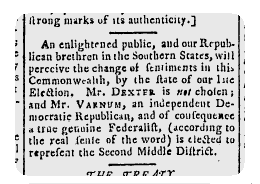
Some would say that any real republic is a regime with a popular or majoritarian element that is limited by checks and balances and restraints on the powers of government. These limits distinguish it from a democracy. That usage is not wrong, but it doesn’t necessarily track the terminology of the US founders. For instance, Jefferson defined a republic as a “government by its citizens in mass, acting directly and personally, according to rules established by the majority; and … every other government is more or less republican, in proportion as it has in its composition more or less of this ingredient of the direct action of the citizens.” As the image shows, many of Jefferson’s contemporaries agreed that a republic was a democracy.

For others, a republic is a system in which the people own and control the most important goods. That is why communist states have generally named themselves republics. One justification may be etymology. The Latin phrase res publica means the public’s thing (or good, or wealth, or interest). Thus, if you believe that things like factories and farms should be public property, you may be inclined to use the word “republic.” In addition, the French revolution has often inspired communists and other left radicals. That revolution called itself “republican.” There is also a less prominent tradition of radical commonwealth thought in English; and “commonwealth” is a direct translation of res publica.

For some political theorists of the last 30 years (e.g., Philip Pettit, Ian Shapiro) republicanism means opposition to domination, which is arbitrary power over others. A republic is a regime that successfully combats domination, and modern republicans debate the necessary and ideal tools for that end. Rule of law, popular participation and responsive government, civil liberties, and checks and balances are among the options.

A different school of modern theorists see a republic as a regime that expects a particularly high degree of virtue from its citizens. For instance, Hannah Arendt defines a republic as a community that allows and expects participants to display civic virtues in public forums.

Until recently, I would have held onto one fixed point. I would have proposed that any definition of republic should cover the regime that governed Rome between the overthrow of the kings and the reign of emperor Augustus and his successors, because the word first arose to name that system. In analyzing the Roman republic, we might prefer to emphasize its appreciation of civic virtues, its empowered populace, its mixed constitution with limited popular power, its defense of private rights, its public property (the forum, the army), or its commitment to rule of law and other protections against domination (for free men)–but one way or another, we would have to tie our definition to the ancient regime. And a monarchy would be incompatible with a republic, since the Roman republic is what we call the interlude between the era of kings and that of emperors. Today, most of the countries that do not call themselves republics are monarchies.

But then I read Anthony Kaldellis, The Byzantine Republic: People and Power in New Rome (Harvard, 2015). Kaldellis shows that almost all Romans believed that their republic persisted under the emperors. The structure of its government changed, but Rome remained a republic–indeed, until 1453. To call a limited period of Roman history “the republic” is to impose modern terminology on the past.

I suspect that one reason that many moderns have believed that the emperors ended the Roman republic is Tacitus. He is a superb author, enormously valuable and timely, but he does have an ax to grind. As a senator and a member the hereditary senatorial class, Tacitus views the emperors’ usurpation of the Senate’s powers as a fundamental blow to liberty. In modern times, his account has been a powerful inspiration for anyone who wants to defend representative legislatures against tyrants. But the Roman senate was never representative; it was oligarchical. Other Romans could disagree with Tacitus that weakening the Senate really undermined the republic. For many of them, the defining feature of a republic (per Kaldellis) was its coherence as a community. Some Romans viewed emperors as good guardians of their community, in which case the republic could thrive under Augustus or his successors. Their main concern was whether a given monarch really served the public good; if not, he was illegitimate.

The conclusion, for me, is that “republic” can mean many different things, and no one should assert that it has only one true meaning. I am interested in anti-domination and civic virtue and prefer to use the word “republican” for combinations of those ideas. But mainly, one should define and clarify one’s terms.

See also: do we live in a republic or a democracy?; civic republicanism in medieval Italy: the Lucignano council frescoes; The French Republic denounces the French State; citizens against domination; James Madison in favor of majority rule etc.

what “republic” means, revisited

Basic political words (including the word “political”) tend to be appropriated by diverse movements and parties over time, which causes them to accumulate diverse and even opposite meanings. “Liberal” is a great example.

Another example is “republic,” which is now millennia old and appears in the official names of major parties as well as 110 sovereign states (by my count), ranging from the Laos People’s Democratic Republic to the Islamic Republic of Afghanistan and including such odd couples as both of the Koreas.

Some would say that any real republic is a regime with a popular or majoritarian element that is limited by checks and balances and restraints on the powers of government. These limits distinguish it from a democracy. That usage is not wrong, but it doesn’t necessarily track the terminology of the US founders. For instance, Jefferson defined a republic as a “government by its citizens in mass, acting directly and personally, according to rules established by the majority; and … every other government is more or less republican, in proportion as it has in its composition more or less of this ingredient of the direct action of the citizens.” As the image shows, many of Jefferson’s contemporaries agreed that a republic was a democracy.

For others, a republic is a system in which the people own and control the most important goods. That is why communist states have generally named themselves republics. One justification may be etymology. The Latin phrase res publica means the public’s thing (or good, or wealth, or interest). Thus, if you believe that things like factories and farms should be public property, you may be inclined to use the word “republic.” In addition, the French revolution has often inspired communists and other left radicals. That revolution called itself “republican.” There is also a less prominent tradition of radical commonwealth thought in English; and “commonwealth” is a direct translation of res publica.

For some political theorists of the last 30 years (e.g., Philip Pettit, Ian Shapiro) republicanism means opposition to domination, which is arbitrary power over others. A republic is a regime that successfully combats domination, and modern republicans debate the necessary and ideal tools for that end. Rule of law, popular participation and responsive government, civil liberties, and checks and balances are among the options.

A different school of modern theorists see a republic as a regime that expects a particularly high degree of virtue from its citizens. For instance, Hannah Arendt defines a republic as a community that allows and expects participants to display civic virtues in public forums.

Until recently, I would have held onto one fixed point. I would have proposed that any definition of republic should cover the regime that governed Rome between the overthrow of the kings and the reign of emperor Augustus and his successors, because the word first arose to name that system. In analyzing the Roman republic, we might prefer to emphasize its appreciation of civic virtues, its empowered populace, its mixed constitution with limited popular power, its defense of private rights, its public property (the forum, the army), or its commitment to rule of law and other protections against domination (for free men)–but one way or another, we would have to tie our definition to the ancient regime. And a monarchy would be incompatible with a republic, since the Roman republic is what we call the interlude between the era of kings and that of emperors. Today, most of the countries that do not call themselves republics are monarchies.

But then I read Anthony Kaldellis, The Byzantine Republic: People and Power in New Rome (Harvard, 2015). Kaldellis shows that almost all Romans believed that their republic persisted under the emperors. The structure of its government changed, but Rome remained a republic–indeed, until 1453. To call a limited period of Roman history “the republic” is to impose modern terminology on the past.

I suspect that one reason that many moderns have believed that the emperors ended the Roman republic is Tacitus. He is a superb author, enormously valuable and timely, but he does have an ax to grind. As a senator and a member the hereditary senatorial class, Tacitus views the emperors’ usurpation of the Senate’s powers as a fundamental blow to liberty. In modern times, his account has been a powerful inspiration for anyone who wants to defend representative legislatures against tyrants. But the Roman senate was never representative; it was oligarchical. Other Romans could disagree with Tacitus that weakening the Senate really undermined the republic. For many of them, the defining feature of a republic (per Kaldellis) was its coherence as a community. Some Romans viewed emperors as good guardians of their community, in which case the republic could thrive under Augustus or his successors. Their main concern was whether a given monarch really served the public good; if not, he was illegitimate.

The conclusion, for me, is that “republic” can mean many different things, and no one should assert that it has only one true meaning. I am interested in anti-domination and civic virtue and prefer to use the word “republican” for combinations of those ideas. But mainly, one should define and clarify one’s terms.

See also: do we live in a republic or a democracy?; a Democratic Republican Federalist; civic republicanism in medieval Italy: the Lucignano council frescoes; every Republican president since 1901 has insisted that the US is a democracy; The French Republic denounces the French State; citizens against domination; civility as equality; James Madison in favor of majority rule; etc, etc.

Transformative Learning and Civic Studies

Newly in print: The Palgrave Handbook of Learning for Transformation, edited by Aliki Nicolaides, Saskia Eschenbacher, Petra T. Buergelt, Yabome Gilpin-Jackson, Marguerite Welch and Mitsunori Misawa (2022).

Although I am not deeply knowledgable about Transformative Learning, a movement launched by the sociologist Jack Mezirow, I like its emphasis on learning as a lifelong process of transforming one’s perspective on society.

This volume includes a chapter entitled “Reconsidering the Roots of Transformative Education: Habermas and Mezirow” by Saskia Eschenbacher and me (pp. 45-58). Our abstract:

Jack Mezirow acknowledged the deep influence of the German philosopher Jürgen Habermas (1929–) on the development of transformative learning. We describe some fundamental elements of Mezirow’s and Habermas’ thought, explore their affinities, and argue that Mezirow did not give adequate attention to two important themes in Habermas: the power and value of social movements and the need to reform the overall structure of a society to enable transformative learning. We argue that transformative learning would benefit from a deeper consideration of these topics. Finally, we introduce Civic Studies, a parallel intellectual movement that also owes much to Habermas, and we suggest a convergence.

when you know, but cannot feel, beauty

In his “Dejection: An Ode,” Coleridge describes the sparkling stars and crescent moon above but bemoans his own state of mind:

I see them all so excellently fair,
I see, not feel, how beautiful they are!

The reason is what we would call depression:

A grief without a pang, void, dark, and drear,
         A stifled, drowsy, unimpassioned grief,
         Which finds no natural outlet, no relief,
                In word, or sigh, or tear—

I consulted Coleridge’s “Dejection” thanks to Anahid Nersessian’s essay on Keats’ “Ode to a Nightingale” (Nersessian 2021). Nersessian is great at wiping away that sense of Keats as a languorous aesthete, a maker of pretty lyrics. As she shows, the Nightingale ode reports suicidal thoughts. The narrator is “half in love with easeful Death” and seriously considering whether it is time to end it all: “Now more than ever seems it rich to die.” The three hard opening words, as Nersessian notes, violate iambic pentameter and ignore the ostensible addressee of the ode. Keats doesn’t begin, “O, Nightingale …” but rather, “My heart aches.”

Nersessian’s essay is not a close reading, but it made me turn back to the text of the ode. I wondered: what exactly is the narrator’s mental condition? (Remember: Keats had medical training, and the first stanza seems almost clinical.) The presenting complaint is a heart that aches. More specifically, “a drowsy numbness pains / My sense.”

This is complicated. Being drowsy and numb suggests a lack of sensation, and that interpretation is reinforced by the analogy to a “dull opiate” that suppresses the narrator’s conscious thoughts, sending him toward Lethe. But the numbness “pains” his sense, as though he had drunk hemlock. I am not sure whether we should assume that hemlock causes a quiet, sleepy death or an agonizing one: Wikipedia suggests that it triggers respiratory distress. I think that the question of lacking consciousness versus suffering is central to the poem as a whole.

In any case, what is the etiology of this numbness/ache? The narrator denies that he is envious of the nightingale’s “happy lot.” (The word “thy” in that sentence is the first mention of the ode’s subject.) When people deny that they are jealous, sometimes they actually are. But the narrator follows with a subtler point. He does not envy the bird’s “happy lot,” where “happy” could mean “favoured by good fortune; lucky, fortunate; successful” (OED). The bird’s lot is to sing in the mid-May evening, and Keats denies being envious of that. Instead, the nightingale causes heartache by “being too happy in [its] happiness”–in other words, by enjoying its role. This is precisely what Keats’ narrator, being depressed, cannot do. The poem describes beauty, yet the narrator cannot feel what such precise and evocative words as these should convey:

The grass, the thicket, and the fruit-tree wild;
         White hawthorn, and the pastoral eglantine;
                Fast fading violets cover’d up in leaves;
                        And mid-May’s eldest child,
         The coming musk-rose, full of dewy wine,
                The murmurous haunt of flies on summer eves.

Do we think that the nightingale is happy, in the subjective sense–happy in its happiness? Keats writes that the bird “sing[s] of summer in full-throated ease.” I suppose I doubt that it sings “of” summer. I assume it sings because the month is May, and its song is a component of what makes an English early summer lovely. I don’t believe that the bird is describing summer, as a poet could.

To modify an example from Robert B. Brandom (who discusses a parrot trained to say “red” in the presence of red objects), the nightingale reliably informs us that it is summer by singing, but the bird cannot express the premises and conclusions that relate to this information. The bird cannot say, “It is summer; therefore, it is not winter,” or “It is summer because spring is over,” or “Since it is summer, we should spend evenings outdoors.” To express points like that would be to talk of summer. Instead, the nightingale sings because it is summer, and as an aspect of summer.

Indeed, its happiness relates to its ignorance. Keats wishes to forget

What thou among the leaves hast never known,
The weariness, the fever, and the fret
         Here, where men sit and hear each other groan;
Where palsy shakes a few, sad, last gray hairs,
         Where youth grows pale, and spectre-thin, and dies ...

That last line may describe the recent and agonizing death of Keats’ brother from tuberculosis, and it eerily foretells Keats’ own death from the same cause two years later. These are serious matters, wrenching tragedies, and the bird’s enviable condition is to know nothing of them. Its mental state is like that of a human being who has forgotten memories and fears of suffering.

We might expect that the bird’s song would cause Keats to forget pain, at least briefly, as he becomes absorbed in the music; but that doesn’t work for this narrator, because he is depressed. “Still wouldst thou sing, and I have ears in vain.” Instead, the narrator considers artificial solutions: “some dull opiate,” “a draught of vintage,” distracting reveries of “faery lands,” or–most effective of all, intentional death.

The darkness and anger of the poem should be taken seriously; it is not some pretty thing. Yet it is rapturously beautiful, the source of such nuggets as “tender is the night” and Ruth “amid the alien corn.” It is about not being able to feel beauty, yet it conveys beauty from that ailment.

In the fourth stanza, Keats commits to join the nightingale not by drowning his sorrows in drink but through the power of verse:

Away! away! for I will fly to thee,
         Not charioted by Bacchus and his pards,
But on the viewless wings of Poesy,
         Though the dull brain perplexes and retards ...

His brain is a problem: it perplexes and retards. “Poesy” looks, at least temporarily, like a way out. But why is it “viewless”? That word could mean invisible: we cannot observe how poetry moves the writer or the reader to a better place. Or it could mean unable to see. Certainly, this poet has trouble seeing. Due to the deep darkness where the nightingale sings, “I cannot see what flowers are at my feet.” Poetry offers words that name objects, but it does not actually allow us to see them. I think the central idea in the fifth stanza (Keats knows which flowers are present from their scent but cannot see them) is a metaphor for literary description. A poem conveys information but not actual experience.

Then he addresses the bird: “Darkling, I listen.” Calling a nightingale “darkling” is a clear allusion to Book III of Paradise Lost, where Milton writes:

            ... as the wakeful bird
Sings darkling, and in shadiest covert hid
Tunes her nocturnal note. ....

The argument of this passage is that God is light; beautiful things reflect God’s love. Since Milton is blind, he cannot see these objects. He misses the “sight of vernal bloom, or summer’s rose …  the cheerful ways of men.” Yet a miracle occurs. God makes the “celestial Light, / Shine inward,” and by purging and dispersing all the ordinary sights of life, allows Milton to “see and tell / Of things invisible to mortal sight.” Milton is like the nightingale, whose song tells of grace even though the bird cannot see in the darkness.

No such consolation is available to the narrator of Keats’ ode, who offers no hint that nature has a benign author. Nature is what gives people tuberculosis. Keats’ narrator is not only depressed but angry about it.

I will offer an alternative perspective, even though I don’t think Keats would agree with it. We are all like the nightingale; our vocalizations and other behaviors are caused by natural processes. (“Dependent origination.”) We cannot escape suffering, which is intrinsic to sentience and afflicts the bird as well as us. (“The first noble truth.”) Mental pain arises naturally. For instance, Keats must think of his recently deceased brother, because he is physically designed to feel grief. Forgetting such things is impossible, and drowning them out would be unethical. (“The middle way.”) However, Keats is not a real entity, and his condition needn’t interest the poet as much as it does. As he writes elsewhere, the poet “has no self”; “not one word I ever utter can be taken for granted as an opinion growing out of my identical nature–how can it, when I have no nature?” (“No-self.”) His protean mind can, however, fill with thoughts such as appreciation, gratitude, and compassion. (Mindfulness, the “third noble truth.”) The beauty of the night is real, just like suffering, and he can focus on the former.

Those who make it across the river and come back to help others over do the most good (“karma”), and Keats’ lyrics provide an example. They enrich the inner lives of us who read them. Keats claims no satisfaction from doing this, because he is depressed and because he doesn’t hold a Buddhist-ish theory. But he achieves what he cannot recognize, and we can read him compassionately for that reason. After all, the last five words (“Do I wake or sleep?”) are no longer addressed to the nightingale, which has departed for the “next valley-glades.” They must pose a question for us, opening a dialogue with readers and perhaps seeking our compassion, which we can give. If our minds are filled with compassion, we have less space for pain.

Keats was an unbelievably good poet. What if we can’t write immortal verse–can we then return to help others cross to a better place? I would say: Keats is a stranger to us, dead two centuries, and worth reading because his words are so excellent. The rest of us just say mundane things, like, “Did you hear that bird?” But we can say such things in relationships–to people we know and like or love. When embedded in a friendship or love, a remark like “Did you hear that bird?” conveys pleasure and care. By that means, we can alleviate suffering even if we could never come up with a phrase as good as “with beaded bubbles winking at the brim.”

Sources: Robert B. Brandom, Articulating Reasons: An Introduction to Inferentialism (Cambridge: Harvard University Press, 2000); Anahid Nersessian, Keats’ Odes: A Lover’s Discourse (Chicago: University of Chicago Press, 2021). See also the sublime and other people; the politics of negative capability; “Keats against Dante: The Sonnet on Paolo and Francesca“; a poem should; empathy: good or bad?; and three endings for Christabel.

the sublime and other people

Early last month, I posted a little poem in celebration of a deep snowfall. I was hardly the first. People appreciate natural phenomena, find ways to represent aspects of what they see, and share the results. We have done this, I suppose, for at least 64,000 years, since the oldest cave paintings we know.

In some cases, an explicit goal is to thank a benevolent power for the gift. For instance, I love how Gerard Manley Hopkins detects a Divine Father behind all “dappled things“–like “skies of couple-colour” or “a brinded cow.” “Praise Him,” says Hopkins. Unfortunately, I cannot share that type of explanation.

For others, the theme is the objective beauty of nature, understood as impersonal but perfect. “The hills / Rock-ribbed and ancient as the sun,—the vales / Stretching in pensive quietness between …” I must admit that I am struck by the subjectivity of such judgments. Our dog appreciates, but I don’t think he is much taken by distant vistas of snow on sagging branches. Smelly fire hydrants are closer to his sublime. A nest of cockroaches has as much objective complexity and order as a snow-covered forest, but most of us human beings (although not all of us) would recoil from it. Nature gives us pure drifts of fresh snow, but also muddy slush and freezing rain. These examples cause me to doubt that beauty lies in nature.

Another response is that we are constituted to enjoy things like snowy views, and this is a wonderfully good fact about us. Just as we may lament our human proclivities to violence, despair, and cruelty, so we can celebrate our ability to savor what we find sublime. And not only celebrate it, but actively cultivate this appreciation and share it with other people through the representations that we create. In that case, the beauty is essentially in us, but it is really there, and that is a reason for gratitude.

I don’t know whether human beings are automatically constituted to enjoy a snowscape. Perhaps we are, but our responses could vary by personality and culture. I am sure that my own appreciation is something learned. I do not simply see the snow; I see it with things already in my mind, like Christmas decorations, paper snowflakes on second-grade bulletin boards, Ezra Jack Keats’ A Snowy Day, Pieter Bruegel the Elder’s “Hunters in the Snow,” Han-shan’s Cold Mountain lyrics, Robert Frost’s ”lovely, dark and deep” woods, Hiroshige’s woodblock prints of wintry Japan, Rosemary Clooney with Bing Crosby. In short, I have been taught to appreciate a winter wonderland, a marshmallow world, and a whipped cream day. Some of these influences probably detract, but they were meant well, which is how I would defend “Hush.”

It’s sometimes said that when Petrarch climbed Mont Ventoux (in Provence) in 1336–simply to enjoy and describe the view–he was the first European ever to do such a thing. Clearly, some people outside of Europe had loved mountain views long before Petrarch. I find it plausible that certain communities of people appreciate vistas, while others do not. And some of us may have learned the sublimity of landscapes from a chain of people originally inspired by Petrarch, although he was surely influenced by the classical sources that he knew so well. We all see what we have learned to see.

To me, this debt to other human beings only deepens the sublime. Nature was not created for us; it just is. And we were not created to enjoy it, although–very fortunately–we do. But our fellow human beings have deliberately shared their appreciation and heightened our own, which means that we are the beneficiaries of benevolent intelligence after all. Praise them.

Stoic Pragmatism for Parenting a Child with Disabilities

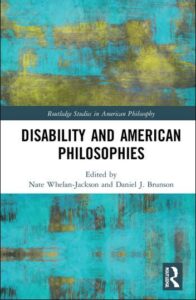
Cover image of the book in which my article was published, 'Disability and American Philosophy.'It takes a village. Raising children takes all hands on deck, including parents or guardians, teachers, administrators, and educational policymakers. This paper examines common philosophical norms relevant to each of these groups. The norms include the idea of wanting a better future for our children than we had; the idea that human beings are rational animals; and that the unexamined life is not worth living. What does that mean for parents, teachers, administrators, and policymakers when our children are intellectually or communicatively impaired?

[featured-image link=”https://ericthomasweber.org/wp-content/uploads/2022/01/Helen-2019FB.jpg” link_single=”https://ericthomasweber.org/wp-content/uploads/2022/01/Helen-2019FB.jpg” single_newwindow=”false” alt=”This photo features my daughter, Helen, in 2019, sitting in her wheelchair and awaiting the school bus on a sunny morning.”]My daughter Helen in 2019. [/featured-image]

WARNING: At least for me, rereading this paper inspired an emotional response. The stoicism called for in the paper is intended to help ease emotional reactions, but the fact of such a need for some readers (and others have let me know that they have shared such a reaction) is itself worth noting in advance.

Click here for the paper in PDF format.
Download the paper here.

We think of the norms I have mentioned as cultural. Philosopher John Dewey saw philosophy as the critique of culture, essentially as thinking about thinking. How we think plays a powerful role in how we treat people and how we educate ourselves and others. In this context, this paper examines one of the difficult contexts for education and the raising of children. And, I offer my own and my family’s experience for consideration, bringing philosophical ideas to bear on tough moments, decisions, and questions.

I first presented a draft of this essay at the annual meeting of the eastern division of the American Philosophical Association in January of 2019. It has just now been published in Disability and American Philosophies, edited by Nate Whelan-Jackson and Daniel J. Brunson in January of 2022 with Routledge Press of London.

It may be worth noting that in 2019 I was still married, something no longer true now, in 2022, when the essay has finally been released in print.

I agreed to publish this article with the understanding that I would have permission to share the essay in this way. You can download a copy of the essay in PDF format here or by clicking on the Adobe image above in this post.

Last, but not least, I have generated a computer-created text-to-speech recording of the essay. If I had more time, I would record myself reading the essay. The following recording took me only a few minutes to generate, by contrast to over an hour or more of work to record it myself. For the sake of accessibility, and at a friend’s request, I generated this audio file, which can be listed to if that is preferred over reading the text. I did not include the notes or bibliography section in the audio file.


Citation:  Weber, Eric Thomas, “Stoic Pragmatism for Parenting a Child with Disabilities: An Essay Addressing Philosophers, Parents, Teachers, and Educational Policymakers,” Chapter 11 in Disability and American Philosophies, Edited by Nate Whelan-Jackson and Daniel J. Brunson (London: Routledge, 2022), 182-198.

individuals in cultures: the concept of an idiodictuon

In linguistics, a language is a whole system of communication used by a group, encompassing its semantics, grammar, and pragmatics. A dialect is a particular form of a language typical of a specific region. A sociolect is like a dialect, except that it is used by a dispersed social group, such as a profession or a class. A register is a form of a language used in a particular situation or context, such as by lawyers in court. And an idiolect is the distinctive way that an individual speaks: that person’s active vocabulary, grammar, accent, and preferred forms and style of speech.

Previous authors have used these distinctions from linguistics to inform models of culture. Language offers a useful model or example for understanding culture because we are familiar with explicit efforts to learn second languages, to list components of a given language in a dictionary, and to invent a writing system to represent a language (Goodenough 1981, p. 3; Goodenough 2003). I am especially interested in the aspects of culture that involve value-judgments: ethics, politics, aesthetics and religion.

I believe the following ten points from linguistics are relevant to thinking about culture (in general) and specifically about values:

  1. Registers, dialects, sociolects, and languages all encompass variation. Each person talks and understands differently from others and evolves as a speaker over time. Therefore, the same body of communication by real human beings can be carved up in many ways. For instance, we can draw a dialect map of the USA that shows more or fewer regions, and we can declare the same material to be a language or a dialect depending on whether we prefer to accentuate differences or similarities.
  2. Idiolects do not nest neatly inside dialects and sociolects, which do not not nest neatly inside languages. They are more like complex Venn diagrams. An individual may draw on several dialects or languages. In cases of code-switching, the individual sometimes uses one register or sociolect and sometimes switches to a different one. Or people may consistently use a mix of influences from multiple sources. For instance, Spanglish is characterized by Spanish influences on English–and there are several different regional Spanglish dialects within the United States today. On the other hand, imagine an elderly American whose speech reflects some influence of Yiddish from the old country. Her idiolect is then not part of any dialect but is a unique mix of two languages with which she may successfully communicate even though no one else nearby sounds like her.
  3. Nobody knows all of any given language, dialect, or sociolect. An effort to catalogue an entire language describes a body of material that none of the users know in full. For instance, nobody knows all the meanings of all the words in an impressive dictionary (which is, itself, an incomplete catalogue of the entire language). Instead, people share sufficient, overlapping portions of the whole that they can communicate, to varying degrees.
  4. Each of us knows our own entire idiolect. (That is what the word means.) However, we could not fully describe it. For instance, I would not be able to sit down and list all the words I know and all the definitions I employ of those words, let alone the grammatical rules I employ. If I were presented with a dictionary and asked which words I already know, I would check too many of them. The dictionary would prompt me to recall words and meanings that are normally buried too deep in my memory for me to use them. That brings up the next point:
  5. Language is dynamic, constantly changing as a result of interaction. A language constantly borrows from other languages. A person’s idiolect is subject to change depending on whom the person talks to. The best way to characterize an idiolect or a language (or anything in between) is to collect a corpus of material and investigate its vocabulary and grammar. That is a worthwhile empirical exercise, but it requires a caveat. The corpus is a sample taken within a specific timeframe. The idiolect or the language will change.
  6. It is possible to make a language (or a smaller unit, like a sociolect) relatively consistent among individuals and sharply distinguish it from other languages. For instance, a government can set rules for one national language and encourage or even compel compliance through schooling, media, religious observance, and even criminal penalties. Law schools teach students to talk like lawyers in court. However, there are also language continua, in which local people speak alike, people a little further away speak a little differently, and so on until they become mutually unintelligible. Before the rise of the nation-state and modern mass media, language continua were much more common than sharply distinguishable languages. Linguistic boundaries require exercises of power that are costly and never fully successful. Meanwhile, at the level of an idiolect, individuals may strive to make their own speech consistent and distinctive or else let it change dynamically in relation with others. People vary in this respect.
  7. Language is–in some way or degree–holistic. That is to say, the components of a language depend on other components. For instance, a definition of a word uses other words that need definitions. I leave aside interesting and complicated debates about holism in the philosophy of language and presume that some degree of holism is inescapable.
  8. Therefore, it can be helpful to diagram an idiolect, a dialect, or a language as a network of connected components rather than a mere list. I am not saying that language is a network; language is language. However, semantic network diagrams are useful models of idiolects, dialects, and languages because they identify important components (e.g., words) and connections among them. A semantic network diagram for a group of people will capture only a small proportion of each individual’s language but may illuminate what they share, showing how they communicate effectively.
  9. While words and other components of language are linked in ways that can be modeled as networks, people also belong to social networks, linked together by relationships of influence. A celebrity influences many others because many people receive her communications. The celebrity is the hub of a large social network. At the opposite extreme, a hermit would not influence, or be influenced by, anyone (except perhaps by way of memories).
  10. Whole populations change their languages surprisingly quickly, and sometimes without mass physical migration. The same population that spoke a Celtic language (Common Brittonic), transitioned partly to Latin, then fully to Germanic Anglo-Saxon, and then to a mixture of Anglo-Saxon and French without very many people ever moving across the sea to England. Today about 33 million people in South Asia also speak dialects of it. A few people can strongly influence a whole population due to their network position–which, in turn, often reflects power.

The point of this list is to suggest some similarities with other aspects of culture. Like a language, another part of a culture can be modeled as a shared network of components (e.g., beliefs, values, or practices) as they are used by people who are organized in social networks, which reflect power.

Such a model is a radical simplification, because each individual holds a distinctive and evolving set of components and connections (e.g., linked moral values); but simplifications are useful. And we can model culture usefully at multiple levels, from the individual to a vast nation.

There are precedents for this kind of analysis. The anthropologist Ward Hunt Goodenough encountered the concept of idiolects in the 1940s, while studying for a doctorate in anthropology (Goodenough 2003). By 1962, he had postulated the idea of “each individual’s private culture, if we may call it that, [which] includes his conception of several wholly or partially distinct cultures (some well elaborated and others only crudely developed in his mind) which he attributes to others individually and collectively, both within and without his community. A person’s private culture is likely to include knowledge of more than one language, more than one system of etiquette, more than one set of beliefs, more than one hierarchy of choices, and more than one set of principles for getting things done” (Goodenough, 1963, 261)

Later, Goodenough named a private culture a “propriospect” from the Latin words for “private” and “view” (Goodenough 1981, p. 98). Harry Wolcott summarizes: “Propriospects … are networks of sense-making connections created and constantly being reformulated by each of us out of direct experience. As we develop and refine our competencies, simultaneously we ‘construct” (and continually ‘re-model’) our individual propriospects” (Wolcott 1991, p. 267).

Individuals may actually share fundamental characteristics of a group, they may perceive themselves to share those characteristics, and they may be viewed by others as sharing them–but these perceptions do not necessarily align, because every group encompasses diverse propriospects. For instance, you might think that believing in God is essential to a culture; and since you believe in God, you are part of that culture; but someone else may define the culture differently and view you as an outsider.

In a review of Goodenough, Mac Marshall (1982) wrote, “While some may disagree with the finer points of his argument, his position on these matters represents the dominant orientation in American anthropology today.”

A different precedent derives from the Polish tradition of humanistic sociology, founded by Florian Znaniecki in the early 1900s. In the 1980s, a Polish sociologist named Marek Ziolkowski (later a distinguished diplomat) wrote interestingly about “idio-epistemes” (presumably from the Greek words for “private” and “knowledge”) meaning “not only … the cognitive content of an individual’s consciousness at a given moment, but … the whole potential content that can be activated by the individual at any moment, used for definite action, and reproduced introspectively.”

Ziolkowski called on sociologists to “enquire into the social regularities in the formation of idio-epistemes, seek relationships among them, establish basic intragroup similarities an intergroup differences.” He acknowledge that any individual will have a unique mentality, “yet every individual shares an overwhelming majority of opinions and items of information with other definite individuals and/or groups.” Those similarities arise because of shared environments and deliberate mutual influence. Ziolkowski coined the word “socio-episteme” for those aspects of an idio-episteme that are shared with other individuals. As he noted, these distinctions were inspired by concepts from linguistics.

Even earlier, in 1951, the psychologist Saul Rosenzweig had coined the word “idioverse” for an individual’s universe of events” (Rosenzweig 1951, p. 301).

An analogous move is Wilfred Cantwell Smith’s influential redefinition of “religion” from a bounded system of beliefs (each of which contradicts all other religions in some key respects) to a “cumulative tradition” of thought and behavior that varies internally and overlaps with other traditions (Smith 1962). According to this model, everyone has a unique religion, although shared traditions are important.

These coinages–idioverse, propriospect, idio-episteme, and cumulative tradition–capture ideas that I would endorse, and they reflect research, respectively, in psychology, anthropology, sociology, and religious studies. However, none of the vocabulary has really caught on. There may still be room for a new entrant, and I would like to emphasize the network structure of culture more than the previous words have done. Thus I tentatively suggest idiodictuon, from the classical Greek words for “private” and “net” (as in a fishing net–but modern Greek uses a derivation to mean a network). An individual has an idiodictuon, a group has a phylodictuon, and a whole people shares a demodictuon.

These words are unlikely to stick any better than their predecessors, but if they did, it would reflect their diffusion through a social network plus their utility when added to people’s existing networks of ideas. That is how all ideas propagate, or so I would argue.

A final point: “culture” encompasses an enormous range of components, including words, values, beliefs, habits, desires, and many more. Given this range, it is useful to carve out narrower domains for study. Language is one. I am especially interested in the domain of values, so I would focus on the interconnections among the values that people hold.

Note, however, that there is no neat way to distinguish values from other aspects of culture, such as desires and urges or beliefs about nature. In his influential empirical theory of moral psychology, Jonathan Haidt identifies at least five “Moral Foundations,” one of which is “sanctity/degradation.” I would have treated this category as a powerful human motivation, akin to sexual desire or violence, but not as a moral category, parallel to “care/harm.” Maybe Haidt is right, or maybe I am, but the evidence isn’t empirical. People actually see all kinds of things as the basis for action and make all kinds of connections among the things they believe. They may link a moral judgment to a metaphysical belief, or a personal aversion, or an aspect of their identity, or a belief about prevailing norms. When we carve out an area for study and call it something like “morality” or “ethics” (or “religion,” or “politics”) we are making our own claims about how that domain should be defined. Such claims require philosophical arguments, not data.

So the steps are: (1) define a domain, a priori, (2) collect a corpus of material relevant to that domain, (3) map it as a network of ideas, and (4) map the human relationships among people who hold different idiodictuons.

For me, the ultimate point is to try to have better values, and the study of what people actually value is preparatory for that inquiry. Clifford Geertz concludes his famous “Thick Description” essay: “To look at the symbolic dimensions of social action–art, religion, ideology, science, law, morality, common sense–is not to turn away from the existential dilemmas of life for some empyrean realm of de-emotionalized forms; it is to plunge into the midst of them. The essential vocation of interpretive anthropology is not to answer our deepest questions, but to make available to us answers that others, guarding other sheep in other valleys, have given, and thus to include them in the consultable record of what man has said.” 

References:

  • Geertz, Clifford, “Thick description: Toward an interpretive theory of culture.” In Geertz, The interpretation of cultures. Basic books, 1973. (pp. 41-51).
  • Goodenough, Ward, Cooperation in change : an anthropological approach to community development. New York, Russel Sage 1963
  • Goodenough, Ward H. In Pursuit of Culture, Annual Review of Anthropology 2003 32:1, 1-12
  • Goodenough, Ward H. Culture, Language and Society (Menlo Park: Benjamin Cummings, 1981)
  • Mashall, Mac, “Culture, Language, and Society by Ward H. Goodenough” (review), American Anthropologist, 84: 936-937.
  • Rosenzweig, Saul. “Idiodynamics in Personality Theory with Special Reference to Projective Methods 1.” Dialectica 5, no. 3-4 (1951): 293-311.
  • Smith, William Cantwell, The Meaning and End of Religion (1962), Fortress Press Edition, Minneapolis, 1991
  • Wolcott, Harry F. “Propriospect and the acquisition of culture.” Anthropology & Education Quarterly 22, no. 3 (1991): 251-273.
  • Ziolkowski, Marek, “How to Make the Sociology of Knowledge Sociological?.” The Polish Sociological Bulletin 57/60 (1982): 85-105.

See also individuals’ ideologies as networks; ideologies and complex systems; judgment in a world of power and institutions: outline of a view; from I to we: an outline of a theory, etc.