“Political philosopher and activist Levine (The Future of Democracy) argues that global problems can best be addressed by a targeted increase in deliberative democracy and citizen action. But the U.S. is currently marked by a decline in civic engagement, Levine notes, resulting largely from structural changes since the mid-20th century that have eroded many working-class organizations. Wielding an impressive command of research and statistics, as well as finer points of moral and political philosophy, Levine’s discussion of the benefits and contours of public engagement draw on lucid analogies and real-world examples (like the annual budget summits convened by Washington, D.C., mayor Anthony Williams, which empowered groups of citizens to deliberate on an area of central import to the whole community). Throughout, the message is that deliberative action among diverse networks of citizens goes beyond injecting public influence into the formal policy apparatus. The necessary goal, Levine writes, “is to democratize the whole process of shaping our common world.” Free market libertarians and others wary of civic engagement–especially where it impinges on market forces or the operation of business–will raise objections, although Levine anticipates these arguments to some degree. Broad in scope yet eminently practical, this book should be an enduring contribution to the study of democratic theory and social action.” -Publishers Weekly
You all knew that some things are worth dying for. One’s country is worth dying for, and democracy is worth dying for, because it’s the most deeply honorable form of government ever devised by man. — President Ronald Reagan, Normandy, June 6, 1984
From World War I until recently, leaders of both major political parties routinely claimed that the United States was a democracy. Politicians often called us “the greatest democracy on earth” and asserted that the purpose of both world wars, Korea, Vietnam, and the Cold War had been to defend democracy. The main debate was whether we had attained a democracy or were still struggling to be one, with the strongest skeptics on the left. A perennial argument pitted left critics–who asserted that our domestic and foreign policies were anti-democratic–against conservative defenders of our credentials as a real democracy.
This consensus about goals has broken down because the hard right now says that we were not founded as a democracy and should not be one.
For example, when Rush Limbaugh reprinted Reagan’s 1984 Normandy speech on his website, he ended the long excerpt just before the invocation of “democracy” that I quoted above. (The words “BREAK TRANSCRIPT” mark where that passage would start.) If the sainted President Reagan said that our men died at Normandy for democracy, Limbaugh would have to agree. But a current right-wing talking point holds that we are a republic and not a democracy. So Reagan’s speech is truncated.
I have been involved in writing a new voluntary framework for state social studies standards. A conservative blogger named Shane Vander Hart reviewed a draft, writing, “I noticed that on pg. 29 it is mentioned we live in a constitutional democracy when in fact we live in a constitutional republic. It is troubling that those writing this document couldn’t get something as basic as that right.”
It is debatable whether the United States is a democracy, but you aren’t making a factual error if you use the word that was preferred by virtually all 20th century presidents.
First of all, even if the US was not founded as a democracy, the 15th, 17th, 19th, and 24th amendments to the Constitution, the state constitutions, two centuries of legislation, and Lincoln’s interpretation of the Civil War as a struggle for government “by the people” have made us a representative government on the basis of one person/one vote, which is a reasonable definition of a democracy.
Second, it is not clear that the founders intended a republic in contrast to a democracy, if we look past the words (whose meanings vary depending on the writer and the time) and think instead about the underlying ideas.
Madison wrote of a “pure democracy, by which I mean a society consisting of a small number of citizens, who assemble and administer the government in person.” He was thinking of Athens and other Greek city states. He did not recommend this model: “Such democracies have ever been spectacles of turbulence and contention.”
Note that Madison says “such democracies,” referring to the “pure” type, which is small and direct. That doesn’t rule out the possibility of other types of democracy. He calls his own preferred form of government a republic, which is (a) representative and (b) very large. He considers both features as definitive and essential to success. If a republic’s representatives were directly chosen by the people on the basis of one person/one vote (as ours are today), that would fit most definitions of a “democracy,” although it would no longer be the pure and original type. It would still meet Aristotle’s criterion that “the partnership (koinonia) of democracy is based on numerical equality” (NE 1241b). Thus we could say that Madison co-founded a republic that became a democracy with the passage of the 17th Amendment.
Jefferson is more favorable than Madison to popular rule. He does not use the word “democracy,” but “the core of [his] thought is a project for democracy.”* Like Madison, he prefers the word “republic,” but he uses it to name the very system that Madison would call a democracy:
Indeed, it must be acknowledged, that the term republic is of very vague application in every language. Witness the self-styled republics of Holland, Switzerland, Genoa, Venice, Poland. Were I to assign to this term a precise and definite idea, I would say, purely and simply, it means a government by its citizens in mass, acting directly and personally, according to rules established by the majority; and that every other government is more or less republican, in proportion as it has in its composition more or less of this ingredient of the direct action of the citizens. — Jefferson to John Taylor, 1816
His idea of a republic is not a constitutional system, because the majority not only governs but establishes the rules and can alter them at will. Jefferson goes on to say that a real republic must be small, and he cites the New England township as a model. But, he adds, one can mix the “ingredient of the direct action of the citizens” with other ingredients to produce hybrid systems at larger scales. They may incorporate elected or appointed offices as well as popular votes. “The further the departure from direct and constant control by the citizens, the less has the government of the ingredient of republicanism.”
Madison and Jefferson jointly founded the Democratic-Republican Party in 1791. It was often simply called the Republican Party, although the terminology was unofficial and varied. It rested on democratic/republican societies, which variously chose the words “Democratic,” “Republican,” “True Republican,” “Constitutional,” “United Freeman,” “Patriotic,” “Political,” “Franklin,” and “Madisonian” in their names. They were the opponents of the Federalists. Once the French Revolution turned bloody, “the very name ‘Democracy’ was used as part of the Federalist attack on [these] societies. ‘Democracy’ was carefully distinguished from ‘republicanism,’ and the former was equated with French Jacobinism. A poem entitled ‘Democracy,’ published in 1794, linked democracy with lawless confusion.”** Yet the Federalists were badly beaten in the election of 1800, and the party that Madison and Jefferson founded dominated American politics for a generation.
The word “democracy” still had partisan overtones in Lincoln’s day. Although deeply democratic himself, he often often used the word pejoratively to mean rule by his opponents, the capital-D Democrats. His Republican successor Teddy Roosevelt, however, called our system a “democratic republic” in his inaugural address of 1905. That was about the time when a bipartisan consensus formed that our aspirations ought to be democratic.
Today, we have a mixed form of government with a strong element of popular or majority rule. Jefferson would call that element “republican”; many people today would call it “democratic.” No one, then or now, would assert that we have a pure democracy. In the social studies framework, we called our system a “constitutional democracy” to indicate that the powers of the people are checked. The government is not in “direct and constant control by the citizens.” [Likewise, the powers of the federal government are limited.]
How did this semantic ambiguity arise? The word “democracy” is of Greek origin. It literally means “rule of (or by) the people.” One could hold that the sovereign power in the US is the people–and hence we have a democracy in the etymological sense. Like all old words, however, “democracy” has accumulated resonances beyond its etymological origins. It may invoke the Greek city-states (whether seen as ideals or as disasters) or mass modern societies.
“Republic” comes from the Latin. My Latin dictionary says that “publicus” means “belonging to the people.” Thus “res publica” means the “thing belonging to the people,” whereas “democracy” is the “people’s rule.” If there is a significant difference in the etymological sense of these words, it is the difference between something that the people have (a republic) versus a power they wield (democracy). A better translation than “the public thing” is “commonwealth.” The words “republic” and “commonwealth” invoke the Roman regime before Caesar Augustus, the Cromwellian state, the early American colonies, and the ante-bellum US system. The meaning of “republic,” however, is malleable, because it depends on which features of the Roman republic and its descendents one considers definitive.
Ultimately, the United States can be called republican and democratic. The two words have interestingly different origins and resonances but are not sharply distinguishable. Nor do we have either a pure republic/democracy. Some limitations on the republic/democratic element are wise, but our current system is flawed by most standards. Although our democratic/republican aspirations are only partly realized, they remain beacons.
*Michael Hardt, “Jefferson and Democracy, ” American Quarterly, Vol. 59, No. 1 (Mar., 2007). **Sheldon Foner, The Democratic-Republican Societies, 1790-1800: A Documentary Sourcebook of Constitutions, declarations, Addresses, Resolutions, and Toasts (Greenwood, 1976). p. 25
Alumni of the Summer Institute of Civic Studies have designed a series of discussions at Frontiers of Democracy about mass incarceration, juries, and citizenship. The discussants include Andrew Nurkin (Executive Director of Princeton AlumniCorps, Princeton), Peter Pihos (doctoral candidate, University of Pennsylvania) and Joshua Miller (Philosophy professor at Morgan State)–all of whom teach in prisons. I will try to write more about their impressive and troubling thoughts after the conference ends. Meanwhile, we were treated to a virtual discussion among three of my friends on the topic of the jury. The discussants are Josh Miller, Albert Dzur (Bowling Green), and John Gastil (Penn State). The whole thing is worth watching, but if you are pressed for time, listen to and think about the questions they pose at the very end (minute 20).
In my introductory remarks (below the fold), I will explain how the conference draws together separate streams of discussion and organizing, and I will propose a conceptual framework for our common work.
As organizers of this conference, we generally try to avoid doing a lot of talking, but my colleagues have prevailed on me—or indulged me—to make some introductory remarks about who has gathered here this weekend and for what purpose.
I’d ask you to consider the conference as a tree. That’s not the most original metaphor, but it will work.
Its deepest roots are the individual stories of the 150 participants, every one different, but each one planted in its own rich soil of community, of personal and collective history and memory, and of civic practice and experience.
For instance, people have been meeting to talk about their common problems and aspirations for thousands of years in every inhabited continent. Since the 1960s, there has been something of a boom of explicit, organized, deliberative processes and experiments—deliberation that you can see and name; deliberation at a human scale. In 2002, many of the groups that had been helping to organize these citizen deliberations, both in the US and overseas, came together at Airlie House in Virginia and launched the Deliberative Democracy Consortium to promote research and learning, networking, and advocacy. Matt Leighninger directs the DDC today.
People have also been teaching the next generation to be good citizens for thousands of years, and universities have been operating in our societies for more than a millennium. But since the 1980s, there has been something of a renaissance of explicit efforts to strengthen the civic role of higher education. In 2006 and 2007, a group of highly experienced academics and civic leaders from outside academia met to share their work and discuss the potential of higher education to enhance American democracy as a whole. They launched a consortium called The Democracy Imperative, or TDI for short, to connect practitioners to academics and convene people who approach “educating for democracy” in diverse ways: intergroup dialogue, interdisciplinary problem-based learning, social justice, Sustained Dialogue, conflict resolution, community organizing, community-based participatory research, and so on. TDI was formed to bring these (and others) together so that they would not feel alone on their campuses. Today, Nancy Thomas directs that effort.
In 2012, Nancy came to CIRCLE and Tisch College at Tufts. CIRCLE, which I direct, studies the civic learning and engagement of young Americans and tries to focus on those not in college or on a path to college. The forms of practice that we tend to study include civic education in middle schools and high schools and in community-based organizations that serve working-class young people.
Meanwhile, Tisch College aims to prepare all Tufts students be lifelong active citizens and creates an enduring culture of active citizenship on this campus. CIRCLE and Tisch College are your hosts today, and Tisch College supports this conference generously. Kathy O’Connor and Charlotte Ringle, who work for Tisch, are the dedicated and talented logistical leaders of the conference.
In 2008, DDC and TDI teamed up to organize a conference called “No Better Time” at the University of New Hampshire. I was just a participant, so I can say it was a great success—perhaps in part because the political moment was optimistic and propitious in 2008, but No Better Time also drew a great group of people for an engaging format.
Just months before “No Better Time,” seven scholars from a variety of disciplines had met at the University of Maryland. They all shared the view that mainstream scholarship is not useful to citizens—people who want to improve or even co-create their worlds. It’s not only that theory is disconnected from practice, but the prevailing theories themselves are misguided. Mainstream scholarship ignores human agency and creativity. It separates fact from value in harmful ways. It can tell you, for example, that the odds of starting a social movement are low—but not what you should do if you want to start a good one.
The scholars who gathered at Maryland included the late Elinor Ostrom, the first woman to win the Nobel Prize in Economics, Jane Mansbridge, the current president of the American Political Science Association, and our friend Harry Boyte, who is following this conference from South Africa. The whole group wrote a manifesto entitled The New Civic Politics: Civic Theory and Practice for the Future.
This manifesto led to a concrete experiment. Since 2008, Karol Soltan from the University of Maryland and I—both co-authors of the original statement—have been trying to practice the new civic politics by co-teaching an annual Summer Institute of Civic Studies at Tufts. It is an intense, theoretically rich academic exercise that has now involved about 100 people who have come from Bhutan, Singapore, China, Mexico, South Africa, and numerous other countries and backgrounds to debate civic renewal. Many are here today, and some have organized the “track” on Civic Theory, which has a focus on prisons and crime.
In 2008, the Summer Institute culminated in a public panel that C-SPAN covered on cable. The next year, we decided to join forces with DDC and TDI to repeat the “No Better Time” conference but at Tisch College instead of UNH. And we have held some version of a public conference each year. It has gradually turned into Frontiers.
Meanwhile, The Center for Engaged Democracy has been holding summer institutes for four years. Based at Merrimack College, the Center acts as a hub for people who run or want to start certificates, minors, and majors focused on civic and community engagement, broadly defined. The Center’s 2013 annual meeting has been taking place here, and many participants are sticking around for Frontiers. Dan Butin leads the Center.
The National Coalition for Dialogue and Deliberation is an association of more than 2,000 members who practice and promote deliberative democracy. Sandy Heierbacher leads that effort. One of their signature methods is to hold meet-ups or regional gatherings, one of which has been happening here, as part of Frontiers 2013, so NCDD is another root of our tree.
Earlier this year federal program, the United States Institute on Civic Engagement, selected The Center for Civic Engagement at Miami University Hamilton to host student leaders from the countries of Botswana, Kenya, Uganda, and Zambia. They are here today and represent yet another root.
These roots have come together to support a pretty impressive trunk. But we could certainly ask what else should be included.
We could also ask about strategies and forms of work that may be missing. Civic education, broadly defined; deliberative democracy and dialogue; and civic scholarship are all well represented here. If you think those are all the most important and relevant forms of civic work, you can be satisfied. I personally believe that a many other forms are also important—and some are also represented here even though I haven’t named them yet.
For example, many people collaborate to manage and strengthen public resources: watersheds and forests, public libraries, cyberspace. They may talk and deliberate, but that isn’t really the heart of their work, which is more about management and co-production.
Many people are building alternative economic institutions—land trusts, community development corporations and social enterprises—that are more governable and accountable than transnational firms.
Many people struggle for political reforms and rights, not only in Egypt and the Palestinian Territories but also right here in the US.
Many people are involved in strengthening the civic health or capacity of communities by organizing citizens into effective groups and networks. These may not be primarily spaces for discussion. Service, belonging, and advocacy may be more central to their work.
Many people are trying to improve the media environment and serve what the Knight Foundation calls “the information needs of communities.” They are creating innovative software, formats, and organizations, some of them for-profit. Again, those people may deliberate and may educate, but the heart of their work is elsewhere.
I have begun to offer a list, and I could go on. Any list requires some kind of conceptual framework. You should be able to explain what deep principles define your list and encourage you to include some things and omit others. I do not expect my own conceptual framework to be shared by everyone who has gathered here today. On the contrary, debate about our frameworks is essential and exciting. One of the reasons that we need theory as well as practice is that we must be able to define what we are for. I’ll tell you my own framework in about one minute, not to settle the matter, but to provoke discussion.
I think that good citizens deliberate. By talking and listening to people who are different from themselves, they enlarge their understanding, make themselves accountable to their fellow citizens, and build a degree of consensus.
But deliberation is not enough. People who merely listen and talk lack sufficient knowledge and experience to add much insight to their conversations; and talk alone rarely improves the world. Deliberation is most valuable when it is connected to work—when citizens bring their experience of making things into their discussions, and when they take ideas and values from deliberation back into their work. Work is especially valuable when it is collaborative, when people make things of public value together. They are typically motivated to do so because they seek civic relationships with their fellow citizens, relationships marked by a degree of loyalty, trust, and hope. In turn, working and talking with fellow citizens builds and strengthens civic relationships, which are scarce but renewable sources of energy and power.
A combination of deliberation, collaboration, and civic relationships is the core of citizenship—in my personal view. If we had much more of this kind of civic engagement, we could address our most serious problems. Indeed, more and better civic engagement is a necessary condition of success; none of the available ideologies or bodies of expertise offers satisfactory solutions, which must emerge instead from a continuous cycle of talking, working, and building relationships.
Unfortunately, genuine civic engagement is in decline in the US and in many other countries, neglected or deliberately suppressed by major institutions and ideologies and by the prevailing culture. Our motivation to engage has not weakened, but we have lost institutionalized structures that recruit, educate, and permit us to engage effectively.
In fact, we face serious obstacles or deficits:
Our political system is organized to favor professionally-led, well-funded interests instead of creative, deliberating communities and grassroots movements.
Our major social policies are hostile to active civic participation. (For example, education is driven by standardized tests that experts write; public health depends on insurance companies and state bureaucracies rather than co-ops and community-based organizations.)
Our voluntary associations no longer have the means to recruit millions of Americans and develop the skills and motivations to participate as active citizens.
Our companies, because of their ability to withdraw investment, are virtually ungovernable by local authorities and communities.
Our culture lacks positive and plausible descriptions of collective agency, although it provides many depictions of lone heroes and of apolitical groups of friends.
Our news media generally overlook examples of deliberation and public work but relentlessly cover competition among professional politicians.
Despite their commitments to political rights and their heritage of experiments with participatory democracy, liberals and progressives are enamored of expertise, command-and-control regulation, and redistributive politics to the exclusion of active citizenship.
Despite their resistance to technocratic elites and their heritage of experiments with decentralization, conservatives are enamored of markets and negative liberties to the exclusion of active citizenship.
Our schools and colleges offer inadequate civic education, distributed unjustly to favor the most advantaged students, with an emphasis on factual knowledge instead of civic skills.
Our scholars in the social sciences and humanities produce an inadequate supply of knowledge relevant to active citizens (people who make moral and strategic judgments about how to improve the world directly).
Our funders—in both the state and philanthropic sectors—provide negligible streams of money for participatory processes, as compared to the funds available for concrete services.
On the other hand (sooner or later, there had to be another hand), we live in period of civic innovation, when, against the odds, people are at work on demanding, sophisticated, and locally effective forms of civic engagement. I estimate that 1 million Americans are involved in such work each year. Certainly they have many kindred spirits in other countries. These people see the need for citizenship and are building impressive practices and models. Their work remains scattered and local because it is contrary to the mainstream of national policy. Civic engagement cannot achieve sufficient scale and power without reforms in our most powerful institutions. The way to achieve such reforms is to organize the most active citizens into a self-conscious movement for civic renewal.
We are not 1 million Americans. We are about 150 international people out of the 7 billion human beings on earth. But we are deeply rooted in networks and communities that reach many more. That is why our gathering is so important. Of course, neither the root nor the trunk of a tree reflects its whole value. Its value is manifest in what it produces, its branches, leaves, and fruits. So, having come together, we must now branch out and produce a new harvest of civic theory and civic practice.
Philip Pettit and some others have been reviving the classical theory of republicanism as a theory that treats “domination” as the basic evil to be avoided. Domination often takes the form of arbitrary commands (“Do it because I say so”). Republican institutions, such as elections, legislatures, and judicial review, look attractive because they minimize domination, which is not the same as maximizing individual liberty.
I see the appeal, but it seems to me that non-domination is a virtue in a whole range of settings, some of which are not, and cannot really be, republics. Families and workplaces are two important examples. The remarkable American management theorist Mary Parker Follett (1868 – 1933) offers insights about how workplaces can reduce “arbitrary command” without becoming–or pretending to be–republics. For instance, in The Illusion of Final Authority (1926?), she writes that “Arbitrary command, the exaction of blind obedience, breaks initiative, discourages self-reliance, [and even the] lover’s self-respect.”
I think the solution is … to depersonalise the matter, to unite those concerned in a study of the situation, to see what the situation demands, to discover the law of the situation and obey that. That is, it should not be a case of one person giving commands to another person. Whenever it is obvious that the order arises from the situation, the question of someone commanding and someone obeying does not come up. Both accept what the situation demands. Our chief problem then is not how to get people to obey orders, but how to devise methods by which we can best discover what the order shall be. When that is found the employee could issue direction to the employer as well as employer to employee. This often happens quite easy and naturally: my stenographer or my cook points out the law of the situation to me, and I, if I recognise it as such, accept it even although it may reverse some previous direction I have given.
An order then should always be given not as a personal matter, not because the man giving it wants the thing done, but because it is the demand of the situation. … But while people should not be asked to follow directions blindly, at the same time a subordinate should not have the attitude of carping, of finding fault, of thinking things from above wrong. The attitude most desirable for receiving orders is intelligent scrutiny, willingness to suggest changes, courtesy in the manner of suggesting, and at the same time no prejudice in regard to what is prescribed, but the assumption that the way prescribed is probably the best unless one can show some convincing reason to the contrary.
For what it’s worth, that would also be my philosophy of parenting. Parents should strive to create a climate and set of situations in which neither the giving of orders nor carping and whining are common; instead, the family will generally do what the situation demands. Note that this has little to do with democracy (equal political power), nor does it always require explicit reason-giving and deliberation; but it is non-domination.
I am helping to organize three sessions at this year’s APSA Conference that are relevant to civic renewal and civic education. The theme of the whole conference is “Power and Persuasion,” and the APSA president is the excellent Jane Mansbridge. Improving the relationship between persuasion and power is an essential goal of civic renewal. In that context …
1. Theme Panel: “Power and Persuasion from Below: Civic Renewal, Youth Engagement, and the Case for Civic Studies”
Aug 30, 2013, 4:15 PM-6:00 PM
Chair: Peter Levine, Tufts University. Participants: Paul Dragos Aligica, George Mason University; Carmen Sirianni, Brandeis University; Karol E. Soltan, University of Maryland; Filippo A. Sabetti McGill University; and Meira Levinson, Harvard University
“Civic renewal” refers to an international set of movements and practices that enhance citizens’ agency and may therefore strengthen persuasion over raw power. In the US, it includes public deliberation, broad-based community organizing, and collaborative governance, among other efforts. Its values have also been reflected in aspects of the Occupy Movement and the Arab Spring, to name just two recent global movements. Youth are at the forefront of some of these efforts and must always be incorporated in them. “Civic Studies” is an emerging scholarly field inspired by Elinor and Vincent Ostrom and the Bloomington School, by social science as phronesis, by the new constitutionalism, by theories of public work and democratic professionalism, by research on deliberative democracy, and by related academic movements that take civic agency seriously. Civic education should draw on Civic Studies and support civic renewal.
2. APSA Committee on Civic Education and Engagement Roundtable: The Measurement and Assessment of Civic Learning in K -12 and College Education
Saturday, Aug 31, 2013, 8:00 AM-9:45 AM
13:00-14:30 on 29, 30 and 31 August 2013, Chicago
Chaired by Peter Levine. Participants: Elizabeth Bennion, Indiana University, South Bend; David Campbell, Notre Dame; Meira Levinson, Harvard University.
We will be thinking about what should be measured, how to measure it, and new opportunities afforded by tools like games and badges. One topic will be the ideas in the APSA’s edited volume, Teaching Civic Engagement: From Student to Active Citizen. But we will broaden the discussion beyond the question of how to measure students’ learning in college-level political science classes.
3. APSA Working Group on Young People’s Politics
August 29, 30 and 31, 2013, 1:00-2:30 PM
Convenors: Peter Levine, Tufts University; James Sloam, Royal Holloway, University of London
The political participation of young people in industrialized democracies has changed significantly over the past few decades. Although youth turnout in elections may be declining (or, as in the United States, has flatlined at a relatively low level), there is overwhelming evidence to show that young people are not apathetic. Indeed, it is young people who are diversifying political engagement: from consumer politics, to community campaigns, to international action groups; from the ballot box, to the street, to the Internet. Since the onset of the global financial crisis, we have witnessed a proliferation of youth protest: against authoritarianism (the Arab Spring), corporate greed and economic inequality (Occupy), youth unemployment (the ‘outraged young’ in Spain), and political corruption (the rise of populist parties like the Five-Star Movement in Italy). The international dimension of young people’s politics has also become increasingly apparent through the diffusion ideas and mobilisation from Cairo, to Madrid, to New York, to Istanbul to Rio. The APSA working group on young people’s politics will explore research on the nature of youth participation from a comparative perspective. To contextualise youth participation, it will also examine how public policy defines young people’s lives in our democracies e.g. through participation (or non-participation) in the labour market or opportunities (or lack of opportunities) for social mobility. Finally, the working group will focus on efforts to strengthen the civic and political engagement of young people (e.g. through civic education or political science education).
The working group sessions will provide an interactive forum for participants to discuss their own research with colleagues working in the same area, to reflect on panels visited by participants at the Annual Meeting (in the first meeting, we will agree on panels to recommend to participants), and discuss the potential for future research collaboration (e.g. conferences, funding, edited volumes) and the establishment of an APSA organised section on young people’s politics.
I don’t want to seem overly intellectual about the Zimmerman trial, because I am angry about it, but I can report a relevant discussion in today’s Summer Institute of Civic Studies seminar. We have been reading thousands of pages about democratic theory, community organizing, social movements, Gandhi, etc. One question that arose this morning is whether we ought to be discouraged. All this talk about bottom-up strategies for social change, and yet the available strategies seem rather unpromising in the aftermath of the trial.
One response is that the Trayvon Martin case actually became national news only because of the skillful and organized efforts of civil rights groups. Thus it is not the case that a news event occurred and we are unable to do much about it. People first made the killing into a news event. Then again, there may be something fundamentally disempowering about “news” defined as that which is new and transitory. In some ways, the important thing about the Martin case is that it is not news.
We had readJohn Dewey in The Public and its Problems:
“News” signifies something which has just happened, and which is new just because it deviates from the old and regular. But its meaning depends upon relation to what it imports, to what its social consequences are. This import cannot be determined unless the new is placed in relation to the old, to what has happened and been integrated into the course of events. Without coordination and consecutiveness, events are not events, but mere occurrences, intrusions; an event implies that out of which a happening proceeds. Hence even if we discount the influence of private interests in procuring suppression, secrecy, and misrepresentation, we have an explanation of the triviality and “sensational” quality of so much of what passes as news. The catastrophic, namely, crime, accident, family rows, personal clashes and conflicts, are the most obvious forms of breaches of continuity; they supply the element of shock which is the strictest meaning of sensation; they are the new par excellence, even though only the date of the newspaper could inform us whether they happened last year or this, so completely isolated are they from their connections.
To be sure, many writers are busy placing the Martin case in broad historical perspective. Searching for Emmett Till and Trayvon Martin yields 233,000 web results, although the most prominent bear headlines like “Liberals shamelessly liken Trayvon Martin to Emmett Till.” These search results show that the broad context is being contested and debated. The question is whether that focus can be sustained in any useful way given the definition of “news” as what’s new. In other words, what happens after the Zimmerman trial moves down and then off news websites?
Another issue that are readings have addressed is the question of “root causes.” I would subscribe to the theory that racism was at the root of the Martin case. But it is a different question whether an effective citizen should generally confront causes understood to be “roots.” The word “radical” means a concern with roots; and traditionally, radicals have been the ones who advocate dealing with the root causes of problems: the control of property in Marxism, race in critical race studies. But Roberto Mangabeira Unger argues that presuming an immutable connection between one underlying cause and its consequences limits human imagination and strategic options. This limitation was most clearly displayed in the record of the communist states, which abolished the one cause they saw as a “root,” private property, but hardly innovated at all when it came to politics. They borrowed their committees, secretaries and general secretaries, police forces and jails, newspapers, and even industrial corporations from the old regime. The results were predictably bad.
Unger would advocate brainstorming all the possible changes we could make in the light of the Zimmerman verdict and then acting where we have the best chance of success. Confronting racism is one option, but not necessarily the most promising one. Abolishing “stand your ground laws” is another. But that’s just the beginning of the brainstorm. What about: investigatory grand juries whenever anyone is killed, truth and reconciliation commissions, restorative justice, enhanced rights to civil lawsuits in response to stand-your-ground killings, no guns for anyone, armed groups of black teenagers patrolling neighborhoods to deter crime, no jury trials, juries that are twice as large …?
Hope is a scarce but renewable resource, essential in times like the present. Unger would advise that limiting our responses to root causes is an obstacle to hope.
Finally, we discussed the question of nonviolence (having just read about Gandhi). My own view is that the line between violence and non-violence is not the essential question. The essential question is how to act effectively while setting strict limits on one’s means of action, because otherwise we tend to escalate until the results are tragic. The rule, “I will not cause physical harm to you even if you harm me” is not a moral imperative all on its own. (Physically harming someone lightly is not as cruel as financially ruining them.) But nonviolence creates a relatively bright line that prevents unplanned escalation, which is almost always disastrous.
This week and all of next week, my colleague Karol Soltan and I will be leading the fifth annual Summer Institute of Civic Studies, an intensive seminar for scholars, practitioners, and graduate students. I love the atmosphere of the class every year. I attribute it in part to the serious subject matter and in part to the fact that we charge no tuition and give no grades. People attend because they really care about the material.
Over the past 10 years, I have blogged about almost all of the voluminous readings. We begin with “inspirations and provocations.” One is the magnificent poem “The Republic of Conscience” by Seamus Heaney, which confronts you with the question: are you a citizen of the republic of conscience? We read it in a style pioneered by my friend Elizabeth Lynn of the Project for Civic Reflection. Our list of guiding questions is here.
I also like to use this as a provocation: “Never doubt that a small group of thoughtful, committed citizens can change the world. Indeed, it’s the only thing that ever has.” It’s attributed to Margaret Mead, but I like to provoke people by suggesting that it is wrong on several levels. A brief definition of “civic studies” would be the discipline that provides more accurate and valid theories than this one.
Still on Day One, we move to our first actual theorist, the late and much lamented Elinor Ostrom. She essentially defined “good citizenship” as solving problems of collective action, such as free-riding and the tragedy of the commons. She showed that people can solve those problems, but they must design rules and norms well.
We alternate between theorists (in the mornings) and “venues” of civic action (in the afternoons). The first venue is the individual person in development. During the session devoted to that venue, we consider civic education and youth (not otherwise prominent themes in the course). We consider the individual in development because what it means to be a “good citizen” depends on how old you are—the answer is different if you are 8 or 80. Also, people don’t automatically learn to be good citizens; that has to be taught, which raises difficult issues: Who has a right to decide that they should learn? How should the state relate to parents if they have different goals? See the “civic education” entry in the Stanford Encyclopedia of Philosophy for a summary.
As new and unexpected issues arise in discussion, I may blog about them here.

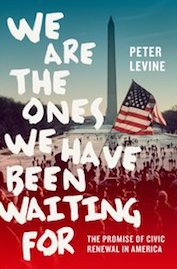 “Political philosopher and activist Levine (The Future of Democracy) argues that global problems can best be addressed by a targeted increase in deliberative democracy and citizen action. But the U.S. is currently marked by a decline in civic engagement, Levine notes, resulting largely from structural changes since the mid-20th century that have eroded many working-class organizations. Wielding an impressive command of research and statistics, as well as finer points of moral and political philosophy, Levine’s discussion of the benefits and contours of public engagement draw on lucid analogies and real-world examples (like the annual budget summits convened by Washington, D.C., mayor Anthony Williams, which empowered groups of citizens to deliberate on an area of central import to the whole community). Throughout, the message is that deliberative action among diverse networks of citizens goes beyond injecting public influence into the formal policy apparatus. The necessary goal, Levine writes, “is to democratize the whole process of shaping our common world.” Free market libertarians and others wary of civic engagement–especially where it impinges on market forces or the operation of business–will raise objections, although Levine anticipates these arguments to some degree. Broad in scope yet eminently practical, this book should be an enduring contribution to the study of democratic theory and social action.” -Publishers Weekly