Civic Science

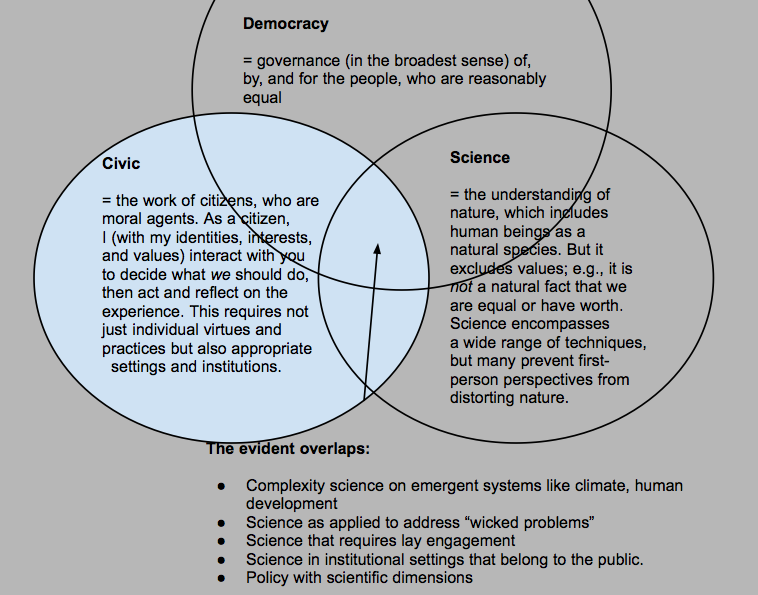
(Arlington, VA) I am at the National Science Foundation for a meeting on Civic Science. According to the background materials,

Civic science is a method of inquiry into important contemporary issues that enriches democracy by bringing citizens from all backgrounds and disciplines – not just scientists – together in shared projects that analyze current conditions, envision a better future, and devise a pathway to that future. Civic science is both an approach to generating knowledge and a democratic practice. In civic science, scientists express democratic citizenship through their scientific work: they engage in democratic world-building efforts as scientists. … The fundamental scientific question of “how does the world work” is situated in the context of democratic inquiry into a critical question—“What should we do in the face of complex problems?” Civic science, thus, integrates its work closely with the “purposive” disciplines of arts, humanities, and design, which ask fundamental questions about what is good and just, encouraging us to envision and debate ways of relating and living as civic agents.

Civic science is like “transdisciplinary” science (e.g., NRC 2014), but expands and enriches such frameworks by closely linking the practice of science to democracy and to other ways of knowing and learning from arts, humanities and design traditions and fields. Similarly, Civic Science is like community based participatory research (CBPR) and social movement-based “citizen science” in that it focuses on complex, pressing, real-world problems, and values diverse ways of knowing. However, in ways that usefully challenge theory and practice in CBPR, civic science intentionally and explicitly aims to promote democracy by framing scientific inquiry as an opportunity for participants to develop their capacity to work across differences, create common resources, and negotiate a shared democratic way of life. …

Civic science draws from research and theory in three areas: science and technology studies (STS), civic studies, and complex systems theory. Together, they provide the rationale for civic science and point to the benefits of pursuing civic science as an approach for furthering knowledge and democracy.


The post Civic Science appeared first on Peter Levine.

the principle of affected interests and the decline of the nation state

The dominant theory of democracy used to be a sovereignty theory. A “people” would consist of a bounded group, all of whose members would have equal rights to discuss and decide the issues that came before them. Such groups might be nation-states bounded by international borders, but they might also be organizations or associations; they were sovereign to the extent that they could make decisions about categories of issues. They would thus exercise what the French Revolutionary theorist Benjamin Constant called the “liberty of the ancients,” meaning the right “to deliberate, in a public space, about war and peace, to ratify treaties of alliance with foreigners, to vote laws, pronounce decisions, examine the accounts, actions, and management of officials, to compel them to appear before the whole people, to accuse them, to condemn or acquit them.”

Two problems arise for all such sovereign groups: 1) they may not have a legitimate moral basis to exclude outsiders from their decisions, and 2) they may not have actual control over the situations that they confront. For example, the US may not have a legitimate moral justification to exclude Germans from influencing our government’s surveillance policy, which also affects Germany; and the US government cannot control capital markets or pollution flows that cross its borders.

These problems have become more severe and more evident in a highly interconnected world. A traditional justification for the sovereignty theory presumed that nation states could safeguard the interests of their own members without impinging often on others. But, as my friend Archon Fung writes, “If there once was a time when the laws of a nation-state could adequately protect the fundamental interests of its citizens, many argue that such time is past.” He and others argue that we should shift from a sovereignty theory to a “theory of affected interests,” or at least add the latter to our understanding of democracy.

According to a theory of affected interests, a democracy is not a group of people who constitute a fixed polity that has a right to decide on everything that comes before it. In fact, if Americans can decide every topic under our government’s control, we will violate non-Americans’ rights to be consulted on matters that affect them as much or more than they affect us. Rather, each person has a potentially unique set of interests and a right to be consulted on all the decisions that affect those interests. For example, I have interests in clean and safe streets in my neighborhood and also the amount of carbon produced by Chinese industry. Archon Fung proposes as the basic democratic principle that “An individual should be able to influence an organization if and only if that organization makes decisions that regularly or deeply affect that individual’s important interests.” On that basis, I may have a right to influence Cambridge, MA and the People’s Republic of China, as well as Microsoft, the National Security Agency, and the American Political Science Association. The world becomes more democratic to the extent that each person has influence over the various overlapping organizations that affect him or her.

Empirically, this seems to be one direction politics is taking in our digitally enabled, global world. Social movements now draw people from a range of political jurisdictions who share a common interest. Movements target the appropriate organizations, which may be governments, corporations, or NGOs. They work like networks rather than institutions: people who share interests connect up to protest, boycott, or otherwise confront organizations.

Visiting Tufts in July, Archon cited the example of the Coalition of Immokalee Workers, farm laborers in the Florida tomato industry who were subject to terrible pay, stolen wages, and even documented cases of slavery. The sovereignty theory of democracy would not work for them because they were mostly not US citizens; they would be badly outvoted even if they were citizens; and they worked in a global market. Instead, the workers identified consumers from many nations who felt a moral stake in not supporting oppression. (The consumers had an interest, but not a purely selfish one.) The workers organized a boycott that forced the major buyers to negotiate. The result was a binding code of conduct that the workers can help enforce.

In essence, they identified a common interest with global consumers, targeted a set of international companies, and created a new micro-democracy just for their issue, in which they have considerable clout. One could define a more democratic world as one in which there are more such movements that represent more interests more effectively. Digital media would make that version of democracy more attainable than it ever was in the past. The democratic nation state would have decreasing relevance.

However, we should consider what would be lost if the sovereignty theory gave way entirely to a theory of affected interests. Constant spoke for a long line of civic republican theorists who envisioned citizens as groups of people who do not assess their individual interests in an ad hoc way and decide what affects them. Rather, they take responsibility for forming opinions about all matters that involve the group, giving at least some attention to abstract principles of justice as well as interests. Because they are responsible for considering a wide range of issues, they can weigh conflicting claims. For example, they should not only care about the farmworkers but also industry, the environment, and consumers. They should make laws that govern not only the tomato industry but the whole economy. And they should be subject to the laws that they influence, consistent with Aristotle’s definition of a citizen as one who both rules and obeys (Politics III:5).

So far, the democratic nation state has provided the main venue for this kind of citizenship. It has the two limitations named above: it may not have acceptable reasons to exclude outsiders, and it may not be capable of addressing all of its own problems. Therefore, the state should not be the only venue for democracy. Yet the democratic nation state is an achievement that we should not casually discard. Nations are big enough that they encompass some diversity of culture and class, and the successful ones have been able to organize one reasonably representative national discussion about justice. That requires an inclusive public sphere, a powerful and accountable legislature, and a sense of common fate that draws people’s attention to the public good. I read works as diverse as the “Gettysburg Address” and Bleak House as contributions to building that sense of common fate at the national level. Perhaps we should now understand ourselves as global citizens as well, but we are not literally people who both rule and obey at that scale. Meanwhile, we are at some risk of losing the national solidarity that underlies hard-won sovereign democratic institutions.

The post the principle of affected interests and the decline of the nation state appeared first on Peter Levine.

We Are the Ones We Have Been Waiting For in 10 minutes

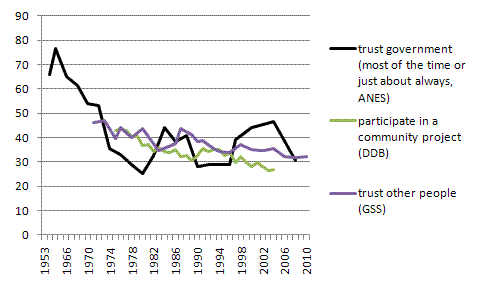
This video from Frontiers of Democracy 2014 is my best effort to summarize my book We Are the Ones … in 9 minutes and 39 seconds. It presents the book as an effort to answer the problem that was most on my mind during the conference–how to achieve leverage over large systems while retaining the human relationships and sense of personal agency that are most evident when we work together in small voluntary groups.

The post We Are the Ones We Have Been Waiting For in 10 minutes appeared first on Peter Levine.

leverage as a moral issue

Newly out from Springer is Leveraging: A Political, Economic and Societal Framework, edited by my friend David M. Anderson. Anderson identifies bargaining leverage, resource leverage, and investment leverage as three distinct but related issues and then develops the idea of a “leverage mean,” which is the “mean between the extremes of too much leverage and too little leverage.” He and the other contributors examine cases from Wall Street meltdowns to parenting. Significant portions of the book are available online for free.

I’ve been thinking about leverage lately as well. We begin the Summer Institute of Civic Studies by examining forms of human interaction that are direct and human. In community organizing, deliberative democracy, and the management of common pool resources, the participants can explain what they believe and value to one another and can tangibly affect the outcomes with their own words and work.

But we don’t believe that we can stop at that scale, because the national and global economy and environment are crucial. Therefore, by the second week of the course, we are reading authors like James Madison and Bruce Ackerman who are interested in the design of nations and other large-scale systems. But then the deliberate, intentional, active citizen tends to recede from view. After all, most of us are not in the position to write a new constitution that will be ratified. As one of our participants acutely noted, “I had to miss a day, and when I returned, we were talking about Madison. Where is the civic in that?”

The problem is one of leverage. If we only do what is right, we leave most of the world unchanged. If we seek to change the world at large scale, we must get others to do what is right as well. That is leverage. For the most part, our leverage in the social world comes from creating, using, and changing institutions.

As the Archimedean metaphor suggests, to use leverage is to manipulate–to treat something as a means. In the social world, that something will have to be human: a person or a group. Leverage is necessary if you care for the world at any significant scale. But leverage is also risky and is ethically problematic because it can’t be fully reciprocal and relational. I think this is a fundamental problem, and Anderson and colleagues have opened an important line of inquiry.

The post leverage as a moral issue appeared first on Peter Levine.

Frontiers of Democracy 2014

I’m with more than 140 scholars, practitioners, and activists from as far away as India, Ukraine, and Israel at Frontiers of Democracy 2014. We are streaming some of the conference live, but another good way to check in on the conversation is to follow the Twitter hashtag #demfront. So far, I’ve hear lots of tough, passionate, and thoughtful conversation about whether the small-scale democratic practices that we create–practices marked by deliberative and relational values–have anything to do with the large-scale structures that dominate our lives. One way that they might relate is by actually shoring up existing institutions, at the expense of justice. But can we critically assess powerful structures in a way that gives us agency? If this conference became a critical seminar on global crony capitalism, would we do anything differently after we left?

The post Frontiers of Democracy 2014 appeared first on Peter Levine.

needed: the case method for civics

David Garvin has written, “All professional schools face the same difficult challenge: how to prepare students for the world of practice. Time in the classroom must somehow translate directly into real-world activity: how to diagnose, decide, and act. A surprisingly wide range of professional schools … have concluded that the best way to teach these skills is by the case method.”

I propose that we need cases for citizens. Of course, there are many case studies available. Participedia provides hundreds of examples of citizens’ engagement with government. Many books (including my own) tell stories of successful or failed civic efforts.

But the case method is a little different. A “case” in this context means a deliberately incomplete story. It ends at a point of decision for a character or small group. The decision is contrived or chosen to be difficult in the specific sense that it is unresolvable by any formula or algorithm. Such difficulty may arise because the situation involves conflicting and incommensurable values or because the facts and likely outcomes are uncertain–or both. These two sources of indeterminacy are extremely common. Yet we must act. Garvin writes:

“The case system, ” business school alumnus Powell Niland, now of Washington University, has observed, “puts the student in the habit of making decisions.” Day after day, classes revolve around protagonists who face critical choices. Delay is seldom an option. Both faculty and students cite the “bias for action” that results—what Fouraker professor of business administration Thomas Piper calls “courage to act under uncertainty.”

In the Summer Institute of Civic Studies last week, we discussed a case study from Harvard’s Pluralism Project. It involves an adult leader (who, coincidentally, I happen to know) who helped youth organize an interfaith event in a synagogue and who must decide, at very short notice, what to do about a sign that says, “We support Israel.” This is a case about religious pluralism, but we could also consider it a case of civic action. We need more cases like it.

By the way, if you follow the argument of Bent Flyvberg (whom we also read in the Institute), then you will conclude that all knowledge of the social world is particularistic and case-specific. The only valid knowledge comes from cases. I think that is too strong. General knowledge is also helpful. If there are no laws or algorithms that tell us what we should do, there are at least useful rules-of-thumb and principles, both explanatory and normative. Yet cases play an essential role, especially if the purpose is to educate citizens to act.

The post needed: the case method for civics appeared first on Peter Levine.

explaining Dewey’s pragmatism

In the Summer Institute of Civic Studies, we read chapter 5 of John Dewey’s The Public and its Problems, which exemplifies pragmatism as a method or as a theory of knowledge and value. This year, we are also reading a lecture by Hilary Putnam entitled “The Three Enlightenments” (from “Ethics without Ontology”), which I find helpful for elucidating Dewey’s method.

Putnam distinguishes three stages of enlightenment, of which the last is the “pragmatic” stage inaugurated by Dewey. We can consider Putnam’s three stages using an example–voting–that he does not use himself.

1. The Greek stage of enlightenment is exemplified by Socrates’ going around Athens, asking “why?” Socrates won’t do or endorse anything until his “why?” question is answered. As Putnam says, Socrates seeks “reflective transcendence” as he tries to throw off both “conventional opinion” and “revelation” and make his own reason the only judge.

If Socrates encountered our practice of regularly voting for our leaders (which, of course, originated in his culture), he would say, “Why do you do that?” We could not reply: “Because it’s in the Constitution.” Or “Because it is our custom.” We would have to give a reason that could overcome his skepticism.

2. The Age of Enlightenment stage repeats this skepticism but adds two big ideas capable of offering answers: the social contract and natural science. Actually, each offers a potential justification of voting. If society is and ought to be a social contract, then giving everyone a vote to select their leaders is a means of renewing the contract. Or one could say that voting is a right that people would demand before they entered the contract in the first place. Further, we can study whether voting leads to good outcomes, such as social welfare. That kind of investigation employs the tools of natural science to study a social phenomenon.

3. The third stage is Deweyan and pragmatic. It is a “criticism of criticisms.” It rejects enlightenment reason. For instance, the concept of a social contract is an invention. Even if we accept it, it does not answer all the “Why?” questions. Why should there be a social contract? Why should persons be equal? Further, no empirical study of voting can vindicate it by demonstrating its positive outcomes. Why, after all, should we value those outcomes? Why did we decide to measure them as we do?

In contrast, Dewey would say that he was formed by a society in which voting is a norm. He does not have a vantage point completely independent of that society. That is the basic reason that he and the rest of us vote. It is not appropriate to ask the “Why?” question as if one could stand apart from this society. That kind of skepticism leads nowhere. As Dewey puts it (p.158), “philosophy [once] held that ideas and knowledge were functions of a mind or consciousness that originated in individuals by means of isolated contact with objects. But in fact, knowledge is a function of association and communication; it depends upon tradition, upon tools and methods socially transmitted, developed, and sanctioned.”

However, we do not have to continue doing what we have done. It is appropriate to ask whether we should change our political system. The evidence we need to make that decision is much more than data about causes and effects.

As Putnam says, Dewey is “simultaneously fallibilist and anti-skeptical.” To be fallibilist is to presume that what you believe today may be wrong. To be anti-skeptical is to believe that you ought to go forward even if you cannot answer every “Why?” question adequately. Putnam adds that “traditional empiricism is seen by pragmatists as oscillating between being too skeptical, in one moment, and insufficiently fallibilist in another of its moments.” For instance (a pragmatist might argue), empirical political science is too skeptical when it treats value-judgments about matters like democracy as mere matters of subjective opinion; but it is insufficiently fallibilist when it treats data about things like voting as reliable bases for deciding what to do. And political philosophy is insufficiently fallibilist when it strives for permanent answers to questions like, “Should we vote?” The answer will be different a century from now.

Putnam writes:

For Dewey, the problem is not to justify the existence of communities, or to show that people ought to make the interests of others their own [that much is natural and unavoidable]; the problem is to justify the claim that morally decent communities should be democratically organized. This Dewey does by appealing to the need to deal intelligently rather than unintelligently with the ethical and practical problems that we confront.

So what about voting (as an example of a social practice that we should assess)? It is what we have inherited, so we must start with it. It has arisen as a tool for making our social life more intelligent–or it is useful for that purpose, regardless of its original reasons. But it is merely a tool, and there may be better ones.

[We] must protest against the assumption that the [democratic] idea itself has produced the the governmental practices which obtain in democratic states: General suffrage, elected representatives, majority rule, and so on. … The forms to which we are accustomed in democratic governments represent the cumulative effect of a multitude of events, unpremeditated as far as political effects were concerned and having unpredictable consequences. …

The strongest point to be made in behalf of even such rudimentary political forms as democracy has already attained, popular voting, majority rule and so on, is that to some extent they involve a consultation and discussion which uncover social needs and troubles.

See also “Dewey and the current toward democracy.”

The post explaining Dewey’s pragmatism appeared first on Peter Levine.

what qualifies a theorist to be part of civic studies?

We are almost halfway through the 2014 Summer Institute of Civic Studies at Tufts University. A group of 24 professors, graduate students, and civic leaders from many countries (only half are from the US) are deep into discussing several thousand pages of theoretical readings. We present the readings as an emerging–and disputable–canon for a field we call “civic studies.”

What qualifies an author to be included?

I have argued here that the only serious question for human beings as members of communities is: “What should we do?” Importantly, the question is not “What should be done?” which is much more commonly addressed in modern scholarship. Thus we must reform scholarship to make it address the citizen’s essential question.

A contributor to the nascent discipline of civic studies helps us to decide what we should do. A theorist of civic studies is someone who doesn’t just address that question in a particular context (e.g., “What should we parents of X school do to improve it?”). Instead, she or he offers guidance about broad categories of situations–perhaps about all situations that confront human beings. That is the screen through which I put potential contributors to the canon of civic studies.

So far this week, we have considered Jurgen Habermas, Elinor Ostrom, Robert Putnam, Harry Boyte, Albert Dzur, and Bent Flyvbjerg. Roberto Mangabeira Unger is up next.

As an example, Habermas addresses the question, “What should we do?” roughly as follows. It is a moral question, about what is right or just to do. It is not the question: “What do we want?” nor “What does our perspective, bias, or interest cause us to want?” We may have to choose against our desires or interests. The claim that something is right is like the claim that something is true. In both cases, we put the proposition before other human beings and seek their free agreement. If, for example, I assert that it would be right or just for me to pay lower taxes, then–if the conversation is free and public–I will have to give reasons persuasive to my fellow citizens. It won’t matter what my motives are. My arguments will have to be valid from others’ perspectives.

(By the way, if I make a claim about my motives–e.g., “I really only want to pay lower taxes because I want to help others,” that is a separate proposition that can also be tested by other human beings. They can look for consistency and other evidence of sincerity. Claims of justice, truth, beauty, and sincerity require different justifications but are alike in that they are all requests for free assent and they all promote reasonable inquiry.)

Thus what we should do is (a) whatever we decide to do in a very good conversation. But that implies (b) that we must participate in such conversations. And since they do not occur automatically, we must (c) work to make them happen, which is not just a matter of organizing and facilitating discussions but also of changing the incentives and rules that apply in public life so that democratic discussions flourish more. Finally, discussion by itself is insufficient to accomplish justice, so we must (d) press the economic and political systems to respond to reasonable public opinion.

This leaves much to be worked out–and is not ultimately satisfactory to me–but it qualifies Habermas as a civic theorist.

The post what qualifies a theorist to be part of civic studies? appeared first on Peter Levine.

on the contributions of Vincent and Elinor Ostrom

Vincent and Elinor Ostrom founded a whole school of thought–some call it the Bloomington School–that now orients the work of many scholars and practitioners around the world. Last week, about 250 people came from many countries to give papers inspired by the Ostroms’ framework as part of a conference entitled the “Workshop on the Ostrom Workshop.” In my paper, I argued that the Ostroms addressed the citizen’s question, “What should we do?,” which is the guiding question of “Civic Studies.” I am posting a PDF of my paper here. It is a bit of a cut-and-paste job, portions of it having appeared on this blog or in various published articles.

The post on the contributions of Vincent and Elinor Ostrom appeared first on Peter Levine.