against fatalism: responding to Krugman and Sunstein

(Washington, DC) Harry Boyte, Albert Dzur, and I have a letter in the latest New York Review of Books that is pertinent to today’s column by Paul Krugman. Krugman’s piece, entitled “Economics and Elections,” is deeply depressing and depressed, exemplifying the very mode of thought that Harry, Albert, and I wanted to challenge in our letter about Cass Sunstein and Michael Walzer, which we wrote more than a month ago.

Krugman argues today that the British Tories did immense and unnecessary damage to the UK economy by enforcing austerity policies. However, the British economy has grown of late, and “a large body of political science research” finds that what determines the outcome of a national election is economic growth during “the last two quarters before the election.” That factor is much more important than any behavior or rhetoric by politicians or anything that the media can say or do. It explains why the Tories may win.

For politicians, the lesson is to ignore the good of the country if you want to be reelected. In fact, “the politically smart thing might well be to impose a pointless depression on your country for much of your time in office, solely to leave room for a roaring recovery just before voters go to the polls.” Scholars and public intellectuals can do little to change this reality, Krugman argues, but they should commit to the truth anyway, like geeky existentialists. Our duty as intellectuals:

Try to get it right, and explain our answers as clearly as we can. Realistically, the political impact will usually be marginal at best. Bad things will happen to good ideas, and vice-versa. So be it. Elections determine who has power, not who has the truth.

(By the way, this is an interesting reversal for Krugman, who early in the Obama years was quick to accuse the president of not using the Bully Pulpit effectively. As he now notes, political scientists basically don’t believe in the Bully Pulpit.)

Cass Sunstein, a distinguished and often insightful political scientist, has collected evidence along similar lines to the “large body” of research cited by Krugman today. Sunstein and his co-author Reid Hastie argue that individuals and groups reach irrational conclusions because of hard-wired cognitive limitations, such as a tendency to “groupthink.” The behavior of voters in a national election is just an example.

Such evidence should be taken seriously. But Michael Walzer offered an important critique in the New York Review of Books that could also apply to Krugman’s article today. Walzer argued that problems (like groupthink) that bedevil discussions inside Congress, the Supreme Court, or any committee room may not be as serious as “powerlessness and inequality.” He concluded:

Organizing, agitating, demonstrating—these are ways of bringing the powerless to the attention of the powerful. They can contribute importantly to democratic decisions, even if they seem nondeliberative. … Sometimes we will want the people outside the room actually to win—to organize and agitate so successfully that they take over the small groups who dominate decision-making, with the result that they change the political conversation. … So, yes, we need to be wiser in the ways described by Sunstein and Hastie; but we also need a radically different kind of decision-making than what they describe, involving a larger number of people inside and outside the rooms where small groups sit.

We concur but would push the argument further. Political institutions can be changed. This is not only a matter of adjusting the rules that govern, for instance, parliamentary districts in the UK or campaign finance in the US. It is also about achieving cultural change within major institutions, such as legislatures, newspapers, and schools and colleges. It is about changing us (the citizens), not just them (the rulers). We wrote:

Sunstein, like Habermas and many others, sees major institutions as largely fixed and unchangeable, not subject to democratizing change. This assumption generates fatalism, which has shrunk our imaginations about decision-making, politics, and democracy itself. The challenge is to recognize that institutions of all kinds are human creations that in turn can be recreated, reconnected to questions of civic and democratic purpose. For this task we need to bring in Max Weber as well as Machiavelli and Marx [whom Walzer had recommended in his review]. Weber described the “iron cage” that results from technical rationality. In his essay “The Profession and the Vocation of Politics,” Weber also evocatively termed the pattern “the polar night of icy darkness.” Thawing the polar night is a frontier of democracy in the twenty-first century.

The evidence that Krugman and Sunstein cite is empirical. By definition, it derives from the past. In the case of Krugman’s column today, it derives from quantitative studies of US presidential campaigns since World War II. We should pay attention to trends in the recent past so that we know what to change. But we cannot allow the past to become a dead hand so that we surrender our political agency.

I addressed the very same topic in We Are The Ones We Have Been Waiting For (pp. 26-7):

The outcome of presidential elections in the United States is strongly correlated with the performance of the economy in the previous year. That means that all the deliberate work of campaigns, parties, and independent advocacy groups matters less than the blind, impersonal force of the business cycle.

Nevertheless, working together in small groups is morally important—it is what we should do and should care most about. To be a good person is to do this work well. That is reason enough to make it a central question for reflection and research. In addition, deliberate human action has significant impact. Small groups of thoughtful, committed citizens do make a difference under appropriate circumstances, as shown by the civil rights movement, the women’s movement, the conservative legal movement, and numerous other examples. … Elinor Ostrom won the 2009 Nobel Prize in Economic Sciences for demonstrating that the organization and governance of voluntary groups affects whether they can solve social problems. These findings suggest that “small groups of thoughtful, committed citizens” matter, even if other factors matter too.

If the leaders of the South African freedom movement reviewed the scholarly literature on democratization during the apartheid years, they must have found it depressing. Prosperity, economic equality, and ethnic homogeneity were the factors that had been found to increase the odds of a successful transition to democracy. These structural factors were all evidently absent in South Africa. … Thus, if the African National Congress and other democratic reformers had been guided by hard-nosed, empirical research, they would have chosen a goal short of democracy, something like a negotiated arrangement among separate authoritarian communities. But they were right to ignore the scholarly literature because it was based on empirical data—in a word, on the past—and the past can never determine the future. So far, their peaceful revolution appears a monumental work of deliberate human agency.

The post against fatalism: responding to Krugman and Sunstein appeared first on Peter Levine.

from soft skills to agency

I’m very pleased to see a blog post by Andy Calkins, Deputy Director of the Next Generation Learning Challenge, entitled “It’s Time to Trash the Terms ‘Non-Cogs’ and ‘Soft Skills.'”

Partly in response to the hegemony of standardized testing, some organizations and individuals have been pushing for “non-cognitive” or “soft” skills (e.g., collaboration, grit, participation) as important measures and goals of education. Theirs is a valid goal, but I agree with Calkins’ critique of the terminology. The kinds of skills that have been named “non-cognitive” actually require advanced cognition; the skills that have been labeled “soft” are, in every sense, quite hard.

But it’s not his critique of terminology that makes me recommend Calkins’ post. Rather, it’s the alternative master term that he recommends to replace “non-cog” and “soft.” Calkins chooses “agency,” which is indeed an apt word for the individual student outcomes that have been overlooked in the era of narrow assessments. Agency comprises an individual’s ability and motivation to interpret and change the world. But it is not an only individual matter. Agency has to be political (in the broadest sense), because individuals are truly effective as agents when they work together.

Thus we can say that citizens have agency; and people who exhibit agency in public contexts are citizens. Doris Sommers, who visited Tisch College earlier this week, would argue that citizenship is “cultural agency”: intentionally shaping the common world together. And Harry Boyte and Blase Scarnati write, “Agency can be understood as a form of empowerment that has conscious political dimensions, or as effective and intentional action that is conducted in diverse and open settings in order to shape the world around us.”

In We Are the Ones We Have Been Waiting For (pp. 27-8), I write:

A master question for social theory during the twentieth century was structure versus agency: whether people’s voluntary choices made any difference in politics, or whether underlying “structures” determined everything. This question divided, for example, French existentialists (who preached the value of intentional political acts) from French structuralists (who thought that political events, including major elections and revolutions, were superficial perturbations on the permanent structures below). But the question for the twenty-first century should be different: not how much impact agency has, but how that impact can be expanded. The reason to expand it is not that agency is intrinsically good. Hitler was an effective political agent. Rather, deliberate and effective human action is one necessary condition of a worthwhile human life. If there is no agency, life can have no point.

In the context of education, “agency” moves us from a purely individualistic framework to a recognition of collaboration, social capital, networks, public discourse, and other outcomes for groups and communities.

This argument is important coming from the Next Generation Learning Challenge, which is influential, hard-nosed about measures and methods, and involved with enhancing students’ success as currently measured. (For full disclosure, the NGLC funded us for a randomized experimental test of iCivics’ Drafting Board module, which we found to be effective.) It would be easy and unremarkable for me–a civics and democracy guy–to endorse agency. For the NGLC to choose it as a master term is much more valuable.

See also: “from the achievement gap to empowerment

The post from soft skills to agency appeared first on Peter Levine.

a different approach to human problems

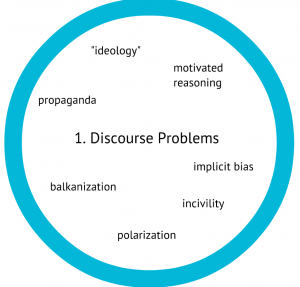
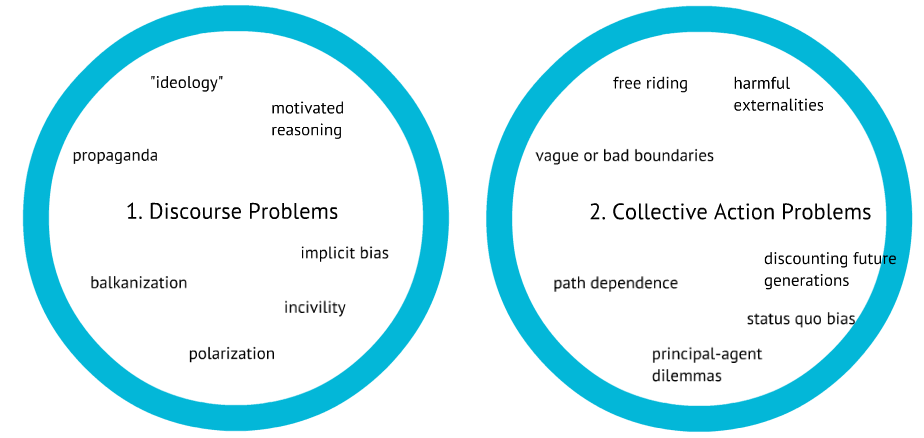
Crime, poverty, tyranny, racial injustice, and environmental degradation may be among the chief issues at a given time. But beneath such specific challenges are general forms of problems. To reprise a diagram from a previous post, we face problems of discourse (when we think or want the wrong things) and problems of collective action (when we can’t get what we want).

discourseAcademics certainly study these problems. Google Scholar finds more than 77,000 books or articles on free-riding, which is one variety of a collective action problem. It finds more than 9,000 citations of implicit bias, which I would categorize as a discourse problem. There is no shortage of material to read, and much of it is useful.
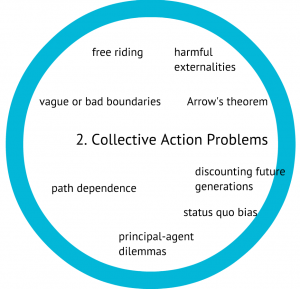
But the study of human problems and their solutions suffers from three general collective actionlimitations that we should address:

  1. Too little attention is paid to what we (you and I and the people we can influence) are able to do. For instance, pumping carbon into the air is a classic harmful externality. It’s serious enough that it threatens our survival. Economics offers a solution: tax the carbon. The tax might not even have to be very high, and other tax cuts could offset it. That sounds like the answer, but it isn’t something that we (you and I and our friends and colleagues) can implement. We lack the power to set taxes. Even if we formed the body of the US Congress, we couldn’t tax carbon in China. So the proposal to tax carbon is not the solution; it just poses new problems that we must define, analyze, and address in ways that guide our actions. (By the way, several of the most common proposed solutions are inadequate. For instance, we cannot vote for candidates who would tax carbon unless such candidates actually run, have a chance of winning, and hold a whole platform of ideas that we endorse. Also, we cannot just voluntarily cut our own carbon emissions and hope that others do as well. So what should we do?)
  2. The moral question (what is right and good?) is too often sidelined. Although the diagrams shown above list “problems,” these phenomena are not necessarily bad. For instance, when we promote competition among firms by preventing them from coordinating their prices, we are putting them in a Prisoner’s Dilemma. That is desirable because it’s better for profits and prices to be low. But when nonprofits compete instead of collaborating on the common good, that is damaging. So I say–but clearly, I owe an argument for those judgments. An underlying theory of justice must determine which Prisoner’s Dilemmas are good and bad. Some of the prevalent methods for deciding what constitutes a problem–or a solution–are morally indefensible. For example, neither false consciousness as a methodological tool on the left nor Pareto optimality on the right will reliably distinguish right from wrong. So what is right for us to do?
  3. Theory is insufficiently exploited as a resource. Sometimes people teach and investigate social problems in highly experiential ways, by rolling up their sleeves and tackling issues like homelessness or habitat loss in specific programs, classes, or other projects. Much can be learned from experience, which is why I am a lifelong advocate of civic engagement in k-12 schools and colleges. And yet, if you invite a group of people to choose, define, and address a problem from scratch, you are asking them to reinvent the whole history of thought. You may inspire them by telling them, “Never doubt that a small group of thoughtful, committed citizens can change the world.” But when they fail to improve the world, as they almost always will, their sense of self-confidence will fall–as seen consistently across a wide range of programs. It is hard enough to make noticeable progress on entrenched challenges without taking full advantage of the accumulated and organized analysis of other people. So what is smart for us to do?

The nascent Civic Studies movement proposes to ask “What should we do?” and then take very seriously the various generic forms of human problems–along with explicit moral argumentation. Three benefits should follow. We should unify our understanding of the various genera of problems–which are now distributed across the social sciences and humanities–by viewing them from a single perspective, that of a reflective small group of citizens. We should enhance human agency and satisfaction by making ourselves the cause of solutions, not just the objects of other people’s actions. Above all, we should actually improve the world by identifying solutions that we (you and I and our friends) can accomplish.

To give a little more concreteness to the list of problems, I will briefly discuss some of the key ones. This is a radically incomplete list; and the discussion of each one below is highly preliminary. The point is to indicate the agenda of Civic Studies.

  1. Discourse Problems
    1. Ideology: This word can be defined in various ways, but I have in mind a systematic distortion of one’s beliefs and preferences due to an overall theory that is wrong. For instance, some people believe that the United States was once a welfare state with a social safety net that has been badly frayed because of neoliberalism. And other people believe that the United States was once a society of free, self-reliant entrepreneurs that is now becoming socialist. They cannot both be right. If either belief or (as I happen to think) both beliefs are wrong, then we have a problem of ideology, because these ideas are prevalent and influential.
    2. Implicit Bias: In experiments using fictional resumes, “White-sounding names (e.g., Emily, Greg, Sarah, Todd) received 50 percent more callbacks for interviews than resumes with African American-sounding names (e.g., Lakisha, Jamal, Latoya, Tyrone) (Bertrand & Mullainathan, 2004). Putting this in perspective, ‘a White name yields as many more callbacks as an additional eight years of experience on a resume’ (Bertrand & Mullainathan, 2004, p. 992).” That is evidence of a bias that is pervasive and damaging even if it is unconscious and unintended. Implicit bias is not limited to matters of race and seems to be extraordinarily common.
    3. Motivated Reasoning: We are good at selecting and emphasizing facts that support our pre-determined ideas, and equally good at marginalizing or debunking facts that complicate or challenge those ideas. For example, as people obtain more education, their opinion about climate change correlates more with their political ideology. Conservatives become less likely to believe in it, and liberals more so, the more education they have. Why? Because well-educated conservatives are sophisticated enough to recognize that accepting evidence of climate change would challenge their economic views, so they use mental techniques (also exhibited by liberals on other topics) to debunk or marginalize the evidence. Many studies find that deliberate efforts to debunk myths actually reinforce the same myths because people hear the information selectively.
    4. Polarization: Numerous studies have found that groups on one general side of an issue will migrate toward more radical opinions as a result of interacting. Groups that span a wide spectrum of opinion will often polarize into relatively radical opposing subgroups. One of several reasons is that individuals want to be accepted into a group of like-minded peers.
  2. Collective Action Problems
    1. Principal-agent problems: An “agent” is someone whom a “principal” employs to take care of her interests. For instance, I employ my dentist to take care of my teeth. But my dentist’s interests may diverge from mine: for instance, if expensive surgery is an option. The same divergence can occur in political contexts. Almost all Americans believe that money has too much influence in politics and should be curtailed. Yet for decades before the Supreme Court got in the way, Congress did very little to restrain private money in politics, even when the Democrats (who were rhetorically opposed to it) controlled both branches of government. Why? Because politicians are agents of citizens, and as agents who have been elected in a system of unrestricted private money, they have different interests from their principals.
    2. Free riders: It is often tempting to let other people carry the burden for a public good, in which case the good may not be provided even if everyone wants it. Examples range from a failure to clean the dishes in a group house to the failure of nations to limit their carbon emissions.
    3. Path dependence: We might all be better off if, a century ago, cars had been developed to use electricity instead of gasoline. By the 21st century, electric cars would be fantastically fuel-efficient and convenient. But the petroleum path was chosen, and now to shift to electricity is very expensive and difficult–so much so that it might even be unwise.
    4. Arrow’s Impossibility Theorem: It has been logically proven that no system for turning votes into decisions can simultaneously meet several obvious criteria. In practical terms, the main implication is that we must choose between voting systems that force a two-sided choice (like referenda or two-party elections) or voting systems that allow many to win small shares of power (as in Israeli elections). The former systems disadvantage anyone who is dissatisfied with the forced choice. The latter can lead to stalemate or unpopular minority rule.

A subset of these problems will typically confront any concrete group of human beings who aim to improve their world. In many circumstances, the various problems will closely interrelate, causing webs or cycles of challenges. For instance, ideology may prevail over good evidence (a discourse problem) because the effort to become truly informed about public issues is not worthwhile for each party (a collective action problem).

Yet–and this is a crucial point–groups of people do solve human problems. They do build institutions and norms that make life better. Every decent and functioning government, association, neighborhood, and network is a triumph of reasonable hope over chastened experience. The master theorists of Civic Studies are people like Elinor Ostrom and Jürgen Habermas (a student, respectively, of collective-action problems and of discourse problems), who seek to understand in order to defend, improve, and spread such cases of human success.

See also Ostrom plus Habermas is nearly all we need; my piece on Civic Studies in Philosophy & Public Policy Quarterly; the book Civic Studies: Approaches to the Emerging Field; and The Good Society symposium on Civic Studies.

The post a different approach to human problems appeared first on Peter Levine.

Peter Railton on why meetings are essential

The American Philosophical Association’s John Dewey lectures are autobiographical remarks by senior philosophers who draw lessons from their whole lives as scholars and people–much in the spirit of Dewey. University of Michigan Professor Peter Railton exemplifies the genre with his 2015 lecture, Innocent Abroad: Rupture, Liberation, and Solidarity, which is a wonderful reflection on a life of thought integrated with action.

What I want to quote is his defense of “meetings,” which is strikingly similar to the arguments I offer in We Are the Ones We Have Been Waiting For. Railton writes:

Oscar Wilde is still right—because the cost of building a society where the people have more say in how their lives are run is still many, many meetings. What is a meeting, after all, but people deliberating together with a capacity to act as a group that is more than just a sum of individual actions, and this sort of informed joint action is a precondition for significant social change. Come together, decide together, act together, and bear the consequences together. We must own our institutions or they will surely own us. As Aristotle told us, one becomes a citizen not by belonging to a polity or having a vote, but by shouldering the tasks of joint deliberation and civic governance. And there is no civic or faculty governance, no oversight of discrimination in hiring and promotion, no regulation of pollutants, no organization of faculty or students to initiate curricular reform, no mobilization by professional associations to protect their most vulnerable members or to promote greater diversity, no increased humaneness in the treatment of animals and human subjects, no chance to offset arbitrariness and bullying within offices and departments, no oversight of progress and revision of plans in response to changing circumstances, without actual people who care spending long hours in the work of planning, meeting, and making things happens. The alternative is for all these decisions to be made at the discretion of those on high—or not at all. …

Of course, I am using ‘committees’ and ‘meetings’ as stand-ins for countless forms of joint deliberation and action. It needn’t fill the streets with banners or occupy buildings—sustainable activism is the work of a lifetime, not just of youthful bravado. What most impresses me about the activism of today’s youth is that it persists, indeed, flourishes, in countless ways that are more integrated with the ways of working of the world. As I look around me from the vantage point of Philosophy, I see colleagues and students investing countless hours trying to enhance the inclusion of women and other under-represented groups, or to build collective bargaining for graduate student instructors and term lecturers, or to reach out beyond the university to promote equitable trade, or to support humane and ecological practices in agriculture, or to bring new resources to under-served communities. These efforts involve personal sacrifice, and often made by those within the academy whose positions are the least secure. Moreover, they are making these sacrifices without a movement at their backs, or a Zeitgeist to buoy them from below. So it behooves those of us who are more secure to revive our spirit of activism. To lend a hand, and to use whatever leverage we might have to provide badly-needed support.

I agree with every word above. I’d only add that opportunities to talk, listen, and work with fellow citizens have weakened. The proportions of Americans who said that they attended community meetings, worked with neighbors to address problems, and belonged to organizations fell between 1975 and 2005.

These trends were not accidental but reflected intentional moves to sideline citizens. For instance, jury trials were replaced with plea-bargaining. The proportion of Americans who served on public boards declined by about 75 percent during the second half of the twentieth century, due to consolidation of local governments and the replacement of lay bodies with professional managers. The decline of unions meant many fewer union meetings and collective bargaining sessions; it also meant that labor was no longer a force that could demand public discussion of issues.

It follows that democracy not only takes a lot of evenings. It also requires a fight for the right to use our evenings to govern ourselves–against people who would rather govern us.

The post Peter Railton on why meetings are essential appeared first on Peter Levine.

apply for the 2015 Summer Institute of Civic Studies

The seventh annual Summer Institute of Civic Studies will be an intensive, two-week, interdisciplinary seminar bringing together faculty, advanced graduate students, and practitioners from many countries and diverse fields of study.

Organized by Peter Levine of Tufts University’s Tisch College and Karol Soltan of the University of Maryland, the Summer Institute will engage participants in challenging discussions of such topics as:

  • What kinds of citizens (if any) do good regimes need?
  • What should such citizens know, believe, and do?
  • What practices and institutional structures promote the right kinds of citizenship
  • What ought to be the relationships among empirical evidence, ethics, and strategy?

The syllabus for the sixth annual seminar (in 2014) is here. The 2015 syllabus will be modified but will largely follow this outline. You can read more about the motivation for the Institute in the Framing Statement by Harry Boyte, University of Minnesota; Stephen Elkin, University of Maryland; Peter Levine, Tufts; Jane Mansbridge, Harvard; Elinor Ostrom, Indiana University; Karol Soltan, University of Maryland; and Rogers Smith, University of Pennsylvania.

Practicalities

The daily sessions will take place from June 15-25, 2015, at the Tufts campus in Medford, MA. The seminar will be followed (from June 24, evening, until June 27) by a public conference–“Frontiers of Democracy 2015”–in downtown Boston. Participants in the institute are expected to stay for the public conference. See information on the 2014 conference here.

Tuition for the Institute is free, but students are responsible for their own housing and transportation. A Tufts University dormitory room can be rented for $230-$280/week. Credit is not automatically offered, but special arrangements for graduate credit may be possible.

To apply: please email your resume, an electronic copy of your graduate transcript (if applicable), and a cover email about your interests to Peter Levine at Peter.Levine@Tufts.edu. For best consideration, apply no later than March 15, 2012. You may also sign up for occasional announcements even if you are not sure that you wish to apply.

The Sister Seminar in Ukraine

In 2015, there will also be a parallel Summer Institute at Chernivitsi University in Ukraine. It is co-organized by Dr. Tetyana Kloubert (University of Augsburg) with Karol Soltan and Peter Levine and funded by the German government through the DAAD. Participants from Ukraine, Belarus, Poland, and Germany are eligible. More information here.

Please feel free to share this announcement.

The post apply for the 2015 Summer Institute of Civic Studies appeared first on Peter Levine.

the Women’s Studies/Civic Studies analogy

In introducing Civic Studies, I am increasingly using an analogy to Women’s Studies. This is how it goes:

In the 1960s, a political movement–known retrospectively as Second-Wave Feminism–developed, with the goals of liberating women and achieving gender equality. That movement had intellectual leaders, including academics and independent writers. They shared political goals with the movement but they also had intellectual objectives: to challenge the invisibility of women in all fields of study (from cancer research to classical history), to explore issues related to gender, and to develop novel theories and methodologies that emerged from thinking as and about women. One strategy for accomplishing those goals was to create women’s studies as a discipline, with all that entailed: journals, conferences, and courses. Apparently, the first women’s studies course was taught at Cornell in 1969, and the first two degree programs were launched in 1970. The courses could be pedagogically innovative, but what really defined them was their subject matter and the developing canon of assigned writers. Of course, participants did not hold uniform ideas but engaged in a rich debate. They have built up a new discipline, developed several generations of scholars, challenged and altered virtually all the other disciplines, and offered insights and information to political and social movements.

Likewise …

Since the late 1980s, there has been a movement to restore the role of active, responsible, collaborating citizens in the creation and the governance of communities. It has arisen to counter trends–centralization, marketization, consumerism, crony capitalism, and positivism–that marginalize citizens. Perhaps it does not deserve comparison to Second Wave Feminism, although if we take a global perspective, it has had striking successes (see this World Bank volume, village democracy in India, or the many cases described in Participedia). This civic renewal movement has an intellectual component led by prominent academics along with some independent writers (e.g., Parker Palmer, Frances Moore Lappé). They too have confronted a problem of invisibility within the academy. Too much research across the social and behavioral sciences, the humanities, and the professional disciplines ignores what I would call “citizens”: people who combine facts, strategies, and values to define and address social issues in common with peers. Citizens are invisible because of artificial distinctions between facts and values and because of research methods that miss human agency. In response, the intellectuals involved in Civic Studies are beginning to build up courses, journals, conferences, and allied efforts (e.g., Civic Science). Again, the pedagogy may be innovative, but this is not an educational reform movement. Our goals are rather to develop a new discipline, to alter the other disciplines, to derive new insights by thinking about and as citizens, and to inform political and social movements that renew civic life.

The post the Women’s Studies/Civic Studies analogy appeared first on Peter Levine.

the two basic categories of problems

Human beings face two fundamental categories of problems: problems of discourse and problems of collective action.

Problems of discourse make our conversations go badly, so that we believe or desire the wrong things. They include, for example, our unconscious biases in favor of members of our members of our own groups and our strong tendency to “motivated reasoning,” or picking facts and theories because they yield the results we want. A different example is ideology, defined (in this context) as holding a distorted view of reality that preserves the advantages of the privileged.

Meanwhile, problems of collective action cause us to get results that we do not desire, even when we agree about goals and values. An example is the temptation to “free ride” on other people’s contributions, or the extreme cost of changing a system once it has been chosen and developed (“path dependence”).
Screen Shot 2015-02-10 at 10.20.04 AM

How can I justify the claim that these are the two fundamental categories of problems? My claim is subjective, but it does arise from 20 years of thinking about social problems, during which I have constantly found myself drawn to two quite different conversations. One is about deliberation, communication, and the flaws thereof. The most relevant disciplines are political philosophy, cultural studies, and communications. Famous authorities include Marx and the Frankfurt School, Habermas, Derrick Bell, John Rawls, Judith Butler, and many more. The other conversation is about rational choice, public choice, and game theory. The most relevant disciplines are economics and social psychology. Authorities include Elinor Ostrom, James M. Buchanan, Mancur Olson, and Kahneman & Tversky.

The two sets of problems are connected. For instance, one explanation of motivated reasoning is that to choose the most convenient facts is easier than giving all the evidence a full and rigorous consideration; and we can get away with the easier path because we can free-ride on other people’s intellectual labor. Thus the discourse problem of motivated reasoning is linked to a basic collective action problem.

Yet neither set of problems is, in my view, reducible to the other. For instance, a very ambitious game theorist might assume that game-like models can explain all breakdowns of human interaction. But game theory takes as given the values and identities of the players. In fact, those are not fixed but are generated and changed by discourse.

By the same token, some cultural critics might argue that all of our problems arise from distorted discourse, bias, and ideology. But I think that even if we all sincerely agreed about something as important as climate change, problems of collective action would still be formidable. We would not only face the mother of all tragedies-of-the-commons but also challenges of path dependence (e.g., our dependence on internal combustion engines) and boundary issues (the countries that use the most carbon are separated from the big producers).

I am well aware that we also face a whole range of urgent concrete problems not shown above, such as global warming or racism today–or (at other times in our history) plagues and famines and invading hordes. But while those threats are matters of life and death for specific communities, the two categories shown above apply at all times. They establish the form of human interaction, into which are poured such specific content as poverty, racism, authoritarianism, disease, etc.

I was trying to think of a place where demographic diversity would be absent and where there would be such a high degree of consensus about one transcendent goal that the participants would not care about matters like poverty or climate change. In such a place, we might see neither discourse problems nor collective action problems. I came up with the all-male Orthodox Holy Community of Mount Athos, which is now a quasi-autonomous monastic republic within the EU. Although I certainly do not know the details, I quickly found an example of the two generic problems afflicting this community:

In June 1913, a small Russian fleet, consisting of the gunboat Donets and the transport ships Tsar and Kherson, delivered the archbishop of Vologda, and a number of troops to Mount Athos to intervene in the theological controversy over imiaslavie [the belief that the Name of God is God].

The archbishop held talks with the imiaslavtsy and tried to make them change their beliefs voluntarily, but was unsuccessful. On 31 July 1913, the troops stormed the St. Panteleimon Monastery. Although the monks were not armed and did not actively resist, the troops showed very heavy-handed tactics. After the storming of St. Panteleimon Monastery, the monks from the Andreevsky Skete (Skiti Agiou Andrea) surrendered voluntarily. The military transport Kherson was converted into a prison ship and more than a thousand imiaslavtsy monks were sent to Odessa where they were excommunicated and dispersed throughout Russia.

If a bunch of white men who have voluntarily renounced property, sex, and freedom and who are totally devoted to the Orthodox faith can face deadly problems of discourse and collective action, then these challenges seem universal. That doesn’t mean they always defeat us; it just means we always have to work on them.

The post the two basic categories of problems appeared first on Peter Levine.

Tisch talks on the humanities and civic engagement

The Initiatives in the Public Humanities at Tisch College sponsor this series of monthly brown bag lunches during the spring semester of 2015. The Tisch Talks in the Humanities seek to identify areas of mutual interest and concern through conversations informed by contemporary civic and cultural practices.

All sessions take place at 12pm at Tisch College, Rabb Room, Lincoln Filene Hall
Moderated by Diane O’Donoghue, Senior Fellow for the Humanities, Tisch College

Feb 2: Source @Sourcing
Marie-Claire Beaulieu, Assistant Professor, Department of Classics
Jennifer Eyl, Assistant Professor, Department of Religion

Professors Beaulieu and Eyl will discuss the impact of contemporary practices of knowledge production, such as found in the digital humanities and open-source scholarship, on the audiences and reception of classical and biblical texts.

March 30: Generative Empathies
Amahl Bishara, Assistant Professor, Department of Anthropology
Doris Sommer, Ira Jewell Williams, Jr. Professor of Romance Languages and
Literature and Director, Cultural Agents Initiative, Harvard University
Peter Levine, Associate Dean for Research, Tisch College

Professors Bishara, Sommer, and Levine will explore current discourses around the meanings and uses of “empathy,” a topic with implications that are both compelling and complex.

April 27: Neighboring
Penn Loh, Director, Master in Public Policy Program and Community
Practice, Urban and Environmental Policy and Planning
Peter Probst, Professor and Chair, Department of Art and Art History

Professor Probst and Mr. Loh will discuss the implications of proximity as the provocation to objects and acts of “neighboring.”

The post Tisch talks on the humanities and civic engagement appeared first on Peter Levine.

Frontiers of Democracy 2015

Frontiers of Democracy 2015 will take place in Boston, MA on June 25-27.

While powerful forces work against justice and civil society around the world, committed and innovative people strive to understand and improve citizens’ engagement with government, with community, and with each other. Every year, Frontiers of Democracy convenes some of these practitioners and scholars for organized discussions and informal interactions. Topics include deliberative democracy, civil and human rights, social justice, community organizing and development, civic learning and political engagement, the role of higher education in democracy, Civic Studies, media reform and citizen media production, civic technology, civic environmentalism, and common pool resource management. Devoted to new issues and innovative solutions, this conference is truly at the frontiers of democracy.

More information, including a link to a registration page, can be found here.

Frontiers of Democracy is a public conference, open to anyone who registers. It follows the Summer Institute of Civic Studies, a seminar that is accepting applicants for 2015.

The post Frontiers of Democracy 2015 appeared first on Peter Levine.

social criticism as reading social forms

Patterns and forms are very common in the social world. In Forms: Whole, Rhythm, Hierarchy, Network, my sister Caroline Levine focuses on the four forms named in her title. She acknowledges that her list may not be exhaustive, and one form that I might add is clustering, which arises when cases congregate near a mode that is seen as normal. But certainly, her four forms are ubiquitous.

To take a very simple example: Employees A and B work at Organization C. (They are within the same bounded whole). A was hired first, has more seniority, and will retire first. (Rhythm.) A supervises B. (Hierarchy). A and B exchange information. (Network.)

Some social theorists would argue that one of these forms is logically or temporally primary or is simply more important than the others across a wide range of cases. For instance, Marx recognized trade networks and the bounded wholes of states and classes, but for him, the key question was hierarchy: which class was dominant? Some current network theorists are eager to understand everything (including organizations’ hierarchies) as special forms of networks. But there is no a priori reason to presume that any of these forms is primary. They overlap and interact. If, within some broad domain (such as religion, or America, or postindustrial capitalism) one form is most important, that is an empirical generalization, not an analytical truth.

Why do we use certain forms to construct society?

I can imagine three mutually compatible reasons for the frequent appearance of these forms in the social world. First, they work. They have various practical advantages, or, as Caroline says, “affordances.” If you want to protect a group, then building a wall or perimeter around them can be a good idea. If you want information to flow, then a network of dirt paths or fiber-optic cables can be useful. Sometimes what people intend is irrelevant. A form just turns out to have practical value, and therefore it survives and spreads regardless of the intentions of its designers, revisers, and adopters.

Second, the same forms and patterns are very common in nature, and particularly in biology, where the study of them is known as morphology. Sometimes we imitate natural forms as we construct social phenomena.

Third, our brains may be designed to detect the forms found in nature, so that we are good at making (and also noticing) similar forms in society and culture. My dog is good at noticing bounded wholes (the perimeter of our house or any place we stay), rhythms (he expects to be fed at exactly 6:00 pm) and hierarchies (he understands himself as the lowest creature on the family’s organizational chart). But I am not sure he recognizes networks. If humans shared that limitation, then our society might not have any networks—because we couldn’t create them—or it might have networks that we couldn’t detect. And just as Barkley probably cannot see networks, we may miss forms that arise in nature or society.

By the way, we are not considering categories such as before and after or near and far that might be viewed as features of being (Aristotle) or thought (Kant). We are rather considering concrete and constructed distinctions such as inside/outside the prison or on the sabbath/on a workday. The question is not whether these distinctions are metaphysical or epistemological (or linguistic). They are social facts that we make. The question is whether they resemble similar forms in nature because lawlike tendencies govern both domains, because we choose to copy nature, or because we think that we see forms in nature that look like the forms of our social life.

Emile Durkheim navigated these waters and found himself, I would say, in roughly the right place. He held that the categories of thought had social origins. For instance, the rhythms of time with which a scientist measures biological or geological change have origins in the social rhythms of work and festivals.

But if the categories originally only translate social states, does it now follow that they can be applied to the rest of nature only as metaphors? If they were made merely to express social conditions, it seems as though they could not be extended to other realms except in this sense. Thus in so far as they aid us in thinking of the physical or biological world, they have only the value of artificial symbols, useful practically perhaps, but having no connection to reality….

But when we interpret a sociological theory of knowledge in this way, we forget that even if society is a specific reality it is not an empire within an empire; it is a part of nature, and indeed its highest representation. The social realm is a natural realm which differs from the others only by a greater complexity. …. The fundamental relations that exist between things … cannot be fundamentally dissimilar in the different realms. [The Elementary Forms of the Religious Life, trans. J.W. Swain, 1915]

Thus, by building and interpreting social structures that involve boundaries, rhythms, hierarchies, and networks, we gain the vocabulary and conceptual apparatus to attain real understanding of similar forms in nature.

Value judgments of social forms

One thing that we do—and nature does not—is to make value judgments about the instantiations of the various forms. For instance, if A supervises B, we may judge that wise and fair, unfortunate but necessary, or oppressive. If A and B belong to the same organization, but C does not, we may likewise judge that arrangement to be desirable, acceptable, or unjust. And of course, we can broaden the lens, making judgments not about A and B but more generally about employment, organizations, states, and markets. Asked why we make any of these judgments, we may cite a whole range of relevant value considerations: equity, liberty, desert, obligation, virtue, precedent, and more.

We could think of each judgment as a tag or descriptor applied to the case under consideration, but here is where I see my own recent work on moral networks as relevant. After all, our various judgments are connected. They form structures of their own.

In fact, it has often been noted that moral judgments can take the form of bounded wholes. All lies are unethical, Kant argued—putting a boundary around a large set of cases.

It has also often been noted that moral judgments can be placed in hierarchies. J.S. Mill began On Utilitarianism: “From the dawn of philosophy, the question concerning the summum bonum, or, what is the same thing, concerning the foundation of morality, has been accounted the main problem in speculative thought, has occupied the most gifted intellects, and divided them into sects and schools, carrying on a vigorous warfare against one another.” Highest goods and foundations are metaphors of hierarchy. For Mill, the principle of utility was supposed to govern our other moral ideas, much as the leader of an organization directs her employees.

And it has often been noted that moral thought, which has extension in time, involves rhythms. You sow what you reap; punishment follows the crime. Far more complex moral rhythms can be found in novels and works of narrative history.

I am interested in adding moral networks to the other three types of moral forms (boundaries, hierarchies, and narratives), because I believe that we connect our specific moral ideas to others in numerous meaningful ways. We see causation, implication, similarity, and other relations between pairs of moral ideas; and the result is a complex network that has interesting network features (centrality, modularity, gaps). But this way of thinking about morality does not exclude the categories of wholes, rhythms, and hierarchies. In fact, often the ideas that we connect together into networks are claims about boundaries; portions of our networks take the form of hierarchies; and our networks evolve over time.

So now we see at least four formal types (the keywords in Caroline’s title) playing out in at least three domains: nature, society, and ethics. Moreover, those three domains are intimately linked. Durkheim already explored how biological and social forms connect. I would add that moral judgments are closely and reciprocally connected to social forms. B accepts A’s supervision because both believe that A has an obligation to guide B. (Then the social form gains its power from its perceived moral significance.) A stranger who independently criticizes their arrangement must have learned to make her judgments as a social being enmeshed in her own wholes, rhythms, hierarchies, and networks. (Her moral structure has a social origin). She thinks that B should be liberated from A’s oversight because she has observed a different society in which people are not so supervised. (Her moral norm derives from analysis of an actual social structure). And so on.

Moral judgment deals with emergent and evolved natural and social realities rather than simple categories and scenarios. Social realities are complex because millions of diverse people have constructed them over long periods and under conditions of imperfect communication, collective-action problems, path-dependence, incomplete information, mixed motives, etc. Hardly any societies look neatly designed.

If we make value judgments based on rough heuristics and instincts that our ancestors acquired millennia ago in simpler social situations, we are poorly prepared to deal with this complexity. To the extent that our instincts guide us, we are prone to serious error. But instincts may not guide us to the degree that it appears if one studies moral psychology by asking subjects their gut reactions to stylized cases, such as out-of-control trolley cars. What we actually do all day is to navigate complex, overlapping social forms. We may be a bit better at that task than current psychological data suggests.

Implications for structure and agency

Learning to make better moral judgments is then a matter of interpreting complex, overlapping forms—not only social structures but also moral ones. I am interested in solitary methods for improving that analysis, such as literally mapping our own networks of moral ideas and looking for formal strengths and weaknesses.

But we have grave cognitive limitations, so moral learning is intrinsically social and cumulative. Durkheim again:

Collective representations are the result of an immense co-operation, which stretches out not only into space but into time as well; to make them, a multitude of minds have associated, united and combined their ideas and sentiments; for them, long generations have accumulated their experience and their knowledge. A special intellectual activity is therefore concentrated in them which is infinitely richer and complexer than that of the individual.

This seems correct as far as it goes, but it can imply that individuals really don’t have much agency or choice and we cannot achieve intentional social improvements. Consider this passage from Talcott Parsons’ An Outline of the Social System (1961):

… As the source of his principal facilities of action and of his principal rewards and deprivations, the concrete social system exercises a powerful control over the action of any concrete, adult individual. … The patterning of the motivational system in terms of which he faces this situation also depends upon the social system, because his own personality structure has been shaped through the internalization of systems of social objects and of the patterns of institutionalized culture. This point, it should be made clear, is independent of the sense in which individuals are concretely autonomous or creative rather than “passive” or “conforming,” for individuality and creativity are, to a considerable extent, phenomena of the institutionalization of expectations.

Although Parsons denied he was dismissing agency, this passage certainly seems to. But we can look at the same phenomena another way. Some social systems reflect accumulated, collaborative learning. They do not just exist and control us; we have made them, working together and expressing our diverse values and interests. They are also responsive to our further learning.

To the extent that we persuade ourselves that existing patterns are all-powerful, we renounce our capacity and obligation to change them. The opposite view has been staked out by Roberto Mangabeira Unger, who argues in False Necessity that the analysis of society in terms of inflexible structures arbitrarily blocks our freedom. Unger takes “to its ultimate conclusion” the thesis “that society is an artifact” (p. 2). All our institutions, mores, habits, and incentives are things that we imagine and make. Unger “carries to extremes the idea that everything in society is politics, mere politics”–in the sense of collective action and creation (p. 1). According to Unger, even radical modernists have assumed that some things are natural, although we can actually change them. Importantly, radicals have assumed that the relations between one domain (or type of form) and another are given. For instance, for Marxists, the economy is fundamental and it always determines politics. Unger thinks we can change any part of the picture. He wants to get rid of all “superstitious inhibitions.”

I am drawn to Unger but worry that his mechanical model overlooks the degree to which a society is like an organism: sensitively interconnected and not so easy to retool without doing unanticipated damage. In any case (and here Unger would agree), social systems differ in the extent to which they embody and enable collaborative learning.

Caroline uses the depiction of Baltimore in HBO’s series The Wire as an exemplary analysis of overlapping social forms, which it is. And Baltimore (as depicted in The Wire) does reflect some democratic agency and learning—more so than North Korea would, even though North Korea could also be interpreted as a pattern of human-made boundaries, hierarchies, networks, and rhythms. But even if Baltimore is better than North Korea, it is far from optimal as a venue for democratic learning because of poverty, violence, racism, and bad institutional design.

In The Public and its Problems, John Dewey wrote (p.158), “philosophy [once] held that ideas and knowledge were functions of a mind or consciousness that originated in individuals by means of isolated contact with objects. But in fact, knowledge is a function of association and communication; it depends upon tradition, upon tools and methods socially transmitted, developed, and sanctioned.” Nevertheless, said Dewey, we need not continue doing what we have done so far. We can ask whether we should change our political system. As Hilary Putnam Putnam writes in “The Three Enlightenments” (from “Ethics without Ontology”):

For Dewey, the problem is not to justify the existence of communities, or to show that people ought to make the interests of others their own [that much is natural and unavoidable]; the problem is to justify the claim that morally decent communities should be democratically organized. This Dewey does by appealing to the need to deal intelligently rather than unintelligently with the ethical and practical problems that we confront.

To conclude: we must analyze any social situation for its formal patterns. We must make value judgments about those patterns. Our value judgments are also patterned, so we should reflect on their structure, not only on each opinion by itself. Finally, we must ask whether these patterns (in the social world and in our own thought) permit human agency and desirable change. Effective and responsible agency is not solitary but requires deliberation with people different enough from ourselves that their perspectives challenge and expand ours, but close enough to us that we can build new structures with them using the shared material at hand. In turn, that requires certain political and social conditions, which we must work to attain.

The post social criticism as reading social forms appeared first on Peter Levine.