two dimensions of debate about civics

It is good that Americans disagree about civic education. We are a free and diverse people who care about youth and the future of our republic. Agreement is not to be expected and could even be problematic. The question is whether we can disagree well while also giving our students an appropriate array of choices that they can assess for themselves.

I think there are almost as many ideas about the ideal approach to civics as there are people in the debate, and it is a mistake to assume that the field has polarized into just two or a few camps. Many individuals hold nuanced and complex views.

If I had to try to categorize views, I definitely would not use one continuum from left to right. I see two different axes that may help to organize the debate–as long as one remembers that hardly anyone chooses an extreme point on either continuum, and many see value across the whole map.
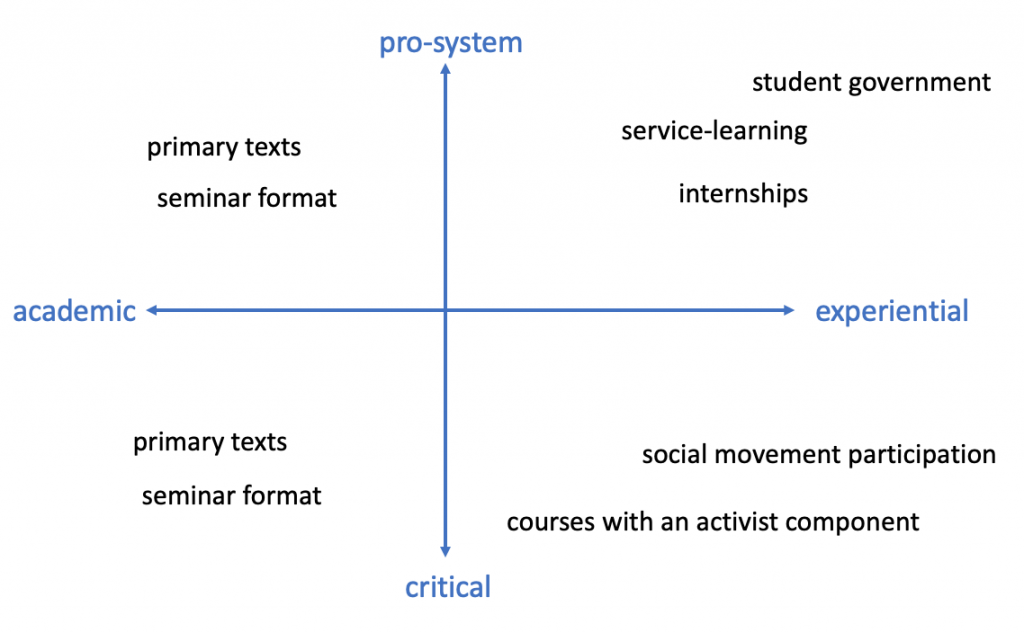
The vertical axis runs from favorable to critical of the US political system and society. Tennessee Gov. Bill Lee recently tweeted that his state’s schools will teach “unapologetic American exceptionalism.” In this context, “exceptional” doesn’t usually mean atypical; it means better. That places Gov. Lee pretty close to the top of my graph. Someone who wants students to focus on historical and current injustices would fall near the bottom.

The horizontal axis runs from classroom-based work (reading, discussing, and writing about texts) to experiential learning. It may also reflect a debate about whether knowledge or skills are the most important outcomes. Lee added, “By prioritizing civics education in TN schools, we are raising a generation of young people who are knowledgeable in American history and confident in navigating their civic responsibilities.” He seems to be open to engagement as an outcome, so maybe he would support the whole top half of my graph.

These two axes are distinct and orthogonal. The most common forms of experiential civics–approaches like service-learning and student government–are often pro-system. They belong above the middle of the chart. In the Positive Youth Development field, service-learning is understood as “contributing positively to self, family, community, and, ultimately, civil society” (Chung & McBride 2015). Service-learning may also encompass critical reflection about systems (Mitchell 2008), but I think the critical aspect has been rare and often superficial.

On the other hand, if you really want to teach some version of critical theory in a K-12 classroom, you are probably interested in assigning and discussing texts. (That is why it is called “theory.”) So you likely fall the left of the middle of my chart–on the same side as the people who want to assign classical texts that they appreciate. The pedagogy is similar; the debate is about which texts to assign, which topics to discuss, and which interpretive lenses to use. Meanwhile, many of us strive to assign texts with diverse perspectives and cultivate a robust discussion within the classroom.

For what it’s worth, my own emphasis is on learning how to build and manage associations. I’d use an academic pedagogy (reading, writing, and discussing texts, data, and models) for a pragmatic purpose: making civil society work. I’d let the students decide the ultimate objectives of their own associations. This approach implies a canon of texts (Alexis de Tocqueville, Gandhi, Robert Michels, Jane Addams, Mary Parker Follett, Saul Alinsky, Bayard Rustin, Ella Baker, Jenny Mansbridge, Elinor Ostrom …) that is neither pro- nor anti-system, as a whole.

I would never claim that this is the only important approach, but I think it is undersupplied.

See also: NAEd Report on Educating for Civic Reasoning and Discourse; an overview of civic education in the USA and Germany; The Educating for American Democracy Roadmap; etc.
results of the Civic Spring Project

Last spring, the Institute for Citizens and Scholars (formerly the Woodrow Wilson National Fellowship Foundation) jumped into action to support community-based organizations that would help young people to address the crisis of the pandemic. Their Civic Spring Project funded Groundwork Elizabeth (NJ); The Institute of Engagement (Houston, TX); Kinston Teens, Inc (NC); the Prichard Committee for Academic Excellence (KY); Youthprise (MN), and the Newark (NJ) Youth One Stop and Career Center. Along with funds, these organizations received in-kind support and were included in a professional learning community.

Now CIRCLE has published a detailed evaluation. (I did not play any role in it, although at an earlier stage, I was one of many colleagues who had advised on the design of the project and then helped to select the grantees.)

Almost all the youth in these projects said they learned the kind of content that they would learn in a civics class, which demonstrates that hands-on, out-of-school projects can teach the facts and skills that we also value in an academic context.

Sixty-one percent felt that they had made their communities better places to live. For instance, “the Kentucky Student Voice Team members extensively documented the experiences of Kentucky students during the pandemic and used those findings to inform policymakers. … Minnesota Young Champions recruited young Minnesotans to engage in advocacy work to extend unemployment benefits to young people.”

CIRCLE also presents nuanced findings about the conversations that included youth and adults or that convened people from various programs and roles. They report some challenges: power dynamics, lack of clarity about roles, and some issues with communication. For instance, “The same behaviors regarding [the Community of Practice] were interpreted differently–the CoP planners intended for flexibility and responsiveness, but CoP participants perceived this as unclear purpose and lack of intentionality in the planning, schedule, design, and implementation of the CoP. Different stakeholders held different goals and they were communicated at different times and through different fora.”

Collaboration is hard, especially when people come from different walks of life; and we’re not very good at it these days. (See my recent Medium post.) A classic problem is permitting flexibility while also giving clear direction. We get better at these tasks with practice and reflection, which is exactly what this project offered.

civic education and the science of association

I have a new post up today on Medium, thanks to McGraw-Hill. It’s entitled “Reimagining Civic Participation Through the Science of Association.” It begins …

America’s constitutional democracy depends on us — the people — to organize ourselves in groups of all sizes and for many purposes. Voluntary associations address community problems, they make it possible to limit the scope of government, and they empower people to express their diverse beliefs and passions. Freedom of association is both a constitutional right and a pillar of American society.

Unfortunately, human beings do not automatically know how to associate well. Challenges arise that lack obvious solutions. How can we resolve disagreements so that disappointed participants don’t quit or just drift away? What is the best response when some members shirk their fair share of the work? What is an effective way to prevent leaders from dominating a group or even stealing its assets? How should an association communicate its purpose and values to busy outsiders?

The Science of Association

Answers to these questions (and many others) constitute what Alexis de Tocqueville called “the science of association.” Visiting the United States in 1831, he credited the success of our young republic to the people’s skill at this “mother science of a democracy.” He observed that Americans had perfected this “science” better than any other nation and had used it for the most purposes.

The traditional way to learn how to associate was to join functioning groups and watch how they worked. In The Upswing (2020), Robert D. Putnam and Shaylyn Romney Garrett show that associational life grew and strengthened from about 1890 until about 1960 as Americans developed the science of association to unprecedented levels.

But then rates of membership shrank just as steeply. Today, most citizens do not feel they associate much at all. Just over one in four Americans report that they belong to even one group that has responsible leaders and in which they can actively participate. (Of these groups, religious congregations are the most common; online groups are also fairly frequent.)

When functioning groups are scarce and fragile, we cannot count on them to teach a younger generation to participate. However, schools can play a role in reversing this decline. [Read more here about what schools can do.]

NAEd Report on Educating for Civic Reasoning and Discourse

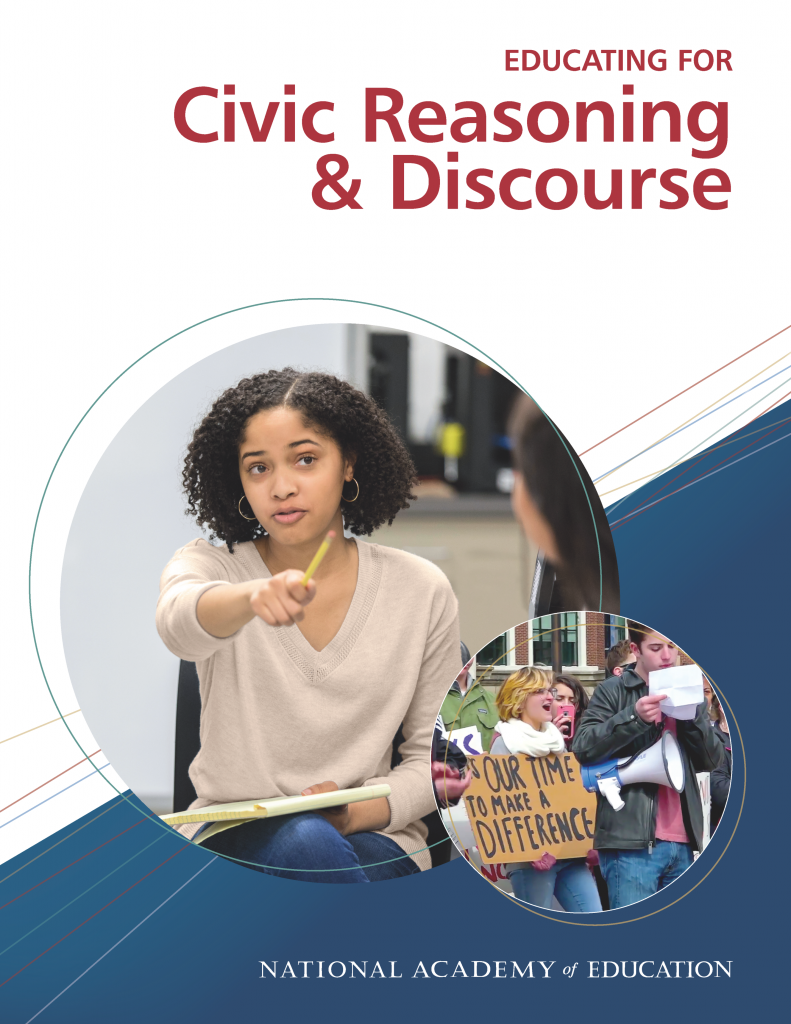
The National Academy of Education (NAEd) is releasing its report on Educating for Civic Reasoning and Discourse. I was on the Steering Committee along with eight wonderful colleagues, and many more scholars contributed to writing the document. You can attend a public forum to hear more about it on May 3, 2021, 12:00 pm – 2:00 pm Eastern Time. Register here.

I’d describe this report as a response to problems of polarization, incivility, motivated reasoning, propaganda, and strained democratic institutions, along with racial injustice and other social crises. It is a response from the learning sciences, with papers by specialists on learning, schooling, and human development. In contrast to the Educating for American Democracy Roadmap, this report is more about how to teach (rather than what to teach); and it addresses education broadly, not just the disciplines of history and civics, which are the focus of the Roadmap. I worked on both projects simultaneously and benefited from the two perspectives.

Aficionados of Civic Studies will recognize this definition from the NAEd report:

DEFINING CIVIC REASONING AND DISCOURSE

Early in its work, the National Academy of Education (NAEd) Committee on Civic Reasoning and Discourse agreed on a shared definition of civic reasoning and discourse to guide the development of this report. The central question guiding the formulation of this definition concerns “What should we do?” and the “we” includes anyone in a group or community, regardless of their citizenship status. To engage in civic reasoning, one needs to think through a public issue using rigorous inquiry skills and methods to weigh different points of view and examine available evidence. Civic discourse concerns how to communicate with one another around the challenges of public issues in order to enhance both individual and group understanding. It also involves enabling effective decision making aimed at finding consensus, compromise, or in some cases, confronting social injustices through dissent. Finally, engaging in civic discourse should be guided by respect for fundamental human rights

an overview of civic education in the USA and Germany

In this video, I offer a very broad introduction to civic education in the USA–framing my remarks historically. Essentially, I trace a tradition of experiential, community-based civic learning that runs from de Tocqueville through Jane Addams to Dorothy Cotton and onward; and a tradition of studying civics in school that really takes off with Horace Mann. These two traditions intertwine, and John Dewey is an important bridge between them. I argue that neither is in very good condition today.

Then Bettina Heinrich, from the Protestant University of Applied Sciences Ludwigsburg, gives an overview of “politische Bildung” (political education or development) in the Federal Republic of Germany, focusing on the post-War period. We both note significant mutual influence between these two countries.

Another event will follow this one:

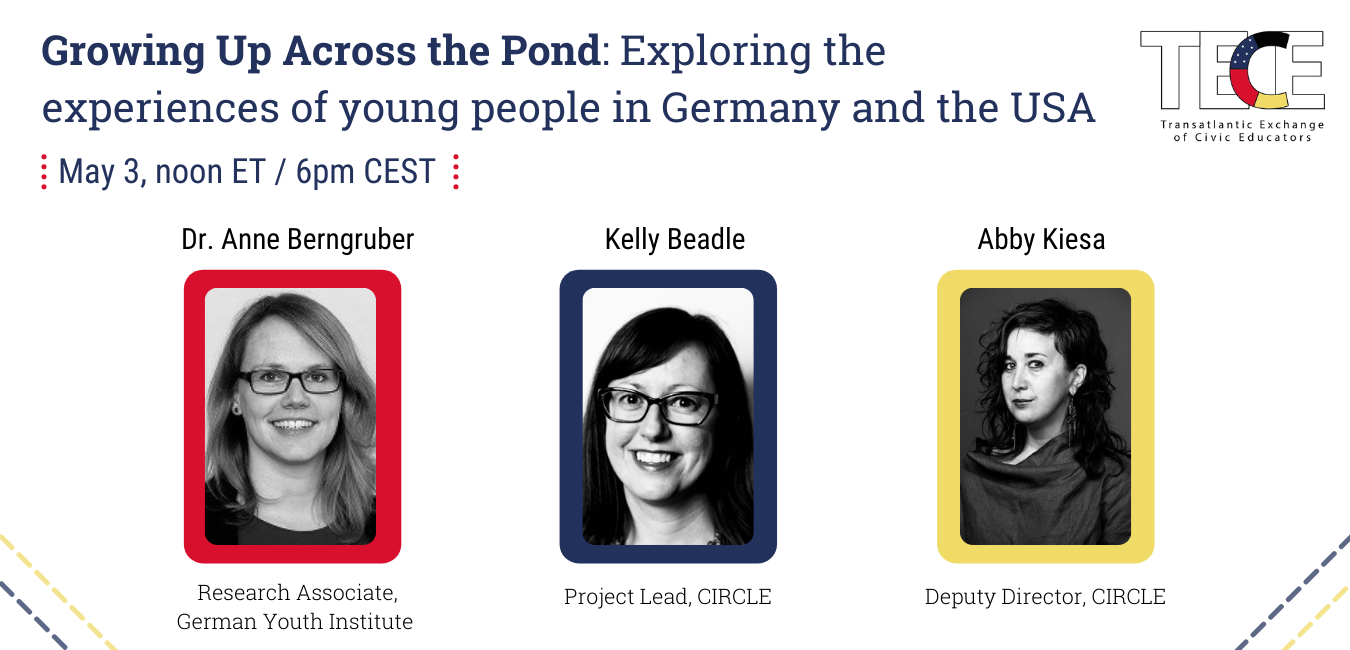
“Growing Up Across the Pond” (May 3, noon US Eastern Time) will be more about the general context for youth in Germany and the USA today. (You can register here.)

These are both open events, meant for anyone who is interested. They are also introductory events for people who might want to join The Transatlantic Exchange of Civic Educators (TECE), which “will bring together German and U.S.-American extracurricular civic learning professionals to unlock opportunities for mutual learning and reintroduce a transatlantic dimension to the field.”

a German/US civic education discussion

At a free online event on April 20th 2021, 5-6pm (Central European Time) / 11–noon (US Eastern Time), Bettina Heinrich, Professor of Social Work and Culture Work at the Protestant University of Applied Sciences Ludwigsburg, and I will talk about concepts, infrastructures and approaches for civics/political education in our respective countries, with time for questions from the audience.

For Americans who have not especially thought about civic education in the Federal Republic of Germany, here are some reasons you might be interested: Germany has a very impressive system of adult education that serves a wide range of people and includes elements of democratic education. The USA had a positive influence on Germany democratic education after WWII, just as German models had influenced American higher education in the 1800s and early 1900s. In other words, the two countries are more closely linked that you might think. Nevertheless, there are intriguing differences between “civics” in the US and politische Bildung in Germany. Finally, Germany tends to do an impressive job of addressing the evils of the past. Without equating or even comparing historical evils, we can learn from their experience as we reckon with our own history.

Registration information here: https://tece-usde.org/kick-off-event-announced/

Transatlantic Exchange of Civic Educators (TECE): School Based and Non-Formal Civics in Germany and the USA

The Tisch College of Civic Life is excited to announce the launch of the Transatlantic Exchange of Civic Educators (TECE), a new project in partnership with the Association of German Educational Organizations (AdB). This fellowship will bring together ten participants from Germany and ten from the United States to engage in dialogue in the field of extracurricular/OST youth and young adult civic learning.

From July 2021 through March 2022, fellows will participate actively in in-person exchange activities in Germany and the U.S., as well as online programming to include peer-learning seminars, site-visits, and thematic small-group work.

Are you involved in the field of civic learning with young people (ages 12-29) in a community or youth work organization, after school association, museum, historical site, youth organizing nonprofit, research association or other related institution? Can you commit to enhancing your own practice and boosting the work of your organization through international professional exchange?

We are eager to accept your application by the deadline on May 18th. More information on the program and how to apply can be found here.

As part of our project launch, we will host an open event, “Civic Learning vs. Politische Bildung: A Discussion of Concepts, Infrastructures and Approaches in the US and Germany”, on April 20 at 11:00am EST/5:00pm CET with Dr. Peter Levine, Associate Dean and Lincoln Filene Professor of Citizenship & Public Affairs in Tufts University’s Jonathan M. Tisch College of Civic Life, and Prof. Bettina Heinrich, Professor of Social Work and Culture Work at the Protestant University of Applied Sciences Ludwigsburg. The main event will be followed by an informal Q&A session, where applicants can ask questions about the application process. The event will be held in English. To register, please visit: https://us02web.zoom.us/meeting/register/tZwkfuuorTIsGdWiSdKJJDFLCXl24qVgi29X

Please contact greeson@adb.de with any questions.

Background

The effort to reengage in transatlantic dialogue in the field of youth civic learning comes at a critical time, as both Germany and the United States experience similar societal challenges: structural racism, right-wing populism, polarization and mistrust of democratic institutions and the media, not to mention a strained transatlantic relationship, all exacerbated further by the COVID-19 pandemic.

In Germany, the field of non-formal civic education, which falls within the broader “youth work” sector, is legally established and involves a rich array of public and civil society institutions. This system has roots in the democratic “reeducation” effort post WWII in Germany, which was led by the United States. It has its own guiding principles and professional field, separate from school-based civics.

Even though they share a connected history, interactions between school-based and non-formal civic education and between German and US civic educators been sparse. Professional discourse has developed separately, resulting in distinct and diverse infrastructures, concepts, and approaches. In bringing together actors in the field of civic learning, civic engagement and civic youth work from two national approaches and infrastructures, we hope to unlock opportunities for mutual learning through an investigation of common challenges and respective approaches, as well as to identify promising new concepts and future partnerships.  

The Educating for American Democracy Roadmap

The Educating for American Democracy (EAD) Roadmap and related materials are now public on an interactive website. This has been my top extracurricular priority for the past year and a half (working along with many wonderful colleagues), and I’m excited it’s out.

There will be a free national forum to discuss it later today, and you can register to attend here.

In The Wall Street Journal, six former U.S. education secretaries (Lamar Alexander, Arne Duncan, John King, Rod Paige, Richard Riley and Margaret Spellings) write together:

Despite our differences on policy and priorities, we believe that the Roadmap to Educating for American Democracy provides a promising path. The project is the result of a 19-month collaboration among more than 300 scholars, educators, practitioners and students from diverse backgrounds. The ambition of this plan is to re-establish civics and American history as essential components of education.

There has also been good coverage so far in EdWeek, the Newshour, the Washington Post,  WGBH, The74.

launch of Educating for American Democracy #EADRoadmap

Join us at the National Forum on March 2nd from 3-4:45pm ET for the official release of the Educating for American Democracy report.

Moderated by Judy Woodruff of PBS Newshour, the forum will feature leading scholars discussing the Roadmap’s guidance about what and how to teach in history and civics. This project is the result of 17 months of work by over 300 contributors.

I was one of the co-PIs, and this project has been my focus (outside of Tufts work) since 2019.

Please join us for the launch of the first truly national and cross-ideological conversation about civic learning and history at a time when our country needs it most.

All are welcome to attend the national forum. Please register and encourage others to register at forum.educatingforamericandemocracy.org.

setting a higher standard for success in civic education

Sarah Garland has a good piece in The Hechinger Report on whether schools–and specifically, civic educators–can combat political extremism. She presents the evidence as mixed, and no one thinks that schools are equipped to solve that problem all by themselves.

Meanwhile Weinschenk & Dawes have a new article that re-analyzes longitudinal data from US students and finds that civic education does not boost voter turnout, once other factors are considered.*

My response is the same in both cases. Thousands of dedicated civic educators are doing their best in classrooms and community settings. However, as a society, we have not invested in civics. We have not put much public or private money into it, or built it into policy reforms, or required kids to spend much time on it, or emphasized it when educating future teachers, or even conveyed its importance to most of our youth.

As a result, the aggregate effects from taking a civics course are not likely to be large. Program evaluations and studies of specific classrooms sometimes find big impacts (albeit in the short term, since few evaluations involve long-term follow-up), but the effects of typical courses are limited.

If people take away the conclusion that civics doesn’t work, that will be a self-fulfilling prophesy. (And it would reflect a misunderstanding of the relationship between data–which always describes the past–and envisioning the future.) But it is true that we must invest considerably more in civics to get the results we need.

*Weinschenk, A., & Dawes, C. (2021). Civic Education in High School and Voter Turnout in Adulthood. British Journal of Political Science, 1-15. doi:10.1017/S0007123420000435. See also The Educating for Democracy Act of 2020.