setting a higher standard for success in civic education

Sarah Garland has a good piece in The Hechinger Report on whether schools–and specifically, civic educators–can combat political extremism. She presents the evidence as mixed, and no one thinks that schools are equipped to solve that problem all by themselves.

Meanwhile Weinschenk & Dawes have a new article that re-analyzes longitudinal data from US students and finds that civic education does not boost voter turnout, once other factors are considered.*

My response is the same in both cases. Thousands of dedicated civic educators are doing their best in classrooms and community settings. However, as a society, we have not invested in civics. We have not put much public or private money into it, or built it into policy reforms, or required kids to spend much time on it, or emphasized it when educating future teachers, or even conveyed its importance to most of our youth.

As a result, the aggregate effects from taking a civics course are not likely to be large. Program evaluations and studies of specific classrooms sometimes find big impacts (albeit in the short term, since few evaluations involve long-term follow-up), but the effects of typical courses are limited.

If people take away the conclusion that civics doesn’t work, that will be a self-fulfilling prophesy. (And it would reflect a misunderstanding of the relationship between data–which always describes the past–and envisioning the future.) But it is true that we must invest considerably more in civics to get the results we need.

*Weinschenk, A., & Dawes, C. (2021). Civic Education in High School and Voter Turnout in Adulthood. British Journal of Political Science, 1-15. doi:10.1017/S0007123420000435. See also The Educating for Democracy Act of 2020.

three new cases for learning how to organize and make collective change

The SNF Agora Institute at Johns Hopkins University has published three cases about the choices and dilemmas that confront groups of people who strive to make social change. These are like business-school cases: they are factual narratives that conclude with moments of choice that are meant to be discussed in groups, whether in high school, college, or in movements and organizations.

I am proud to have played a role in the project from the start. We felt that cases are really useful for teaching and professional development, but most actual cases provided by business schools, schools of public policy, and wonderful initiatives like The Pluralism Project and Justice in Schools focus on individual protagonists. We were interested in voluntary groups that must deliberate before they can choose. David Moss’s excellent Case Method Project does some of what we intended, but its focus is on high schools and American history, whereas we wanted to serve social movements with some current examples.

These are free, and we would love to know how they work in various settings.

The Montgomery Bus Boycott

What objectives, targets, strategies, demands, and rhetoric should a nascent social movement choose as it confronts an entrenched system of white supremacy? How should it make decisions?

The Montgomery, Alabama, Bus Boycott of 1955–1956 is a classic example of a social movement episode that accomplished its immediate goals despite severe obstacles. It catapulted the 26-year-old Rev. Martin Luther King Jr. into international prominence and launched similar episodes in many American cities across the South and then also the North. By investigating their situation and choices, you can develop skills and insights to use as activists today.

The ISAIAH Trash Referendum

Should a faith-based organization take on an issue not of its choosing? Can relational organizing help its leadership support a new mayor while also engaging their base and holding their coalition together?

This is a case study about an organization in Minnesota called ISAIAH, a faith-based organization that works to expand the power and influence of people who have often been overlooked, especially poor people and people of color.

This case examines what happened when, to support a new mayor with whom the organization wanted to work,  ISAIAH became involved in a divisive issue—not of its own choosing—that revolved around garbage. ISAIAH faced at least three choices: 1) stay out of the fight over garbage; 2) use mobilizing techniques to help the mayor win the garbage issue; or 3) use relational organizing to enter into a power relationship with the mayor in the garbage fight—even though most of the people in ISAIAH’s networks didn’t care much about the issue.

The AMOS Project and the Campaign for Universal Preschool

Can faith-based organizers garner enough support to win universal preschool in a racially divided city? How should a grassroots group manage a disagreement with its own powerful coalition partners?

This case study is about the AMOS Project, an organization in Cincinnati, Ohio, and its grassroots efforts to pass legislation that would provide preschool education for most of the city’s children. AMOS’s grassroots efforts increased the political pressure to pay for the program, but at one point, the whole effort seemed likely to fall apart. How could a grassroots network of congregations manage a disagreement with allies in the business community and achieve its goals?

The Educating for Democracy Act of 2020

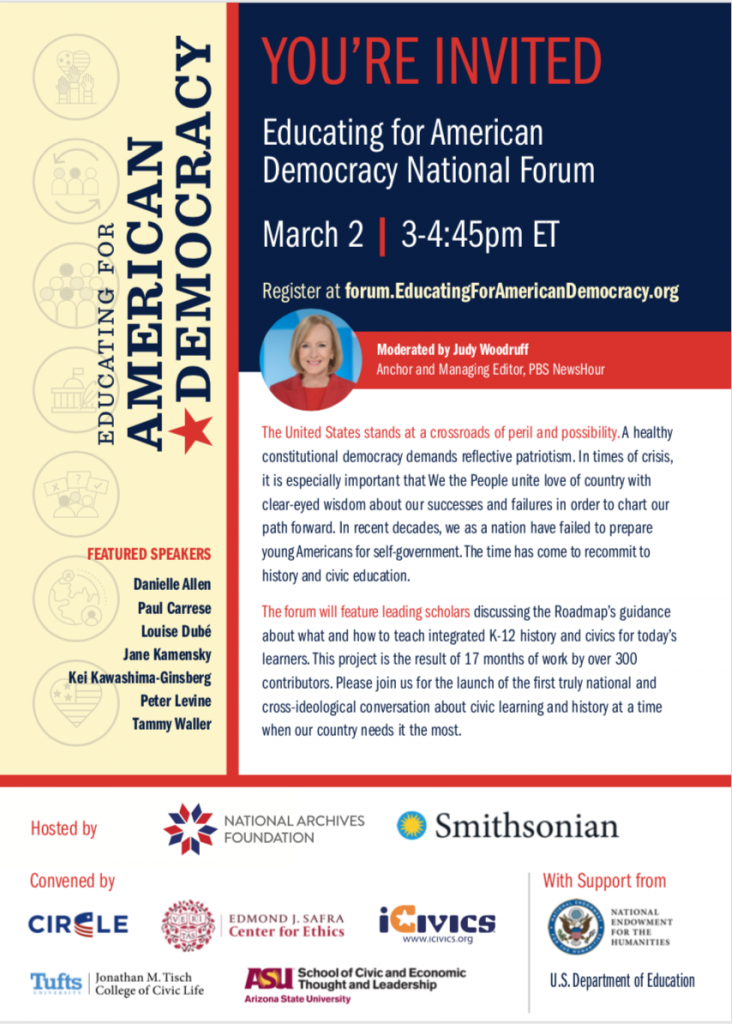
Senator Chris Coons (D-DE) and Senator John Cornyn (R-TX) have introduced the Educating for Democracy Act of 2020. It would significantly increase federal investment in civic and history education. It is the Senate companion to the U.S. House version of the Educating for Democracy Act that was introduced on September 17th by Congresswoman Rosa DeLauro (D-CT) and Congressman Tom Cole (R-OK). 

Note those D’s and R’s–this is bipartisan legislation with support from influential Members on both sides of the aisle.

The Act would authorize $1 billion in federal investment in civic and history education, including research, innovation and teacher professional development. Funds would go to state and local education agencies to strengthen and improve civic and history education; to non-profit entities to develop or expand access to curricula, instructional models, and other programs; and to colleges and universities to educate future elementary and secondary school teachers. The bill would also require the National Assessments of Educational Progress (NAEPs) in civic and history education to be conducted every two years at grades 4, 8 and 12, with state level results made publicly available so that states can be tracked and assessed.

The full bill summary is available here

Senators Coons and Cornyn and Representatives DeLauro and Cole will reintroduce this legislation in the new congress in January, but it is important to persuade U.S. Senators to co-sponsor the bill now. Please be in touch with your own Senators.

who needs civic education?

The Monmouth University Poll released on Nov. 19 asked people (among other questions), whether Trump has done more than other presidents to undermine or to uphold the Constitution, whether respondents fear what their political opponents would do to the country, and whether Donald Trump has “drained the swamp” or made corruption worse. Here are the responses by age group.

Young people are the least likely to think that Trump upheld the Constitution, least afraid of their opponents governing, and most likely to believe that Trump worsened corruption.

I suppose reasonable people might debate these questions. A very conservative person might believe that Trump’s judicial appointments are saving the Constitution. A thoughtful progressive might fear what Trumpian Republicans would do to the country.

But generally, we would want people to answer these questions in the negative. Citizens should know that Trump disparages the Constitution, that it’s important to cede power when opponents win elections, and that the forms of corruption reported during the Trump administration are deeply problematic.

Of course, everyone needs civic education. The young need it most because they are the future and because they must be equipped to become more effective as citizens. But if you want to know who demonstrates the greatest deficits in basic civic dispositions, it is not the young.

the debate shows why we need civic education

Imagine young Americans watching last night’s debate. Try telling yourself that we have a special problem with youth. Try telling yourself that young people’s understanding of the system, commitment to democracy, or civic and personal virtues represent particular deficits.

Young Americans do urgently need and deserve more and better civic education–meaning not only courses and curricula by that name, but a whole k-12 education that prepares them to be active and responsible citizens. This need is critical.

But the reason is not a decline in civic education since Donald Trump’s youth (or mine), nor a decline in young people’s knowledge, skills, and virtues. The evidence about how courses and requirements have changed over time is mixed and ambiguous, but we never offered much civic education. Outcome measures such as the NAEP Civics Assessment are remarkably flat. Certainly, American history is presented much better now than in my day, in part due to mountains of valuable scholarship.

Improving civics is an urgent need not because it used to be better but because older people have handed today’s youth a republic in disastrous condition. The fiasco of the debate serves as an apt metaphor for the whole system. One can assign most, or even almost all, of the blame for last night to Donald J. Trump; nevertheless, the debate encapsulates our whole era.

Civic education is not well positioned to address some aspects of the problem. For instance, presidential overreach is on Suzanne Mettler’s and Robert C. Lieberman’s list of Four Threats, but it is not something that civics can directly fix; nor is gerrymandering; nor is income inequality. Trump himself is a threat (according to me), and he must be dealt with at the polls and then perhaps in the courtroom, not in the classroom.

However, on their list are two problems that civic education can address: hyper-polarization and conflicts over who belongs in the citizenry. Students can learn to deliberate with people who disagree and can learn to understand, appreciate and include all their fellow Americans. Some would add misinformation as yet another threat, and it is also something that civics addresses.

Saving the republic is not the only reason to teach American history, government, and civics. These are intrinsically interesting and worthy topics. Learning about them enriches the mind and soul. And teaching social studies demonstrably improves reading scores. But saving the republic is a pretty good reason to focus on civics, now.

what if the traditional and student-centered pedagogies go together?

I’m helping with the evaluation of a civic education curriculum. I don’t want to go into details because this is an unpublished evaluation for a specific organization in a particular context. However, I have observed an interesting pattern and wonder what explains it and whether it generalizes.

We asked both the students and the teachers about various pedagogies. For instance, the students were asked to evaluate statements like these (among others):

  • Memorizing facts was the best way to get a good grade from teachers my classes.
  • Teachers lectured, and the students took notes.
  • Students were encouraged to make up their own minds about issues.
  • Teachers encouraged students to express their opinions during class.

Their teachers were asked about the same list of pedagogies, but the questions for them were phrased in terms of how much they used each approach.

The goal was to distinguish various approaches and then correlate them with things like the number of correct answers to factual questions, students’ skills, and their beliefs about democracy. Then we could see whether, for example, students who discussed issues more in class were more confident about their skills for discussion. The findings wouldn’t be causal, but they would be suggestive.

In the actual data, the most teacher-centric and the most student-centric approaches (if you can accept those descriptions) correlated. For instance, there was a positive correlation (0.29) between “Teachers encouraged students to discuss political or social issues about which people have different opinions” and “Memorizing facts was the best way to get a good grade from teachers in my classes.” Likewise, there was positive correlation (0.28) between “Most students felt free to express opinions in class even when their opinions were different from most of the other students” and “Teachers required students to memorize facts or definitions.” The correlations were even larger in the teacher data.

Most of the student outcomes–especially their ability to answer factual questions–correlated positively with all of the pedagogies. Students were more likely to know the facts if their teachers lectured and if they discussed issues–not surprisingly, since these two pedagogies correlated with each other.

One interpretation is that some students just got more of everything than the others–their “dosage” was higher. But I don’t think so, based on what I know about the intervention. Besides, the questions weren’t phrased in a way that should measure dosage.

Another interpretation is that these approaches should and do complement each other. I can certainly see why good teachers might say both “I encouraged students to express their opinions during class” and “I placed great importance on students learning facts.” (These responses were correlated at 0.8).

A third interpretation is that these questions don’t yield valid data, because teachers and students are not very aware of the pedagogies they experience, and are especially unaware of how their experiences compare to others’.

I’m wondering whether the positive correlation between apparently contrasting teaching styles is commonly observed.

Putting the US Constitution in its Place: A Broader Agenda for Civic Education

I put a draft chapter on Academia.edu in case anyone is interested in commenting. It is for a forthcoming volume edited by Carol McNamara about American citizenship.

The abstract:

Almost all American students are required to study the formal structure of the US government, and most perform fairly well on concrete, factual questions about the Constitution. But there is much more for competent citizens to learn. After I explore some valid reasons to include the Constitution in required curricula, I argue that the document provides a poor framework for civics as a whole, giving students a distorted view of the social world and failing to motivate them for ethical civic engagement. I conclude with a sketch of a curriculum in which the US Constitution has a place, but a fairly modest one.

Here is an excerpt:

… the Constitution is a distorting lens through which to view the social and political world. It is, after all, a charter for the federal government of the United States, albeit one that protects the rights of the states, associations, and individuals. It has much to say about the three official branches of the national government. It also mentions certain other institutions that seemed important to its 18th-century authors, such as the armed forces, militias, and privateers (“letters of marque”); religion and the press; lawyers (“Assistance of Counsel”); and associations and public assemblies. It does not mention any of the following components of our 21st-century system: political parties and lobbies; unions and organized professions (other than the law); permanent regulatory and national security agencies and the civil service; for-profit and nonprofit corporations and capital markets; or broadcast and digital media and the Internet.

Courts strive to apply constitutional principles to these modern institutions by expanding 18th-century categories. For instance, publicly traded, general-purpose corporations—which became common in the 19th century—are treated as examples of “associations” under the First Amendment.* I lack the competence to assess such rulings, but I think that the Constitution is problematic as a curricular framework. A curriculum based on that text will leave scarce time for analyzing most of the institutions that actually structure our lives, because they are unmentioned in the document.

While studying the First Amendment, students might be invited to think about the types of associations, religions, and equivalents of “the press” that exist in our time. But that is an odd and constraining way to investigate the structure and functions of Facebook, the Democratic Party, Sunni Islam, The Washington Post and its parent holding company, Black Lives Matter, the National Rifle Association, the American Federation of Teachers, and General Motors, to name just a few “associations.” A course on how our society works would go deeply into those organizations and give much less time to the question of how the US Constitution applies to them.

And another:

A heavy emphasis on the Constitution also implies a causal theory that is sometimes made explicit in k-12 classrooms. Students may take away the thesis that our society can be explained by the Constitution and the founders’ vision. The world we observe around is the one the founders “framed” for us.

That thesis is, at best, contestable. The organizations, norms, and systems of the United Kingdom and the United States today are in many ways similar, despite the fact that the USA has an idiosyncratic (some would say, “exceptional”) written constitution, whereas the British constitution is unwritten and has very different components: a monarch, an established church, a cabinet that is part of Parliament, and parliamentary sovereignty. Meanwhile, both the USA and the UK function very differently from the same countries a century ago. The reason is not that they have changed their constitutions profoundly but rather that urbanization and then suburbanization, industrialization and then deindustrialization, capitalism and then the welfare state, immigration and internal migrations, technology and global capital markets have transformed these two societies—more or less in parallel. The causal impact of the US Constitution on the USA seems limited.


*“Corporations and other associations, like individuals, contribute to the ‘discussion, debate, and the dissemination of information and ideas’ that the First Amendment seeks to foster.” Citizens United v. Federal Election Commission, 558 U. S. 1 (2010), quoting Bellotti, 435 U. S., at 783. See also: on teaching the US Constitution; the Citizens United decision and the inadequate sociology of the US Constitution; liberals, conservatives, and love of the Constitution; is our constitutional order doomed?; and how to teach the constitution of cyberspace.

the new NAEP civics results

Today, the National Assessment Governing Board released new results for social studies subjects from the National Assessment of Educational Progress (NAEP). EdWeek says, “8th Graders Don’t Know Much About History, National Exam Shows.” Betsy DeVos calls the findings “stark and inexcusable.”

History and geography scores fell, although I don’t know if I’d agree with EdWeek’s Stephen Sawchuk and Sarah D. Sparks that “Eighth graders’ grasp of key topics in history have plummeted.” Here are the median history scores over time:

I would probably say that history scores “declined to a significantly significant degree compared to 2014, meaning that the change from 2014-18 is unlikely to reflect sampling bias.” The differences between 2018 and all other years are within the margin of error and therefore may not be improvements or declines at all.

Civics is my own field of interest, and I was one of the designers of the NAEP Civics Assessment instrument. The results for Civics were flat. (Unless you want to say that they “plummeted” by one point.)

The NAEP is extraordinarily useful for analyzing differences in scores by demographic group and for understanding how educational experiences (e.g., taking an 8th grade civics course) relate to outcomes. Unless you have worked with the dedicated folks at the Educational Testing Service and the National Assessment Governing Board, you cannot imagine how careful they are about test-design and implementation or how complex the whole process is.

However, as in the past, I would like to offer these caveats about the NAEP results and the surrounding commentary.

First, as noted above, the changes are subtle, and some are within the margin of error. There is no evidence here of dramatic decline.

Second, the definitions of “proficient” and “advanced” are basically arbitrary. The 1998 designers chose scores that would count as “proficient,” based on their own judgment. Based on the data from that year, they said that just 22% of American 8th graders were proficient. They must have been aware that they would communicate a message of crisis.

The subsequent Assessments have been normed to the 1998 instrument. Roughly speaking, if we drafted an instrument that indicated a major improvement, it would probably not be fielded as such, because the high scores in the pilot phase would suggest that it was an invalid measure–the questions must be too easy.

Therefore, it isn’t really news that the proficiency level is in the neighborhood of 25%. That is how the test is designed. This is not to say that we can’t gradually boost it to 30% or higher if we make a lot of progress in classrooms. But you should understand why the numbers could not be much higher.

The judgment that most kids are not proficient is subject to debate. If you look at the actual questions and how many 8th graders got each one right, you may conclude that most students are below proficient. Or you may think that the questions are surprisingly hard and that we are expecting a lot from 13-year-olds.

For instance, 50% answered this item right:

The United States Congress can pass a bill even if the President disagrees with the bill because

  1. Congress must make sure that the needs of all citizens are met
  2. Congress can make laws more quickly when it does not have to involve the President
  3. Congress usually knows more about what the laws mean than the President does
  4. Congress is the primary legislative power of the government

Is 50% a terrible result, or not too bad? That is a matter of judgment and expectations, not statistics.

Third, the NAEP measures some things but not others. The Civics assessment includes many items about the structure of the US government–which branch or level has what authority. It excludes current events, value-commitments (such as patriotism or commitment to equality), items about social issues, detailed questions about civic institutions outside of government (e.g., What does a PTA do?), items about specific state and local governments, and measures of students’ civic activity outside of school.

Finally, it is difficult to separate reading from civics, particularly at the 4th and 8th grade levels. I don’t think anyone does that better than the NAEP does, but it’s an intrinsic challenge.

A kid who hasn’t actually learned anything specific about the US government but is used to reading advanced texts–The Lord of the Rings, for example–could glean a lot of correct answers based on the meaning of words like “primary” and “legislative” in the example above. A different kid who has dutifully learned some specific civics content might be thrown by the language of the Assessment, especially when the prompts contain longer passages.

It is true that literacy is a civic asset and that people who can do a lot with words are better prepared for civic life. However, if we think there is a separate domain of civic learning–as I do–then measuring it with a written instrument that isn’t confounded with literacy is a challenge.

Overall, I believe there is valuable information in the NAEP (and it’s important for Congress to fund it regularly). But the headlines are hyped. The data show evidence of stability in the relatively narrow set of outcomes that the Assessment measures, with the caveat that the test is designed to be stable over time. If we want to improve civics, we should focus mainly on what helps various kinds of kids to learn the various domains of content that are on the test–plus the important outcomes that the NAEP does not measure at all.

See also: deep in the thickets of test design (2011), some surprising results from the 2010 NAEP Civics assessment (2011), what did young voters know and understand in 2012? (2012), effects of debate, discussion, and simulation in k-12 schools, and persistent civic gaps (2013), CIRCLE’s release on today’s Civics results (2015),

what does the word civic mean?

I use the word “civic” every day. It is in the title of my college (The Tisch College of Civic Life) and the major that I direct (Civic Studies) and in the names of many topics and fields that I work on, from civic education to civic media.

But what does it mean? In my own mind, “civic” has certain associations and resonances, although I rarely articulate them. During a recent conversation with colleagues, I realized that most don’t hear the same meanings I do. I don’t blame them; there is no agreement about the definition, and the word has been used in many ways. I’ll turn to its history below.

Today, some people hear in the word “civic” a disciplinary intention, an effort to draw a boundary around respectable and approved behaviors (the “civic” ones). Sometimes it is almost synonymous with “civil.” In turn, “civility” sometimes means almost the same as “politeness.” People may use “civic” to identify approved behaviors, or else they may oppose the word as too restrictive and controlling.

Others want to make the word strictly empirical, rather than a value-laden adjective. Then “civic” may refer to a list of activities, from voting to marching in a protest–regardless of the participants’ values and goals. For example, a march would be civic whether the marchers were members of the Southern Christian Leadership Conference or Mussolini’s Brown Shirts. (But if we take this approach, why are certain activities on the list, and others not?)

I’d like to make space for a more inspiring use of the word that has deep historical roots. My dictionary-style definition would go something like this:

Civ’-ic. adj. 1. Of or pertaining to a group of relatively equal self-governing people. Hence, 2. virtues, values, or skills for self-government, e.g., civic courage, civic knowledge. 3. Assets belonging to or created by self-governing people, e.g., a civic forum. 4. Activities or other phenomena related to self-government, e.g., civic engagement, civic dialogue, civic education.

By a “self-governing people,” I mean to include all the citizens of any republican country, but not only such groups. A town or city within a larger country can have self-governing power. So can a voluntary association or even some kinds of firms; and they may be self-governing even if the states in which they operate are authoritarian. Thus, institutions of various types and scales can be civic.

The history of a word helps explain how it has accrued its diverse definitions and resonances.

The English word “civic” derives from Latin civicus, which primarily refers to relations among fellow members of the same city. In turn, the classical city (the polis or urbs) was self-governing: not usually egalitarian, but quasi-autonomous and governed by a deliberative assembly. So civicus always had echoes of a deliberative forum.

“Civic” enters the Romance languages to translate Latin texts. According to the Oxford English Dictionary (OED), the very first use in English (1542) refers specifically to the ancient Roman oak-leaf-and-acorn garland awarded to men who had saved fellow citizens in war.

A kind of garland was its only meaning in English until the time of the Commonwealth, when Parliament overthrew the monarch and declared a republic. During this period, the Company of Mercers of the free city of London put on a pageant entitled “Charity Triumphant,” parading a female allegorical figure through the streets of the city. Edmund Gayton (“considered a hack writer” and then imprisoned for debt), published a long descriptive and celebratory poem about this pageant, including the sentence, “I cannot here set forth the reason of the late extinguishing these Civick Lights, and suppressing the Genius of our Metropolis, which for these Planetary Pageants and Pretorian Pomps was as famous and renouned in forraign Nations, as for their faith, wealth, and valour.”

Gayton probably deserves his obscurity, but he does seem to coined the word “Civick” in one of its important senses: “of, belonging to, or relating to a citizen or citizens; of or relating to citizenship or to the rights, duties, etc., of the citizen; befitting a citizen” (OED).

In his time, the English were enthusiastic about self-governance and the ideal of a commonwealth, itself a translation for “republic,” meaning the good that a people makes and owns together. Of course, this was also the period of Puritan self-governance in New England and the invention of important activities that we now naturally call “civic”: town meetings, local elections, and civic education, which Massachusetts had required in 1642.

Just one year later, in 1656, Blount’s dictionary defines “Civick” as “pertaining to the city.” Since then, one of its meanings has always been akin to “urban,” as in “Civic Center” for the name of a city’s convention hall. But I think that “the city” had a different original meaning. Now we think of large, dense municipalities. Originally, an urbs or polis was any autonomous community. For instance, the whole Massachusetts Bay Colony was meant to be a City on the Hill.

By 1747, “civic” was used to modify “virtue.” By the end of that century, the word “civique” (with similar associations) had become influential in France. According to the Constitution of 1791: “The Civic Oath (le serment civique) is: ‘I swear to be faithful to the Nation to the law and to the king and to preserve with all my power the Royal Constitution, decreed by the National Constituent Assembly for the Years 1789, 1790 and 1791.‘”

Across the Channel, Edmund Burke denounced the French revolutionaries who would overthrow traditional values and institutions, including religion. He added:

These enthusiasts do not scruple to avow their opinion, that a state can subsist without any religion better than with one; and that they are able to supply the place of any good which may be in it, by a project of their own—namely, by a sort of education they have imagined, founded in a knowledge of the physical wants of men; progressively carried to an enlightened self-interest, which, when well understood, they tell us will identify with an interest more enlarged and public. The scheme of this education has been long known. Of late they distinguish it (as they have got an entire new nomenclature of technical terms) by the name of a Civic Education.

Burke, Reflections on the Revolution in France

According to the OED, this was first use of the word “civic education” in English. It referred to a radically republican, secular, and patriotic project to which the author, Burke, was hostile. To bring civic education to England would be “the most dangerous shock that the state ever received.”

Thus the first English use of the phrase “civic education” was a denunciation. Yet the ideals that animated the French Revolution–self-governance, commitment to the common good–have deep resonances in England and the USA.

By the way, the word “civics” is a noun, in my opinion: short for “civic education.” It is often used adjectively in the phrase “civics education,” but I think that’s a grammatical mistake. In any case, “civics” is strictly American, and its first attested use is in the Boston Daily Advertiser in 1885: “Henry Randall Waite, Ph.D., president of the American Institute of Civics, was the next speaker… The use of the word civics for political science was explained.”

In short, “civic” has many meanings, but some of the oldest and most recurrent ones refer to a republican ideal: concrete communities of people should decide and act together and develop the rules, values, resources, and habits necessary to succeed.

how have political science and k-12 civics diverged?

It’s risky to generalize about k-12 civics. In the USA, there are no national standards for civics, state standards tend to be incoherent and not firmly enforced, and textbooks divide the market. Some teachers in some classrooms present highly critical accounts of US politics. Others are committed to American exceptionalism and celebratory narratives. The whole woke-to-MAGA spectrum is represented.

Many k-12 teachers try to avoid adopting positions in the classroom by presenting only hard facts about the constitutional process or by organizing deliberative discussions in which many perspectives are honored. Yet even an ostensibly neutral approach must reflect choices about the most important questions, topics and themes.

It is also risky to generalize about the discipline of political science, which encompasses more heterogeneous subfields than most disciplines. Whole subcultures of political scientists strike me as pro-regime, while others are radical. (See this post for some observations about the balkanized profession.)

But I’d still tentatively hypothesize that the center of gravity in political science stands apart from the center of gravity for k-12 civics, especially if we look at mass-market textbooks and state standards documents for evidence about civics. And I’d suggest that these are the three main gaps:

  1. Political science has haltingly recognized a wider range of perspectives on American political history and institutions, giving more attention to women and people of color as political thinkers and critics. That has meant more attention to critiques of the US system, but also alternative ideals and visions of progress. Again, this generalization ignores woke high school teachers and conservative or traditionalist political science professors, but I’d still venture the generalization.
  2. Political science has widely embraced versions of the New Institutionalism. I have written a primer on that movement, but in essence, it finds that institutions rarely operate as intended because they have their own logics and incentives. This means that it is unlikely that the US government would work as its authors planned. James Madison was an early and brilliant institutionalist who designed constitutional provisions to prevent certain kinds of corruption and failure. But the New Institutionalism has vastly expanded the list of threats, and few political scientists would argue that the US Constitution’s design addresses all these threats in a satisfactory way. Much of the high school curriculum is designed to teach students why the framers designed our system to work as it does. Many political scientists would emphasize that it does not, and could not, work as intended but rather faces serious perils. By the way, here I am not referring to intended “features” of the original Constitution, such as white-male dominance. I am referring to unforeseen “bugs.”
  3. Political science has experienced the behavioral revolution. Human beings evolved to make decisions without full consideration of relevant facts and information, employing heuristics and biases and rationalizing our biases with cherry-picked reasons. It’s common in civics curricula to present a model of the citizen as an independent thinker who decides on the best policy and chooses the candidates who come closest to those views. At least according to political scientists like Achen & Bartels (Democracy for Realists, 2016), this model is a myth. Citizens inevitably join up with large groups and vote to demonstrate loyalty to their groups.

The solution to this gap is not to move k-12 civics all the way to the center of gravity of professional political science. For my taste, the professional discipline is too cynical, not sufficiently normative or interested in problem-solving. Exposing students to cutting-edge political science is unlikely to make them more active and efficacious citizens. A big dose of New Institutionalism plus Behaviorism could kill anyone’s interest in politics unless the insights of those movements can be combined with some creativity and optimism.

At the same time, to ignore the findings of modern political science is increasingly untenable. We need new combinations.

See also: don’t let the behavioral revolution make you fatalistic; the New Institutionalism, deliberative democracy, and the rise of the New Right; on teaching the US Constitution; is our constitutional order doomed?; we should be debating the big social and political paradigms; and constitutional piety.