CIRCLE has created new visual guides on how to engage the 50% of young people who don’t vote, five policy steps for better youth engagement, and–displayed below–a path to stronger democracy. Please share!



CIRCLE has created new visual guides on how to engage the 50% of young people who don’t vote, five policy steps for better youth engagement, and–displayed below–a path to stronger democracy. Please share!
I enjoyed a conversation with Dr. Matt Townsend yesterday on the topic of civic education. Here is the audio. Dr. Matt’s show has a national audience and is devoted to “talking about good.” We discussed the importance of learning to deliberate controversial current issues with people who disagree.
(Washington, DC) I’m here for the National Council for the Social Studies annual convention. Right after the election, the NCSS sent a “post-election message” that talked generally about the importance of teaching about government and civic engagement:
As social studies educators, we teach and learn about our system of government, about controversial and timely issues, and about making informed decisions as active participants and defenders of our democracy. Our civic duty did not end at the voting booth; in fact, it has just begun. We can share instructional practices about the electoral process, the upcoming transition plans for newly elected leaders at all levels, and the new teams that will play a central role in our conversations for the next several years. We teach the principles of our U.S. Constitution.
This message could have been sent after any presidential election in the past century. There was no mention of Donald Trump or anything unusual about the campaign or the condition of the republic. I am not necessarily critical of this stance, which reflects a deep-seated and well-grounded commitment to a certain form of political neutrality. Many other schools, districts, universities, and nonprofits have taken a similar stance. However, civic educators must at least consider whether a different set of principles should apply in 2016.
Here are some arguments for neutrality:
But here is the opposite argument:
I actually think the the choice between these two approaches is fairly hard. Individuals and groups can reasonably reach various conclusions. I write only on my own behalf and do not know what I would say if I represented something like the NCSS or a school district. But, at a minimum, everyone involved in educating the next generation should consider this choice.
Just published: Peter Levine & Kei Kawashima-Ginsberg, “State Policies for Civic Education,” in Esther Thorson, Mitchell S. McKinney, and Dhavan Shah, eds., Political Socialization in a Media-Saturated World (New York: Peter Lang, 2016), pp. 113-24.
Abstract: Several large cross-sectional surveys confirm the same patterns: high-quality forms of school-based civic education (such as moderated discussion of controversial current topics) are related to students’ civic knowledge and engagement, but state policies that mandate various forms of civics are not related to civic knowledge or engagement for their young adult populations. We explore the possibilities that: 1) the existing state policies are not satisfactory, 2) state policies cannot reliably influence educational practices, or 3) support for implementation is essential.
I think the last point is most important, and that’s why we have been working closely with Florida Partnership for Civic Learning and the Illinois Civic Mission Coalition to support local stakeholders (district leaders, academics and teacher educators, nonprofits, and state officials) to implement their respective states’ policies for k12 civics. A good law may be necessary, but it is insufficient without continuous attention to implementation: producing a good test every year, supporting current and future civics teachers, selecting and recommending materials, analyzing data from tests, surveys, and interviews to learn what’s working, and using the resulting insights to improve standards, tests, materials, and professional development–in a continuous cycle.
 I’m delighted to see that the new edition of America: The Owner’s Manual is out. Senator Bob Graham, a truly dedicated leader for civic engagement, has written it with Chris Hand. They take the research, structure, and impact of the book with the utmost seriousness and have worked hard to revise it for a new edition. As I say in my blurb, “America, the Owner’s Manual is the only book that comprehensively explains how to be effective in American politics and civic life, and it does so brilliantly. It’s consistently practical, realistic, accessible, and inspiring. It’s perfect for anyone who wants to improve the world.” It works very well as a textbook, but you can also use it on your own or with a voluntary group.
Buy it here. Follow it on Twitter, @USAownersmanual; on Facebook, USAownersmanual; or use hashtag #ATOMbook.
According to a new paper released today by CIRCLE:
“This generation has grown up in a vitriolic and polarized political climate. In order to sort through the noise, young people need to have a deep understanding of the ideological values that divide us and how those values do, and do not, map onto political parties,” reports Paula McAvoy, lead author of the study and program director for the Center for Ethics and Education at UW-Madison, who completed this study with Rebecca Fine and Ann Herrera Ward. “Our team’s findings show that state standards stop short of asking students to make meaningful connections between partisanship, ideology, and the issues of the day. If schools are to fulfill their mission of preparing young people for political participation, teachers need to be encouraged to bring these ideas into the classroom.”
“Understanding what major political parties are and what they stand for is essential in navigating politics and elections in the U.S., but very little support exists. These findings emphasize the need to strengthen standards and support teachers in U.S. civic education,” said Kei Kawashima-Ginsberg, Director of CIRCLE. “Encouraging this type of learning about politics, elections and voting is a major reason why we are collaborating with other organizations to support teachers during this election year via the Teaching for Democracy Alliance.” For more on this Alliance see here.
For CIRCLE’s full briefing, please see here or the interactive map here. More research and background on youth civic education can be found on CIRCLE’s Quick Facts on Civic Education page.
CIRCLE’s 2016 Election Center will continue to offer data products and analyses providing a comprehensive picture of the youth vote, including the Youth Electoral Significance Index, which offers insight into key states where young people have the potential to shape the 2016 general election.
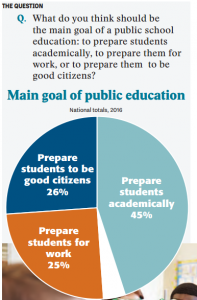 The annual Phi Delta Kappa survey of public attitudes toward education is out.
Adults are asked whether preparing students to be good citizens is important and how well schools are doing it. Eighty-two percent say it’s extremely or very important, and 33% say schools are doing it extremely or very well. As a priority, it ranks somewhat below developing work habits and providing factual information, it ties with critical thinking, and it comes ahead of working in groups.
In a different question, respondents are asked to pick the single main goal of education. About a quarter choose preparing students to be good citizens, which is on par with preparing students for work but behind preparing students academically.
The advantage of a forced choice is that most people will favor a whole set of good outcomes if allowed to pick them all. However, there’s something a little artificial about the results of a forced choice. My job is to study and advocate for civic education, so I’d pick the “citizenship” choice. I nevertheless believe that preparing students academically and for work are essential goals, and are complementary with civics. So it’s not the case that 26% of Americans think only citizenship matters, or that 74% think it doesn’t matter at all.
Still, the forced-choice reveals that education for citizenship is the top priority for quite a few Americans. That’s valuable to know, because the major reforms that have passed through education like earthquakes’ seismic waves since 1980 have hardly mentioned civics at all. The PDK survey doesn’t prove that Americans put the civic mission of schools above all else, but it does suggest a lot of support, which ought to be reflected in policies.
Further, the forced choice reveals differences within the public. It appears that the civic mission is most important to young and older citizens; parents and other adults in the traditional child-rearing years are more concerned about academics.
There’s also a partisan and ideological split: “Fifty percent of conservatives emphasize academics vs. 43% of moderates and 40% of liberals. Liberals instead are more likely (33%) than moderates (24%) and conservatives (22%) to say schools should focus on building citizenship. Republicans are less apt than others to value a role for citizenship instruction in public schools.” The partisan divide creates challenges for proponents of civic education. In my opinion, citizenship should be a core value for conservatives, and it’s important to make that case.
The PDK poll doesn’t ask people what they mean by “good citizens.” We know from other studies that answers would vary. Some think of good behavior–obedience in the kindergarten classroom or staying out of trouble as a teenager. Others think of patriotism and support for the regime; still others, of activism and debate. Note that support for citizenship education is strongest among liberals and young people, and I doubt that most of them favor simple obedience.
One thing we can conclude is that good citizenship shouldn’t be an afterthought for policymakers, for 82% of adults think it’s at least very important, and 26% think it’s the main goal of schools.
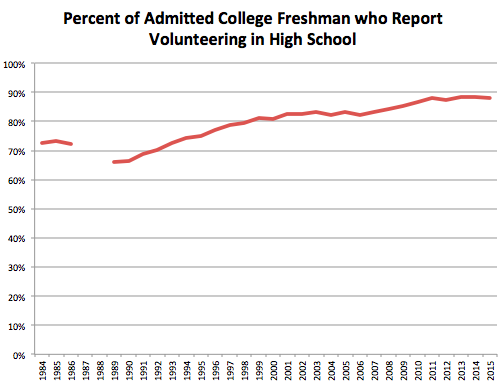
This graph is based on data from the Higher Education Research Institute (HERI) American Freshman survey. I don’t think I have seen the trend presented in one place and continuing until 2015, so I offer the graph for public consumption. The trend is consistent with what we know about high school civics. Service programs became much more popular after the 1980s, as new initiatives, such as the federal Learn & Serve America grants, came online. Rates of volunteering have plateaued since ca. 2010, but at high levels. Service is pretty much expected of today’s prospective college students. However, volunteering is strongly correlated with socioeconomic advantage. People of the same age as these admitted freshman who are not going to college volunteer at much lower rates.
I’m back from a very inspiring meeting of civic activists, civic educators, and students in the White House. It was convened by the Domestic Policy Council along with Civic Nation and the Beeck Center, with support from Tisch College and o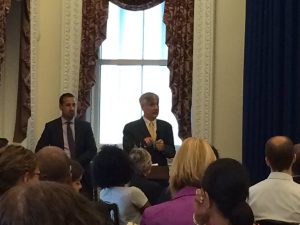 thers. Committed and skillful teachers and students attended from selected schools across the country. These students are not just learning about civic engagement, practicing to be citizens, or developing civic skills. They are at the forefront, right now, of addressing the most serious issues in their communities. We need them, and many more like them, to govern the republic better than it has been governed and to achieve justice that has eluded us so far.
We learned that US Secretary of Education John King is sending a “letter of guidance” to all state education agencies about new federal support for the humanities as part of the “well-rounded” education mandate of the Every Student Succeeds Act. As a humanities person, I am glad about that direction, and as a civics advocate, I’m pleased that civics is included among the humanities.
The US Department of Education has also made civics a core component of the Department’s “Blue Ribbon Schools” program, which recognizes excellence.
Meanwhile, the House Appropriations Subcommittee on Labor/HHS and Education recently passed the 2017 appropriations bill, which includes the first funding for civics and American History in years. The appropriation includes $6.5 million for competitive grants to improve instruction in American history, civics, and geography, particularly for schools in under-served rural and urban communities. It also includes nearly $2 million for American History and Civics Academies: professional development opportunities for teachers of these disciplines. For now, it’s just a House appropriations bill, but it’s an important step toward actual dollars for civics.
Washington (DC): I am on a civics road trip: the First Annual Civics Literacy Conference in Massachusetts, an advisory board meeting for iCivics inside the Supreme Court building, and then a meeting with executive branch people.
The public discourse about civic education often takes the form: “Why don’t people (meaning adults) know basic facts about politics? Why do 10% of college graduates think Judge Judy is on the Supreme Court? We should teach schoolkids these facts!”
But almost all students study and face some kind of tests on facts like the number of US Senators. The problem is, adults don’t remember what they learned as kids.
That is because adults are not obligated to retain or update their civic knowledge. You spend 13 years of school learning to read and write. Then, if you have a job that involves written words, you must constantly update your literacy skills. You spend a few dozen hours in school learning about politics, and then you’re a citizen—but that role comes with no rewards or penalties. Nothing bad happens to you if you forget what you learned. Yes, politics affects us all. It is interested in you even if you aren’t interested in it. But just because it affects us all, each of us can let others take care of it.
Some of us do update and even dramatically expand what we learned as kids about civics. The reason is: we’re interested. Something made us feel that politics was intriguing, important, dramatic, and rewarding for us as individuals. I conclude that the main purpose of civic education in k-12 schools is to increase the proportion of young people who reach that conclusion.