new CIRCLE youth survey: high youth engagement in the 2018 election

From today’s CIRCLE release:

The 2018 midterms have the potential to be historic for youth political participation, with young people receiving campaign outreach, paying attention, and intending to vote at unusually high levels (34% “extremely likely” to vote) that come close to the levels of engagement seen in the 2016 presidential election. Young people who report being actively engaged with the post-Parkland movement for gun violence prevention are even more likely (50%) to say that they’re extremely likely to vote. Our poll reveals strong support overall for Democratic candidates in Congressional elections (45% plan to vote for Democrats, versus 26% for Republicans), but large disparities among different demographic groups of young people, with Black and Latino youth much more likely to support Democratic candidates, young white men actually favoring Republicans, and unaffiliated white youth spreading their support across various parties and ideologies. We also find that, for all the focus on young people’s engagement with political content online, family remains the most important way for youth to learn about the election and the most influential in their engagement and participation.

Much more is here, and this is just the first in a series of analytical posts drawn from a new survey of 2,087 people aged 18 to 24 in the United States, with representative over-samples of Black and Latino youth, and of 18 to 21-year-olds.

reforms for a broken Supreme Court

In the Republic of A, the highest appeals court may overturn legislation based on the text of an idealistic but short and vague constitution (without further appeal to the legislature), that court consists of just nine justices appointed for life, appointment requires an agreement between the president and the Senate, and those two bodies are separately elected and can belong to different parties. This sounds like … a royal mess.

You’d predict that Supreme Court appointments in this republic would be another form of regular legislative politics, but with higher stakes and less accountability. When one party controlled both the executive branch and the Senate, they would appoint a justice to promote their agenda for the rest of her or his life. When the branches were split, they would be unable to make appointments at all, unless as part of elaborate horse-trades. If the public did not accept these realities, then politicians would attempt to conceal the underlying situation by endorsing justices with appropriate judicial “temperaments” and sterling resumes, trying to avoid discussing the nominees’ positions on issues.

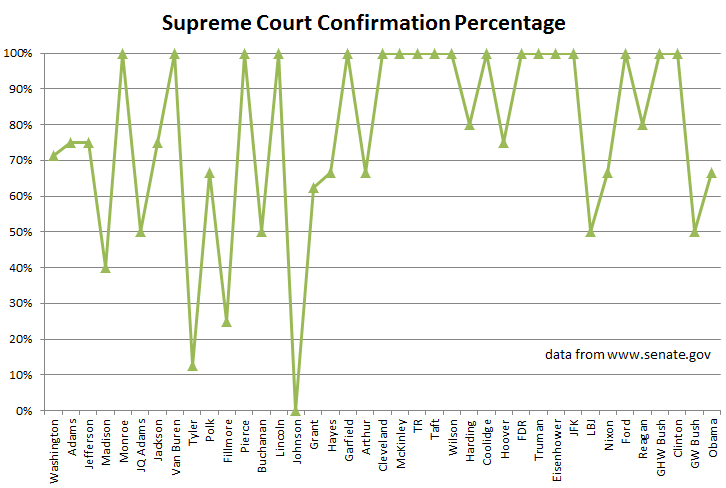
The actual record in the Republic of the USA is a bit more complicated. There have been long periods of rocky confirmations–especially 1800-1870–as well as lulls in that strife.

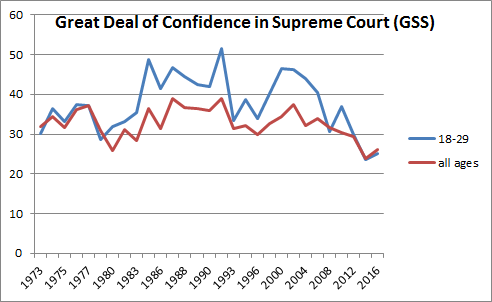
Note also the waning public confidence in the Supreme Court. Here I show the trend for younger adults separately, because early-adult experiences are formative, and youth have lost a lot of confidence since ca. 2000.

One explanation for the lulls could be a degree of consensus about the issues coming before the court, but that can’t explain why Taft could appoint five conservative justices, and FDR, eight liberals. Throughout that period, there was a bitter debate about the role of government, yet presidents were successful at appointing justices who shared their views.

A different explanation is that our two parties were divided internally on ideological lines from about 1890-1980. Thus any president could almost always assemble a majority by combining his whole party with the faction of the opposition that was aligned with him ideologically. That situation only ended ca. 1990, when the parties polarized in Congress. Note the resulting turbulence since then.

The Supreme Court is not simply a machine for implementing partisan policy preferences. Justices are also guided by legal principles, considerations that arise in the specific cases or controversies that come before them, constitutional texts and interpretations, precedents, deliberations among the Nine, and concern for the institution of the court. They may reach unexpected conclusions.

Yet we see generally different results from justices appointed by Democrats versus Republicans. That means that the Supreme Court represents at least a big dose of legislative politics by other means. The small number of justices, their life terms, and the randomness of who can appoint and confirm new members all raise the stakes and lower our confidence in the fairness of the process.

From this perspective, the familiar list of grievances (Bork, Thomas, Garland, Gorsuch, Kavanaugh) is predictable and only likely to worsen. If we are open to alternatives, we might begin to consider:

  1. Weakening judicial review so that the Court is less likely to be the final arbiter of deeply contested issues. That would be a democratic reform but not a liberal one, and it could be dangerous for minorities of all kinds.
  2. Strengthening advice and consent by developing a norm that the president should choose from a short list acceptable to members of both parties. That reform has a centrist bias that may not be desirable.
  3. Constitutional reform. For instance, imagine that justices hold rotating nine-year terms. Then every year at least one vacancy would arise (more if someone resigned or died). Debates over confirmation would be constant, but the stakes would fall. Each new president could count on four chances at appointments, followed by the referendum of a national reelection campaign. A two-term president with a Senate majority could entirely reshape the court, but her successor could change it back.

[Confirmation data from the Senate. See also: is our constitutional order doomed?are we seeing the fatal flaw of a presidential constitution?,  two perspectives on our political paralysis,  and the changing norms for Supreme Court nominations.]

the regime that may be crumbling

Margaret Thatcher and Ronald Reagan would be pleased that Trump has signed a massive tax cut, presided over deregulation, and saved NAFTA by essentially reenacting it after running for president against it. Nevertheless, his worldview and his coalition are inconsistent with their legacy.

The regime that they founded has had the following characteristics:

  1. Political elites widely agree that government programs, especially redistributive welfare programs, are inefficient and counterproductive. It was Bill Clinton who announced “the era of big government is over” and ended the federal welfare guarantee. It was the Socialist President François Mitterand who led France into austerity (“la rigeur“) in 1983. What characterizes this period is not the electoral victory of pro-market parties, but the fact that the opposition also criticizes the welfare state.
  2. Progressive movements channel most of their energy into opening capitalist institutions to women, people of color, and sexual minorities, rather than overturning capitalist institutions. Progress means being able to be who you are at work or in school. That is a broadly libertarian impulse.
  3. Many huge countries liberalize and deregulate their economies, fully entering the competitive global economy. Whether as a result or by coincidence, they see rapid and sustained improvements in human development (education, health, longevity). Of the 135 countries with data, 132 have seen improvements in the Human Development Index since 1970, many to a startling degree.
  4. International flows of capital rapidly increase. So do rates of economic migration, albeit at a slower rate than capital. Developed nations become more diverse as a result of immigration.
  5. Developed nations deindustrialize, with the losses of manufacturing jobs concentrated in certain cities. For example, Detroit’s population falls by more than 50%.
  6. Unions practically vanish. Union density falls from more than 30% of US workers in 1955 to 10% now (6.7% in the private sector).
  7. Many countries get “tough on crime,” expanding the use of prisons.
  8. Some nations that are capitalist and authoritarian become magnets for capital. Of the world’s nine Alpha+ and Alpha++ Global Cities, five are located in authoritarian states: Singapore, Hong Kong, Beijing, Dubai, and Shanghai.
  9. The US and NATO countries spend heavily on the military (with most of the money flowing to defense industries). They are especially prone to intervene in the Persian Gulf, where the oil comes from. We should also acknowledge that the chance of dying in a war during this period is the lowest in human history. One interpretation is that the US and its allies have locked things down in ways that really do reduce violence, albeit also to the advantage of multinational corporations. Terrorism is a feature of this period, but it kills an infinitesimal number of people compared to war.

I believe that most of the trends enumerated above were popular. I am familiar with the Martin Gilens/Benjamin Page argument that the US is an oligarchy–responsive to lobbies, not to ordinary voters. I think that explains why specific bills are blocked even though they are popular. It does not explain a much deeper and broader trend toward a certain kind of global corporate political-economy.

Reagan was elected in a country with a large White majority that was affluent by historical and global standards. A voting majority was suburban, Christian, and bourgeois. To a rough approximation, they got what they voted for. Every indication is that Chinese citizens appreciate the progress generated by their version of a neoliberal regime.

The questions now are: 1) Are people revolting against the current order? How many people? How effectively? 2) What is most likely to replace it? New versions of egalitarianism? Ethnonationalism and authoritarianism? Davos Man strikes back? And 3) How to move forward? It is generally a lot harder to build things up than tear them down, and we don’t just need new governmental policies; we also need new institutions in civil society.

(I see that I’ve addressed the same topic once before, offering a different list: what is the political economy that people are revolting against?)

defining equity and equality

You can find authoritative explanations of the differences between “equity” and “equality,” but I think the definitions of these words vary, and there is no objectively correct distinction.

However, we can generalize a bit. To say that something is “equal” does not imply a positive value-judgment. Some people are taller than me. That means that our heights are unequal, but it is not an injustice. Nor does making things more equal always improve justice. Procrustes stretched his prisoners who were too short and lopped the feet off those who were too tall to make all their bodies an equal length. That was not an example of justice. “Equal” has a meaning in mathematics (already attested in Chaucer), and when it’s transported to social and ethical contexts, it retains its mathematical flavor of value-neutrality.

It’s true that the word has long been used as a synonym for fairness. Milton:

… till one shall rise
Of proud ambitious heart; who, not content
With fair equality, fraternal state,
Will arrogate dominion undeserved
Over his brethren, and quite dispossess
Concord and law of nature from the earth …

But Milton has to say “fair equality.” Out of context, without such a modifier, inequality may not imply injustice.

In contrast, the word “equity” has a positive valence, whether in the law (a “court of equity”), in ethics, or in social analysis. If something is equitable, to that extent it is fair. The question becomes: What constitutes fairness? Answers vary depending on people’s philosophical beliefs, social roles, and cultures.

Interaction Institute for Social Change | Artist: Angus Maguire.

In this well-known picture, several things are equal (the heights of the boards that make up the fence, the altitude of the ground at all points, the sizes of the three boxes, the height of all the heads in the second picture). Some things are unequal, especially each person’s body height.

Despite its label, the first situation is not equal in every respect. But it is inequitable according to three reasonable standards of fairness: everyone should get what he or she needs, everyone should have equal opportunities, and everyone should be a full participant in the activity. These standards can diverge–or they may not even apply in some circumstances–but here they converge to rule the first situation unfair.

The second situation, meanwhile, illustrates equality in some respects. All the heads are the same distance above the fence; the fence is level. But that picture also illustrates equity because it meets several reasonable standards of fairness.

In this case, giving everyone an equal upward boost is inequitable, because their needs are different. But that is only one way in which equality can diverge from equity. If one person really deserves or merits more than another, then giving both people the same amount would be equal yet would violate equity. If Procrustes came along and violently made these three people the same height, that would be equal but not at all equitable. And if we hacked a portion of the fence away to let the short kid see, that would be equitable among the viewers but perhaps unfair to the owner of the fence. In fact, we only celebrate the solution in the second picture if we think it is fair to be able to watch a game for free from over a fence.

The main point is that “equity” always requires an account of fairness: what fairness demands in the circumstances. Equality, on the other hand, always requires measurement. Sometimes when a given measure is equal, that demonstrates equity, but sometimes it doesn’t.

See also: we are for social justice, but what is it?trends in egalitarianism and sorting out human welfare, equity and mobility.

was Lincoln trying to tell us something?

The penultimate paragraph of Lincoln’s “Lyceum Address” (Jan 27, 1838)

[Memories of the sacrifices of the American Revolution] were the pillars of the temple of liberty; and now, that they have crumbled away, that temple must fall, unless we, their descendants, supply their places with other pillars, hewn from the solid quarry of sober reason. Passion has helped us; but can do so no more. It will in future be our enemy. Reason, cold, calculating, unimpassioned reason, must furnish all the materials for our future support and defence.–Let those materials be moulded into general intelligence, sound morality, and in particular, a reverence for the constitution and laws: and, that we improved to the last; that we remained free to the last; that we revered his name to the last; that, during his long sleep, we permitted no hostile foot to pass over or desecrate his resting place; shall be that which to learn the last trump shall awaken our WASHINGTON.

“Trump” here means to summon loudly like a trumpet, as in John Keble’s Christian Year (1827): “Awake—again the Gospel-trump is blown.” It probably doesn’t mean “To give forth a trumpet-like sound; spec. to break wind audibly (slang or vulgar),” although the OED attests that sense from 1425 onward.

In all seriousness, Lincoln’s address is a timely reminder that high ambition may have motivated the founders to create a republic, but the ambitious gain no renown from keeping an existing republic going. The irony is that Lincoln ended up with a massive memorial on the National Mall because history gave him the opportunity to save and re-found a union imperiled by others.

See also: ambition: pro or con?  and hearing the faint music of democracy

the pivotal youth vote in Ayanna Pressley’s election

Early this month, Boston City Councilor Ayanna Pressley defeated incumbent Rep. Mike Capuano in the Democratic primary. CIRCLE’s analysis shows that Pressley performed best in precincts where young adults or people of color are most numerous. Those precincts also saw the biggest turnout increases compared to the most comparable recent election. “For example, Boston’s Ward 21, Precinct 2—home to Boston University’s Student Village—saw 400 percent more votes cast in this primary compared to four years ago, which dwarfed the median increase of 166 percent across all precincts.”

It’s true that precincts with lots of youth or people of color tend to be located in the City of Boston, where Pressley has been a councilor. So it could be that she performed best within her own jurisdiction. (She is a respected veteran elected official, even though she is sometimes portrayed simply as an insurgent.) However, she also won precincts outside of Boston that have favorable demographics.

I find it interesting that age and race/ethnicity separately predicted support for her. Or, to put it another way, she did well in student precincts that are predominantly white and upper-income as well as in low-income neighborhoods.

the Massachusetts Citizens’ Initiative Review

[Press Release] – A 20-person panel of voters convened by the Massachusetts Citizens’ Initiative Review (CIR) pilot project has released its Citizens’ Statement on Question 1, the ballot question on nurse staffing limits.

The Citizens’ Statement is intended to assist voters by providing them with the results of their fellow citizens’ four-day deliberation on the ballot question. It sets out the panel’s key findings as well as the strongest and most reliable reasons to support or oppose Question 1.The Citizens’ Statement is available online.

The Massachusetts Citizens’ Initiative Review deliberations were held from September 12-15 at the Watertown Free Public Library. The campaigns for and against Question 1 both appeared before the citizen panel three times to present their arguments and answer questions.

The citizen panelists also heard from seven neutral experts in fields relevant to nursing, patient safety, and healthcare. Trained facilitators guided the deliberations that resulted in the Citizens’ Statement.

The Massachusetts CIR pilot project was organized by State Representative Jonathan Hecht in partnership with Tufts University’s Jonathan M. Tisch College of Civic Life and Healthy Democracy, the organization that pioneered CIR in Oregon and others states. Experience in Oregon, where CIR has been part of the official election process since 2011, has shown it to be a highly effective and well-received way to inform voters about complicated ballot measures.

This is the second time Massachusetts Citizens’ Initiative Review has been used in Massachusetts.

In 2016, 77% of voters who saw the Citizens’ Statement on marijuana legalization (Question 4) said it was helpful in making their decision. On major factual issues, voters who read the Citizens’ Statement were better informed and more confident in their knowledge than those who only read the official voter guide. John Gastil, Professor of Communications at Penn State and one of the nation’s leading CIR researchers, will conduct surveys to determine how helpful the 2018 Citizens’ Statement proves for Massachusetts voters.

The 20-member citizen panel was selected from respondents to a mailer sent to 15,000 randomly-selected Massachusetts voters.

the Massachusetts Citizens’ Initiative Review

[Press Release] – A 20-person panel of voters convened by the Massachusetts Citizens’ Initiative Review (CIR) pilot project has released its Citizens’ Statement on Question 1, the ballot question on nurse staffing limits.

The Citizens’ Statement is intended to assist voters by providing them with the results of their fellow citizens’ four-day deliberation on the ballot question. It sets out the panel’s key findings as well as the strongest and most reliable reasons to support or oppose Question 1.The Citizens’ Statement is available online.

The Massachusetts Citizens’ Initiative Review deliberations were held from September 12-15 at the Watertown Free Public Library. The campaigns for and against Question 1 both appeared before the citizen panel three times to present their arguments and answer questions.

The citizen panelists also heard from seven neutral experts in fields relevant to nursing, patient safety, and healthcare. Trained facilitators guided the deliberations that resulted in the Citizens’ Statement.

The Massachusetts CIR pilot project was organized by State Representative Jonathan Hecht in partnership with Tufts University’s Jonathan M. Tisch College of Civic Life and Healthy Democracy, the organization that pioneered CIR in Oregon and others states. Experience in Oregon, where CIR has been part of the official election process since 2011, has shown it to be a highly effective and well-received way to inform voters about complicated ballot measures.

This is the second time Massachusetts Citizens’ Initiative Review has been used in Massachusetts.

In 2016, 77% of voters who saw the Citizens’ Statement on marijuana legalization (Question 4) said it was helpful in making their decision. On major factual issues, voters who read the Citizens’ Statement were better informed and more confident in their knowledge than those who only read the official voter guide. John Gastil, Professor of Communications at Penn State and one of the nation’s leading CIR researchers, will conduct surveys to determine how helpful the 2018 Citizens’ Statement proves for Massachusetts voters.

The 20-member citizen panel was selected from respondents to a mailer sent to 15,000 randomly-selected Massachusetts voters.

how Brexit is unlike Trump (and what to do about it)

When they think about Brexit, most of my American friends equate it with the election of Donald Trump. Both events are seen as manifestations of xenophobia, paranoia toward elites, and even Russian propaganda.

You can tell that this analogy is weak from the stance of Labour, which is meeting right now for its conference in Liverpool and debating a huge range of motions on Brexit. Yesterday, the Guardian reported:

Consensus appeared to break out as Jeremy Corbyn insisted he would follow the democratic will of his party if delegates voted for a second referendum on the final Brexit deal. But trouble could still be brewing. The Labour leader refused to say which way he would vote. The Unite chief, Len McCluskey, added his tuppence worth, suggesting it would be wrong for any new vote to include the option of staying in the EU. Remainers will be unimpressed.

Last night, after 5.5 hours of negotiation, party leaders emerged with a draft statement that criticizes “the Tories’ chaotic approach to the Brexit negotiations,” calls for a general election, and fudges everything else. Corbyn himself voted against Brexit, but he also voted against the key European treaties of 1975, 1992, and 2008; he has little positive to say about the current EU; and he has frequently pledged to “respect the referendum” that passed Brexit.

Imagine if Bernie Sanders won control of the Democratic Party and refused to say which way he would vote on Trump’s Wall or the refugee ban, while expressing respect for the policy implications of an election held several years ago. That would be plausible if Brexit were like Trump–but it isn’t.

I can’t overstate my own disappointment with the Brexit vote. My commitment to European integration goes back to the 1970s, when I was a child in a London primary school with a literal WWII bomb site next door. The European Economic Community was forming in those days, and we studied each member country in turn–in order to become peaceful, pluralist, democratic Europeans. (By the way, this was a Christian socialist state primary school run on progressive lines.) I’m proudly a citizen of the USA but have remained deeply invested in the ideal of European unity.

However, it is a matter for debate and reasonable disagreement whether the current form of the EU merits membership. One doesn’t have to be a bigot or a fool to want to leave. If you approach politics from the left, you will see both pros and cons to exit.

For Labour politicians, ambiguity is attractive, because they can hope to win votes from both sides on Brexit while blaming the inevitable fiasco on chaotic Tory management.

I happen to believe in what Bill Galston once called “the obligation to play hardball,” and I think a Labour policy of deferring on Brexit until the outcome crushes the Conservatives is possibly a good hardball play (to use a baseball metaphor for the land of cricket).

But it also has risks, even from a Labour perspective:

  1. Constitutional risks: there is now a widespread sentiment in Britain that respecting a referendum is the best way to honor democracy. (And holding a second referendum would somehow undermine the people’s will.) The traditional view was that the British people were best represented by Parliament, which they choose to exercise sovereignty between elections. That is a better political theory, because government should be deliberative and flexible. Parliamentary sovereignty would return if Labour took a clear position against Brexit. No one would doubt that Parliament could overrule the referendum once voters gave Labour a mandate to do so. It would then be equally clear that Britain is heading toward Brexit because the Tories are in the government. Hence there is only one reason that parliamentary sovereignty is at risk: the opposition refuses to take a position on the most pressing issue of the day.
  2. Risks to the European left: many have noted that if Labour takes over and Britain gains the same status as Norway (all the rules without a vote in Brussels), then Europe will lose the strongest potential voice of the left–Corbyn, as the leader of the second-biggest EU economy. The best way for a Labour voter to try to influence all of Europe is to stay in the EU.
  3. Risks to the United Kingdom: the most obvious danger is the collapse of Irish peace due to a hard border. But you can also see pro-European Scotland constantly looking to leave Britain if the UK leaves the EU. There are arguments for Scottish independence, but if you’re a Labour voter (either north or south of the border), you should definitely want to keep all those leftish Scots in the country.
  4. Risks to Labour: I can believe that Britain will sustain a terrible shock from Brexit and that voters will long blame the Tories for it. But will they respect Labour if Labour didn’t oppose Brexit while it had a chance? On the other hand, if the exit goes reasonably well, the Tories will benefit. Thus ambiguity presents electoral risks, not just as benefits, for Labour.

self help: a short story

Political prisoner K. was sentenced to solitary, with only cement walls, a cot, a stinking bucket, and a food slot for company.

One day, on his way back from interrogation, he saw a tattered paperback on the floor. The guard let him take it with him. It turned out to be Letting Your Inner Boss Shout by Dr. Bradford P. Bradley, PhD.

K. was enraged at first by its solecisms, trivialities, cliches and lexical trespasses. Anything would be better than this! After reading it several times without finding any value in its Six Winning Strategies for Asserting Your True Needs in an Office Context, he began selecting fragments from the pages. The rule was to leave chosen words in place but hide the rest. For instance:

Another game: rearranging all the words of a sentence to say something better:

The Six remember. Strategies, always.

True, winners: their real minds speak.

These activities engaged K’s. attention for several days, but something kept intruding. Or rather, someone. Dr Bradley, PhD.–Brad Bradley–just Brad. Was he raggedly bearded and balding, with spots on his head and long speeches to give? Or a young guy, bored out of his mind, looking for new life though writing? A pseudonymous woman, quiet observer of her office culture? An ironist, chuckling as he typed?

K. couldn’t quite tell. Alternatives multiplied into a whole community of Brads.

The real author, whoever it might be, seemed to deserve the respect of attention. Maybe Brad really had only five strategies in mind, but the book was too short and he’d wracked his poor brain until he came up with a sixth to pad the pages. Or maybe Brad knew that eleven strategies were necessary for achieving your life goals, but the cheapskate publisher forced him to cut five of them, and now he was worried to death about his misinformed readers.

It was good, in any case, to have a companion. The six strategies had been meant as gifts; perhaps it would be better to accept them as such. With thanks, even.

Prisoner K. and Dr. B. Just the two of them, in solitary but not solitary. Shouting their inner bosses. Hearing the other’s shouts. Having someone to walk with blindfolded to the final wall.

(Chicago, Sept. 20)