More Temperate

Most trees have leafed out for two or three days.
Each leaf unfolding in place to fill its space, green;
But the trees that flowered are wilting now,
Bold blooms shrinking to leave more space between,
Dwindling to stipples along each bough.
Superimposed: a lacy screen, damascened,
Patches on a slate background--the dripping sky--
Grey except at some hidden place where a break
Must let the sun flood up to certain high
Shingles, a wire, a spire that's a streak
Of brilliant white. All silent, a still sheen,
Sheer, stretched thin to fade or end in a blaze.

considering censure

The question of the moment should not be what decision to reach in re Donald Trump. Justice is always best served by a process that generates evidence and permits a defense before any decision is reached. A process conducted by Congress cannot avoid being political, but it can be structured so that all sides get heard and the conclusions are open rather than foreordained. This is important for fairness and legitimacy.

Not to hold any kind of process at all would itself be a decision. It would be a clear statement that presidents enjoy impunity when their party controls at least one house of Congress. That would be another step in the degeneration of our system. I think this degeneration reflects fairly deep flaws built into the Constitution. But that is no excuse for non-action.

An impeachment process would require public hearings and debates, which would be valuable for the American people to see and to assess. It would count as a “judicial proceeding,” thus justifying the release of key documents, including those involved in grand jury proceedings. It would also justify sending the president written questions, and if he refused to answer, that refusal would be material to the decision. It would force all members of the House to take a position; all Senators, too, if the House voted to impeach.

On the other hand, impeachment is not much of a sanction if it doesn’t lead to conviction in the Senate. A split result might further cheapen the constitutional remedy of impeachment.

Although Jeffrey Isaac is right that members of the House and presidential candidates can address other issues while an impeachment process unfolds, their attention and the public’s focus are finite resources. Impeachment would dominate politics. If that helped Trump by keeping him in the spotlight or by obscuring a truly substantive debate about policy and philosophy within the Democratic primary, it would not serve the public interest.

Senators should be forced to take positions on Trump’s alleged obstruction, but an impeachment vote could be more politically costly for Democratic incumbents than for Republicans. The Post is reporting that the public is currently against impeachment, 56%-37%. Opinions certainly could shift as a result of the process, but you have to assume that attitudes toward Donald Trump are now pretty durable. It doesn’t make sense to punish a president by subjecting his opposition to a tough political battle.

The considerations against impeachment make me wonder about censure. Like impeachment, censure would not be a foreordained decision but a choice for each house of Congress to consider after due investigation and public debate. The practical consequences of censure are the same as those of impeachment if we assume that the Senate would fail to convict. The civic advantages of the debate and public vote are the same. I suppose nobody knows whether censure counts as a “judicial process,” but the House would certainly argue so when demanding sealed grand jury documents. The public might be more receptive to censure than impeachment, and it could be done quicker.

The main disadvantage is that a process to determine whether to censure the president forecloses the possibility of removing him from office. It says that Trump will finish his term unless something else arises that necessitates impeachment. That implication is hard to swallow but might make the best sense overall.

Volodymyr Zelensky, servant of the people?

I’m very curious what my politically diverse but well-informed Ukrainian friends think about their presidential election. It’s mostly framed in the West as: “comedian with no political experience is elected president.” That is a little misleading: it suggests a stand-up comic winning on the basis of one-liners. Volodymyr Zelensky is actually the founder and creative leader of a company that produces successful movies and TV series in which he stars.

His most recent show is Servant of the People, which is available on Netflix with English subtitles, and which my wife and I have been watching. Zelensky plays a high school teacher who goes on a profane rant against corrupt politicians that his students film and post on YouTube. They also crowd-source his campaign funds and get him on the ballot, and he’s elected president.

Ukrainians have now voted to make the writer/actor of this role their actual president. It is roughly as if Americans chose Amy Poehler for president because of her role as Leslie Knope on Parks & Rec–either selecting Leslie to lead our real country (a naive reaction) or choosing the creator of Parks and Rec because of the show’s values and its portrayal of America. Or it might be a little like electing Ronald Reagan as governor of California because of his fictional personas plus his political speeches (which made a seamless whole in the 1960s).

Servant of the People is well-made, well-acted, funny. I can totally understand why people would be interested in voting for its creator, who is utterly appealing on screen.

Of course, the show is also a powerful device for persuasion. In the controlled environment of a fictional world, Zelensky can construct events to make his character the good guy and to sideline difficult questions. Plato’s warnings about the power of theater come to mind. Instead of describing Zelensky as a “comedian,” I would call this entrepreneur/actor with a law degree a highly skillful rhetorician. On screen, he is without guile. But to create that persona took artistry.

Questions:

What is the political thesis of the show? The targets are corruption, hypocrisy, arrogant elites, and social unfairness. Those are very real problems in Ukraine and many other countries. It can, however, be misguided to treat integrity as the only goal while neglecting contested policy questions. Zelensky’s fictional character dodges policy questions from the press because they are ridiculously wonky and because he’s a a draftee into politics who doesn’t know the answers. The real Zelensky has avoided interviews and press conferences even though he seriously ran for president. This strikes me as problematic.

What does Zelensky stand for? Reading scattered quotes available in English, I would guess he’s basically a Europhile liberal, in the Ukrainian context: in favor of civil liberties, some market reforms, and tilting West. But not a hardcore nationalist–for example, Servant of the People is performed in Russian rather than Ukrainian. He’s ethnically Jewish, which should give no one a free pass but which rarely accompanies xenophobia in that part of the world. On the other hand, it’s not great to have to guess the president’s positions from scattered quotes.

Is he qualified? I don’t believe that political leaders must be, or even should be, policy wonks. They should learn from experts (and from others) while setting the tone and direction. Zelensky is a very capable person–again, not just a stand-up comic but the author of complex (if problematic) political fiction and the founder and leader of an enterprise. He did study law. I would think his resume is fine if he demonstrates an ability to share power, delegate, and learn.

Ukrainians have rolled the dice. Given the alternative, I fully understand why they took this risk. It’s not the textbook version of how a democracy should work, but the status quo has been intolerable, and at least the explicit values of Servant of the People are benign. Nor does the textbook account ever fully apply. My fingers are crossed.

civility, humility, tolerance, empathy, or what?

It sounds like a parody of a professor’s life, but I have actually attended conferences since 2016 on the themes of: 1) empathy and compassion, 2) civility, 3) responsiveness, and 4) tolerance. I missed an excellent-looking meeting on 5) humility and conviction, but I teach those concepts in classes on Gandhi’s political thought. Nobody has invited me to a meeting about 6) openness or 7) fallibalism, but I would consider attending.

In case you’re wondering, the participants in these meetings have been delightfully humble, empathetic, civil, and so on. It doesn’t mean we were right.

The question is: which intellectual virtues should we develop in ourselves and in others in various settings? This is not a matter of rules or controls. In many settings, people have–and should have–rights to talk and respond to others as they wish. It’s more a matter of what we should strive for, ourselves, and sometimes how we should assess others. For example, if I’m a high school teacher who assigns students to discuss a contentious issue, on what basis should I assess their interactions?

The full list of criteria would also include 8) truth and 9) justice. For instance, you can make a claim that is admirably civil, empathetic, and responsive, yet demonstrably false. That is not generally desirable. Or perhaps you could engage in an admirable way with other people while making claims that are simply unjust. You could be an avuncular and gracious Nazi. Unless we adopt a completely procedural understanding of justice (it just is what people decide that it is, by discussing), there can be a gap between a good discussion and a just outcome.

But the first seven criteria seem important even if we leave truth and justice aside for the moment. First, it matters how our discussions go because it’s one way that we explore truth and justice. Second, we should simply relate to each other well. By conversing, we form or sustain a community and share a social space. So the quality of discourse affects the quality of the commons.

So which of the first seven are virtues, for whom, and in which combinations?

  1. Empathy is an affective reaction that can distort our judgment (for instance, by focusing us too much on a concrete case) and that can be unwelcome or unhelpful. If you’re a victim of racial injustice, you don’t want me, a white guy, to say that I feel your pain–or even to try to feel it. You want me to keep a clear head and do something about it.
  2. Civility is sometimes defined in terms of rules and norms of politeness. For instance, to use an offensive word or to yell at another person is uncivil. Politeness actually has value in many circumstances, but civility-as-politeness doesn’t seem to be the core issue. You can say horrible things with polite words, or valuable things laced with profanity. As Tony Laden notes in his contribution to A Crisis of Civility?: Political Discourse and Its Discontent, there is a different scholarly literature in which civility means not politeness but “a form of engagement in a shared political activity characterized by a certain kind of openness and a disposition to cooperate.” That seems the right direction but not easy to assess in practice. It takes us to …
  3. Responsiveness. We all have a valid interest in others’ being responsive to us. It seems to be a virtue. But … should you respond positively to a heinous new idea? Does being genuinely responsive entail shifting your views closer to the speaker’s? Or can you be responsive without changing your mind? If so, what does that entail?
  4. Tolerance is much better than intolerance, as a general rule. But it doesn’t seem sufficient. We don’t merely want to be tolerated, but also welcomed and listened to. At the same time, some ideas are intolerable. Tolerance doesn’t seem necessary or sufficient for good interactions.
  5. “Humility and conviction” is the name of a great program at UConn. This combination of words has the advantage of balance. We should be humble, because we can easily be wrong; but we should also take a stand. Humility alone is compatible with being wishy-washy. But conviction without humility is zealotry. This is (in the broadest sense) an Aristotelian way to think about virtues–as the mean between extremes. It raises the standard problem for Aristotelian accounts: What is the mean in each circumstance? Who should be more humble, and should should be less so?
  6. Openness is one of the Big Five personality traits. It seems desirable but needs some balance and moral direction. Otherwise, it shades into prurient curiosity or thrill-seeking. For example, openness correlates with use of illegal drugs. Although I am not an alarmist about drugs, a psychological trait that could either cause you to listen well to new ideas or experiment with ecstasy doesn’t seem to be reliably a virtue.
  7. Fallabilism means knowing that you could be wrong. “The spirit of liberty is the spirit which is not too sure that it is right; the spirit of liberty is the spirit which seeks to understand the minds of other men and women” (Learned Hand). We should all be fallibalists, but again the question is what this means in practice. For example, I know colleagues involved in Science and Technology Studies who are primarily concerned about the excessive authority of science and want to preserve skepticism about climate change. My own view is that we should declare anthropogenic global warming a settled issue and decide what to do about it. But that would be less fallibalist.

See also: Empathy and Justice; civility: not too much, not too little; what sustains free speech?; responsiveness as a virtue.

what constitutes coordination?

[W]e addressed the factual question whether members of the Trump Campaign “coordinat[ed]”-a term that appears in the appointment order-with Russian election interference activities. Like collusion, “coordination” does not have a settled definition in federal criminal law. We understood coordination to require an agreement–tacit or express–between the Trump Campaign and the Russian government on election interference. That requires more than the two parties taking actions that were informed by or responsive to the other’s actions or interests. We applied the term coordination in that sense when stating in the report that the investigation did not establish that the Trump Campaign coordinated with the Russian government in its election interference activities.

— from the Mueller Report

That faint sound you hear is hundreds of philosophers paging through their thumb-worn copies of seminal books and articles about shared agency and collective intentionality and revving up their word processors to write lecture notes and articles.* I have not investigated this literature sufficiently to have useful views, but it is a rich topic of current investigation that bridges ethics, metaphysics, and philosophy of language and mind.

What does it mean to say, “We are doing something?” Is the “we” a real thing or just a shorthand for several “I’s”? If a bunch of people all run for shelter at the sound of thunder, are they coordinating? What if they take exactly the same actions as part of a dance? Does the “we” mean something different in the sentences “We all ran for shelter” and “We all performed a dance”? (This is from Searle.)

What if I say to you, “Let’s go for a walk”? Do I then have an ethical obligation to coordinate my itinerary and pace with you? (From Gilbert). Is the obligation just the usual one to honor a promise, or does it stem from my new relationship to you?

Let’s say that all the members of the Supreme Court believe that something is unconstitutional and issue a unanimous ruling to that effect. Later, the same nine people all think that dinner was awful. In one case, did the Supreme Court make a judgment, whereas in the other case, nine people made separate judgments? What if the nine issued a ruling and then found out that it was invalid because they weren’t properly in session at the time? Did they incorrectly believe that they were acting as a group? (Inspired by Epstein).

Robert Mueller says that whether the Trump campaign and Russia coordinated is a “factual question.” But it requires a definition of coordination. Apparently, the legal definition of that word (from statutes and/or precedents) is unsettled. But in any case, the deeper issues are philosophical–and not simple to resolve.

*e.g., Brian Epstein, The Ant Trap: Rebuilding the Foundations of the Social Sciences (Oxford Studies in Philosophy, 2015); Margaret Gilbert, “Walking Together: A Paradigmatic Social Phenomenon” in her 1996 book Living Together: Rationality, Sociality, and Obligation, pp. 177–94; Larry May, Sharing Responsibility (Chicago: University of Chicago Press, 1992); Philip Pettit and David P. Schweikard, “Joint Actions and Group Agents,” Philosophy of the Social Sciences, vol. 36, no 1, 2006, 18–39; John Searle, “Collective Intentions and Actions,” in P. Cohen, J. Morgan, and M.E. Pollack (eds.), Intentions in Communication (Cambridge, Mass. MIT Press, 1990); Raimo Tuomela, “We Will Do It: An Analysis of Group Intentions;” Philosophy and Phenomenological Research, vol. 51, no. 2 (1991), pp. 249–77; David J. Velleman, “How to Share an Intention,” Philosophy and Phenomenological Research, vol 57 (1997), pp. 29–51; and other such papers.

North Eastern Public Humanities Conference, April 26-7

Register here. Some events have limited space. Friday, April 26: UMass Boston Campus Center, Alumni Lounge (all day)

Friday, April 26: UMass Boston Campus Center, Alumni Lounge (all day)

9:00-9:30 Welcome, Coffee, Introductions

9:30-12:00 Pre-texts Workshop: Doris Sommer (Harvard)

Friday Afternoon: Discussion of NEH Grant/Boston Harbor Islands Boat Tour

12:00-1:30 Lunch: NEH Connections Grant: UMass Boston collaboration with Boston Harbor Islands National Park: UMass Boston team

1:30-4:00 Harbor Boat Tour, Thompson Island Visit

Friday Evening: Website Launch/Graduate Student Lightening Rounds/Dinner

4:15-5:45 Graduate Student Lightening Rounds

  • Yale: Sylvia Ryerson and Candace Borders
  • More Graduate Students TBA

6:00-6:30 Round-Up of NEPH Ways Forward/Burning Issues/In-Progress Work (discussion continued over dinner):

  • Geographic locale, collaborative network
  • Context/site-specific “models” approach
  • Methodologies/practice/skills

Approx. 6:30 Dinner

Saturday, April 27: UMass Boston Campus Center, Alumni Lounge (morning) Chinatown Pao Art Center/Tufts (afternoon)

Saturday Morning: NEPH Concurrent Sessions

9:00-9:10 Coffee, Introductions

9:10-10:00 Film, Social Justice, and Public Humanities

Dario Guerrero, ROCIO (Documentary Film): DACA Harvard student filmmaker, goes home to Mexico to care for mother, not allowed to return to US (sponsored by UNAM at UMassBoston)

10:00-11:00 Concurrent #1 OR #2: New Practices

Concurrent #1: Exhibitions and Museum Practice

  • Colin Fanning (Bard Graduate Center)

Concurrent #2: Digital Public Humanities

  • James McGrath (Brown)

11:00-12:00 Concurrent #3 OR #4: New Initiatives/Institutionalizations

Concurrent #3: Journal of the Public Humanities, Case Method for the Humanities

  • Jeffrey Wilson (Harvard): Journal of the Public Humanities
  • Doris Sommer (Harvard): Cases for Culture:https://profession.mla.org/a-case-for-culture/

Concurrent #4: Grants: Institutionalizing New Models of the Public Humanities (Mellon Foundation Grants)

  • Cheryl Nixon, Betsy Klimasmith (UMass Boston): Humanities Hub
  • Stacy Hartman (CUNY): PublicsLab

12:00-1:30 Lunch

Presentation of new NEPH website: Micah Barrett (Yale)


Saturday Afternoon: Panel/Discussion of Chinatown Partnerships
1:30 Leave UMass Boston to travel to Chinatown via “T”: Pao Arts Center, One Greenway, Boston
2:30-4:30 Tisch College at Tufts and Boston’s Chinese Community: Two Conversations about Projects and Partnerships
2:30-2:40: Opening Remarks

2:40-3:30: The Impact of a Community Arts Center on Gentrification: an NEA-funded Project between the Pao Center and Tisch College

  • Peter Levine and Cynthia Woo3:30-4:30: Archives and Activism: Tisch’s Work with the Chinese Historical Society of New England
  • Susan Chinsen, Stephanie Fan, Diane O’Donoghue

4:30 Reception at Pao Art Center

how much of a theory of justice do activists need? (a dialogue)

Some students are on their way to occupy their university’s central administration building to demand a minimum wage of $17 for all employees. They are surprised to encounter the ghost of John Rawls (JR):

JR: I see your signs and determined faces and presume that you are engaged in an act of civil disobedience. What is your demand?

Students: Social justice!

JR: Hmm, what does that require?

Students: A living wage!

JR: Which is?

Students: $17/hour.

JR: Is that your ideal outcome? Does social justice entail that every employee be paid no less than $17? Every employee of this university? Every American? Everyone in the world? Is there a maximum just salary? For instance, does your college president make more than justice permits?

Students: Look, we don’t get to write the rules. We’re just trying to boost the take-home pay of some people in our community. We’d go higher if we thought it was realistic.

JR: Would you go higher if that required cuts in financial aid?

Students: We are just applying pressure for one aspect of social justice. Figuring out the right balance is not our job.

JR: OK, but you also have other jobs. For instance, voting. If you think $17/hour constitutes justice, you should vote for a moderate Democrat or perhaps a liberal Republican. If you want much more equity, you should join Democratic Socialists of America.

The ghost of Mohandas K. Gandhi [MHK] emerges, to the surprise of everyone except John Rawls, who is Gandhi’s roommate in Purgatory. (Everyone goes to Purgatory.)

MHK: Don’t let him to deter you with these questions about ultimate ends. None of us has sufficient knowledge, wisdom, or moral rectitude to know what social justice entails. Our job is to make ourselves the best agents of change that we can be.

You plan to put yourselves at some risk. That is good; as I’ve written, “a life of sacrifice is the pinnacle of art, and is full of true joy.” However, you will also impose some costs and inconvenience on the university, and your demand might not be right. Are you sure that you have purified your own motives?

Students: Well, we’ve acknowledged our positionality and checked our privilege.

MHK: Awkward terminology, but it sounds like what I’d advocate. Have you created a group that represents all, and do you live together truthfully?

Students: Could you clarify?

MHK: For me, the main issue was making sure that the movement for Indian swaraj (independence, in the spiritual as well as the political sense) incorporated Muslims, Harijans, women, and others, and that we related to each other appropriately. If we organized ourselves right, we were already making the world better. The political consequences were beyond our control. As Krishna teaches in the Baghavad Gita, “Motive should never be in the fruits of action.”

JR: I’m Kantian enough to agree that a good action is one that has the right motives, not one that turns out to make the world better. But surely you need a North Star, a sense of what the goal should be?

MHK: Only in the vaguest sense, because–again to quote myself–“man is not capable of knowing the absolute truth.”

JR: Well, I agree with that and would leave much to be decided in a just society by deliberating citizens and their elected representatives. But surely we can propose provisional theories of justice?

Students: Um, this is interesting and all, but we have got like a building to occupy?

[Exeunt]

See also: Gandhi on the primacy of means over ends; a real alternative to ideal theory in political philosophy; why study social justice?; Abe Lincoln the surveyor, or the essential role of strategy; and how to think about other people’s interests: Rawls, Buddhism, and empathy.

Notre-Dame is eminently restorable

I’m sure others have made this point or are typing it this minute, but I will pile on …

Notre-Dame de Paris is a stunning building but not a well-preserved medieval one. It has been through a lot, including the 18th-century removal of the original stained glass in the nave, the smashing of statuary and most of the remaining glass during the French Revolution, and a profound reconstruction that began in 1844. Some of the most famous features of the cathedral are the work of Eugène Viollet-le-Duc, a Romantic-era restorer who was comfortable redesigning medieval buildings in ways that are now obvious to us. The gargoyles, the spire that collapsed yesterday, portions of the interior architecture, and much of the stained glass is by Viollet-le-Duc, not by anonymous craftsmen of the 12th and 13th centuries. Many other Gothic buildings are much better preserved.

John Ruskin wrote in 1849 (not specifically about Notre-Dame but about the general approach to restoration in his time):

Neither the public, nor those who are responsible for the maintenance of public monuments, understand the true meaning of ‘restoration’. It signifies the most complete destruction that an edifice can suffer; a destruction from which not a single vestige can be recovered; a destruction that comes from the false description of the thing destroyed. It is impossible, as impossible as it is to bring the dead back to life, to restore whatever might have been grand or beautiful in architecture….the enterprise is a lie from the beginning to the end.

Notre-Dame is not a “lie,” but it is to a large degree a legacy of the French Romantic period, as much a creation of Victor Hugo and Viollet-le-Duc as of the first builders in 1160-1260. It is part of the city that we know today, which was profoundly influenced by Georges-Eugène Haussmann (1809-1891), the flattener of ancient neighborhoods and planner of boulevards:

Old Paris is gone (no human heart

changes half so fast as a city’s face) …
There used to be a poultry market here,
and one cold morning … I saw

a swan that had broken out of its cage,
webbed feet clumsy on the cobblestones,
white feathers dragging through uneven ruts,
and obstinately pecking at the drains …

Paris changes … but in sadness like mine
nothing stirs—new buildings, old
neighbourhoods turn to allegory,

and memories weigh more than stone

From Richard Howard’s translation of Baudelaire, Les Fleurs du Mal

It is not a criticism to place Notre-Dame in the 19th century. The years from 1848-1870 mark the apogee of a certain Parisian culture that is admirable and attractive. It was the age of boulevards and cafes, Seine embankments, and Impressionist cityscapes, all of which shape our view of Notre-Dame. The reason the history matters is that we can reconstruct late-19th-century buildings when they are well documented, as every stone of Notre-Dame is. In contrast, we would have neither the materials nor the craftsmanship to reconstruct the stained glass of the nearby Sainte-Chapelle if that were lost.

The fire is a tragedy; the crown jewel of 19th-century Paris will be badly damaged for some time. But in the long run, this will be a footnote.

See also: seeing Paris in chronological order; Paris from the moon; and Basilica of Notre-Dame, Montreal.

Participatory Action Research as Civic Studies

Thanks to the fabulous Tisch College postdoc Margaret McGladrey, we are holding a symposium on “Participatory Action Research as Civic Studies” today at Tufts, with 15 speakers.

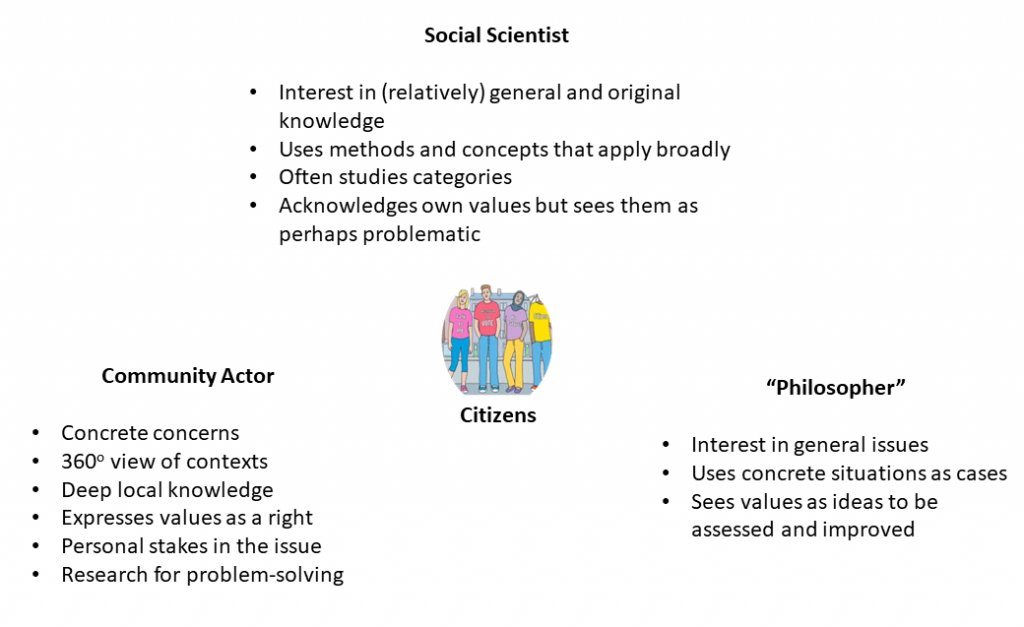
I’m planning to make a few remarks revolving around three “ideal types” or imaginary characters.

I won’t try to explain the whole chart here, but a few explanations might be useful.

The community actor could be a nonprofit leader, activist, or government official. The social scientist could be qualitative or quantitative, teaching in a university or working for an agency or even a research firm. And the “philosopher” need not be a professor of that academic discipline. She might be a scholar from a different field (e.g., theology, normative political theory, law, education) or someone working outside academia, for instance, as a writer or a clergyperson.

When I say that the social scientist “often studies categories,” I mean that her topic is often a set of examples that meet the same criteria: Dominican women, prenatal care programs, kids who are existing foster care. In contrast, a community actor is often concerned with a heterogeneous, multifaceted object like a school or a neighborhood.

When I say that the social scientist “acknowledges [her] own values but sees them as perhaps problematic,” I am thinking about the disclosures of bias and social position that are increasingly common in scholarly articles. Traditional conceptions of science understand it as a quest to understand the world independent of the observer. Social scientists know that observers have values, bias, and assumptions. That is because we are all human. But they regard those attributes of themselves as potential obstacles to understanding their objects of study. So they use techniques for reducing bias, and they disclose or acknowledge their values for the sake of the reader. In contrast, a civic actor typically asserts values as a matter of right, as things that she has. Often those assertions are tied to identities: “As a Pentecostal, I believe …” Finally, a philosopher is trained (if we are trained in anything), to ask whether any claim about values is the best one. We view values not as biases to disclose but as claims that require testing.

In the middle are some “citizens,” using that term in its moral (not legal) sense. They are people who feel responsible for their world: for changing it or preserving what is good about it. They need what each of the three ideal types offer, and they can’t distinguish sharply among these offerings. They need particular and general knowledge, information and good values.

I take it that movements like Participatory Action Research and Community Based Participatory Research attempt to bring together the Community Actor with the Social Scientist, either by reducing differences among these people or by making them into partners. Civic Studies, as we actually practice it so far, tends to combine the Social Scientist and the Philosopher, but really it should bring all three together.

a Civic Studies flowchart

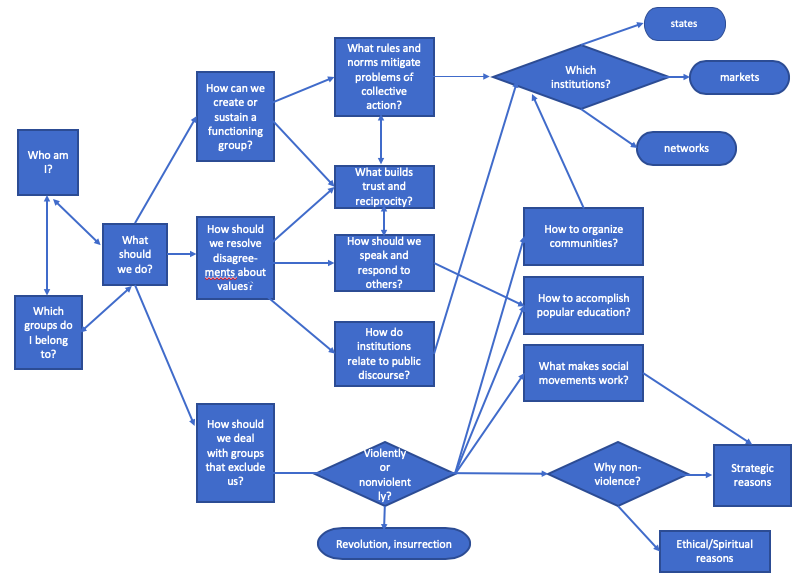
This is an agenda for research and education. It’s a way of organizing the major topics of our Introduction to Civic Studies course for undergraduates. It isn’t intended directly as a flowchart for civic actors (activists, leaders) because their problems are more concrete and more varied. But I hope that by addressing these topics in cumulative research, and by teaching the results (interactively), we can build a base of knowledge useful for activists. (See also the page about Civic Studies on the Tisch College website.)