Gandhi versus Jinnah on means and ends

(Posted while leading the 11th annual Summer Institute of Civic Studies, on questions like this one.)

A major theme in Gandhi’s thought it the primacy of means over ends.

In 1924, some Indian political leaders proposed the immediate creation of a new, independent “Federated Republic of the United States of India.” They argued that this end justified a wide range of strategies. They wanted to “delete the words ‘by peaceful and legitimate means’ from the Congress creed, so that men holding every shade of opinion may have no difficulty in joining” the independence struggle. That would have expanded the range of means employed to achieve the goal of home-rule.

Gandhi replied, “They say ‘means are after all means’. I would say ‘means are after all everything’. As the means so the end.” The “only universal definition to give it is ‘that status of India which her people desire at a given moment.’ If I were asked what India desires at the present moment, I should say I do not know.” For Gandhi, the means used to pursue swaraj (independence in its deepest sense) had to be good ones. “As the means so the end. Violent means will give violent swaraj. That would be a menace to the world and to India herself.”  

Drawing on Karuna Mantena, I would suggest the following Gandhian reasons to focus on means rather than ends. Human beings are cognitively limited and cannot see justice far beyond our own present circumstances. Human beings are motivationally flawed and highly susceptible to various distorting and destructive impulses. Therefore, we must choose modes of politics that channel our impulses in beneficial rather than harmful directions. Forming too sharp a definition of justice (or any of its components, such as national sovereignty) can simply excuse bad behavior. Consequences are always difficult to predict and control, and trying to pursue elaborate ends is foolish. We disagree, and what we decide about justice right now is contingent on how we are organized, so it is crucial to get the organization right. Finally, how we participate in politics helps to constitute the world. By acting, we don’t merely bring about a result (usually an unpredictable one); we immediately create a new reality just in virtue of our action.

A focus on means and a reluctance to specify ends does, however, pose a risk. A person might (whether intentionally or inadvertently) select and defend means that generate a foreseeable outcome or that foreclose the outcome that others prefer. That could be a back-door strategy for getting the ends that the person wanted in the first place. To claim that you are too humble and aware of your own limits to know the best goals is disingenuous if it’s clear what ends your favored means will lead to.

This was essentially Muhammad Ali Jinnah’s quarrel with Gandhi. Gandhi insisted that the social movement for Indian independence must involve close collaborations among Hindus, Muslims and adherents of other faiths. Immediately after saying that he did not know what India wanted, he added that he only endorsed a few values, including “truthful relations between Hindus and Mussalmans.” (“Truthful,” for him, would imply a close, sincere, and interactive relationship.) For Gandhi, the means of political action in India must incorporate interfaith dialogue and cooperation.

Although Gandhi insisted that “Congress leaves swaraj undefined,” Jinnah could see that if Hindus and Muslims won independence together, they would found a democracy with a large Hindu majority. This new country might be secular, or it might be Hindu-dominated, but it couldn’t be an Islamic republic–simply because of demographics. Jinnah identified the Congress as a Hindu organization and created the Muslim League as an alternative. He objected when Congress tried to place its Muslim President, Maulana Azad, in the provisional cabinet for British India, arguing that the Muslim League should name all Muslim members. After Gandhi’s assassination, Jinnah eulogized him as “one of the greatest men produced by the Hindu community and a leader who commanded their [sic] universal confidence and respect.” Jinnah regretted Gandhi’s death “so soon after the birth of freedom for Hindustan [his term for India] and Pakistan.” Thus, although Gandhi claimed that “means are after all everything,” Jinnah saw that Gandhi’s means would prevent Jinnah’s goal, a sovereign Pakistan. And he charged Gandhi with having an implicit goal of his own: the creation of a “Hindustan.”

The broader, theoretical question is how to think about means and ends when sometimes the means that we choose for good intrinsic reasons have foreseeable ends that are subject to debate. Yet, if we propose a clear vision of our goal, how can we know that it is right, and who gets to evaluate it? Surely, that requires a process that is not simply designed to yield a given outcome.

For what it’s worth, this is my verdict on the case at hand. Gandhi joined and then led an interfaith party for swaraj that encouraged debates about both means and goals. Jinnah was a member of that party, albeit mostly before Gandhi’s arrival from South Africa. Jinnah and others had the right to quit the party and movement. Exit is a legitimate choice in movements and party politics. As a result of Jinnah’s exit, Gandhi’s means failed: Congress ceased to be a forum for dialogue and cooperation that included the kinds of people who preferred the Muslim League. But Gandhi’s failure doesn’t invalidate his general advice to focus on means rather than specific ends.

Drawing here on Karuna Mantena, “Another Realism, the Politics of Gandhian Nonviolence,” American Political Science Review, vol. 106, no. 2 (May 2012) and various original passages from Gandhi’s works that Mantena’s article led me to. Also drawing on Ramachandra Guha, Gandhi: The Years that Changed the World, 1914-1948 (New York: Knopf, 2018)
the metaphor of going into a community

Researchers, students, government officials, organizers, activists–lots of people talk about “going into communities.” Although I resist the rhetorical move of “problematizing” everything, I think this metaphor deserves scrutiny. It assumes that communities are physically located and bounded, which is probably the exception, especially in the 21st century

It also assumes that we are not already “in.” If, for example, a group of Tufts students and faculty decide to go into Somerville to do some research or service, it’s worth noting that they were already in that city when they set out. A community should not be defined in a way that gerrymanders ourselves out of it. If we mean to name a demographic or social group, then we should say that. A demographic category is not a community.

If a community is a web of relationships, then to enter it you must form relationships with at least some of the people who belong to it–face-to-face or remotely. You cannot then simply leave it by moving your body away. You can break off the relationships, but that is also a way of relating to other people, with consequences.

If we decide to move to a different location to do work, that doesn’t mean that we go from a state of not being in a community to being in one. It means that we have a chance to form relationships with new people, and most of them probably move around a lot, too.

The whole spatial metaphor of traveling in and out of communities may be left over from classical field ethnography–traveling to Samoa to collect data–but it easily misleads.

engaged political science

Today we begin the American Political Science Association’s Institute of Civically Engaged Research (ICER) at Tisch College. The participants are about 20 political scientists–PhD candidates and current professors–who are interested in engaged scholarship. I am leading the ICER along with Amy Cabrera Rasmussen (Cal State-Long Beach) and Valeria Sinclair-Chapman (Purdue) and a roster of visitors.

In one of our sessions today, we will discuss four readings that offer varied perspectives on what engagement might mean for political scientists:

  •  Flyvbjerg, Bent. “Social science that matters.” Foresight Europe 2 (2005): 38-42.

Flyvbjerg, a Danish planning professor, stimulated considerable debate in American political science with pronouncements like this: “No predictive theories have been arrived at in social science, despite centuries of trying. This is a wasteful dead end.” Flyvbjerg advocates “phronetic” social science, in which the scholar prompts and joins public discussion of four questions: “(1) Where are we going? (2) Who gains and who loses, and by which mechanisms of power? (3) Is this development desirable? (4) What, if anything, should we do about it?” The words “desirable” and “should” indicate a concern with normative questions; Flyvbjerg calls his questions “value-rational.” But the key issue is “praxis”: what should “we” (a group to which the social scientists belongs) do?

Hacker is a distinguished Yale professor and policy entrepreneur. He developed and advocated the “public option” as a complement to the Affordable Care Act. In that case, he engaged the national public in a discussion of what to do and formed a kind of partnership with laypeople who included the President of the United States. Hacker stands at one end of a power/status continuum, the other end of which might be a Youth Participatory Action (YPAR) project in which a social scientist and a few adolescents study their own neighborhood. Hacker concludes that by “speaking the truth to the power [that he] studied,” he learned about the political process (e.g., the nuances of interest groups’ agendas) and so became a “better political scientist.”

Marta Struminska-Kutra describes her struggles to conduct an ethical research project in an unnamed but specific city, with its own power dynamics and hierarchies. In this theoretically demanding paper, she explores the compensating advantages and limits of three approaches. A “critical perspective” uncovers and challenges power but can be paternalistic and impotent if the community doesn’t share the “liberal, egalitarian, environmental, and collective” values of the researcher. The “constructivist perspective” fully honors local values and goals but risks paralysis and satisfaction with the status quo. And the “pragmatist perspective”–aimed at addressing concrete problems–risks benefitting only the people who have defined the problems in the first place. She suggests a practice of deliberately shifting among the three.

  • Tickner, J. Ann. “On the Frontlines or Sidelines of Knowledge and Power? Feminist Practices of Responsible Scholarship.” International Studies Review, vol. 8, no. 3, 2006, pp. 383–395. JSTOR, www.jstor.org/stable/3880253.

This is a presidential address for the International Studies Association in which Tickner questions the role of IR scholars–men like Henry Kissinger–who stand beside policymakers (also usually men) in the capitals of empires. She juxtaposes an ideal of the “intellectual as an exile in his or her own society, … who raises embarrassing questions, is unsettled, unsettles others, and stands on the side of the weak and unrepresented.” She finds support for that stance in feminism. But she concludes with a call for pluralism, wanting to make space for scholars who stand on the frontlines (even “implementing legislation”) as well as those who stand on the sidelines, closer to “those who have not been the subject of history.”

See also Bent Flyvbjerg and social science as phronesis; what gives some research methods legitimacy?; principles for researcher-practitioner collaboration; and Participatory Action Research as Civic Studies.

Frontiers of Democracy and summer institutes: coming up

The more-or-less final agenda for Frontiers of Democracy 2019 is up. We are oversold. If you want to attend and don’t have a ticket, you can email me to get on the waiting list. The talks on June 20 will be video-recorded and archived later (but not live-streamed.)

Before Frontiers and feeding into it are three other meetings:

And following the Frontiers conference will be the 11th annual Summer Institute of Civic Studies, for about 20 selected professors, graduate students, and activists from Argentina, China, Iran, Mexico, Spain, and the USA.

Participants in these groups, plus about 16 alumni of past Summer Institutes, plus another 50 people who simply signed up to attend will all convene at Frontiers.

Since I am in charge of ICER, Frontiers, and the Summer Institute, blogging has been light for the past week or so, and the forecast is for continued sporadic posting here–although I traditionally blog about some of the themes that arise.

how a mixed economy shapes our mentalities

(On my way to London for a small conference on Friedrich Hayek and Elinor and Vincent Ostrom).

These are some of the activities that we undertake as we organize social activity in a mixed 21st century economy:

  1. Observing prices of inputs and outputs and identifying opportunities for profit (market);
  2. Discussing a collective choice and then voting according to our preferences (democracy);
  3. Taking direction from a supervisor and directing subordinates to help fulfill that order (bureaucracy);
  4. Framing a complaint against another party and bringing it before a neutral tribunal (law);
  5. Forming an intimate, loving relationship with a concrete other person and taking that person’s interests as one’s own (family, and related groups);
  6. Drawing people of like minds together into a voluntary grouping (network);
  7. Assembling evidence for a conclusion and submitting it for expert review and possible publication and citation (science);
  8. Constructing a creative work within the boundaries of a genre and seeking the approval of a knowledgeable aesthetic community (art);
  9. Professing articles of faith and participating in the rituals of fellow believers (religion).

Sometimes these ways of interacting come into conflict. A society can use one method or another to make a decision, but not both at the same time; and the consequences of such choices may be profound. For example, if you have no ability to produce goods that have market value, but social outcomes are determined entirely by #1, then you may starve. But if the majority hates people like you and laws are made solely by #2, you may die. In subtler everyday cases, the balance among state regulation, bureaucracy, scientific autonomy, etc. can have huge economic and sociological effects.

Still, I start with the presumption that we need all of these ways of interacting. Each reflects accumulated experience and partial but significant truths about the world. Each results from the cumulative thinking of countless people, who surpass the mental capacity of any individual or small group. Each has proven a degree of fitness in the competition for support. It’s a dangerous form of arrogance to minimize any of these logics a priori, even though we are entitled to argue for one over the others in particular cases.

Thus I dissent from Hayek-style classical liberals who would assign these eight logics to two boxes. For Hayek, #1, #4, #5, #6 and #8 are “emergent” or “spontaneous” forms of order that reflect lots of people making specific choices in their own circumstances. We are good at these ways of thinking. On the whole, using these methods should generate progress, as improvements survive and mistakes die off. These methods should yield enough stability and predictability that individuals can act intentionally.

In contrast, Hayek thinks that #2 and #3 are examples of deliberate social engineering, which exceeds our capacities and endangers others by allowing too much discretion.

I disagree with this categorization because all these logics are emergent. Their current states reflect the largely uncoordinated activity of countless predecessors, who have thought and interacted in eight different ways. Just for example, any democratic system (#2) is a highly complex combination of rules, norms, forums, and offices. It cannot simply be the rule: “50%+1 wins,” because that rule doesn’t stand on its own. Who gets to vote? Who sets the agenda? Who is influential? The current state of a democratic system probably reflects some successful adaptation to circumstances. See Ostrom, E. (1986). An Agenda for the Study of Institutions. Public Choice,48(1), 3-25.

I also dissent from strong democrats and social democrats who think that only #2 is ultimately just; therefore, a deliberative democracy should be sovereign and able to make all decisions unless it chooses to assign decisions to other institutions (including courts and markets). I think this approach privileges one form of interaction, which has distinctive limitations as well as advantages.

So far, this is a familiar argument for a mixed economy (or political pluralism in Galston’s sense). I’ve tried to defend this position before, for instance in “polycentricity: the case for a (very) mixed economy” and “should all institutions be democratic?” Here I would like to add a point about the impact of such pluralism on our mentalities.

Participating in any collective endeavor teaches skills and values. We learn and develop lasting habits of character from each of the activities listed above.

Every time we use one of these logics, we learn to see the world in a particular way–for example, as a set of goods that all have current prices, or as a commonwealth shaped by our collective decisions, or as set of natural processes that can be objectively understood. We are responsible for making specific decisions: what to buy or sell, which way to vote, whether to join a church. But we are also responsible for making the meta-decision about which decision-making processes to use. It is unlikely that we will make those meta-decisions wisely unless many of us have substantial experience with each logic.

If market logics are hegemonic, everything (and everyone) looks like a good with a price, and other ways of thinking atrophy. Therefore, classical liberals/libertarians are wrong to think that a market accommodates all values and mentalities that are compatible with other people’s freedom. A rampant market shapes the subjectivity of its participants and makes them less capable of other forms of interaction. This is the truth in the charge against “neoliberalism” (a social order that is heavily influenced by market logics.)

A related problem for libertarians is that they need people to be socialized to favor market values. Two centuries after classical liberal ideas emerged, great masses of people have not gravitated to them. And when people have the freedom to form groups, sometimes the groups they design–such as gated residential communities and disciplined corporate bureaucracies–probably teach the next generation to expect and value imposed social order. Should young people be raised to think in market terms? If so, what is a legitimate way to accomplish that?

But the same charge might be made against the other logics, too. There are subcultures in which almost everyone is allergic to market thinking and only learns to participate in voluntary networks or aesthetic communities. Yet these subcultures don’t spread to the whole population any more than libertarianism does.

I am hinting at two empirical claims: 1) Immersion in any social form shapes subjectivity, influencing how people interact and the forms of interaction that they value. And 2) People who work in multiple social forms are better at weighing their respective pros and cons.

I think there is a large but dispersed empirical literature on the first claim, but I have not explored it thoroughly. I doubt much is known about the second claim.

The underlying theory here is compatible with two famous thinkers, who make somewhat strange bedfellows. One is the author of Federalist #51 (probably Madison) who writes, “This policy of supplying, by opposite and rival interests, the defect of better motives, might be traced through the whole system of human affairs, private as well as public.” He is emphasizing one principle of good design (division of power) that might be used across different social forms, but we could generalize his point. People are embedded in many private and public arrangements, all of which need principles of design.

That bring me to John Dewey, who writes, “The forms to which we are accustomed in democratic governments represent the cumulative effect of a multitude of events, unpremeditated as far as political effects were concerned and having unpredictable consequences.” For Dewey, as we develop new forms of self-government in any domain (a state, an office, a family), we have an opportunity to learn what works better and test its logic elsewhere.

See also: against state-centric political theorythe right to strikeChina teaches the value of political pluralism; explaining Dewey’s pragmatism; the truth in Hayek; the legacy of Elinor Ostrom and the Bloomington School; and why the deliberative democracy framework doesn’t quite work for me.

“the body of us all”: Anne Carson’s “The Glass Essay”

Anne Carson’s long poem entitled “The Glass Essay” relates how the narrator, having been dumped by her romantic partner, goes home to Canada to visit her mother (a difficult-sounding person–prone to rehashing old criticisms) and her father, now suffering from Alzheimer’s. Being a scholar, this narrator takes with her

… lot of books—

some for my mother, some for me
including The Collected Works Of Emily Brontë.
This is my favourite author.

She thinks about Emily and Charlotte Brontë, about herself, about her father and her mother. She feels strong emotions. For example:

Anger travels through me, pushes aside everything else in my heart,
pouring up the vents.
Every night I wake to this anger,

the soaked bed,
the hot pain box slamming me each way I move.
I want justice. Slam.

I want an explanation. Slam.
I want to curse the false friend who said I love you forever. Slam.
I reach up and switch on the bedside lamp. 

But the poem moves toward something that I can only call transcendence. The narrator concludes with a perspective and a moral concern that goes infinitely beyond herself and her own circumstances.

But how can you transcend your circumstances if you are a modernist writer who favors concrete images and objective correlatives? How can you transcend earthly pain if you cannot invoke God? (“I am uneasy with the compensatory model of female religious experience and yet ….”) How can you transcend the injustices you have faced if you believe that your identity as a woman matters–that not everyone has the same problems, that differences are important?

One answer, Anne Carson suggests, is time. “Days passed, months passed and I saw nothing.” She finally attains insight, but only after a long wait. Another answer is hard thinking. The narrator probes herself, nature, and other people. She asks the hard questions and debunks her own answers.

Most importantly, you need the courage to believe and say things that are un-ironic, explicitly ethical, and close to cliché:

I saw a high hill and on it a form shaped against hard air.

It could have been just a pole with some old cloth attached,
but as I came closer
I saw it was a human body

trying to stand against winds so terrible that the flesh was blowing off the bones.
And there was no pain.
The wind

was cleansing the bones.
They stood forth silver and necessary.
It was not my body, not a woman’s body, it was the body of us all.
It walked out of the light.

This is moving because it is so hard-won.

See also: on the moral dangers of cliché and on the proper use of moral clichés.

asking the public to do the reading

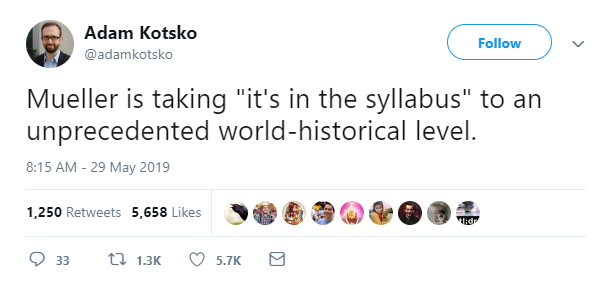
Buzzfeed’s Tanya Chen assembles lots of tweets and other quotes that analogize Bob Mueller to a frustrated college instructor. The American people are his students. Since we didn’t do the reading, we want him to explain it all in simple terms.

These are amusing responses, but they raise the question of what millions of Americans are really obligated to read. I once heard a Supreme Court justice say (to the approbation of the audience in the room) that citizens shouldn’t criticize judicial decisions unless they have read them, presumably in full. Some environmentalists despair that most people didn’t read the last big Intergovernmental Panel on Climate Change (IPCC) report for themselves. It seems outrageous that the President of the United States, who swore to uphold the Constitution, would fail a basic test of its contents. (For instance, he expects the judiciary to review an impeachment process.)

But once you put several of these assignments together, it makes for a daunting syllabus.

And it depends on what else you would do with your time. Instead of reading the Mueller Report, I have actually spent hours neurotically checking second-hand opinions about the report in order to root for the ones that say that Trump is in big trouble and boo the ones that say he’s been exonerated. That was a bad decision about how to allocate my attention. If I’d spent the same hours reading the report, I might have learned something. However, the text of the report would not change my opinions and behavior in a way that would matter for the country. So it would have been wiser still for me to spend my time not on the Mueller Report, nor on the endless second-hand commentary, but rather (for example) on the work of the astoundingly creative Anne Carson.

I start with faith that certain responsible summaries of the Mueller Report will give me what I need to know. I then waste time reading all the other commentary in the light of what I already believe. If I took Sean Hannity to be the responsible commentator instead of Lawfare or the New York Times, my behavior would be exactly the same but my conclusions would be the opposite. The problem is deciding who is the responsible intermediary, and you can’t do that with 100% certainty unless you read the original text for yourself. But again, it is not obvious that we are morally obliged to understand the Mueller Report with 100% certainty, when there are other things to do with our day.

The Great Professor in the Sky definitely expects us to do the reading. But I am not sure we are all obliged to take Professor Mueller’s class. We do face a mandatory exam called the 2020 election, but it will cover a whole lot of material, and you can do fine on it even if you didn’t take Mueller.

Your responsibility as a citizen–as distinct from your duty as a person–obliges you to collect information and insights about public affairs. (Your duty as a person is to read Anne Carson.) But there is an awful lot to learn about public affairs, of which the Mueller Report is only one sample. What bothers me is the implication that everyone should have mastered that particular body of material, when no one can understand everything that matters.

what does the European Green surge mean?

The Greens did very well in the EU elections. One interpretation is that a substantial minority of Europeans are now seriously focused on climate issues and voted Green to promote EU-wide climate policies.

But the Greens also stand for pan-Europeanism, multiculturalism, civil liberties, and the rule of law; and they have a specific demographic base. They are challenging or even replacing social democrats as a pillar of the center-left, without expanding the total center-left vote by much (if at all). It is not clear that they have a stronger policy platform on climate issues than the socialist parties in countries like Germany.

Therefore, a different interpretation is plausible. Perhaps the social democrats have fractured along class lines, and the Greens have taken away their college-educated vote, not because of climate but because of a whole basket of issues and values.

To explore that second hypothesis, I’ll focus on Germany–the birthplace of social democracy (in 1875) and the EU’s most important economy. There, the Social Democratic Party (SDP) came in third with less than 16%, surpassed by the Greens at 20.5%.

The SPD was traditionally a coalition of unionized industrial workers plus college-educated employees who were close to the welfare state (teachers, civil servants, and the like). These were the groups that stood to benefit most from an active state, and they were effectively organized in unions, professional associations, and the SDP itself. In other words, they didn’t just have votes but also organizational muscle. They played a major role in building the welfare state.

However, at least some of the party’s white-collar base has migrated to the Greens, who have become less environmentalist and more of a socially-liberal, cosmopolitan, center-left party. And some of the industrial workers have left the SPD for the right. The net result is a weakening of the organized center-left. Yes, the Greens are flourishing, but that is mostly at the expense of the SDP and reflects a fracturing of the social democratic coalition that helped to build the Federal Republic.

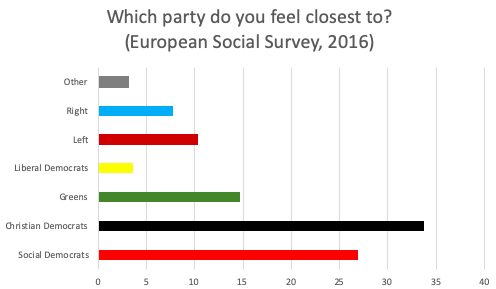
An EU election can be misleading if you want to understand the deeper state of a country’s politics. Only about 60% of eligible Germans voted this week, and they presumably focused more than usual on European issues. They certainly opted more than usual for small parties. Therefore, as second graph, I show how the whole German adult population responded when asked which party they felt closest to in 2016:

These data are now two years out of date but probably reflect the underlying conditions. The order is still the familiar one–Christian Democrats, Social Democrats, Greens, and then others–but the once-mighty SDP is already down to 26.2% in this survey. Left parties claim 58.7% of the total electorate but stand very far apart on issues. The traditional establishment parties (Christian Democrats, Social Democrats, and Liberal Democrats or FDP) claim just 64.2% of the vote in total. Both the left and the center are larger than the right, but the center-left is far from dominant.

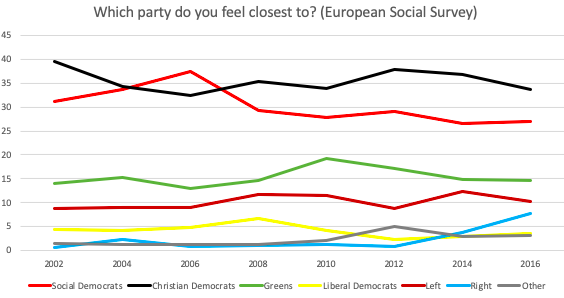
This third graph shows how this pattern had evolved since 2002:

The change in the position of the Christian Democrats has not actually been huge. They have certainly seen some erosion since the immigration crisis, but they are only six points less popular than they were in 2002. The Greens stand not far from where they were in 2002, but they temporarily improved their position while the Social Democrats were sustaining their largest decline (2006-10). The right also rose, but mostly after the SDP had seen its major losses (2012-16).

That graph is consistent with the theory of a fragmenting SDP. However, trends in party support do not tell you how individuals shifted. Maybe the Greens grew by attracting former SDP members, but maybe those two lines converged for other reasons. The Greens declined and the right-wing grew after 2010, but we don’t assume that Green Party members defected all the way to the right.

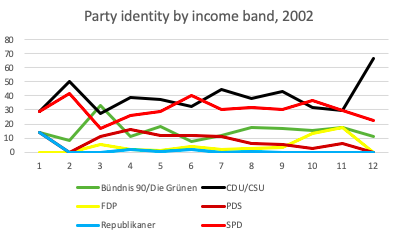
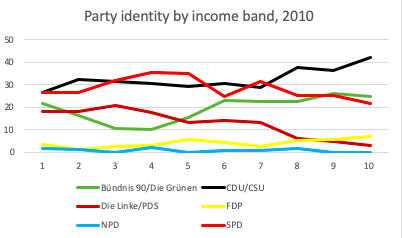
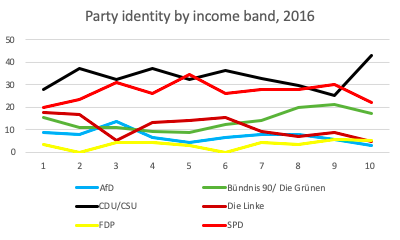
As an imperfect test of the thesis that the SDP has indeed lost members to the Greens and the right, I graphed party support by income band for three selected years. I am assuming that if the SDP falls and the Greens or the right-wing rises within a specific income stratum, then people are actually changing their party affiliations in that way.

In 2002, the SDP performed best at three levels: the poor (who might benefit most from welfare), the fourth and fifth deciles (which may reflect unionized industrial workers), and the 8th and 9th deciles (where people with a lot of education may land). The Christian Democrats dominated among the rich but drew votes from across the spectrum. The Greens could not yet be described as an affluent party. Also (not shown here) they performed worse than the SPD among students. The right drew strongest from the lower-middle class.

By 2010, the Greens were more affluent and the SPD had lost a substantial amount of support in the upper deciles. The Greens were now also running even with the SPD among current students. The far right was weaker than it was in 2002, but I think that reflected a temporary change in the array of parties. The left drew support almost entirely from the lower income bands.

And by 2016, the right was much stronger–in third place in some of the lower income bands, behind only the SDP and Christian Democrats. Meanwhile, the Greens had become distinctly affluent and (again not shown here) they dominated the current student vote. They lost support only in the top income range, where the Christian Democrats were still ahead (although less so than in 2002).

These patterns are not sharp and dramatic; there is actually a fair amount of stability despite tumultuous times. But it does look as if the SDP has lost members to the Greens over lifestyle issues, and to the right because of nationalism.

The SDP and the Greens can certainly come together again in parliamentary coalitions, but at the grassroots, the coalition that sustained the German welfare state looks weaker than it was for decades. Also, I am not sure the Greens have the organizational muscle that the SPD had in its heyday, which means that their capacity to implement policy may be weaker.

If you care about environmental policy and social justice, you have to welcome the Greens. But the question is whether the center-left as a whole has sufficient capacity to govern.

marginalizing views in a time of polarization

I recently posted “marginalizing odious views: a strategy,” which was about a powerful and sometimes valuable tool for self-governance. When communities define specific perspectives as beyond consideration, they uphold norms without needing formal censorship. This is good when it happens to Nazis (for instance), but problematic when it’s used to block serious consideration of minority views.

I assume that marginalization is a perennial strategy. Its advantages and risks–especially as compared to a strategy of engagement–are also perennial. But the context does make a difference.

When most Americans got their news from three rather similar TV networks plus a metropolitan daily newspaper that had from zero to three local competitors, marginalization depended on the mass media. You could try to marginalize a position that you considered odious, or create space for a currently marginalized view, but your success would depend on what Walter Cronkite and his ilk thought. If a position wasn’t marginalized on the network news, it wasn’t marginalized. And if a view never got aired in the mass media, then it was pretty marginal even if you and your friends believed in it.

At the same time, the two major parties had overlapping national elites with similar educational pedigrees who, while disagreeing about some important matters of policy, still tended to agree about what was marginal. Along with the mass media, they adjudicated what belonged on the national agenda. Thus the terms of the game were clearly defined, even if the rules were problematic because they gave too much power to homogeneous elites.

Now that the media landscape is highly fractured, we live in many separate epistemic communities. What is mainstream in one setting can be effectively marginalized in another. Just to name one example, the phrase “illegal immigrants” is pretty much marginalized in both my city and my university, but it is the standard phrase across large swaths of America.

The fact that our national discourse is polarized and balkanized has been widely noted, but I want to emphasize the consequences for a strategy of marginalization:

  1. It is now virtually impossible to marginalize across the society as a whole. Given any opinion, some people are comfortably expressing it right now in public (online) to their fellow believers.
  2. It is now much easier to marginalize within a community in which you in are the mainstream. The temptation to say, “We don’t say that here” is very high when that can be so successful.
  3. There is also a constant temptation to demonstrate that each community is biased by forcing it to confront views that it is trying to marginalize. That makes the community look intolerant to external audiences. For instance, if a university seems pervasively liberal, invite Milo, watch the reaction, and cry “Censorship!”
  4. Since being marginalized feels like being censored, more people have the experience of censorship in various specific settings where their own views are unpopular. In fact, almost everyone would be marginalized somewhere.
  5. The same statements often have a double effect. For their proponents, they reinforce shared norms. For their opponents, they serve as examples of what must be marginalized. For instance, Rush Limbaugh clearly has two audiences: conservatives who like what he says and liberals who are appalled by quotes that circulate in their networks. (Both reactions benefit Limbaugh by bolstering his prominence.)
  6. The strategy that is furthest from marginalization–trying to learn from other people while sharing your opinions with them–is harder than ever, because we all hide in homogeneous communities.

I continue to think that marginalization has a place in politics. Not every opinion deserves respectful consideration. Communities gain coherence and value by drawing limits around what they will consider. However, I suspect that a fractured media system makes marginalization too tempting and persuasion too difficult, with costs for democracy.

the Civic Studies Wikipedia page

There is a new page on Wikipedia about Civic Studies. It’s not about civic education* but about the developing “interdisciplinary field that empirically investigates civic engagement, civic education, and civil society.” Civic Studies also strives to “influence the social sciences and humanities in general to take the perspective of intentional human actors–people who reason and work together to improve their worlds–in addition to institutions and impersonal social forces.”

I wrote all the text that’s on this page so far, but I’m hoping it will be a living document to which others will contribute.

*For civic education, you could consider the Stanford Encyclopedia of Philosophy entry by Jack Crittenden and me.