college student turnout more than doubled in 2018

My colleagues at the Institute for Democracy and Higher Education here at Tisch College have released their national report on the 2018 election and sent detailed specific reports to each of the roughly 1,031 colleges and universities that participate in our National Study of Learning, Voting, and Engagement (NSLVE). This research is based not on surveys (which have errors in sampling and self-reporting), but on official voting records for about 20 million people.

As reported in today’s Washington Post, the headline is that college student turnout more than doubled between 2014 and 2018 (the last two midterm elections). It’s true that everyone’s turnout grew in 2018, but college students far surpassed the national trend. My favorite statistic is that turnout rose on 99% of all the NSLVE campuses. Now that is a significant pre-/post- change.

The full report has much more detail on demographic groups, profiles of selected colleges, and suggestions for maintaining the momentum. As always, the actual result (40% of college students voted in 2018) remains too low, but the only way forward is by raising engagement one step at a time, and doubling it is a good step.

Elizabeth Warren in a tradition of radical American progressivism

A lively and valuable debate is underway about whether Senator Sanders or Warren should carry the flag of the left. Considering that Sanders calls himself a “socialist,” and Warren says she’s pro-“market,” it’s worth thinking about what each means by these words and how their words relate to their policies and their political strategies or theories-of-change. For instance, if both use the New Deal as a positive reference point–Sanders to illustrate socialism and Warren to show how capitalism can be saved–then maybe the difference is merely semantic. Or maybe not.

I would contribute one observation. Elizabeth Warren may belong in a specifically American tradition of progressive politics that is distinctive from socialism and that lacks a crisp name of its own, so far as I know. But it has these features:

  1. Enthusiasm for truly competitive markets that are free of monopolies. Competition is supposed to lower profits to minimal levels and make companies accountable to consumers and prospective workers. For instance, Louis Brandeis argued in 1912 that “our people appreciate better than they did before, the great economic truth which was embodied in the Sherman Law”: “the value of competition.” “The Democratic position … is that private monopoly in industry is never permissible; it is never desirable, and is not inevitable; competition can be reserved, and where it is suppressed, can be restored.”
  2. An understanding of the public as consumers. In 1912, the Progressive thinker Walter Weyl wrote that the office of “consumer is most universal, since even those who do not earn wages or pay direct taxes consume commodities. In America to-day, the unifying economic force, about which a majority, hostile to the plutocracy, is forming, is the common interest of the citizen as a consumer of wealth” (The New Democracy, New York, 1914, pp. 248-50)
  3. Related to the last point, a preference for universal identities over special interests and particular identities.
  4.  An ideal of the government as the protector of consumers. Robert M. La Follette said in 1906: the “welfare of all the people as consumers should be the supreme consideration of the Government.” Often this is extended to workers as well.
  5. Related to the last point, a defense of democracy (with reforms like referenda and publicly finance campaigns) as the system that makes government most accountable to all the people, not to special interests.
  6. A theory that citizens should mainly monitor their own rights and choose leaders and officials to protect them. For their part, prospective leaders should offer detailed proposals for solving problems. “I have a plan for that” is exactly this approach.
  7. A belief in transparency and access to information as tools of reform, captured in Brandeis’ famous line that “sunlight is the best disinfectant.” Brandeis also wrote that the Sherman Antitrust Act would remain inadequate without stronger enforcement, better “administrative machinery,”and “comprehensive, accurate, complete knowledge” of the behavior of businesses (mandatory transparency).

Note that this is not socialism. That word can be defined in many ways, but surely it would stretch the term to use it for a political philosophy that prizes competition and consumer identities.

But it can be radical, and it’s a deeply American tradition. Roger Taney, while Secretary of the Treasury under Andrew Jackson, said, “it is proper that [banking] should be open as far as practicable to the most free competition and its advantages shared by all classes of society.” A century-and-a-half later, Ralph Nader also championed deregulation of selected industries, consumer rights, transparency, and popular sovereignty.

To illustrate Senator Warren’s adherence to this tradition, I would cite (for example) her interview with Franklin Foer in The Atlantic:

I believe in markets and the benefits they can produce when they work. Markets with rules can produce enormous value. So much of the work I have done—the Consumer Financial Protection Bureau, my hearing-aid bill—are about making markets work for people, not making markets work for a handful of companies that scrape all the value off to themselves. I believe in competition.

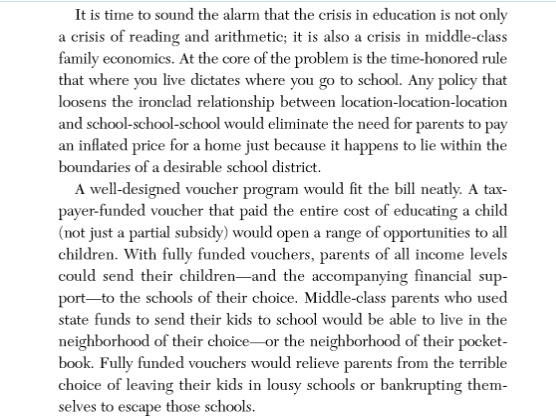
Or consider her endorsement of school vouchers in The Two-Income Trap: Why Middle-Class Parents are Going Broke (2003):

Warren’s specific position on vouchers has changed, but not her deeper philosophy.

Her stance deserves very serious consideration, and a case can be made that it is the best path forward for the American left. But I would raise these questions:

Should the consumer identity satisfy us? What about criticisms (cultural, environmental, and spiritual) about consumerism? Would it be better to see us all as producers? And what about other identities that differentiate Americans, such as race and ethnicity?

Should the implicit role left for citizens satisfy us? Is our job to critically evaluate candidates’ plans for solving our problems, or must we take deeper action?

Do competition and transparency work? (I think Warren herself would say: only sometimes.)

(Most quotes from my book The New Progressive Era. See also: citizenship in the modern American republic: change or decline?; transparency is not enough

The National Commission on Civic Renewal, A Nation of Spectators

In 1997, the National Commission on Civic Renewal published its report, A Nation of Spectators: How Civic Disengagement Weakens America and What We Can Do About It. The Commission was partly a response to Robert Putnam’s 1995 article, “Bowling Alone.” The Pew Charitable Trust funded and convened it, and Bill Galston directed it, with me as the research director. My main contribution was an Index of National Civic Health (INCH), which is one ancestor of today’s Civic Health Index.

There may have been an echo of the report in George W. Bush’s Inaugural Address: “I ask you to be citizens. Citizens, not spectators. Citizens, not subjects. Responsible citizens, building communities of service and a nation of character.” (Quoted without comment on what followed.)

One of the recommendations was a research center on youth civic engagement, which we founded in 2001 as CIRCLE.

In 1997, the Internet was up and running, and we maintained a website for the Commission and its report. But that is long gone and the report is hard to find. So here it is, scanned as a PDF, as one record in the history of professional efforts to strengthen civic engagement in the USA.

we should be debating the big social and political paradigms

[The following post is inspired by Rogers Smith’s recent APSA presidential address, and I believe is consistent with it, but I incorporate some additional elements.]

Consider a sample of articles about politics, or society more generally. One might be an interpretation of some remarks by Thomas Jefferson. Another reports an experiment in which people are more likely to vote when contacted one way rather than another. A third is a critique of a prevalent word (say, “security”) from the perspective of Michel Foucault. A fourth shows that rational agents in a certain situation are better off when rules are externally imposed on them.

Each of these articles presumes, and contributes to, a larger paradigm that combines values, causal theories, and methods. Perhaps the interpreter of Jefferson believes that the United States is still founded on its written Constitution and that the intentions of the founders matter today. The experimentalist presumes that voting in a regime like the modern USA is a consequential act, and it would be good to increase voting by several percentage points if possible. The critic of “security” sees a world of pervasive injustice sustained by ideology, in the sense of distorting views that preserve the status quo. The rational-choice modeler thinks that all (or many) institutions can be analyzed as the interactions of utility-maximizing individuals.

(For the sake of space, I have omitted a classical Marxist, a deep feminist, a post-colonial theorist, a Prospect Theorist, a radical environmentalist, and many others who deserve places on the list.)

In these articles, you will not see much about their larger paradigms, worldviews or schemata. Their paradigms may not even be mentioned. Instead, you will see evidence in support of the specific claims of each article (whether in the form of statistics, quotations, or equations).

Of course, journals offer limited space, and there may not be room to present a whole paradigm. In addition, citing your scheme may only hurt you in the review process. Reviewers who happen to oppose your overall paradigm may be alienated, when they would have been persuaded by your detailed findings if presented alone.

For instance, imagine that you discover that texting people increases their turnout more than emailing them. That is more persuasive as a bare finding than as part of an argument for the significance and value of voting in a mass democracy within a capitalist market economy.

A certain form of positivism (or verificationism, or empiricism) is still widely influential. It holds that facts can be verified directly. Larger mental constructs are fashioned by us and are only valid to the extent that they match all the facts. If big, general ideas influence our beliefs, they are sources of bias. Therefore, we may need to disclose our paradigms as caveats, but we don’t want to focus on them.

Some people would hate to be described as positivists but end up in a similar place for a different reason. They presume that they have a right to their fundamental views as a matter of identity. “As a migrant from the global south, I explore the colonization of indigenous spaces …” This is not a disclosure of bias, nor a defense of a thesis; it is a claim to be recognized as a member of the scholarly community. To disagree is to deny the author’s place in the community.

I believe that the really important task is to select our worldviews, our big normative/conceptual schemes. It matters which of the available choices we adopt, and maybe we can create better ones. Therefore–as I think Rogers Smith argued–it is a real weakness in any intellectual community if the paradigms are implicit or merely stated, rather than explained, justified, and put into competition.

Within political science, many contrasting worldviews are available. You can walk down the hall of the APSA Annual Meeting past rooms in which everyone accepts the basic normative principles of contemporary electoral democracy, and other rooms in which people are quoting Slavoj Žižek about ideology.

It is hard to compare such worldviews or paradigms, because they have different normative, epistemic, and sometimes metaphysical premises. A finding within one paradigm does not disprove a different paradigm. A certain kind of relativism interferes with comparative assessment.

However, we can consider a whole body of specific findings along with their shared overall claims. We can ask whether this whole literature is coherent, whether it generates persuasive specific findings by its own lights, whether it informs practice in any useful way, whether it makes sense of other literatures, how it handles criticisms and rival views, whether it is responsive to new evidence and events, and whether its normative implications are defensible when fully articulated. Each paradigm has points of relative strength and weaknesses.

It would be helpful if people had that discussion in print, instead of always only writing within paradigms (at least for journal articles.)

See also trying to keep myself honest, how philosophy is supposed to work

AAC&U Webinar: Sept 19 2019

“The Confounding Promise of Community: Why It Matters More Than Ever for Student Success,” September 19, 2019; Online, 2:00-3:00 p.m. (ET)

In this webinar, I’ll be discussing my recent article in Liberal Education entitled, “Another Time for Freedom? Lessons from the Civil Rights Era for Today’s Campuses.” Other authors in the same special issue of Liberal Education will also share their work.

Webinar Registration
Cost: Free for AAC&U members; $99 for nonmembers
Check your institution’s membership status here

What is the role of community—as a concept, an outcome, and an entity—in a liberal education, and how can community contribute to student success? How do students experience community, on and off campus? This webinar will examine emerging definitions of community, ongoing efforts to create inclusive pathways for engagement, and ways community-based practices can advance inclusive excellence. From multiple institutional perspectives, presenters will explore how a collective understanding of community can shape a commitment to equity and student success.

All webinar registrants will be eligible for a 20% discount on copies of the new issue of Liberal Education, which fully explores the webinar topic. In this issue, authors—many of whom are webinar presenters—share research findings, commentary, and recommendations on the confounding promise of community. 

Moderator

Ashley Finley
Senior Advisor to the President and Vice President for Strategic Planning and Partnerships
AAC&U

Presenters

Geoffrey Buhl
Professor, Mathematics and General Education Chair
California State University Channel Islands

Leeva Chung
Professor, Communication Studies
University of San Diego

Marta Elena Esquilin
Associate Dean, Honors Living-Learning Community
Rutgers University-Newark

Jason Leggett
Assistant Professor of Politcal Science and Criminal Justice
Kingsborough Community College

Peter Levine
Associate Dean of Academic Affairs and Lincoln Filene Professor for Citizenship & Public Affairs
Tufts University’s Jonathan Tisch College of Civic Life

translations from Kuruntokai

Kuruntokai (The Short Collection) is an anthology of classical Tamil verse collected by Pooriko Nachinarkiniyar in the sixth or the seventh century CE. The poems are lyrics of love and longing. Apparently they offer layers of religious symbolism. Here are two translations of #36, giving some sense of the original:

Poem from the purple-flowered hills

Talaivi says to her friend—

He swore “my heart is true.
I’ll never leave you.”

My lover from the hills,
where the manai creepers
sometimes mount the shoulders of elephants
asleep among the boulders,
promised this on that day
when he embraced my shoulders, making love to me.

Why cry, my dear friend?

Paranar, Kuruntokai, verse 36, translated by A. Anupama
She Said

On his hills,
 the ma:nai creeper that usually sprawls
 on large round stones
 sometimes takes to a sleeping elephant.

At parting,
 his arms twined with mine
 he gave me inviolable guarantees
 that he would live in my heart
 without parting.

Friends, why do you think 
 that is any reason for grieving? 

 Paranar (Kuruntokai 36), translated by A.K. Ramanujan

Or #46 …

Poem from the fertile fields and fragrant trees

Talaivi says—

Don’t you think they have sparrows
wherever he has gone, with wings like faded water lilies,
bathing in the dung dust in the village streets
before pecking grain from the yards
and returning to their chicks in the eaves,
common as evening loneliness?

Mamalatan, Kuruntokai, verse 46, translated by A. Anupama
She Said

Don't they really have
in the land where he has gone
such things
as house sparrows

dense-feathered, the color of fading water lilies,
pecking at grain drying on yards,
playing with the scatter of the fine dust
of the street's manure
and living with their nestlings
in the angles of the penthouse

and miserable evenings,

and loneliness? 

 Ma:mala:tan (Kuruntokai 46), translated by A.K. Ramanujan

I’ll try a reply:

We used to watch sparrows like this one.
They'd look up at her, at me, hopeful,
Head tilted: crumbs? fly away?

Now it's only me. This one flutters up
To hunch under an eve and wait.
When the rain stops, maybe it will find a bite.

See also: when the lotus bloomed, nostalgia for now, voices

Syllabus of Introduction to Civic Studies, fall 2019

Fall 19 Civic Studies 0020-01 Intro to Civic Studies

Instructors: Peter Levine, Brian Schaffner. TA: Gene Corbin

Sept 4: Introduction

Introduction to the course and the instructors.

In class exercise: “The “Christmas Tree Crisis” at Sea-­?Tac Airport” (handout in class)

Sept 9: Problems of collective action

(In class, we will simulate a collective action problem.)

Sept 11: Elinor Ostrom’s solutions to the Tragedy of the Commons

Sept 16: Ostrom continued

Sept 18: Ostrom Continued

Sept 23: Social capital as part of the solution

Sept 25: Why do people voluntarily participate?

Sept 30: Discussing good ends and means

Reading assignment: the Harvard Pluralism Project’s case entitled A Call to Prayer (Links to an external site.).  In the discussion sessions this week, students will deliberate what the people of Hamtramck, MI should do. In the class session on Sept 30, additional discussion of deliberation (what it is, what it can accomplish, and what else is needed for good decision-making).

Oct 2: Habermas and Deliberative Democracy

Oct 7: Does deliberation work?

Oct 9: Other forms of discourse: 1) testimony and empathy

[Oct 14: vacation day]

Oct 15 (Tuesday): Other forms of discourse: 2) dissent

  • Tommie Shelby, “Impure Dissent” from Dark Ghettoes: Injustice, Dissent and Reform (2016)

Oct 16:  How can we design for deliberation?

Oct 21: Midterm in class

Oct 23: Exclusion and Identity

Oct 28: What happens when people experience diversity?

Oct 30 Guest lecture on political hobbyism (Eitan Hersch) 

Social Movements 

Nov 4: Identity and the Common Good

Nov 6: Social Movements 

(Nov 11: no class)

Nov 13: Community Organizing

Nov 18: Nonviolent Campaigns

Nov 20:  Gandhi 

Nov 25: Gandhi continued

  • Gandhi, Notes, May 22, 1924 – August 15, 1924, in The Collected Works of Mahatma Gandhi (Electronic Book), New Delhi, Publications Division Government of India, 1999, 98 volumes, vol. 28, pp. 307-310

[Nov 27: no class]

Dec 2: Does nonviolence work? Does violence work?

Dec. 4: Student presentations in class

Dec 9: Student presentations in class

Dec 17: Final exam (3:30-5:30 in the Rabb Room)

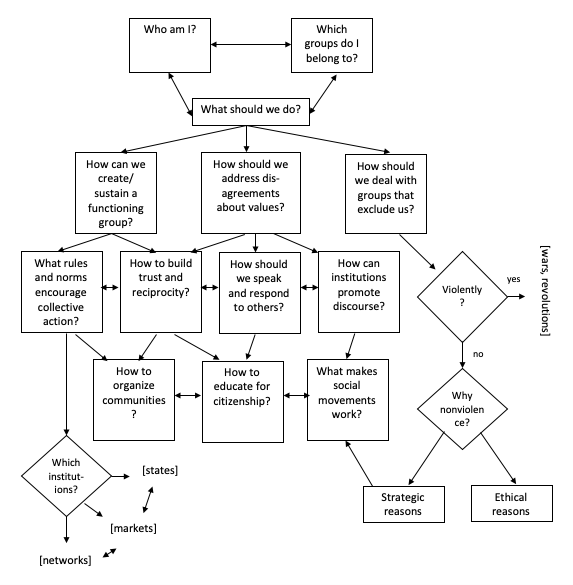
Conceptual Outline of the Course
(click for more information)

voter suppression shows we have a democracy

An interesting panel at the American Political Science Association conference explored whether the conceptual distinction between democracy and authoritarianism is (still) useful. In arguing against this distinction, some panelists cited ways that a particular democracy–the USA–fails to honor democratic norms. An example of our failure (which didn’t provoke any overt dissent on the panel) was voter suppression.

To be clear, I oppose the policies that are described as voter suppression. I was deposed and testified as an expert witness in the successful federal lawsuit against North Carolina, and I have done other work to promote access to voting and to attack restrictions.

However, I would make the conceptual distinction in a different way from several of the panelists. “Democracy” is not the name for a just or fair society. A democracy is a society in which majorities govern (for better or worse). Having a democracy opens vistas for developing human potential and for improving the world. But it also presents characteristic challenges.

Two endemic challenges of democracy are relevant to voter suppression. First, when the majority of people hold problematic views, we get problematic policies. For instance, requiring photo identification for voting is unnecessary and creates a barrier, but it is highly popular among a broad spectrum of Americans. Second, because majorities are powerful in a democracy, you can expect bare-knuckled struggles over who actually turns out. When such struggles go well, they become competitions to boost turnout. But you will predictably see efforts to keep the other side home.

Precisely because it matters who votes in the USA, political actors play rough here. Conceptually, that just reinforces the thesis that the US is a democracy. Nobody would bother to erect subtle impediments to turnout if the vote didn’t matter.

These examples raise the normative question of whether a democracy is the ideal system. Most people would say no, at least insofar as they would want to modify the core idea of democracy with one or more adjectives: liberal, classically republican, social, deliberative, or otherwise.

Given my way of thinking, was the US a democracy before the Civil War, before women’s suffrage, and under Jim Crow? Is it a democracy now, when more than two million people are incarcerated?

These are profound injustices, but democracies can be–and frequently are–unjust. To the degree that large numbers of people are officially excluded from the polity, the system is undemocratic. Therefore, the US was not a full democracy until the Voting Rights Act. Yet a diagnosis of these past and current injustices must put some of the blame on the democratic aspects of our system. A reason for racist policies has been the racist views of many in the white majority. A major reason for mass incarceration is popular support (across racial groups) for draconian punishments. A motive for disenfranchising women and African Americans is that voting matters.

In short, I am against saying, “We are not really a democracy and should stop congratulating ourselves on being different from authoritarian regimes.” Instead, I favor saying: “We are a democracy, and that is why we (the people) must fight–constantly, effectively, and hard–for fairness.”

See also: do we live in a republic or a democracy?; from modest civic reforms to a making a stand for democracy; what does it mean to say democracy is in retreat?; “Habermas with a Whiff of Tear Gas.”

civically engaged research in political science #APSA2019

(Washington, DC) Rogers Smith concluded his presidential address at the American Political Science Association’s annual meeting with a call for more engaged scholarship, which I would define as co-producing knowledge with people who belong to the communities being studied. Smith said that if political scientists had conducted more civically engaged research with such communities as African Americans after the Civil Rights era, gay Americans after Stonewall, industrial workers after deindustrialization, or rural whites since 2000, the discipline would have been better prepared to understand important political developments that have ensued–and those constituencies would trust political science more.*

Strengthening engaged scholarship in political science is a personal commitment of mine. Thanks to Smith’s leadership, colleagues and I offer the APSA Institute for Civically Engaged Research (ICER) through Tufts’ Tisch College. The first ICER was held last June, and the next one will be in 2020.

I believe that there are few fully documented, peer-reviewed examples of civically engaged projects in political science–especially compared to the large body of such studies in fields like public health. Many political scientists actually conduct civically engaged research, and they do it well. But peer-reviewed publications generally report only the findings of such studies, with hypotheses, data, and conclusions. It’s very rare to document the partnership that produced the research. The best examples that I have found are not peer-reviewed but are put online by institutes committed to the process of partnerships, such as MIT’s GovLab, or by the nonprofit organizations that collaborate with political scientists. There is also some important writing about collaboration, but without much detail about specific projects.

The shortage of fully-documented, peer-reviewed examples means that civically engaged research is not sufficiently valued in the discipline. The work involved in building and maintaining relationships only pays off to the extent that it results in generalizable findings that can be presented as if they came without a partnership.

Another result is that it’s hard to teach engaged scholarship. Appropriate reading assignments are scarce. Many of our readings for ICER did not come from political science. Relatedly, it is hard to discuss some of the serious issues that arise for engaged research in political science, because there is a scarcity of texts that explicitly address such issues.

A third consequence is that the partners who influence political science go unrepresented. One of my great heroes is Elinor Ostrom, whose work richly deserved the Nobel Prize that she won. She was an exemplary partner of many grassroots groups, from Indianapolis to Nepal, and learned a great deal from them. But they are not visible in her published work.

I suspect that one cause is the relatively strong grip of a certain form of positivism in political science, compared to fields like public health, education, and anthropology. The peer-review process focuses on findings and evidence, not process.

Another reason is that civically engaged research in political science presents special challenges. The discipline is not defined by a single methodological toolkit. Political scientists use methods that overlap with those employed in other fields, from the interpretation of classical texts to ethnography to econometrics. What defines the discipline is an explicit focus on power, authority, and governance.

When nonprofit organizations or social movements and networks focus explicitly on power, authority, and governance, we think of them as “political” entities. We readily assign partisan and ideological labels to them. For an academic, it can be tricky to work with groups that are political, let alone partisan. One solution is to downplay the partnership and simply report the findings. (Get-out-the-vote works, for example.)

The problem in a field like public health is that issues of power tend to be overlooked or concealed. But the problem for political science is that those issues are front-and-center.

Engaged research requires such values as loyalty, reciprocity, and trust. A scholar who forms a partnership with a non-academic group must commit (to some extent) to the needs and agendas of that group. If its agenda is political, such a commitment poses at least a potential challenge to the academic’s need to be nonpartisan, intellectually honest, and independent. We witnessed this tension during ICER when an excellent local elected official visited and basically told the political scientists that unless their work advances her agenda, it is part of the problem.

My conclusion is that Smith’s call for more engaged research in political science is an ambitious one. We do have the asset of plenty of political scientists who are quietly involved in exemplary partnerships. We do not–yet–have a sufficient body of explicit examples that help to build knowledge of how to do partnerships well.

*This is my paraphrase based on memory; some of the details may be wrong. See also: The American Political Science Association Institute for Civically Engaged Research (ICER) at Tisch College this summer; engaged political science; scholarship on engaged scholarship; Participatory Action Research as Civic Studies; and conservative engaged scholarship

courses that count for the Civic Studies major at Tufts, fall 2019

Required Introductory Course:

CVS 0020/PHIL 0020/PS 0020: Introduction to Civic Studies (Brian Schaffer, Peter Levine) (The syllabus from last semester is here, but it will change somewhat.)

Thinking about Justice:

ENG 176/CVS 0110/PJS 176/ENV 176: Earth Matters (Elizabeth Ammons)
CVS 0014/PHIL 24: Introduction to Ethics (Monica Link)
CVS 0018/PS 0041/PHIL 0041: Western Political Thought (Vickie Sullivan)
CVS 0015/REL 0001: Introduction to Religion (Owen Cornwall)
CVS 0210/UEP 0286: Environmental Ethics (Sheldon Krimsky)
PHIL 0092-03/Env 0095-01 Climate Change Ethics (George Smith)
PHIL 0191:03 Seminar: Race and Black Progress (Lionel McPherson)
SOC 188 Seminar: Du Bois’s Sociological Dream (Freeden Oeur)

Social Conflict, Inequality, and Violence:

CVS 0027/SOC 0011: Sociology of Race & Ethnicity (Staff) PS 121: Seminar: Political Culture in Comparative Perspective (Conuelo Cruz)
CVS 0121/SOC 113: Urban Sociology: Global Perspectives on Space, Inequality and Resistance (Anjuli Fahlberg)
CVS 0129/ECON 144: Income Inequality, Poverty, and Economic Justice (Elizabeth Setren)
HIST 109: Decolonization: Race, Empire, Archive (Kris Manjapra)
SOC 112: Criminology (Daanika Gordon)

Civic Action and Social Movements:

ANTH 144: Media of the Middle East (Amahl Bishara)
CVS 0033/REL 0042/HIST 125/AMER 15: Religion and Politics in American History (Heather Curtis)
CVS 0035/PSY 13: Social Psychology (Keith Maddox)
CVS 0131/SOC 106: Political Sociology (Anjuli Fahlberg)
CVS 0132/CSHD 165: Families, Schools, and Child Development (Christine McWayne)
CVS 0133/PS 0118-02: Organizing for Social Change (Daniel LeBlanc & Kenneth Gladston)
ENG 23/CVS 0031: Dissent & Democracy: American Literature to 1900 (Elizabeth Ammons or Nathan Wolff)

Civic Skills:

AMER 0145: Mass Incarceration and the Literature of Confinement (Hilary Binda)
CVS 0049/PHIL 92-02: Philosophy for Children (Susan Russinoff)
CVS 0145/ENV 120: Introduction to Environmental Fieldwork (Staff)
CVS 0147/CSHD 167: Children and Mass Media (Julie Dobrow)
CVS 150-04: Dialogue, Identity, and Civic Action (Jonathan Garlick)
CVS 0170/CSHD 143-02: Developing Leaders Who Make a Difference: Leadership in Civic Context (Diane Ryan)
CVS 0183/UEP 0130/PJS 0131: Negotiation, Mediation, and Conflict Resolution (Robert Burdick)
ED 164: Education for Peace and Justice (Deborah Donahue-Keegan)
ENV 170/CVS 0149: Environmental Data Analysis and Visualization (Kyle Monahan)
EXP 0079: EPIIC: Education for Public Inquiry and International Citizenship
PJS 50: Science and Civic Action (Jonathan Garlick)

Internship Seminar:

CVS 099: A required internship. This includes a weekly 2.5 hour class with graded assignments and a final project.