the New Institutionalism, deliberative democracy, and the rise of the New Right

In public debates about issues and problems, we typically consider institutions in two ways. On the one hand, we discuss their explicit purposes and missions, as reflected in the laws that create and govern them or (if they are autonomous) their mission statements and express goals. We ask whether these purposes are good and, if not, how we should change them. On the other hand, we discuss the institutions’ outcomes: what they actually achieve.

For instance, in public debates about public schools, we debate what they explicitly strive for (producing citizens? boosting the economy?) and what they really accomplish in terms of outcomes for students.

We are then frustrated because institutions do not seem to produce their intended outcomes, nor do reforms move them in the intended directions. This may be because of a set of well-known phenomena:

  • Path-dependence: Once an institution has developed in a certain way, shifting it is expensive and difficult.
  • Principal/agent problems: People in institutions have their own interests and agendas (which need not always be selfish); and there is a gap between their assigned roles and their actual goals.
  • Institutional isomorphism: Even when institutions are set up to be self-governing, they come to resemble each other. Witness the striking similarities among America’s 50 state governments or more than 5,000 colleges and universities.
  • Rent-seeking: People within existing institutions often extract goods from others just by virtue of their positions. Economists call these payments “rents.”
  • Bounded rationality: The individuals who operate within institutions have limited information about relevant topics, including the rest of their own institution. Information is costly, and it’s rational not to collect too much.
  • Voting paradoxes: No system for aggregating individual choices by voting yields consistently defensible results.
  • The Iron Law of Oligarchy: Even in organizations explicitly devoted to egalitarian democracy (the classic examples are socialist parties), a few highly-committed and tightly networked leaders almost always rule.
  • Epistemic Injustice: Knowledge is produced by institutions–not (for the most part) by individuals–and institutions favor knowledge that is in their own interests.

New Institutionalists emphasize and explore these phenomena. Their findings suggest either that citizens (meaning everyone who deliberates about how to improve the social world) should become much more attentive to these features of institutions, or else that we are incapable of social analysis because it is just too hard for millions of people to deconstruct millions of institutions. In the latter case, we should abandon ambitious theories of public deliberation and democracy.

New Institutionalism is heterogeneous. For one thing, it is ideologically diverse. Scholars who write about rent-seeking and voting paradoxes are often coded as right-wing, and sometimes they attribute rents mainly to governmental entities as opposed to markets. (Still, those of us on the left should take this issue seriously if we want to design governments that work for people). Scholars who write about Epistemic Injustice are often coded as left-wing; this idea emerged in feminism. The Iron Law of Oligarchy originated on the left, too, with Robert Michels.

New Institutionalism is diverse in other ways apart from ideology. For instance, the version that emerged from Rational Choice Theory is methodologically individualist. It models institutions as the result of interactions among individuals who have distinct goals and limited information. Some other versions of New Institutionalism are explicitly critical of methodological individualism. They attribute causal roles to institutions as opposed to individuals.

There is also a debate about determinism versus chance and choice. Historical institutionalists often emphasize the contingency of outcomes. Due to a random confluence of circumstances at a pivotal moment, an institution gets on a “path” that persists. In contrast, institutionalists who use rational-choice analysis often try to demonstrate that a given institution is in equilibrium, which implies that it almost had to take the form that it does.

Given this heterogeneity, we might begin to wonder whether New Institutionalism is a thing at all. Here is an alternative view: Institutions matter, but so do ideas, values, climates of opinion, identities, technologies, demographic changes, and biophysical feedback (e.g., climate change). Because many factors are relevant, there is often a moment when someone needs to say, “We have been neglecting institutions!” This person usually fails to find adequate resources in the “old” institutionalist authors: Weber, Veblen, Michels, et al. So she naturally calls herself a “New Institutionalist.”

In that case, New Institutionalism is not a movement or a phase in intellectual history. It is a recurrent stance or trope in debates since ca. 1900. As Elizabeth Sanders writes:

Attention to the development of institutions has fluctuated widely across disciplines, and over time. Its popularity has waxed and waned in response to events in the social/economic/political world and to the normal intradisciplinary conflicts of ideas and career paths. … Some classic works that analyze institutions in historical perspective have enjoyed a more or less continuous life on political science syllabi. Books by Max Weber, Maurice Duverger, Alexis de Tocqueville, John Locke, Woodrow Wilson, Robert McCloskey, and Samuel Beer are prominent examples.

Elizabeth Sanders, “Historical Institutionalism,” in The Oxford Handbook of Political Institutions (2008)

Still, a case can be made that we are in the midst (or perhaps the wake) of a New Institutionalist Movement. Sanders observes that classic theories of institutions were “increasingly sidelined … with the rise of behaviorism after the Second World War, particularly with the emergence of survey research and computer technology. …. However, after a hiatus of several decades, the study of institutions in historical perspective reemerged in political science in the 1970s, took on new, more analytical, epistemological characteristics, and flowered in the 1980s and 1990s. Why this reemergence?”

I’d give a slightly different answer from hers. I would note that several ideologies were influential from ca. 1945-1980. Here I don’t define an “ideology” as a form of invidious bias, nor as a mere basket of ideals. It is a more-or-less harmonious combination of ideals, causal theories, grand narratives, exemplary cases and models, and favored institutions. It makes sense of the world and motivates change, including positive change.

By that definition, liberalism, wealth-maximizing utilitarianism, democratic socialism, deliberative or participatory democracy, and Leninism were all ideologies. But none took sufficient account of the phenomena listed above. None was Institutionalist, in that sense. And all have been set back on their heels by the increasing strength and plausibility of Institutionalist research.

This my basis for claiming that New Institutionalism is a movement with consequences. Almost all of the ideological options available in 1968 or 1980 are less confident, less coherent, and less prominent today, thanks in significant measure to Institutionalist analysis conducted since then.

This account applies strongly to the stance that I grew up with: deliberative democracy. It originated in normative political philosophy plus small-scale voluntary experiments that succeeded in their own terms. It never attended enough to Institutionalism, and it now looks increasingly naive.

The main exception is classical liberalism/libertarianism. In the political domain, this ideology faces at least as much trouble as the others do. The libertarian-leaning (but never consistent) Republican Party has been taken over by authoritarian nationalists. However, in the intellectual domain–in the classroom–libertarianism has offered a coherent answer to New Institutionalism. It holds that all the flaws of institutions are worse in monopolistic state organizations than in markets. It can even explain why this insight is not more broadly understood: state schools and nonprofit colleges are run by rent-seekers who oppose libertarian ideas.

I dissent on several grounds (as do thoughtful classical liberals), but I’d still venture that classical liberals weathered New Institutionalism better than their rivals did, which explains a certain confidence in their ranks from ca. 1980-2008.

But now classical liberalism faces the same threat as all the other ideologies. The movement that is being called Populism (although I’d apply that word to other traditions, too) is perfectly calibrated for a world explained by New Institutionalism. Populism begins by denouncing all the institutions around us as corrupt because they unaccountably fail to generate their promised outcomes. It attributes this failure to the treason of elites: people well situated within existing institutions. It describes a homogeneous “us” (usually a racial or national group) that has been betrayed by “them,” the elites and foreigners. And it endorses a strong leader who fights for us against them. It dismisses specific institutional analyses as mere excuses and envisions a simple system that avoids all such Institutionalist problems. In this system, the authentic citizens constitute a unified majority; they select a leader in an occasional vote; and the leader rules.

In the face of this challenge, what are our options?

  • We could embrace the right-wing authoritarian populism. That is morally repugnant. Also, it won’t actually work over the long run.
  • We could ignore the findings of New Institutionalism and barrel ahead with an ideology like deliberative democracy or social democracy. I don’t think that’s smart.
  • We could count on elites to address the flaws of the institutions they lead. I don’t think that will happen, not only because elites are untrustworthy but also because these flaws are hard to fix.
  • We could beat the right-wing populists in other ways: by revealing their corruption, seizing on their missteps, or just running better candidates. This is important, but what happens after a Putin, an Orban, or a Trump?
  • We could re-engineer the institutions we care about by giving more attention to New Institutionalist insights. I think European social democrats have done so, to a degree. Social welfare programs in the Eurozone reflect concerns about path-dependence, feedback loops, principal/agent issues, etc. Deliberative democrats could, likewise, build deliberative institutions that take more account of such problems. This is a worthy approach but it requires compromises. For instance, social democratic systems may have to be less egalitarian to enlist the support of wealthy constituencies. And deliberative democratic forums may have to be made less democratic, for similar reasons.
  • We could enlist a wider range of people than just “elites” to work on the problems of specific institutions. We could make the solutions democratic. That is valuable but a long and slow process.
  • We could educate the public about the inner workings of institutions, their pathologies and solutions. That is important but hard.

I see our work in Civic Studies as a combination of the last two responses.

See also: teaching about institutions, in a prison; a template for analyzing an institution; decoding institutions; a different approach to human problems; fighting Trump’s populism with pluralist populism; separating populism from anti-intellectualism; against methodological individualism.

NEH and Department of Education award $650,000 to Educating for American Democracy, a collaborative project to create a roadmap for excellence in civic education

Led by iCivics, Arizona State University, Harvard University, and Tufts University, the effort will bring together more than 100 experts in civics, history, education, and political science to outline a strategy for teaching American Democracy in the 21st century.

WASHINGTON, D.C. (Nov 1, 2019) — The National Endowment for the Humanities (NEH), in partnership with the U.S. Department of Education, has awarded a $650,000 cooperative agreement to a collaborative of experts who will work together to design a roadmap to prepare K-12 students for America’s constitutional democracy.

Educating for American Democracy: A Roadmap for Excellence in History and Civics Education for All Learners will bring together more than 100 leading academics and practitioners in education, civics, history, and political science to set out a foundation for understanding and teaching American history and civics. And it will issue a roadmap that will outline high-priority civics content areas and make clear and actionable recommendations for integrating the teaching of civics and history at every grade level, along with best practices and implementation strategies that teachers, schools, districts and states can use to shape their instructional programs. 

The roadmap will develop the foundation from which to prepare all students to understand the value of America’s constitutional democracy as well as its past failures and present challenges. Our goal is to design a program that will secure a strong commitment to and sense of ownership of that democracy in K-12 students.

Educating for American Democracy is a cross-partisan effort led by the Edmond J. Safra Center for Ethics at Harvard University, the School of Civic & Economic Thought and Leadership at Arizona State University, Tufts University’s Center for Information & Research on Civic Learning and Engagement and Jonathan M. Tisch College of Civic Life, and iCivics — the country’s largest civic education provider. 

The group has formed a Steering Committee, as well as task forces in History, Political Science, and Pedagogy that will hold two convenings over the next year — one at Louisiana State University and one at Arizona State University. It will then issue its report, which will be authored by Danielle Allen from Harvard University, Paul Carrese from ASU, Louise Dube from iCivics, and Kei Kawashima-Ginsberg and Peter Levine from Tufts University, prior to a National Forum on September 2020 in Washington, DC, which will be co-hosted by the Smithsonian Institution’s National Museum of American History and the National Archives and Records Administration Foundation. 

“As the United States looks toward our 250th anniversary as a nation in 2026, it is critical that our K-12 educational system teaches the rights and responsibilities of citizenship and the democratic principles on which the country was founded,” said NEH Chairman Jon Parrish Peede. “The National Endowment for the Humanities is pleased to be working with Educating for American Democracy to identify ways to improve the teaching and learning of American history and government so that all students gain an appreciation of the workings of the world’s oldest constitutional democracy.” 

The Educating for American Democracy project responds to an NEH-Education Department call for proposals for a fifteen-month project that would highlight innovative approaches, learning strategies, and professional development practices in K-12 civics education, with an emphasis on activities and programs that benefit low-income and underserved populations.

Educating for American Democracy will rely on the expertise of the teams at ASU, Harvard, and Tufts and will utilize iCivics’ community of more than 100,000 teachers, as well as partner communities for field testing to ensure that the Roadmap is a practical and useful document in the classroom. It will draw upon the collective network of CivXNow, a coalition of 113 organizations and foundations dedicated to improving civic education in order to disseminate the curriculum. 

Educating for American Democracy is an effort to provide guidance for integrating history and civics so that today’s learners form a strong connection to our constitutional democracy—and take ownership of it,” said Louise Dubé, the executive director of iCivics, which was founded by Justice Sandra Day O’Connor in 2009. “We are very thankful that this cooperative agreement with NEH and the Department of Education will give our team of experts, academics, and practitioners the opportunity to design a trans-partisan roadmap for excellence in history and civics education.”

The Educating for American Democracy cooperative agreement is funded through a partnership between NEH’s Division of Education Programs and the U.S. Department of Education’s American History and Civics Education-National Activities program and is part of NEH’s newly announced “More Perfect Union” initiative focused on the upcoming 250th anniversary of the founding of the United States.

“Our republic is at a crossroads, facing deep partisan and philosophical polarization, while understanding of and trust in America’s democratic institutions are dangerously low – especially among younger citizens.  Our interdisciplinary and balanced team of scholars, teachers, and civic educators believes that the relative neglect of civics education in the past half-century is a major root cause of much civic and political dysfunction,” ASU’s Paul Carrese said. “We’re grateful to the NEH and Department of Education for marshaling the resources and attention needed to spur real reform.”  

National Endowment for the Humanities: Created in 1965 as an independent federal agency, the National Endowment for the Humanities supports research and learning in history, literature, philosophy, and other areas of the humanities by funding selected, peer-reviewed proposals from around the nation. Additional information about the National Endowment for the Humanities and its grant programs is available at: www.neh.gov.

The School of Civic & Economic Thought and Leadership at Arizona State University blends a liberal arts education with civic education to prepare 21st century leaders for American and international affairs, balancing study of classic ideas with outside-the-classroom learning experiences.  The School also provides civic education programs such as a podcast (Keeping It Civil), the Arizona Constitution Project, and the Civic Discourse Project – a national-caliber speakers program partnering with Arizona PBS to provide a space for civil discourse on pressing issues.  https://scetl.asu.edu/

The Edmond J. Safra Center for Ethics at Harvard University seeks to strengthen teaching and research about pressing ethical issues; to foster sound norms of ethical reasoning and civic discussion; and to share the work of our community in the public interest. The Center stands at the core of a well-established movement giving ethics a prominent place in the curriculum and on research agendas at Harvard and throughout the world. The Center’s Democratic Knowledge Project is a K-16 civic education provider that seeks to identify and disseminate the bodies of knowledge, capacities, and skills that democratic citizens need in order to build and sustain healthy, thriving democracies.

Tufts University’s Tisch College of Civic Life and Center for Information and Research on Civic Learning and Engagement: The only university-wide college of its kind, the Jonathan M. Tisch College of Civic Life at Tufts University studies and promotes the civic and political engagement of young people at Tufts University, in our communities, and in our democracy. Peter Levine serves as Associate Dean of Academic Affairs. Tisch College’s Center for Information and Research on Civic Learning and Engagement (CIRCLE), directed by Kei Kawashima-Ginsberg, is a premier research center on young people’s civic education and engagement in the United States, especially those who are marginalized or disadvantaged in political life. CIRCLE’s scholarly research informs policy and practice for healthier youth development and a better democracy. https://tischcollege.tufts.edu/iCivics: U.S. Supreme Court Justice Sandra Day O’Connor founded iCivics in 2009 to transform the field through innovative, free educational video games and lessons that teach students to be knowledgeable, curious, and engaged in civic life. Today, iCivics is the nation’s largest provider of civic education curriculum, with our resources used by over 108,000 educators and more than 6.7 million students each year nationwide. Visit www.icivics.org to learn more

we are lucky with our right-wing authoritarian

(Washington, DC) At today’s Deliberative Democracy Consortium’s Research & Practice Meeting on “Deliberative Democracy and Human Cognition,” Shawn W. Rosenberg made a point that I have often considered but never expressed.

Here is the background to the point: A broad range of people in many advanced democracies are potential supporters of ethno-nationalism (which means racism in the United States), autocratic leadership, and hostility to opposition parties, a free press, and intellectual critics. In a contest with liberal democratic values, this combination has built-in advantages. It is simpler, less cognitively and emotionally demanding, and more affirming of the people who belong to the ethn0-nationalist in-group.

In the United States, the chief representative of that combination is Donald J. Trump. But he lost the popular vote in 2016 and has never surpassed 45.5% popularity in the polling average. I think this is because he combines the globally ascendant right-wing authoritarian package with: personal indiscipline and frequent incompetence, laziness, blatant small-bore corruption and nepotism, a failure to retain the loyalty of his lieutenants, ignorance of the structures of power, a superficial grasp of his own ideology, and a rhetorical style that impresses only a small minority of Americans (a subset of his own voters).

If and when we face a right-wing authoritarian “populist” who moderates his (or her?) rhetoric skillfully, deploys resources efficiently, develops and implements strategies, sacrifices some personal needs and interests for his ideology, and manages the White House competently, we will be in deep trouble.

On the other hand, we might prove lastingly fortunate if this special moment of opportunity for white nationalism in America (while the national majority is still white but perceives status threat*) is dominated by a man who happens to be very bad at his job.

See also: Trump at the confluence of populism, chauvinism, and celebrity; fighting Trump’s populism with pluralist populism; pluralist populism; is Trumpism akin to the European right? etc.

*Whether status anxiety explains the 2016 election is controversial; but even if it doesn’t, the anxiety still seems palpable.

work and play and civic life

(My notes for a talk this evening at a Ludics Seminar at Harvard’s Mahindra Center on “The Role of Play in Human Evolution and Public Life: Work, or Play?”)

It is very common to distinguish politics or civic life from both work and play. (The words “politics” and “civic” have overlapping meanings, coming respectively from Greek and Latin, and I’ll use them interchangeably here.)

Aristotle provides an early example of the distinction between work and politics. He begins with the premise that “the citizen’s function” is “deliberating and judging (whether on all issues or only a few).” In other words, to act as a citizen means to talk, to listen, and to vote. It is discursive and cognitive. Citizens, understood as deliberators and judges, must be free from doing the necessary tasks of life, which are done by slaves (who work for individuals) and by mechanics and laborers (who work for the community). Aristotle advises: “The best form of city will not make the mechanic a citizen.” Note that the mechanic or laborer is not defined by poverty, for some are very rich, but by participation in the marketplace. Working distorts people’s values and goals and makes them bad at deliberation about the public good, perhaps because they focus on their economic interests. Governance is best reserved for a class that has enough wealth not to work.

I cannot think of anyone today who would openly disenfranchise workers for the reasons that Aristotle cites. However, the same distinction between work and politics is evident in several political traditions that make the opposite value-judgment from Aristotle’s. Like him, they presume that politics is about talking, listening, and deciding, and it’s done outside of work. But unlike Aristotle, they think that only those who work are worthy of politics, because they alone have the appropriate values or because their productive labor gives them the right to rule.

One version holds that people of industry and thrift are worthy of governing a republic. This idea is familiar from the English Revolution, the Dutch Republic, and Colonial New England. It associates the bourgeois work ethic with republican virtues.

A different version is agrarian populism, which sees the stalwart farmer as the most legitimate citizen. Like Cincinnatus, a republican farmer puts down his plow to govern and fight, but he hastens back to his fields when his civic duty is done. Jeffersonian American populism and Russian Narodnism are examples.

A third version is Marxist. The workers form a class, distinguished from the bourgeoisie, who merely claim a “work ethic” while they exploit the actual laborers. The working class should rule. Marx offers the resonant ideal of unifying work with Aristotelian politics, removing the alienation between ruling and making. But my impression is that Marxist reforms–from mild democratic socialism all the way to Maoism–have hardly ever realized that ideal. Instead, they have tended to distinguish–just as Aristotle did–between work and governance, but they make the workers into the governors. You work in the factory by day, and after the whistle blows, you attend a workers’ council meeting to make decisions. In fact, the problem with socialism, according to Oscar Wilde, is that it occupies too many evenings.

Two additional strands of reform have developed since the Industrial Revolution. I endorse both, but they are not my main subject here. One aims to democratize the workplace by creating co-ops and other alternative enterprises that are governed on the basis of one-worker, one-vote. The other puts democratic pressure on the workforce by forming an independent association of workers than can negotiate and strike–a union. Both reforms narrow the gap between work and politics, but not in the way that I will describe.

My friend Harry Boyte advocates a different ideal, which he calls Public Work. He has uncovered many precedents for it from around the world.

Public Work begins with a conceptual shift. We should no longer distinguish deliberating and judging from designing and making. They are all aspects of building our public world, our res publica or common-wealth.

For example, the democracy of ancient Athens was not just a discussion among gentlemen; it was also a set of physical spaces–like the Pnyx, where the discussions occurred–that people had built with their hands. The workers and the deliberators were jointly responsible, and their tasks were not sharply distinguishable. Talking in a forum is one kind of work; building the forum requires deliberation and judgment as well as skill and sweat.

Closer to our time and place: Harvard Square is the joint creation of the Cambridge City Council (which deliberates and judges about things like zoning rules), many firms and corporations (including the Harvard Corporation), workers who do everything from drawing blueprints to pouring cement, and the people who put their bodies onto the streets for a wide variety of reasons, including the homeless who sleep there. All of them create the common space.

Public Work disputes the standard definition of “civic engagement” as activities that people undertake voluntarily without being paid, such as voting, protest, or discussing issues. That definition trivializes civic life by reducing it to after-work voluntarism and marginalizes the many ways that people contribute to public spaces and institutions. Public Work also disputes the distinctions among public, private, and nonprofit sectors. A private enterprise might turn out to contribute more and better to a public good than a government does.

We do need a definition of the word “public” in “Public Work,” or else the phrase threatens to encompass all work and ceases to guide judgments and reforms. Perhaps to be public, work must involve intentional efforts to create public goods (at least as byproducts) and must be responsive to other citizens. If you run a bank in Harvard Square, you strive to make a profit; but if you also ensure that the facade of your building is attractive and harmonious with the other structures in the Square and you take advice and feedback from other people, including the homeless who sleep on your doorsteps, you have made your work more public. If everyone behaves like that, we have a democratic commonwealth.

This ideal suggests a whole range of reforms, from regulations that compel consultation to changes in the training and education of professionals. We might also reconceive some policy proposals, such as the Green New Deal, as opportunities for many people in many sectors to do Public Work. Reducing greenhouse emissions and mitigating the damage of climate change are public goods. People can contribute to these goods by paying taxes, supporting regulations, participating in local planning processes, volunteering after work, reorienting their businesses, conducting research, refraining from certain purchases, and educating their own children. All of this–together–can be seen as Public Work and promoted (but not fully realized) by federal policy.

So far, I have discussed work and tried to soften the distinction between work and politics or civic engagement. But we are not only workers and artisans; we also like to play. We are homo ludens as well as homo faber.

In Making Democracy Fun, Josh Lerner argues that civic and political leaders should learn from people who know how to make good games. For instance, in an enjoyable game, you glean the information you need as you go along. You needn’t study for months before you can begin to play. But we tend to assume that you can’t be a good voter until you have already studied many details about government and policy. Couldn’t we integrate learning into political participation?

Likewise, fun games give most of the players something satisfying to do all the way through. If only a few get to play, or if the game continues long after the result is obvious, people drop off. Couldn’t we redesign civic processes so that everyone has interesting roles all the way through?

Our colleague Eric Gordon [who will be present] has contributed excellent examples of such redesigns and important theoretical insights, such as his idea of “meaningful inefficiency“:

Well designed human systems are indeed comprised of efficient transactions, but they should also include encounter, wonder, relation and caring, experiences largely absent from the smart city paradigm. Borrowing from game design, where players are provided with goals, and confronted with unnecessary obstacles that make their striving for that goal meaningful, I suggest that these meaningful inefficiencies are necessary for making a city smart. When there is room for play in the systems with which we interact, there is opportunity for people to form relationships, build trust, care for one another, and make shared meaning — all of which comprise the foundation for resilient communities.

To summarize the argument so far: Most people reflexively distinguish citizenship and politics from work and from play. When you’re on the job or having fun, you are not involved in politics or civic engagement. If you get paid for public service, that is work; but if you help others for free, that is volunteering, which is an example of civic engagement. If your after-work activity is a game, it is not service. The standard view is a three-way distinction: work, play, politics.

Harry Boyte and others reject one of these distinctions, the one between work and politics. For Boyte, politics is Public Work. In passing, he sometimes complains that we have reduced it to mere play. “It is as if citizens have been consigned to the playground of civil society after they have been chased off everywhere else.”

Josh Lerner, Eric Gordon, and others reject the other distinction: between play and politics. In passing, Lerner suggests that we have made politics too much like work (in a bad sense). He cites Erik Erikson for the idea that play involves self-imposed rules. So does democratic politics, because the people are supposed to make the rules that govern them. In contrast, work is defined by externally imposed rules (p. 61).

Must these two critical positions conflict? It may depend on how we define play or games and work. These particular definitions are notoriously difficult. In the great text of his late phase, The Philosophical Investigations, Wittgenstein uses “game” as his primary example of a word that functions very well for communication even though it cannot be defined with necessary and sufficient conditions. We can learn what the word “game” means. We can use it correctly or incorrectly. Mistakes in our use of the word can be demonstrated. Yet the dictionary’s definition will not teach us how to use it, basically because it is a family-resemblance term. It encompasses many types of behavior that cluster together without having one common denominator.

The same is likely true of the word “work.” In fact, Wittgenstein gives examples of games that are work. Already on the first page of the main text of the Investigations, he asks us to imagine

[A] language that is meant to serve for communication between a builder A and an assistant B. A is building with building stones: there are blocks, pillars, slabs and beams. B has to pass the stones, and that in the order in which A needs them. For this purpose they use a language consisting of the words “block”, “pillar”, “slab”, “beam”. A calls them out;—B brings the stone which he has learnt to bring at such-and-such a call.——Conceive this as a complete primitive language. (PI #2, Anscombe translation)

This example is also a game, and it is also work. Wittgenstein presents the example as he begins to analogize all language to games, and all purposive human behavior to language.

To explore the similarities further: Both work and game-play usually involve interactions among multiple parties, although at the limit, one can work alone or play solitaire. Both require planning and execution. Both can result in success or failure. Both can either satisfy or bore and alienate. (Similar design features may increase the odds of satisfaction). Both imply agency: purposive action within a larger structure. Both depend on rules, but the rules must permit innovation and judgment. Both usually develop as traditional structures that newcomers can learn, but we can invent new forms of work and new games. We can find what Mihály Csíkszentmihályi calls “flow” in either work or play.

The overlap is large and important, but I would like to conclude with a difference that inclines me to favor Public Work.

Characteristically, work produces things of market value (even if the producer does not choose to sell or trade them). This is not characteristic of play. Borderline forms of play, such as professional athletics, hunting, and such hobbies as knitting may produce tradable goods, but in each case, we wonder whether “play” is really the right word.

Producing things with market value generates political power or leverage over systems. Once producers organize themselves, they can refuse to provide goods or deploy their revenue to influence politics. By these means, workers have been able to win a share of political power. They haven’t been granted power because they deserve it as a matter of fairness; they have demanded and seized it.

The classic case is an organized strike, but workers have many other ways to influence states. I believe that democracy arose basically because elites in certain countries (beginning with Holland and England) offered segments of their productive classes political voice in return for a willingness to pay taxes, purchase government bonds, and enlist in the military. These countries then decisively defeated monarchies because they could field much larger and better armies and navies. The nascent democracies had a Darwinian advantage over monarchies; they spread because their workers and elites coorperated.

This means that work tends to promote democracy. I don’t see the same pattern for play. Josh Lerner offers excellent advice to benign political leaders (including the organizers of insurgent social movements) whose goal is to engage the people. Such leaders should learn from game-design and create opportunities for play. But I don’t see an equally viable strategy for using play to combat obstinate power, whether in the state or in popular movements (which tend to turn into oligarchies).

It is worth thinking about some interesting cases in which play does seem to confer power. Lerner cites the Theater of the Oppressed of Augusto Boal: poor people improvise public theatrical performances. Their activities can be classified as “play,” and they contribute to radical social reforms. But I suspect that they only succeed when poor people also use their work for leverage.

Another interesting example is Participatory Budgeting, which invites the public to develop and choose proposals that get public funding. It is somewhat game-like and it turns out better to the extent that it uses good practices of game design. It originated with an elite: the leaders of the newly elected Workers party in Porto Alegre, Brazil. But it proved so popular that succeeding governments retained it. That suggests that the popularity of play generated some power. On the other hand, I once wrote a chapter for the World Bank that conceptualized Participatory Budgeting as Public Work. I think it was the play aspect that made PB enjoyable, but the work aspect that made it powerful.

I mention all of this because automation and artificial intelligence may worsen the scarcity of work, yet human needs may continue to be met by an increasingly productive economy, giving more people more time for play. If play conferred power and tended to strengthen democracy, this would be good news. But if democracy depends on work–on elites needing the support of workers–then the news is bad. We may be heading for authoritarian oligarchies that rely on machines and very high-skilled labor to generate wealth and that offer play to keep most people compliant. To respond to that threat, we probably ought to save work rather than expand play.

gratitude

(Provo, UT) I am at Brigham Young University, discussing civic engagement with insightful faculty and students, against a background of cold, clear mountains. Within the past two weeks, I have had somewhat similar conversations inside the classroom of a Massachusetts medium security prison, a Tufts classroom with 50 talented 18-20-year-olds, a glittering living room in Boston’s Louisburg Square (at a political fundraiser), and in various coffee shops around Cambridge, MA. I’ve also heard a lecture on Tagore and the Upanishads and chatted with colleagues scattered across the country.

I just want to express my gratitude for these opportunities. To some extent, they come with being an academic, which is a privilege in itself. But my particular role and institution make such experiences especially frequent, diverse, and rewarding.

See also: at BYU; and teaching about institutions, in a prison

MassForward event: Advancing Democratic Innovation and Electoral Reform in Massachusetts

Please Join MassForward for “Advancing Democratic Innovation and Electoral Reform in Massachusetts” (Register Here)

Wednesday, November 13, 2019

8:30 to 10:30 a.m. Continental breakfast will be available at 8:00 a.m.

The Edgerley Center for Civic Leadership at the Boston Foundation 75 Arlington Street, 3rd Floor, Boston

Please join the Boston Foundation for the release of new research by MassINC and Tufts’ Tisch College of Civic Life that examines the health of our Commonwealth’s democratic processes and institutions. From increasingly strong one-party rule to lack of representation for communities of color, this report new provides data to illuminate acute challenges and presents a comprehensive set of reforms and innovations to fortify our democracy at the state and local level. This opening presentation will be followed by a panel conversation with leaders who can offer a wide-range of perspectives on workable solutions to these pressing challenges.

Welcome & Opening Remarks

Paul S. Grogan, President & CEO, The Boston Foundation

Presentation of Report

Peter Levine, Associate Dean of Academic Affairs & Lincoln Filene Professor of Citizenship & Public Affairs, Tisch College of Civic Life at Tufts University

Panel Discussion
Jay R. Kaufman, Retired State Representative (D), 15th Middlesex District, Commonwealth of Massachusetts; Founder & President, Beacon Leadership Collaborative
Beth Lindstrom, Former Executive Director, Massachusetts Republican Party
Keith Mahoney, Vice President, Communications & Public Affairs, The Boston Foundation (Moderator)
Laurie Nsiah-Jefferson, PhD, Interim Director, Center for Women in Politics & Public Policy; Interim Director, Gender, Leadership, and Public Policy Graduate Certificate Program at UMass Boston Pavel Payano, Councilor-at Large, City of Lawrence

Closing Remarks
Juana Matias, Chief Operating Officer, MassINC

For additional information, please contact Michelle Hinkle at 617-338-4268 or michelle.hinkle@tbf.org

By working in collaboration with a wide range of partners, the Boston Foundation provides opportunities for people to come together to explore challenges facing our constantly changing community and to develop an informed civic agenda. All of the Boston Foundation’s civic leadership activities are supported by our annual campaign for Civic Leadership. Visit www.tbf.org/civicleadership to learn more about this important campaign. Visit www.tbf.org to learn more about the Boston Foundation and its activities.

The Role of Social Movements in Fostering Sounder Public Judgment

Public Agenda has released the first papers in their series on “Sounder Public Judgment.” Among them is my paper on “The Role of Social Movements in Fostering Sounder Public Judgment.” It’s a short essay but it has several objectives:

  1. To encourage people who sit within formal institutions, such as my own university, to analyze and respond to social movements better. Movements are not just bunches of protesters; they have structures and norms that can be admirable or problematic and that deserve attention.
  2. To encourage proponents of deliberation (or, more generally, good discourse and conversation) to see social movements–including radical movements–as essential components of a deliberative society. There may be a tension between cause-driven movements and the institutions (such as newspapers and universities) that pursue impartiality; but a deliberative society needs both.
  3. To encourage social-movement participants to understand the value of deliberation within their movements and in the broader society, and to take advantage of the expertise and techniques of the people and organizations that directly promote deliberation.

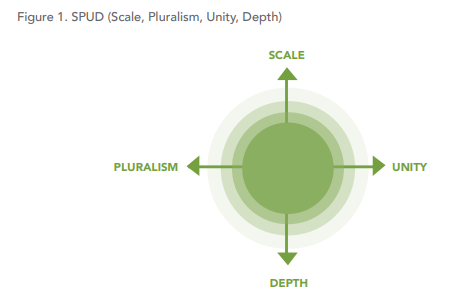
I also took the opportunity to put my SPUD framework in print again:

See also: the value of diversity and discussion within social movements; social movements of the sixties, seventies, and today; deliberation depends on social movements; a sketch of a theory of social movements; What is the appropriate role for higher education at a time of social activism?; pay attention to movements, not just activists and events; Habermas with a Whiff of Tear Gas: Nonviolent Campaigns and Deliberation in an Era of Authoritarianism; we need SPUD (scale, pluralism, unity, depth)

teaching about institutions, in a prison

The Tufts University Prison Initiative of the Tisch College of Civic Life (TUPIT) is my institution’s contribution to the national movement for prison education. Colleges and universities are offering classes, degree programs, and special events for people in prisons or for incarcerated people along with students who come from “outside.” Sometimes, corrections staff and scholars of criminal justice also participate in these programs as learners, educators, or both.

In the era of mass incarceration–and in the wake of massive cuts to prison education programs–these efforts are far too small to fill the need, but they offer valuable opportunities and potential models for broader reform. Some of my favorite colleagues are deeply involved in prison education, and that includes the Founding Director of TUPIT, Prof. Hilary Binda, and her colleagues here at Tufts.

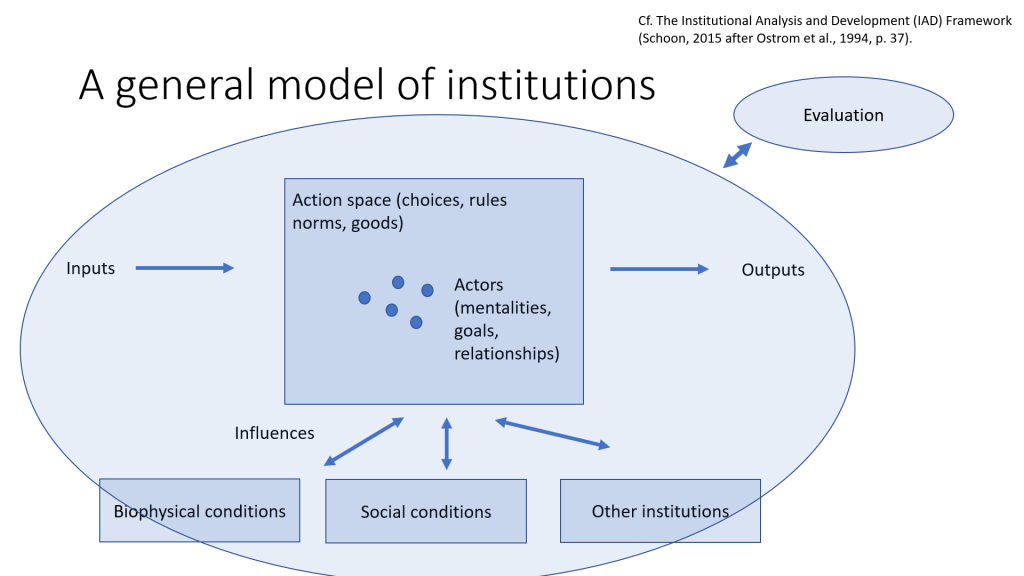
Thanks to TUPIT, I got to guest-teach a class at MCI-Concord last week. The class consisted of about 25 incarcerated men who are working on associates degrees. I presented my current working model for institutions, which I had also presented a few days earlier in the very different environment of a Tufts brown-bag series.

I told the students at MCI Concord that they should decide whether we’d focus on the prison as an institution, or spend more time on other examples. I’d say that we talked about prisons about half the time during the 2-hour conversation, but we also discussed families, gangs, schools, businesses, the foster-care system, and even biological systems such as forests. At least one student was interested in understanding the self as an “institution” that could fit the model. At Tufts, in contrast, the main institution that we’d discussed was “science”—mainly because that was the topic of the brown bag series in which I presented. Science and a prison make a pretty sharp contrast, but the model covers both.

For me, a goal was to test the validity of the model with this particular group. I think it largely passed muster, although many classes are too polite to share their reservations, and this was an exceptionally polite class, by any standard.

Certain aspects of the model seemed illuminating for at least some students. For example, the diagram shows a two-way arrow between biophysical conditions and the action space, which is composed of rules, norms, etc. Students at MCI-Concord generated the insight that the walls and barbed wire around the prison are biophysical conditions that both shape, and are shaped by, the rules and norms on the inside.

Among the interesting topics that arose was the distinction between a rule and a norm. Which is the right word for “Don’t snitch” within MCI-Concord? It is not an official rule; in fact, it violates the official rules. But it may be more than a norm, since it is enforced by the community, with clear consequences. Maybe it is a community-imposed rule.

I took one major challenge away from the conversation. The model that I presented is static or cross-sectional. It analyzes how an institution functions at a given time. The students wanted to know how people develop and change as they pass into, out of, and through multiple institutions. I suggested to them that they might be thinking that way because they’re taking a course that is all about personal transformation, but I also acknowledged that personal change is a concern for everyone, everywhere. So I came away feeling that the model of institutions should somehow connect to a model of personal development.

Finally, a word about the origins of this model. Where did I get this diagram, and why do I claim it might be valid? Essentially, it is my simplification of the Institutional Analysis and Design Model developed by Elinor Ostrom and her colleagues, which she presented in her Nobel Lecture. That is a pretty strong pedigree. I have simplified it in order to make it more general. The kinds of cases that Ostrom investigated are well modeled by game theory. They involve actors with fairly fixed goals who interact by bargaining. But human beings also interact in other kinds of situations, e.g., when we don’t know what we want and we are open to discussing it, or when our interests fuse due to very strong emotional attachments. My more general model is meant to cover bargaining situations, deliberative situations, loving relationships, and more. I am also interested in explicitly analyzing the role of power in institutions—not that Ostrom was blind to power, but I think she interpreted it too narrowly. I have claimed that power operates on every element of this model.

how to assess candidates in a presidential primary

Voters in a primary are a bit like members of a hiring committee. They have a batch of eager candidates and must choose one to represent their party and–they hope–hold the office.

I have served on dozens of hiring committees, including some for nonprofit CEOs and senior university administrators. Head-hunters give consistent advice about how to assess candidates. They advise committees not to ask how a candidate will or would address issues in the future. Candidates don’t really know, because their strategies will depend on the details of the issue and the other stakeholders’ actions. They almost inevitably give platitudinous responses: “I will bring people together, build consensus, and then move decisively.” “I will identify the ineffective programs and phase them out.” Such responses have zero informational and predictive value. Instead, committees should ask candidates how they actually addressed challenges in their previous work, and what they learned from that experience. This is more informative.

I don’t think that advice applies to voters in legislative elections. A legislator faces decisions about whether to vote yea or nay on bills. Newly elected legislators–back-benchers–do little else than vote yea or nay. It makes sense to ask legislative candidates (especially newcomers) how they would vote.

I realize that voters around the world are cynical about politicians’ promises. But I think cynicism should be reserved for their very general rhetoric about outcomes. “I will bring the country together” or “I will generate 5% growth” — these are promises waiting to be broken. (If they come to pass, it’s mostly good luck.) On the other hand, when candidates say, “I will support HR 1234,” that is quite predictive. It’s good to ask them how they will vote.

But presidents are more like CEOs than legislators. To be sure, they face decisions about whether to sign or veto bills, but those are rarely their decisive actions. Most of their impact results from hiring, firing, and guiding subordinates and jawboning all kinds of independent actors: 535 members of Congress, foreign heads of state, civil society actors and corporate leaders. (They also have the bully pulpit to address the nation, but the impact of that is somewhat overrated.)

We’d like to know how well they’ll do in those conversations and what their (precise) objectives will be. But what they say how they will deal with other people has limited value. It’s currently fashionable to place Democratic candidates on a scale from accommodating to tough, where the question is how they will handle their relationship with Republicans. I don’t think how they present themselves on the campaign trail predicts that very well at all.

Candidates should publish policy briefs, and we should read them. The main reason is that a campaign is a precious opportunity for a national debate about issues, influencing citizens’ knowledge and values. But policy briefs are not very informative about a candidate’s actual performance as president.

A brief may tell you something about the candidate’s goals and values. A Democratic candidate who says “Medicaid for all,” is conveying more progressive ideals that a candidate who asks, “How will we pay for that?” But an actual Democratic president will not choose between those two policy positions. She or he will: (1) choose one or two issues to emphasize at key moments, (2) deal with members of Congress across the spectrum about those issues and the many issues that arise for other reasons; and (3) decide whether to sign or veto the actual bills that emerge from Congress–if any do. Asking candidates how they will perform those tasks is not terribly informative, because the question yields platitudes of the form, “I will bring people together and move forward together” or “I will rally the troops and drive change through.” (Those sound different, but neither describes what they will actually do.)

The 2020 Democratic Primary has generated an especially large number of interesting policy proposals. The Warren campaign, in particular, has made a meta-issue of having detailed policy briefs. (“I have a plan for that.”) I like the message that Warren is detail-oriented and interested in policy, a major contrast to the incumbent and probably predictive of how she would govern. I like the ethic of presenting specific ideas to the voters: it takes people seriously as thinkers. I also think the policy debate among candidates may have some influence on other actors–Members of Congress, interest groups, and the public–which is beneficial. But I would still take the headhunters’ advice and focus more on how candidates have actually dealt with challenges than on what they say they would do if they were president.

Deliberative Democracy Consortium conference on whether deliberation is feasible

From this official registration page:

On October 30 and 31, the Deliberative Democracy Consortium is convening researchers, scholars, and deliberative democracy practitioners in Washington, D.C., to explore the intersection of deliberative democracy with human cognition, social and emotional intelligence, and moral decision making.

We will explore questions such as:

1) Given what we know about human cognition and moral development, is deliberative democracy feasible?

2) At what scale?

3) Under what conditions?

This meeting will give scholars, practitioners, funders, and others an opportunity to explore both the promise and the limitations of deliberative democracy in the context of human behavior and development. The meeting may result in an edited volume; future convenings; an action plan; a statement of shared values; promising partnerships; etc.

Agenda

Evening of Wednesday, October 30 – 5:00pm – Reception with no host bar and heavy hors d’oeuvres

Thursday, October 31 – 9:00am – 4:00pm – All day meeting – Continental breakfast (8:30am) and lunch included

I’ll be moderating a panel. Part of our session description (still under construction) says:

The traditional “civics class” description of democracy assumes that citizens reason independently about issues, listen to and learn from each other, and then select leaders or policies that represent their views. It is consistent with liberal democratic tenets of individual and minority rights, free speech and the rule of law. 

The Behavioral Revolution presents a very different premise: human beings are deeply biased, and the reasons we express are mainly justifications for opinions we already held without conscious choice. Meanwhile, New Institutionalism suggests that even when individuals reason well, the processes that yield decisions in groups add arbitrariness and bias. These are two of the most influential currents in the study of human beings, and both tend to support arguments for expertise and unregulated markets, technocracy, or authoritarianism. Specifically, right-wing authoritarian populism is on the rise.  …

How can deliberative democracy address these problems of citizen capacity and the consequent vulnerability of liberal democracy?

Please join us.