Civic Studies Major’s courses for fall 2020

This is an unofficial list of the courses that will count for Civic Studies at Tufts next fall. It is likely to change a bit at the margins but gives an insight into our curriculum.

Cluster: Civic Action and Social Movements
Children, Nature and the Development of Earth StewardsCVS 0032CHSD 0034-01George Scarlett
U.S. Elections: Rules, Strategies, and OutcomesCVS 0034PS 0112Eitan Hersh
Social PsychologyCVS 0035PSY 0013Som Sommers or Keith Maddox
Information, Technology, and Political PowerCVS 0036PS 0115Eitan Hersh
Families, Schools, and Child Development CVS 0132CSHD 165Christine McWayne
Topics in Economic Development CVS 0133ECON 0136-01Margaret McMillan
Organizing for Social Change CVS 0150-02PS 0118-02Daniel LeBlanc & Kenneth Galdston
Environmental Justice, Security, and Sustainability CVS 0174UEP 278Penn Loh
Cluster: Civic Skills
Education for Peace and Justice CVS 0041ED 0164Deborah Donahue-Keegan
Spanish in the CommunityCVS 0042SPN 0146Nancy Levy-Konesky
Science and Civic Action CVS 0050-03PJS 50Jonathan Garlick
Tisch Scholars Foundation A CVS 0083AGrace Talusan, Sara J. Allred
Tisch Scholars Fieldwork PracticumCVS 0084Sara J. Allred
Community Practice Theory and MethodsCVS 0141UEP 287Penn Loh
Introduction to Environmental FieldworkCVS 0145ENV 120John de la Parra, others
Mass Incarceration and the Literature of ConfinementCVS 0146AMER 0145Hilary Binda
Children and Mass Media CVS 0147CSHD 167Julie Dobrow
Environmental Data Analysis and VisualizationCVS 0149ENV 170Kyle Monahan
Philosophy for ChildrenCVS 0150-07PHIL 0091-02Susan Russinoff
Leadership in Civic ContextCVS 0170CSHD 143-02Diane Ryan
Negotiation, Mediation, and Conflict ResolutionCVS 0183UEP 0130Robert Burdick
Seminar In American Politics: Polling the 2020 ElectionCVS 0184PS 0119Brian Schaffner
Teaching DemocracyCVS 0251-01UEP 294-01Teaching Democracy
Communications and Media for Policy and PlanningCVS 0251-02UEP 294-02Penn Loh
Cluster: Social Conflict, Inequality, and Violence
War and Terrorism CVS 0015-01PHIL 0045-01Lionel McPherson
Sociology of ViolenceCVS 0022SOC 0075Brett Nava-Coulter
Intimate ViolenceCVS 0060SOC 0180Anjuli Fahlberg
Law, Religion and International Relations CVS 0124REL 08Joseph Walser
Democracy and Its Alternatives CVS 0134PS 138David Art
Cluster: Thinking about Justice
Critical Race TheoryCVS 0011ED 0167-01Shameka Powell
Western Political Thought CVS 0018PS 0041Ioannis Evrigenis
Political PhilosophyCVS 0150-03PHIL 191-03Erin Kelly
The Gap Between Law & JusticeCVS 0150-04UEP 0194Sonia Spears
Philosophy of LawCVS 0150-09PHIL 123-01Erin Kelly
InternshipCVS 0099Sherri Sklarwitz
Introduction to Civic StudiesCVS 0020PHIL 0020Peter Levine, Brian Schaffner

Tufts University’s Tisch College launches Center for State Policy Analysis

This new center is consistent with a recommendation in our report entitled MassForward: Advancing Democratic Innovation and Electoral Reform in Massachusetts.

From the official announcement:

MEDFORD/SOMERVILLEMass. (Feb. 13, 2020)–Tufts University’s Jonathan M. Tisch College of Civic Life today announced the creation of a new, non-partisan Center for State Policy Analysis (cSPA) to ensure that lawmakers and residents in Massachusetts have access to the best information on effective public policy.

cSPA will conduct detailed, independent analyses of current legislative issues and ballot questions in Massachusetts and will widely share this research with the public. The Center aims to partner with experts at Tufts University and beyond to provide real-time analysis that informs legislative debates and helps voters better understand the stakes of ballot initiatives.

Former Boston Globe data-journalist Evan Horowitz will serve as cSPA’s executive director, supported by an advisory council that includes:

  • Governor Jane Swift, president and executive director of LearnLaunch;
  • Governor Michael Dukakis, Distinguished Professor of Political Science at Northeastern University
  • Alan Solomont, dean of Tisch College;
  • Michael Widmer, former president of the Massachusetts Taxpayers Foundation;
  • Michael Curry, deputy CEO & general counsel at the Massachusetts League of Community Health Centers;
  • Katharine Craven, chief administrative officer at Babcock;
  • Ted Landsmark, director of the Dukakis Center at Northeastern;
  • David Cash, dean of the McCormack Graduate School at UMass Boston;
  • Carolyn Ryan, senior vice president for Policy and Research, Greater Boston Chamber of Commerce; and
  • Kate Dineen, executive vice president, A Better City.

“With a history of policy leadership, and facing gridlock in Washington, Massachusetts has the opportunity to take the lead on issues like climate justice, transportation investment and healthcare,” said Alan Solomont, ambassador (ret.) and dean of the Tisch College of Civic Life. “Given our mission to study and strengthen civic life, and to promote the power of people and communities to bring about change, Tisch College is proud to host and support this nonpartisan center that can help lawmakers and citizens better understand policy issues and identify solutions.”

Working with academics and policy experts at Tufts and beyond, cSPA will produce leading research on key issues in Massachusetts political and civic life, including assessments of the economic, environmental, geographic, budgetary and equity implications of pending legislation and ballot initiatives.

“Having spent time in academia, at think tanks, and in journalism, I think there’s a real opportunity to start bridging these worlds—producing relevant, rigorous, readable research on a timeframe that works for policymakers,” said Horowitz. “Massachusetts is the perfect place to begin. The commonwealth has the richest collection of academic expertise in the world and a long history of pushing the bounds on policy innovation, from 17th-century public schools to 21st-century healthcare reform.”

In the coming months, cSPA plans to release:

  • An analysis of the Transportation Climate Initiative, which would establish a regional cap-and-trade system for gasoline;
  • A review of the options—and trade-offs—for addressing rising prescription drug costs; and
  • Research on the projected impact of the fall 2020 ballot questions, potentially including right to repair, expanded sales of beer and wine in food stores, and ranked-choice voting.

discussing school choice

In my public policy course, we are discussing school choice as an opportunity for exploring theoretical issues (What is a market versus a state? What is a public good versus a private good?); empirical questions (What happens when you implement various systems of choice? How should we measure the outcomes?), and normative principles (What counts as an acceptable outcome, or an ideal outcome?) Most policy questions involve a combination of mandates and choice, or choices structured and constrained by laws. School choice is therefore exemplary of broader issues.

Some quick notes from the readings so far:

1. Chubb, John E., and Terry M. Moe. America’s public schools: Choice is a panacea. The Brookings Review 8.3 (1990): 4-12.

This is a classic (1990) manifesto for the modern school choice movement. It presents a radical proposal, and is therefore not based on data or experience from the past. The main argument is theoretical, applying a certain strand of public choice theory. The authors argue that if you favor any particular approach to education, there is little point in advocating it to government-run schools, which work in the interests of government officials. The only reform that can succeed is to make schools accountable to parents, who will then demand the education they want–squeezing out bad practices and supporting a diverse array of schools that meet their diverse preferences. Note, however, that in their proposal, the government remains the funder of education, which is therefore as much a public good as Medicare is, or schooling in a country like the Netherlands that uses vouchers. Bernie Sanders’ college proposal is like theirs for k-12 schooling.

2. Sigal R. Ben-Porath and Michael C. Johanek, Making Up Our Mind: What School Choice is Really About

Johanek contributes a chapter on the history of how American kids have chosen, or been placed in, particular schools since colonial days. Ben-Porath presents and analyzes the main conflicting principles of justice that arise when we consider who should attend which schools, and who should decide. It’s a complex and wide-ranging book, but if I had to derive one summary statement, this would be it: We do not face a decision about whether or not to implement “school choice.” Which school you attend is inevitably a function of choice under constraints. The appropriate question is: Who should choose among which options for whom, and how?

3. Robert Pondiscio, How the Other Half Learns: Equality, Excellence, and the Battle Over School Choice (2019)

Pondiscio embeds himself in a school within the controversial charter network called Success Academy. He has written a nuanced and beautifully reported account that eludes easy categorization. But again, if I had to summarize it, I’d say something like this: Success Academy actually works extraordinarily well for the goals that its parents and teachers sincerely value–best defined not as high test scores but as winning a competition that they consider worthy. The school works because the parents and teachers share these goals, and both sacrifice to make it succeed. Although the parents are diverse individuals, a common profile is a culturally conservative working-class family of color that values discipline and is especially concerned about the variety of racism that manifests as low expectations. These families often thrive at Success Academy and have a right to the choice that it offers. But the model wouldn’t scale very far, because it depends on the specific value commitments and capacities of its parents and teachers.

4. Abdulkadiroglu, A., Angrist, J., Dynarski, S., Kane, T., & Pathak, P. (2011). Accountability and flexibility in public schools: Evidence from Boston’s charters and pilots. The Quarterly Journal of Economics 126(2), 699-748. 

This is a quantitative study that claims to measure causation, whereas Pondicio’s book is a qualitative study that offers a perspective on what it’s like to be inside one school. (We need both methods.) According to this paper, being randomly selected to attend and then actually attending a Boston charter school is associated with higher test scores regardless of other factors. However, random admission to a Boston “pilot” school is not associated with higher scores. Both charters and pilots are choice schools that use lotteries to admit students. The main difference is that the pilot schools come under the standard union contract, while the charters do not. The charter schools have smaller classes and longer hours, probably because they pay their non-unionized teachers less/hour. A reader could conclude that unions are the problem–or that spending more money on unionized teachers would allow regular schools to equal charters. It is also worth considering whether the measured outcomes (test scores) are what we should value.

5. Meira Levinson, “Is Pandering Ethical? Power, Privilege, and School Assignment”

Levinson describes the relatively new Boston Public School (BPS) assignment plan. Every child is assigned a basket of schools that includes all the local ones plus an equal mix of good, medium, and bad schools (as measured by scores) from across the city. Parents rank their preferences, and competing choices are randomly settled by an algorithm.

Putting distant schools in every student’s basket improves equity, because poor neighborhoods have worse-scoring schools. If every child had an equal chance of attending any BPS school across town, that would maximize equity, but it would sacrifice convenience and neighborhood schools. It would also alienate a set of middle class parents who believe in equity and diversity, do not argue that they deserve better schools, but would leave BPS if their kids were assigned to “bad” schools. If they stay in BPS, they improve it.

What to do about these families? Levinson says it’s not a matter of compromising, because they don’t claim a right that needs to be balanced against other parents’ claims. It’s not a question of coercing them, because they can leave. She thinks “pandering” is the best description, and it may be ethically obligatory to pander given unjust social contexts.

how many foundings has the US had?

Here are six answers to the question in my heading. Arguments can be made in favor of each.

  1. The founding took place from 1776-1789, from the Declaration to the Constitution. Although the architects of the new republic sought to recycle some existing materials, they drew a new blueprint for the base on which our system stands. It was designed to be alterable–and it has been altered–but the foundation is still recognizable.
  2. The foundation was poured in 1492 and 1619. Once Europeans began seizing land from indigenous people and importing enslaved Africans to work that land for them, the basic arrangement was set. The 1788 Constitution essentially preserved that structure. Some better things have been built on top of it, but the original floor is still down there, not far below the surface and determining what can be constructed above.
  3. The social contract has been renegotiated at several key points: 1776 (Declaration), 1781 (Articles of Confederation), 1788-9 (Constitution), 1864-5 (post-Civil War amendments), 1938-45 (the Supreme Court reverses itself and allows the welfare state), 1954 (Brown v Board), and arguably again since the 1980s. These shifts are fairly fundamental and not well described by treating the 1788-9 contract as still foundational. The 21st-century political system is incompatible with the Framers’ plan, but that is because we have chosen to lay new foundations.
  4. The United States was founded in 1788-9. In the 1900s, we ignored some of its basic principles, such as the list of enumerated powers, without explicitly and legitimately renegotiating them. The foundation is still in place, but we have built unsound structures on top of or beyond it. The Constitution is “in exile” (a phrase apparently more used by critics of this view than proponents of it).
  5. The actual political-economic system in which we live is fundamentally based on publicly traded corporations, industrial production, organized labor, regulatory agencies, credentialed professions, public and private bureaucracies, mass media, mass schooling, securities markets, electronic networks, science (as a set of powerful institutions), databases of people and objects, and a permanent war machine. These elements are not envisioned in the US Constitution, which influences them somewhat but hardly determines them. The same basic structure is evident, for example, in Canada. The modern foundation has been poured one layer at a time, but if you had to pick a symbolic date for this option, it might be 1908, when the first Model T rolled off the assembly line.
  6. There is no foundation. A society is not well understood as a base and superstructure or as a single game with basic rules. It’s a complex, emergent system best understood as whole series of overlapping and interacting institutions, each with rules of its own that affect the other institutions’ rules. All is flux.

I realize that most people don’t explicitly discuss this question, yet I think that today’s opposing ideological camps would each answer it differently. It could even serve as an ideological Rorschach Test.

See also: constitutional piety; the Citizens United decision and the inadequate sociology of the US Constitution; the role of political science in civic education; polycentricity: the case for a (very) mixed economy.

youth in the Iowa caucuses

Posted just now by CIRCLE:

Young people had an extraordinary impact on the first-in-the-nation Iowa caucuses, representing a higher share of the overall vote than in previous caucuses and propelling Sen. Bernie Sanders to one of the top spots, according to a youth turnout analysis released by researchers from the Center for Information & Research on Civic Learning and Engagement (CIRCLE)—the preeminent, non-partisan research center on youth engagement at Tufts University’s Jonathan M. Tisch College of Civic Life.

Young people (ages 17-29) turned out at an estimated rate of 8% and made up a 24% share of all caucusgoers, the highest youth share since CIRCLE has been tracking Iowa entrance polls.

Young people strongly backed Sen. Bernie Sanders (48%), followed by former Mayor Pete Buttigieg (19%) and Sen. Elizabeth Warren (12%). 

Midlife

The young speak to say something, to make a name.
The old repeat to hold themselves the same.
Midlife is for any age, a state of mind.
It’s saying what you think you’d better say,
Like it or not, because the words, not you,
Might budge some dense thing in someone’s way
(Although by speaking you are using time,
That dwindling light, that sinking sun).
Your words are not true, not original,
Not worth repeating, especially by you;
They have their purpose, they take their turn.
Midlife is the breadwinner, the driver,
The gentle nudge and the picture-taker.
Tender to those who speak to speak, and those
Who sing one more time what they fear to lose.

See also: youth, midlife & old-age as states of mind; echoes.

inequality in India and the UK, 1930 and today

(Baton Rouge, LA) In 1930, Gandhi wrote to the Viceroy of India–one of innumerable such letters. His thesis: British rule in India was a “curse.” Among his complaints: the Viceroy was paid five thousand times as much as the average Indian, whereas the British Prime Minister was paid only 90 times as much as the average Briton. Gandhi didn’t quite spell it out, but I think he implied that a government that depends on the consent of the governed will not overpay its leaders, but an empire may.

Today, India has a Prime Minister of its own. His official governmental salary is about US $26,400 per year, which is about 414 times the median income of his countrymen ($616/year).* That ratio is less than a tenth of the ratio in 1930. As Gandhi would have predicted, democratic India pays its leader much less than imperial Britain did, at least in comparison to ordinary incomes.

PM Modi declares assets of about US $350,000, but I have no idea whether such disclosures are credible. Of course, his office comes with many perks–not only the usual ones (official residences, travel, etc.), but also things like free tolls on all national highways.

Gandhi didn’t calculate the ratio between the UK Prime Minister’s salary and the average Indian salary in his time, but based on his numbers, I think it was 640-t0-one. Today, the UK Prime Minister is paid just under US $200,000 per year. That is about five times the mean individual salary in the UK, 100 times the mean income in India, and 7.5 times the salary of his Indian counterpart. The first two ratios represent a considerable improvement in equity compared to 1930. Still, the PM’s salary (by itself) would put him in the top 1% in Britain. Boris Johnson is reported to hold assets of about $2 million. And he has a nice free house in Downing Street.

If someone today were paid 5,000 times as much as a median Indian, as the Viceroy was in 1930, that would translate to about US $3 million in annual income. That would be much higher than any government salary but far lower than the highest salaries in India’s private sector. Bollywood actor Akshay Kumar earned US $65 million last year. That is 105,000 times the median income. Mukesh Ambani, who leads Reliance Industries, has an estimated net worth of $58.4 billion.

What do these changes suggest? First, democratic and independent nations do put downward pressure on the salaries of their leaders. In fact, US $200,000 is a modest salary for the leader of the whole British Government, if one compares it to CEOs’ salaries in the private sector. However, democracies still tolerate large gaps between the pay of their political leaders and average people–perhaps wisely, to attract talent to the government. And they offer sometimes surprising perks that are not only valuable in market terms but also symbolically distance leaders from citizens. (Every Indian toll booth announces that the top officers of the national government can drive through for free.)

Meanwhile, independent democratic nations are currently tolerating enormous gaps between the average income and the highest salaries in their private sectors.

*The mean income in India is $2,016. I find that number less meaningful, but Gandhi may have been using the mean in 1930.

See also defining equity and equality; the remarkable persistence of social advantage; why some forms of advantage are more stubborn than others; and notes from India

where to focus your political energies

Everyone should read Politics Is for Power: How to Move Beyond Political Hobbyism, Take Action, and Make Real Change by my friend and colleague Eitan Hersh. It is a gentle and disarming critique of how many of us spend our time and energy as citizens. It comes with valuable suggestions for how to improve our impact. Read the whole thing, but for a teaser, see Eitan’s recent New York Times op-ed, “Listen Up, Liberals: You Aren’t Doing Politics Right” (subtitled “Politics is about getting power to enact an agenda. And the only way to do that is face-to-face organizing.”)

My response is to audit my own political activity to select work that meets these criteria: 1) The issues and problems are important. 2) I might be able to shift some people’s opinions or behavior by expressing my views to individuals who trust–or could trust–me. And 3) These people have–or could have–influence over decisions, e.g., by voting in an actually contested upcoming election, by changing their own organizations, by building new organizations, or in other ways.

Using those criteria, here are some possible foci for my own attention, ranked from most valuable (#1) to least worthy (#7). Your list will be different, because everyone has a unique set of assets and opportunities.

  1. Advocate for changes in the state and local policies and the available materials for civic education in US schools. This is not the world’s most important issue. (It isn’t the earth’s climate.) But I have been paid to work on it for decades and have some comparative advantages in terms of credibility, information, access, and networks. Then again, I must be careful not to be satisfied with working on this issue, for which I am paid and assessed. I should also be engaged on other issues in my own time.
  2. Advocate for affordable housing in Cambridge, MA, where I live. Dense and affordable housing in a city with excellent public schools would be good for the climate and for racial and economic justice. Housing is a salient and contested issue in our city. Most neighbors believe in affordable housing abstractly, but the proposed policies are deeply contested. I hold views on the matter, and if I invested my time, I might be able to make persuasive arguments to undecided voters within my own networks of trust, and expand those networks.
  3. Form relationships and exchange ideas with people in one or more other countries, especially countries that do not get a huge amount of attention in the US and about which I might have some direct knowledge. Even though the geographical scale is large, people can increase the odds of peace and understanding through informal diplomacy and by educating their own fellow citizens back home.
  4. Advocate for policies within Tufts, where I work. I do this every week while sitting in committee meetings or sending emails. Sometimes, the issues are significant. I have an increment of influence here. But I also face both practical and ethical limitations as a middle-manager. There are issues on which it is appropriate and important for me to advocate, and others that really aren’t in my domain. Drawing that line can be an ethical challenge for anyone who works within a Weberian organization.
  5. Advocate specific policies to presidential primary candidates and legislators. I am not going to accomplish anything by taking a stand on the major policy issues of the day, such as single-payer healthcare or Iran. But there are specific issues on which I might have some special expertise and credibility and an ability to be mildly influential. For example, I believe that a Green New Deal (of any scale) must incorporate citizen participation in order to be effective. This is something I could advocate.
  6. Take and express a view on the Democratic presidential primary candidates. Millions of others are also doing that, and almost every point that could be made has been made. Still, my social network includes a wide distribution of Democratic primary voters, from strong Democratic Socialists to committed centrists, and I suppose I might shift someone’s view by making a good point. (The reason I haven’t done this yet is that I am deeply torn and don’t know where I stand. Maybe I should just figure that out for myself and quietly cast my secret ballot on March 3.)
  7. Take and express a position on the impeachment of Donald J. Trump. The decision-makers are the members of the US Senate. My senators (Warren and Markey) are 100% likely to convict. Approximately 1 bazillion words have already been said or written about this topic. Among those words are many annoying ones that I could criticize all day. But everyone I know has already made up their minds. I have no special expertise, influence, or leverage. This is one of those bright, shiny objects that lures my attention and distracts me from actually improving the world.

what kind of a good is education?

In Making Up Our Mind: What School Choice is Really About (University of Chicago Press, 2019), Sigal R. Ben-Porath and Michael C. Johanek write that education is a private good, a public good, and a positional good. These concepts are worth unpacking because they are central to debates in education policy, and policy more generally.

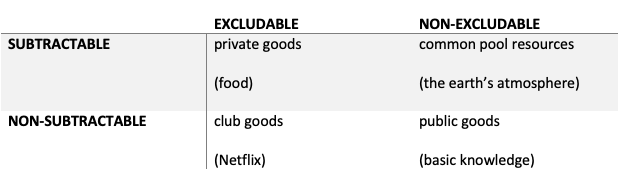
Elinor Ostrom argued that pure public goods meet two criteria: they are non-excludable and non-subtractable. The former means that it is practically impossible (regardless of your goals) to keep people from benefitting from the good. The latter means that using some of the good does not use it up; the same amount is left for others.

A classic example of a public good is national defense: if the US maintains a military deterrent against foreign invasion, then everyone in the US benefits, and my security does not detract from yours. Another example is any basic discovery about nature. As Jefferson wrote: “He who receives an idea from me, receives instruction himself without lessening mine; as he who lights his taper at mine, receives light without darkening me.”

For Ostrom, a pure private good meets the opposite criteria: it is excludable and subtractable. For instance, a bowl of rice can (practically speaking) be reserved for one person, and if that person eats a bite of it, less rice is left. Even if I leave it in the lunchroom for anyone to take, it is still a private good because I could have excluded it and subtracted from it.

This twofold distinction permits goods that are neither public nor private. Some goods are excludable but non-subtractable. An example would be Netflix: the company can keep you out unless you pay, but one person’s use (hardly) subtracts from anyone else’s. These are called “club goods.”

And some goods are subtractable but non-excludable. For instance, the fish in the ocean are definitely subtractable: over-fishing can wipe them out. But it is practically very difficult and expensive to block individuals from fishing. An even more important case is the earth’s capacity for absorbing carbon. It is subtractable but non-excludable. These are called “common pool resources.”

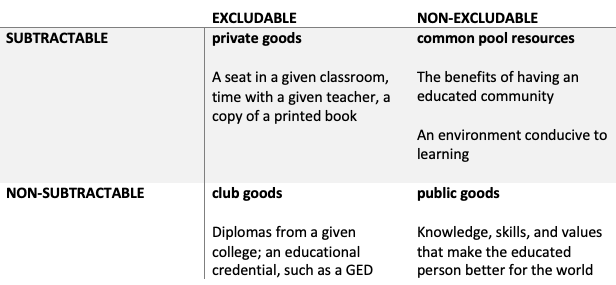
Using Ostrom’s four-way distinction, what kind of a good is education? This is a complicated question, because education involves a range of inputs, outputs, and contextual factors. Many are neither purely subtractable nor non-subtractable. For instance, adding another student to Tufts’ enrollment doesn’t really subtract from anyone’s experience or the value of Tufts diploma, but adding 10,000 students would. Spaces at Tufts are somewhat subtractable and completely excludable. We offer something between a club good and a private good.

As a rough guide, here are some preliminary categorizations of some (not all) educational goods.

Ostrom’s framework is meant to be exhaustive, and I believe it is. But you can also tag specific goods with additional labels:

A positional good: This is a good whose value is relative to the value of other people’s goods of the same kind. For instance, if one candidate for a job holds a BA, and all the other candidates hold Associates Degrees, the college grad has an advantage that is a positional good. In a competition with MAs, the same person would have a positional disadvantage. Positional goods must be excludable but may not be completely subtractable. (My holding a BA does not reduce the supply of BAs). These are often club goods.

A luxury or “Veblen” goods: These are goods for which the demand increases as the price rises. People sometimes want things because they are expensive–consumer brands are examples. Admission to US private universities may be a Veblen good, although that’s a critical claim. It’s certainly the case that colleges are more desirable the more selective they are, and if you consider the “price” of admission to be tuition plus the applicant’s accomplishments, then college is a classic Veblen good. Most students want to attend colleges that are harder to get into.

What to make of these distinctions depends on your ideological positioning. I start with the stereotypical liberal stance, but I am uncertain about it and interested in shifting. That position says that education is importantly but not exclusively a public good because of the words in the bottom-right square (above). Insofar as it’s also a private good, we don’t want to leave markets to generate it all by themselves, because some families won’t be able to afford it and disparities will create problematic positional goods. Yet education is, in part, a private good, and we wouldn’t be able to generate it without some involvement by markets.

Martin Luther and Martin Luther King

In my course on the thought of Martin Luther King, as we explore various influences on MLK, we are spending some time on the influence of Protestant theology, and specifically, the debates within American Lutheranism that King encountered when he attended Crozer Theological Seminary and then BU’s School of Theology.

One motivation for assigning Walter Rauschenbusch, Reinhold Niebuhr, and Howard Thurman–along with Martin Buber and some excerpts from the Bible–is to help us understand how King thought. In other words, there is a biographical reason to read these works. But I also believe that it’s our obligation to try to understand justice and injustice, and we inevitably do so by working critically and creatively with the materials we inherit. For Christians, those materials include the highly heterogeneous inheritance of scripture and doctrine, from which many ideas can be made. So, although I am secular, I find it useful to watch Christian theologians work with those inherited materials, and their insights often translate.

One topic for theology in any of the Abrahamic faiths is: Why is there evil in a world created by an omnipotent and omniscient God? And what is the solution to this evil?

For MLK, the specific versions of these questions are: Why does racism (and poverty, and war) exist? What is the solution? Note that it’s a choice to use religious terms like “sin,” and it’s worth thinking about whether these words can and should be translated into secular terms, such as “inequity.”

Howard Thurman puts the question more forcefully (Jesus and the Disinherited, p. 7): “Why is it that Christianity seems impotent to deal radically, and therefore effectively, with the issues of discrimination and injustice on the basis of race, religion and national origin?” Is this impotence intrinsic to Christianity or a betrayal of it?

In the background is Martin Luther’s view that we all sin. (Even if you didn’t commit any sinful acts, you would have sinful thoughts and sins of omission). No one merits salvation. Salvation is by grace, through Jesus Christ, and enabled by “faith alone.” This faith is individual: an inner state. There is no solution to sin in this world, although you will not intentionally and grievously sin if you are faithful.

Translated into politics, this doctrine can promote acceptance of injustice in this world and an emphasis on individual faith, although Protestant thinkers have not all reached such conclusions.

Walter Rauschenbusch (1861–1918) preached “The Social Gospel.” For him, sin has a social cause; it’s not just individual. In Theology for the Social Gospel, p. 60, he writes, “sin is transmitted along the lines of social tradition.” “Sin is lodged in social customs and institutions.” An explicit example (p. 79) is racism, which doesn’t come naturally but is “lodged” in customs.

For instance, to steal is to break the Seventh Commandment. But people steal because of private property, scarcity, and inequality. The cause is root is “profitability.” With alcoholism and militarism, the mechanism is social authority, which explicitly favors wine and war (pp. 63-5).

The solution is social reform. Social reform can be fully successful on earth. At a minimum, Rauschenbusch endorses “the feasibility of a fairly righteous and fraternal social order” (p. 102)

The Christian Bible is compatible with this view. To put it bluntly, Jesus wants social reform. Individual salvation and conversion really mean social commitment (p. 98). Faith really means hope in social change and a commitment to work for it (p. 101). Sanctification is accomplished by cooperative work. And prayer has pragmatic value. God is a real interlocutor, but the reason to pray is to receive divine encouragement for social work (p. 105)    

Reinhold Niebuhr (1892–1971) distinguishes moral “man” (we could say, “individuals”) from immoral society. This is a way of finding both good and evil in the created world.

Individuals can strive for unselfishness, and this is a valid ideal for us as individuals. Selflessness is an intrinsic goal. For instance (per Moral Man and Immoral Society, p. 263), Jesus doesn’t command us to forgive our enemies as a strategy for social change but as “an effort to approximate complete moral perfection, the perfection of God.”

If individuals would all be altruistic, society would not have to coerce and punish. There would be no need for law. And when human relations are “intimate,” love can generate justice (p. 266)

But individuals will never all be altruistic at large scales, so we need coercion: law, power, and conflict. (This is a version of original sin.)

Whereas people should strive to be unselfish, laws must be made just. Justice and altruism fit together uncomfortably. The tension is permanent. But we need both.

Specifically, African Americans have been patient and peaceful, but this has not accomplished justice (p. 268). One specific problem has been the temptation of privileged minorities of Blacks to defect to the dominant group (p. 274).  Pacifism is “altogether unrealistic” (p. 269) and selfishness is inevitable (p. 272). Thinking that society can be made moral encourages fanaticism (p. 277).

But that doesn’t make Niebuhr a hard-nosed realist. He argues that a society needs people who strive for individual goodness. Retaining the inner ideal of unselfishness is “not a luxury but a necessity of the soul.” (p. 277)

Howard Washington Thurman (1899 – 1981) begins by noting that there are many sermons about the Christian obligations of the rich. But what does Christianity say to the oppressed?

God could have taken any human form to save the earth. God chose to be a poor Jew during the Roman Empire, a member of a “minority” (p. 17). Jesus was someone without legal privileges (p. 33) Why did God choose this vessel?

Because Jews were persecuted. Jesus’ sacrifice was not only a death that was an opportunity for a miracle; it was specifically a political persecution. Jesus was unjustly executed by the state because he was poor and a member of a minority group. He preached to the disinherited, not to the powerful.

Jesus’ lot is “the position of the disinherited of every age … This is the question of the Negro in American life.” (p. 23). Thurman explores the “striking similarity” of ancient Jews to modern Blacks (p. 34)

Anyone who is disinherited faces these four choices:

  1. Nonresistance > Imitation (the path of Herod and the Sadducees)
  2. Nonresistance > Separatism (the Pharisees)
  3. Resistance > Armed (the Zealots)
  4. Resistance > Nonviolence (Jesus) “a technique of survival for the oppressed” p. 29

Hence Jesus and God stand with the disinherited. As in the title of Thurman’s early article: “Good news for the disinherited.”

These are some of the materials from which the young Martin Luther began to stitch his own cloth.

See also: the I and the we: civic insights from Christian theology; notes on the metaphysics of Gandhi and King; how to think about the self (Buddhist and Kantian perspectives); and the kind of sacrifice required in nonviolence.