ideologies and complex systems

A recent paper entitled “A Complex Systems Approach to the Study of Ideology”* presents a theory much like the one I have begun to develop in a series of posts on this blog and other work.

The authors write,

If we construe ideologies as complex systems, we have (at least) two levels of systems embedded in each other. At the individual level, the elements are ideas, beliefs, and values, whose interactions give rise to a person’s understanding of society, which in turn guides individual political behavior. At the group level, the elements are individual minds whose interactions give rise to discourses and power dynamics, which in turn guide collective action and societal change. We thus conceive of an ideological system as a network of minds, where minds are networks of concepts.

Fig 1 illustrates their model. Compare a diagram of the ideas held by my undergraduate class some years ago (with each student’s ideas in a different color):
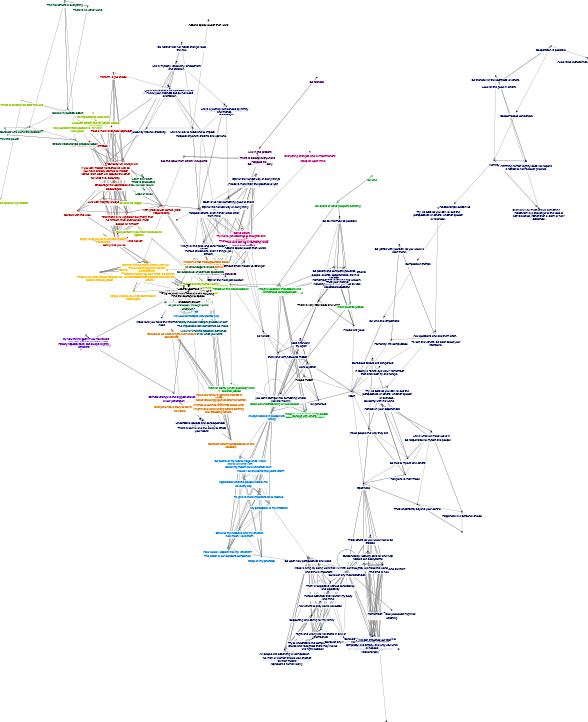
The authors of “A Complex Systems Approach” also diagram the ideology of the Tea Party Movement, using the qualitative analysis in a well-known article by Vanessa Williamson, Theda Skocpol, and John Coggin as their material.

Their diagram of the Tea Party is not heavily documented, but it demonstrates a payoff of their method. A paradox about the Tea Party is that they were powerful opponents of Obamacare yet passionate defenders of Medicare. The authors of “A Complex Systems Approach” explain this pattern by arguing that “representations of social programs are connected on one hand with representations of the self as a hard worker contributing to society and, hence, deserving of the government check …, but on other hand with the highly negative representations of government, spending, and taxation common to conservative ideologies.”

Each idea and link in the Tea Party ideology is consistent enough in its own way, and the overall system generates a combination of policy positions that only seem inconsistent if you try to place the whole ideology on one linear spectrum from pro- to anti-welfare. As a network of ideas, the ideology is as well structured as many others are. This is not an endorsement, since some of the specific nodes in the Tea Party’s network are objectionable by my lights. But a complex systems model offers a more refined analysis.

The word “complex” is used loosely and in various ways, but the authors of “A Complex Systems Approach” mean systems that exhibit “emergence, nonlinearity (disproportionality of cause and effect), path dependency, and multiple equilibria.” In the Tea Party ideology, for example, resentment of groups perceived as undeserving (which, in turn, is a racialized perception) has a powerful effect because of its location in the whole network. The Tea Party can land in several places (libertarian or #MAGA) that reflect multiple equilibria.

I find it intuitive that our ideas are structured and that the structures matter apart from the lists of individual ideas we hold. I acknowledge that we are not necessarily conscious of the whole structures of our own thought. Self-consciousness requires critical introspection and/or interaction with other people, and it is always partial.

However, I do believe we are conscious of portions of the network at any given time–not just the individual ideas, but the connections among them. Much of our discourse is about mini-structures of ideas, e.g., “I think this because of that.” Methods that reveal structures of ideas and links are alternatives to the family of methodologies that use latent variables to “explain” lists of specific beliefs, as in Moral Foundations Theory. I believe that such methods assume rather than demonstrate that human beings are driven by a few unconscious psychological traits. Although such explanations offer some insight, they should be combined with methods that allow us to see how people and groups build more complex structures. This is why I am excited to see this new paper and the work that underlies it.

* Homer-Dixon, Thomas, Jonathan Leader Maynard, Matto Mildenberger, Manjana Milkoreit, Steven J. Mock, Stephen Quilley, Tobias Schröder, & Paul Thagard. “A Complex Systems Approach to the Study of Ideology: Cognitive-Affective Structures and the Dynamics of Belief Systems.” Journal of Social and Political Psychology [Online], 1.1 (2013): 337-363. Web. 4 May. 2020. I had been previously influenced by Thagard’s work although I have not made the detailed study of it that it deserves.

See also: judgment in a world of power and institutions: outline of a view; from I to we: an outline of a theory; an alternative to Moral Foundations Theory; etc. `

this year, last year

One year ago, I posted this:

Most trees have leafed out for two or three days.
Each leaf unfolding in place to fill its space, green;
But the trees that flowered are wilting now,
Bold blooms shrinking to leave more space between,
Dwindling to stipples along each bough.
Superimposed: a lacy screen, damascened,
Patches on a slate background--the dripping sky--
Grey except at some hidden place where a break
Must let the sun flood up to certain high
Shingles, a wire, a spire that's a streak
Of brilliant white. All silent, a still sheen,
Sheer, stretched thin to fade or end in a blaze.

It was a different time. Also a different place: I wrote it in our usual home in Cambridge, MA, but we have been sheltering for weeks in West Tisbury on Martha’s Vineyard.

I will say one thing for the poem: it is precisely described. “Wire” and “spire” are convenient rhymes, and they probably look forced, but I actually watched the slender white spire of Memorial Church and a telephone wire, both lit from below by a band of setting sun breaking through low clouds.

(Other poems on this site.)

A COVID-19 survey for teenagers

I am sharing this survey invitation by request and would encourage you to send it to middle-school or high-school students you know, including those in schools or programs where you work (if their own policies allow).

I would like to invite you to participate in a survey on how adolescents are understanding and processing what COVID-19 means to humanity and their societies, as well as thinking about themselves, their societies, and their future trajectories and opportunities during the COVID-19 global crisis. I want to know more about your perspective on what is going on, and your participation is valuable to helping better understand what impacts the changes related to COVID-19 have on young people.

The study is being conducted by myself, Gabriel Velez, with the approval of the Marquette University Institutional Review Board. You are eligible to participate in this study because you are a middle or high school student.

If you decide to participate in this study, you will be asked to complete an online survey of approximately 20 to 30 minutes. Your answers will be recorded, but they will only be connected to your name if you provide us with your name to be contacted for a follow up survey. Your responses will not be shared with your school. At the end of the survey, we will ask for your email address if you are willing to participate in a follow up interview with a researcher.

In order to participate in this survey, you will have to give your informed consent. If you are under 18 years old, you will also need your parents to indicate that they give you permission to participate. When you click the link to the survey, the first page will be for you to read and agree to. The second page will then be for your caregiver, and they should read it over and click that they give permission for you to participate.

To access the online survey and participate, please click this link:
https://marquette.az1.qualtrics.com/jfe/form/SV_e52JGB5TPllRpSB

Remember, this is completely voluntary. Your decision to participate or not will not be known by anyone at your school or affect your relationship with your school or with any school personnel.

You can choose to be in the study or not. If you’d like to participate or have any questions about the study, please email Gabriel Velez (Gabriel.velez@marquette.edu).

Thank you very much. Sincerely,
Gabriel Velez
Marquette University College of Education

money should flow from New York to Florida

This is just a salvo in the current debate about whether the feds should send money to states:

“It’s not fair to the taxpayers of Florida. We sit here, we live within our means, and then New York, Illinois, California and other states don’t. And we’re supposed to go bail them out? That’s not right,” GOP Sen. Rick Scott tells poolers of sending more money to states— Burgess Everett (@burgessev) April 27, 2020

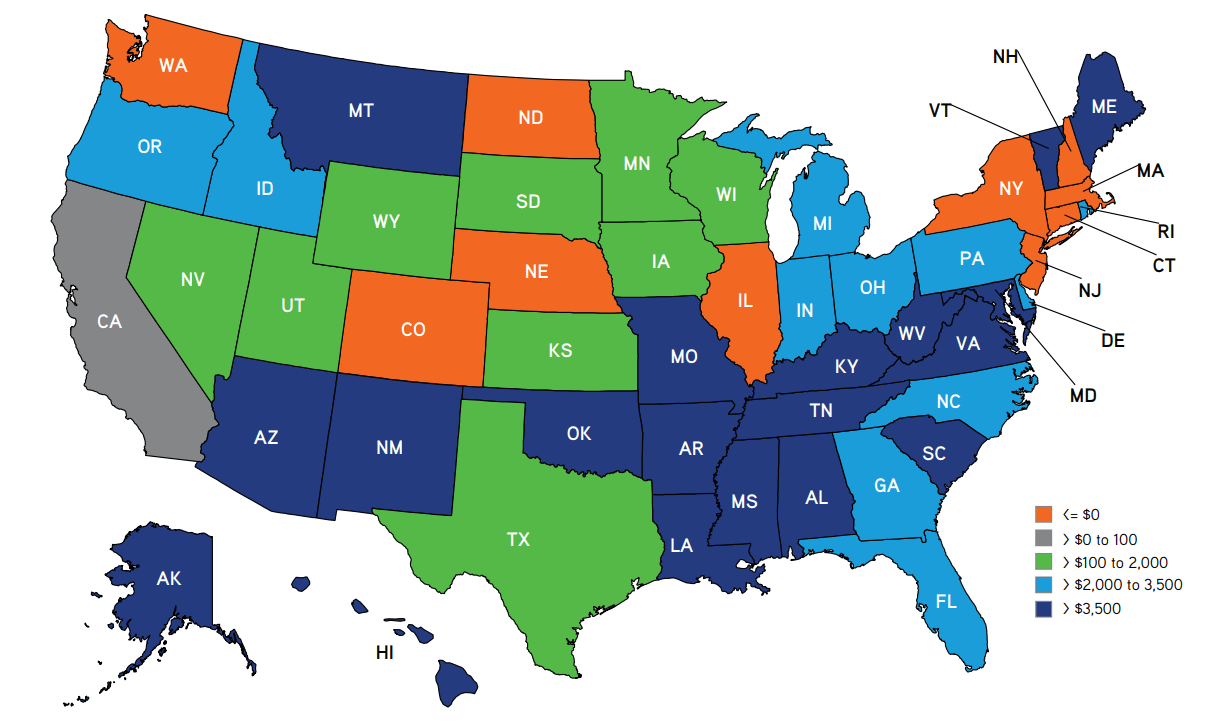
The Rockefeller Institute calculates the net flow of money from state to state on a per capita basis. Note that net money flows from New York and Illinois (although not actually from California) toward Sen. Scott’s Florida (h/t Jonathan Cohn).

But this is as it should be. The progressive position should be that people in the band of states from Pennsylvania to Arizona deserve support from states like New York, Massachusetts, and New Jersey. It is not a matter of noblesse oblige or the kindness of Yankees. Wealth is concentrated in places like Manhattan and Boston. These places are home to many rich individuals and concentrations of organized capital. Progressives believe that concentrated capital is problematic. At a minimum, it distorts power. At the worst, it is exploitative, expanding at the expense of people in Alabama or New Mexico. People in those states have a right to a larger share of the national wealth.

It’s OK to make fun of conservative politicians from recipient states who won’t acknowledge that they benefit from federal redistribution.

It’s important to think about why people in recipient states often vote against redistribution while people from supplier states may vote for it.

There is also a troubling paradox that the political party that is at least mildly more favorable to redistribution draws so much of its votes from states that lose out from redistribution. From William Jennings Bryan to Lyndon Baines Johnson, the states that wanted a strong federal role in the economy were net recipients of federal aid, and they viewed Wall Street as their enemy. Now the Senate Democratic Leader, the nation’s most prominent Democratic governor, and the 2016 Democratic presidential nominee all directly represent Wall Street.

These are paradoxes and conundrums, but the best response is not to object to the interstate flow of money, to mock Red State politicians for mischaracterizing it, or to ask people in poorer states to be more grateful for the help they get from the north. The right response is to reinforce public support for the social contract that rightly sends money from Massachusetts to Mississippi.

See also does the Left care about Alabama?; white working class alienation from government; an expert class and the grassroots; defining equity and equality.

the new NAEP civics results

Today, the National Assessment Governing Board released new results for social studies subjects from the National Assessment of Educational Progress (NAEP). EdWeek says, “8th Graders Don’t Know Much About History, National Exam Shows.” Betsy DeVos calls the findings “stark and inexcusable.”

History and geography scores fell, although I don’t know if I’d agree with EdWeek’s Stephen Sawchuk and Sarah D. Sparks that “Eighth graders’ grasp of key topics in history have plummeted.” Here are the median history scores over time:

I would probably say that history scores “declined to a significantly significant degree compared to 2014, meaning that the change from 2014-18 is unlikely to reflect sampling bias.” The differences between 2018 and all other years are within the margin of error and therefore may not be improvements or declines at all.

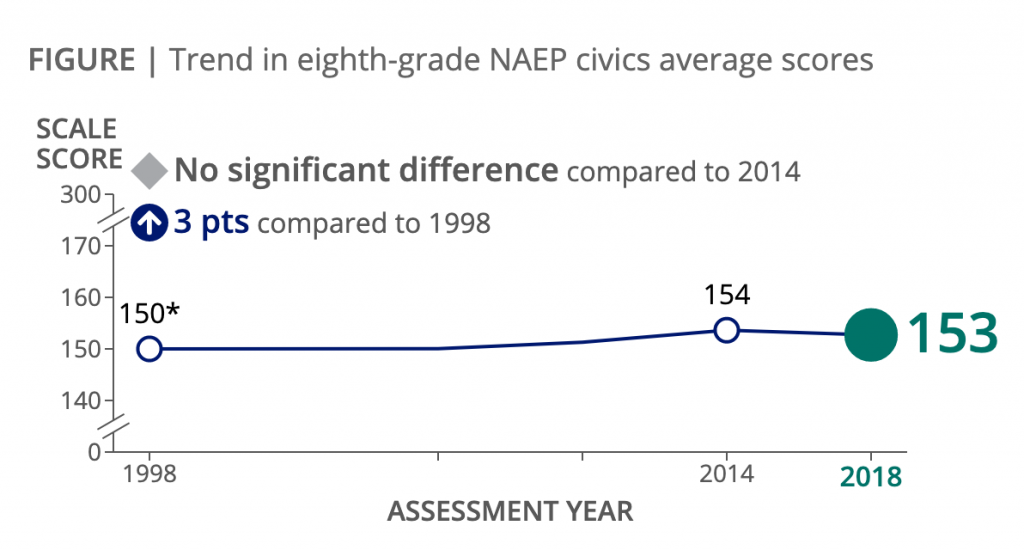
Civics is my own field of interest, and I was one of the designers of the NAEP Civics Assessment instrument. The results for Civics were flat. (Unless you want to say that they “plummeted” by one point.)

The NAEP is extraordinarily useful for analyzing differences in scores by demographic group and for understanding how educational experiences (e.g., taking an 8th grade civics course) relate to outcomes. Unless you have worked with the dedicated folks at the Educational Testing Service and the National Assessment Governing Board, you cannot imagine how careful they are about test-design and implementation or how complex the whole process is.

However, as in the past, I would like to offer these caveats about the NAEP results and the surrounding commentary.

First, as noted above, the changes are subtle, and some are within the margin of error. There is no evidence here of dramatic decline.

Second, the definitions of “proficient” and “advanced” are basically arbitrary. The 1998 designers chose scores that would count as “proficient,” based on their own judgment. Based on the data from that year, they said that just 22% of American 8th graders were proficient. They must have been aware that they would communicate a message of crisis.

The subsequent Assessments have been normed to the 1998 instrument. Roughly speaking, if we drafted an instrument that indicated a major improvement, it would probably not be fielded as such, because the high scores in the pilot phase would suggest that it was an invalid measure–the questions must be too easy.

Therefore, it isn’t really news that the proficiency level is in the neighborhood of 25%. That is how the test is designed. This is not to say that we can’t gradually boost it to 30% or higher if we make a lot of progress in classrooms. But you should understand why the numbers could not be much higher.

The judgment that most kids are not proficient is subject to debate. If you look at the actual questions and how many 8th graders got each one right, you may conclude that most students are below proficient. Or you may think that the questions are surprisingly hard and that we are expecting a lot from 13-year-olds.

For instance, 50% answered this item right:

The United States Congress can pass a bill even if the President disagrees with the bill because

  1. Congress must make sure that the needs of all citizens are met
  2. Congress can make laws more quickly when it does not have to involve the President
  3. Congress usually knows more about what the laws mean than the President does
  4. Congress is the primary legislative power of the government

Is 50% a terrible result, or not too bad? That is a matter of judgment and expectations, not statistics.

Third, the NAEP measures some things but not others. The Civics assessment includes many items about the structure of the US government–which branch or level has what authority. It excludes current events, value-commitments (such as patriotism or commitment to equality), items about social issues, detailed questions about civic institutions outside of government (e.g., What does a PTA do?), items about specific state and local governments, and measures of students’ civic activity outside of school.

Finally, it is difficult to separate reading from civics, particularly at the 4th and 8th grade levels. I don’t think anyone does that better than the NAEP does, but it’s an intrinsic challenge.

A kid who hasn’t actually learned anything specific about the US government but is used to reading advanced texts–The Lord of the Rings, for example–could glean a lot of correct answers based on the meaning of words like “primary” and “legislative” in the example above. A different kid who has dutifully learned some specific civics content might be thrown by the language of the Assessment, especially when the prompts contain longer passages.

It is true that literacy is a civic asset and that people who can do a lot with words are better prepared for civic life. However, if we think there is a separate domain of civic learning–as I do–then measuring it with a written instrument that isn’t confounded with literacy is a challenge.

Overall, I believe there is valuable information in the NAEP (and it’s important for Congress to fund it regularly). But the headlines are hyped. The data show evidence of stability in the relatively narrow set of outcomes that the Assessment measures, with the caveat that the test is designed to be stable over time. If we want to improve civics, we should focus mainly on what helps various kinds of kids to learn the various domains of content that are on the test–plus the important outcomes that the NAEP does not measure at all.

See also: deep in the thickets of test design (2011), some surprising results from the 2010 NAEP Civics assessment (2011), what did young voters know and understand in 2012? (2012), effects of debate, discussion, and simulation in k-12 schools, and persistent civic gaps (2013), CIRCLE’s release on today’s Civics results (2015),

trends to watch in civil society

The situation is fluid and unpredictable, but it’s worth tracking these developments.

  1. Lots of philanthropy for COVID-responses. The Foundation Center and GuideStar are tracking $7.9 billion in philanthropic commitments (so far) that specifically address COVID-19. You can find extensive detail here.
  2. Deep layoffs in the nonprofit sector. Nonprofit service agencies are either losing donations or contracts or simply letting employees go because they can’t do their jobs.
  3. Lots of creative new forms of collective action and dissent under pandemic conditions, including protests in which participants stand far apart or ride in cars, refusals to go to work, etc. This crowdsourced list* is admirably broad, encompassing everything from pure service efforts (e.g. sewing masks) to adversarial politics, and ranging from evangelical pastors holding services in defiance of meeting bans to pro-ban parishioners protesting such pastors.

I continue to think that the problem for civil society will not be the pandemic; it will be the depression. If you can resume pre-COVID values, priorities, methods, and habits once the pandemic eases, you will. But many people will not be able to do so because they will have lost their jobs in civil society or their ability to afford civic activity. Still, some of the creative ideas that we’re seeing under the current extreme conditions may prove durable.

*Chenoweth, E., Choi-Fitzpatrick, A., Pressman, J., Santos, F., Ulfelder, J. 2020. “Methods of Dissent & Collective Action Under COVID: A Crowdsourced List.” Crowd Counting Consortium, crowdcounting.org. See also: effects on civil society will be mediated by the economy; and COVID-19 is not a metaphor.

notes on the social role of science: 1. the example of fetal ultrasounds

We reflect on–and we argue about–the point at which human beings become persons with rights, how (if at all) gender relates to biological differences, the degree to which people are interdependent versus free, the rights of disabled persons, and the roles of mothers and other parents.

Meanwhile, we are surrounded and supported by tools and technologies that obtain data and information to guide decisions and judgments. Methods for obtaining and analyzing data have high prestige. But methods for reflecting on moral and metaphysical issues attract widespread skepticism, except among people who are deeply committed to particular moral/metaphysical views (often, religions).

In this context, we have a tool–fetal ultrasound imagining–that purports to peer into the womb and provide data about the developing organism, including its viability and its genitalia, as well as the prospective mother’s health. People may suspect that this scientific tool will shed light on personhood, sex, disability, and motherhood, not to mention such specifically contested questions as abortion and gender attribution.

The tool is used in specific, culturally resonant ways. Often prospective parents go into the medical facility together. The prospective mother is prepared and treated as a patient–in a blue gown, and so on. The room where the procedure is conducted is private, separated by a closed door from the waiting room. A large, precise, moving image appears on a screen. The parent or parents are asked whether they want to know whether the child is/will be a boy or a girl, which determines whether they are shown the genital area. At least some pregnant women report that the image compels everyone’s attention to the fetus and negates the woman, since she is literally made invisible (Barad 1998). Prospective parents of “normal” or “healthy” children are congratulated and offered good wishes. They can take still photos or even videos home with them.

If we ask “What is a fetal ultrasound session?” (as Clifford Geertz asked, “What is a Balinese cockfight?“) we might consider several answers:

  1. “A fetal ultrasound (sonogram) is an imaging technique that uses sound waves to produce images of a fetus in the uterus. Fetal ultrasound images can help your health care provider evaluate your baby’s growth and development and monitor your pregnancy. In some cases, fetal ultrasound is used to evaluate possible problems or help confirm a diagnosis” (The Mayo Clinic). Note: “your baby” as a description of the object. Not “the baby,” not “the fetus,” not “you.”
  2. An apparatus that uses a piezoelectric transducer, a crystal that both receives and produces ultrasound waves in complex interactions with the mother, the fetus, the computer, the video screen, and the viewers (Barad 1998).
  3. A “bonding scan” also known as a “recreational” or keepsake” ultrasound, meant to produce pictures or videos to save and share with friends and family or even with the child later on (per LiveScience.com, which does not endorse such uses).
  4. An application of SONAR technology, invented to detect and destroy enemy submarines (Barad 1998)
  5. One of the events to expect when you are expecting. A moment to anticipate, celebrate, and share.
  6. A ritual that encourages prospective parent(s) to: 1. bond as couples and begin bonding with their child, with whom they will form a nuclear family, 2. bring the fetus to term because is already moving and kicking, 3. avoid behaviors, such as alcohol consumption, that might harm the fetus, 4. encourage them to begin to begin thinking and talking about it as a “boy” or a “girl,” who will have an appropriate name, pronouns, etc., 5. allow them to announce the pregnancy to a larger audience, thus enhancing their social capital, 6. reinforce the authority of credentialed medical professionals in white coats, and 7. produce revenue for the clinic.

Karen Barad wrote a brilliant 1998 article* that explored much of this terrain. I would respectfully dissent from part of her analysis, only because I am trying to work out a view that better fits my sense of the problematic power of science.

Inter alia, Barad raises epistemological doubts about the image that we see on the screen. We are not “peer[ing] innocently at the fetus,” but using an elaborate apparatus that produces an image as a result of complex interactions that can be changed by altering the apparatus. It is a mistake to think that the referent, when we talk about this image, is “the fetus.” The referent is a “phenomenon that is constituted by the inter-action of the apparatus and the object.” Barad cites Niels Bohr’s epistemology in opposition to the older, “Newtonian framework” in which observation was the “benign facilitator of discovery, a transparent and undistorting lens passively gazing at the world.”

I completely agree that looking inside the torso of a pregnant woman is not innocent or automatically benign. Whether to do it, how to design the procedure and the larger event, and what conclusions to draw are moral and political choices that should be critically assessed. Fetal ultrasound could be banned, discouraged, publicly funded, or required. The image could be seen only by a professional who would give written results to the pregnant woman alone. Or it could be done only by the pregnant woman, who would decide whether to share any information with anyone, including a physician. It could be re-designed so that the woman was depicted in the image along with the fetus, or in many other ways.

A fetal ultrasound event is a social phenomenon that reflects and reproduces power. There is a risk that it will block critical deliberation about issues like abortion and gender by claiming to present natural facts just as they are. To quote Bruno Latour, science can “render ordinary political life impotent through the threat of an incontestable nature” (Latour, 2004, p. 10).

Yet I do believe that we are looking at the fetus. In fact, it is precisely because the technology allows us to actually peer into the woman’s body that it is invasive.

When you see a car coming down the road, you may not actually look at the object that matters. Your brain interprets a reflection on the back of your retina, which may reflect the image on a convex mirror, which distorts reality by showing objects smaller than they would appear if seen directly. But you’d better not pull out into the road if there’s a car coming. The mirror is an excellent device for looking around corners, which is why we use it.

We are in a world of tools that we use effectively for a variety of reasons. In the Philosophical Investigations, Wittgenstein encourages us to see representations as tools that we can use for many purposes. A blueprint can provide instructions to a builder or ideas for a heist, or it can decorate a wall. There is nothing tricky about its metaphysical status. A picture does nothing mysterious inside us that needs analysis (Philosophical Investigations, 188). Whether the visual experience of an image is authentic is not an interesting question (190). The question is what uses we make of an object, including using it to represent a different object. For instance, to see a painting as a portrait of someone is to use it in a certain way. “Now when I say, ‘We consider a portrait to be human’ – when and for how long do we do this? Whenever we see it at all (and don’t see it as something else)” (199).

Likewise, when we are presented with a moving image from inside a pregnant woman, we can see it as a person, or as a boy, or as a fetus, or as a medical problem. Science has no legitimate right to tell us which way to see it. However, the ritual of a fetal sonogram event–conducted by people in white coats with scientific degrees–probably does determine how we will see it. The ultrasound technology really works; the question is whether and how we should use it.

Sources: Karen Barad, “Getting Real: Technoscientific Practices and the Materialization of Reality,” Differences: A Journal of Feminist Cultural Studies 10, no. 2 (1998): 87-91; Bruno Latour, Politics of Nature: How to Bring the Sciences into Democracy, trans. Catherine Porter (Cambridge, MA: Harvard, 2004); Wittgenstein, Philosophical Investigations, German text (1953), my translations.

See also: what does a Balinese cockfight have to do with public policy analysis?; issues in the philosophy of social science; science, democracy, and civic life; is science republican (with a little r)?; nature includes our inner lives; some thoughts on natural law; is all truth scientific truth?; decoding institutions; media literacy and the social discovery of reality

new minor: Entrepreneurship for Social Impact in Civic Studies

We’re launching a new minor within the Civic Studies program. It complements the Civic Studies Major and the existing minor, which is called Peace & Justice Studies. I anticipate that these two minors will draw students with different interests, thereby promoting intellectual diversity and debate. We’re thinking about adding even more minors over time. One prospect is a minor in Interfaith Civic Studies, or something along those lines.

The Entrepreneurship for Social Impact minor requires six courses, including Intro to Civic Studies (which I regularly reach) and the Innovative Social Enterprise course offered through the Tufts Entrepreneurship Center. The remaining four courses include two from the approved Civic Studies list and two from the approved Entrepreneurship course list.

New Civic Engagement Section of the American Political Science Association

The APSA has approved a new section on Civic Engagement. In the proposal for this section, we noted that “APSA has been dedicated to civics education and the task of stimulating civic engagement since its inception in 1903.” However, there had not been “an organized section” for “political scientists who specialize in teaching and/or research in civic engagement.”

We said that our purposes would include:

  • To promote the teaching of and scholarship in civic engagement through sponsorship of civics education and civic research panels and/or short courses.
  • To facilitate the development of faculty in this field through mentoring.
  • To publicize new research and share pedagogical experiences through a newsletter and/or journal.

With APSA’s approval, we are now in business and we invite political scientists to join the section. For APSA members, the cost is minimal ($5 per year). After you log in to apsanet.org, click on your name and you will go to your own profile. “Add section” will be one of the options. That will bring up a list of sections you can join. Ours is the second from the bottom on the list. Or you can do so by adding it the next time you renew your registration. 

We welcome scholars working with diverse methodological backgrounds and in diverse institutional settings including research-intensive universities, teaching-intensive colleges and universities, HBSUs and HSIs, community colleges, and in the nonprofit sector.

We have been given two panels at the APSA annual meeting in September. Please look for those in the program and help us out by attending, if you can. Also, we are planning to hold a business meeting and a reception at the annual meeting.  They should be listed in the program or we will advertise them separately. Please join us for those events. The business meeting will be our first as an organized section and we would appreciate your input on the governance of this new section.

The co-chairs are Elizabeth Bennion and Richard Davis. I am the Vice-Chair, and Malliga Ochs is the Treasurer.

why the relatively good US numbers for COVID-19 mortality?

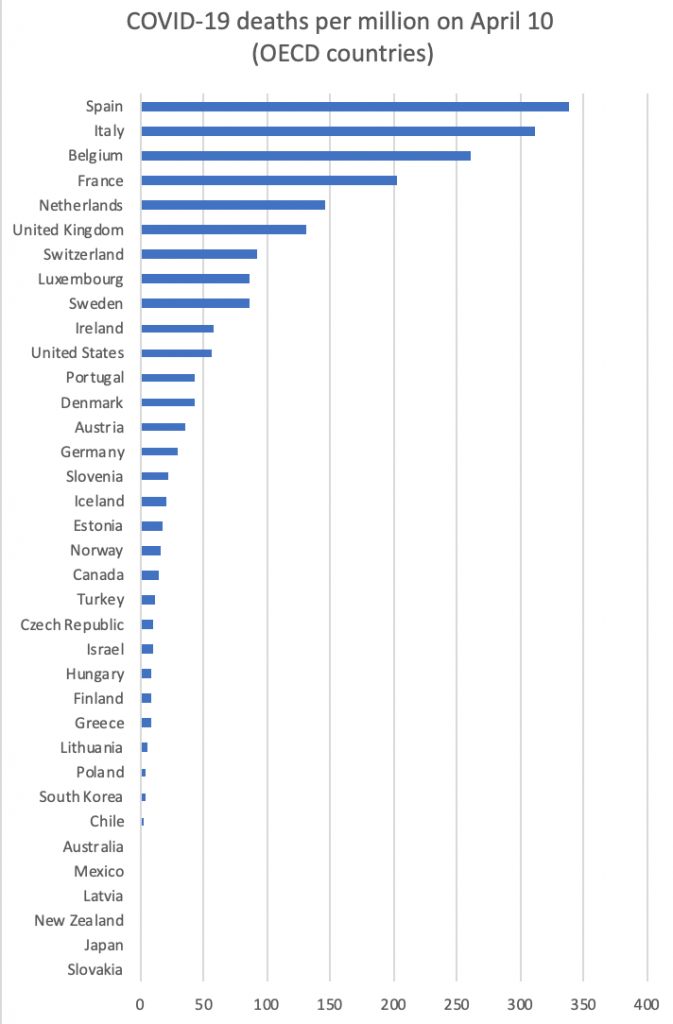
Major news sources are reporting that the USA has had the most cumulative COVID-19 deaths. That is a meaningless statistic, since our population is, for example, seven times larger than Spain’s. On a per capita basis, the US is reporting far fewer cumulative deaths than ten major OECD countries.

(My analysis of data from Our World in Data.)

One objection is that we are experiencing the pandemic later than Spain and Italy, and our per-capita cumulative rate will grow to meet theirs. However, assuming we peak (as expected) early this week, then we should not converge with Italy and Spain.

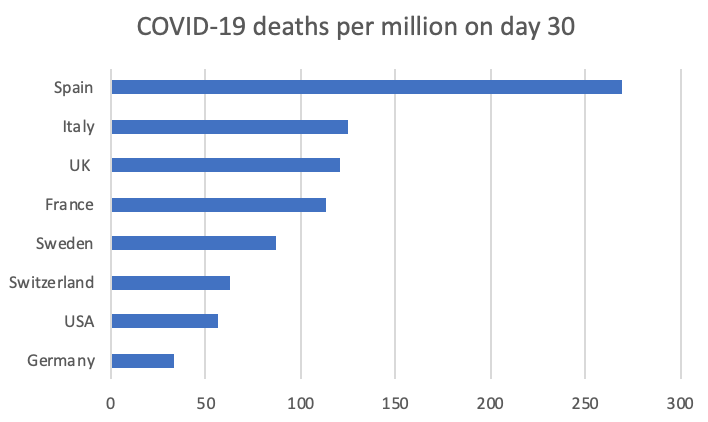
For a more precise comparison, here are per-capita cumulative deaths on the 30th day after each country saw its deaths reach one in ten million.

(I have consulted Kevin Drum’s daily updates to find Day 30 for each country. Several nations have not yet reached Day 30 and are not shown.)

The ratios are, indeed, smaller in this second graph than in the first. For example, on April 10, Spain had almost six times more cumulative deaths per capita than the USA that same day. If you compare the two countries on their respective Day-30’s, which happened weeks apart, the ratio is just 4.8-to-one. Still, the gap is unlikely to close much further, which means that Spain’s outcome will be four or five times worse than ours.

Another objection is that national aggregates are misleading because health outcomes in the USA are badly unequal by race. If per capita mortality for African Americans and Native Americans were shown separately, those numbers might look much worse. Then again, white Americans would then look even more fortunate in international comparison.

The same goes for regional breakdowns. On its own, New York City would look bad, but removing New York would make the national statistics look even better.

A third objection is that these statistics are inaccurate. No doubt, some COVID-19 deaths are not being appropriately counted. However, I am using deaths instead of diagnoses, because mortality statistics are generally considered pretty reliable and comparable across countries. Also, the epi-curves in these countries are rising smoothly in the expected ways.

A fourth objection is that we have only considered the first wave. If the pandemic revives in a second wave, all bets are off. I would say that it is wise to prepare for a second wave, but the only data we can discuss come from the current phase. It’s worth trying to analyze what it means.

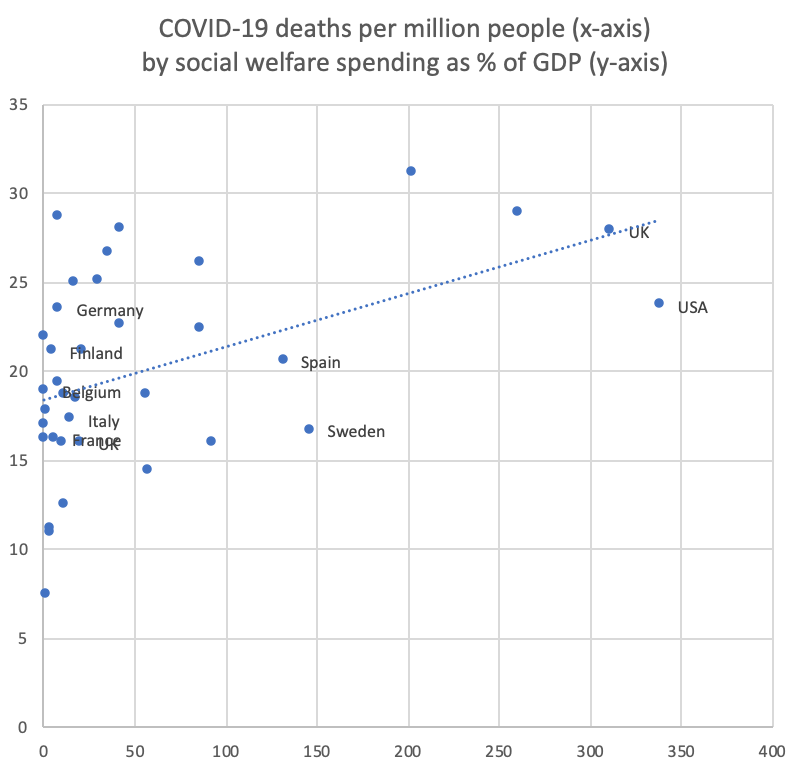
Assuming that these statistics are fairly accurate, there doesn’t seem to be a meaningful relationship between COVID-19 mortality and the size of a welfare state (% of GDP spent on social welfare). The correlation would be positive (more spending goes with higher mortality), but the scatterplot is diffuse.

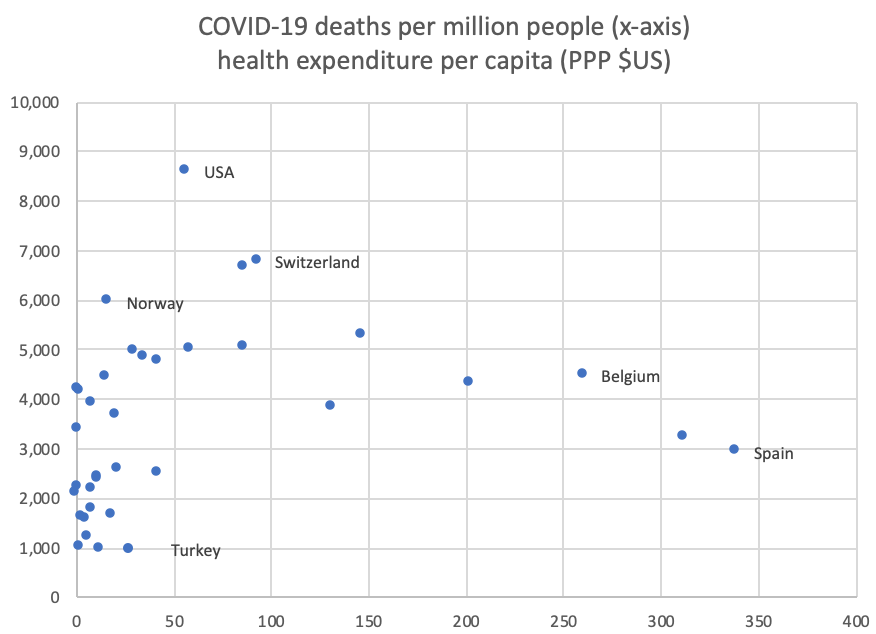
Nor is there a correlation between COVID mortality and health expenditures per capita, adjusted for purchasing power.

The preliminary evidence suggests that public policy, political leadership, and the social contract matter much less in this pandemic than I would have thought. I think we must look elsewhere for explanations of the variance in COVID-19 deaths.

Some differences in national outcomes may be due to social and geographical factors, such as the median age of populations, population density, or the frequency of living together in intergenerational households. I suspect a major variable is the timing of the onset of the disease. By the time the pandemic was starting its rise in the USA, many Americans had already become alarmed by the news from Italy and Spain; we self-isolated pretty rigorously. Like Iran, Italy and Spain didn’t have the benefit of as much warning. Meanwhile Taiwan and South Korea did better because they had previously experienced SARS.

This analysis is preliminary and amateurish and could easily change. That said, it challenges my own ideological priors. I would have assumed that Donald Trump would make things worse here than in other countries, and that our lack of health coverage would set us up for failure. It is always worth challenging your own ideological premises when conflicting evidence arises.

It’s also important to prepare for a summer and fall in which anti-Trump forces will try to blame the US situation on him, and the most cogent defense will be that the US is actually faring better than most social democracies. I don’t expect Trump to present his defense with any discipline, but his critics should be ready for it.