I admire and recommend Shapiro’s book, Politics against Domination, but I use the review as an opportunity to push two positions that I frequently advocate:
The state should not be sharply distinguished from other institutions; it is not uniquely capable of dominating people [or preventing domination]; and
The salient question is not how to design a state to prevent domination–because none of us are really state-designers–but how we should prevent domination by working through the state and the other institutions that we can influence.
The rest of the special issue is valuable. I have been particularly eager to see Brooke Ackerly’s essay, “Rage, Resistance, and Politics against Oppression,” in print. She explores the overlap and the differences between domination–the keyword in modern republican political theory–and oppression, a fundamental term for much of the left, especially for intersectional social movements. That contrast is valuable for anyone to consider.
Some of the threats to democracy in the USA involve bias or injustice in our political system: barriers to registration and voting, gerrymandered districts, the filibuster, money in politics, the Electoral College, and an unrepresentative Senate. With some important exceptions, reforms that address those problems will tend to benefit Democrats and progressive causes.
A particular kind of polarization also threatens democracy. The problem is not disagreement. Our elected representatives should hold diverse political views–maybe more diverse than they do now. Debate and contestation are valuable. It is good to have at least two parties with sharply distinct approaches, so that people can choose between them.
However, our Constitution was written by people who disliked parties and didn’t anticipate them. It is badly designed for partisan polarization. Whenever the branches are controlled by different parties that have homogeneous ideologies, all the incentives favor mutually destructive game-playing.
I can accept the argument that Republicans have played harder and less ethically than Democrats, although I am not certain that’s true, because my prior assumptions and my media stream are biased. But even if it’s true, all the incentives now predict that Democrats will play tit-for-tat.
Besides, affective partisanship–disliking fellow citizens because of their political identities–is the kind of divide that prevents human groups from governing themselves. In order to deliberate, you need not agree, but you must believe that it’s valuable to discuss common issues with the other side. Affective polarization blocks discussion. In the absence of a reasonable level of goodwill, arguments and reasons have no purchase.
The main alternative is simply power: amassing more votes than the other side has. That is preferable to amassing more dollars or more guns than the other side, but it is still raw power. It is government by accident and force, not by reflection and choice, to paraphrase Federalist #1. I suppose if mobilizing more votes consistently generated good outcomes, it might be OK–but it doesn’t.
Democrats and progressives (if they take power) and nonpartisan reformers face a real dilemma. Political reforms will be seen as partisan because they have unequal effects, but partisan polarization is also a problem–and an obstacle to achieving progressive goals.
This is what I would recommend:
First, push political reforms despite their partisan impact if they’re the right things to do. Not only are equity and accountability very high priorities, but our current system actually worsens polarization by giving the parties too many opportunities to pass or block policies without building consensus. I’d vote for expanding the Senate and the Supreme Court, but those reforms are so unlikely that perhaps it’s a mistake to focus much attention on them. More to the point would be voter protection, districting reform, and ending the filibuster.
Second, include political reforms that are bad for Democrats if those are also the right things to do. Redistricting reform meets that criterion in some states. Ranked-choice voting might qualify. Constraining the executive branch is an example, if Biden is president.
An often-overlooked problem involves the dates of municipal elections. Many mayors and city councils are elected in odd-numbered years or in different months than November. Democratic incumbents and municipal employees’ unions benefit because the electorate shrinks to hard-core party and union members. But turnout is often miserably low. I’d move municipal elections to November of even-numbered years and fight Democratic city halls to get that done.
Third, take explicit actions to reduce affective polarization by promoting cross-partisan dialogue and deliberation.
Civic education can help if it focuses on discussions of contested issues.
The federal government could organize official public deliberations on controversial matters. The UK Climate Assembly might be a worthy recent model, but the same method could be used to discuss whether to open schools during the pandemic.
After the election, Biden and/or Harris could attend listening sessions with people who might be alienated from them–including right-wing groups but also marginalized people of color. It would be easy to mobilize partisans to distort these sessions. Biden/Harris could turn them into manipulative symbolic events. However, skillful advance work could make them work out better. For example, imagine Biden visiting a conservative evangelical church in the South without prior public notice (maybe he’d coordinate in advance with the pastor) and listening to congregants behind the closed church doors before emerging to make some remarks. If that were done with sincerity, it could make a difference.
The extreme polarization of the news and information sphere may actually help. As Barack Obama learned, it doesn’t really matter how you act; the right-wing news cycle will treat you as an anti-American extremist. Under these circumstances, why not push for genuinely worthwhile reforms, while also making sincere efforts to combat polarization?
A perennial question is the relative importance of influential decision-makers (“leaders”) versus other factors that can cause social outcomes, such as the structure of institutions, mass opinion and behavior, demographic and ecological change, or sheer accident.
Reporters have a professional bias to overestimate the impact of leaders, because it’s easier to write about individuals than abstractions. Video journalists have the strongest bias, because they must put human beings on screen.
Headhunters and search firms have a similar bias. Like journalists, they are indispensable. I wouldn’t recommend trying to find a nonprofit or college executive without their assistance. But they do tend to overestimate the impact of the kind of people they help to hire. They will tell you, for instance, that Dean So-and-So “raised the ranking” of her college. Any Dean was, at most, only a contributing factor to a change in reputation.
I don’t know much about corporate boards, but I suspect they also overestimate (and hence overpay) top executives. That is partly because their explicit task includes hiring, compensating, and assessing CEOs. It’s partly because they tend to be corporate executives themselves. And it is simply easier for anyone to visualize the impact of a person than an abstraction. But if a board believes that the boss personally doubled the company’s earnings, they are not thinking clearly about causality.
Near the end of War and Peace, Tolstoy offers the opposite view–surely exaggerated, but worth considering as a corrective. He argues that of all the people who fought in the Napoleonic Wars, Napoleon was the least consequential. In a battle, each soldier could decide to stand or run. If most of them stood, Napoleon became a genius. If they broke and ran, he was a defeated fool. His fate was entirely in their hands.
And it was not Napoleon who directed the course of the battle, for none of his orders were executed and during the battle he did not know what was going on before him. So the way in which these people killed one another was not decided by Napoleon’s will but occurred independently of him, in accord with the will of hundreds of thousands of people who took part in the common action. It only seemed to Napoleon that it all took place by his will.
At a larger scale, Tolstoy says, the Napoleonic Wars were the result of an underlying historical current that caused great masses of Europeans to spill beyond their national borders. Napoleon was carried by this current all the way to Moscow. In subsequent decades, Europeans would instead fight their own countrymen in revolutions (and, although Tolstoy doesn’t say so, would conquer other continents). Napoleon was not a cause but an unwitting product of his time.
In her classic work The Thirty Years War, C.V. (Veronica) Wedgewood asks why so many people in the 1600s were so interested in dynastic politics: royal marriages, successions, and usurpations. Commoners were willing to die to ensure that one family prevailed over another. She says the reason was “the faulty transmission of news” and poor “diffusion of knowledge.” People just didn’t know about aspects of politics apart from royal persons. “The public acts and private character of individual statesmen thus assumed disproportionate significance, and dynastic ambitious governed the diplomatic relations of Europe.”
In those days, people would naturally explain important social developments as the consequence of leaders’ actions. For instance, many would have said that south-central Europe was consolidating because of the Hapsburgs’ fortunate marriages or that England had remained Protestant because James VI of Scotland (a Protestant) had inherited the throne. But these were myopic explanations. Much more likely, the Hapsburgs married well because south-central Europe was consolidating, and Jacobean England was Protestant because of the strength of reform movements in northern Europe.
We should be able to fix this problem today by gathering more information and analyzing it better. However, we now have the opposite problem: too much data. So much information is available that we cannot process it, and one common response is to return to understanding the world in terms of the behavior of a few famous or infamous individuals. To the list of people who overestimate the impact of leaders, I would add: most of us voters.
It should come as no surprise when elites try to undermine democracies and other forms of republican self-government. It is not in their interest to share power. A republic’s founding story is usually the overthrow of a tyrant, an oligarchical cabal, or a theocrat; and many republics have died at the same hands.
But what if the people don’t want to rule? This is an acute worry at times like the present, when some electorates seem to prefer politicians who disparage democratic values (not just Trump in 2016, but also Jair Bolsonaro and Narendra Modi today) and when the only governments in the world that appear to be broadly trusted are in China, the UAE, India, Indonesia, and Singapore.
Meanwhile, influential frameworks or paradigms in political psychology are raising doubts about people’s ability to participate in–and support–democracy.
Evidence that the people don’t want to rule
These concerns were at least as grave between the world wars, when dictators emerged as popular figures, sometimes attaining office through genuine elections, and when theorists like Walter Lippmann and Joseph Schumpeter anticipated today’s academic skepticism about people’s desire and capacity for self-government.
One cluster of research on this problem was the Frankfurt School, whose most pressing original topic was the failure of the European working class to support revolution. I don’t happen to share the founders’ Marxism, but theirs was a species of republican theory: they wanted the people (equated with the workers) to rule themselves instead of being ruled by capital. And they were concerned about a very real problem: workers’ support for right-wing authoritarians like Mussolini. By exploring the hypothesis that popular opinion might affect history and not simply result from historical forces, the Frankfurt School broke from one orthodox currant in Marxism. As Wayne Gabardi writes, for them, “the problem was not one of objective conditions, but rather of subjective states. This required a radical rethinking of the relationship between social structure and character structure, political-economic forces and social-psychological syndromes, the material and the mental.” It is reminiscent of today’s focus on “subjective states” as an explanation of outcomes like Trump’s 2016 election.
Wanting to add an empirical dimension to the research, Max Horkheimer hired Erich Fromm to conduct a survey. Fromm and colleagues collected data from 584 Germans, including items about their objective circumstances, their lifeworlds, and their opinions. Among the questions were: “What do you and your wife think about early sex education for children (birth, procreation, sexual diseases)?” and “Do you like jazz?” Fromm and colleagues concluded that many of the workers who belonged to left parties held authoritarian attitudes in their personal lives and showed other telltale signs of fascism, such as anti-Semitism and admiration for Mussolini.
This study was the main inspiration for The Authoritarian Personality, the major work that the Frankfurt School’s Theodor Adorno and several American colleagues published in 1950. (See my recent post on that book’s methodology.) Given the change of time and place, the question had shifted from “Why doesn’t the working class support Marxist revolution?” to “Why don’t voters support liberal democracy?” But the threat was the same: authoritarianism. “The major concern was the potentially fascistic individual, one whose structure is such as to render him particularly susceptible to anti-democratic propaganda” (p. 1). The conclusion was also similar to Fromm’s: a substantial proportion of Americans appeared to be potential fascists.
A comparable finding emerged much later on from John R. Hibbing and Elizabeth Theiss-Morse’s Stealth Democracy: Americans’ Beliefs about How Government Should Work (2002). Many Americans apparently believed that political disagreement was a sign of corruption and preferred government by disinterested elites.
And the currently very influential Moral Foundations theory of Jonathan Haidt finds that many people display a latent variable of Authority, which sounds at least potentially undemocratic, especially if it is a predominant factor for an individual. At the same time, Moral Foundations theory implies that people will generally be resistant to sharing political power with other citizens who emphasize different Foundations from their own.
Counter-evidence
Each of these research programs has been criticized.
The authors of The Authoritarian Personality did not field their scales with representative samples of the US population, so they could not estimate the prevalence of potential fascism. They did not attempt to identify pro-democratic personalities or estimate their prevalence. And they did not explore whether there might be left-authoritarians as well as right-authoritarians.
Michael Neblo, Kevin Esterling, Ryan Kennedy, David Lazer, and Anand Sokhey (2010) challenged the Stealth Democracy thesis in a paper entitled “Who Wants to Deliberate – and Why?” For part of their paper, they simply asked questions that were the reverse of those fielded by Hibbing and Theiss-Morse. For instance, Hibbing and Theiss-Morse had tested the proposition: “Our government would run better if decisions were left up to nonelected, independent experts rather than politicians or the people.” Thirty-one percent agreed, which Hibbing and Theiss-Morse considered high. Neblo et al. tested: “It is important for the people and their elected representatives to have the final say in running government, rather than leaving it up to unelected experts.” Ninety-two percent agreed. Hibbing and Theiss-Morse found that 86% agreed that “Elected officials would help the country more if they would stop talking and just take action on important problems.” But Neblo et al found that 92% agreed that “It is important for elected officials to discuss and debate things thoroughly before making major policy changes.” Hibbing and Theiss Morse found a majority (64%) in favor of the statement: “What people call ‘compromise’ in politics is really just selling out one’s principles.” But Neblo et al found that 84% agreed, “One of the main reasons that elected officials have to debate issues is that they are responsible to represent the interests of diverse constituencies across the country.”
By asking questions that were opposites of Hibbing and Theiss-Morse’s items, Neblo et al. revealed that even most people who held anti-democratic views also held pro-democratic views. One way to make sense of the apparent contradiction is to think that people wanted real dialog and deliberation, but were unimpressed by the actual debate in Congress.
The other main source of evidence in Neblo et al. is a field experiment, in which people were offered the chance to deliberate with real Members of Congress. People were more likely to accept if they had negative attitudes toward elected leaders and the debates in Washington. Again, that could be because they did not reject deliberation in principle but disliked the official debates that they heard about or watched on TV. People who held those skeptical views were especially impressed by an offer from their real US Representative to deliberate. Individuals were also more likely to accept the offer to deliberate if they were young and if they had low education.
Further, if people showed up to deliberate, their opinions of the experience were very positive. According to the paper, “95% Agreed (72% Strongly Agreed) that such sessions are ‘very valuable to our democracy’ and 96% Agreed (80% Strongly Agreed) that they would be interested in doing similar online sessions for other issues.” These results are consistent with almost all practical deliberative experiments.
Kevin B. Smith and colleagues (2017) cast doubts on three strong claims of the Moral Foundations Theory: that the dispositions labeled “foundations” are stable for individuals over time, that these foundations predict and explain political ideology (and hence explain ideological differences), and that the foundations are inherited–as they must be if they result from Darwinian selection. Surveying twins along with other family members, Smith et al. find that “moral foundations are not particularly stable within individuals across time, at least compared to ideology.” At a given point, individuals’ answers to Moral Foundations questions do relate to their ideologies, but their views change over time. The causal arrow seems to point from ideology to moral foundations, as much as the reverse. Presumably, people are influenced by events, experiences, and discussions to revise their political views, thereby changing their Moral Foundations (which are not actually foundational). Thus the stream of research exemplified in Moral Foundations Theory has been “overly dismissive of the role of conscious deliberation.”
I also believe that we should be careful about generalizing the findings of Moral Foundations Theory to political contexts. Haidt et al. ask individuals to make private judgments about emotionally charged questions that are often related to human biological functions: universals. In completing these questionnaires, respondents do not have to act, make decisions together, preserve relationships with fellow decision-makers, follow procedures for group decision-making, or assess the kinds of complex, changing, and morally mixed institutions that are the main topics of politics–things like the US government, or the neighborhood’s public schools, or Islam. (See Flanagan 2016.) The Foundations may recede in importance once we enter the Public Sphere.
What should we make of the evidence?
So far, I have summarized some empirical evidence that challenges the assumption that people really want to govern themselves, and then some rebuttal evidence. But once any evidence emerges that people may not want to deliberate and rule themselves, the worm of skepticism is already inside the apple. Maybe some studies have overstated the prevalence of anti-democratic attitudes; nevertheless, it’s clear that such attitudes exist, and they may be prevalent in a given time and place. That helps to make sense of the fact that 44% of Americans approve of Donald Trump’s performance in office, even today.
This is the main response I would offer: Some people are authoritarian. It is not wrong to construct a causal theory in which these people help to cause democracies to fail. However, that is not the whole causal story. Something makes people authoritarian. If authoritarianism were inherited or hard-wired, then we could not explain massive changes in attitudes toward democracy within the same populations. In Erich Fromm’s time, many Germans were proto-fascists, which they demonstrated by giving Hitler’s party the largest share of the vote in 1932. Today, their descendants widely support one of the stablest and best-performing liberal democracies in history. Context and experience must matter.
Some combination of centuries of feudalism followed by rapid industrialization, the slaughter and then defeat of World War I, hyperinflation, and sophisticated Nazi propaganda could make people into fascists. On the other hand, living in Angela Merkel’s Germany makes or keeps most people liberal and democratic. As Neblo and colleagues show, inviting people to a well-designed deliberative event with their own elected representatives increases their commitment to democracy. The Tocquevillian argument is that “experience with liberty” and “experience with solving problems directly through collective action” inculcate liberal and democratic virtues (Allen, Stevens & Berg 2018, p. 36)
What should we do?
One conclusion might be that elites–the people in charge of institutions–should create rewarding opportunities for self-governance at many scales, from empowered student governments in middle schools to national deliberations that influence Congress.
That conclusion is true but empty. Elites will not share power because they should. They will do so if they believe it is in their self-interest, and they are more likely to reach that conclusion to the extent that the public organizes to demand self-governance. Unfortunately, such pressure will be weak to the extent that most people have lost experience with, and appetite for, self-governance.
A vicious cycle is certainly possible–and probably evident in many countries today. But the situation is not as dire as it might seem. The good news is that we do not need the active support of a majority of citizens to spread opportunities for self-rule. Some of us can build such opportunities and invite others in, and we can thereby expand the constituency for real democracy.
If we could ask the public–in a truly valid and reliable way–whether they want a deliberative democracy, the results would probably be mixed and ambivalent. Depending on the political context, more or fewer people would agree. Unfortunately, at crisis points, when it’s most important for people to stand up for democracy, their support is likely to be the softest.
But whether a whole society should be a deliberative democracy is not the salient question, anyway. None of us can decide to make it one. The salient question is whether we–you and I and our colleagues and allies–should build and expand opportunities for deliberative democracy in the various contexts where we have influence: our schools and colleges, neighborhoods, voluntary associations, and online venues.
The answer to that question may not always be yes. Values other than deliberation and democracy may be paramount in some contexts, such as a scientific lab, an artist’s studio, or a warship. But there are good reasons for us to build more deliberative democratic opportunities than we find around us today. These opportunities can make their immediate contexts better and can extend the public’s appetite for deliberative democracy at larger scales.
Citations: Wayne Gabardi, “The Working Class in Weimar Germany: A Psychological and Sociological Study by Erich Fromm, Barbara Weinberger and Wolfgang Bonss” (review), New German Critique, No. 41, Special Issue on the Critiques of the Enlightenment (Spring – Summer, 1987), pp. 166-178; Neblo, M. A., Esterling, K. M., Kennedy, R. P., Lazer, D. M., & Sokhey, A. E. (2010). Who wants to deliberate—and why?. American Political Science Review, 566-583; Smith, Kevin B., John R. Alford, John R. Hibbing, Nicholas G. Martin, and Peter K. Hatemi. “Intuitive ethics and political orientations: Testing moral foundations as a theory of political ideology.” American Journal of Political Science 61, no. 2 (2017): 424-437; Flanagan, Owen. The geography of morals: Varieties of moral possibility. Oxford University Press, 2016. Barbara Allen, Daniel Stevens & Jeffrey Berg, Truth in Advertising? Lies in Political Advertising and How They Affect the Electorate (Lexington Books 2018).
Any serious (non-fiction) thinker makes claims, supports them with warrants, expects each claim to be challenged, and will withdraw a claim if the challenge proves valid.
However, people make many types of claims, with many kinds of warrant.
Here is a chart that suggests six different kinds of claim (descriptive, causal, conceptual, classificatory, interpretive, and normative) with examples of how a humanist, a social or behavioral scientist, and a natural scientist might make each of them.
humanities
Social/Behavioral Sciences
Natural Sciences
descriptive claim
King Lear was written soon after Oct. 12, 1605. (Warrant: it refers to “these late eclipses in the sun and moon.”)
44% fewer people dined in a restaurant this year than last year.
2019 was the second-warmest year on record.
causal claim(s)
Shakespeare wrote King Lear. Machiavelli influenced Shakespeare (which may mean: Shakespeare chose Machiavelli as an influence).
Mass concern about COVID-19 has reduced demand for restaurants.
Increased burning of carbon causes the climate to warm.
classificatory claim
King Lear is a renaissance tragedy.
Restaurant meals are a form of consumer purchasing.
Carbon dioxide is an example of a greenhouse gas.
conceptual claim
The renaissance was the rebirth of classical culture, which included such classical ideas as Stoicism.
The price of a commodity is a function of supply and demand.
The carbon cycle includes photosynthesis, respiration, burial, extraction, exchange, and combustion.
interpretive claim
King Lear reflects a fundamental pessimism that is incompatible with Christianity.
A restaurant meal can be a status symbol or else a mere convenience.
n/a (?)
normative claim(s)
King Lear is a great play. King Lear displays the moral perils of avoiding love.
People should stay out of restaurants to combat COVID-19.
We should cut carbon consumption.
Every one of these claims (including the normative ones) is testable and falsifiable. Each one requires some kind of reason–but not the same kind of reason.
Each kind of researcher or scholar makes more than one kind of claim. It is not true that natural scientists rely exclusively on experiments and are only interested in causal claims. They also describe, classify, and build conceptual models.
It is not clear, however, that natural scientists truly make interpretive claims. They certainly interpret data, but I think their interpretations are actually descriptive, causal, conceptual, or classificatory claims. In the humanities, “interpretation” means understanding the subjective meaning of an action for the actors, and that is not possible for most of the natural world–excepting people and perhaps some other animals. In a phrase like “the Copenhagen interpretation of quantum mechanics,” I don’t think that the word “interpretation” means what it does for a scholar of human beings. It’s more like a model.
It is also not clear that science–natural or social–provides reasons for normative claims. It is true that we should cut carbon consumption, but not directly because of what science finds. Science describes and explains the situation; to decide that we should do something requires a different kind of reason.
People can provide good normative reasons (or bad ones, which can be rejected), but these reasons do not arise from science. That is why scientists often claim to be value-neutral. In contrast, humanists’ claims often have strong normative implications. To explain, classify, describe, conceptualize, or interpret a human action often provides the grounds for judging it.
With the encouragement of the Journal of Public Health Policy and Springer Nature, I’m posting a pre-print of a forthcoming JPHP article entitled “Why Protect Civil Liberties during a Pandemic?“
The abstract:
During a public health emergency, a government must balance public welfare, equity, individual rights, and democratic processes and norms. These goods may conflict. Although science has a role in informing wise policy, no empirical evidence or algorithm can determine how to balance competing goods under conditions of uncertainty. Especially in a crisis, it is crucial to have a broad and free conversation about public policy. Many countries are moving in the opposite direction. Sixty-one percent of governments have imposed at least some problematic restrictions on individual rights or democratic processes during the COVID-19 pandemic, and 17 have made substantial negative changes. The policies of Poland and Hungary reflect these global trends and continue these countries’ recent histories of democratic erosion. The expertise of public health should be deployed in defense of civil liberties.
I’ll also quote a passage here:
Imagine a government that is legitimate (having an unquestioned right to make laws and regulations within its territory) and benignly motivated. A pandemic such as COVID-19 will force this government to make difficult decisions. It should strive to maximize public welfare, which can be measured on the dimensions of health, economic prosperity, security, and environmental sustainability, among others. The government should strive for equity, meaning that the costs and harms (as well as any benefits) are distributed fairly. It should attend to individual rights, which can be understood as “trumps” that people may play against policies that benefit the general welfare [2]. For example, an individual may claim a right to move freely when subjected to a quarantine; that claim presents a tradeoff that the government must resolve. Finally, the government should protect political processes and norms, such as a free and vibrant debate and fair elections.
These goods may conflict. Closing businesses has health benefits but also economic costs and may restrain individual economic rights. Allowing a mass protest enhances democratic debate but can allow a virus to spread. The relevant goods are incommensurable—not measurable on a single scale. And governments must weigh and balance them under conditions of uncertainty, not knowing for sure whether closing businesses will help control the epidemic or whether allowing a protest will spread the infection.
Now imagine that a government is neither legitimate nor benign. Perhaps a dictator has seized power in a coup. He, too, will face difficult choices during a pandemic, but there is no reason to expect him to weigh the costs and goods in an impartial fashion. More likely, he will see the pandemic as an opportunity to consolidate power, eliminate threats, and profit economically. …
I’ll be presenting at these two events, which are open and online:
Finding Belonging Amidst Neighborhood Development: A Case for the Arts in Boston’s Chinatown: “The Pao Arts Center uses arts, culture, and creativity to promote social cohesion and community well-being in an ethnic enclave, Boston’s Chinatown. In the same neighborhood, luxury development may be disrupting the community’s close-knit social fabric and sense of a coherent cultural identity. A team comprised of Tufts University researchers, Pao Arts center staff, and community residents investigated whether the Pao Arts Center remedies the effects of this displacement. Preliminary findings from the research will be presented.” Wednesday, October 7, 2020, noon-1:00PM. Register here.
The Impact of Political Polarization on Teaching: “The combination of remote learning blurring the lines between classroom and home, and the hyperpolarized political climate are raising more and more concerns for classroom teachers as they navigate relevant, timely and often controversial topics with their students. Come join a group of civic scholars and educators as they engage in conversation around some of the issues pressing on teachers this school year.” October 8 at 7:00 – 8:00pm ET. Register here.
I also recommend this event, which is public but face-to-face:
Central Square Theater (Cambridge, MA): Women’s Vote Centennial: Voter (Dis)Enfranchisement Today, Thursday, October 8, 2020, 8:30 PM 9:00 PM. More here. (I am listed as a speaker and cannot actually make it, but the real presenters are great.)
Human beings have latent characteristics, factors that we cannot directly observe or ask individuals to report but must infer from many observations. For example, you cannot reliably assess students’ knowledge of American history by asking them one question or by inviting them to say how much they know about the topic. The standard method is to ask them many questions about varied topics in US history and derive one or more scores from all this data. Similarly, we typically ask many questions or use many observations to assess a person’s extraversion, racial bias, performance on the job, or even likelihood of voting next November.
One common method for inferring the latent variables from many direct observations is factor analysis, invented by Charles Spearman in 1904 and prevalent in psychology since then (Fabrigar et al., 1999).
In the study of politics, factor analysis is often used to infer latent variables from people’s opinions about political issues and about related topics, such as morality, economics or social identities. This method yields genuine insights. However, to the degree that it explains the phenomena of public opinion and political behavior, it has three troubling implications.
First, some people may have anti-democratic traits that emerge as latent variables, whether or not they would admit to opposing democracy. That was a finding of the classic 1950 work, The Authoritarian Personality by Adorno, Frenkel-Brenswik, Levinson, & Sanford. Given a long questionnaire about a wide variety of topics, some people scored high on an F-scale (“f” for fascism), meaning that they were latently authoritarian, although most would have denied it.
A comparable finding emerged from John R. Hibbing and Elizabeth Theiss-Morse’s Stealth Democracy: Americans’ Beliefs about How Government Should Work (2002). Many Americans apparently believed that political disagreement was a sign of corruption and would prefer government by disinterested elites.
And the currently very influential Moral Foundations theory of Jonathan Haidt finds that many people display a latent variable of Authority, which sounds at least potentially undemocratic, especially if it is a predominant factor for an individual.
Second, if people have latent stances about ordinary political matters, but those stances vary, we are likely to polarize and not to be able to resolve our disagreements, which lie below the surface and may be difficult to shift. Hibbing and Theiss-Morse write, “Deliberation will not work in the real world of politics where people are different and where tough, zero-sum decisions must be made. … Given the predilections of the people, real deliberation is likely to make them hopping mad or encourage them to suffer silently because of a reluctance to to voice their own opinions in the discussion” (207).
Similarly, Haidt writes, “I began to see that many moral matrices coexist within each nation. Each matrix provides a complete, unified, and emotionally compelling worldview, easily justified by observable evidence and nearly impregnable to arguments from outsiders” (Haidt, p. 125). (Here he uses the metaphor of a matrix from the 1999 movie of that name, but factor analysis is his main method.)
Third, if we have latent characteristics that explain our concrete ideas and beliefs, we are not the self-conscious, self-critical learners and participants in self-governance that we might imagine ourselves to be. Haidt and team say, “Individuals are often unable to access the causes of their moral judgments” (Graham et al, 2011, p. 368).
I think that latent psychological characteristics exist, and the search for political ones has yielded insights. However, we should be alert to the implications of this method and careful about overstating its significance.
Given a set of data on a roughly related topic, you are going to be able to find factors. You can’t know a priori how much of the variance the factors will explain, but they will explain some of it. This method may help you to understand your dataset, but it does not reveal that people actually possess latent characteristics. That is a presumption of the method, not a finding of it. [NB: This paragraph applies to exploratory factor analysis, not to confirmatory factor analysis. The latter, when conducted appropriately, tests a hypothesis that has been generated for other reasons.]
Further, the statistical output does not demonstrate that the factors you found are foundations, causes, explanations, or reasons for the directly-observed data. All you have found is that you can model each measured variable as a function of the other variables and an unobserved variable, with some error. The interpretation of that finding requires some other basis, such as a substantive theory of human psychology.
Finally, the whole approach of deriving factors from a questionnaire or an observational checklist (or “big data”) is only one way to study human beings. It should be compared to other methods, including the sensitive interpretation of their explicit speech and their intentional actions and interactions. Such comparisons are especially important if we are trying to draw broad, meta-conclusions about whether people are capable of deliberative self-governance.
All of these issues arose in The Authoritarian Personality, which combined factor analysis of questionnaire data with the psychoanalysis of selected subjects. Although the investigators came either from quantitative, largely Anglophone, positivist research or from Continental critical theory, they shared a premise: people may not know what they really want or believe, but we can find out by digging into their unconscious. In this study, extensive interviews, in what the authors describe as “clinical” settings, were used to suggest survey questions and then helped to interpret the output of factor analysis.
On the team was Theodor Adorno, the great Frankfurt School theorist. Almost forty years later, his colleague R. Nevitt Sanford recalled that “Adorno was a most stimulating intellectual companion. He had what seemed to us a profound grasp of psychoanalytic theory, complete familiarity with the ins and outs of German fascism and, not least, a boundless supply of off-color jokes” (quoted in Gordon, p. 39). I find Adorno’s critical reflections on the study even more timely and interesting than his jokes.
In The Authoritarian Personality, the authors make their theory vivid and concrete by presenting portraits of two pseudonymous subjects, both Republican-voting, college-educated, white men in their twenties. Larry is reluctant to categorize people into groups or make assumptions about individuals based on their demographic characteristics. He is interested in a wide variety of people, is self-critical, and overtly opposes discrimination. In contrast, Mack quickly categorizes people into groups he sees as homogeneous, he views their underlying traits as inescapable, and he assumes that the groups to which he belongs are in zero-sum conflict with the others. He is “pre-fascist” or susceptible to authoritarian politics.
Now consider the behavioral scientists who categorize individuals like Mack and Larry as “highs” or “lows” on measures like the f-scale, and who trace such differences to “deep-lying trends in [the] personality”–trends of which the individuals are unaware (Chapter 1). These scientists sound much more like Mack than Larry.
This similarity raises at least two possibilities:
Mack is right. People do fall into discrete, homogeneous, and contending groups that are determined by underlying, unchosen factors. Mack is wise to categorize people and to assess whole groups critically. It’s just that the category of people we should be concerned with are the authoritarians (including Mack), not the groups that Mack dislikes, such as Jews.
The Authoritarian Personality reflects some of the same problematic social conditions that gave rise to Mack. Authoritarians and scholars of authoritarianism manifest the same tendencies because they are both influenced by the same circumstances.
I think Adorno makes the second argument. Under his own name, he contributes a chapter of “Remarks” to The Authoritarian Personality. Here he describes a shift from the “free competition and market economy” of the late 1800s, which prized and actually enhanced individuality, to the “mass society” of the mid-1900s (Kindle loc. 1417, 1453). “It is not accidental that Freud’s theory was conceived during the second part of the nineteenth century, when individuality as a social category was at its height” (1420). In keeping with his time, Freud emphasized the importance of the individual’s family, biography, and inner life for explaining idiosyncratic outcomes. But now “our society is … on its way to become one and whole, leaving less and less [sic] loopholes for the individual and tolerating less and less nonsocial, individual realms of existence” (1448). “The overwhelming machinery of propaganda and cultural industry” make individuality impossible and mold us into groups” (1463). Or again:
The whole pattern of present-day culture is molded in such a way that it takes care of the masses by ‘integrating’ them into standardized forms of life which are built after the model of industrialized mass production, and by actually or vicariously satisfying their wants and needs. … Populations are treated en masse because they are no longer “masses” in the old sense of the term. They are manipulated as objects of all kinds of social organization, including their own … [1455-6]
In private notes not included in The Authoritarian Personality, Adorno elaborated:
Our high-scoring subjects do not seem to behave as autonomous units whose decisions are important for their own fate as well as that of society, but rather as submissive centers of reactions, looking for the conventional “thing to do,” and riding what they consider “the wave of the future.” This observation seems to fall in line with the economic tendency towards gradual disappearance of the free market and the adaptation of man to the slowly emerging new condition. Research following the conventional patterns of investigation into public opinion may easily reach the point where the orthodox concept of what people feel, want, and do proves to be obsolete (quoted in Gordon, pp. 44-5).
Adorno implies that factor analysis works–it explains our world–because the social and political system has destroyed the autonomous, self-critical individual. People like Larry, who still try to think freely and treat others as free individuals, are naive about their real conditions. “Modern society is a mass society” (1453).
The co-authors of the book advocate “increasing the kind of self-awareness and self-determination that makes any kind of manipulation impossible.” They advocate a true education in the Kantian sense: Bildung. Its ideal is “the rational system of an objective and thoughtful man”–becoming at least as emancipated as Larry, and much more so than Mack.
I assume that Adorno signed on to this chapter because he shared his colleagues’ ideal. Note that despite Adorno’s left-radical roots, this ideal (like Adorno’s lament for the “decay of individuality brought about by the decline of free competition and the market economy” [1417]) makes him sound like a classical liberal in the tradition of de Tocqueville and Mill. The difference, I think, is his profound pessimism about returning to a liberal society under modern conditions.
In any case, this is the main point I want to draw out: To infer unobserved characteristics from human beings’ concrete statements about morality and politics can yield insights, but it also implies a view of people as incapable of self-governance. It thus aligns the researcher with anti-democratic or illiberal research subjects. This is a matter of degree, and cautious use of factor analysis is often helpful. Maybe we can even emancipate people by revealing what they latently believe so that they can criticize those beliefs. But if you think that factor analysis will yield truly definitive insights about public opinion, then your view of the world is akin to Mack’s. Adorno would say you are simply a realist. I think you might be overestimating the power of the method.
See also: who wants to deliberate?; Moral Foundations theory and political processes; structured moral pluralism (a proposal); and Habermas and critical theory (a primer). Citations: Fabrigar, L. R., Wegener, D. T., MacCallum, R. C., & Strahan, E. J. (1999). Evaluating the use of exploratory factor analysis in psychological research. Psychological methods, 4(3), 272.Graham, Jesse, Nosek, Brian A., Haidt, Jonathan, Iyer, Ravi, Koleva. Spassena, & Ditto, Peter H. 2011. Mapping the Moral Domain. Journal of Personality and Social Psychology, 101:2; Haidt, Jonathan. 2012. The Righteous Mind: Why Good People Are Divided by Politics and Religion; Gordon, Peter E. “The authoritarian personality revisited: Reading Adorno in the age of Trump.” Boundary 2 44, no. 2 (2017): 31-56.
We are having a national debate about defunding the police or otherwise deeply restructuring criminal justice. The reasons are Eric Garner, Michael Brown, Tamir Rice, Breonna Taylor, and all the other unarmed African American civilians who have been killed by police. Their homicides are symptoms of broader injustice. For example, I find that being Black raises one’s chance of being treated in a discriminatory way by the police almost five-fold, and that 42% of African Americans have been mistreated by the police at some point in their lives.
Elinor Ostrom did not contribute to analyzing the roots of racial injustice. She didn’t focus, in general, on differences of identity. I would not recommend her as a source on those topics, although they are integral to any discussion of police reform.
She did, however, conduct pioneering empirical research on policing in America, focusing specifically on disparate results by race. Her findings and her broader theoretical framework offer valuable insights–less about the roots of structural racism than about possible solutions.
Concretely, she and colleagues found that police served all citizens, and especially Black citizens, best when police departments were small, when their jurisdictions overlapped, and when various aspects of law enforcement were disaggregated and assigned to distinct agencies in a polycentric manner. She opposed the powerful trend to centralize and consolidate bureaucracies and to apply crude outcome measures, such as numbers of arrests.
More broadly, Ostrom understood public safety as a common pool resource in a polycentric world. Public safety is a common pool resource because it is subtractable (individuals can undermine public safety) but non-excludable (individuals cannot be prevented from benefitting from the resource). She argued that common-pool resources are challenging but not impossible to create and preserve. They are not doomed to the tragedy of the commons. Moreover, both of the dominant modern ways of preventing tragedies of the commons–states and markets–are frequently flawed and do not exhaust our options.
The police epitomize a state solution to crime. The government requires citizens to contribute taxes to pay for a distinct and specialized service-provider that has the capacity to enforce laws, including the requirement to pay taxes. This is a stable institution. The overall problem is trustworthiness: why should we trust the police to act in everyone’s interests?
Market solutions include private security services, walls and locks, and insurance against kidnapping, among many other tools. The drawbacks include inequitable outcomes and a tendency to shift danger from one household to others.
But we can generate public safety in other ways. For instance, the voluntary associations that people create and run reduce crime in their communities. Sharkey, Torrats-Espinosa, and Takyar find that “every 10 additional organizations focusing on crime and community life in a city with 100,000 residents leads to a 9 percent reduction in the murder rate, a 6 percent reduction in the violent crime rate, and a 4 percent reduction in the property crime rate.” That finding fits very nicely with the Ostroms’ theory. Vincent Ostrom told Paul Aligica:
We do not think of ‘government’ or ‘governance’ as something provided by states alone. Families, voluntary associations, villages, and other forms of human association all involve some form of self-government. Rather than looking only to states, we need to give much more attention to building the kinds of basic institutional structures that enable people to find ways of relating constructively to one another and of resolving problems in their daily lives.
The Ostroms’ ideas are congruent with some current reform proposals. For instance, Black Lives Matter says:
We demand a world where those most impacted in our communities control the laws, institutions, and policies that are meant to serve us – from our schools to our local budgets, economies, police departments, and our land …. This includes: Direct democratic community control of local, state, and federal law enforcement agencies, ensuring that communities most harmed by destructive policing have the power to hire and fire officers, determine disciplinary action, control budgets and policies, and subpoena relevant agency information.
This past summer, predominantly nonviolent mass protests, forced police reform onto the policy agenda. The momentum is palpably fading. Astead W. Herndon reports in the New York Times:
Over three months ago, a majority of the Minneapolis City Council pledged to defund the city’s police department, making a powerful statement that reverberated across the country. It shook up Capitol Hill and the presidential race, shocked residents, delighted activists and changed the trajectory of efforts to overhaul the police during a crucial window of tumult and political opportunity.
Now some council members would like a do-over.
Councilor Andrew Johnson, one of the nine members who supported the pledge in June, said in an interview that he meant the words “in spirit,” not by the letter. … Lisa Bender, the council president, paused for 16 seconds when asked if the council’s statement had led to uncertainty at a pivotal moment for the city.
“I think our pledge created confusion in the community and in our wards,” she said.
The regrets formalize a retreat that has quietly played out in Minneapolis in the months since George Floyd was killed by the police
You could explain this retreat as ordinary politics: mass protests pushed the pendulum one way; now it is swinging back, and politicians are just riding along. But I would add another explanation. I think that only relatively small and specialized circles–including people inspired by Elinor Ostrom as well as some left-radicals–have seriously considered concrete ideas for providing public safety with much less reliance on police. The public as a whole is not aware of these alternatives. That is a reason to continue to apply and to publicize the work of Elinor Ostrom and the Workshop.
I also believe that the Ostrom tradition should pay more attention to issues of difference and exclusion that relate directly to Lin Ostrom’s model. One of her design principles for managing a common pool resource is to establish clear boundaries around the community that owns the resource. In the case of policing, geographical boundaries can help. But another boundary is available: race.
Although public safety is non-excludable, in the sense that an individual cannot easily be excluded from its benefits, whole groups can be excluded from the boundaries of a community. When being Black raises your odds of being mistreated by the police five-fold, it appears that a salient boundary is race. A majority-white jurisdiction can provide public safety for white people but not for others. In fact, the police not only serve and protect those inside the boundary but also play a major role in maintaining the color line.
It’s obviously not enough to say that clear borders are assets for communities, although they are. We must also distinguish between good, bad, and evil borders. At this point, I think we need resources other than those provided by Lin Ostrom’s own work, although I suspect she would agree with that point.
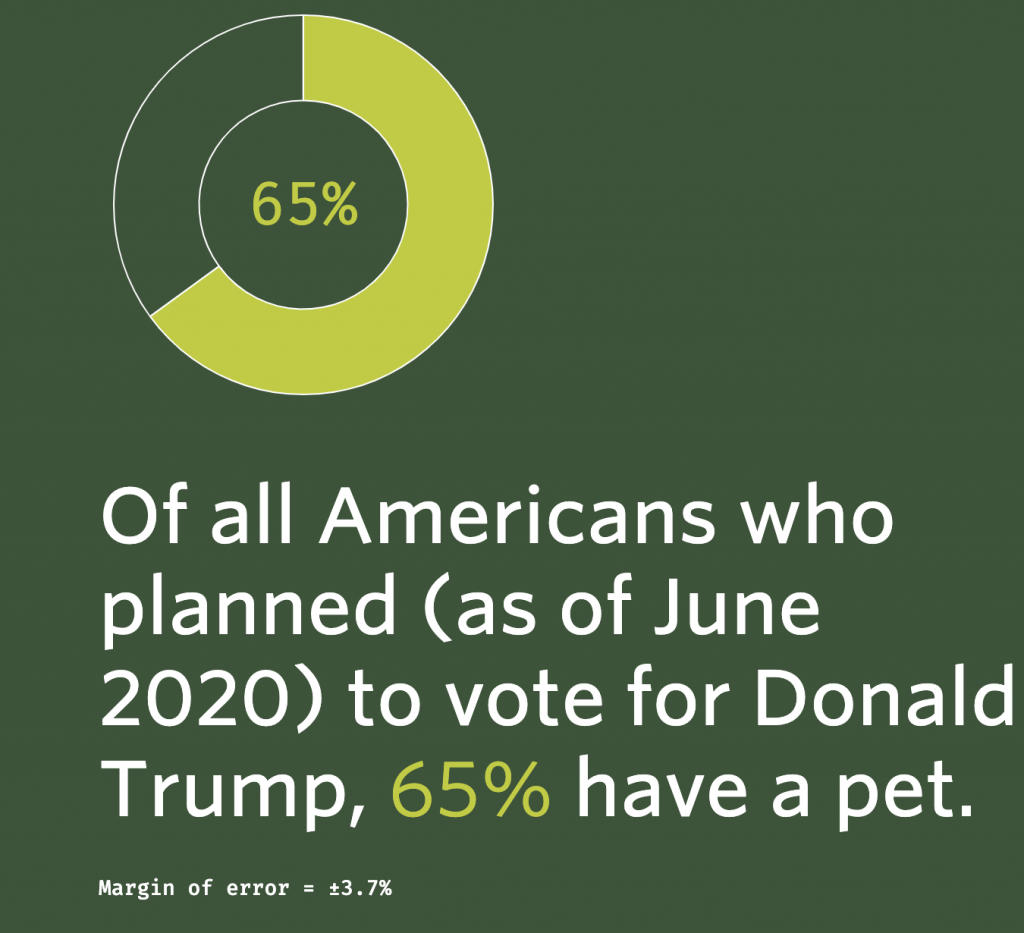
We surveyed a nationally representative sample of 1,267 Americans from May 29-June 10, 2020. Biden led by 50.5%-37%. That result is now far out of date. However, respondents answered more than 350 questions either in this survey or in surveys that they had taken previously. As a result, we are able to look at many more attributes of the electorate than in a typical political poll: matters like which chronic diseases Biden and Trump supporters have, whether they donate money to colleges, how they define their identity, and whether they have pets. (In case you’re wondering, Trump voters are 8 points more likely to have pets.) Given the remarkable stability of the race, I am confident these patterns still apply.
This new article on the Equity Research website provides a lot of detail. Here I’ll just share the portion about identity. All the statistics reported here are for likely voters: those who rated their own chances of voting in November 2020 as seven or higher on a 10-point scale.
Only 10% of whites said that race was important to their own identity (or “salient”). Among that group, Trump led by 61.5%-31%, whereas Trump’s lead among other whites was just 5 points (47%-42%–less than a majority).
More than half of African Americans (57%) said that their race was salient, and those African Americans supported Biden over Trump by 96%-3%. The margin was somewhat closer (80%-10%) among African Americans who did not report that race was salient
About one third (31%) of Latinos said that race was salient, and they favored Biden by 67%-23%. Among the majority of Latinos who said that race was not salient, Biden’s margin was somewhat narrower (60%-19%).
Biden led narrowly (48%-42%) among women who see gender as salient, but by a wide margin (52%-30%) among those who do not. Women who see gender as salient were also more likely to identify as conservative compared to women who do not see gender as important to their own identity (26% versus 18%). It appears that women who see gender as salient are more often expressing traditionalist views of gender rather than feminist views. Biden also performed better among men if they did not see gender as important to their identities.
Twenty-eight percent of voters reported that religion was important to their identity. Trump led 58%-31% among those voters, whereas Biden led by a similar margin, 58%-29.5%, among voters who did not see religion as salient.
As shown in Fig. 1, Biden led among all categories of people who felt that class was not important to their own identities, and especially among those in the lowest and highest income categories who felt that way. Trump led by substantial majorities among people who felt that class was important to their identities and were in either the low- or high-income brackets. In other words, Trump led among working-class people who identified with their class and among wealthy people who identified with their class.