public event on Governing the Commons: 30 Years Later with discussion of policing and climate change

The Ostrom Workshop at Indiana University is offering a virtual event on October 2, 2020 – 9:00 AM – 12:30 PM. It celebrates the 30th anniversary of Elinor (Lin) Ostrom’s Governing the Commons. I’m on the panel about environmental justice and policing studies, and there are other panels about social-ecological systems thinking and practice; polycentric governance; and the “‘new commons’ (health, data and knowledge, urban).” It’s free but registration is required.

See also insights on police reform from Elinor Ostrom and social choice theory; new chapter on Elinor Ostrom and Civic Studies; and many previous posts on this blog.

defining civically engaged research in political science @APSA2020

If you’re participating in the American Political Science Association’s virtual annual meeting this year, there’s a Roundtable on Facilitating Civic Engagement Research
(Sep 9 – 4:00 pm – 5:30 pm EDT) with Richard Davis, Mary Currin-Percival, Eitan Hersh, Diana Owen, Stella Rouse, and me.

“Civic engagement research” can mean research about civic engagement, which is my main job. Such research can be empirical, asking what causes various people to engage (or not) in various ways, and what their engagement accomplishes. Or it can be normative, asking what makes engagement good or bad, a right or a duty.

I am also interested in research that is done in a civically engaged way. Amy Cabrera Rasmussen, Valeria Sinclair Chapman, and I direct the APSA’s Institute for Civically Engaged Research as an annual seminar for political scientists who want to learn to work in an engaged way.

One conclusion I take away from ICER so far is that there’s a robust debate about what defines civically engaged research.

One kind of definition is methodological. On this view, you are doing civically engaged research if you form a research partnership with a group or network of people outside academia and frame your questions, collect and analyze your data, and disseminate the results together with the partner. This definition is content-neutral and not necessarily connected to any particular ideal or agenda. Perhaps entering a partnership simply helps you to generate certain kinds of knowledge and insight.

A different definition is about solidarity. The civically engaged researcher conducts research as a way of being part of some group, or a strong ally of it. The group in question might be demographic, but not necessarily. Sometimes, for example, researchers express solidarity and membership in the geographical community where they work. This definition can be methodologically neutral–you’d be a civically engaged researcher if you do your research as a Chicagoan, regardless of whether you use ethnography or multivariate regression or any other method.

A third definition suggests efforts to make research influential–to connect research directly to public conversations, policy analysis and advocacy, or trainings and program evaluations. This definition encompasses efforts that begin inside academia, whether or not they involve partners. One of many such examples would be the Center for Inclusive Democracy, on whose advisory board I sit. They produce research studies, policy briefs, a tool for citing polling locations, datasets and maps, and public presentations. Tisch College’s new Center for State Policy Analysis also fits this model, or Tufts’ Equity Research Group.

CIRCLE, which I directed for seven years, has bridged these definitions to some degree. CIRCLE has formed many specific research partnerships with grassroots groups. Its original board consisted of scholars and practitioners who represented a nascent theory/practice community for youth civic engagement. Some of them identified as “youth,” which means they belong to CIRCLE’s population of interest. CIRCLE has always employed at least one key staff person whose main responsibility is to develop and tend partnerships. At the same time, CIRCLE began in academia, with political scientists as its first two directors; and some of its work has been relatively detached empirical social science meant to affect the world.

See also: civically engaged research in political science #APSA2019; engaged political science; scholarship on engaged scholarship; and Apply for the Second Annual APSA Institute for Civically Engaged Research (ICER) at Tufts University’s Tisch College, June 15-18, 2020

let’s go for a walk

A human is a spidery thing: digits,
Appendages for sensing the currents,
Good for catching, clutching, striking, stroking;
An upright anemone, an antenna.

A dog is a nose-delivery system,
Built for forward motion with detours:
A face on propulsive feet, a torpedo
(Until sacked-out, done for now, recharging).

Joined by the filament of a leash that
Ties me to him as much as him to me,
We loop through a net of scents, sounds, memories,
Tugged back to the door that keeps us both safe.

discrimination boosts civic engagement

My colleagues Debbie Schildkraut and Jayanthi Mistry have published a new research brief on the Tufts Equity Research page. They find that people who feel they have experienced discrimination are more likely to be involved in civic activities like canvassing and contributing money to causes. People who have been discriminated against are also more confident in their ability to address community problems.

For example,

As figure 4 shows, as the frequency of perceived discrimination in the past 12 months increases, the likelihood of having worked with others informally to solve a community problem increases substantially. While a white or Hispanic person who has never experienced discrimination the past 12 months has only a 25% chance of this type of collaboration, a white or Hispanic person who experienced all types of discrimination frequently has a 72% chance. Black respondents show an equally impressive increase in engagement (19% to 63%)

Viewing one’s own racial or ethnic identity as important does not boost civic engagement. Neither does thinking that being American is important. However, “When people are prompted to think specifically about their relationship to a larger group and its potential power, their racial identity and American identity matter more than perceptions of discrimination in promoting civic engagement.”

Read the rest here.

where have we already seen second waves of COVID-19?

I’m definitely not an epidemiologist, so take this post with thousands of grains of salt. But I am trying to think about whether we should expect a major second wave of COVID-19.

Andrew Atkeson, Karen Kopecky, Tao Zha look at the 23 countries and 25 states with the highest death tolls and find a consistent pattern for all of them. One clear peak has been followed by “relatively slow growth or even shrinkage of daily deaths from the disease.” These are illustrations of the classic pattern:

There is enormous variation in the death rate at the peak. For instance, at their respective peaks, 24 people per million died each day in Belgium, versus 0.27 per million in New Zealand. Yet most states and countries–and all the ones included by Atkeson, Kopecky, and Zha–look similar 20-30 days after the peak. Belgium, for example, has had less than one daily death per million since June 12.

However, some countries and states do not exhibit this pattern. I have found pretty clear evidence of second peaks in Croatia, Iran, Israel, Japan, and Turkey, plus Idaho, Louisiana, and Mississippi.

I included the USA in the graph because it also shows two humps (the second smaller than the first). However, disaggregating US data to the state level suggests that there were simply two batches of states that had one peak each. At the state level, the only true second peaks that I see are in Idaho, Louisiana, and Mississippi. There are also some cases, like Australia, in which you can see a second peak if you squint–but the death rate has never been high. And there are countries, like Ukraine, that seem to wobble upward slowly without peaking,

Reading Atkeson, Kopecky, and Zha, one might guess that most badly-afflicted countries have accomplished impressive declines by implementing interventions. That is not such good news, since these policies are costly and hard to sustain. But it would be surprising if all the jurisdictions in their sample accomplished the same outcome in 20-30 days despite applying divergent policies. There is some chatter that these places have reached herd immunity, but I am convinced by Howard Forman and others that’s not what’s happening. Still there could be a strong tendency for COVID-19 to taper off for other reasons, which might offer good news.

It could also be the case that we simply haven’t seen many second waves yet. When you play Russian Roulette, things often go fine for a while, but the game always ends the same. Possibly places like Turkey and Croatia and Idaho and Louisiana demonstrate that we’re all at risk of a resurgence at a random moment.

Some European countries have recently reported increases in cases, although not deaths. Perhaps this is only because of increased testing rates–but then again, why is testing becoming more common unless rising numbers of people are experiencing symptoms? Deaths may follow.

In any event, I am searching and waiting for more information about the actual second waves. Why have they happened and what can we learn from their experiences?

taxing and spending are more compatible with democratic values than regulation is

Democratic governments can choose what and how much to tax and how to spend the resulting revenue without undermining essential aspects of good governance: accountability, representativeness, rule of law, transparency, public deliberation, and the ability to learn from experience. In fact, better governance tends to accompany higher government spending.

Regulation is more difficult to square with democratic values and other aspects of good governance. Complex regulatory systems create tensions with democracy and other political values, which I briefly explore below.

This is why I am hopeful about proposals like the Green New Deal, which promise to address profound crises by taxing and spending. Insofar as we must also address the climate crisis by regulating (which may be necessary), we’ll face more difficult tradeoffs between ends and means–between essential environmental outcomes and improving our politics.

In any republic, whether a true democracy or not, we must know who the decision-makers are and what they do in order to hold them accountable. We must be able to predict the consequences of their actions to plan our own behavior, thus gaining a reasonable level of control and responsibility.

These two principles imply that state decisions should be made by finite groups of clearly identified actors, e.g., the 535 Members of Congress and the President, acting on the record. Their policies should be as clear, uncomplicated, and durable as possible. As Madison writes in Federalist 62:

The internal effects of a mutable policy are … calamitous. It poisons the blessings of liberty itself. It will be of little avail to the people, that the laws are made by men of their own choice, if the laws be so voluminous that they cannot be read, or so incoherent that they cannot be understood: if they be repealed or revised before they are promulg[at]ed, or undergo such incessant changes, that no man who knows what the law is to-day, can guess what it will be to-morrow.

Taxation is compatible with these principles. A tax usually requires a recorded vote in Congress and the president’s signature, so we know who enacted it. Although there can be some ambiguity and unpredictability about who ultimately pays–companies try to pass their taxes on to consumers–you often know if you are paying a tax. You can decide if you think it’s worth it.

Regulation can also be compatible with these principles. If Congress banned automatic weapons, that would be a clear regulation for which representatives could be held accountable. No one can be sure of its downstream consequences, such as its effects on the homicide rate. But the direct effect is very clear: companies must stop selling automatic weapons to consumers.

However, regulations often violate these principles. In a complex society, regulations that are designed to maximize outcomes (such as safety or efficiency) will be complicated, and they will have to change frequently to keep pace with changes in society. Congress cannot write such regulations. It is composed of too few people with too little time and expertise. Congress almost inevitably delegates its regulatory power to regulators. Those people are often dedicated, underpaid civil servants. Yet they are anonymous and numerous, and they have interests and biases that are hard to know, let alone control. They can write regulations to benefit incumbent companies and industries and to discourage competition. Special interests can capture the regulatory process. Meanwhile, Congress has every incentive to take credit for the declared intentions of a law while delegating the tough choices to regulators, thus dodging responsibility. A particularly common move is to pass a law that requires incompatible outcomes–like safety and economic efficiency–and then complain about the actual regulations.

To be sure, taxes can also be designed in ways that are complex, mutable, opaque, and biased in favor of incumbent interests. The federal tax code is 2,600 pages long, with too many exemptions and loopholes. However, the Code of Federal Regulations is 186,374 pages long, or 72 times as long. Several times as many pages are added to the CFR each year (including under Trump) than comprise the entire tax code.

Big differences in quantity (like a 72-to-one ratio in page numbers) can turn into qualitative differences. Taxing and spending are more transparent and predictable than regulation.

I vote for parties and candidates who are relatively favorable to both regulation and taxing-and-spending. Often those interventions promote equity and the public good. I understand them as components of a mixed or pluralist political economy, which is the kind I support.

Nevertheless, it is always important to consider the costs and risks of good things. For the drawbacks of taxation and regulation, it’s worth reading or rereading classical liberals/libertarians and public choice theorists. I believe they offer stronger arguments against regulation than against taxation. Their concerns are especially relevant when the regulatory state lacks both legitimacy and actual capacity. Then the odds are low that agencies will achieve clear victories as they address complex public problems. Their impact is likely to be ambiguous and contested, at best. Under these circumstances, it is much more promising to raise revenues and purchase solutions that all can see.

See also: on government versus governance, or the rule of law versus pragmatism; on the Deep State, the administrative state, and the civil service; The truth in Hayek; how a mixed economy shapes our mentalitiesChina teaches the value of political pluralism; better governments tend to be bigger; A Civic Green New Deal; and the Green New Deal and civic renewal.

police discrimination, race, and community poverty

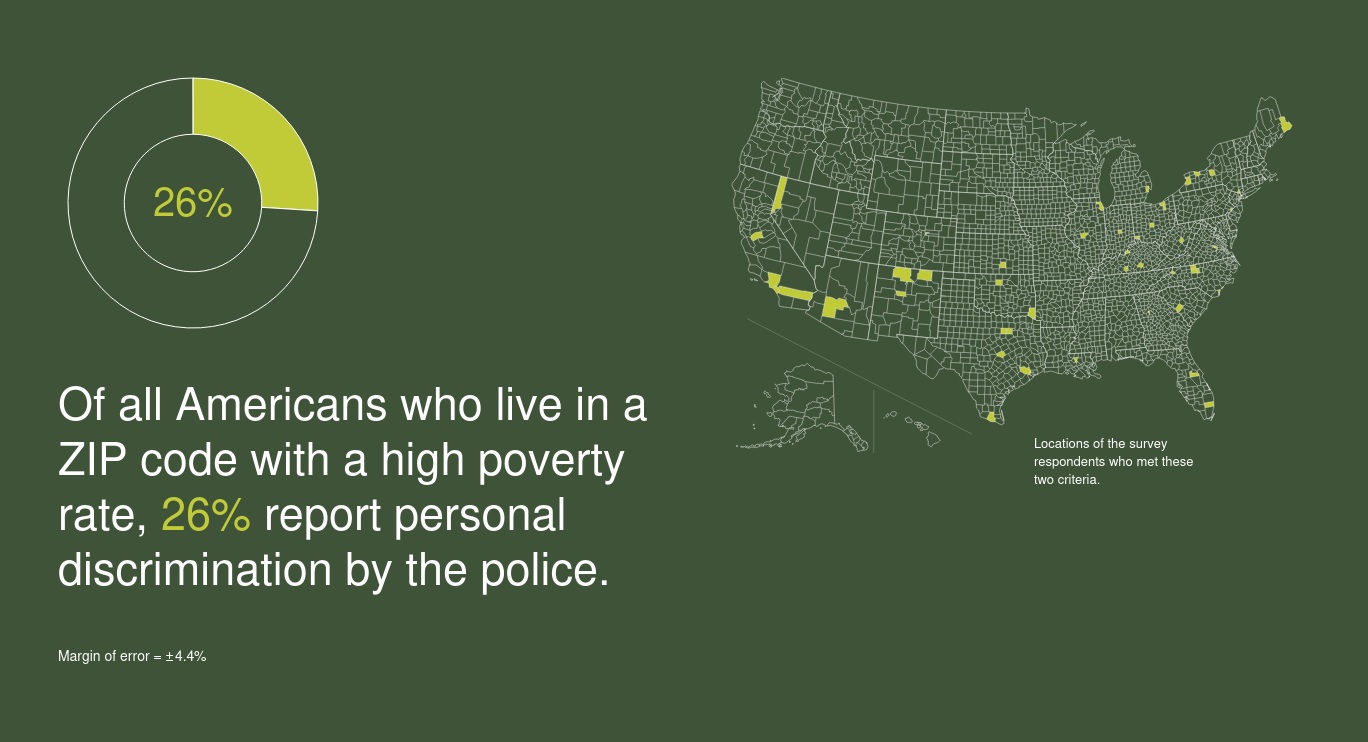
Our new Equity in America website shows that more than a quarter of Americans who live in high-poverty ZIP codes report having been personally mistreated by the police. That is 10 points higher than the rate in high-income communities.

Zooming in on the map shows that many of the people in our survey who live in high-poverty ZIP codes and who reported police discrimination reside in smaller cities or towns. Chicago, Miami, Queens (NY) and Los Angeles each supply one person in our survey who met these criteria, but so does my hometown of Syracuse, NY, Aurora, CO, and Spokane, WA, for example.

So I formed the hypothesis that living in a low-income, smaller community might be a risk factor for police discrimination. I tested that hypothesis with a binomial logistic regression, treating being discriminated against by the police as a yes-or-no matter. This is a similar method that might be used to predict being hired for a job or getting a disease. These issues are very different morally, but we can use the same math.

For possible predictors, I considered race, gender, education, age, English-language proficiency, household income, housing type, county-level income (not self-reported, but from Census data), and any mental health diagnosis.

It should not surprise anyone that being African American is the major risk factor. If we include any police discrimination, being Black raises the odds of being mistreated by the police almost five-fold (4.6 times), and that result is statistically significant at any level. If you exclude discrimination that happened far in the past, being Black still raises the odds threefold (2.955 times).

Identifying as female cuts your odds in half or better. More education helps, to a statistically significant yet modest degree. (This implies that highly educated African Americans have almost the same risk as those with little schooling.) The risk declines with age, but that pattern just misses being statistically significant, as does the risk from being Latino. Having a low family income, not speaking English well, reporting mental health issues, and living in an apartment rather than a house are not significant predictors. Neither is living in a poor ZIP code or a town or rural area as opposed to a city.

In short, my hypothesis about community factors was not correct–the race and gender of the individual is what matters. However, it remains true that a lot of police discrimination occurs in smaller, low-income communities, and that has implications for how we should address this grievous problem.

See also: Two-thirds of African Americans know someone mistreated by police, and 22% report mistreatment in past year; more data on police interactions by race; insights on police reform from Elinor Ostrom and social choice theory; and explore the dimensions of equity and inequity in the USA.

explore the dimensions of equity and inequity in the USA

How did I spend my summer vacation? Mainly, working with colleagues to build this new website.

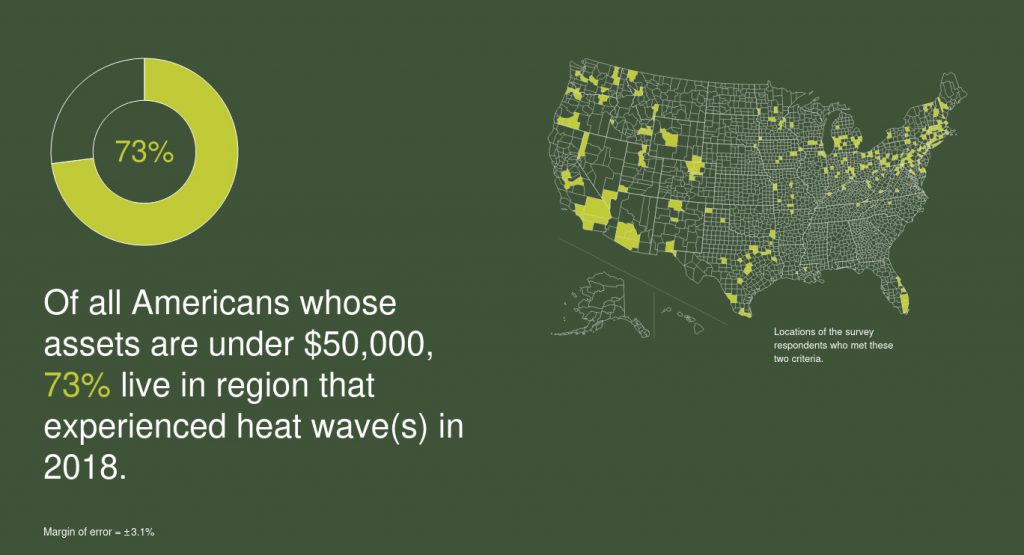
You can use it to explore how various categories of Americans–racial groups and genders, people from different walks of life, voters supporting Trump or Biden, and more–fare on a whole range of social outcomes, from having diabetes, to being confused for someone of the same race, to being laid off because of COVID. A very simple interface yields results like this:

The site also presents “research briefs” based on the underlying survey data that go well beyond the queries that you can run yourself using on the homepage. So far, they are about COVID and policing; more are coming.

This is an effort to inject some additional facts into the public debate, to experiment with data-visualization, and to bring faculty together from across a research university to combine their disciplinary perspectives on one multifaceted issue.

See also: debating equity; defining equity and equality; sorting out human welfare, equity and mobility; college and mobility; and 14 kinds of research we need for #reducinginequality.

better governments tend to be bigger

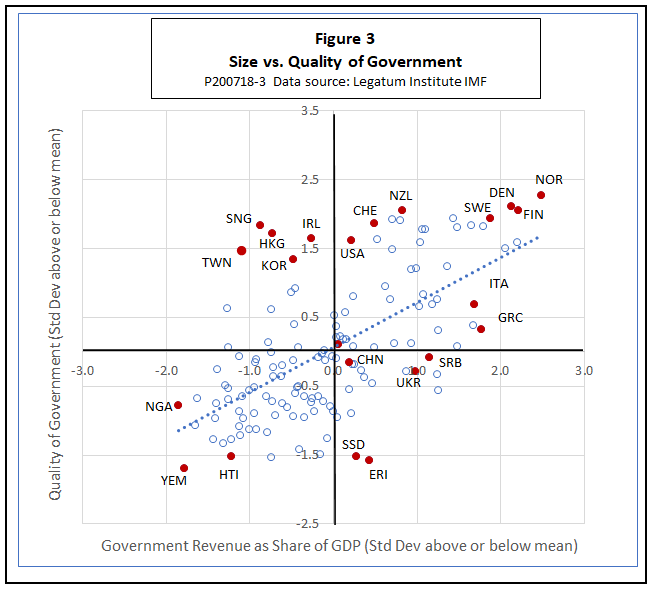
In an article entitled “Quality of Government: A Statistical Portrait,” Ed Dolan displays a positive relationship between the size and the quality of government:

It’s true that richer countries tend to have both better and larger governments, so this correlation could be driven by wealth. However, in a regression model that controls for GDP, the relationship between the size of government and the quality of government remains strong and positive.

Here, size of government means state revenue as a share of GDP. Dolan omits petro-dependent countries, because they are on their own path, but suffice it to say that some of them have a lot of revenue and poor government. (They would go in the bottom-right quadrant, which is almost empty without them.) Dolan’s measure of quality comes from the Legatum Institute and is an index of the following components:

  1. Rule of law
  2. Government integrity 
  3. Protection of property rights
  4. Contract enforcement
  5. Protection of investor rights
  6. Executive constraints
  7. Government effectiveness
  8. Regulatory quality
  9. Government accountability

Dolan also provides suggestive evidence that “life is better in countries that have high-quality governments, and even more so when those governments are both higher-quality and larger. That is true both when a ‘better life’ is defined in terms of the satisfaction of basic human needs and when it is defined in terms of human freedom.” 

This article appears on the website of the Niskanen Center, which leans libertarian or pro-market, in a pragmatic and open-minded way. Most of the nine quality measures above are ones that a market-oriented economist would endorse. When someone like me, who usually votes for the left wing of the Democratic Party, cites this kind of study from this kind of source, it can look like a kind of gotcha. “See, pro-market economists admit that government helps.” But that is actually not my motivation. I am genuinely committed to individual rights and liberty, including economic liberty, and I want to be pragmatically open to what works.

I’d acknowledge, too, that if this chart measures “quality” accurately, then the USA gets more bang for our buck than, say, Sweden. We spend less of our GDP on government yet get almost as good a government. The only reason to prefer the Swedish model would be a somewhat different definition of “quality” (which I would probably defend).

Still, it seems intuitive to me that people are more free–in all senses, including libertarian ones–in the countries at the top-right of Dolan’s chart. (See: the Nordic model.) It is also intuitive that few countries other than petro-states spend a lot and get poor government and individual freedom. So this graph should be the premise for discussions of how we can obtain both more and better government.

Hilary Mantel and Walter Benjamin

Both the Mishna (Sanhedrin, 4) and the Quran (5:32) advise that to kill one person is like killing all human beings.* The Mishna says that God created humanity in the form of one original person to remind us of that fact. It means that when Henry VIII had Thomas Cromwell’s head chopped off on July 28, 1540, Henry destroyed a whole world.

Hilary Mantel proves this fundamental moral truth by richly imagining the inner life of the Tudor politician in the three volumes of her Wolf Hall trilogy. The main character (almost always called “he,” without a name), progresses through time and interacts with other people like an ordinary fictional protagonist, but often the narration traces his mind as it jumps to the past or envisions possible futures. Much of the trilogy is devoted to daydreams.

Cromwell is an unlikely candidate to be liked–a shrewd and sometimes ruthless political actor, a Protestant fundamentalist (in our terms), and a royalist. He’s also poorly documented. Most people have seen him as the villain or–at best–the cipher who killed Thomas More and Anne Boleyn. His portrait by Hans Holbein makes him seem private and distant. He is literally set further away than Holbein’s other subjects.

I’m guessing that is why Mantel chose him: to exercise her genius for sympathetic imagination. She must invent most of his past and his inner life, presenting a whole subjective world that would otherwise be opaque. We care for Cromwell not because we agree with him or have behaved like him, but because we can see a whole world through his eyes.

Mantel’s imagination is extraordinary, whether she is conjuring ordinary physical things like plums and footstools or spinning stories around the documented facts. Just for example, Elizabeth Seymour is sure she has been chosen to marry Thomas Cromwell. But he has invited her to marry his son. They talk at cross-purposes for a whole conversation until the awkward misunderstanding dawns on both of them. Who but Mantel would have thought to insert that twist?

In his essay “The Storyteller,” Walter Benjamin explores a distinction between a story and a novel. A story is succinct, vivid, subject to many interpretations, meant to be remembered in full and retold to others. It is a communal object, recited orally to a group of people who enjoy each other’s company as they listen and speak in turn.

In contrast, a novel is profoundly individual, a silent communication from one author to one reader at a time. It provides so much detail and interpretation that the reader’s creativity is constrained by the author’s intentions; and it’s too long and carefully constructed to be paraphrased, let alone memorized and retold. Although novels have diverse subjects, the classic topic is one person’s inner life as he or she progresses toward a conclusion; and the clearest conclusion is death. Don Quixote is the “first great book of the genre.”

The novel arises once words can be mass produced for private consumption. It is a capitalist object, meant for a market. It also arises when people become truly afraid of death–not just of dying, but of observing and talking about death. “Dying was once a public process in the life of the individual and a most exemplary one.” But in the bourgeois 19th century, “the general consciousness the thought of death … declined in omnipresence and vividness.” The novel fills a gap by allowing us to imagine the death of an individual who is safely fictional as a way of contemplating our own mortality.

In a story, the hero is admirable beyond realism but hard to imagine from the inside. In a novel, the protagonist is flawed, and the more you read, the more flaws you see. Don Quixote “teaches how the spiritual greatness, the boldness, the helpfulness of one of the noblest of men, Don Quixote, are completely devoid of counsel and do not contain the slightest scintilla of wisdom.” Yet we identify with the protagonist because her or his life functions like ours. Any life is a vast array of experiences, memories, and hopes, banal in their totality but unique in their details. A novel consoles us by implying that our life, too, is worthy. Benjamin says:

To write a novel means to carry the incommensurable to extremes in the representation of human life. In the midst of life’s fullness, and through the representation of this fullness, the novel gives evidence of the profound perplexity of the living.

A life is coherent because the present person has memories of her or his own past. Each of us has a unique collection of memories, and we are sufficiently attached to it that we are sad to think it will vanish with our deaths. We vainly counter that fate with monuments and memoirs and by boring children with our recollections. But a novel allows us to see someone else’s memories as a permanent object:

“No one,” Pascal once said, “dies so poor that he does not leave something behind.” Surely it is the same with memories too—although these do not always find an heir. The novelist takes charge of this bequest, and seldom without profound melancholy. …

The novel is significant, therefore, not because it presents someone else’s fate to us, perhaps didactically, but because this stranger’s fate by virtue of the flame which consumes it yields us the warmth which we never draw from our own fate. What draws the reader to the novel is the hope of warming his shivering life with a death he reads about.

Benjamin means to criticize the novel and lament the decline of the story. But his real target is capitalism, and the novel gets caught in the crossfire. Certainly, he understands what an achievement a novel is. And none seems to fit his theory better than Mantel’s trilogy.

Particularly as Cromwell approaches his end, he seems obsessive about cataloging his past, as if he could leave it as a coherent legacy. He thinks:

All your life you tramp the empty road with the wind at your back. You are hungry and your spirit is perturbed as you journey on into the gloom. But when you get to your destination the doorkeeper knows you. A torch goes before you as you cross the court. Inside there is a fire and a flask of wine, there is a candle and beside the candle your book. You pick it up and find your place is marked. You sit down by the fire, open it, and begin your story. You read on, into the night.

This scene of reading is exactly how Benjamin understands the novel, in general. It is a private experience of taking stock of a life to persuade oneself that it has meaning, even though each of us is but one among billions and fated to vanish.

Benjamin would probably emphasize that Thomas Cromwell was an early bourgeois, building a commercial commonwealth at the expense of the aristocracy and the clergy. Mantel describes foreign and court politics more than domestic policy, but the novel probably conveys–and it is plausibly true–that Cromwell revolutionized English society along bourgeois lines. That would make him a perfect choice for the protagonist of a Benjamin-style novel.

Benjamin doesn’t mention that Quixote is about two men, not one. So is the Wolf Hall trilogy. Cromwell tells Henry:

“What would I want with the Emperor, were he the emperor of all the world? Your Majesty is the only prince. The mirror and the light of other kings.”

Henry repeats the phrase, as if cherishing it: the mirror and the light. He says, “You know, Crumb, I may from time to time reprove you. I may belittle you. I may even speak roughly.”

He bows.

“It is for show,” Henry says. “So they think we are divided.”

As this passage suggests, Cromwell and Henry are mirror and light to each other. We can see their relationship either way, Cromwell reflecting the royal will or Henry shining because of Cromwell’s brilliance. Cromwell can also see himself as a combination of the mirror and the light. “The silver plate, reflecting himself to himself: the mirror and the light of all councillors that are in Christendom.”

As in the original master-slave dialectic, Henry needs Cromwell as much as vice-versa. Both are appealing in their respective ways, mixing needs and interests with a strong sense of responsibility. Each embodies his proper role–much like Archbishop Cranmer, who “does what is in him. It is all any man can do.”

It’s important that the trilogy is historical fiction. Mantel gives us access to an unfamiliar objective world along with an unfamiliar subjectivity. The implication is that a lifeworld can survive for five hundred years after the observer dies; maybe the same can happen to you or me. Yet the result feels fragile and precious, dependent on Cromwell’s survival as a character and Mantel’s art. That fragility charges the novel with suspense even though most readers will have a pretty good sense of how things must end. (Well, it’s how all things must end.)

Mantel has invented a diction to summon the world of her novel: 21st-century English that closely describes 16th-century England, with a dose of free indirect discourse (third-person narration that adopts some of the tone of the character being described). Clear anachronisms are rare and may be mistakes. “Why do we not, as the tennis players say, cut to the chase?” asks Ambassador Chapuys, using a phrase that originated in early Hollywood. Several characters refer wittily to the sentence, “Et in Arcadia ego,” which was coined ca. 1618. And Cromwell’s thought, “Florence made me … London unmade me,” suggests a reference to Purgatorio, V. 133, which only became famous after 1800. If these are flaws, they are tiny, and perhaps it’s best to think of the book as a loose translation of 16th century speech into modern English.

In sum, Mantel seeks to build something that is a terrible shame to end. That is exactly what we should say about any human life: even the life of a renaissance courtier who had many other people’s deaths on his conscience. In this sense, the novel is a moral achievement as well as a creative one.

*I ignore knotty questions about these two texts and how they relate. Most of the online commentary about them is sectarian and uncharitable toward other people’s faiths. Let’s assume that many Jews and many Moslems have read these passages in the way I am suggesting here.

See also: Hilary Mantel, Wolf Hall; Hilary Mantel, Bring Up the Bodies; history and fiction in Hilary Mantel’s A Place of Greater Safety; Calvino’s free hyper-indirect discourse; and Kieran Setiya on midlife: reviving philosophy as a way of life (with a digression on Benjamin and the importance of death in the novel). My own effort at a Tudor novel is The Anachronist. Finally, Clair Wills offers a much less favorable review in The New York Review. I don’t share her verdict, but she makes significant points.