prospects for nonviolent resistance in Ukraine and in Russia

It is not inevitable that Russia will gain control of large portions of Ukraine, but that outcome is certainly possible, even if the invaders must resort to sustained shelling and bombing to capture cities. If an occupation does come to pass, I would anticipate (and support) an armed insurgency. My topic, however, is the possibility of nonviolent resistance–in Ukraine, in Russia, and even in Belarus.

I make no assumption that nonviolence is morally superior to war. An insurgency will be fully justified in the event of an occupation. However, I believe:

  • Nonviolence has powerful potential.
  • A nonviolent movement can complement a violent insurrection, as was the case in British India, South Africa under apartheid, or Palestine 1987-93 (notwithstanding major differences among these examples).
  • A nonviolent movement permits a whole population to participate in forging a democratic future together, whereas a military effort is intrinsically hierarchical and selective; and
  • The circumstances for nonviolence could be propitious. Here I will make a cautious case for optimism.

Already, we see effective moments of nonviolent resistance in Ukraine. This is the widely-viewed video of a Russian tank turning around and driving away when confronted by civilians (apparently near Zaporizhzhia). Although many such cases will have tragic results, the example is powerful. Presumably, most Russian soldiers do not want to run over or shoot Ukrainian civilians. Their reluctance will be a serious challenge to the Putin regime.

Restraint by ordinary Russian soldiers is one reason for tentative optimism. I do not share the view that Russians will be restrained because of their cultural, linguistic, and other similarities to Ukrainians. During this period of very strongly justified concern about racism, we sometimes forget that people can eagerly slaughter others who look just like them. Ukraine from 1932 to 1945 (or even from 1914 to 1945) provides catastrophic examples. Putin’s problem is different. He has failed to legitimate the invasion in any way; and human beings rarely like killing other people unless a war has been legitimized (or they are scared of being killed first).

A second favorable circumstance: Ukraine may have the largest number of highly experienced nonviolent civil resisters in the world, thanks to the successful Revolution of Dignity (2014), which is pervasively and eloquently memorialized in the parts of the country that I have visited. Certainly, the Russian regime–and any puppet regime it installs Ukraine–will be more ruthless than many of the governments that have lost to nonviolent protests. At the same time, the Ukrainian nonviolent resistance will be particularly large, experienced, and motivated. An almost unstoppable force will meet an almost immovable object, with unpredictable results.

Size is an advantage for nonviolent movements. Erica Chenoweth and Maria Stephan found that no major protest movement between 1900 and 2006 failed if it mobilized 3.5 percent of the national population. Their work has inspired claims like this one: “Once around 3.5% of the whole population has begun to participate actively, success appears to be inevitable.” The word “inevitable” overstates Chenoweth’s and Stephan’s findings: the next effort could end in failure. Many of the fully successful cases occurred during a period (ca. 1985-95) when authoritarian regimes were senile and demoralized, whereas lately they have proven resourceful and resilient.

More importantly, some people have drawn a mistaken inference from Chenoweth’s and Stephan’s finding, assuming that the presence of 3.5 percent of the population on the streets causes a regime-change or another major policy shift. As several experts have told me, the causal story is almost certainly different. If a set of organizations and networks is able to get 3.5 percent of the population onto the streets against a government, then either it is strong enough to pose a serious threat, or else the failure of the regime to stop such a large protest indicates the government’s hesitancy, incompetence or internal divisions–or all of the above. In other words, 3.5 percent is a symptom, not a cause.

Still, we could expect a large nonviolent movement in Ukraine. Maciej Bartkowski summarizes a 2015 survey of Ukrainians that showed a high degree of hypothetical willingness to join a nonviolent movement against a foreign occupier. Of course, there is no way to know whether answers to such survey questions predict actual behavior, but so far, the level of mobilization in Ukraine exceeds expectations. In the 2015 poll, three times more people stated that they would act nonviolently than violently. Given the extraordinarily high rates of voluntary participation in the war so far, that ratio would imply that virtually every Ukrainian will take part in nonviolent direct actions.

Organization and leadership offer a third reason for optimism. A Russian guy who was aligned with Putin once badgered me with the question: “Do you believe in spontaneous revolutions?” He believed–as Putin probably sincerely believes–that the Ukrainian peaceful revolutions have been CIA operations. I could have named the Russian Revolution of 1905 as an example of a spontaneous uprising, since it seemed to come out of nowhere. But a better answer is: no. Massive popular movements are not spontaneous; they are organized. However, the Ukrainian Revolution of Dignity was organized by Ukrainians in a decentralized way (with modest European and US support), and many of the organizers are still around to try the same approach again.

I am not sure whether the same person can serve as the leader of a nonviolent movement and an armed insurrection. (Nelson Mandela is a special case, for many reasons, including that he was imprisoned.) President Zelensky, if he survives, will presumably head the insurrection, just as he currently serves as the commander in chief of Ukraine’s armed forces. Still, one can see his principled decision not to leave Kyiv as an example of the kind of sacrifice that nonviolence demands. He may inspire, even if he cannot organize, a nonviolent struggle.

The other side of the coin is the potential for nonviolent antiwar–or even pro-democracy–movements in Russia and Belarus. I have no way of estimating the chances of success in either country. However, we have already seen very brave Russians take to the streets as well as anti-war protests in Minsk. May they succeed, not only for Ukraine’s sake but also for the good of their respective countries.

A truly effective movement in Russia or Belarus would require the kinds of organization and coordination that state security agencies are increasingly effective at destroying. Therefore, no one should imagine that success will be likely or easy. Yet resistance can take many forms: not only massive public protests but also a palace coup, emigration and disinvestment, or what James C. Scott named the “weapons of the weak”: ordinary foot-dragging and noncompliance. Russians and Belarusians might use those tools out of genuine support for Ukraine or simply because they resent their superiors and their orders. The Ukrainian official Oleksiy Arestovich appealed recently to Russian soldiers: “Like any military person, you know that there are a million ways not follow the order … You get lost, you break down, the radio station does not work, etc. We believe in you and count on your courage, honor and prudence, which will allow you to make the right choice in this time of tension.”

Indeed, courage, honor and prudence can take a wide range of forms, from throwing a Molotov cocktail at an armored personnel carrier, to holding a sign in a Moscow street, to challenging Putin in a closed-door meeting, to just failing to understand an order on the radio. I am certain we will see a lot of all these things in the days and weeks to come. Whether they succeed is perhaps the most important question of all, unless the Ukrainian military can actually win a conventional war on the ground.

See also: why I stand with Ukraine (from 2015); working on civic education in Ukraine (2017); and Ukraine means borderland (2017). See also the case for (and against) nonviolence.

Save the Date: June 24 for a special one-day version of the Frontiers of Democracy conference, a Festival of Cases

If you are ready to register, you can purchase a ticket for the event now for either the in-person or online version (ticket prices go toward meeting our costs).
Otherwise, please hold the date!

Civic cases describe difficult choices faced by real groups of activists, social-movement participants, or colleagues in nonprofit organizations. By discussing what we would do in similar situations, we can develop civic skills, explore general issues, and form or strengthen relationships with other activists and thinkers.

You are invited to spend June 24 discussing your choice of two such cases in groups of up to eight peers. The day will also include plenary discussions and talks, including a keynote by Tisch College Dean Dayna Cunningham on Multiracial Democracy.

Most of the cases have been developed by the SNF Agora Institute at Johns Hopkins University, Justice in Schools, or the Pluralism Project at Harvard, co-sponsors of Frontiers this summer. Selected cases can be found here, and more options will be available by June. Unlike most cases about business, public policy, or ethics, these stories involve groups of voluntary participants who must make decisions together.

06/21/2018 – Boston, Mass. – The opening remarks were held for the Frontiers of Democracy Conference inside the Sackler Building on Thursday, June 21, 2018. (Jake Belcher for Tufts University)

You can choose to participate for the whole day remotely, joining other remote participants in Zoom rooms for the case discussions and watching the plenaries online. You are also enthusiastically welcomed to participate in-person at Tufts University’s downtown Boston campus.

Frontiers of Democracy has been held annually since 2009, with a hiatus due to the COVID-19 pandemic. It traditionally attracted about 140 activists and scholars or advanced students from many countries for relatively informal discussions of civic topics. The 2022 version is intentionally shorter and hybrid in format.


Purchase a ticket now or save the date!

Transformative Learning and Civic Studies

Newly in print: The Palgrave Handbook of Learning for Transformation, edited by Aliki Nicolaides, Saskia Eschenbacher, Petra T. Buergelt, Yabome Gilpin-Jackson, Marguerite Welch and Mitsunori Misawa (2022).

Although I am not deeply knowledgable about Transformative Learning, a movement launched by the sociologist Jack Mezirow, I like its emphasis on learning as a lifelong process of transforming one’s perspective on society.

This volume includes a chapter entitled “Reconsidering the Roots of Transformative Education: Habermas and Mezirow” by Saskia Eschenbacher and me (pp. 45-58). Our abstract:

Jack Mezirow acknowledged the deep influence of the German philosopher Jürgen Habermas (1929–) on the development of transformative learning. We describe some fundamental elements of Mezirow’s and Habermas’ thought, explore their affinities, and argue that Mezirow did not give adequate attention to two important themes in Habermas: the power and value of social movements and the need to reform the overall structure of a society to enable transformative learning. We argue that transformative learning would benefit from a deeper consideration of these topics. Finally, we introduce Civic Studies, a parallel intellectual movement that also owes much to Habermas, and we suggest a convergence.

when you know, but cannot feel, beauty

In his “Dejection: An Ode,” Coleridge describes the sparkling stars and crescent moon above but bemoans his own state of mind:

I see them all so excellently fair,
I see, not feel, how beautiful they are!

The reason is what we would call depression:

A grief without a pang, void, dark, and drear,
         A stifled, drowsy, unimpassioned grief,
         Which finds no natural outlet, no relief,
                In word, or sigh, or tear—

I consulted Coleridge’s “Dejection” thanks to Anahid Nersessian’s essay on Keats’ “Ode to a Nightingale” (Nersessian 2021). Nersessian is great at wiping away that sense of Keats as a languorous aesthete, a maker of pretty lyrics. As she shows, the Nightingale ode reports suicidal thoughts. The narrator is “half in love with easeful Death” and seriously considering whether it is time to end it all: “Now more than ever seems it rich to die.” The three hard opening words, as Nersessian notes, violate iambic pentameter and ignore the ostensible addressee of the ode. Keats doesn’t begin, “O, Nightingale …” but rather, “My heart aches.”

Nersessian’s essay is not a close reading, but it made me turn back to the text of the ode. I wondered: what exactly is the narrator’s mental condition? (Remember: Keats had medical training, and the first stanza seems almost clinical.) The presenting complaint is a heart that aches. More specifically, “a drowsy numbness pains / My sense.”

This is complicated. Being drowsy and numb suggests a lack of sensation, and that interpretation is reinforced by the analogy to a “dull opiate” that suppresses the narrator’s conscious thoughts, sending him toward Lethe. But the numbness “pains” his sense, as though he had drunk hemlock. I am not sure whether we should assume that hemlock causes a quiet, sleepy death or an agonizing one: Wikipedia suggests that it triggers respiratory distress. I think that the question of lacking consciousness versus suffering is central to the poem as a whole.

In any case, what is the etiology of this numbness/ache? The narrator denies that he is envious of the nightingale’s “happy lot.” (The word “thy” in that sentence is the first mention of the ode’s subject.) When people deny that they are jealous, sometimes they actually are. But the narrator follows with a subtler point. He does not envy the bird’s “happy lot,” where “happy” could mean “favoured by good fortune; lucky, fortunate; successful” (OED). The bird’s lot is to sing in the mid-May evening, and Keats denies being envious of that. Instead, the nightingale causes heartache by “being too happy in [its] happiness”–in other words, by enjoying its role. This is precisely what Keats’ narrator, being depressed, cannot do. The poem describes beauty, yet the narrator cannot feel what such precise and evocative words as these should convey:

The grass, the thicket, and the fruit-tree wild;
         White hawthorn, and the pastoral eglantine;
                Fast fading violets cover’d up in leaves;
                        And mid-May’s eldest child,
         The coming musk-rose, full of dewy wine,
                The murmurous haunt of flies on summer eves.

Do we think that the nightingale is happy, in the subjective sense–happy in its happiness? Keats writes that the bird “sing[s] of summer in full-throated ease.” I suppose I doubt that it sings “of” summer. I assume it sings because the month is May, and its song is a component of what makes an English early summer lovely. I don’t believe that the bird is describing summer, as a poet could.

To modify an example from Robert B. Brandom (who discusses a parrot trained to say “red” in the presence of red objects), the nightingale reliably informs us that it is summer by singing, but the bird cannot express the premises and conclusions that relate to this information. The bird cannot say, “It is summer; therefore, it is not winter,” or “It is summer because spring is over,” or “Since it is summer, we should spend evenings outdoors.” To express points like that would be to talk of summer. Instead, the nightingale sings because it is summer, and as an aspect of summer.

Indeed, its happiness relates to its ignorance. Keats wishes to forget

What thou among the leaves hast never known,
The weariness, the fever, and the fret
         Here, where men sit and hear each other groan;
Where palsy shakes a few, sad, last gray hairs,
         Where youth grows pale, and spectre-thin, and dies ...

That last line may describe the recent and agonizing death of Keats’ brother from tuberculosis, and it eerily foretells Keats’ own death from the same cause two years later. These are serious matters, wrenching tragedies, and the bird’s enviable condition is to know nothing of them. Its mental state is like that of a human being who has forgotten memories and fears of suffering.

We might expect that the bird’s song would cause Keats to forget pain, at least briefly, as he becomes absorbed in the music; but that doesn’t work for this narrator, because he is depressed. “Still wouldst thou sing, and I have ears in vain.” Instead, the narrator considers artificial solutions: “some dull opiate,” “a draught of vintage,” distracting reveries of “faery lands,” or–most effective of all, intentional death.

The darkness and anger of the poem should be taken seriously; it is not some pretty thing. Yet it is rapturously beautiful, the source of such nuggets as “tender is the night” and Ruth “amid the alien corn.” It is about not being able to feel beauty, yet it conveys beauty from that ailment.

In the fourth stanza, Keats commits to join the nightingale not by drowning his sorrows in drink but through the power of verse:

Away! away! for I will fly to thee,
         Not charioted by Bacchus and his pards,
But on the viewless wings of Poesy,
         Though the dull brain perplexes and retards ...

His brain is a problem: it perplexes and retards. “Poesy” looks, at least temporarily, like a way out. But why is it “viewless”? That word could mean invisible: we cannot observe how poetry moves the writer or the reader to a better place. Or it could mean unable to see. Certainly, this poet has trouble seeing. Due to the deep darkness where the nightingale sings, “I cannot see what flowers are at my feet.” Poetry offers words that name objects, but it does not actually allow us to see them. I think the central idea in the fifth stanza (Keats knows which flowers are present from their scent but cannot see them) is a metaphor for literary description. A poem conveys information but not actual experience.

Then he addresses the bird: “Darkling, I listen.” Calling a nightingale “darkling” is a clear allusion to Book III of Paradise Lost, where Milton writes:

            ... as the wakeful bird
Sings darkling, and in shadiest covert hid
Tunes her nocturnal note. ....

The argument of this passage is that God is light; beautiful things reflect God’s love. Since Milton is blind, he cannot see these objects. He misses the “sight of vernal bloom, or summer’s rose …  the cheerful ways of men.” Yet a miracle occurs. God makes the “celestial Light, / Shine inward,” and by purging and dispersing all the ordinary sights of life, allows Milton to “see and tell / Of things invisible to mortal sight.” Milton is like the nightingale, whose song tells of grace even though the bird cannot see in the darkness.

No such consolation is available to the narrator of Keats’ ode, who offers no hint that nature has a benign author. Nature is what gives people tuberculosis. Keats’ narrator is not only depressed but angry about it.

I will offer an alternative perspective, even though I don’t think Keats would agree with it. We are all like the nightingale; our vocalizations and other behaviors are caused by natural processes. (“Dependent origination.”) We cannot escape suffering, which is intrinsic to sentience and afflicts the bird as well as us. (“The first noble truth.”) Mental pain arises naturally. For instance, Keats must think of his recently deceased brother, because he is physically designed to feel grief. Forgetting such things is impossible, and drowning them out would be unethical. (“The middle way.”) However, Keats is not a real entity, and his condition needn’t interest the poet as much as it does. As he writes elsewhere, the poet “has no self”; “not one word I ever utter can be taken for granted as an opinion growing out of my identical nature–how can it, when I have no nature?” (“No-self.”) His protean mind can, however, fill with thoughts such as appreciation, gratitude, and compassion. (Mindfulness, the “third noble truth.”) The beauty of the night is real, just like suffering, and he can focus on the former.

Those who make it across the river and come back to help others over do the most good (“karma”), and Keats’ lyrics provide an example. They enrich the inner lives of us who read them. Keats claims no satisfaction from doing this, because he is depressed and because he doesn’t hold a Buddhist-ish theory. But he achieves what he cannot recognize, and we can read him compassionately for that reason. After all, the last five words (“Do I wake or sleep?”) are no longer addressed to the nightingale, which has departed for the “next valley-glades.” They must pose a question for us, opening a dialogue with readers and perhaps seeking our compassion, which we can give. If our minds are filled with compassion, we have less space for pain.

Keats was an unbelievably good poet. What if we can’t write immortal verse–can we then return to help others cross to a better place? I would say: Keats is a stranger to us, dead two centuries, and worth reading because his words are so excellent. The rest of us just say mundane things, like, “Did you hear that bird?” But we can say such things in relationships–to people we know and like or love. When embedded in a friendship or love, a remark like “Did you hear that bird?” conveys pleasure and care. By that means, we can alleviate suffering even if we could never come up with a phrase as good as “with beaded bubbles winking at the brim.”

Sources: Robert B. Brandom, Articulating Reasons: An Introduction to Inferentialism (Cambridge: Harvard University Press, 2000); Anahid Nersessian, Keats’ Odes: A Lover’s Discourse (Chicago: University of Chicago Press, 2021). See also the sublime and other people; the politics of negative capability; “Keats against Dante: The Sonnet on Paolo and Francesca“; a poem should; empathy: good or bad?; and three endings for Christabel.

US polarization in context

A comparative approach is useful for testing theories about one of the prominent phenomena of our time: polarization.

If you assume that people naturally polarize because of hard-wired features, such as the human tendency to prefer members of our own groups, then you would expect levels of polarization to be consistent across time and countries.

If you assume that polarization is specifically an American issue, you might look at unusual features of US society that have persisted over time, such as our two-party system, the salience of race and racism, sheer size, the private news media, or the fact that we have several regional elites who don’t necessarily know each other (Wall Street financiers, Texas oilmen, Silicon Valley entrepreneurs, etc.).

If you assume that the problem is global and recent, you might look at international developments, such as social media, plutocracy, the decline of a neoliberal consensus, or the revival of illiberal nationalism.

If you assume that the problem is specifically American and recent, you might focus on changes in the US system, such as the departure of Southern conservatives from the Democratic Party after the 1960s, or the replacement of national party structures with entrepreneurial candidates, or more sophisticated gerrymandering, or the election of Barack Obama, which may have alerted some White voters to the emerging reality that the Democrats are decisively more diverse than the Republicans:

The comparative graph for this post illustrates a few selected points.

FIrst, current levels of polarization in the USA are comparable to those in Weimar Germany or India at the time of partition and worse than Denmark’s under occupation. Bolsonaro’s Brazil and Venezuela score even higher than the USA today, but that is not good company. Polarization cannot be hard-wired if it varies so much, and our levels are alarming.

Second, social media cannot simply and straightforwardly explain the recent growth in polarization, for media would affect tech-savvy Denmark as much as the USA. Yet Denmark is one of several democracies that demonstrate consistently low polarization. (The EU as a whole shows some increase in polarization since 2000, but much less than the USA.)

Third, the USA has seen polarization increase a lot lately, which works against explanations that evoke stable features of US society, such as the two-party system.

I am not one who views polarization as an intrinsic evil. If a society is divided between democrats and authoritarians, the problem is not polarization; it is the authoritarians. Less division between good and bad players may indicate a harmful compromise. In the Weimar case, I think polarization posed a challenge to the fragile representative system, but the main problem was the Nazis. (Stalinists made things worse.) Describing Weimar as an example of “polarization” suggests that there were several groups who just didn’t get along. Instead, some groups belonged in jail.

Nevertheless, polarization poses challenges of its own. It encourages political actors at all levels to push their own rights and interests to the limits, without concern for any collateral damage to the institutions. The levels in the USA today exceed those in comparable countries by large margins and resemble those recorded just before notorious historical disasters.

Caveat: the graph (from V-Dem) does not show objective measures of polarization, but the assessments of social scientists who study these countries. See also: affective polarization is symmetrical; promoting democracy and reducing polarization; empathy boosts polarization; marginalizing views in a time of polarization; civic education in a time of inequality and polarization; vaccination, masking, political polarization, and the authority of science

the sublime and other people

Early last month, I posted a little poem in celebration of a deep snowfall. I was hardly the first. People appreciate natural phenomena, find ways to represent aspects of what they see, and share the results. We have done this, I suppose, for at least 64,000 years, since the oldest cave paintings we know.

In some cases, an explicit goal is to thank a benevolent power for the gift. For instance, I love how Gerard Manley Hopkins detects a Divine Father behind all “dappled things“–like “skies of couple-colour” or “a brinded cow.” “Praise Him,” says Hopkins. Unfortunately, I cannot share that type of explanation.

For others, the theme is the objective beauty of nature, understood as impersonal but perfect. “The hills / Rock-ribbed and ancient as the sun,—the vales / Stretching in pensive quietness between …” I must admit that I am struck by the subjectivity of such judgments. Our dog appreciates, but I don’t think he is much taken by distant vistas of snow on sagging branches. Smelly fire hydrants are closer to his sublime. A nest of cockroaches has as much objective complexity and order as a snow-covered forest, but most of us human beings (although not all of us) would recoil from it. Nature gives us pure drifts of fresh snow, but also muddy slush and freezing rain. These examples cause me to doubt that beauty lies in nature.

Another response is that we are constituted to enjoy things like snowy views, and this is a wonderfully good fact about us. Just as we may lament our human proclivities to violence, despair, and cruelty, so we can celebrate our ability to savor what we find sublime. And not only celebrate it, but actively cultivate this appreciation and share it with other people through the representations that we create. In that case, the beauty is essentially in us, but it is really there, and that is a reason for gratitude.

I don’t know whether human beings are automatically constituted to enjoy a snowscape. Perhaps we are, but our responses could vary by personality and culture. I am sure that my own appreciation is something learned. I do not simply see the snow; I see it with things already in my mind, like Christmas decorations, paper snowflakes on second-grade bulletin boards, Ezra Jack Keats’ A Snowy Day, Pieter Bruegel the Elder’s “Hunters in the Snow,” Han-shan’s Cold Mountain lyrics, Robert Frost’s ”lovely, dark and deep” woods, Hiroshige’s woodblock prints of wintry Japan, Rosemary Clooney with Bing Crosby. In short, I have been taught to appreciate a winter wonderland, a marshmallow world, and a whipped cream day. Some of these influences probably detract, but they were meant well, which is how I would defend “Hush.”

It’s sometimes said that when Petrarch climbed Mont Ventoux (in Provence) in 1336–simply to enjoy and describe the view–he was the first European ever to do such a thing. Clearly, some people outside of Europe had loved mountain views long before Petrarch. I find it plausible that certain communities of people appreciate vistas, while others do not. And some of us may have learned the sublimity of landscapes from a chain of people originally inspired by Petrarch, although he was surely influenced by the classical sources that he knew so well. We all see what we have learned to see.

To me, this debt to other human beings only deepens the sublime. Nature was not created for us; it just is. And we were not created to enjoy it, although–very fortunately–we do. But our fellow human beings have deliberately shared their appreciation and heightened our own, which means that we are the beneficiaries of benevolent intelligence after all. Praise them.

Activities and ideas for activists

Just lately, I have been writing copy for a new Civic Studies website (more than for this blog). It began as a companion to my forthcoming book, What Should We Do? A Theory of Civic Life. I wanted to summarize some core ideas from the book and link them to activities and practical tools that readers might find useful. I’ll be happy if the site gradually evolves away from the book to reflect changes in the world, the publication of new research, and other people’s contributions.

The backbone is this navigable “learning map,” which poses recurrent questions that confront groups of people who try to make change:

I anticipate roughly doubling the number of entries over the next month or so. (Requests are welcome.) And then I would hope to see it grow more gradually, with input from others.

assessing equity in health, wealth, and civic engagement

Newly published and open-access: Stopka, T.J., Feng, W., Corlin, L., King, E, Mistry, J. Mansfield, W, Wang, Y, Levine, P. & Allen, J. Assessing equity in health, wealth, and civic engagement: a nationally representative survey, United States, 2020Int J Equity Health 2112 (2022). The abstract is below. The project website, with interactive tools for exploring the data, is here.

I am proud that our model includes “evaluative criteria” (normative principles) along with empirical information and causal arrows. One of my most basic beliefs is that these domains must be integrated in order to decide what to do in the world. I would acknowledge, however, that our approach is cross-sectional–it’s all about similarities and differences in the present. It therefore obscures historic injustices, which are central to many of our most important current debates about social justice.

Background

The principle of equity is fundamental to many current debates about social issues and plays an important role in community and individual health. Traditional research has focused on singular dimensions of equity (e.g., wealth), and often lacks a comprehensive perspective. The goal of this study was to assess relationships among three domains of equity, health, wealth, and civic engagement, in a nationally representative sample of U.S. residents.

Methods

We developed a conceptual framework to guide our inquiry of equity across health, wealth, and civic engagement constructs to generate a broad but nuanced understanding of equity. Through Ipsos’ KnowledgePanel service, we conducted a cross-sectional, online survey between May 29–June 20, 2020 designed to be representative of the adult U.S. population. Based on our conceptual framework, we assessed the population-weighted prevalence of health outcomes and behaviors, as well as measures of wealth and civic engagement. We linked individual-level data with population-level environmental and social context variables. Using structural equation modeling, we developed latent constructs for wealth and civic engagement, to assess associations with a measured health variable.

Results

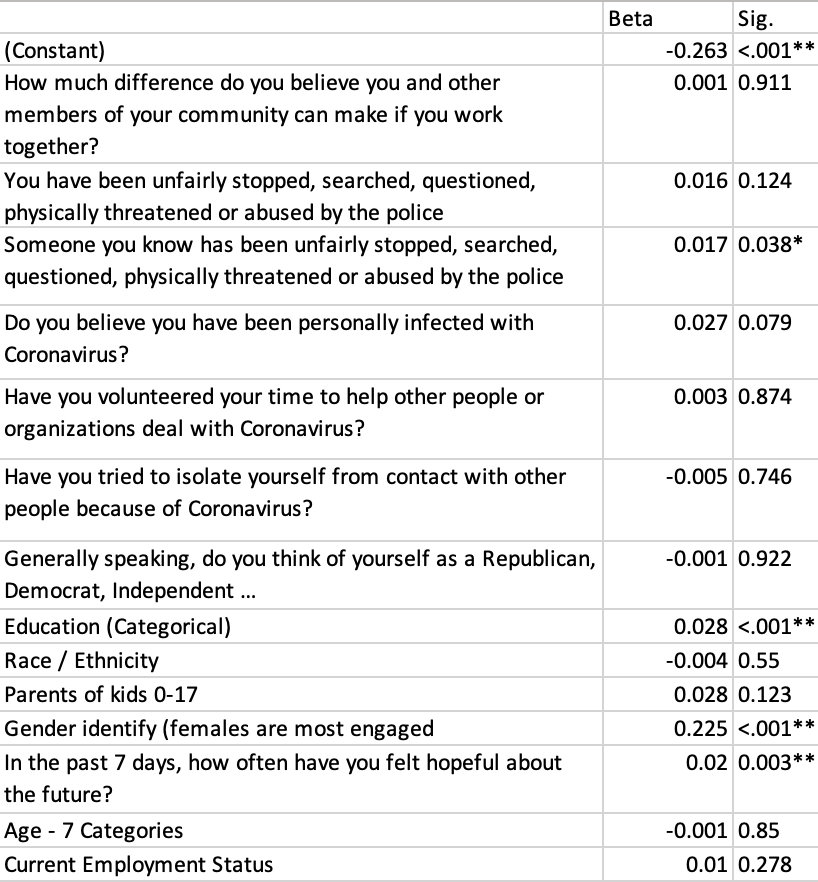
We found that the distribution of sociodemographic, health, and wealth measures in our sample (n =?1267) were comparable to those from other national surveys. Our quantitative illustration of the relationships among the domains of health, wealth, and civic engagement provided support for the interrelationships of constructs within our conceptual model. Latent constructs for wealth and civic engagement were significantly correlated (p =?0.013), and both constructs were used to predict self-reported health. Beta coefficients for all indicators of health, wealth, and civic engagement had the expected direction (positive or negative associations).

Conclusion

Through development and assessment of our comprehensive equity framework, we found significant associations among key equity domains. Our conceptual framework and results can serve as a guide for future equity research, encouraging a more thorough assessment of equity.

Apply for the 2022 Institute for Civically Engaged Research (ICER)

The American Political Science Associations’ Institute for Civically Engaged Research (ICER) is a four-day, residential institute that provides political scientists with training to conduct ethical and rigorous civically engaged research. Up to 20 scholars will be selected as ICER Fellows and invited to attend the 2022 Summer Institute. ICER Fellows will network with other like-minded political scientists, and together, learn best practices for conducting academically robust, mutually beneficial scholarship in collaboration with communities, organizations, and agencies outside of academia.

The first Summer Institute was organized in partnership with Tufts University’s Jonathan M. Tisch College of Civic Life in 2019. ICER was canceled in 2020 due to COVID-19 and hosted virtually in 2021. For 2022, we anticipate holding the Institute in person at Tufts University, outside of Boston, MA, from June 20-23.

The Institute will take place on campus at Tufts University from June 20-23. Approximately twenty fellows will meet each day for intensive discussions and workshops. Thanks to support from the Ivywood Foundation, participation in the Institute for Civically Engaged Research is free, housing on the Tufts campus will be provided, and scholarships are available to defray costs of meals and travel. Applicants are expected to seek financial support from their home institution, but admission to the Institute will not be affected by financial need.

To apply, please complete this form. Application deadline: March 1, 2022.

Note: The Institute will operate according to the recommendations and requirements of federal and local public health authorities. We plan for the Institute to be held in person at Tufts University but reserve the right to change these plans as the public health situation warrants.

we must be able to disagree about pandemic policies

The social media and news sources that I follow are full of strong statements about masking rules, vaccine mandates, school closings and other pandemic policies. Some people argue that proponents of loose policies are callous, scientifically ignorant, or even racist because morbidity and mortality rates have been disproportionately high among people of color. Others argue that mandates reflect the arrogance of elites or the creeping power of state bureaucracies. On that side of the argument are some libertarians who would usually be placed on the right, but also some leftist thinkers who are skeptical of science and state power, in the tradition of Horkheimer & Adorno, Michel Foucault, Bruno Latour, Giorgio Agamben, et al. There is also a partisan layer in this debate, with caution about the pandemic being coded as Democratic, and skepticism about its seriousness as Republican.

I rarely depict “both sides” in US politics as equally extreme and polarized. I generally believe that the left wing of the Democratic party represents valid perspectives within a constitutional order while the Trumpian right presents a threat to that order. Still, a recent survey finds, “Nearly half (48%) of Democratic voters think federal and state governments should be able to fine or imprison individuals who publicly question the efficacy of the existing COVID-19 vaccines on social media, television, radio, or in online or digital publications.” This statistic comes from a right-leaning pollster. I don’t have any reason to doubt the concrete result, but I would have investigated possible intolerance on the other side of the debate as well. I would guess that significant numbers of respondents would support locking up school boards that mandate masks and prosecuting Dr. Fauci. Meanwhile, some serious writers on both sides reject the legitimacy of disagreement and use opposing arguments about COVID-19 as evidence that our whole political system is fundamentally broken.

Our system may indeed be close to breaking down, but not because individuals have the temerity to disagree about COVID-19 policies.

A caveat: it is not clear that the real debate is as hot, personalized, and divided as my media feed suggests. Twitter attracts controversialists with strong, ideological perspectives, whereas many Americans are apolitical. The news media covers controversy and gives little attention to routine decision-making. Outrageous threats at a school board meeting can attract national attention while a boring agreement will draw low-key local coverage, at most. However, there are plenty of serious people who publicly deny the legitimacy of disagreement about COVID-19, and they require a response.

I would start with a general view of politics. All types and layers of governments and other institutions–including firms–constantly make grave decisions. They imprison people, fire them, and give or deny them crucial services. Even routine decisions, such as zoning regulations or the development of new products, can profoundly affect people’s welfare. Although some decisions are simply good or bad, many are debatable. They have both winners and losers, they involve conflicting values, and their consequences are unpredictable. Nor is it safe to do nothing, for that can sometimes be a harmful failure.

Americans don’t particularly like disagreement, especially when it involves conflicts of principle and identity under conditions of uncertainty. Therefore, we place many consequential decisions out of view. For instance, we have dramatically reduced the number of jury trials (which require regular citizens to make choices) in favor of plea-bargaining. And decisions about matters like zoning are made in forums that draw very little attention.

COVID-19 has forced such decisions into the open. Like other issues, it involves conflicting values and interests under uncertain conditions. Yes, vaccines are highly effective and safe, and critics do themselves no credit when they doubt such findings. A large, randomized, double-blind experiment with a mass-produced chemical product presents an exceptional opportunity to resolve empirical uncertainty. However, there is plenty of room for doubt about the empirics of other matters, such as school closings and masks, and even about mandates for vaccines.

Indeed, the evidence about the effects of policies on the pandemic is murky. You can tell it’s confusing just by glancing at the ten states with the highest per capita cumulative death rates so far, which include Mississippi and Oklahoma but also New Jersey and New York. (Among the best-off so far: Utah and Nebraska as well as Vermont and Hawaii.) Of course, one should control for factors other than state policies. A typical study that uses controls finds small effects: e.g., mask mandates reduce the growth of cases by 2 percentage points. I think that finding counts in favor of a mask mandate, but with many caveats; it certainly does not neutralize all concerns or close the case. For one thing, the virus itself keeps changing, as do other circumstances, such as the percentage of people with immunity. Also, the pandemic has rolled out in regional waves, which means that the same methodology will yield different results depending on when the study is conducted. We won’t have a clear picture until it is clearly over.

If you believe in democracy, you should be glad that people can influence public decisions. If you believe in pluralism or polycentricity, you should be glad that there are many different forums for decision-making: federal, state, and local governments; executive, legislative, and judicial bodies; corporations and nonprofit institutions; professional and scientific bodies; and transnational organizations. You should see disagreement as evidence of liberty, diversity, and participation.

But you won’t get the policies you want. If you’re fortunate, you may be aligned with public opinion and the decision-makers in your own community. Then you will appreciate local policies and will probably observe reasonably high levels of voluntary compliance. However, in a polycentric world, you will not see the policies you support enacted or obeyed everywhere else. Communities will vary. Yet the policies adopted in other places may affect you. So the variation will be frustrating and even angering.

People are entitled to strong views and emotions, including anger. But it is important to distinguish process from outcomes. State and local governments in the US may decide whether to require masks or not. Some decisions may be wiser than others, but the unwise ones are still legitimate. If some people have to wear mask when they don’t believe in them–or attend schools where masks are absent even though they do believe in them–that is democracy at work. The health risks may be serious, but governments constantly make decisions that affect health, and even life. People walking around in mandatory masks are not serfs to a tyrannical state, but communities that have eschewed masks are not idiotic. We disagree. Decisions must be made. It is good that we the people can make them.

Here are some tips to consider:

  • Don’t threaten or bully individuals. Certainly, do not try to jail them for their opinions.
  • Obey politically legitimate policies even if you disagree with them unless they violate your core principles, but be careful about mistaking your opinions for sacred principles. Usually, decisions require some to compromise what we want and believe.
  • If you are on the winning side, acknowledge that the losing side is being asked to sacrifice.
  • Protect others’ freedom of speech, not only from censorship but also from the tyranny of majority opinion.
  • Pay attention to equity and structural forms of injustice, but don’t assume that you know what people believe (or what is good for them) based on their demographics.
  • To address scientific issues, look for the most recent and rigorous scientific publications. Googling around for opinions is not “research.” On the other hand, do not overstate the policy significance of specific scientific papers, and do not use empirical findings to squelch normative disagreements. For instance, if mask mandates reduce the spread of COVID-19, it does not automatically follow that a state’s governor should require masks in all public schools.
  • Hold onto your general political and philosophical views (if you wish), but don’t use the pandemic as an opportunity to score debating points on behalf of your philosophy. We should be trying to do the right thing here and now. Besides, the current pandemic may prove more of an exception than a proof-point for several leading ideologies. Libertarians should recognize that libertarian thinkers have often endorsed restrictions during epidemics. Critics of mainstream science should acknowledge the enormous value of the corporate-produced vaccines. Progressives (like me) should ask why well-funded public scientific agencies have performed so poorly in several respects.
  • Keep an eye open for arguments and evidence that trouble your own assumptions, but don’t give up on trying to decide what’s really best to do under the circumstances, with the evidence that we have at hand.

See also: collected posts on the COVID-19 pandemic, and in particular, vaccination, masking, political polarization, and the authority of science; why protect civil liberties in a pandemic?; and theorizing democracy in a pandemic.