forthcoming in 2013: Civic Studies (the book)


This is a video of me (having a bad hair day) and some good friends making the case for the civic mission of higher education.

It is also an advertisement for the Civic Series, a set of short books on themes related to active citizenship and higher education. I am co-editing the volume entitled Civic Studies with Karol Soltan. It should be available by the end of 2013. The Table of Contents follows:

I. Overview

1. Peter Levine, “The Case for Civic Studies”
2. Karol Soltan, “The Emerging Field of a New Civics”
3. (multiple authors) “Framing Statement on Civic Studies”

II. The art and science of association: the Indiana Workshop

4. Filippo Sabetti, “Artisans of the Common Life: Building a Public Science of Citizens”
5. Paul Aligica, “Citizenship, Political Competence, and Civic Studies: the Ostromian Perspective”

III. Deliberative participation

6. Tina Nabatchi and Greg Munno, “Deliberative Civic Engagement: Connecting Public Voices to Public Governance”
7. Ghazala Mansuri and Vijayendra Rao, “The Challenge of Promoting Civic Participation in Poor Countries”

IV. Public work

8. Harry C. Boyte and Blase Scarnati, “The Civic Politics of Public Work”

V. Research engaged with citizens

9. Sanford Schram, “Citizen-Centered Research for Civic Studies: Bottom-Up, Problem-Driven, Mixed methods, Interdisciplinary”
10. Philip Nyden, “Public Sociology, Civic Education, and Engaged Research”

The post forthcoming in 2013: Civic Studies (the book) appeared first on Peter Levine.

public speaking engagements this fall

Please join me if you can:

  • Sept. 20, DC: National Conference on Citizenship, panel on “Civic Education and the Civic Mission of Schools” (Also webcast.)
  • Sept. 25, Morven Park in Northern VA, “Distinguished Voices in Civics
  • Oct. 2, Elon University, Greensboro, NC Oct. 2: public lecture on We Are the Ones We Have Been Waiting For.
  • Oct. 10, MIT Center for Civic Media, Civic Media Lunch, “The Promise of Civic Renewal”
  • Oct. 9, DC, National Press Club newsmakers’ forum
  • Oct 11-12, Austin, TX, American Board of Trial Advocates’ Open Forum for Civic Education for Our Youth
  • October 21, Gutman Library, Harvard University, Distinguished [sic] Author’s Talk about We are the Ones. … With confirmed panelist Jane Mansbridge (and others to be named).
  • Nov. 9, Austin TX, Texas Conference on Civic Life
  • Nov 22, St. Louis, MO, National Council for the Social Studies

The post public speaking engagements this fall appeared first on Peter Levine.

the new framework for social studies

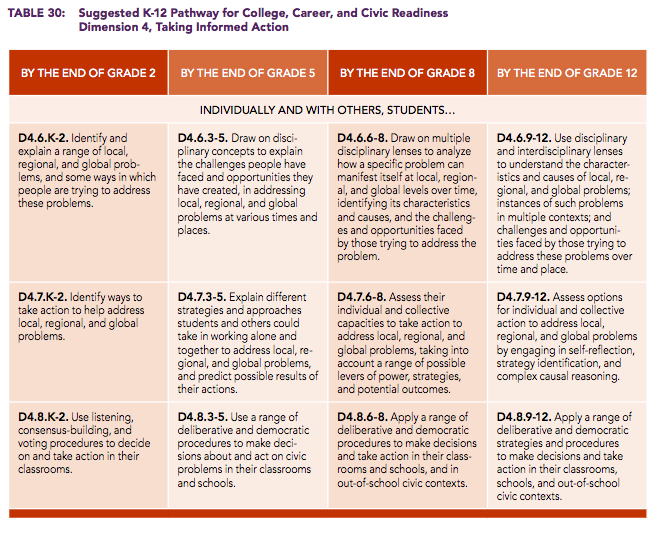
One of my projects for the last several years has been to help write the C3 (College, Career and Citizenship) Framework for the social studies. It was released today by the National Council for the Social Studies, and CIRCLE issued a supportive release.

All states have social studies standards, but these documents tend to be incoherent, excessively long and detailed, and poorly aligned with tests, textbooks, and course requirements. The same has been true in other disciplines, and the now-controversial Common Core is an effort to standardize the standards for English and math to a better model. Our C3 Framework, instead, recognizes the right, power, and obligation of states to set their own standards. But it provides general guidance. Maryland and Kentucky are implementing the C3 Framework, and I hope other states will follow suit. The more states use it, the more the market will grow for improved texts and materials, tests and assessments, and teacher education. Unless they are implemented well, new standards will not make much difference. But they are a start.

One thing I especially like about the C3 is the “instructional arc,” which goes from “developing questions and planning inquiries” to “communicating conclusions and taking informed action.” We authors realized that students don’t get to decide what questions to ask, in a vacuum. The teacher decides that it is time to study Native Americans or the New Deal. But we wanted to indicate that asking questions is the start of real intellectual work.

“Taking informed action” may be controversial, but it is essential, because we learn advanced civic skills through practice. I would make two points in support of the “Informed Action” section: 1) Action can mean many things, not just community service or activism. Solving problems within the classroom or managing a student group would also count. And 2) action is not a newfangled addition to the social studies curriculum. It was a stronger component of civics in the mid-20th century, when courses called “community civics” and “problems of democracy” were very common. It is already mentioned in many state standards, albeit in miscellaneous ways. If anything, action has diminished as political science has become the model for high school civics. We are just putting a bit of it back in.

The post the new framework for social studies appeared first on Peter Levine.

for reform of testing

Over at the National Journal, Fawn Johnson reports that the Common Core standards for English and math have become controversial because of testing. “Now that it’s time for states to actually measure how their students are doing, it’s a lot harder to gloss over the problems with feel-good talking points.”

In an invited response, I argue that the existing standardized tests are bad–19th century tools–and the Common Core offers the opportunity to improve them. Progress may be halting, controversial, and painful, but I still favor innovation. In my comment, I argue that the existing tests are bad because they are separated from learning; overly standardized; completely private (so that they don’t assess how children communicate and collaborate with each other, even though that’s actually the purpose of English/Language Arts); and secret in ways that reduce legitimacy.

The post for reform of testing appeared first on Peter Levine.

why engineers should study Elinor Ostrom

(New Haven) Next week, I will lead a discussion of the Nobel-Prize-winning research of the late Elinor Ostrom. I will be with a group of engineers, natural scientists, and social scientists who are concerned about water, one of the basic scarce and contested natural resources.

Ostrom studied water-management, but she was a political scientist concerned with “civic engagement,” especially the practices that ordinary people develop to manage common resources. Why should an engineer or a scientist concerned with water care about civic engagement, as Ostrom analyzed it?

One reason is that ordinary people’s deliberate and creative action is a more important condition of successful resource-management than analysts had thought before Lin Ostrom wrote. The dominant 20th century view held that resources were either public or private. If they were private, the owners would have incentives to protect them (although market failures might occur under specific conditions). Public resources, however, would be destroyed by the Tragedy of the Commons in the form of free-riding, overuse, underinvestment, etc. Thus public resources had to be privatized or else governed by a central state. Water was quasi-public because you can’t own the oceans or clouds (“fugitive resources”), although you can own a gallon of water or a spring. Applying the theory that public goods were doomed, 20th century regimes either privatized or nationalized forests, grazing lands, and water. The results were frequently catastrophic, contributing to mass human and animal death. (See Governing the Commons, p. 23. All subsequent quotes are also from that book.)

Ostrom discovered that, contrary to the simplistic theories of collective action, people were capable of managing public goods, including waterways and fisheries. They did not always succeed, but they did not always fail, either. Variation in the ways that they worked mattered to the outcomes. To succeed, they needed institutional arrangements, skills, norms, motivations, and habits. All of these factors then became important predictors of preserving or destroying natural resources. An engineer or a chemist cannot ignore these factors if she actually wants to contribute to good water management. Discovering a process or inventing a technical system does no good unless someone uses it. That someone cannot be an omnicompetent and incorruptible state, because there is no such thing. Somehow, people have to adopt any technical innovation, and often they can contribute to designing it as well.

An example is a crisis of overfishing off Alanya, Turkey (pp. 19-20). The fishers solved the problem through an ingenious system of randomly assigning all the licensed boats to specific starting points and rotating these locations on a fixed schedule. Privatization could not have solved the problem because this was already a system of private boats and workers, and the fish are a “fugitive resource.” Nor could it have been solved by the state, except at high cost. The fishers knew exactly where to put each location, and the state would have had to recreate that knowledge—assuming that it acted fairly and without corruption. The best solution was a self-created one.

If the first reason to read Ostrom is that she studied citizenship and found that it mattered, the second is that she was a citizen. She was a scientist who won countless NSF grants as well as the Nobel and a MacArthur “genius” award. But she was a scientist who wanted to improve the world, and that made her a model citizen. For instance, after introducing the prisoner’s dilemma, she writes, “As long as people are described as prisoners, policy prescriptions will address this metaphor. I would rather address the question how to enhance the capabilities of those involved to change the constraining rules of the game to lead to outcomes other than remorseless tragedy (p. 7).”

This is a complex pair of sentences, worth unpacking. Ostrom’s ultimate goal is to avoid “remorseless tragedy.” The stakes are high, and they are defined in moral terms, even though Ostrom is a scientist. To avoid tragedy, she will not propose direct solutions. Instead, she wants to “enhance the capabilities of those involved.” These people will not merely act within a system, discussing issues and making choices. The limiting case of a person who makes a choice within a fixed system is the prisoner in a prisoner’s dilemma. “Individuals who have no self-organizing and self-governing authority are stuck in a singe-tier world. The structure of their problems is given to them” (p. 54). In contrast, Ostrom wants people to change the rules. And she is part of that process, because she discloses her own goal in the first-person singular: “I would rather address. …” In real life, Ostrom actually worked with peasants and fishers because she had to learn from them and because she wanted them to benefit from her findings.

In short, Ostrom not only discovered that complex social/environmental systems involve deliberate human collective action. She also treated social science as part of those systems, and herself as one of the human beings who was trying to manage the commons.

Other insights from Governing the Commons:

“Instead of presuming that optimal institutional solutions can be designed easily and imposed at low-cost by external authorities, I argue that ‘getting the institutions right’ is a difficult, time-consuming, conflict-invoking process” (p. 14).

“… as long as analysts assume that individuals cannot change … situations themselves, they do not ask what internal or external variables can enhance or impede the efforts of communities of individuals to deal creatively and constructively with perverse problems such as the tragedy of the commons” (p. 21)

“Empirically validated theories of human organization will be essential ingredients of a policy science that can inform decisions about the likely consequences of a multitude of ways of organizing human activities. Theoretical inquiry involves a search for regularities. … One can, however, get trapped in one’s own intellectual web” (p. 24)

“The basic strategy is to identify those aspects of the physical, cultural, and institutional setting that are likely to affect [the results.] Once one has all the needed information, one can then abstract from the richness of the empirical situation to devise a playable game that will capture the essence of the problems the individuals are facing” (p. 55).

The post why engineers should study Elinor Ostrom appeared first on Peter Levine.

Discovering Justice

I am proud to have joined the board of Discovering Justice and will attend my first board meeting later today. Discovering Justice teaches younger children about the law and the justice system in ways that increase their appreciation of legal norms and institutions while also encouraging them to use “the power of their own voices.”

Civic education is delivered by the 165,000 full-time social studies teachers in American schools. It is funded by states and localities as part of the general education system. However, independent nonprofit organizations serve important roles in producing materials and lesson plans, developing new models and approaches (“R&D”), convening and educating teachers, and advocating for supportive policies. For instance, I am proud to serve on the board of Street Law, Inc., and my organization works closely with iCivics and Generation Citizen on their evaluations.

Discovering Justice is highly unusual in focusing on younger children. Although some of the other civics NGOs have programs for grades k-8, they all emphasize adolescence. Much less is known about the civic development of young children and the lasting impact of providing civic education in the early grades. As the eminent political scientist Sir Bernard Crick lamented in 1999, “there is no political Piaget.” The way to find out what actually works is generally to develop, test, and refine interventions that may work. Usable research almost always begins with practical experimentation. Discovering Justice is doing that work for civic education k-8.

The post Discovering Justice appeared first on Peter Levine.

how to teach 9/11

Last year, I wrote a piece for CNN on how to teach 9/11 in public schools. That article will be part of a Twitter chat this evening at 9 pm eastern. The hashtag is #PTchat.

In brief summary, I argued that states should not require the teaching of 9/11, because states should generally refrain from requiring specific historical topics at all. If they go down that path, then everyone who thinks that X is important will demand that X be included in state standards to prove that the government cares. That’s why Illinois requires teachers to discuss Leif Erickson, the Irish Potato Famine, and the importance of trees and birds.  Long lists prevent curricular depth and diversity among schools. For instance, in Boston, 8th graders will focus on Reconstruction for several months, in partnership with Facing History. That would be impossible if they had to race to cover 9/11 by way of many other specified topics.

However, 9/11 is an example of a good topic to cover. It has the advantage of being recent, and too often, history class stops at World War II or the 1960s (in part because the accumulated state requirements take too long to cover). Ending more than a generation ago conveys the message that history is over and students have no role in it.

If teachers do elect to discuss 9/11 in social studies class, it should be treated relatively dispassionately, in a scholarly way, and students should be encouraged to consider the related controversies (such as whether the US should have invaded Afghanistan and Iraq as a result). We don’t want to indoctrinate kids with any particular view, but we do want them to learn to deliberate and reason about complex and contentious issues.

One subtle question is what counts as a legitimately open question for discussion, as opposed to a question that should be considered settled in a social studies classroom. (Diana Hess is the expert on this topic.) For instance, slavery is a settled question, but same-sex marriage, even though I strongly favor it, ought to be presented as unresolved. The suggestion that 9/11 was a US government conspiracy should not be treated on a par with the idea that al-Qaeda attacked the US. A student who thinks 9/11 was a conspiracy should be held accountable for providing very rigorous evidence (which I believe will be impossible). Nevertheless, the attack can be understood in several broader political contexts, and students should be encouraged to explore the controversies with due respect for evidence and logic.

The post how to teach 9/11 appeared first on Peter Levine.

threats, negotiations, and deliberation: the case of the Syria crisis

It has been frequently remarked that it seems to have been reserved to the people of this country, by their conduct and example, to decide the important question, whether societies of men are really capable or not of establishing good government from reflection and choice, or whether they are forever destined to depend for their political constitutions on accident and force. – Hamilton, The Federalist #1 (first paragraph)

Here are three modes of interaction that apply to the Current Emergency:

1. Making credible threats to deter bad behavior. The Geneva Protocol to the Hague Convention bans the use of chemical weapons. President Obama called that a “red line.” There is a case for drawing red lines and credibly threatening to punish people who cross them. Mark Kleinman lays out an argument for Congressional authorization based on this idea of credible threats. Kleinman doesn’t consider his argument determinative, but Ross Douthat does. Douthat writes that a “no”vote in Congress would “basically finish off the current American president as a credible actor on the world stage” because he could no longer make credible threats.

[Footnote: I wish that no one would say "bombing Syria" or--in Kleinman's phrase--"an attack on Syria," because that is a euphemism for "killing human beings resident in Syria." Syria is an abstraction that cannot die or suffer. As Hannah Arendt and George Orwell taught us, euphemisms are deadly in politics. Maybe we should kill people in Syria, but let's call that what it is.]

2. Zero-sum political struggle between the President and Congress. That is the implicit model that people imagine when they think that by asking Congress to vote, Obama already weakened himself, and a “no” vote would be a humiliation that would embolden the Republicans to oppose him on all other fronts. “Negotiation” is an appropriate word for nonviolent zero-sum interactions. In this case, the president wants a yes. He and his people are busy negotiating with Members of Congress and will either succeed or fail.

3. An open-ended discussion about what to do. This is the model that people invoke when they say that the President prompted an important national conversation about military intervention by asking Congress to debate a resolution on Syria. If that model applies, the administration must honor the results of the vote, but any result could be called a victory for the process.

My origins are in deliberative democracy, but I try not to be naive about it. Deliberative moments are rare and fragile and depend on cultural norms and formal structures. You can’t deliberate with Assad (which doesn’t mean that you are required to bomb his army). You can’t necessarily deliberate with Congress if they are in a mood to wreck your administration or if the constitutional structure is dysfunctional. It is harder to deliberate if pundits are standing by with political scorecards, ready to call a “no” vote a humiliating defeat that ends your presidency.

On the other hand, the deliberative model has value. We ought to prize what Madison called “the mild voice of reason” whenever it has a chance. If Congress rejects the president’s proposal, that is not actually a defeat for him. We could commend his decision to go to Congress as a courageous and enlightened form of leadership. Certainly, in a family, a neighborhood, or a workplace, admirable leaders often delegate tough decisions to groups and agree to accept the results. We do not call that weakness; it can be wisdom. But it won’t be seen as wise unless someone says it is.

Politics cannot be pure deliberation. However, if we fail to recognize the deliberative moments, they have no chance at all. Regardless of the results, I am preemptively celebrating the president’s decision to go to Congress and I am preemptively denouncing all the reporters and talking heads who will score it as a win or a loss for the White House. Let’s pay attention to whether the bombing would be good for Syria and whether the debate is good for our democracy.

The post threats, negotiations, and deliberation: the case of the Syria crisis appeared first on Peter Levine.

cover blurbs for We Are the Ones We Have Been Waiting For

WeAretheOnes“As America has wallowed through an unprecedented decline in civic engagement, Peter Levine has been a lighthouse warning of the dangers of civic alienation. Now, he makes the encouraging case that although we will live for a while with the consequences of past mistakes, the worst of the storm is over. Professor Levine concludes with ten common sense strategies that can energize the people and their governmental institutions while preparing a new generation of Americans with the values and competencies to sustain our reinvigorated democracy.”—Bob Graham, United States Senator (1986-2004)

“Peter Levine is a remarkable asset—a scholar whose research is rigorous and unflinching but whose passion for democracy brims with optimism and engagement. In We Are the Ones We’ve Been Waiting For, Levine catalogues all the ways our institutional systems discourage engagement among citizens. But he finds and lifts up a million people doing civic work for a better world, and asks us to join and harness that energy for real change. It’s clear-eyed and a clarion call—and a must read whether you’re a full time advocate or ‘just’ a citizen hoping to make a difference.” —Miles Rapoport, President, Demos

“We know what it means to get better leaders. But how are we supposed to produce better citizens? That’s the question Peter Levine brings into focus. If the examples he describes can spur the one million most active citizens into a movement for civic renewal, we will all benefit from communities that are more deliberative, more collaborative, and more engaged.”—Alberto Ibargüen, President and CEO, the John S. and James L. Knight Foundation

“In an America now rife with inequality, institutionalized corruption, a jobless recovery and more prisoners than any other country, many sense that we stand at a nadir of democracy. With inspiring erudition, Levine points to an unlikely solution: the people themselves. Drawing from experiences in schools from Washington, D.C. to neighborhoods in San Antonio, he develops a pragmatic approach to civic revitalization that builds upon developments in organizing, deliberation, civic education, and public service, but goes far beyond any of these to reach for an ambitious vision of participatory democracy. He asks us to join the emerging civic movement he describes, and we all should.”—Archon Fung, Ford Foundation Professor of Citizenship and Democracy, Harvard Kennedy School

The post cover blurbs for We Are the Ones We Have Been Waiting For appeared first on Peter Levine.

are we seeing the fatal flaw of a presidential constitution?

This is what dysfunction looks like: On one hand, the president can’t get anything through Congress, which can’t pass its own agenda either, let alone get it by the president’s veto. (See Mike Allen and Jim Vanderhei’s forecast of an ugly fall in the legislature.) On the other hand, as Gordon Silverstein argues, “the Obama administration has steadily, and significantly built up and exploited presidential power.”

The most disturbing diagnosis is that we are now seeing the breakdown that was written into the Constitution but that we had long avoided for contingent reasons. Republicans are acting badly (in my opinion), and the president is pushing some constitutional limits–but the disturbing argument is that both sides are acting just as one would predict given the constitutional structure.

Bruce Ackerman laid it out 13 years ago in “The New Separation of Powers,Harvard Law Review, 113 (2000), pp. 645-7:

One of our foremost students of comparative government, [Juan] Linz argues that the separation of powers has been one of America’s most dangerous exports, especially south of the border. Generations of Latin liberals have taken Montesquieu’s dicta, together with America’s example, as an inspiration to create constitutional governments that divide lawmaking power between elected presidents and elected congresses — only to see their constitutions exploded by frustrated presidents as they disband intransigent congresses and install themselves as caudillos with the aid of the military and/or extraconstitutional plebiscites. From a comparative point of view, the results are quite stunning. There are about thirty countries, mostly in Latin America, that have adopted American-style systems. All of them, without exception, have succumbed to the Linzian nightmare at one time or another, often repeatedly. Of course, each breakdown comes associated with a million other variables, but as Giovanni Sartori puts it, this dismal record “prompts us to wonder whether their political problem might not be presidentialism itself.”

It is possible, of course, to avoid the Linzian nightmare without re-deeming the Madisonian hope. Rather than all out war, president and house may merely indulge a taste for endless backbiting, mutual recrimination, and partisan deadlock. Worse yet, the contending powers may use the constitutional tools at their disposal to make life miserable for each other: the house will harass the executive, and the president will engage in uni- lateral action whenever he can get away with it. I call this scenario the “crisis in governability.”

Once the crisis begins, it gives rise to a vicious cycle. Presidents break legislative impasses by “solving” pressing problems with unilateral decrees that often go well beyond their formal constitutional authority; rather than protesting, representatives are relieved that they can evade political responsibility for making hard decisions; subsequent presidents use these precedents to expand their decree power further; the emerging practice may even be codified by later constitutional amendments. Increasingly, the house is reduced to a forum for demagogic posturing, while the president makes the tough decisions unilaterally without considering the interests and ideologies represented by the leading political parties in congress. This dismal cycle is already visible in countries like Argentina and Brazil, which have only recently emerged from military dictatorships. A less pathological version is visible in the homeland of presidentialism, the United States.

The logic is straightforward. Sooner or later you end up with a different party in control of each branch. Members of the legislature are not held accountable for the overall state of the country, because voters are more likely to blame (or reward) the president or the legislature as a whole than their own representative. Thus legislators have every incentive to make things go badly for the president until their own party takes the executive branch back. Meanwhile, the president wants to succeed, and getting the support of a backstabbing opposition looks increasingly unattractive, so he acts on his own. The result is a “crisis in governability”–at best.

Why did we not have this crisis before? (After all, we have had a presidential system since 1789.) I think we have had moments of it, but one phenomenon traditionally made it rare. Our parties were ideologically incoherent, because race, economics, and region caused cross-cutting fractures. In particular, the Democrats long accommodated both the most liberal and the most illiberal politicians on questions related to race. The result was a set of minority blocs in Congress: liberal big-city Democrats, Prairie populists, segregationist Dixiecrats, liberal Republicans, libertarian Republicans, etc. A president had the advantage of a prime minister in a parliamentary system: he could build a majority by assembling blocs. For instance, Reagan governed with a coalition of Republicans plus Dixiecrats, sometimes compromising with Tip O’Neill but also driving his own agenda through a willing Congress.

That kind of coalition politics became impossible once the parties aligned neatly into right and left, as they have done for the first time in US history. One party now controls each house at any given moment, and if it is not the same as the president’s party, they will lock horns. Almost nothing has been accomplished in the last three administrations, for good or ill, except wars and bursts of legislation during the narrow windows when the president has had a working majority because of an election or a terror attack: 1993-4, 2001-2, and 2008-9.

Linz found that 30 countries had borrowed our constitutional model, and all 30 faced constitutional meltdown. Are we now joining the trend?

The post are we seeing the fatal flaw of a presidential constitution? appeared first on Peter Levine.