Tamsin Shaw’s critique of moral psychology

I think that Tamsin Shaw’s article “The Psychologists Take Power” (New York Review of Books, February 25, 2016) is very important. I enjoyed an informal seminar discussion of it on Friday, but that conversation made me realize that the article is rather compressed and allusive, and its argument may not convey to readers who are unfamiliar with the research under review or with important currents in moral philosophy.

This is how I would reconstruct Shaw’s argument:

First, the psychological study of morality presents itself as a science; it claims to be value-neutral and strictly empirical. The phenomena under study are called “moral,” but the researchers purport or at least strive to be value-free.

Given that self-understanding, psychologists are attracted to three research programs: evolutionary biology, neuroscience, and game theory. Each presents itself as value-neutral. The three programs can be made highly consistent if one focuses on rapid human reactions to very basic stimuli, such as sexual desire or perceived threat. These reactions presumably arose well before cultural differentiation, they have Darwinian explanations, they would serve individuals or groups in competitive situations (e.g., while struggling for food or mates), and they light up specific parts of the brain. Findings that seem consistent with all three streams of research have special prestige because they seem particularly hard-headed and empirical. (A perfect example is the Times’ article yesterday: “What’s the Point of Moral Outrage? It may seem noble and selfless, but it’s also about improving your reputation.”)

People who think this way about morality are basically amoral. They have no independent moral compass. Yet they learn techniques that are useful for manipulating subjects, particularly in extreme situations where instinctive human impulses are most pertinent. Therefore, it is no surprise (Shaw writes) that some of them became professional advisers on torture during the first years of the Iraq occupation. Any argument against torture will seem to them arbitrary and subjective.

The last point may be a bit of an ad hominem, although it is certainly worth taking seriously as a warning. But even if all psychologists use good professional ethics, the agenda of making moral psychology strictly empirical needs to be challenged.

For one thing, you can’t study phenomena categorized as “moral” without independently deciding what constitutes morality. We have many deep, instinctive impulses. For instance, we are capable of altruism and even self-sacrificing love, but also of violence and greed. It’s plausible that many of these impulses have evolutionary roots and can be explained in game-theoretic terms. But only some of them are moral. Imagine, for instance, that I said, “Greed is a moral virtue that we developed early in our evolution as a species to motivate individuals to maximize resources.” This would not be a scientifically false statement. It would be morally false. The mistake is to call greed a “virtue.”

Jonathan Haidt likes to provoke liberals by describing “authority” and “sanctity” as moral values. They may be, but that requires a moral argument against the position that only care, fairness, liberty, and loyalty count as moral. The fact that some people see authority and sanctity as virtues does not make that opinion right. Hitler thought that racial purity was moral, and he was wrong. So moral reasoning is indispensable.

Further, when we reason morally, we are usually thinking about very complex, socially constructed phenomena that we don’t directly perceive. We certainly don’t experience them as immediate sense-data. I wrestle with my feelings about democracy, the United States, academia, capitalism modernity, etc. These things don’t appear in my visual field like violent threats or piles of yummy food. I experience such institutions through speech and text, through vicarious reports, and by accumulating experience and arguments over decades. Possibly the impulses that homo sapiens developed early in our evolution influence my judgments. For instance, I may have a deep, unconscious tendency to separate people into in-groups and out-groups, and that may affect my tendency to see the USA as my group. But I could treat another unit as my main group, I could be uninterested in (or even unaware of) the USA as an entity, or the country might not even exist. A nation is a social construction, built by people for complex reasons, that we understand in a mediated way. It would be a contentious assumption, not a hard-nosed scientific premise, that our most primitive impulses have much to say about institutions or our attitudes toward them.

See also: Jonathan Haidt’s six foundations of morality; neuroscience and morality; morality in psychotherapy; on philosophy as a way of life; is all truth scientific truth?; and right and true are deeply connected.
on the original meaning of democracy

We call ourselves a democracy and a republic. There’s a current right-wing talking point that we are only the latter, but I’ve argued that this claim deviates from a long bipartisan consensus that the US aspires to be a democratic republic. But what do these two terms mean?

This definitional question is challenging because the words come, respectively, from Greek and Latin, and they were coined to name specific regimes that had lots of eccentric features (huge juries in Athens; a host of executive officials in Rome) that no one considers definitive. The words have subsequently been used by many writers in many languages to name a wide variety of regimes–and sometimes as terms of abuse.

For instance, a “republic” presumably must name a regime that has something in common with the original, the ancient Roman res publica. One defining feature of the Roman republic was simply that it wasn’t a monarchy. Thus people who want to remove Queen Elizabeth II as the titular monarch of Australia (or Britain) call themselves “republicans.” Their proposal would change virtually nothing about the power structure; it would be almost entirely symbolic. But they have precedent for calling a regime without a monarch a “republic.”

In a very different vein, Jefferson defined a republic “purely and simply” as “government by its citizens in mass, acting directly and personally, according to rules established by the majority; and … every other government is more or less republican, in proportion as it has in its composition more or less of this ingredient of the direct action of the citizens.” For Jefferson, a “republic” is what others would call a direct and participatory democracy. Yet the original Roman republic was composed of legislative bodies and officers who represented various classes and interests. Some were elected and others were appointed. All were limited by various laws (albeit unstably so). Thus, for some, a republic is a government that avoids direct and participatory democratic elements.

Still other writers have noticed the ancient Roman penchant for civic duty and public service and have used the word “republic” for a regime that demands a great deal from its citizens and that encourages public engagement as a positive good. It is an alternative to the kind of liberalism that favors individual rights. Meanwhile, another tradition takes seriously the etymology–“res publica” means “public thing [or good]”–and translates the phrase as “commonwealth.” A “commonwealth,” in turn, could mean all the things that are commonly owned by the people. And if the people’s wealth extends to the land, then a certain kind of agrarian socialism emerges as the definition of republicanism.

That’s all about “republic,” but I’d like to address the term “democracy,” relying on a fascinating article by Josiah Ober.* Ober notes that if the Greeks had wanted a word that meant rule of the many (or the common people), they would have used pollo- as the suffix prefix. To name a regime in which all rule, they could have used “panocracy.” If they had wanted to emphasize the equality of all, they would have used iso-. For instance, isegoria meant an equal right to participate in deliberations in the agora. But they chose demo-, which refers to the whole people as one, without sociological distinctions.

Meanwhile, if they had wanted to specify who governed, in the sense of casting votes or holding offices, they would have used the suffix -archy. A monarchy has one ruler, an oligarchy has a few, and anarchies have none. The suffix -kratia is different. It does not imply an office or action but rather power, in the sense of capacity or an ability to make things happen.

Thus, in its original form, a democracy is a regime in which the whole population has the power to make things together. By the way, this definition comes close to uses of the word “republic” that emphasize the public’s role in making the res publica. So perhaps “democracy” means “republic” after all.

*Josiah Ober, “The Original Meaning of ‘Democacy’: Capacity to Do Things, Not Majority Rule,” Constellations, vol. 15, no. 1 (2008)

humanities work related to incarceration

All are welcome to 2016’s second Tisch Talk in the Humanities, “Stages of Detention,” on March 4 at 2:00 pm in the Rabb Room, Lincoln Filene Hall, Tufts University’s Medford campus.

Increasingly, scholars in the arts and humanities are working in and around prisons. On March 2, we will hear from two distinguished practitioners and will have the opportunity to discuss their work.

Noe Montez is Assistant Professor of Drama and Dance at Tufts. Professor Montez’s project explores guided tours of Southern Cone detention sites that have recently been converted into spaces of memory in order to explore how trauma and commemoration are performed as part of an ongoing process of transitional justice. His work includes research on sites in Argentina, Chile, and Uruguay. He has also completed a monograph that explores a Buenos Aires theatre’s collaboration with human rights activists in Argentina’s post-dictatorship.

Amy Remensnyder is Professor of History and a Public Humanities Fellow at Brown. Since 2010, Professor Remensnyder has been teaching history to men incarcerated in Rhode Island’s medium security prison. She is the founder and director of the Brown History Education Prison Project. Her increasing interest in issues of incarceration spurred her to design a course on the global history of prison and captivity, which she has taught both at Brown and at the prison. She is beginning work on a book about the global history of captivity.

The moderator and organizer is the Tisch Senior Fellow for the Humanities, Diane O’Donoghue.

the 10 places where youth voters will have the most impact

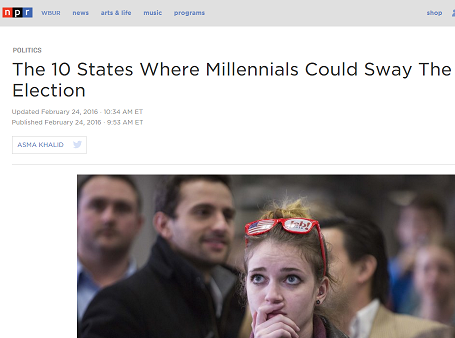
The current homepage of NPR news is a feature article by Asma Khalid about CIRCLE’s Youth Electoral Significance Index (YESI). My CIRCLE colleagues have identified the top 10 states and 10 congressional districts where the youth vote will matter most in Nov. 2016.

Politicians, campaigns, educators, and civic leaders should reach out to young people everywhere. But we recognize that political actors with limited resources will want to invest where they can have the biggest impact, and reporters may want to cover the youth vote where it counts for the most in electoral terms. Hence the YESI.

YESI

why don’t young people like parties?

Young Americans are not very loyal to parties. Many young people hold political beliefs that may make them almost guaranteed to vote for one party rather than the other–true “swing” voters are very rare–but they don’t identify with parties as organizations or devote their energy to parties as opposed to candidates and causes. I think that is partly why young people have so far been happy to vote for Bernie Sanders over Hillary Clinton by 4:1 margins. Remember that the primary election process was set up to allow party members to choose their party’s nominee, but young people who vote in the Democratic primaries don’t blink an eye to support a candidate who has chosen not to be a Democrat during his political career. I am not saying they should behave differently; I just think it’s interesting.

I have often heard cultural/generational explanations of this trend. Supposedly, Millennials are less favorable to organizations of all kinds. They prefer and expect looser and less hierarchical networks. There may be some truth to that, but I would suggest a different hypothesis. Young people are less loyal to parties than their predecessors were because parties don’t do anything any more.

Parties used to have functions, such as recruiting volunteers, paying workers, and organizing events (not to mention controlling patronage). Parties are now labels for clusters of entrepreneurial candidates and interest groups. The change occurred because the campaign finance reforms of the early 1970s defunded the parties, and then the deregulation of the 2000s allowed vast amounts of money to flow to entities other than parties. The Koch Brothers’ political network, for instance, employs 3.5 times as many people as the Republican National Committee does.

If parties do nothing for or with young people, it is easy to explain why youth don’t care about parties.

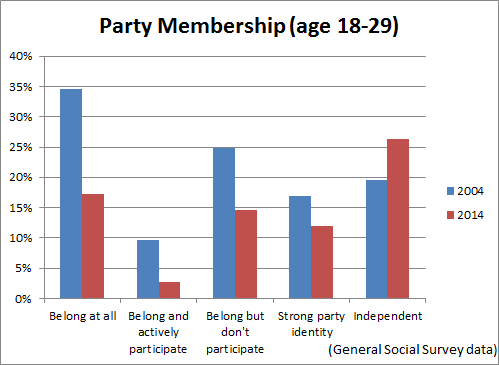
The General Social Survey asks about partisan ID at least every other year. The proportion of younger people who are Independents has grown, but most political scientists argue that that trend is misleading since the number of undecided or swing voters has actually shrunk. More to the point are questions that the GSS has asked only twice, about membership and active participation in parties. We know that parties didn’t do much to engage youth in 2004, because Dan Shea surveyed local party leaders that year, and “Only a handful of [county] party chairs mentioned what we might call significant activities, programs that require a significant amount of time or resources.” The parties were already hollow compared to decades earlier. He also asked an open-ended question: “Are there demographic groups of voters that are currently important to the long term success of your local party?” Just eight percent named young voters.

Nevertheless, the GSS indicates that the proportion of youth who actively participated in parties was 3.6 times higher in 2004 than it was in 2014. The hollowing-out continues.
partyID

every Republican president since 1901 has insisted that the US is a democracy

Anyone who works on civic education or grassroots civic engagement will sooner or later encounter critics who say, “The US is not a democracy–it is a republic” as if that were a profound objection to teaching or practicing democratic values. In a longer post, I analyzed the terms “democracy” and “republic” in the language of the Framers and subsequent authors. I argued that: (1) populist Framers like Jefferson used the word “republic” to mean what can also accurately be called a democracy, and (2) the original Constitution did include undemocratic elements, but they have been deliberately removed by the 15th, 17th, 19th, and 24th amendments to the Constitution. That means that although the Framers would call the United States a republic, it is now a democracy, at least in aspiration.

Here I would like to emphasize a related point. During the 20th century, almost all American political leaders asserted that the US was a democracy. Conservatives tended to be more sanguine about how much of a democracy we actually had. Left-liberals were the ones who argued that America was not authentically democratic because of persistent injustices. It is only in the last decade that it has become a talking-point for some conservatives that the US is (and ought to be) a republic and not a democracy.

I have quickly found one quotation from each GOP president since McKinley in which the president called the US a democracy. This was the result of 30 minutes of web searching; many more examples could be found:

[*It’s been noted that I accidentally omitted William Howard Taft, and it’s not easy to find a positive statement by him about democracy. He was, indeed, an opponent of the direct-democracy reforms of his era. So Taft may be an exception.]

  • Teddy Roosevelt, “A Charter of Democracy” (1912): “I believe in pure democracy. With Lincoln, I hold that ‘this country, with its institutions, belongs to the people who inhabit it. Whenever they shall grow weary of the existing government, they can exercise their constitutional right of amending it.'”
  • Warren Harding, Inauguration Address (1921): “Because we cherish ideals of justice and peace, because we appraise international comity and helpful relationship no less highly than any people of the world, we aspire to a high place in the moral leadership of civilization, and we hold a maintained America, the proven Republic, the unshaken temple of representative democracy, to be not only an inspiration and example, but the highest agency of strengthening good will and promoting accord on both continents.”
  • Calvin Coolidge’s Address at the Celebration of the 150th Anniversary of the Declaration of Independence (1926) is probably the most interesting, because it is an explicit and rather scholarly argument that the Framers had created a democracy. “Placing every man on a plane where he acknowledged no superiors, where no one possessed any right to rule over him, he must inevitably choose his own rulers through a system of self-government. This was their theory of democracy. In those days such doctrines would scarcely have been permitted to flourish and spread in any other country. This was the purpose which the fathers cherished.” Coolidge quotes Thomas Jefferson saying that his “‘best ideas of democracy’ had been secured at church meetings.” Coolidge says that Jefferson was influenced by John Wise, who had written, “Democracy is Christ’s government in church and state.”
  • Herbert Hoover, in a Challenge to Liberty (193o) argued that the New Deal had repudiated democracy, leaving “the Republican Party alone the guardian of the Ark of the Covenant with its charter of freedom.” He added, “You might think that reform and change to meet new conditions of life are discoveries of the New Deal. Free men have always applied reform. We have been reforming and changing ever since George Washington. Democracy is not static. It is a living force. Every new idea, every new invention offers opportunity for both good and evil.”
  • President Eisenhower’s Farewell Address as president (1961): “We must never let the weight of this combination endanger our liberties or democratic processes. … We want democracy to survive for all generations to come, not to become the insolvent phantom of tomorrow.”
  • Richard Nixon, State of the Union Address (1970): “In the majesty of this great Chamber we hear the echoes of America’s history, of debates that rocked the Union and those that repaired it, of the summons to war and the search for peace, of the uniting of the people, the building of a nation. Those echoes of history remind us of our roots and our strengths. They remind us also of that special genius of American democracy, which at one critical turning point after another has led us to spot the new road to the future and given us the wisdom and the courage to take it.”
  • Ronald Reagan, Normandy, June 6, 1984: “You all knew that some things are worth dying for. One’s country is worth dying for, and democracy is worth dying for, because it’s the most deeply honorable form of government ever devised by man.”
  • George H.W. Bush, Inaugural Address (1989): “We meet on democracy’s front porch. … Our children are watching in schools throughout our great land. And to them I say, Thank you for watching democracy’s big day. For democracy belongs to us all, and freedom is like a beautiful kite that can go higher and higher with the breeze. And to all I say, No matter what your circumstances or where you are, you are part of this day, you are part of the life of our great nation.”
  • George W. Bush at the National Endowment for Democracy (2005) “The roots of our democracy can be traced to England, and to its Parliament — and so can the roots of this organization. … Working democracies always need time to develop — as did our own. We’ve taken a 200-year journey toward inclusion and justice — and this makes us patient and understanding as other nations are at different stages of this journey.”

For more than a century, both Democrats and Republicans vigorously claimed that the US was a democracy as well as a republic. It’s possible that the names of the two major parties have recently encouraged some people to view the words “republic” and “democracy” as partisan labels. That is both an etymological error and an unfortunate barrier to what used to be shared aspirations. I happen to be confident that the language of democracy will regain its consensus appeal for Americans, thus inspiring us to honor our democratic ideals. But we are sailing through a rough patch right now, and virtually no political word seems able to unite rather than divide.

Association for Moral Education 2016 conference theme is civic engagement

(Arlington, VA) Tisch College is a cosponsor of the Association for Moral Education’s 42nd Annual Conference: 8–11th December, 2016 at the Harvard Graduate School of Education, Cambridge, MA, USA

Conference Theme: Civic engagement: a cultural revolution? The expanding definitions of ‘civic’ participation, their intersections with ethics, and the implications for education

The challenges and innovations in civic engagement in and beyond formal education are gaining worldwide attention. There are interesting links, synergies and dialogues among civics, ethics and moral development, including the significance of new media.

Submissions are welcome from scholars, students and practitioners across the many disciplines that contribute to the study and practice of moral and civic education, including psychology, education, sociology, philosophy, interdisciplinary, cultural studies, among others.

Submission deadline: March 14, 2016.

For submission details, and/or to register or the conference, please go to the conference website.

Korsgaard on animals and ethics

(Northern Virginia) I made some comments about animal rights and welfare at one of the Tisch Talks in the Humanities last week. I have contributed no original scholarship on this topic, nor even followed the vast literature closely. But in the course of a quick lit. review, I came across the line of argument that Christine Korsgaard has developed, and it struck me as persuasive. I’d put a central point like this:

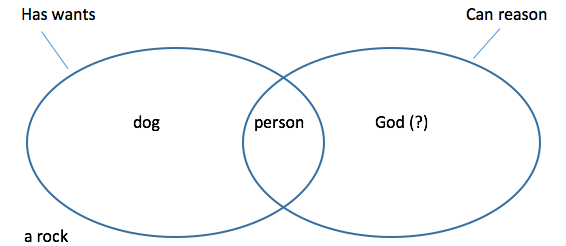
  1. There are two kinds of beings, those that have wants and those that don’t.
  2. There are two kinds of beings, those that can “reason” and those that cannot (where to reason is to have reflexive thoughts, or the ability to assess wants, desires, etc. critically).

Screen Shot 2016-02-11 at 1.23.50 PM

Inert objects like rocks and stars neither have wants nor can they reason. It follows that nothing is good or bad for them. All members of the animal kingdom, including human beings, have wants. That implies that some things are good and bad for each of them. Perhaps we alone are rational, in the Kantian sense. In that case, we and not animals have moral duties. But our moral duties are not only to those who are rational, but to those who have wants, which includes animals.

(I put God in the space for “can reason,” but “has [no] wants,” because I’ve been reading Spinoza this winter, and that’s his view. It’s theologically plausible that if there’s a God, God has wants. In that case, God would be in the same zone with us.)

Kant wrote:

If a man shoots his dog because the animal is no longer capable of service, he does not fail in his duty to the dog, for the dog cannot judge, but his act is inhuman and damages in himself that humanity which it is his duty to show towards mankind. If he is not to stifle his human feelings, he must practice kindness towards animals, for he who is cruel to animals becomes hard also in his dealings with men.

Korsgaard is a major Kantian, but in her Tanner Lectures on “Fellow Creatures: Kantian Ethics and Our Duties to Animals” (2004) and subsequent work, she disagrees with Kant’s reasoning here. What is wrong with shooting the dog is not that the man somehow neglects his duties to other humans. He has done wrong by mistreating the dog. Just like the man, the dog has desires, and there are things that are good for the dog. The man has negated the dog’s good in his own interest.

It is likely that dogs do not have the capacity to reflect on or change what they want. Therefore a dog does not have the right or obligation to participate in creating moral norms that are binding on itself or the man. It “cannot judge” in the way that a person can. We don’t blame it (or genuinely esteem it) for acting like a dog; that is simply its nature. But the man’s duty to reflect on his own desires is precisely the duty to take others’ desires into account. It doesn’t matter whether the others can judge; it matters whether they have desires and goods. Likewise, our duties to other human beings are not contingent on their acting like Kantian rational subjects.

See also: latest thoughts on animal rights and welfare and my evolving thoughts on animal rights and welfare.

what the Sanders youth phenomenon means for the future

(En route from NYC to DC) Early reports from the New Hampshire exit polls suggest that Sen. Sanders won about 8 in 10 voters under 30. Follow CIRCLE tomorrow for exclusive estimates of the size of the youth turnout. That will be important for helping to sort out whether Sen. Sanders’ dominance so far is a sign of his appeal–or of Hillary Clinton’s weakness.

I drew the latter conclusion while talking about Iowa last week on WGBH’s Greater Boston show with Jim Braude. Here’s the video clip. He and the other guests were very excited about Sen. Sanders’ large lead among young voters, both in the Iowa results and the Nrw Hampshire polls. Although I should try to avoid the role of the graying curmudgeon, I drew attention to Hillary Clinton’s poor showing in Iowa. Less than 5,000 young people caucused for her in the whole state, which seems to me an alarming sign both for Democrats in November and for anyone who cares about youth participation.

Just to put my comments in a broader context, I do think that Sanders’ youthful following is important. True, only about 35,000 youth voted for Sanders in Iowa. That is about one percent of the state’s population, and it was favorable terrain for him. Still, thousands of young people are having formative experiences as activists on the American left through his campaign (even as others come up through Black Lives Matter or the Dreamers’ or Marriage Equality campaigns). We know from extensive research that such experiences leave lasting imprints. A classic work is Doug McAdam’s Freedom Summer. It’s amazing how many leading figures of the left went to Mississippi in 1964, and McAdam shows how that summer shaped them for decades to come. I suspect when we read the biographies of leading progressive activists in 2030, many will say they worked for the Vermont senator in the winter and spring of 2016.

In the short term, the American left will struggle if Hillary Clinton is elected president (as I expect her to, unless a Republican beats her in November). While a centrist Democrat holds the ramparts against a Republican House, Republican statehouses, and a conservative judiciary, people to the president’s left will face constant pressure to pipe down. Concretely, the organized left may face a shortage of money, paid positions, media attention, technological innovation, and other forms of capacity–much as I recall from the Bill Clinton years, when I myself was young.

This is not ground for despair. Young activists can find solutions. For some of them, experiences with the Sanders Campaign will prepare them for the next four or eight years. Their activism will help President Hillary Clinton to do a good job, because (as FDR said) leadership is deciding who to cave to. She’ll need some pressure from that side.

All of which is to say that the youth support for Sanders is a real phenomenon that is worth following and caring about. But if one is interested in who will win the 2016 presidential election, I am afraid the Sanders phenomenon is likely to be something of a footnote as the primary campaign moves to larger and more diverse states. In that context, the important question is whether Senator Clinton can improve her showing with youth, whom she will absolutely need to win in November.