join us at the National Conference on Citizenship, Oct 13-14

The National Conference on Citizenship is always an important gathering of Americans who strive to improve our nation’s civic life. This year, the Tisch College of Civic Life at Tufts University is an equal partner in sponsoring and planning the conference. It will be highly interactive and will focus on issues of diversity, equity, and inclusion. I urge allies and colleagues to join us there. The official invitation follows:

Are you concerned about civic life in America?  Are you frustrated by fractured communities, divisive politics, and processes that exclude many of our people?  Do you feel we can do better?  Do you have solutions you want to share with others?

Then join fellow citizens, government leaders, and innovative entrepreneurs who are working to design and support engaged and resilient communities at the 2016 Annual Conference on Citizenship in Washington, DC.

The 2016 conference is Co-hosted by the Jonathan M. Tisch College of Civic Life at Tufts University and will specifically focus on issues of diversity, equity, and inclusion in civic life. Unless we make progress on these issues, we cannot move our country forward. 

Click here to view the agenda at-a-glance.

The 2016 conference will be highly interactive. Participants will help shape the agenda for civic renewal in America and will leave with contacts and practical ideas to strengthen their own work. There will be opportunities to address unresolved and contested issues in civic life.

The National Conference on Citizenship draws practitioners in fields like; democracy and political participation, service, civic education, community development, community organizing, public deliberation, health and wellness, youth development and workforce development, public arts and humanities, collaborative governance and work with government agencies, civic technology, and social entrepreneurship, and people from other fields interested in improving America’s civic life.

Please join us for this important convening and invite other colleagues whose voices need to be heard. Register today!

information, news, and meaning

Walter Benjamin was a radical social theorist in the high Continental tradition. John Dewey was an American pragmatist and a democrat. T.S. Eliot was a political reactionary. Despite their differences, they lived around the same time and sometimes made a very similar point: information is replacing wisdom or meaning.

I quote some passages to that effect below. I won’t supply a lot of commentary–let alone any solutions–but I do want to underline the urgency of their point. It’s estimated that people now produce and exchange 2.5 billion exabytes of data every day. All the words that people have spoken since the origins of the species amount to roughly 4 billion exabytes. That means that between now and Friday afternoon, we will create and share about as much new data as we have had time to speak since the early Paleolithic. I’m not assuming that speech is better than text or images, but this comparison underlines the astounding growth in volume. Meanwhile, wisdom seems more or less flat. We hope that increasingly powerful analytical tools can make sense of all the new data, but perhaps they just add another level of transient information.

1.  In “The Storyteller” (1936), Walter Benjamin argues that traditional storytelling took two forms: reports from far away and versions of local tradition. Both forms were oral and social, the storyteller interacting with a live audience. Both were intended to be useful, conveying a moral message or practical guidance and building a community.

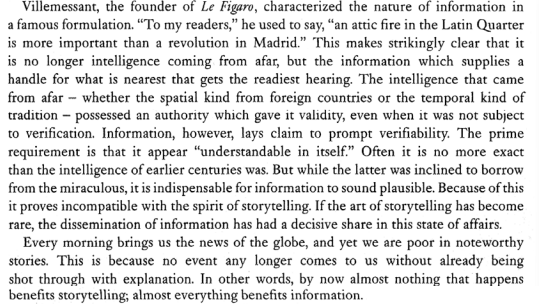
The novel, Benjamin argues, undermined storytelling. It existed for many centuries but only grew into an important institution with the rise of the bourgeoisie, for whom information is a commodity with economic value. The novel’s rise was simultaneous with the development of the news media as purveyors of information, epitomized by the French center-right daily newspaper Le Figaro:

Screen Shot 2016-08-28 at 10.45.40 AM
From our perspective, the nineteenth-century novel might seem a repository of profound meaning. For Benjamin, it was already a way-station on the route from meaningful stories (which were concise, ethically demanding, and social) to information as a commodity.

2. T.S. Eliot, “The Rock” (1934):

The endless cycle of idea and action,
Endless invention, endless experiment,
Brings knowledge of motion, but not of stillness …
Where is the wisdom we have lost in knowledge?
Where is the knowledge we have lost in information?

3. John Dewey, from The Public and its Problems (1927):

The physical agencies of publicity [of communicating with the public] which exist in large abundance are utilized in ways which constitute a large part of the present meaning of publicity: advertising, propaganda, invasion of private life, the ‘featuring’ of private incidents in a way which violates all the moving logic of continuity, and which leaves us with those isolated intrusions and shocks which are the essence of ‘sensations’ [pp. 168-9] …

‘News’ signifies something which has just happened, and which is new just because it deviates from the old and regular. But its meaning depends on relation to what it imports, to what its social consequences are. This import cannot be determined unless the new is placed in relation to the old, to what has happened and been integrated into the course of events. Without coordination and consecutiveness, events are not events but mere occurrences, intrusions; an event implies that out of which a happening proceeds. … The catastrophic, namely, crime, accident, family rows, personal clashes and conflicts, are the most obvious forms of breaches of continuity; they supply the element of shock which is the strictest meaning of sensation; they are the new par excellence, even though only the date of the newspaper could inform us whether they happened last year or this, so completely are they isolated from their connections [179-80].

Call for Papers: Facts, Values, and Strategies in Citizen Politics

Tufts’ University’s Tisch College of Civic Life and the journal The Good Society seek proposals for papers to be presented at a conference at Tufts on May 18, 2017 and then published in The Good Society as part of a special issue edited by Tisch Associate Dean Peter Levine. Tisch College can offer travel and lodging for presenters at the conference.

Framing:

Current global crises of democracy raise fundamental questions about how citizens can be responsible and effective actors, whether they are combating racism in the United States, protecting human rights in the Middle East, or addressing climate change. If “citizens” are people who strive to leave their communities greater and more beautiful (as in the Athenian citizen’s oath), then their thinking must combine facts, values, and strategies, because all three influence any wise decision. Mainstream scholarship distinguishes facts, values, and strategies, assigning them to different branches of the academy. Many critics have noted the philosophical shortcomings of the fact/value distinction, but citizens need accounts of how facts, values, and strategies can be recombined, both in theory and in practice. John Dewey, Hannah Arendt, Mahatma Gandhi, Jürgen Habermas, Amartya Sen—and many other theorists of citizenship—have offered such accounts.

Actual civic movements also combine facts, values, and strategies in distinctive ways. For instance, the American Civil Rights Movement used the language of prophesy, and Second Wave Feminism strategically advocated new ways of knowing. This special issue invites theoretical, methodological, historical, empirical, and case-study articles related to the question: how should citizens put facts, values, and strategies together?

Paper proposals of up to 300 words should be sent to Peter Levine at peter.levine@tufts.edu and to Good Society editor Trygve Throntveit at tthrontv@umn.edu by November 1, 2016. Prospective authors must be willing to present drafts by May 1 2017, attend a one-day conference at Tufts on May 18, and revise for final publication by September 2017.

my Introduction to Philosophy seminar

I will be teaching Intro to Philosophy at Tufts this semester, starting tomorrow. This course can be taught in several different ways: for instance, with a chronological sequence of major works, with a focus on one large issue, or with an array of excellent but accessible recent articles that give a flavor of the current discipline. I’ve opted to emphasize one of the great philosophical questions: “How should I live?” I’ve tried to select authors who represent reasonably diverse cultural traditions; it was while planning the syllabus that I wrote a piece for Aeon entitled “The lack of diversity in philosophy is blocking its progress.”

The readings will specifically consider whether truthfulness, happiness, and justice are important aspects of a good life. Some of the assigned authors will argue that these three goods fit together neatly, for to be happy requires being truthful and just. But some of our authors will dispute that premise.

I paste the reading assignments below.

Syllabus: Subject to Change

Sept. 7: Overview and introduction

I. Truthfulness

Is there an obligation to seek the truth? To say or teach the truth to others? How does truthfulness relate to happiness and justice? Can we know truths about ethics?

Sept. 12: Plato, Apology, sections §17-35. Also Justin P. McBrayer, “ Why Our Children Don’t Think There are Moral Facts ,” The New York Times, March 2, 2015. Or in this PDF if you have trouble reading it on the NY Times site.

Sept. 14: Plato, Apology §35-42

Sept. 19: Friedrich Nietzsche, Beyond Good and Evil, aphorisms §1-12

Sept. 21: Nietzsche, Beyond Good and Evil, aphorisms §13-32

First paper due. Describe a situation in which it’s problematic whether to be truthful or not. Argue in favor of being truthful or not being truthful in this situation. Define what you mean by the term “truthful.” Give reasons for your position and explain and counter good reasons against it. Cite at least one relevant passage from Plato or Nietzsche.

II. Happiness

What is happiness? What are the best paths to happiness? Do we have a right to pursue our own happiness? Can we make others happy?

Sept. 26: Epicurus, “Letter to Menoeceus” (We will also discuss Socrates’ remarks about happiness in the “Apology,” already assigned.)

Sept. 28: “Buddha,” in the Stanford Encyclopedia of Philosophy (entry by Mark Siderits)

Oct. 3: “Buddha” (continued)

Oct. 5. Emerson, “Self-Reliance”

Oct 10: No class (Columbus Day)

Oct. 12: More discussion of the “happiness” readings.

Second paper due. Assignment TBA

III. Justice Toward Others

What are principles of justice? Which principles of justice are binding on whom? How do they relate to each other?

A. Welfare

We discussed happiness in the previous section. Could maximizing the happiness of all human beings–or something similar to that–be the main principle of justice?

Oct. 17: Mill, Utilitarianism, chapter 2 (“What Utilitarianism Is”) and chapter 5 (“On the Connection Between Justice and Utility”)

Oct. 19: Rawls, A Theory of Justice, Part I, chapter 1, §5 (versus utilitarianism)

Oct. 24: More discussion of welfare.

B. Liberty

Oct 26: Milton and Rose Friedman, Free to Choose, Introduction and chapter 6 (“What’s Wrong With Our Schools?”)

Oct 31: Friedrich Hayek, The Constitution of Liberty, Chapters 1, 4 and Postscript (pp. 11-21, 54-70, 397-411.)

Nov. 2: John Rawls, A Theory of Justice, Part I, 1 §1-4, 2 §11-17, and 3 §24

Nov. 7: Discussion of Rawls continues.

Nov. 9: Isaiah Berlin, “Two Concepts of Liberty” (1958), in Isaiah Berlin, Four Essays on Liberty (1969)

Third paper due. Assignment TBA

B. Equality

Nov. 14: Tim Scanlon, “When Does Equality Matter?

Nov. 16: Robert Nozick, Anarchy, State and Utopia, pp. 149-177

Nov. 21: Bayard Rustin, “From Protest to Politics: Future of the Civil Rights Movement,” Commentary (February, 1965)

Nov. 23: More discussion of the “equality” readings. Fourth paper due.

D. Democracy

Nov. 28: Robert A. Dahl, Democracy and its Critics, pp. 106-52

Nov. 30: Kwasi Wiredu, “Democracy and Consensus in Traditional African Politics” (http://them.polylog.org/2/fwk-en.htm) and Emmanuel Chukwudi Eze, “Democracy or Consensus?” ( http://them.polylog.org/2/fee-en.htm)

E. Identity

Nov. 30: Audre Lorde, “ The Master’s Tools Will Never Dismantle the Master’s House ” and Steve Biko, “Black Consciousness and the Quest for True Humanity

Dec. 5: Todd Gitlin, “The Left, Lost in the Politics of Identity,” Harper’s Magazine, 1993; and Susan Bickford, “Anti-Anti-Identity Politics: Feminism, Democracy, and the Complexities of Citizenship,” Hypatia Vol. 12, No. 4.

Dec. 7: More discussion of the readings on democracy, diversity and inclusion.

Fifth Paper due.

Assignment: Dec. 12: Final discussion

why some forms of advantage are more stubborn than others

Let’s make these assumptions:

  1. All the slots in a desirable institution are held by white men, most of whom are wealthy, and none of whom are out as gay. That would (for instance) be a rough description of the student bodies of Harvard, Yale, and Princeton ca. 1960.
  2. Wealthy, straight, white men also tend to hold biased views of the other groups.
  3. Most people want their children to have at least the same advantages (in both absolute and relative terms) that they’ve had.
  4. People with social, cultural, or financial capital are quite good at obtaining advantages for their own kids. Just for instance, after the collapse of the Roman Empire and the demise of paganism, France was run by Frankish bishops instead of the Roman landlords who had dominated Gaul. But it turns out the bishops were descended from the landlords, because the Gallo-Roman elite figured out how to weather even the profound disruptions of AD 300-600 and put their own sons on top of the new order.

Now let’s envision that the biased views mentioned in #2 (above) go away. Wealthy, straight, white men develop genuinely respectful, appreciative, egalitarian views toward all others. Meanwhile, the other groups come to believe that they have equal potential and rights, rather than internalizing bias against themselves. What happens?

Most women and most gay men are children of straight men. Therefore, if advantaged moms and dads simply form the opinion that their own daughters and gay children have fully equal potential and worth, then they will demand spaces for those kids at the top of the social scale. Social outcomes should change quickly as a result of attitudinal changes. The only obstacles are: (1) persistent bias, which may become implicit and subtle, (2) leftover policies and structures that discriminate, such as policies regarding parental leave, and (3) the reluctance of incumbents to yield their own places. To the last point: you wouldn’t expect tenured Ivy League professors or US Senators to resign to make room for women, but you would expect the gender ratio to improve with generational turnover, as long as attitudes truly change.

In contrast, most people have the same race/ethnicity as their parents. Therefore, even if all the white parents who dominate the preferred slots in a society come to believe that people of color are fully equal and entirely welcome, if they also succeed in obtaining slots for their own kids, then racial demographics will shift slowly, if at all. Attitudinal change will have little impact on outcomes. Absent major pressure from outside the system, all you’ll see is slow, incremental change as each family of color that makes it to the top holds a spot for its own kids.

As for class advantage, it presumably consists of having a better-than-average chance of attaining a desirable social role for yourself or your kids. In the list above, I assume that a society provides highly some desirable social slots (such as places in the student body of Harvard, Yale, and Princeton), and that parents confer advantage in obtaining those slots. For instance, US parents who have attended college have an 82% chance of sending their own kids to college, versus a 36% chance for parents who didn’t complete high school.

But both of those circumstances are variables, not constants. A society can offer a steeper or gentler gradient of social advantage, and the correlation between parents’ and children’s advantage can be larger or smaller. In Continental Europe and Canada, colleges do not differ nearly as much in reputation and resources as they do in the US and Britain, which means that it matters less where you enroll. However, it is worth noting that even in Sweden, with a century of social democracy behind it, today’s upper class is substantially descended from the 17th century aristocracy. But Swedish women now earn 95% as much as Swedish men and fill 43% of the seats in the legislature. In Sweden, new attitudes toward gender (and sexual orientation) led to deep changes in individual choices and social policies. But new attitudes toward class didn’t dislodge Sweden’s most advantaged families.

the Danish Parliament’s paternoster

Earlier this month, my family and I took the free and excellent tour of the Danish Parliament in Copenhagen. There were many serious insights to be gleaned about parliamentary government, unicameral legislatures, multiple-party systems, and the cultural norms that prevail in Scandinavia, such as egalitarian informality.

But I write not to share insights; I write to relate an anecdote. Although the embedded sideways video is not mine, it shows part of the same tour that we took. The machine in the background is a “paternoster”–like an elevator except that the doors remain always open and a sequence of boxes passes by continuously. You have to jump on and off. Characteristically for Denmark, this contraption is considered too dangerous for tourists and reporters, but MPs and their staff can ride it. As the guide notes, this makes it a good refuge from journalists (who otherwise are allowed everywhere in the parliament building, at will).

The guide–or one of his colleagues–once explained to some Danish 7th-graders that the paternoster goes up, over, and down. That means that if you ride it up on the left, soon you will be coming back down on the right, still standing comfortably upright. The oldest Member of Parliament at the time, who was also a minister in the government, heard this explanation as he rode up. A few seconds later, down he came on the left–standing on his head.

It is fairly hard to imagine this happening in the US Capitol.


public support for civics

PDKThe annual Phi Delta Kappa survey of public attitudes toward education is out.

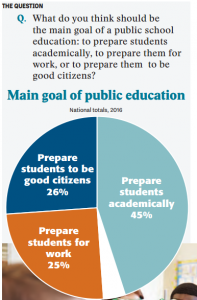
Adults are asked whether preparing students to be good citizens is important and how well schools are doing it. Eighty-two percent say it’s extremely or very important, and 33% say schools are doing it extremely or very well. As a priority, it ranks somewhat below developing work habits and providing factual information, it ties with critical thinking, and it comes ahead of working in groups.

In a different question, respondents are asked to pick the single main goal of education. About a quarter choose preparing students to be good citizens, which is on par with preparing students for work but behind preparing students academically.

The advantage of a forced choice is that most people will favor a whole set of good outcomes if allowed to pick them all. However, there’s something a little artificial about the results of a forced choice. My job is to study and advocate for civic education, so I’d pick the “citizenship” choice. I nevertheless believe that preparing students academically and for work are essential goals, and are complementary with civics. So it’s not the case that 26% of Americans think only citizenship matters, or that 74% think it doesn’t matter at all.

Still, the forced-choice reveals that education for citizenship is the top priority for quite a few Americans. That’s valuable to know, because the major reforms that have passed through education like earthquakes’ seismic waves since 1980 have hardly mentioned civics at all. The PDK survey doesn’t prove that Americans put the civic mission of schools above all else, but it does suggest a lot of support, which ought to be reflected in policies.

Further, the forced choice reveals differences within the public. It appears that the civic mission is most important to young and older citizens; parents and other adults in the traditional child-rearing years are more concerned about academics.

There’s also a partisan and ideological split: “Fifty percent of conservatives emphasize academics vs. 43% of moderates and 40% of liberals. Liberals instead are more likely (33%) than moderates (24%) and conservatives (22%) to say schools should focus on building citizenship. Republicans are less apt than others to value a role for citizenship instruction in public schools.” The partisan divide creates challenges for proponents of civic education. In my opinion, citizenship should be a core value for conservatives, and it’s important to make that case.

The PDK poll doesn’t ask people what they mean by “good citizens.” We know from other studies that answers would vary. Some think of good behavior–obedience in the kindergarten classroom or staying out of trouble as a teenager. Others think of patriotism and support for the regime; still others, of activism and debate. Note that support for citizenship education is strongest among liberals and young people, and I doubt that most of them favor simple obedience.

One thing we can conclude is that good citizenship shouldn’t be an afterthought for policymakers, for 82% of adults think it’s at least very important, and 26% think it’s the main goal of schools.

a reason for hope: the Citizens Initiative Review

(Posted from DC) The Massachusetts 2016 Citizens Initiative Review just concluded. Twenty randomly selected citizens spent four full days hearing testimony and intensively deliberating to write a statement meant to inform Massachusetts voters about the pending marijuana legalization referendum. Tufts’ Tisch College is a sponsor of this process, and I made a few visits during the days of deliberation, which are open to the public. I can report that my fellow citizens were deeply responsible, thoughtful, serious, and civil. At the end, I understand they found themselves moved by what they had accomplished.

Their task was to write a statement to guide voters. Their short document had to include the strongest reasons to vote for and against the initiative. Their fine product is here.

In contrast to politics as usual, the CIR isn’t polarized, and it’s not about winning and losing. In a good sense, it’s personal: participants get to know each other and try to make something valuable together. It is demographically reflective of the whole state. Money can’t get you into the room or buy your ideas a better hearing. It’s open-ended: no one can predict or determine what the deliberators will write, and each voter who reads their statement will make up her own mind about the referendum.

To observe 20 of your fellow citizens–of all ages, races, and walks of life–playing a role in making policy is a beautiful thing and an antidote to despair.

the signal in this election versus the noise

Here is a graph of the presidential polls from this election so far. Most people choose narrow ranges for the y-axis in graphs like this, to draw attention to the shifts. I show the full 0%-100% range, to display how the whole American public has split. I also choose the stronger option for “smoothing,” so that each day’s measure is an average of several days on either side. The result is a highly stable advantage for Hillary Clinton all the way along.

It doesn’t really seem to have made that much difference what Trump has said, or what has been reported about Clinton’s emails and her Foundation, or how she has spent her $319 million in TV ads. It looks as if most people had their minds made up as soon as it was clear who the nominees would be.

The trend looked similar in 2012, except that it was always much closer that year.

I’d say that partisan identification outweighs almost everything, except that Trump is underperforming, for a GOP nominee, by a few points.

the Nordic model

We are just back from a vacation in parts of Iceland, Denmark, and Sweden. Although I’ve been in the region before, I am very far from expert on Nordic politics and economics. But it’s worth understanding the Nordic model–even if it looks a little rickety today and may depend on factors that couldn’t transfer to the US–because basic measures of human well-being are extraordinarily high in the five Scandinavian nations. For instance, Norway has the highest human development level in the world. I think the Nordic model represents a fusion of two contrasting impulses, a combination that is perhaps obscured in talk about social democracy or democratic socialism.

The (conservative) Heritage Foundation’s Index of Economic Freedom makes the point. From Heritage’s perspective, Denmark is an odd mix, although its overall rank is high. Heritage considers Denmark very bad at “limited government,” because one aspect of the Nordic model is high taxation and spending. On the other hand, Heritage ranks Denmark very high on measures like business freedom, investment freedom, and property rights (as well as freedom from corruption, which everyone values).

I think the Nordic model boils down to competitive entrepreneurship in the global marketplace plus strongly egalitarian social policies for everyone in the home country. Scandinavians are out and about, learning foreign languages (95% of Swedes speak English), and studying and working overseas. Goods as well as human beings flow across their borders. Denmark’s international trade is 102% of GDP. I’m not certain how that number can be greater than 100%, but the ratio is obviously much higher there than in the US, where trade is 27% of GDP. You see imports everywhere in Scandinavian stores, as well as export-oriented businesses.

Competitiveness brings material benefits: high-quality goods and services selected from around the world. It provides opportunities for ambitious and talented people to create new things. An index of innovation ranks Sweden first in the world, and Finland and Denmark are also in the top 10. Competition also identifies and rewards excellence. The result is a lively, flexible, future-oriented society. Scandinavians are proud of their nations’ marquee industries and are notably patriotic without being bellicose.

At the same time, competitiveness hurts people–the people who cannot or don’t happen to win, who were doing fine before all the market “disruptions,” who value traditions, or who don’t even want to fight for success in market economies. Competition can also erode civic virtues and responsibilities, including concern for public institutions and shared resources.

That’s why the other side of the Nordic model is so important. At home, everyone has very extensive and unconditional economic rights, which cost a lot of money. The public sector budget is 55% of GDP in Denmark. The state also demands people’s time and attention. Sweden, Denmark, Iceland, and Denmark all rank in the top seven for voter turnout, they have among the highest rates of associational membership in the world, and their governments are rated as the least corrupt.

All of this is hard to build and maintain, and I have not mentioned the drawbacks and frailties of the model. My point is really an ideological one. There are genuine virtues to systems that we might call “neoliberal,” systems that involve property rights, competition, and globalization. Strongly democratic societies that protect everyone’s welfare also have virtues. And although these goals can trade off in some respects, it’s possible to pick elements from the neoliberal menu and others from the socialist menu without contradiction.