what it means that people prefer a businessman to a politician for president

The contrast between Donald Trump the businessman and Hillary Clinton the politician has been underplayed (although not entirely overlooked) as an explanation of the 2016 election. I don’t interpret Americans’ admiration for business leaders as a preference for the market over the government, although that distinction might influence some people. Instead, evidence shows that many people dislike deliberation and compromise in politics. That stance is compatible with admiring a president who expands the government, as long as he acts like a private-sector boss.

In 1998 (when HRC was First Lady), John R. Hibbing and Elizabeth Theiss-Morse* found that most Americans didn’t rate their fellow citizens as informed or intelligent. They didn’t want to participate in government or politics, nor did they prefer a political system with much public involvement. They had few policy preferences, but they strongly disliked the people in charge of the government. They suspected political elites of selfish and greedy behavior. For instance, they thought that elected officials get rich from government service. They believed that the public had consensus on most issues, yet agreement was mysteriously absent in Congress. They interpreted elites’ disagreement as a sign of corruption. A majority of their respondents (about 70%) agreed with two or three of the following propositions, which qualified them as believers in what Hibbing and Theiss-Morse called “Stealth Democracy”:

  • “elected officials would help the country more if they would stop talking and just take action on important problems” (86% agree)
  • “what people call compromise in politics is really just selling out on one’s principles” (60%); and
  • “our government would run better if decisions were left up to nonelected, independent experts rather than politicians or the people” (31%) or “our government would run better if decisions were left up to successful business people” (32%)

Fifty percent wanted the government to be run more like a business. There was also considerable support for billionaires and technocratic experts, since neither could profit from their own decisions. In 1992 Harris Poll, 55% of respondents had agreed that Ross Perot wouldn’t be influenced by special interests because he was rich.

In their book, Hibbing and Theiss-Morse used a survey that’s now 19 years old. In 2009, Michael Neblo, Kevin Esterling, Ryan Kennedy, David Lazer, and Anand Sokhey challenged their findings empirically, but in 2015, Hibbing and Theiss-Morse repeated the analysis and connected it to the Trump campaign. Believers in what they called “Stealth Democracy” preferred Trump to Clinton by 38%-13%; people who disagreed with that view narrowly favored Clinton.

Trump is a perfect example of a leader who says he’ll “just take action,” in harmony with the consensus of all real Americans. Hillary Clinton exemplifies a politician who is good at compromise, who acknowledges disagreements and engages in debates–and who has become rich as a result of her political career.

I believe that people learn from experience that disagreement exists and compromise is necessary. They learn those truths by participating in diverse groups that can make consequential decisions. But the proportion of adult Americans who either attend weekly religious services or belong to a union has dropped by 21 points, from a majority of 55 percent in 1970 to a minority of 34 percent in 2012. The proportion of all Americans who serve on any local board had plummeted by 75% since the mid-1900s, due mostly to consolidation of governmental functions plus professionalization. Juries are also much less prevalent: 1 in 40 felony cases now goes to a jury trial, down from 1 in 12 as recently as the 1970s.

People still know how bosses operate in the private sector. But few know what it’s like to be democratic leaders, because few are allowed to play such roles locally. That’s a recipe for a rejection of democratic values.

*Stealth Democracy: Americans’ Beliefs about How Government Should Work (Cambridge University Press, 2002). I draw here from my own 2003 summary.

assessing the congressional town meeting protests, 2009 and 2017

In 2009, when Democratic House members went home to discuss the Affordable Care Act with their constituents, they faced disruptive questions and protests, often from people loosely affiliated with the Tea Party. The protesters cited such supposed evils as Death Panels. This year, when Republican House members go home to discuss repealing the same legislation, they face disruptive questions and protests from supporters of the ACA. In at least one case, a Member of Congress decried the Death Panels that are supposedly now in existence and was hooted down as a liar by his constituents. In both 2009 and 2017, many Members of Congress have decided not to hold so-called Town Meetings at all because of the prospect of protests that would be covered on mass media.

2009

2017


I was prone to lament the protests in 2009 but welcome them in 2017. That sounds like hypocrisy, but the comparison is more complicated. First, the same behavior can be appropriate or inappropriate depending on its purpose and content. Making such distinctions requires judgment, but judgment is essential in politics and is not merely a form of bias. In other words, the right judgment may be that the protests of 2017 are helpful even though those of 2009 were harmful. One reason may be that the protesters of 2017 are speaking truth, and those of 2009 were repeating lies. I acknowledge that’s a simplification, but it may be roughly correct.

Second, if we treat a political act (such as organizing or disrupting a public meeting) as a general category, without reference to its purpose or outcome, we still must weigh several values. Disrupting a meeting is bad for civility but may enhance free speech and agency. Only a purist about civil dialogue would automatically oppose any form of disruption.

I took a somewhat unusual position in ’09. I argued that deliberation–i.e., genuinely listening and being open to changing one’s mind–plays an important role in a democracy. When protesters shut down events sponsored by Democrats, or when Democrats stopped holding open meetings in fear of protests, deliberation suffered. This was a shame because we are all badly limited, morally and cognitively, and we need opportunities to hear from the other side.

However, I said then, a major cause of the disruption was the design of these events. In a truly deliberative event, such as a classic New England Town Meeting, the participants make a collective decision that is not pre-determined by the organizer. To make such a discussion go well requires rules that give people and arguments equal time and organize the debate. An event that is billed as a “Town Meeting” is a fake deliberation if the politician-organizer has already made up his or her mind and just wants to persuade the audience. Giving members of the public a chance to react for a minute at the mic. is a recipe for angry responses. Such meetings are so predictably bad that they provide frequent moments of comedy on Parks & Rec:

The solution would be to reserve events that are billed as deliberative for genuine deliberations. Citizens would be invited to discuss and design solutions, and the organizers would be open to any outcomes. An example is our successful recent experiment with a Citizens Initiative Review in Massachusetts.

When, on the other hand, a representative already holds a position on an issue and wants to persuade the public, she or he is entitled to screen the audience, to talk only through the media, or otherwise to control the format. At the same time, opponents are entitled to exercise their rights of assembly and petition to argue the opposite position. If the politician chooses to speak in an open room, then she should expect disruptions. If the politician screens the audience, she should expect people outside with signs.

Several additional issues arise for me:

  1. What should matter to protesters is winning. You win if you get more than 50% of the public to support you actively, e.g., by voting in 2018. A protest that may inspire your side and even encourage more participation may also alienate the undecided. Everyone involved in a social movement should read Bayard Rustin’s 1965 article “From Protest to Politics” to remember the difference between moral purity and political effectiveness. Perhaps “What would the median voter think about this?” is not the only important question, but it is always one question to consider explicitly.
  2. The number of people who are present at these events is trivially small in a nation of almost 320 million. The protests matter because they are covered by mass and social media. Controversy and outrage are profitable for media companies. That means that moments of disruption will receive disproportionate attention, and most moments of actual dialogue will be lost. An effective protest may have at least two mediated audiences: supporters whom it inspires, and opponents whom it outrages. They will see the same event in different media contexts. Smart political activists think their way through to the media coverage in all channels.
  3. Listening is a political virtue, even if it’s not the only virtue. Speaking out of turn at a meeting, or drowning out the main speaker, may be the right thing to do. It allows other people to hear you and it honors your right to a voice. But it does have a cost: the audience can’t hear the person you have drowned out or preempted. It’s appropriate to reduce that cost by (for example) interrupting briefly and then yielding back the floor.
  4. Politicians who appear at open public meetings before hostile audiences to defend their settled positions are not strictly deliberating. They have made up their minds and they seek to use their influence to affect public opinion. However, by physically appearing before their critics, they demonstrate vulnerability. As Danielle Allen argues in Talking to Strangers, democracy requires vulnerability. It is a necessary (but not sufficient) condition for valuable interactions between people who are strong and weak. Therefore, Republican Members of Congress who continue to face protesters in open meetings deserve some credit–which takes nothing away from the protesters who challenge them.
  5. A protest is a moment of potential, but only if the protesters find other ways of acting together politically. In turn, that requires members of the protest movement to form durable relationships and to develop and extend their skills, usually in the context of organizations to which they belong. In a very important recent interview, Marshall Ganz says, “Many Democrats confuse messaging with educating, marketing with organizing. They think it is all about branding when it is really about relational work. You engage people with each other, creating collective capacity. That’s how you sustain and grow and get leadership.”

Dubai, Uganda, and today’s global political economy

My family and I are just back from visiting our daughter, who works in Uganda, with a two-day stop in Dubai, where there’s a change of flights en route from Boston to Entebbe. We chose these destinations for family reasons. But it’s significant that Emirates Airlines flies direct from Dubai to Uganda. Even though the United Arab Emirates is small, and these two countries lie far apart, the UAE is Uganda’s 4th-largest source of imports. Dubai, an “Alpha+ Global City,” is a hub in a network of financial and human capital for a vast hinterland that includes Uganda, where 84% of the population still depends on subsistence agriculture.

There is much to like in both places—and reasons to hope that their futures will be brighter. However, if the worst aspects of each state predominate, and if the world increasingly resembles this pair of nations, then the human future will be dystopian.

Two centuries ago, both the Buganda Kingdom north of Lake Victoria and the Sheikdom of Dubai were independent monarchies. If we assume that today’s basket of most desired goods (life expectancies above 70, individual freedom, security, etc.) define human development—a contested assumption—than both societies were poorly developed. But they had rich and complex cultures and social structures.

The British made both kingdoms into dependencies and then subsumed Buganda within a full-fledged colony. The period of colonialism must have been experienced as traumatic in both countries. There were important differences. For instance, most Ugandans–but virtually no Emiratis–converted to Christianity. But they also shared some experiences, such as in-migration from South Asia. (Indians and Pakistanis now far outnumber Arabs in Dubai.) Police departments, accounting firms, factories, and many other innovations that we might label “modern” or “Western” arrived in both places with the British.

They gained independence within ten years of each other, but their economic trajectories have split. Dubai, a city-state entrepôt on one of the world’s busiest shipping lanes, has become the 9th-wealthiest nation in the world, with a per capita GDP of nearly $70k. Uganda, a land-locked agricultural nation of 38 million, ranks 163 out of 188 countries on the Human Development Index and has a per capita annual GDP of $572 and a median individual income (my favorite summary statistic) of $2.50 per day. By definition, that means that half of Ugandans live on less than that much–at least as far as a cash economy is concerned–and one in five live below the poverty line of $1.90 per day.

Their political trajectories have also split. Dubai has been a stable absolute monarchy within the federal structure of the United Arab Emirates. Political rights are nonexistent; there is no legitimate public sphere, in the sense of a zone where citizens freely form public opinion and influence the state. The Ruler may choose to consult, but he decides. Most residents are not citizens in any sense; about 90% percent are expatriates.

Albert O. Hirschman argued that two strategies are valuable when you don’t like how things are going: exit or voice. In Dubai, political voice is irrelevant or even illegal. But exit (along with entrance somewhere else) is prevalent. People shape Dubai by moving themselves and their assets there or away, whether they are construction or domestic workers from India or the Philippines or bankers or real estate developers from wealthy nations. With the exception of the most exploited workers, they can leave if they are dissatisfied. This means that Dubai has been created by its residents, not by the Ruler. It’s the residents who have thrust astounding numbers of postmodernist skyscrapers out of the desert or have withdrawn their capital when dissatisfied. But their influence is entirely individual and apolitical.

Uganda, meanwhile, has had a tumultuous history, with only three presidents (although four regimes) so far since independence, and still no peaceful transfer of power. We visited the underground cells behind Idi Amin’s former presidential palace where thousands were tortured and killed by electrocution; no one left those chambers alive. I don’t think I am naive about the limitations of the current democracy, as Yoweri Mouseveni spends his 31st year in the presidency. Yet Uganda is a democratic republic. The people govern through representative institutions, albeit with several dubious elections since 2001. The newspapers call Ugandans “citizens,” respecting them as the people who ultimately govern the republic and implicitly holding them responsible for doing so. (I think respect and responsibility are what define a republican form of government.)

Three democracy indices from V-Dem (not available for UAE)

The Ugandan press is vibrant and competitive. The standard journalistic style is a bit more stenographic than what we are accustomed to in the US. Many articles basically report what someone said, in the same order that he or she said it. But the perspectives captured in these stories are diverse and often sharply critical. There is a public sphere, even if the state is somewhat unresponsive to it.

If voice is more evident in Uganda than in Dubai, exit is rarer. Few Ugandans can afford to or want to leave, although remittances from emigrants are rapidly growing. The largest migration of people consists of refugees into the country from South Sudan; they lack both exit and voice.

In Dubai, the global consumer brands are pervasive, including the Trump brand, now attached to a huge new golf course. There is a preserved old quarter that represents traditional Emirati culture, but it is probably smaller than one Bulgari ad on the side of one high-rise office building. We saw at least four billboards for completely different products that used the same format: a White woman in fashionable Western clothes and an Emirati man in a traditional white dishdosh and headscarf are beaming at the same consumer good. Even though about 70% of the residents are Asians, rich Westerners and Arabs are the normative consumers.

In Uganda, despite a few ads for Coca-Cola and Pepsi, the global brands are rare. Almost all stores are one-story brick structures with a raised front wall that can display messages above the door. By my count, about 30% of the stores in the cities and along the paved intercity roads (but fewer on dirt back roads) display painted advertisements for a handful of local brands, mostly telecom service-providers, construction materials, and detergents. Another notable form of advertising consists of new mosques, ubiquitous next to the roads in this overwhelmingly Christian country, thanks to funding from Turkish and other Middle Eastern sources. Finally, one often sees the logos of aid agencies: national, multilateral, or nongovernmental. In one national park, a sign announced that the signage had been given by the “people of the United States” through USAID. Paying for the signs that carry our national logo seems a way to maximize the ratio of branding to actual benefit.

Language often offers insights into culture. I’m sure that individuals in each country have unique relationships to the languages they speak, but I’ll risk some generalizations about English in Uganda and in the UAE. Ugandan (or East African) English is a branch of the language, like the Queen’s English or my own. It is mutually intelligible with American English, yet highly distinctive, full of terms for local foods and activities, loan-words from Swahili, and idioms and rhythms that make it a vehicle for expressing a particular culture. You could learn to speak Ugandan English, and that would be a linguistic attainment, an addition to your repertoire.

The English of the UAE sounds to me like what one learns in a second-language course in a business college. It is error-prone but functional, jargon-filled, strictly pragmatic. It might offer possibilities for creativity and insight—but I doubt it. I’m guessing that most residents experience cultural depth and aesthetic satisfaction in their native tongues. In Joseph O’Neill’s wonderful novel set in Dubai, The Dog, the narrator says, “I have a real soft spot for the habitual accent of Arab speakers of good English, in whose mouths the language, imbued with grave trills, can seem weighted with the sagacity of the East. (See Alec Guinness in Lawrence of Arabia.)” That may be true, but only 12% of the UAE’s residents are Emirati, and not all of those speak good English. Purely functional English–plus math–is the code of business, and business is the culture that counts in Dubai.

Looking toward the future, one can imagine that Dubai adds political liberties and public deliberation to its market freedoms, and Uganda not only honors the true spirit of its republican constitution but also develops sufficiently so that all its people attain the core human capabilities. That would be a better world. To be even more utopian, we might hope that the relationships among Uganda, Dubai, and the inevitable third corner of the triangle–the OECD nations–becomes genuinely just, not just in the sense that human circumstances converge but also that the people of Uganda can make real claims on the people of Dubai or New York.

One can also imagine that Dubai continues to prosper without political freedom, much as Shanghai also does today. Absolute monarchies seem quaint, but arguably the real players in Dubai are the big corporate investors, and corporations are not democracies. Their influence could grow, not only in Dubai but in all the Global Cities. Indeed, as the world gets hotter, dryer, more postmodern, higher-tech, more racially intermingled, yet more culturally homogeneous, one could imagine that all the cities that dominate the global economy will look like Dubai today. Already, the man whose portrait hangs in every federal office building in the USA also has his name on the huge billboards for Dubai’s newest golf course.

Meanwhile, Uganda faces rapid population growth, a median age of 15, a worsening climate, unstable neighbors in several directions, and the risk of political instability once Mouseveni finally retires. One could imagine that Uganda will look much as it does today, only poorer and more violent, and that many other nations will look more like it. That is the dystopian future that haunts us.

The Anachronist

In the year 1596, Anna is about to be burned at the stake. As the constable prepares to light the fire below her, she can do nothing but seek a solution in her own memory and imagination.

The Anachronist is a game in which you make choices that determine the outcome. By increasing Anna’s knowledge, you can create opportunities for her to act. By decreasing the entropy or disorder of the whole situation, you can raise the odds that the ending will be a happy one for all of the characters. If you try to conclude the story while knowledge is too low or entropy is too high, Anna will burn.

At the same time, The Anachronist is literary fiction. With as many words as a novel, it’s indebted to authors like Joyce, Borges, Calvino, and Pamuk. It uses modernist and post-modernist literary techniques–as well as an interactive format–to explore questions of perspective, historical change, and truth.

Emily Short writes:

The Anachronist is a Twine piece by Peter Levine. It’s long, and paced like a novel rather than like a short story or a poem; it very much belongs to the category of readerly IF [Interactive Fiction]. …

As for what it’s about, that is a little more difficult to describe. The protagonist is being burned at the stake in 1598 (perhaps), but in the moment that she stands in the flame, her mind wanders. She imagines her surroundings in Oxford, or possibly a painting of her surroundings; she thinks about alchemy, the art of memory, the intellectual commitments of a former teacher.

Your task is an abstract one, to do things that globally increase knowledge or decrease entropy. Part of the gameplay involves recognizing and selecting anachronistic references; those links aren’t highlighted for you, but if you succeed in finding something, that counts against entropy.

The knowledge aspect is a little trickier. Most of the choices at least in the early stages of the story are choices either to look more closely at some aspect of the world or else to move onward. My impression was that looking more closely would often increase knowledge, but I’m not certain how consistently that was applied. Some choices overtly claim to have changed your knowledge/entropy status, but I’m not sure that there aren’t other, covert alterations.

I have not yet had the time to read the whole thing. One of the themes so far is a meditation on cultural contact, on how people portray and understand those from other cultures. But that is definitely not the only thing going on, and I’d need to finish the piece in order to say much more.

It’s been online for about three weeks. Some other early readers’ responses are here. Or click to enter the world of The Anachronist.

mixed feelings on the DeVos nomination battle

I opposed Betsy DeVos’s nomination, I’m grateful to the people who protested it, and I’m sorry she won confirmation. But I’m not sure it’s a good sign that she attracted more effective opposition than the other nominees have. (That is, unless the grassroots opposition to Jeff Sessions has been relatively underreported.) The purpose of this post is not to check the momentum of the anti-DeVos efforts but to ponder today’s ideological spectrum and how we should identify and counter the worst threats to democracy.

Why did DeVos get more effective criticism than the other nominees? It can’t be because she poses a graver danger. The Every Child Succeeds Act of 2015, which had bipartisan support, determines federal k-12 education policy. Congress won’t reopen that legislative compromise. Moreover, education is predominantly a state responsibility, and the 2015 Act gave the states more discretion. The Higher Education Act is due for renewal, but I doubt Congress will muster a majority for a major change. DeVos will have to operate within the parameters of two demanding statutes. In contrast, the cabinet secretaries in charge of foreign policy, justice, financial regulation, and environmental issues have much more freedom of action.

Nor do DeVos’ radical views explain why she attracted more effective opposition than Trump’s other nominees. She is a very strong proponent of school choice, to such an extent that some mainstream proponents consider her support a liability. But the idea of introducing market mechanisms into education has been dominant for 25 years, and both the Clinton and Obama administrations endorsed versions of that theory. Democratic Sen. Cory Booker has worked with DeVos on school choice initiatives. To be sure, she acknowledges that she favors school choice so that religious schools can expand, whereas some other pro-market reformers just expect better performance to result from competition. But that difference of motivation may not make much difference for actual policy.

It’s true that DeVos performed poorly in her hearings, but was she really less qualified than Rick Perry or Ben Carson? If the Senate has been assessing competence and qualifications, then you’d have to consider sexism to explain why Senators seem to prefer those two men to DeVos. After all, DeVos has worked on education issues, albeit narrowly defined.

It’s not hard to find other explanations for DeVos’ harder path to confirmation. More people care about education than about other issues. Vouchers are unpopular or irrelevant in suburban and rural communities. Also, there is just one cabinet secretary for education, so she attracted all the attention, whereas the nominees concerned with other topics split up the opposition. Here, for example, is a rally against the environmental nominees, but it targets three of them, it’s not very big compared to the anti-DeVos events, and it’s in Democratic controlled Newark, NJ.

Above all, the teachers unions are organized nationally and still have the capacity to prompt grassroots action.

I’m all for that, since I think democracy requires organization. But is it good that mobilization has been most effective against DeVos? We’re used to a linear ideological spectrum, with pro-market/anti-state views on the right and New Deal/Great Society government activism on the left. In that framework, DeVos stands far to the right. Trump is also some kind of right-wing radical. Therefore, DeVos must be like Trump, and blocking her would mean blocking Trumpism. Unions are organized for that purpose, since they exist to counter market rule.

I think this framework is obsolete. We should array political leaders on two continua, from pro- to anti-state and from liberal to authoritarian on social issues. Donald Trump does not stand to the right on the spectrum from pro- to anti-state. He is all for using the massive power of the federal government. He just wants to use it for an ethnonationalist, reactionary program.

This is the taxonomy I have in mind for the issue of education:

I code Ted Kennedy as pro-state and socially-liberal, although he was a major architect of No Child Left Behind, which introduced market mechanisms. I still think he was more pro- than anti-state, because NCLB also dramatically increased federal spending on education and introduced some new command-and-control regulations. I code Cory Booker as socially liberal and pro-market on education, because he (and not he alone among Democrats) has strongly advocated school choice. I put DeVos just a touch to Booker’s right on the pro/anti-state axis, but also well to his south on the authoritarian scale, because she clearly wants to use education policy to change the whole culture in conservative directions. Still, she chooses to do that by reducing the power of the state, not by expanding it, which makes her not very authoritarian. Finally, Donald Trump stands down there in the bottom-left quadrant, eager to use the state to enforce reactionary norms.

I’m left-of-center on this diagram, but I’m willing to have an ongoing debate with market advocates in which the size of government rises and falls and voters make judgments based on results. It’s the bottom-left that frightens me.

If pro-state authoritarianism is the greatest threat to democracy today, then we must rally all its opponents. They will include pro-government liberals who detest the content of Trump’s policies along with anti-government libertarians who fear the expansion of the state. I would not advocate trying to enlist Betsy DeVos herself in the movement against Trump, although she did oppose him explicitly on ideological grounds in March, saying, “I don’t think Donald Trump represents the Republican Party. I continue to be very optimistic that as we get further along into the process, the more voters know about him, and the more informed they are, the more they’re going to continue to break away.” But even if you don’t want to share a movement with DeVos herself, we need people from her general camp.

As Jon Valant writes, Donald Trump is driving Democrats away from school choice. They used to be divided on that issue, and some, like Sen. Booker, saw choice as means to improve poor systems. Now Trump has endorsed school choice on the stump and has chosen a market zealot for his education secretary, and Democrats are rightly against Trump. Therefore, Democrats are turning against school choice. Valant says, “Trump and DeVos, divisive figures enormously unpopular among Democrats, could become the public faces of charter schools and school choice.”

If you oppose market mechanisms in education (and I’m moderately skeptical of them), then this is a Good Thing. It disrupts the bipartisan support for school choice and turns it into yet another policy proposal that will require single-party control to enact. Down go the odds that we will expand school choice. But if you’re hoping for a leftist plus liberal plus libertarian coalition against Trump, then the shift against school choice could make things harder.

None of that implies that DeVos will be a good Secretary of Education or that it was a mistake to oppose her. I just think we need a coalition against authoritarianism that is equally effective against the true Trumpists and that makes common cause with libertarians until the present danger passes.

Brecht, To Future Generations

Bertolt Brecht, An die Nachgeborenen (1939), in my translation from the very simple and direct German.

I

Truly I live in dark times!
A sincere word is folly. A smooth forehead
Indicates insensitivity. If you’re laughing,
You haven’t heard
The bad news yet.

What are these times, when
A conversation about trees is almost a crime
Because it implies silence about so many misdeeds,
When, if you’re calmly crossing the street,
It means your friends can’t reach you
Who are in need?

It’s true: I earn a living.
But believe me, that’s just a coincidence. Nothing
of what I do entitles me to eat my fill.
It’s a coincidence that I am spared. (If my luck stops, I’m lost.)

They tell me: eat and drink! Be glad that you did!
But how can I eat and drink if
What I eat is snatched from the hungry,
My glass of water from someone dying of thirst?
And yet I eat and drink.

I would like to be wise.
The old books say what wisdom is:
To shun the strife of the world and spend the short time
You’ve got without fear.
Do without violence.
Return good for evil.
Not fulfilling desires but forgetting
Counts as wisdom.
I can’t do any of that:
Truly I live in dark times!

II

I came to the cities in a time of disorder.
When famine ruled.
I came among the people in a time of turmoil
And I rebelled with them.
So the time passed
That was given me on earth.

I ate my food between slaughters.
Murder lay over my sleep.
I loved carelessly
And I looked upon nature with impatience.
So the time passed
That was given me on earth.

In my time, roads led into the swamp.
Speech betrayed me to the slaughterer.
I could do very little. But without me,
Rulers would have sat more securely, or so I hoped.
So the time passed
That was given me on earth.

Energies were low. The goal
Was far in the distance,
Clearly visible, though for me
Hard to reach.
So the time passed
That was given me on earth.

III

You who you will emerge from the flood
In which we have sunk,
Think
When you speak of our weaknesses
And of the dark time
That you have escaped.

For we went, changing countries more often than shoes,
In class warsdesperate
When there was only injustice and no outrage.

This we knew:
Even hatred of humiliation
Distorts the features.
Even anger against injustice
Makes the voice hoarse. Oh, we
Who wanted to prepare the ground for friendliness
Could not ourselves be kind.

But you, when
one can help another,
Think of us
Forgivingly.

(Originally posted in 2014.)

trends in egalitarianism

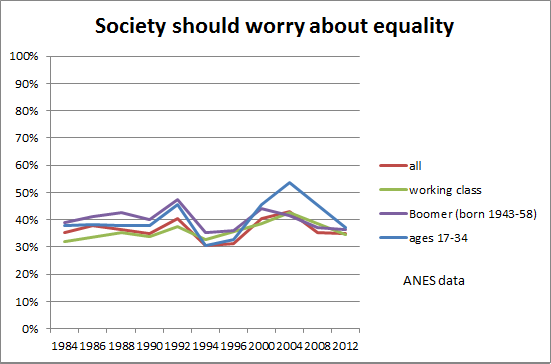
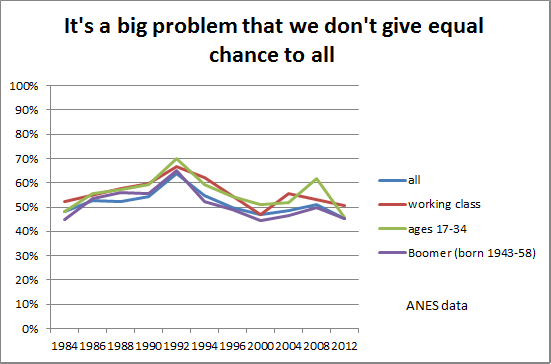
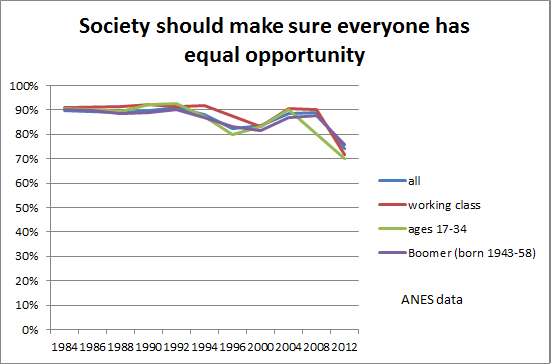
Here are some graphs that show Americans’ changing views of equality. You can click them to expand them. In each case, I’ve graphed the opinion of the whole population, of people who identify as working class (a measure more of self-image than objective resources), of younger people, and of one pivotal generation, the Boomers, as they’ve moved through time. Each point represents at least 100 respondents, usually many more.

Some observations:

Most Americans believe in equal opportunity. Not nearly as many believe that we should worry about equality or that a lack of opportunity is a big problem. (The former question asks whether “We should care less about equality,” and I show the percentage who disagree.) One interpretation is that Americans believe in equality of opportunity but not in equal outcomes, and many perceive that opportunities are pretty equal.

Differences by class, age, and generation are not striking. Younger people have been somewhat more likely to think that we should worry about equality, but they’ve actually been a bit less likely to see unequal life chances as a big problem. Boomers have tracked the national mean during this period, as have working-class people.

The consensus in favor of equality of opportunity fell off substantially during the Obama years. That is not entirely an effect of partisanship, since even in 2012, 83.5% of Republicans favored equality of opportunity, just five points below Democrats.

The other equality measures rose during the Reagan and Bush I administrations, fell under Clinton, rose during Bush II, and fell under Obama. Any of these explanations might hold: people react negatively to the perceived priorities of incumbent politicians; or Americans view equality as taken care of under Democrats and unaddressed under Republicans; or Democrats win elections when the economy is bad, and that’s when Americans grow concerned about equality.

Finally, I really don’t see a secular trend here–i.e., a trend that would reflect long-term changes in the economy or the demographics of the country.  Two of the measures stand roughly where they did in 1984, and the shifts appear to be short-term reactions to presidential administrations or the business cycle. There’s possibly a long-term trend in the general belief that “society” should ensure everyone equal opportunity. One could perceive a decline in that measure since 1992, although if 2016 or 2018 registers a rise, that decline will look illusory.

See also: the most educated Americans are liberal but not egalitarianthe most educated Americans are liberal but not egalitarian (2); a new chapter on generational trends in US politics; and how public opinion on social spending has changed: a generational approach.

the question of sacrifice in politics

Elizabeth Eckford attempting to enter Little Rock School on 4th September, 1957

(Atlanta, en route to Starkville, MS) Sacrifice can be a political act; often politics requires it. Sacrifice would be unnecessary in an ideal society and pointless in a completely static one; but in an unjust society that is subject to change, it is both necessary and powerful. Social movements are fueled by sacrifice. However, sacrifice also presents risks that we must learn to contain.

I’ll consider two cases in this post. Gandhi pledged in 1932 to starve himself to death over an issue related to untouchability. Black parents sent their children to segregated Little Rock schools in 1957 in the face of mob violence. These were acts of sacrifice in the sense that people voluntarily risked something of great value to achieve a political end.

The Gandhi example is fraught. He originally swore to starve in order to prevent Dalits from receiving separate representatives in an all-India legislature. The most charitable interpretation of this rather perplexing stance is nationalist: he wanted everyone to vote simply as an Indian. The great Dalit leader Bhimrao Ramji Ambedkar insisted on separate representation for the so-called Untouchables to prevent them from being dominated by caste Hindus. When he visited the literally starving Gandhi in prison, they negotiated a compromise involving a temporary set-aside of seats for Dalilt. Ambedkar wanted that provision to last for ten years “to stabilise opinion” Gandhi countered:

Five years or my life. Tell your followers that is what Gandhi says and plead my case before them, and if they do not accept this from you surely they do not deserve to be called your followers. My life is in your pocket. I may be a despicable creature, but when the truth speaks through me I am invincible. You have a perfect right to demand cent percent security by statutory safeguards, but from my fiery bed, I beg of you not to insist upon that right. I am here today to ask for a reprieve for my caste Hindu brethren.

Gandhi used a threat to end his own life (and thereby produce an enormous emotional upheaval in the subcontinent) in order to limit a provision intended to help the least advantaged Indians. Soon, the Mahatma converted his fast into an attack on the very principle of Untouchability, but he still used a threat to sacrifice himself to defeat Ambedkar, who was never persuaded on the merits yet found Gandhi politically “invincible.”

The Little Rock school desegregation campaign is far more attractive, yet Hannah Arendt famously disapproved of it. Partly, that was because she interpreted US racial conflict from the perspective of a formerly assimilated German Jew who had concluded that Jews would never be accepted in Europe; thus she leaned toward separatism rather than integration. She also misunderstood race and racism in the US. But most importantly, her republican political ideals caused her to overlook the value of sacrifice.

In a republic, citizens are both rulers and ruled (to use Aristotle’s definition). They make joint, binding decisions about life-and-death matters after airing their differences in public fora. Sometimes, a citizen must pay a high price—for instance, being drafted and then killed in a battle for the republic. But that is not a “sacrifice” in the sense of an individual, voluntary act. It’s the outcome of a joint decision made through law.

A core republican idea is “non-domination.” No citizen may just tell any other citizen what to do. Citizens are governed by general laws that must be defended with general arguments. Therefore, the paradigmatic examples of sacrifice for Christians—God telling Abraham to sacrifice Isaac; God sacrificing His only-begotten son for love of the world—are not models for republican politics.

People are either citizens of a given republic or not. Arendt strongly opposed statelessness because it made refugees into citizens of nowhere. She thought that children and adolescents were not citizens because they couldn’t rule. In “Reflections on Little Rock,” she describes schooling as preparation for “future citizenship.” Because children are not current but future citizens, to ask them to act politically is to expect them to be ruled without ruling.

However, the most startling part of the whole business was the Federal decision to start integration in, of all places, the public schools. It certainly did not require too much imagination to see that this was to burden children, black and white, with the working out of a problem which adults for generations have confessed themselves unable to solve. I think no one will find it easy to forget the photograph reproduced in newspapers and magazines throughout the country, showing a Negro girl, accompanied by a white friend of her father, walking away from school, persecuted and followed into bodily proximity by a jeering and grimacing mob of youngsters. The girl, obviously was asked to be a hero–that is, something neither her absent father nor the equally absent representatives of the NAACP felt called upon to be. It will be hard for the white youngsters, or at least those among them who outgrow their present brutality, to live down this photograph which exposes so mercilessly their juvenile delinquency. The picture looked to me like a fantastic caricature of progressive education which, by abolishing the authority of adults, implicitly denies their responsibility for the world into which they have borne their children and refuses the duty of guiding them into it. Have we now come to the point where it is the children who are being asked to change or improve the world?” And do we intend to have our political battles fought out in the schoolyards?

Arendt didn’t use the word “sacrifice” in this passage because it was not yet part of her vocabulary. Ralph Ellison took her to task on that point in an interview with Robert Penn Warren:

That’s right – you’re forgetting sacrifice, and the idea of sacrifice is very deeply inbred in Negroes. This is the thing – my mother always said I don’t know what’s going to happen to us if you young Negroes don’t do so-and-so-and-so. The command went out and it still goes out. You’re supposed to be somebody, and it’s in relationship to the group. This is part of the American Negro experience, and this also means that the idea of sacrifice is always right there. This is where Hannah Arendt is way off in left base in her reflections on Little Rock. She has no conception of what goes on in the parents who send their kids through these lines. The kid is supposed to be able to go through the line – he’s a Negro, and he’s supposed to have mastered those tensions, and if he gets hurt then this is one more sacrifice.

To her credit, Arendt wrote to Ellison, “It is precisely the ideal of sacrifice that I didn’t understand.”

Danielle Allen, in Talking to Strangers: Anxieties of Citizenship since Brown v. Board of Education, rightly makes the dispute between Arendt and Ellison a central issue for democratic theory. Allen argues that sacrifice is a characteristic political act, because even belonging to a community requires giving things up, and changing it usually carries a higher price. Although formally we all sacrifice by belonging to a community, the actual level of sacrifice always differs very unfairly. Unequal sacrifice is thus a fundamental reality; it calls for specific responses, such as acknowledgement and recompense.

I agree; political theory must address and encompass sacrifice. Acts of sacrifice also have specific cultural and religious resonances, different in each tradition, and these are resources for the world’s oppressed people. The trouble is that sacrifice is also coercive and can overwhelm deliberation. As with many aspects of politics, what we need is balance.