The Two Endings of Brison’s Aftermath

Susan Brison’s Aftermath ends twice: the final chapter discusses her various efforts to retell the story of her brutal rape and attempted murder (she calls it “attempted sexual murder.”) And ends with her final, planned retelling to her son when he is older:

“Tragedy,” Wittgenstein wrote, “is when the tree, instead of bending, breaks.” What I wish most for my son is not the superhuman ability to avoid life-threatening disasters, but, rather, resilience, the capacity to carry on, alive in the present, unbound by dread or regret. Not the hard, flinty brittleness of rock, but the supple tenacity of the wind-rocked bough that bends, the bursting desire of a new-mown field that can’t wait to grow back, the will to say, whatever comes, Let’s see what happens next.

The second ending comes in an afterword where she discusses four murders. The first set of murders is the murder of her friends Susanne and Half Zantop which occurs soon after she submitted the manuscript. The second set is the murder of Trhas Berhe and Selamawit Tsehaye, two of five black women candidates for PhD in physics at Dartmouth a decade before. Because they were black international students from Ethiopia–killed by a third black Ethiopian–the campus treated these murders as non-events, and failed to mourn or respond with what we sometimes think of as the characteristic security theater.

In both cases she struggles with survivor’s guilt, the sense that their deaths and her survival were random, and undeserved. So she finishes the story again:

None of us is supposed to be alive. We’re all here by chance and only for a little while. The wonder is that we’ve managed, once again, to winter through and that our hearts, in spite of everything, survive.

Three Thoughts on Iowa

  • I made a series of predictions on the eve of the caucuses that turned out to be wrong. I predicted that Sanders and Trump would win; I placed some small bets on that basis. I was roundly proven wrong, even though some pundits are calling the outcome a “virtual tie” and a few delegates were apparently allocated by coin flip. I respect the Sanders campaign for trying to spin the loss as a victory, but I don’t get to collect on the bet for a virtual tie for the same reason you don’t get to move in to the White House on the basis of a virtual tie.

Now, I wasn’t really confident in either prediction (I say after the fact). I was swayed by a late poll by Ann Selzer that has had a history of being pretty good. So I’m again struck by the value of making probability forecasts rather than predictions: at best that poll shifted my uncertainty on Cruz/Trump and Clinton/Sanders a little bit towards certainty. But it’s also the case that the right attitude before the event really should have been uncertainty: some outcomes were impossible, but several outcomes were live possibilities. The goal really shouldn’t be to gloat or mope after the fact: the goal should be to update your forecasting abilities, to get better at making future predictions.

  • The caucus format is deliberative. (More so for the Democrats than the Republicans, but still.) That makes polling somewhat less predictive, because polling can only measure pre-deliberative attitudes. We published a really good account of the issues with polling as a measure of “public opinion” in The Good Society a few years back: Liz Turner’s “Penal Populism, Deliberative Methods, and the Production of ‘Public Opinion’ on Crime and Punishment.” Turner argues that surveys produce only one version of the “hypothetical public” which is aggregative, generalized, individualized, and passive. It can (when properly massaged) produce a good prediction about electoral outcomes, since voting ballots, too, have become aggregative, generalized, individualized, and passive. But even mildly deliberative moments like the Iowa caucuses can lead to surprising outcomes because a very different public (no longer hypothetical) is constituted by the caucus form.
  • Finally, the real problem throughout the (Republican) race has been the number of candidates who had some claim to viability. The larger the number of candidates running, the more likely you are to have Condorcet loser (the one who would win the majority of head-to-head ballots) winning the election. Large numbers of (viable) candidates make voting irrational. In Iowa, there were at least six viable Republican candidates measured by delegates, and eleven candidates received at least 1% of the vote. We can see this problem on a much smaller scale with the way that the Clinton campaign planned to use Martin O’Malley as a spoiler, to prevent Sanders from picking up delegates at the margins. That said, I haven’t seen any evidence that this ended up happening, but rather the reverse.

The Symmetry of Rival and Anti-Rival Goods

In DC over the last few days, it was frequently the case that the side-walks were cleared and the roads were not. Yet the roads are plowed by paid contractors driving massive machines while the sidewalks are usually shoveled by residents working for free (or neighbors paid by the residents individually.) What gives? Why do the paid, centrally managed snow removal contractors work so much slower than the the ordinary, non-professional residents?

Put another way, why was I able to convince my neighbors we could (and should) shovel our street out when the plows didn’t come? When they realized that others were doing it, they realized that rather than clear out the whole street, they’d just need to do their small part. They were even willing to shovel the few stretches of homes whose owners didn’t join us, because we couldn’t traverse that territory without helping the slackers.

I’d argue that this is a classic case of common pool resource management. But a shoveled sidewalk is a strange sort of common pool resource: it’s not like fisheries or irrigation where the more one person uses the resource, the less there is for others. That is, it’s not precisely “rivalrous,” one of two conditions required for a common-pool resource to flourish.  In fact, the more people shovel their sidewalks, the better off each individual with a shoveled sidewalk is. This is what economists call “anti-rivalry” and is frequently linked to network effects: the more people use email or Facebook, the more useful email or Facebook are.

Types of Goods

The other condition for a common-pool resource is that the resource must be “non-excludable.” Shoveled parking spaces in DC are frequently protected in this way: a chair or a trash can signals that by dint of shoveling the spot it has become my exclusive property for the duration of the snow.

saved parking

Parking spots are excludable (even if only through threats) and they’re rival: only one of us can park there at a time. Thus, the standard matrix analysis calls them private goods. This is tricky: the street below the snow was a public good, usually, but the act of shoveling seems to give someone the sense that they have a private ownership interest in it. (I mixed my labor with it!) Yet there’s never enough parking spots unless we share them, and short-term visitors are in an especially difficult situation.

You’d think that rivalry and anti-rivalry would be as opposed as that “anti” suggests. But from the perspective of the structures of ownership and distribution, it does seem like anti-rival goods work on the same model as other common pool resources that are rival: thus Lawrence Lessig used anti-rivalry to argue for free open source software, which is how much of the backbone software of the internet was developed. Rather than apportioning a scarce resource, an anti-rival network has to distribute it as widely as possible to realize maximal benefits:

It’s not just that code is non-rival; it’s that code in particular, and (at least some) knowledge in general, is, as [Steven] Weber calls it, ‘anti-rival’. I am not only not harmed when you share an anti-rival good: I benefit.

This continues to produce the standard insider/outside dynamic of a common-pool resource management system, but replaces exclusivity with evangelism. The plow system is just another version of what Elinor Ostrom called “crowding out”:

Citizens are effectively told that they should be passive observers in the process of design and implementation of effective public policy. The role of citizenship is reduced to voting every few years between competing teams of political leaders. Citizens are then supposed to sit back and leave the driving of the political system to the experts hired by these political leaders.

Some of what makes anti-rival goods work is peer pressure: when we were shoveling the street, a few parents came out and confessed apologetically that they couldn’t leave their children alone to come help. The tone of their apologies suggested that there was some guilt involved. But a lot of it was that a simply impossible job became imaginable if each neighbor was able to see that they’d personally benefit: as the shoveled portion of the street expanded, the neighbors in the middle of the block came outside to shovel still farther, since they’d only have a little bit more to do to enjoy the benefits.

The plows came Wednesday afternoon and expanded our cleared lanes. But we had already escaped!

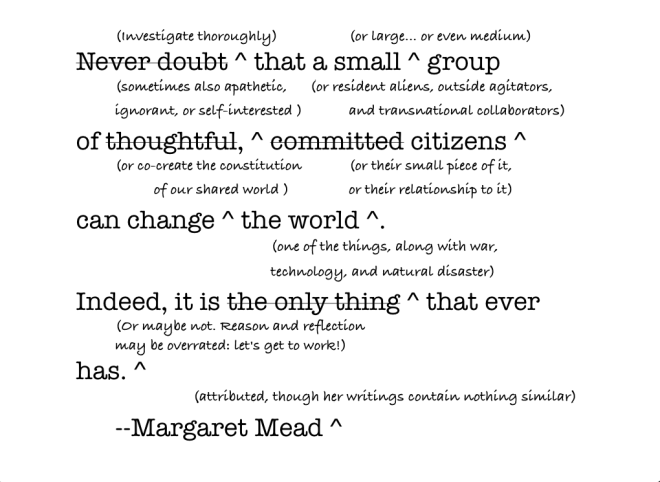
Mead Quote

Partisanship Has Reduced Our Efficacy as Citizens

I’ve been thinking a lot about the new evidence that partisan distrust and even hatred now trumps racial hatred. Consider the now-famous Iyengar/Westwood study, “Fear and Loathing across Party Lines: New Evidence on Group Polarization.” Iyengar and Westwood showed that partisan identification has ceased to be a wholly ideological or instrumental self-description. It’s gone from identification to identity: it’s become an affective relationship that justifies exclusions, bias, and even outright prejudice.

Asked to award a scholarship to fictional high school seniors with equal qualifications, Democrats and Republicans awarded a seniors who had evidence of the opposing party affiliation among their qualifications only 21% of the time. Even when the scholarship candidate from the opposing party was more qualified, Democrats awarded the scholarship to Republican-affiliated high school seniors only 30% of the time, while Republicans awarded the scholarship to more qualified Democrats only 15% of the time! Alongside other evidence from economic games and implicit association tests, this enmity towards now appears like a very serious bias, one that most people almost certainly encounter as a part of their everyday lives.

I just can’t get my mind around the idea that people would feel comfortable privileging members of their party in scholarship competitions. It feels pretty dirty, and it suggests the kind of unwillingness to associate and collaborate that will be a real challenge to democratic public work in the years to come.

It used to be pretty common to remark that racial hatred was cultivated by elites who themselves didn’t feel bigotry deeply in order to prevent the alliance of working people whose interests were closely allied. By preventing workers from developing solidarity, racial mistrust allowed elites to create competition and legitimate violence. And yet everyone seems to have forgotten that lesson now that hatred based on partisan identity is at stake. Elites don’t care about partisan identity nearly as much as ordinary folks now do. Wonks and bureaucrats are partisan but usually get along with their opponents quite well. Technocrats agree on more than we disagree on. But citizens need to be able to work with their neighbors on matters of shared concern even when they don’t agree on federal immigration policy, firearms, or the culture war.

What’s more, partisan identification isn’t even a particularly good guide a person’s ideological positions on those matters. Precisely because most districts are safe districts for one party or another, voters’ experiences of the parties do not necessarily line up with their beliefs about specific policy issues. Ideological consistency of voters has never been particularly strong: it’s growing, but from a very low base.

Even in a world where partisans will deny each other jobs and scholarships, only 56% of Democrats hold mostly liberal views, and only 45% of Republicans hold mostly liberal views. If you expect true ideological consistency from partisans (the sort of thing that political philosophers try to achieve, maybe) then you’ll find partisan identification even less helpful: only 23% of Democrats and 13% of Republicans are consistently or rigorously liberal or conservative. So what justifies the enmity?

I don’t think it can be justified, and I think we need to aim a healthy skepticism at people like Jonathan Haidt who diagnose liberal and conservative brains. What’s left is culture, and our cultures are increasingly trying to justify and legitimate partisan differences in just the same way that they’d justify racial differences or gender differences or class differences. We can’t let that happen.

But what should we do, what should you and I do together, to prevent the growing partisan hatred? Here’s what President Obama–the Citizen-in-Chief–said during the State of the Union:

The future we want — all of us want — opportunity and security for our families, a rising standard of living, a sustainable, peaceful planet for our kids — all that is within our reach. But it will only happen if we work together. It will only happen if we can have rational, constructive debates. It will only happen if we fix our politics.

A better politics doesn’t mean we have to agree on everything. This is a big country — different regions, different attitudes, different interests. That’s one of our strengths, too. Our Founders distributed power between states and branches of government, and expected us to argue, just as they did, fiercely, over the size and shape of government, over commerce and foreign relations, over the meaning of liberty and the imperatives of security.

But democracy does require basic bonds of trust between its citizens. It doesn’t work if we think the people who disagree with us are all motivated by malice. It doesn’t work if we think that our political opponents are unpatriotic or trying to weaken America. Democracy grinds to a halt without a willingness to compromise, or when even basic facts are contested, or when we listen only to those who agree with us. Our public life withers when only the most extreme voices get all the attention. And most of all, democracy breaks down when the average person feels their voice doesn’t matter; that the system is rigged in favor of the rich or the powerful or some special interest.

Too many Americans feel that way right now. It’s one of the few regrets of my presidency — that the rancor and suspicion between the parties has gotten worse instead of better.

]…]

So, my fellow Americans, whatever you may believe, whether you prefer one party or no party, whether you supported my agenda or fought as hard as you could against it — our collective futures depends on your willingness to uphold your duties as a citizen. To vote. To speak out. To stand up for others, especially the weak, especially the vulnerable, knowing that each of us is only here because somebody, somewhere, stood up for us. We need every American to stay active in our public life — and not just during election time — so that our public life reflects the goodness and the decency that I see in the American people every single day.

Maladaptive Perfectionism

Most of my readers should also read this excellent, long article on–basically–IQ, conscientiousness, anxiety, standardized testing, and medical school. Maybe the title should be enough to persuade you: “The Stanford Marshmallow Prison Experiment.” But if not, read this:

There’s a type of joke that I think of as the “white people” joke, although it’s rarely funny and it doesn’t have to be about someone who’s white. The joke is about a mid-40’s housewife who is way too well-educated and bored to be a housewife, and so she tries to find the Grail of healthy food (organic, GMO-free, low acidity, one diet after another) and she plants a garden, and she adopts pets, and she joins nonprofits, and she joins the school board, and she reads every novel on NPR’s end of the year list, and she gets weekly therapy and monthly massages (to about the same effect), and she meditates on the present, and she achieves peace with the past, and she contemplates the future, and everything is feng shui, and yet, despite all this, she feels restless, anxious, unhappy, and she dreams of some sort of vacation.

Or sometimes the joke is about an elderly businessman on his second hair transplant and third cardiac stent and twenty-billionth dollar, and his kids all have grandkids and his wife is deceased, and when he goes out he he orders scotch more expensive than houses, but that isn’t too often—he’s seen enough parties, he’s seen enough people, he has no strong affections, and he works round the clock fighting tooth-and-nail for his billions, because he’s not sure what else, exactly, he’s supposed to be doing.

And the joke, which you hear on forums or sitcoms or in crowded sports bars, goes: “Haha, even though these people are successful, they’re still dissatisfied.”

And I’m here to tell you that this joke is totally backwards. It’s because these people have always been dissatisfied that they achieved success.

If you like that, you’ll probably also enjoy The Last Psychiatrist. Whenever I read Zizek (or indeed many of the French inheritors of Althusser) I think that he’s taken us off the path of melding psychoanalytic insights with marxian political economy. These posts strike me as routing around the damage he’s done. This is the direction I wish philosophy was headed, making sense of the problems at the intersection of our lives, our political economy, and our self-deception.

Calm is not Rational

I’ve written a bit before about Tyler Cowen’s idea for a fallacy of mood affiliation, and I generally find something useful in discussions of it. Here’s the basic story:

It seems to me that people are first choosing a mood or attitude, and then finding the disparate views which match to that mood and, to themselves, justifying those views by the mood.  I call this the “fallacy of mood affiliation,” and it is one of the most underreported fallacies in human reasoning.  (In the context of economic growth debates, the underlying mood is often “optimism” or “pessimism” per se and then a bunch of ought-to-be-independent views fall out from the chosen mood.)

Byran Caplan offers some reflections on using mood as a credibility heuristic (that are consonant with others things he has said) and so it seems worth discussing where he goes wrong.

On Caplan’s account, evidence is the best way to judge credibility and truth. There we agree. But he adds that using appropriate mood as a heuristic for credibility is a wise backup for discounting some movements or claims. He describes the appropriate moods that environmental activists ought to bring to bear on fossil fuels:

A reasonable person who was convinced that fossil fuels posed a major danger would feel a specific package of moods:

1. Sadness that a crucial resource has terrible side effects.

2. Gratitude for all the wonders the resource brought us in the past.

3. Resignation that mankind must forego many of these wonders.

4. Determination to salvage as many wonders as possible by using the best available substitutes for fossil fuels.

When an opponent of fossil fuels evinces none of these moods, it strongly suggests he isn’t reasonable.

This seems unlikely to be true. On the one hand, I do think those are basically the right judgments about fossil fuels: they are awesome, we should be glad that they existed, and it really sucks that we’re going to be giving them up, but it’s time to take action. That said, it’s not clear why I can’t also feel:

  1. Anger that providence does not supply as good a solution without the costs.
  2. Resentment that those who have profited from fossil fuel extraction are willfully denying the evidence that we must change.
  3. Frustration that scientific consensus does not bind more of my fellow citizens and their elected representatives.
  4. Suspicion of the ways that our current interests cause us to downplay the risks and need for resignation and determination.

Those seem perfectly rational to me, too. And we might not be able to hold all those emotions in our mind at the same time, and thus we find that we’re unable to capture the state of perfectly neutral ambivalence that Caplan here suggests is a prerequisite for being considered rational. Worse, though, Caplan’s account of those prerequisite “moods” mistakes how social movements work with how scholars comport themselves.

  1. For Cowen, mood is about having too much of the wrong sort of alignment within your portfolios of beliefs. So mood affiliation is not about demeanor but about getting your beliefs to support your preferred mood (like the just world fallacy.) Some things are good and some things bad, some things are more certain than others, etc. And yet we tend to adopt similar judgments rather than diversify, suggesting that it’s us and not the world that’s drawing those beliefs together. So Bryan Caplan is not using mood in Cowen’s sense, but rather describing something like demeanor.
  2. Most of the evidence suggests that groups of people actively resisting the status quo fall into group polarization dynamics. This is regardless of whether the status quo is just or unjust or safe or dangerous. This means that they will tend to circulate ideas and attitudes among themselves, developing more extreme and fanatical opposition to it than the overall community could support. Thus a heuristic based on demeanor is basically a pro-status quo heuristic.
  3. Sometimes this polarization is primarily attitudinal, and sometimes it is primarily evidential: that is, sometimes movement members help each other engage in motivated reasoning and skepticism, and sometimes they help each other by egging each other on with a bias for action. The attitudinal polarization is likely to be MORE reasonable than the evidential one. Yet representatives of the status quo can then use those attitudinal group polarization dynamics to depict the resistors as irrational and thus wrong. (We can see this in all sorts of places, not just the standard ones.)
  4. The demeanors of calm and dispassionate analysis are, frankly, overrated by college professors and college graduates. It’s how we signal competence, but it’s not the same as subject-matter competence, rather it’s generally a prerequisite competence in dealing with other college graduates.
  5. Lots of obviously wrong people demonstrate the wrong demeanors. But lots of *subtly* wrong people have the right demeanors. Probably then, we should actually develop enough subject-matter expertise to parse the evidence (as Caplan is doing by reading Epstein) and not rely on demeanor so much as a heuristic.

Basically, where I see Cowen contributing is in allowing us to reflect on the ways that our ideas may be too tightly connected to each other by some overarching mood or partisan affiliation. Disaggregation, decoupling, debundling: these aren’t always smart epistemological moves, but there’s a lot of good reasons to experiment with them, rooted in methodological individualism and the necessities of the scientific method.

Caplan, by contrast, seems to want to use it as a heuristic for discrediting others. I’ll admit a bias here: I really want to bend over backwards to understand the views of others and listen carefully to their arguments in hopes of finding useful insights. That’s my fallibilism talking, a mood that I’m quite sure has its own pitfalls. But still, doesn’t it seem unwise to pretend you can’t hear people just because they are shouting? After all, they’re very likely to be shouting because no one listened when they spoke.

Human Rights as Democratic Conversation Starters

Omri Boehm has written a troubling op-ed in the Stone summarizing the failure of human rights discourses to actuate political institutions, entitled “Can Refugees Have Human Rights?” Boehm worries the answer is “No.” Citing the most famous lines from Hannah Arendt’s discussion of refugees ( “If we should start telling the truth that we are nothing but Jews, it would mean that we expose ourselves to the fate of human beings who … are nothing but human beings.”) Boehm diagnoses a failure of modernity to find a metaphysical grounding for human rights, and suggests that this metaphysical failure is the blame for the institutional failure to protect refugees:

The truth is that we have never managed to vouch for human rights in sensible modern terms. One common strategy has been to appeal to nature rather than to God — on this view, human beings have inalienable natural rights — but in order to accept this alternative one must ascribe to nature qualities that science tells us it doesn’t have. […]

Modern political thinkers can meaningfully speak of the state as an instrument for defending the interests of its citizens. When they speak of the state as defending justice, or universal human rights, they are missing the necessary concepts.

This is a common refrain, and indeed it seems to have motivated more than its fair share of philosophical articles and monographs arguing for a return to metaphysical foundations long since rejected. But as I read Boehm, he does not mean to call for such a return. Rather, the failure of political theory in this regard has led to the failure of rhetoric and action. Indeed Boehm seems to regret that these categories can find no purchase among human beings who understand themselves to be the result of evolution, that there is no political theology worthy of the grand gestures of institutional inclusion declared as universal human rights. Call this tragic naturalism: after millennia of supernatural universalism, we can no longer delude ourselves. But we’ll probably always pine for the good old days.

Responding to Boehm, Eric Schliesser argues that the human rights tradition has offered itself as an alternative to democratic politics, calling human rights “political conversation stoppers.” He goes on to explain:

“Once they are invoked matters of principle are settled, and put aside, and all that remains is the technocratic discussion of solving the means by which to implement them. That is, while we often claim that rights generate duties, politically they are designed to generate obedience.”

On Schliessers’ view, human rights (unlike ordinary political rights) are meant to be uncontestable barriers to further inquiry; we must not quibble about slavery or bodily inviolability, but instead get busy abolishing slavery and securing bodily inviolability. Whereas ordinary political rights are constantly the subject of contestation and no entitlement is absolute.

This seems wrong to me. On my view, human rights aren’t political conversation stoppers, they’re a prerequisite for certain kinds of political conversations at all. Indeed, human rights are so foundational to certain kinds of political conversations that many people lay claim to them even where they don’t exist so as to begin or continue a difficult political conversation.

Let’s return to Arendt for a moment: in her analysis of the origins of totalitarianism, she spots a fervor for nation-states the was supported in part by the conviction that “people
 without
 their
 own
 national
 government
 were
 deprived
 of
 human
 rights.” If the only would-be “human” rights that exist are actually national rights, justiciable in one or another courtroom, then every human being needs a nation-state to protect her. “Human” rights sound nice, but they’re not the sorts of things that a lawyer can win a case on, and when you’re fighting the political head-winds of populist anti-migrant rhetoric, you need the courts.

So human rights are metaphysically ungrounded and politically ineffective. Too often we’re only able to give them salience retrospectively, in the context of historical genocide. Worst of all, just where you need them most, like when you belong to a group that has lost its political power–and must seek recognition for your vulnerability and powerlessness–you will find that no one is listening.

Now, it’s not at all clear why philosophers bemoan the metaphysics in situations like this. No one believes that the lack of a metaphysical ground is causing the political inefficacy of human rights. In the hypothetical world where a God exists to supply normative justification for a divine moral law that demands refugees be fed, sheltered, and protected, we would still have a Syrian refugee crisis. We would still have collective action problems, and states trying to avoid their fair share of supporting their burden of stateless persons, and budget limitations, and the fundamental fact that we only half-heartedly want to do the thing God demands. “Make me a humanitarian, Lord, but not yet! (And not before you make my economic competitors humanitarians, too.)” And we would still have difficulty determining which rights God intended to write into the structure of reality and who was charged to protect them.

Meanwhile, tragic naturalism may have some glimmers of hope. For one thing, it draws our attention to the ways in which many rights-claims start off ungrounded and develop institutional and political efficacy over time and through effort. The rights-claims in the Declaration of Independence are rhetorically grounded by God’s creation, certainly, but they were just as obviously not rights that any group of Christians has been able to find the normative purchase on previously.

It has become common, then, to point out that most rights-claims are self-founding. It’s the rights-claim that grounds the right. Of course, this suggests that human rights-claims are not actually universal  or human rights but instead political rights-claims that seek to sidestep the claimant’s lack of the appropriate codified legal status. But it’s not clear why we’d reach for politics (and its “rights of citizens”) in those instances, since most who require the protection of a scheme of universal human rights are equally well barred from political participation.

Ayten Gündoğdu gives an excellent account of this in her recent book Rightlessness in an Age of Rights. Human rights have always had an aspirational quality, as we have seen among the Sans Papier movement in France where those designated economic migrants (and thus ineligible for refugee-status) continue to demand documentation and regularization. The movement has all the signs of a successful set of ungrounded rights: it is a political movement whose very existence assumes the capacity to engage in politics is not simply a matter for citizens.  It is an illegitimate demand that seeks to legitimate itself and the demanders. In this sense, human rights-claimants are always engaged in a kind of political foundation, creating the institutional basis for their own eventual juridical protection.

Of course, such efforts at political foundation often fail. This isn’t a triumphalist account of human rights, as if the problem was resolved in 1948 and need not be revisited. We shouldn’t ignore that the refugee who points to her own vulnerability to justify her rights-claims (while failing somehow to qualify as an asylum-seeker) currently lacks institutional grounding, and that the migrancy crisis will only grow: 232 million people belonged to that category in 2013, and an estimated 9 million Syrians have fled their home since the beginning of the crisis.

When stateless migrants interrupt previous metaphysical and institutional conceptions of human rights by making unrecognized human rights-claims, this interruption does not stop a democratic conversation but start one. If what we want out of human rights is a way to bend democratic polities to some “higher law,” we’ll be disappointed. There never was a real conflict between democracy and human rights, and this goes back to the reason naturalism seems tragic: we’re disillusioned because the story was better than reality could ever be. But there’s no tragedy if we treat human rights as an opportunity to exchange reasons (including ungrounded reasons!) with our fellow-citizens (documented and undocumented) and engage in powerful acts of institutional co-creation with our vulnerable neighbors.

Are gun suicides gun deaths?

After the President asked news organizations to compare deaths by firearms with deaths from terrorism, many did. It’s pretty striking, here’s the chart from CNN:

CNN


But not all of the charts looked the same. Vox’s chart excluded suicides, and thus came to a much smaller (though still striking) result:

gun homicides v terrorism deaths

And this raises an important question. Should we include suicides with a gun in our calculations of gun deaths? Asked that way, the answer seems obvious: of course they should count, a gun death is a gun death. But I think there are important reasons to exclude them. Suicides make up 2/3 of all firearms deaths, but those deaths are probably not preventable by restricting access to guns.

Here’s the argument in outline: people commit suicide with guns because that’s the dominant image of suicide in our culture. Serious restrictions on gun control would change the dominant image of suicide in our culture, and potential suicides would choose different methods.

And yet there’s plenty of evidence to the contrary, so it’s important to think that evidence through. In many cultures, targeting the means of suicide led to major reductions in suicide. We know that when we interview survivors, we find that 70% spend less than an hour planning, so they’re mostly using ready-to-hand methods. Britain reduced its suicide rate by changing the kinds of gas they used to power their ovens. San Francisco hopes to prevent suicides at the Golden Gate Bridge with a steel net.

And yet there are many differences between survivors and successful suicides. Successful suicides plan more carefully, and for longer, choosing deadlier methods. Successful suicides are generally older and maler than survivors. In short, successful suicides seem to mean it more than unsuccessful ones, they make determined choices based on social facts rather than psychological whims. So they won’t be deterred if forced to change methods; we need to change the social facts instead!

The National Academies of Science concluded much the same thing when last they evaluated these questions: “Some gun control policies may reduce the number of gun suicides, but they have not yet been shown to reduce the overall risk of suicide in any population.” The difference is between micro-reductions (fewer deaths at the Golden Gate bridge) and macro-reductions (fewer deaths per 100,000 people.) We can make lots of changes at the margin without touching the infra-marginal causes of suicide, which are likely not tied to method.

This is an example of Simpson’s Paradox: you can reduce the marginal propensity to commit suicide, even make small, local reductions in those numbers, but without affecting the overall rate of suicides. And the same thing goes in the opposite direction: increasing access to guns might lead to short-term and local effects on suicide, but we compensate in various ways. Otherwise, it would be hard to make sense of the fact that our suicide rate is quite low while we have more guns than anyone in the world. We’re in the middle of the pack for the OECD, and France, Finland, and Japan all beat us:

suicide rates

Why is the US suicide rate so low, given the overwhelming number of guns we have? Guns seem to massively increase our homicide rate but not our suicide rate, so what’s going on there? For the largest group of suicides: people basically understand the lethality of the method they choose, and they use less-lethal methods if they don’t want to succeed. So suicide success mostly tracks desire, not access.

Around the world suicides use different methods:

“Poisoning by pesticide was common in many Asian countries and in Latin America; poisoning by drugs was common in both Nordic countries and the United Kingdom. Hanging was the preferred method of suicide in eastern Europe, as was firearm suicide in the United States and jumping from a high place in cities and urban societies such as Hong Kong Special Administrative Region, China.”

So while of course, there’s some feasibility to reducing access to pesticides and firearms, there’s little hope of eliminating access to drugs, high places, or potential nooses.  Britain removed a major non-violent method, and saw serious reductions. We can do the same by targeting non-violent suicide methods. But the big group of suicides have a high transition rate among violent methods (hanging, firearms, jumping) while the smaller group of suicides have low transition rates among non-violent methods (ovens, drug/pesticide poisoning.)

So you can best reduce suicide by regulating access to pesticides and drugs, but regulating access to firearms leads to substitute violent methods. There’s even the risk that though relatively few people will transition from non-violent to violent methods, they’ll do so at a much higher success rate. Britain avoided that fate with its coal gas oven transition, but further targeting prescription drug poisoning might yield different results.

There’s nothing wrong with trying to make suicide more difficult; I endorse strategies that might force rethinking, like waiting periods. But I’m not convinced it’s possible to deter the determined. So in that sense, we should probably treat gun suicides more as suicides and less as gun deaths. The best evidence is that policies designed to reduce our (already low) suicide rate will target social facts, about masculinity, bonding social capital, mental health and self-worth, while the policies best tailored to reduce our (quite high) homicide rates should target a single variable: access to firearms.

An American With a Gun Kills Students, Again

I have a two year old daughter, and I’m overwhelmed every time this happens with fear and anger. I teach at a university, and I feel special fear every time there is an active shooter reported, though I quickly cover it with bravado and statistical arguments. (There were two on my old campus in a single semester a few years back.) Guns make me scared, I don’t want to be anywhere near them. I even think it’s creepy that police officers carry them.


And yet, I’m never very happy with the way these discussions go. More than perhaps any other policy discussion, there’s a palpable sense of paralysis; I have more hope for a basic income guarantee than for substantial and effective gun control. For one thing, everyone who talks about gun control of any sort has to recognize that most there are almost as many guns as people in the US. The horse has left the barn, Pandora has opened the pithos, the djinn has escaped the lamp, etc. Plus it’s impossible to amend the 2nd Amendment under anything like current partisan political conditions. So our response has to be geared towards that. It’s got to involve action and organization and policy savvy.

The NRA’s power is not primarily money: it’s a large, active, and single-issue-voting membership list. The money is comparatively small and irrelevant: all you can do with money is buy ads to affect votes. The NRA already *has* votes, and gun control advocates don’t. For instance, most liberals who want more gun control would still be happy to have Bernie Sanders as President, despite his stance on guns.

So when the President says we should become single issue voters, he’s saying we should choose guns over finance sector regulation, campaign finance consistency, real attention to inequality, pro-choice judges, funding for Planned Parenthood, climate change, and many other things that matter.

That’s what a single-issue voter is: would you vote for a member of the other party if she had a stronger pro-gun-control record than the incumbent from your party? Because NRA members will, even if they mostly don’t have to: they will primary out a viable candidate and accept a loss, which comes to the same thing.

Despite the fact that gun control proponents are in the majority, we just don’t want it enough. We have a minor desire to see fewer mass shootings; gun owners have a strong desire to support untrammeled access to guns. Forget what people say: look at what they do. And we just don’t do much about guns.

And even if we did take that single-issue stance, there’d still be a gun for every man, woman, and child in the US for decades. So we’ll continue to be a country where assholes with guns kill our children and neighbors. And Black men will continue to die at twice the rate of whites, because we talk about school shootings and automatic weapons, but not handguns used in assaults and homicides.

I want to hope that someone will give an answer to the question of what we should do–what my readers and neighbors and friends and I should do–to actually change the terrible, atrocity-ridden status quo. And yet a sober calculations suggests that despair and impotent anger is the appropriate response. The love and hope we nurture can’t reach these issues: the guns will always be a background condition of our lives, a potential risk, yet–if we are white and comfortable–a statistically unlikely one.

It’s like Camus describes in La Peste:

And, indeed, as he listened to the cries of joy rising from the town, Rieux remembered that such joy is always imperiled. He knew what those jubilant crowds did not know but could have learned from books: that the plague bacillus never dies or disappears for good; that it can lie dormant for years and years in furniture and linen chests; that it bides its time in bedrooms, cellars, trunks, and bookshelves; and that perhaps the day would come when, for the bane and the enlightening of men, it would rouse up its rats again and send them forth to die in a happy city.

Arendt’s Considered View on Evil and its Banality

“It is indeed my opinion now that evil is never ‘radical’, that it is only extreme, and that it possesses neither depth nor any demonic dimension. It can overgrow and lay waste the whole world precisely because it spreads like a fungus on the surface. It is ‘thought-defying,’ as I said, because thought tries to reach some depth, to go to roots, and the moment it concerns itself with evil, it is frustrated because there is nothing. That is its ‘banality.’ Only the good has depth and can be radical.” (Letter to Gershom Scholem July 24, 1963)