To Future Generations

A poem for the summer of Ferguson, Gaza, ISIS, and Ukraine: Bertolt Brecht’s An die Nachgeborenen (1939), in my translation from the very simple and direct German.

I

Truly I live in dark times!
A sincere word is folly. A smooth forehead
Indicates insensitivity. If you’re laughing,
You haven’t heard
The bad news yet.

What are these times, when
A conversation about trees is almost a crime
Because it implies silence about so many misdeeds,
When, if you’re calmly crossing the street,
It means your friends can’t reach you
Who are in need?

It’s true: I earn a living.
But believe me, that’s just a coincidence. Nothing
of what I do entitles me to eat my fill.
It’s a coincidence that I am spared. (If my luck stops, I’m lost.)

They tell me: eat and drink! Be glad that you did!
But how can I eat and drink if
What I eat is snatched from the hungry,
My glass of water from someone dying of thirst?
And yet I eat and drink.

I would like to be wise.
The old books say what wisdom is:
To shun the strife of the world and spend the short time
You’ve got without fear.
Do without violence.
Return good for evil.
Not fulfilling desires but forgetting
Counts as wisdom.
I can’t do any of that:
Truly I live in dark times!

II

I came to the cities in a time of disorder.
When famine ruled.
I came among the people in a time of turmoil
And I rebelled with them.
So the time passed
That was given me on earth.

I ate my food between slaughters.
Murder lay over my sleep.
I loved carelessly
And I looked upon nature with impatience.
So the time passed
That was given me on earth.

In my time, roads led into the swamp.
Speech betrayed me to the slaughterer.
I could do very little. But without me,
Rulers would have sat more securely, or so I hoped.
So the time passed
That was given me on earth.

Energies were low. The goal
Was far in the distance,
Clearly visible, though for me
Hard to reach.
So the time passed
That was given me on earth.

III

You who you will emerge from the flood
In which we have sunk,
Think
When you speak of our weaknesses
And of the dark time
That you have escaped.

For we went, changing countries more often than shoes,
In class wars,* desperate
When there was only injustice and no outrage.

This we knew:
Even hatred of humiliation
Distorts the features.
Even anger against injustice
Makes the voice hoarse. Oh, we
Who wanted to prepare the ground for friendliness
Could not ourselves be kind.

But you, when
one can help another,
Think of us
Forgivingly.

*I translate Brecht’s phrase literally, although I do not agree that in his time or ours the situation can be adequately described as die Kriege der Klassen.

The post To Future Generations appeared first on Peter Levine.

found poetry

This may sound like Basho, but it’s actually from Tripadvisor, describing the Dilek National Park in western Turkey:

Purest beach. Comfort of
pine tree’s shadow.
Wild pigs around of you and asking meal.
Peaceful please in every season

Not so much facilities inside.
Do not expect so much.
Hard to find sandy beach inside this park.
Expect wild bores and squirrels around.

The post found poetry appeared first on Peter Levine.

West Chop poem in the Wampum Collection

In lieu of a post today, here’s a link to my poem “West Chop,” which was just published in a Martha’s Vineyard literary magazine called the Wampum Collection. It begins:

Tethered sailboats hunched in a row.
A gull sails the diagonal, taut and low.
Wind and sinking sun scribble the bay
With fleeting streaks of blue, green, gray.

The post West Chop poem in the Wampum Collection appeared first on Peter Levine.

a little play for Lorca

José: We just killed Federico García Lorca!

Juan: We left him in a ditch and I fired two bullets into his arse for being a queer.”*

Amando: You killed Lorca? You and the corporal here?

José (nodding): I was there. I would have shot him, too, if the captain hadn’t already wasted two bullets.

Amando pulls a revolver from his coat and rests the grip on the table, pointing the muzzle between the two men.

Amando: You murdered him because you hated him?

Juan: We executed him to cleanse the nation.

Amando: If there was justice, I would march you to the police station to be tried for murder.

Juan: There is justice. It was done.

Amando: It is my duty to try you, and to punish you, because this is the only room where that can possibly happen now. You confess that you murdered Lorca?

José [rising]: I will go into the village and find soldiers. This man is crazy.

Amando shoots José in the chest and points the revolver directly at Juan.

Amando: Your end will the the same as his, but I will give you time to think about it first. He escaped fear and regret; you will not. We will wait.

A long time passes. The old clock ticks. Some hay blows in under the door.

Amando: You should pray.

Juan: Autumn will come with snails,
misted grapes and bunches of hills
but no one will watch your eyes
because you have died forever.

Amando: What! How do you know those words?

Juan: They were Lorca’s last. He said them in the ditch. They made an impression on me.

Amando: You believe that I cannot shoot you now, because you said those lines?

Juan: You cannot.

Amando: If I let you go, you will be boasting and laughing by midnight.

Juan: You cannot shoot me now.

*Real words, quoted by Jeremy Edelman, The New York Review, June 5, 2014

The post a little play for Lorca appeared first on Peter Levine.

the scholar and his dog

Twelve centuries ago by a long Swiss lake,
Pangur Bán hunted and an Irish monk looked.
The monk strained for sense from knotty old books;
His Celtic cat stared at the rustling rocks.
The cat was sharper and more often struck,
But both loved the chase, and the monk loved his pet.
Twelve centuries later my dog and I
Walk Cambridge streets lost in separate thought.
He stops to sniff trails; I check my emails.
Sensing a modern mouse has scurried by,
He jingles his tags and trots on while I
Shake off my inbox, walk, and concentrate.
The monk’s name is lost. The name Pangur Bán
Lives on, but I assume it was only the man
Who saw the analogy of monk and pet
And put it in verse that speaks to us still. Yet
Could it be my dog and the long-passed cat
Who knew the truth? We all just do what
We’re made to do, and it’s better to do
It together. (Pangur Bán’s mice knew that too.)

Cf. the 9th-century Irish poem as translated by Robin Flower (“The Scholar and His Cat“) and by Seamus Heaney (as “Pangur Bán”); and see the Wikipedia entry for context.

The post the scholar and his dog appeared first on Peter Levine.

versions of Han Shan

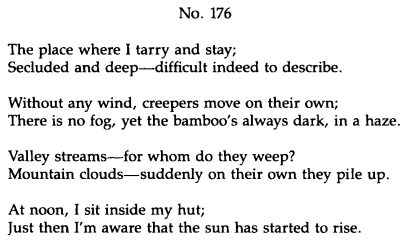
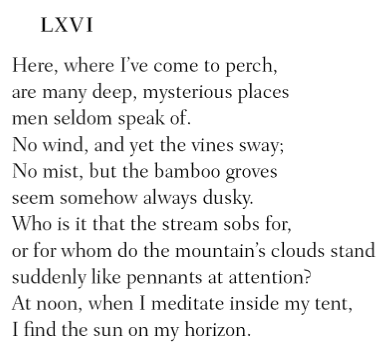
From Robert G. Hendricks, The Poetry of Han-Shan: A Complete, Annotated Translation of Cold Mountain:
Screen Shot 2013-08-25 at 5.08.57 PM
From J. P. Seaton, Cold Mountain Poems: Zen Poems of Han Shan, Shih Te, and Wang Fan-chih:

Screen Shot 2013-08-25 at 5.10.41 PM

And me, using their versions to attempt a third:

Murky places here, dim shapes.
No cause of that motion;
Blurry for no reason.
Whose name do the streams sob?
What agitates the clouds?
Staring until noon,
I realize the day’s dawned.

The post versions of Han Shan appeared first on Peter Levine.

doggerel by a dad

“O aid me ere I err!” bade he.
“Nay, nay, I’ll not,” said she.
“I’ll aid ye not–you’re overwrought,” she sputtered in her tea.
“Avail me, please, I’m on my knees,”
Beseeched the lad, awailing.
“Peace,” said she, “your tears they’ll be completely unavailing.”
“I am,” said he, “a wretched me, with only this petition …”
“Your prayer,” said she, “moves not me, nor will I grant permission
To drip upon my tattered shoe your salty drops o’ woe.”
“I’d only note,” the laddie quote, a-pointing to his toe,
“That you have ta’en seat upon a steamin’ pot ‘o stew.
Underneath that very pot is set a hot fondue
And as you settle in, you see, the one flows in t’other
And both begin to drip upon my only little brother.
As he shakes, our boat it quakes, and o’er the gunnels flow
The last of the drips off the honeyed lips o’ the Bonghi-Donghi-Do.”
“Cease!” cried she. “Prattle not. I care not what you say.
I’ll sit right here and pull yer ear and watch the driplets flow.
I care not a wit for the Bonghi-Do; let him do what ere he may!”

The post doggerel by a dad appeared first on Peter Levine.