Ostrom plus Habermas is nearly all we need

The late, great Elinor Ostrom is much on my mind. I taught her work in Mexico a couple of weeks ago and will be visiting her Bloomington (IN) Workshop in Political Theory and Policy Analysis next weekend. I’d like to claim that many thinkers have influenced me, and I wouldn’t want to have to do without any of them. But I believe we can get at least 80% of the way to a satisfactory social theory if we combine the two thinkers we talked about in Mexico: Ostrom and Jürgen Habermas. They are importantly different, as this table indicates–yet I think both contribute essential insights.

Ostrom Habermas
Fundamental problem Tragedies of the commons. People manipulating other people by influencing their opinions and goals.
Characteristic symptom of the problem We destroy an environmental asset by failing to work together. Government or corporate propaganda distorts our authentic values.
Characteristic starting point People know what they want but can’t get it. People don’t know what they want or want the wrong things.
Essential behavior of a citizen Working together to make or preserve something. Talking and listening about controversial values.
Instead of homo economicus (the individual who maximizes material self-interest) we need … Homo faber (the person as a maker) Homo sapiens (the person as a reasoner) or homo politicus (the participant in public assemblies).
Role of the state It is a set of nested and overlapping associations, not fundamentally different from other associations (firms, nonprofits, etc.). Citizens form public opinion, which should guide the state, which makes law. The state should be radically distinct from other sectors.
Modernity is … A threat to local and traditional ways of cooperating, but we could use science to assist people in solving their own problems. A process of enlightenment that liberates people, but it goes wrong when states and markets “colonize” the private domain.
Main interdisciplinary combination Game theory plus observations of indigenous problem-solving. Normative philosophy (mainly achieved through critical readings of past philosophers) plus system-level sociology.

If you ask me who is right about any of the issues in this table, I am inclined to say: both.

The post Ostrom plus Habermas is nearly all we need appeared first on Peter Levine.

America’s authentic conservative movement

In the influential reform conservative manifesto, Room to Grow, Yuval Levin argues

that what matters most about society happens in the space between the individual and the state—the space occupied by families, communities, civic and religious institutions, and the private economy. … Local knowledge channeled by evolved social institutions—from families and civic and fraternal groups to traditional religious establishments, charitable enterprises, private companies, and complex markets—will make for better material outcomes and a better common life. … What happens in that space generally happens face to face—between parents and children, neighbors and friends, buyers and sellers. It therefore answers to immediately felt needs, and is tailored to the characters, sentiments, priorities, and preferences of the people involved. That kind of bottom-up common life, rather than massive, distant systems of material provision, is what makes society tick and what holds it together. While it can certainly be reinforced by public policy, it could never be replaced with centralized administration, however capable or rational it might be.

Levin decries “public programs that consolidate the application of technical expertise: that try to take on social problems by managing large portions of society as if they were systems in need of better organization and direction.” Instead he advocates a “kind of bottom-up, incremental, continuous learning process, rather than imposing wholesale solutions from above.”

Imagine that there were a large but decentralized grassroots movement dedicated to precisely these values. It would operate at a remove from the state and would be based instead in nonprofit organizations and colleges. It would be skeptical of top-down directives, expertise, and centralizing policies–especially the drive to measure and assess outcomes quantitatively. It would often stand in the way of ambitious plans that originate in bureaucracies.

This movement would evolve elaborate tools for appreciating and developing local norms and assets. These tools might be branded, for example, Asset Based Community Development or Participatory Action Research. The movement might also rely heavily on local deliberative processes to decide what to do, and the real hallmark of those deliberations would be “a belief that constructive processes must focus on strengths and future-oriented possibilities” (as Caroline Lee writes).

Because the movement would believe, as Levin does, in the importance of face-to-face human connections, its characteristic response to a local problem would be a hands-on service project. Prospective volunteers would be taught to respect local norms. They might even insist (in the words of Talmage A. Stanley) on a “militant or radical particularity, knowing a place in its fullness, with its contradictions, its conflicts, its questions, what it means to be a citizen in that place.” The movement would strongly endorse “relational organizing,” with its emphasis on human-to-human bonds.

The movement would also be anchored in the values of diversity (i.e., support for inherited and “evolved” cultures and norms); social capital (seeing value in the networks and values that connect people to each other); and sustainability (strategies for continuing to do what we have done in the past).

In all these respects, this movement would be authentically conservative. But–as my readers will have realized several paragraphs ago–I am referring to community service programs, campus/community partnerships, community-based research projects, and other “civic” practices, most of whose leaders would place themselves well to the left of President Obama on the political spectrum.

I make this argument not to score debating points against Yuval Levin, although he is deeply invested in the idea that the “Left’s social vision tends to consist of individuals and the state, so that all common action is state action, and its purpose is to liberate individuals
from material want and moral sway.” (I have trouble thinking of any prominent American liberal to whom that sentence would apply.) On the whole, I would like to make common cause with Levin, not debate him.

Nor do I mean to provoke my friends and collaborators in the “civic” world by calling them authentic conservatives. I have deep regard for genuine conservative values and believe that they need intellectual development and political support. Authentic conservatism has been swamped by laissez-faire neoliberalism on the right and by soft technocratic managerialism on the left.

But I do think it’s clarifying to recognize everyday civic work as conservative. Like any valid ideology, conservatism highlights certain goods with which other goods conflict. As Bill Galston insists, the hard part of politics is not the choice between good and bad but between good and good. In promoting decentralized, relational, appreciative, bottom-up, voluntary politics, the civic movement to which I belong (and which Levin ought to endorse) risks overlooking other values, especially social critique, cosmopolitanism, efficiency, and dissent.

See also: “what defines conservatism?” “how conservatives can reclaim the civic ideal;” “Edmund Burke would vote Democratic“; and “is society an artifact or an ecosystem?

The post America’s authentic conservative movement appeared first on Peter Levine.

Frontiers of Democracy conference is taking shape

(Washington, DC) This year’s “Frontiers of Democracy” conference will take place on July 16-18, 2014 in Boston, MA. Although the agenda is not completely final, it is now quite detailed, involving about 18 plenary or concurrent sessions–all highly interactive.

In addition to these discussion sessions, there will be some provocative short talks. Signed up to give those are: Ambassador Alan Solomont, the dean of Tisch College; Gloria Rubio-Cortes, president, National Civic League; Josh Lerner, Participatory Budgeting Project; John Gastil, Penn State (communication); Tina Nabatchi, Syracuse University (public administration); Shelby Brown, Executive Administrator, State of Connecticut’s Office of Governmental Accountability; Tim Eatman, Research Director, Imagining America; Sabeel Rahman, Harvard (government and law).

Register here to hold your place.

Frontiers of Democracy is sponsored by Tisch College of Citizenship and Public Service at Tufts University, the Democracy Imperative, and the Deliberative Democracy Consortium.

The post Frontiers of Democracy conference is taking shape appeared first on Peter Levine.

Mike Edwards on civil society

The third edition of Michael Edwards’ invaluable book Civil Society is newly out, and Mike makes a strong argument on OpenDemocracy.net that draws from his book.

He notes that nonprofit organizations are growing (by almost all measures) and offering significant benefits to the people and communities that they serve directly. There are, for example, 3.3 million registered charities in India. In our own work, we find that the number of nonprofits in a US community, adjusted for population, predicts that community’s economic performance (holding many other factors constant).

And yet, as Mike Edwards notes, the world is slipping backward on many fronts, as “economic inequality is rising, democracies are being hollowed out, climate change is worsening, and discrimination based on race, gender, ability and sexual orientation remains endemic.”

These are the kinds of issues that are traditionally addressed by governments. In turn, governments are helpful when broad-based social movements hold them accountable. (Benign elites are possible–but rare and usually short-lived–and, by definition, they cannot address a problem like the hollowing-out of democracy.)

Civil society–defined as an array of nonprofit organizations–can support broad-based social movements:

When one looks at the few times in history when civil society has functioned as a powerful and lasting moral and political lever – like the civil rights and women’s movements of the 1960s and 1970s – large numbers of people became active in translating ethical action into power structures at every level, from the family to the courts and corporations.

In this sense, civil society is like an iceberg, with the peaks of protest rising above the waterline and the great mass of everyday citizen action hidden underneath. When the two are connected – when street protests are backed up by long-term action in every community, bank, business, local government, church or mosque, temporary gains in equality and diversity have more chance of becoming permanent shifts in power and public norms. In that respect it’s not the Arab or any other ‘Spring’ that really makes the difference, but what happens in every other season, of every other year, across every generation.

Unfortunately these episodes of large-scale, joined-up action are quite rare, and the long-term trend has been the opposite, at least in Europe and North America.

Edwards sees two functions for civil society at its best: connecting everyday local action to policy, and building human solidarity across lines of class and race so that citizens support private and public action in the common good. Neither is achieved by civil society understood as a set of social enterprises or social networks. Instead, we need civil society as coalitions of organizations committed to political and social change.

Edwards concludes that “the strength of civil society is declining even as its size continues to expand. … But since civil societies are ours to lose, they are also ours to reclaim, to refresh and re-energize.”

(I make somewhat similar arguments in my qualms about a bond market for philanthropy and can nonprofits solve big problems?)

The post Mike Edwards on civil society appeared first on Peter Levine.

what should we do?

You are a citizen of a group (regardless of your legal status) if you seriously ask: “What should we do?”

The question is what we should do because the point is not merely to talk but to change the world. Thinking is intrinsically connected to action. We don’t think in focused and disciplined ways about the social world unless we are planning to act; and we don’t think well unless we learn from our experience.

The question is what we should do, not what should be done. It’s easy enough to say what should be done (enact a global tax on carbon, for instance). The tough question is what we can actually achieve. That requires not only taking action but obtaining leverage over larger systems. Since our tools for leverage are mostly institutions, this question requires careful thought about real and possible institutional forms. It is also, by the way, not the question “What should I do?” Of course, that is also important, but I cannot achieve much alone and–worse–I cannot know on my own what I ought to aim for. I must collaborate in order to learn enough about what to do.

The question is what should we do, so it is intrinsically about values and principles. We are not asking “What do we want to do?” or “What biases and preferences do we bring to the topic?” Should implies a struggle to figure out what is right, quite apart from what we may prefer. It is about the best ends or goals and also the best means and strategies. (Or if not the best, at least acceptable ones.)

Finally, the question is what we should do, which implies an understanding of the options, their probabilities of happening, and their likely costs and consequences. These are complex empirical matters, matters of fact and evidence.

Academia generally does not pose the question “What should we do?” The what part is assigned to science and social science, but those disciplines don’t have much to say about the should or the we. Indeed, the scientific method intentionally suppresses the should. In general, philosophy and political theory ask “What should be done?” not “What should we do?” Many professional disciplines ask what specific kinds of professionals should do. But the we must be broader than any professional group.

Civic Studies” is a nascent effort to pose the citizen’s question again. We have an emerging canon of authors, which is merely exemplary and not complete. They are all recent or current thinkers and each offers a distinctive method for combining normative, empirical, strategic, and institutional analysis in the service of action.

I don’t offer my own method but merely some eclectic principles. I think:

Our methods should be interactive and deliberative. I will not decide what we should do; we will. Yet procedures will not suffice. It is not enough to say that a diverse mix of affected people should sit together and decide what to do. If I am seated at that table, I must decide what to advocate and how to weigh other people’s ideas. A deliberative process creates the framework for our discussion, but we still need methods to guide our thinking.

Our methods should be conscious of intellectual limitations. This is what I take from conservative thought: a serious doubt that we will come up with a better plan than what our predecessors devised, what the community in question already does, or what emerges from uncoordinated individual action. That doubt can be overcome by excellent thought; but we must be reasonably cautious and humble about ourselves.

We should not pay excessive attention to ultimate ends, to a theory of the good (let alone the ideal) society. First, the path toward the ideal is probably not direct, so knowing where you ultimately want to go may send you in the opposite direction from where you should set out. Second, we should be just as concerned about avoiding evil as achieving good. Third, our concept of the ideal will evolve, and we should have the humility to recognize that we do not believe what are successors will. And fourth, we are a group that has value– the group may even give our lives the value they have. It is just as important to hold the group together as to move it forward rapidly toward the ideal state.

We should not look for “root causes.” That is a misleading metaphor. Social issues are intertwined and replete with feedback loops and reciprocal causality. There is no root. Sometimes it is better to address an aspect of a problem that seems relatively superficial, rather than attack a more fundamental aspect without success.

Our critique should be “immanent,” in the jargon of the Frankfurt School. That is, we should try to improve the implicit norms of a community rather than imagine that we can import a view from nowhere. However, I would alter the idea of immanent critique in two ways. First, we should not only look for contradictions and hypocrisies. Holding contradictory ideas is a sign of maturity and complexity, not an embarrassment. And if you look for contradictions in order to advance your own view, then you are not actually practicing immanent critique. You’re hoping to score debating points in favor of a position external to the community. The immanent critique I recommend is subtler and more respectful than that. Second, it is not always directed at communities, whether geospatial, ethnic, or political. Sometimes it is directed at practices and fields. In fact, I see special value in intellectual engagement with fields of practice whose expressed aims are appealing but which need help with the details.

Finally, we should pay attention to whether our substantive beliefs are structured so as to permit interaction and learning. The question is not (only) whether you believe in equality or liberty, in God or science. The question is how you use those ideas in your overall thinking. If, for instance, you immediately return to a few core principles, that frustrates deliberation, collaboration, and learning. It is equally damaging to drop ideas quickly in order to avoid conflict. The ideal is genuine intellectual engagement with other people, through both talk and action.

The post what should we do? appeared first on Peter Levine.

defining civic engagement, democracy, civic renewal, and related terms

My post entitled “What is the definition of civic engagement?” gets lots of traffic. It does not actually present my definition but a compendium of alternative versions. I have volunteered to draft some new definitions for a particular purpose. This is what I am thinking:

Active citizenship: Working to improve a nation or other community, independent of whether you have legal status as a member of that community. (“You were an excellent active citizen in Massachusetts while you visited here from South Africa.”)

Civil society: The array of nongovernmental organizations and networks that address public issues. Sometimes the definition introduces a qualitative dimension, so that civil society is an array of associations and networks marked by peacefulness, mutual respect, trust, and other virtues. Civil society may include for-profit enterprises as well as nonprofits. (“The government worked with civil society groups to help victims of the storm.”)

Civic education: Any process that strengthens people’s capacity for civic engagement and political participation, at any age and in any setting. (“Newspapers traditionally provided some of the best civic education in America.”)

Civic engagement: Any act intended to improve or influence a community. Often, the phrase has positive connotations, so that engagement is viewed as “civic” to the extent that it meets such criteria as responsibility, thoughtfulness, respect for evidence, and concern for other people and the environment. (“Informed voting is an example of civic engagement.”)

Civic health: The degree to which a whole community involves its people and organizations in addressing its problems. (“Minneapolis/St Paul has the best civic health of large American cities, thanks to a long tradition of strong civic organizations and responsive local government.”)

Civic institutions: The organizations and associated norms and rules that people use for civic engagement. (“Political parties and volunteer groups are two examples of civic institutions.”)

Civic life: For an individual, a life in which civic engagement has an important place. For a community, all the acts of civic engagement and associated norms and values of its members. (“A service experience prepared her for civic life.” “The civic life of Somerville, MA is vibrant.”)

Civic renewal: Efforts to increase the prevalence, equity, quality, and impact of civic engagement. (“Attending a public meeting is civic engagement, but making such meetings work better for the whole community is civic renewal.”)

Democracy: Any system for making decisions in which all the members of the community or group have roughly equal influence, whether they exercise it directly or through representatives. Voting is common in democracies but is not definitive of it. Other means–such as reaching consensus or choosing representatives by lot–can also be democratic; and voting requires other elements to be satisfactory, such as free expression and civil peace. (“An elementary school is not a democracy, but it helps prepare students for democratic participation.”)

Democratic participation: Civic engagement that involves democratic political institutions. (“Petitioning Congress is a form of democratic participation.”)

Politics: Broadly, the means and processes by which people govern themselves and others, using power and influence. One important setting of politics is government, but politics also occurs in other institutions. Politics is not necessarily contentious or zero-sum. (“The Marshall Plan was politics at its finest.”)

Political engagement or political participation: Civic engagement that emphasizes governmental institutions and/or power. (“Voting is a touchstone of political participation in the United States.”)

The post defining civic engagement, democracy, civic renewal, and related terms appeared first on Peter Levine.

the kind of organization we need

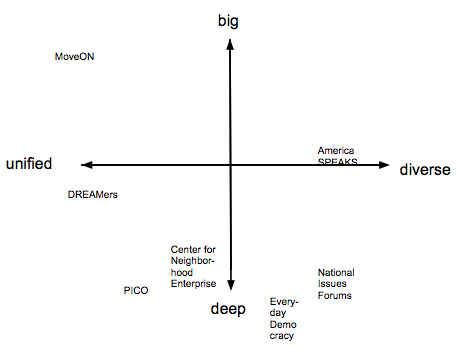
Our important civic organizations can be arrayed from “big” to “deep,” where the big ones touch lots of members, and the deep ones engage relatively small numbers in intensive ways. Meanwhile, the groups can be arrayed from “unified” to “diverse,” where the former organize people who share some common trait–such as an ideology or a social disadvantage–and the latter specialize in convening people who are different from each other. Here are some illustrative examples (with apologies to my friends who are shown below, if you think you should be a placed a little differently).
Screen Shot 2014-05-09 at 3.00.46 PM
The top right quadrant (big and diverse) is empty. Charles Tilly said that all social movements needed WUNC: “worthiness,” “unity,” “numbers,” and “commitment.” If your group is demographically or ideologically homogeneous, you can achieve unity along with numbers pretty easily–you just need the mass membership to demonstrate worthiness and commitment. And if your group is small, you can make it unified by bringing everyone into close relationships with each other.  But if you want all the people in a diverse nation to engage with each other, that requires numbers, commitment, worthiness, and unity in the face of diversity. The nation-state is supposed to achieve that, but it is not working well. It is no surprise that we lack mass, committed organizations capable of generating unity out of diversity–it is a tall order. But we have done better in the past, and we suffer from the lack today.

The post the kind of organization we need appeared first on Peter Levine.

is society an artifact or an ecosystem? (and what that means for citizens)

A fundamental question for anyone who wants to improve the world is which aspects of society are (1) natural and fixed, (2) artifacts that we make, or (3) elements of an ecosystem or social fabric that holds together. This question came into view ca. 1800 and is now inescapable.

Let’s call a society “traditional” to the degree that members view it as natural, permanent, and perhaps of divine origin. For a very long time, some people have been partially non-traditional. They have seen particular aspects of society as artifacts: as things we plan, create, and can change. For instance, the very first Greek historian, Herodotus, collected the varied burial customs of his time. The Egyptians’ “fashions of mourning and of burial are these,” he wrote: “Whenever any household has lost a man who is of any regard amongst them, the whole number of women of that house forthwith plaster over their heads or even their faces with mud. Then leaving the corpse within the house they go themselves to and fro about the city and beat themselves, with their garments bound up by a girdle and their breasts exposed …” Herodotus implied that the Egyptians had somehow made these customs and could switch them for different ones. Yet for him, most aspects of a society were natural and permanent, as were the differences between civilized people (who knew how a society should be run) and barbarians (who got it wrong).

Let’s say that “modernism” is the view that most aspects of society are artifacts. In modernity, people not only understand some aspects of society as artifacts, but they posit that society is generally something we invent and construct; everything human is  artifactual. They believe this not only of objects and actions (such as works of art or laws) but of their underlying principles. Perhaps we have made–not discovered–our concepts and criteria of things like beauty and justice.

Modernity, in this sense, may have arisen at several times in the past. Velcheru Narayana Rao claims that “a form of awareness that can be characterized as modern emerged naturally and organically in the Telugu- and Tamil-speaking parts of the [Indian] subcontinent toward the end of the fifteenth century.” That could well be the case. But the modernism that arose in Europe around 1800 has special significance today because it spread with European power around the world and has never receded.

Two interesting authors hold opposite perspectives on the question of modernism, and I think it’s valuable for citizens to consider both.

Roberto Mangabeira Unger is an ultra-modernist, a “modernist visionary,” as he calls himself (False Necessity: Anti-Necessitarian Social Theory in the Service of Radical Democracy, p. 9). He takes “to its ultimate conclusion” the thesis “that society is an artifact” (p. 2). All our institutions, mores, habits, and incentives are things that we imagine and make. We can change each of these things, “if not all at once, then piece by piece” (p. 4). Unger “carries to extremes the idea that everything in society is politics, mere politics”–in the sense of collective action and creation (p. 1)

Unger argues that that we have not yet taken the modernist project all the way. Even radical modernists have assumed that some things are natural although we can actually change them. Importantly, they have assumed that the relations between one domain and another are given. For instance, for Marxists, the economy is fundamental and it always determines politics. Unger thinks we can change any part of that picture. He wants to get rid of all “superstitious inhibitions.”

Unger fears that the status quo retains an arbitrary advantage. To disrupt it, he proposes a whole range of social reforms that would constantly stir things up: a steep inheritance tax that funds a social endowment, mandatory membership in independent unions that can compete for members, and a “reconstructive branch” of government that can take over institutions for short periods and reform them before leaving. These are ways of creating “a framework that is permanently more hospitable to the reconstructive freedom of the people who work within its limits” (p. 34). The task is to “combine realism, practicality, and detail with visionary fire” (p. 14)

James C. Scott is a critic of radical modernism, especially under conditions when the state is strong and civil society is weak–colonialism and war being particularly dangerous. In Seeing Like a State: How Certain Schemes to Improve the Human Condition Have Failed, Scott describes high-modernist ideology as “a strong, one might even say muscle-bound, version of … self-confidence about … the rational design of social order.”

The modernist’s orientation, as Scott notes, is purely toward the future: what will improve the world going forward? Since that is an intellectual question, the smartest people can basically decide. Existing structures are arbitrary and open to review. Any artifact that works in one place can and should be adopted elsewhere.

High modernism implies a truly radical break with history and tradition. …. All human practices … would have to be reexamined and redesigned. … The structures of the past were typically products of myth, superstition, and religious prejudice. … Society became an object that the state might manage and transform with an eye toward perfecting it (Scott, pp. 92-3).

High modernism forgets humility and the value of local knowledge, the wisdom embodied in traditional practices and any obligations we may owe to the past, the intrinsic limits of human reason and virtue, and the delicate ways that aspects of society interrelate. As Scott shows, high modernist schemes of social improvement can make things much worse. On the other hand, Unger rightly points to the arbitrary advantages of the status quo and our tendency to treat terrible injustice and waste as necessary even when we could change them.

Note that this debate does not map neatly onto the conventional ideological spectrum of left to right. Unger is a radical leftist because he is strongly egalitarian and enthusiastic about state power. He is also an ultra-modernist. But Margaret Thatcher was another kind of ultra-modernist, embracing the creative destruction of capitalism and denying that there was any such thing as “society.”

Meanwhile, the most avid defenders of holistic thinking, local norms, and the precautionary principle are environmentalists (generally placed on the left). European social democrats and US liberals are quick to defend traditional institutions like welfare agencies, schools, and universities against radical reforms. Unger writes (p. 275): “Anyone who accepts the established institutional framework as the horizon within which interests and ideals –including egalitarian ideals — must be pursued is not a progressive. The European social-democratic parties are not progressive.” This is a quarrel within the left. On the right, as well, there can be a debate about the degree to which aspects of a society are artifactual. You can place yourself anywhere on the spectrum from egalitarian to libertarian and separately choose any place on a spectrum from modernist to anti-modernist.

See also Roberto Unger against root causes, the visionary fire of Roberto Mangabeira Unger, Edmund Burke would vote Democratic, and what defines conservatism?


The post is society an artifact or an ecosystem? (and what that means for citizens) appeared first on Peter Levine.

the political advantages of organized religion

A piece of mine entitled “If Millennials Leave Religion, then What?” was published by the Religion News Service and picked up by the Washington Post yesterday. In it, I acknowledge the drawbacks of religion (viewed from a secular, political perspective), but I also catalog its advantages and argue that we don’t yet have a secular alternative that fills the traditional civic and political functions of churches and other religious congregations.

The piece had to be cut for length, which is fine (and I was able to select the cuts). But here, I would like to share one section that was deleted for length. In the published version, I alluded to the “depth” of religion. This is what I meant:

Mark Warren’s wonderful book about faith-based organizing, Dry Bones Rattling, begins with a vignette of Father Al Jost reading from the Book of Ezekiel to a group of Latina parishioners from poor neighborhoods in San Antonio. He chooses the version by African-American songwriter James Weldon Johnson: “Ezekiel connected dem dry bones.” Those lyrics derive from the Shakespearean poetry of the King James Version: “Again he said unto me, Prophesy upon these bones, and say unto them, O ye dry bones, hear the word of the Lord.” Father Jost’s listeners might hear those resonances, or some might recall the Spanish (“¡Huesos secos!”) or the Latin of the Church in which they were raised.

In any case, the effects are palpable. The women are nervous before Father Jost speaks, but they respond “with a resounding ‘Amen’ and [stride] onto the stage to the sounds of a mariachi band … exuding confidence and collective determination.”

I propose that the original quality and the long history of Ezekiel’s poetry explain its political power. Secular equivalents must match this depth of resonance.

The post the political advantages of organized religion appeared first on Peter Levine.

Review of We Are the Ones

(Urbana/Champaign, IL) I am here to talk to a public audience about the arguments of We Are the Ones We Have Been Waiting For: The Promise of Civic Renewal in America. Meanwhile, I’d recommend Michael McQuarrie’s new review of my book (along with Ben Barber’s If Mayors Ran the World). It’s a good, thoughtful article. I appreciate his summary of my book and his partially critical response.

In the final chapter, I say that a movement for civic renewal should expect and welcome vibrant debate, and three likely topics of debate will be: whether economic reforms must precede political empowerment; the role of anger and conflict versus civility and consensus; and the ideological placement of the civic renewal movement (on the left, at the center, aiming for neutrality, or very broad). McQuarrie meets my hopes by staking out strong positions on exactly those issues.

He also reads me as taking the opposite position from him on some of these questions, when I was trying to be more neutral–considering both the pros and the cons and letting readers end where they like. Thus I would like to respond to certain portions of his review, not because they’re necessarily unfair, but as an opportunity to clarify my own views and engage the debate. For example:

The title of Levine’s book—We Are the Ones We Have Been Waiting For—is an inspiring call to action, and in this sense, at least, is similar to Alinsky’s Reveille for Radicals (1946). However, rather than arguing for the possibilities of popular power, Levine is more interested in establishing the potential of citizen engagement for policy. Much of the book seems oriented around questions like “What are the measurable effects of community engagement on school effectiveness?” Levine’s form betrays a shift within the civic renewal movement, as it gains a foothold in foundations, academia, and even the White House. In the process it is becoming more communitarian in its celebration of the values and morality of citizens, while de-emphasizing popular authority and political sense. In terms of practice, contemporary advocates of the civic renewal movement emphasize correct deliberative communication among citizens as a solvent for all manner of political differences. In contrast, many in this tradition from Tocqueville on argued that civic virtue could only thrive in settings of relative socioeconomic equality. Challenging elites with popular power and cries that they are economic parasites, once central to populist activism and discourse, have been trimmed away in Levine’s account to make room for the idea that inequality can be overcome through a more virtuous and deliberative politics.

I do collect evidence that civic engagement boosts social outcomes. That’s because I don’t believe that many citizens, let alone powerful institutional actors, are ready to support active citizenship unless they believe it pays off in terms of better schools, safer streets, or a healthier environment.

I am a hard-headed researcher, so I will only claim that civic engagement has such benefits if it really does. In fact, instrumental arguments will carry us only so far. Civic engagement may not always improve communities. It may generate desirable outcomes, but less cheaply and reliably than other strategies would. It may boost outcomes (like “school effectiveness”) that we trivialize when we try to quantify them, thereby erasing deeply contested value questions. And it may degenerate into mere social hygiene if it is viewed as a tool for social improvement rather than a right of democratic citizens and an aspect of the good life.

On the other hand, arguing for civic engagement as a right will not obtain funding, education, media coverage, or legal authorization for civic engagement. Instrumental arguments, if handled right, can be helpful. They are ammunition for a peaceful army of engaged citizens.

I would like to think that I am not a communitarian (celebrating “the values and morality of citizens, while de-emphasizing popular authority and political sense”) or merely a deliberative democrat (viewing “correct deliberative communication among citizens as a solvent for all manner of political differences”). I am certainly not a technocrat, and I offer a pretty sharp critique of expertise in chapter 4. With McQuarrie, I believe in power and conflict. Activist social movements must hold governments accountable. They will be–and should be–angry at the powers that be and at their fellow citizens who stand in their way. The strategies I recommend at the end of the book are aimed at bolstering their efforts. I do not for a moment count on policymakers to open doors willingly.

I do, however, reject the argument that “civic virtue [can] only thrive in settings of relative socioeconomic equality.” Effective activism is more common in Tanzania and India than in the US. It has often arisen from the poorest strata of American society, starting with slaves in the antebellum era.

The problem with putting economic equality first and expecting civic renewal to follow is that someone must then pursue economic equality without a popular following. Who will that be, why will the succeed, and why should we trust them if they do? Saul Alinsky was a great theorist, but his popular movements ended in disaster. I denounce the political influence of economic elites, because that is a valid critique and because political reform is required for civic empowerment. I would not personally denounce economic elites as economic parasites because I am not sure that is true, and I know it will divide a potentially broader coalition.

I wrote a book in the late 1990s about the Progressive Era (and actually discarded some detailed historical research I had done for reasons of length and coherence). Reflecting on that history, I would now say that some Progressive Era reforms were elitist and downright damaging. Others were populist and “civic,” in my terms (deliberative, collaborative, and relational). Robert M. La Follette, Jane Addams, and John Dewey were their paragons.

To the extent that these valuable reforms flourished, it was partly because economic radicals (Socialists and agrarian populists) challenged the government and capital. That made elites amenable to sharing some power. But the actual reforms enacted from 1900-1914 did not challenge economic inequality. Progressive reforms were indeed about reducing the political influence of money and increasing deliberative popular influence over government. Typically, the inventors and proponents of these civic reforms were not Socialists or populists. They had broader and more centrist coalitions, including many people who would have bristled at a depiction of the wealthy as parasites. The left movements may have won space for civic reforms, but the civic reforms had different origins and motivations.

Coming back to our present day: I would welcome more effective left-populist grassroots mobilizing on economic issues. I think it would change the balance of power in ways that would help civic reformers. But I think we also need a civic blueprint: a vision of how our democracy should look if we had the power to demand it. That’s what I hope to offer in We Are the Ones–along with strategies for civic reform and topics for the movement to debate. McQuarrie has joined the debate in a most welcome way.

The post Review of We Are the Ones appeared first on Peter Levine.