a definition of “civic”

In phrases like “civic education,” “civic engagement,” “civic technology,” or (as in the name of our college) “civic life,” what does the word “civic” mean?  In conversations and writing about the topic, I detect several definitions. Each definition can be introduced with a different keyword:

  1. Power. Perhaps politics means influencing decisions and institutions to get the outcomes you want–or at least to move them closer to your preferences. In democracies, citizens have tools for increasing their influence, e.g., popular votes, petitions, strikes, and protests. “Civic” activities may mean tools for power and influence that are relatively democratic. That category would include popular votes but not presidential decrees; grassroots petitions but not professional lobbying efforts. Acts like voting and contacting government are often included in official surveys of civic engagement. Note that in this conception, politics is zero-sum (every decision has winners and losers), but what makes a form of politics “civic” is its accessibility to ordinary citizens.
  2. Virtue. The adjective “civic” is often paired with nouns like “virtue,” “character,” or “values.” In this conception, the civic is a subset of the political. It’s the best part, the part that exemplifies classical republic virtues, such as concern for the common good, patriotism or cosmopolitanism, commitment to law and to equity, and perhaps even self-sacrifice.
  3. The commons. Every society needs common resources as well as privately owned ones. Common goods may include natural resources (such as air), institutions (such as law), knowledge (such as general principles of science), and norms (such as trust). The whole commons is the “commonwealth,” a direct translation of the Latin res publica (public thing), from which we derive the word “republic.” The commonwealth can be created, expanded and protected, or exploited and degraded. According to some theorists, the civic is work that contributes to the commons. That would include paid work in for-profit enterprises if it produces public goods directly or as externalities. (Note the direct contrast with #1. There, civic engagement was generally zero-sum. Here, it is defined as win/win.)
  4.  Discourse. In some ancient and still-influential conceptions, the core function of a citizen is to deliberate about what is right and good. Public deliberation creates public opinion, which should influence institutions, such as states, courts, and perhaps firms and markets. Civic discourse is defined by deliberative values, such as genuine openness to what others are saying, commitment to truth, and pursuit of consensus. Classical civic institutions are spaces for discourse: newspapers, coffee shops, legislatures, and (now) the Internet.
  5. Community. People need social bonds: to be cared for and to care for others. Most human beings–and especially vulnerable people like children–thrive much better when they are embedded in an affective community. The norms and habits that form among people in such communities (“social capital”) are also resources that can be used for power, discourse, etc.  To  measure social capital, one typically aggregates behaviors like volunteer service and membership in groups, plus attitudes like trust and care. “The civic” is whatever contributes to such community bonds.
  6. Performance. Some would say that civic life offers spaces for people to perform and to be recognized by others. Life is richer and more satisfying when we can create personas and display them for others, and when others can acknowledge and appreciate who we are. The main purpose of a public debate is not to identify the best policy but to display characters. For instance, in the cabinet battles imagined by Lin-Manuel Miranda, Alexander Hamilton and Thomas Jefferson get to show off who they are, and that’s why it’s so great to be in “the room where it happens.” Debate is only one form of performance; activities like theater, spoken word, gaming, and design also count. On this conception, Augusto Boal’s Theater of the Oppressed might be the pinnacle of the civic.

I value all these things. It’s tempting to say, then, that the right definition of “the civic” is the union of all of them. But that seems a bit ad hoc, a miscellaneous assemblage of desirable behaviors and values. It would be better to have an organized account of how they all fit together. For instance, perhaps we need community to provide people with enough support that they can exercise relatively equal power, but power is best when informed by deliberative discourse. In turn, deliberation encourages attention to the commons, allows performance, and both requires and develops republican virtues.

That is a rather discourse-centered theory; one could instead make the various ideas center on the commonwealth, or on democratic exercises of power. It’s also reasonable to weigh some of these ideas much more heavily than others.

See also: what is the definition of civic engagement? and defining civic engagement, democracy, civic renewal, and related terms

democracy in the digital age

New chapter: “Democracy in the Digital Age,” The Civic Media Reader, edited by Eric Gordon and Paul Mihailidis (Cambridge, MA: MIT Press, 2016), pp. 29-47

Abstract: Digital media change rapidly, but democracy presents perennial challenges. It is not in people’s individual interests to participate, yet we need them to participate ethically and wisely. It’s easier for more advantaged people to participate. And the ethical values that guide personal relationships tend to vanish in large-scale interactions. The digital era brings special versions of those challenges: choice has been massively disaggregated, sovereignty is ambiguous, states can collect intrusive information about people, and states no longer need much support from their own citizens. I argue that these underlying conditions make democracy difficult in the digital age.

the world’s first and only Civic Studies rap

(Washington) And now for something different … My colleague Prof. Jonathan Garlick was a participant in last summer’s Institute of Civic Studies at Tufts’ Tisch College of Civic Life. After two weeks of wrestling with theorists like Jurgen Habermas and Eleanor Ostrom–along with fellow academics and practitioners from half a dozen nations–Jonathan summarized it all up in a rap:

“Now, Habermas’ and Ostrom’s inquiries
Are still a bit unclear to me
So let’s elucudiate these mysteries
By clarifyin their philosophies
Picture them both in a rap repartee
As they exchange views and realities
A civic rap battle of history …”

Here are the rest of the lyrics in PowerPoint.

help shape the strategy for civic renewal in America

The 2016 Annual Conference on Citizenship is co-hosted and co-planned by my colleagues and me at the Jonathan M. Tisch College of Civic Life at Tufts University and will specifically focus on issues of diversity, equity, and inclusion in civic life. Unless we make progress on these issues, we cannot move our country forward.

This year’s conference will be interactive; the whole group will think together about what civic life in America would look like if it strove for equity, diversity, and inclusion.

Participants will help shape the agenda for civic renewal in America and will leave with contacts and practical ideas to strengthen their own work.

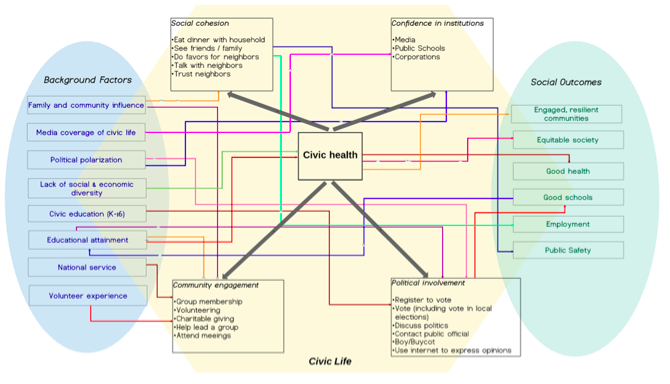
During the day, we will work together to revise and improve our collective understanding of civic life. The map below will be a starting place.

screen-shot-2016-09-27-at-11-37-57-am

On the left are factors that may affect civic life, for better or worse. In the middle is “Civic Health” as it has been measured by the National Conference on Citizenship (NCoC) and its partners over the past decade. Civic Health has four major components that radiate out from the center. On the right are valuable outcomes of having a healthy civic life, such as resilient communities and good schools.

The arrows show connections uncovered by NCoC, Tisch College, and others. For example, we know that k-12 civic education can boost political involvement, that communities with more political engagement have better schools, and that good schools boost educational attainment, so all of those boxes are connected with arrows.

This is just a start, and during the day, we will ask participants to add, edit, or move boxes and arrows to help build a better diagram. We will also ask you to place yourself on the map.

There will be opportunities to hear from inspiring and well informed speakers. Click here to view the agenda at-a-glance.

Please join us for this important convening and invite other colleagues whose voices need to be heard. Register today!

Call for Papers: Facts, Values, and Strategies in Citizen Politics

Tufts’ University’s Tisch College of Civic Life and the journal The Good Society seek proposals for papers to be presented at a conference at Tufts on May 18, 2017 and then published in The Good Society as part of a special issue edited by Tisch Associate Dean Peter Levine. Tisch College can offer travel and lodging for presenters at the conference.

Framing:

Current global crises of democracy raise fundamental questions about how citizens can be responsible and effective actors, whether they are combating racism in the United States, protecting human rights in the Middle East, or addressing climate change. If “citizens” are people who strive to leave their communities greater and more beautiful (as in the Athenian citizen’s oath), then their thinking must combine facts, values, and strategies, because all three influence any wise decision. Mainstream scholarship distinguishes facts, values, and strategies, assigning them to different branches of the academy. Many critics have noted the philosophical shortcomings of the fact/value distinction, but citizens need accounts of how facts, values, and strategies can be recombined, both in theory and in practice. John Dewey, Hannah Arendt, Mahatma Gandhi, Jürgen Habermas, Amartya Sen—and many other theorists of citizenship—have offered such accounts.

Actual civic movements also combine facts, values, and strategies in distinctive ways. For instance, the American Civil Rights Movement used the language of prophesy, and Second Wave Feminism strategically advocated new ways of knowing. This special issue invites theoretical, methodological, historical, empirical, and case-study articles related to the question: how should citizens put facts, values, and strategies together?

Paper proposals of up to 300 words should be sent to Peter Levine at peter.levine@tufts.edu and to Good Society editor Trygve Throntveit at tthrontv@umn.edu by November 1, 2016. Prospective authors must be willing to present drafts by May 1 2017, attend a one-day conference at Tufts on May 18, and revise for final publication by September 2017.

against root cause analysis

I am skeptical of the idea of “root causes” and the assumption that progress comes from addressing the roots of problems. The following points draw from discussions in our annual Summer Institutes of Civic Studies and are indebted to my co-teacher, Karol Soltan.

  1. The metaphor of a “root” seems misplaced. Social issues are not like plants that have one root system at the bottom and branches and leaves at the top, so that if you cut or move the root, you kill or move the whole plant with a single action. Very often, social phenomena are connected in systems that incorporate feedback loops and cycles, whether virtuous or vicious. It’s possible for one thing (A) to affect another thing (B) and for B also to affect A. Very often, outcomes are not the result of one ultimate cause but of the interaction of many causes. And causes can be viewed as outcomes, because there’s lots of reciprocal causation.
  2. Often, successful social action occurs even though the activists don’t know the root cause of a problem or they disagree about what it is. An example is the global movement to end slavery. Religious abolitionists argued that the root cause of slavery was sin, going back to the Fall of Man. “Free labor” abolitionists, like Abraham Lincoln, said that slavery was a plot to undermine a competitive market of labor in which the individual worker could profit. In contrast, Karl Marx wrote in 1847 that slavery was a lynchpin of global capitalism: “Direct slavery is just as much the pivot of bourgeois industry as machinery, credits, etc. Without slavery you have no cotton; without cotton you have no modern industry. It is slavery that has given the colonies their value; it is the colonies that have created world trade, and it is world trade that is the pre-condition of large-scale industry.” Frederick Douglass saw racism (“the wolfish hate and snobbish pride of race”) as a–or perhaps the–root cause of slavery. I suppose that all of them pointed to genuine causal factors, but the main point is that they formed a coalition that targeted the actual problem, not its underlying causes, and they won.
  3. Trying to identify root causes can delay or even block effective action. My friends Joel Westheimer and Joe Kahne wrote a very influential and valuable paper in 2004 entitled “Educating the ‘Good’ Citizen: Political Choices and Pedagogical Goals.”* They found that civic education programs in the US tended to fall into three categories, defined by their objectives for the students. An example illustrates the differences. In a program that aims to produce “personally responsible citizens,” a student will “contribute food to a food drive.” In a program whose ideal is to develop “participatory citizens,” a student will “help to organize a food drive.” In a program that emphasizes “justice-oriented citizens,” the student will “explore why people are hungry and act to solve root causes.” As Karol notes, the first two begin with an action, but the third begins with “exploring,” which doesn’t actually do any good in the world. Now, to be sure, one can also explore a diagram of a complex, interconnected system for a long time before doing anything, so it’s not only root-cause analysis that can fatally delay action. But I think that root-cause analysis is particularly likely to frustrate action because it sends us in search of the biggest, hardest, deepest aspect of a problem, which is exactly where the odds of success may be lowest. And that’s a mistake if problems do not actually have roots.

*Political Science and Politics, April 2004, pp 241-24.

See also Roberto Unger against root causes and roots of crime.

to the European Institute of Civic Studies

I am fleeing the country heading to Augsburg, Germany for the 2016 Summer Institute of Civic Studies. It is aimed at participants from Ukraine, Belarus, and Poland, but they are convening this summer in Germany (thanks to the generosity of the DAAD). The other organizers are my friends Dr. Tetyana Kloubert (Augsburg) and Prof. Karol Soltan (Maryland). I’ll paste the syllabus below; it may be interesting because of its European focus. It ends with a practical training on nonviolent resistance that should be particularly illuminating when experienced right after relatively abstract discussions of democracy and civic society. I will unfortunately miss that part because I’m coming back to the US on August 29, and I will resume blogging then.

Monday, July 25 9:00 – 9:30

9:30 – 11:00 Morning session

Introductions and Inspirations

Framing Statement for the Summer Institute
Seamus Heaney, “In the Republic of Conscience”
Images: fist of Otpor and open hand from Chandigarh
Vaclav Havel, Address at Wroclaw University (December 21, 1992)
Myroslav Marynovych “Civic virtues after Maidan”
11:30 – 13:00 Noon Session

Democracies: Constitutional, Illiberal and Façade

Fareed Zakaria “The Rise of Illiberal Democracy” (1997)
Viktor Orban’s Speech at the 25th Balvanyos Summer Free University and Student Camp (2014)
Attila Agh, “De-Europeanization and De-Democratization Trends in ECE” (2015)
13:00 – 14:30 Lunch break

14:30 – 16:00 Afternoon session

I. The main theoretical debate of civic studies: JürgenHabermas vs. Elinor Ostrom

1. Venue: Negotiation and Deliberation

Roger Fisher and William Ury, Getting to Yes (2d ed.), Chapter 1 “Don’t Bargain Over Positions” pp. 3-14.
Archon Fung, “Recipes for Public Spheres: Eight Institutional Design Choices and Their Consequences” in Journal of Political Philosophy, vol. 11, No. 3. (September 2003), pp. 338-67.
Bernard Manin “Deliberation: Why We Should Focus on Debate Rather Than Discussion.”
17:30 – 19:00 Reception at the Augsburg University

Tuesday, July 26 9:30 – 11:00 Morning session

2. Theorist: Jürgen Habermas

James Finlayson (2005), Habermas: A Very Short Introduction, Oxford: Oxford University Press, (Chapters 1, 2, 4) pp. 1-27, 47-61
11:30 – 13:00 Noon Session

3. Key concepts: Pluralism

Peter J. Boettke et al. (2014), “Polycentricity, Self-governance, and the Art & Science of Association,” in The Review of Austrian Economics, Volume 28, Issue 3 , 311-335
Leszek Kolakowski (1990), “How to be a Conservative-Liberal-Socialist”, Modernity on Endless Trial (University of Chicago, 1990).
Isaiah Berlin (1988), “On the Pursuit of the Ideal,” in The Crooked Timber of Humanity, ed. Henry Hardy (Princeton, N.J.: Princeton University Press)
13:00 – 14:30 Lunch break

14:30 – 16:00 Afternoon session

4. Theorist: Elinor Ostrom and the commons

Thomas Dietz, Nives Dolsak, Elinor Ostrom, and Paul C. Stern (2002), “The Drama of the Commons”, in Drama of the Commons, ed. Elinor Ostrom, Washington, DC: National Academy Press, pp. 3-26
Elinor Ostrom (1996), “Covenants, Collective Action, and Common-Pool Resources”, in The Constitution of Good Societies, ed. Karol Edward Soltan and Stephen L. Elkin, University Park: Pennsylvania State University Press, 23–38
16:30 – 17:30 Evening Presentation (invited speaker)

Wednesday, July 27 9:30 – 11:00 Morning session

5. Key concepts: Social capital

Robert D. Putnam, “Community-Based Social Capital and Educational Performance,” in Ravitch and Viteritti, eds., Making Good Citizens, pp. 58-95;
Jean L. Cohen, “American Civil Society Talk,” in Robert K. Fullinwider, ed., Civil Society, Democracy, and Civic Renewal, pp. 55-85
11:30 – 13:00 Noon Session

II. Civic action and reflection: Education and Civic Education

1. Key concepts: Civic Education – The person in development as a citizen

Benson, Scales, Hamilton, and Sesma (2006), “Positive Youth Development: Theory, Research, and Applications”, in Theoretical Models of Human Development, ed. R. M. Lerner (Handbook of Child Psychology, Vol. 1., 6th ed.), pp. 894-941
Joel Westheimer and Joseph E. Kahne (2004), “Educating the ‘Good Citizen’: Political Choices and Pedagogical Goals”, in Political Science and Politics, 37,2, pp. 241–247
13:00 – 14:30 Lunch break

14:30 – 16:00 Afternoon session

2. Key concepts: Civic Education – Principles of German political (adult) education: Bildung and Mündigkeit as core categories

Hendrik Bohlin (2008), “Bildung and Moral Self-Cultivation in Higher Education: What Does it Mean and How Can it be Achieved?“, in Forum on Public Policy: A Journal of the Oxford Round Table.
Zeuner, Christine (2013), “From workers education to societal competencies: approaches to a critical, emancipatory education for democracy”, in: European journal for Research on the Education and Learning of Adults 4, 2, p. 139-152
Martha Friedenthal-Haase (1996), “The Knowledge-Base of Democracy”, in Democracy and Adult Education, ed. J. Jug et al., Frankfurt am Main et al: P. Lang, pp. 133-138.
16:30 – 17:30 Evening Presentation (invited speaker)

Thursday,

July 28 9:30 – 11:00 Morning session

3. Theorist: Freire

Myles Horton and Paulo Freire (1990), We Make the Road by Walking, Philadelphia: Temple University Press, pp. 115-138
Paulo Freire (2000 [1970]), Pedagogy of the oppressed, New York: Continuum (Chapter 1. The justification for a pedagogy of the oppressed, Chapter 2. The “banking” concept of education as an instrument of oppression)
11:30 – 13:00 Noon Session

4. Re-education and Rethinking the Past

James F. Tent (1984), Mission on the Rhine : reeducation and denazification in American-occupied Germany, University of Chicago Press (Chapter: From Reeducation to Reorientation).
Richard von Weizsäcker (8. Mai 1985): „Zum 40. Jahrestag der Beendigung des Krieges in Europa und der nationalsozialistischen Gewaltherrschaft“ (English translation)
13:00 – 14:30 Lunch break

14:30 – 16:00 Afternoon session

III. Civic theorists respond to modernity

5. James C. Scott

James C. Scott Seeing Like a State: How Certain Schemes to Improve the Human Condition Have Failed, introduction and chapter 3, chapter 9.
16:30 – 17:30 Evening Presentation (proposed by participants)

Friday, July 29

9:30 – 11:00 Morning session

6. Modernity after Auschwitz

Theodor Adorno (2003), Can one live after Auschwitz? : a philosophical reader, Stanford University Press (Chapter 2: Education after Auschwitz)
Theodor Adorno (with Hellmut Becker): Education for Maturity and Responsibility
Daniel Lévy, Natan Sznaider (2005), The Holocaust and Memory in the Global Age, Philadelphia: Temple University Press, 1-39.
11:30 – 13:00 Noon Session

7. Theorist: Hannah Arendt

Hannah Arendt (1967): On Revolution. Excerpts.
13:00 – 14:30 Lunch break

14:30 – 16:00 Afternoon session

8. Roberto Mangabeira Unger and radical modernism

Roberto Unger, False Necessity, Chapter 1 (1-40)
Roberto Unger, Democracy Realized, “A Manifesto” (263-77)
Weekend : Free for private activities; optional sightseeing programs will be available

Monday, August 1, 9:30 – 11:00 Morning session

9. Theorist: Max Weber

Max Weber (1965), Politics as a vocation, Philadelphia: Fortress Press (Max Weber (1988 [1919]), Politik als Beruf, in ders.: Gesammelte Politische Schriften, hrsg. von Johannes Winckelmann, 5. Aufl., Tübingen: Mohr, pp. 505-560 – excerpts)
11:30 – 13:00 Noon Session

10.Theorist: Edmund Burke

Robert Nisbet (1986), Conservatism: Dream and Reality, Minneapolis: University of Minnesota Press, pp. 1-46
William Ophuls (with A. Stephen Boyan) (1992), Ecology and the Politics of Scarcity Revisited, New York: Freemann (Chapter 8), pp. 222-249.
13:00 – 14:30 Lunch break

14:30 – 16:00 Afternoon session

11. Theorist: Friedrich von Hayek

Friedrich Hayek (1960), The Constitution of Liberty, University of Chicago Press, (Chapter 1, Chapter 4 and Postscript)
16:30 – 17:30 Evening Presentation (proposed by participants)

Tuesday, August 2, 9:30 – 11:00 Morning session

IV. Constitutional Democracy

1. Key concepts: Constitutional Patriotism

Müller, Jan-Werner (2008), A General Theory of Constitutional Patriotism, in International Journal of Constitutional Law, Vol. 6, Issue 1, 72-95.
11:30 – 13:00 Noon Session

2. Key concepts: Thinking constitutionally

The Federalist Papers, ? 10 (The Same Subject Continued: The Union as a Safeguard Against Domestic Faction and Insurrection, November 23, 1787), ? 51 (The Structure of the Government Must Furnish the Proper Checks and Balances Between the Different Departments, February 8, 1788).
Stephen Elkin (2004), “Thinking Constitutionally: The Problem of Deliberative Democracy”, in Social Philosophy and Policy, 21, pp. 39-75.
13:00 – 14:30 Lunch break

14:30 – 16:00 Afternoon session

3. Key concepts: Thinking about constitutions

Democracy Reporting International: Ukraine (2014), “The Promise and the Risk of Constitutional Reforms”, Briefing Paper 46, March 2014
Ackerman, Bruce (2000), “The New Separation of Powers”, 634-69, 685-94, 712-25.
16:30 – 17:30 Evening Presentation (proposed by participants)

Wednesday, August 3, 9:30 – 11:00 Morning session

4. Key concepts: Corruption

John Ackerman (2014), “Rethinking the International Anti-Corruption Agenda”, in American University International Law Review, 29, 2, pp. 293-333.
Creative Union TORO Ukraine and the UNCAC Coalition (2011), UN Convention against Corruption. Civil Society Review. Ukraine 2011
11:30 – 13:00 Noon Session

V. Toward a broader civic perspective

Venue: Civic Studies for European Union

Weiler, J.H.H. (2011): On the political and legal DNA of the Union and the Current European Crisis
Dahrendorf (1997), After 1989: morals, revolution, and civil society, Oxford (15. From Europe to EUrope: A Story of Hope, Trial and Error.)
13:00 – 14:30 Lunch break

14:30 – 16:00 Afternoon session

2. Global Civic Work

James Nickel, “Human Rights,” Stanford Encyclopedia of Philosophy, online (http://plato.stanford.edu/entries/rights-human/)
Andrew Clapham (2006), Human Rights Obligations of Non-State Actors, Oxford University Press, pp. 535-48 (Section 11.1 “Dignity”)
James Speth (2008), The Bridge at the Edge of the World, Yale University Press, pp. 199-216
United Nations Organisations (1948), Universal Declaration of Human Rights
Earth Charter Commission (2000) The Earth Charter
16:30 – 17:30 Evening Presentation (invited speaker)

Thursday, August 4

9:30 – 11:00 Morning session

VI. Democracy from below

1. Venue: Community organizing and popular education

John Gaventa (1980), Power and Powerlessness: Quiescence and Rebellion in an Appalachian Valley, Urbana and Chicago: The University of Illinois Press, pp. 3-32
Saul Alinsky (1969 [1946]), Reveille for Radicals, New York: Vintage Books, pp. 76-81; 85-88; 92-100, 132-5, 155-158
11:30 – 13:00 Noon Session

2. Venue: Social movements

Charles Tilly (2004), Social Movements, London: Paradigm Publisher, pp. 1768-2004
Marshall Ganz (2004), “Why David Sometimes Wins: Strategic Capacity in Social Movements,” in Rethinking Social Movements: Structure, Meaning, and Emotion, ed. Jeff Goodwin and James M. Jasper, Lanham, MD: Rowman and Littlefield, pp.177-98.
13:00 – 14:30 Lunch break

14:30 – 16:00 Afternoon session

3. Venue: Social Movements in the Shadow of Gandhi

Bhikhu Parekh (2001), Gandhi, Oxford University Press, (Chapter 4 “Satyagraha”) pp. 51-62
Timothy Garton Ash (2009), “Velvet Revolution: The Prospects,” New York Review of Books, December 3
16:30 – 17:30 Evening Presentation

Workshop: Nonviolent civic strategies (Dmytro Potekhin)

Friday, August 5

9:30 – 11:00 Morning session

Workshop: Nonviolent civic strategies (Dmytro Potekhin)

11:30 – 13:00 Noon Session

Workshop: Nonviolent civic strategies (Dmytro Potekhin)

13:00 – 14:30 Lunch break

14:30 – 16:00 Afternoon session

Workshop: Nonviolent civic strategies (Dmytro Potekhin)

17:30 – 22:00

Summary of the Summer Institute: Perspectives and Challenges in Ukraine, Poland, Belarus and Germany in international comparison

Farewell Evening – Social gathering

communities saving coral reefs: an illustration of Elinor Ostrom’s findings

A new Nature article by Joshua E. Cinner and many coauthors entitled “Bright spots among the world’s coral reefs” is getting a lot of play in mass media. The authors find that, despite grievous damage to coral reefs around the world, some reefs are doing much better than predicted. Among the causes of their success are local institutions and norms:

Our initial exploration revealed that bright spots were more likely to have high levels of local engagement in the management process, high dependence on coastal resources, and the presence of sociocultural governance institutions such as customary tenure or taboos. … For example, in one bright spot, Karkar Island, Papua New Guinea, resource use is restricted through an adaptive rotational harvest system based on ecological feedbacks, marine tenure that allows for the exclusion of fishers from outside the local village, and initiation rights that limit individuals’ entry into certain fisheries

According to economics before Elinor Ostrom, an unowned and unregulated resource is doomed because individuals will exploit it. A coral reef is a perfect example of an unowned resource; thus it must be enclosed and controlled by a private owner or a state to save it from the Tragedy of the Commons. But Ostrom found that communities around the world have developed durable means of protecting such resources for their own use. They apply tacit design principles for the successful management of what she called common pool resources, including clearly defined boundaries, rules for appropriating resources that are congruent with the local biological and cultural circumstances, practical means of monitoring the resource, and procedures that most people in the community have some capacity to influence.* Although the above description of Karkar Island is brief, it seems to manifest these principles.

Ostrom’s findings are profoundly significant, because all over the world, local institutions for protecting common pool resources have been bulldozed (metaphorically or literally) by states and markets. That form of modernization is one cause of our global ecological crisis. If more people were permitted–or even supported–to manage local resources as the Karkar Islanders do, the world would be in better condition.

It is also true–as the Nature authors emphasize–that deadly external threats beset local resources (in this case, coral reefs). As long as we heat the earth at a global scale, it’s virtually inevitable that many or most reefs will be destroyed, regardless of how local people manage them. But it’s a mistake to read Elinor Ostrom as a “Small-is-Beautiful” romantic. Her insight is that collective action problems are omnipresent, but they are not inexorable tragedies. They are “dramas” that can turn out either tragically or happily, depending on how we organize ourselves. The moral of her work is not that indigenous people can save the earth if left alone, but that institutions at all scales must learn to manage resources using the principles that happen to be traditional in places like Karkar Island.

*Ostrom et al., “Covenants, Collective Action, and Common-Pool Resources,” in The Constitution of  the Good Society, ed. Karol Edward Soltan and Stephen L. Elkin, 1996, pp. 23–38.

See also: Peter Levine, “Seeing Like a Citizen: The Contributions of Elinor Ostrom to ‘Civic Studies’” (The Good Society, 2011); Elinor Ostrom, 1933-2012on the contributions of Vincent and Elinor Ostrom; and the cultural change we would need for climate justice.

being a friend to a project

The other day, in the Summer Institute of Civic Studies, we were reading a long review article about Positive Youth Development (PYD). PYD can be described as a set of empirical hypotheses with supportive evidence (e.g., that youth flourish best when given opportunities to contribute to their communities). Alternatively, it could be defined as a set of value propositions that may or may not be empirical (e.g., youth have a right to contribute to their communities). It can also be described as a set of programs for young people. Those programs exist because of funding streams and other policies that can be categorized as PYD as well. And it’s a community of people–scholars, practitioners, policymakers, and maybe youth–who are involved with PYD.

Presented with an article, you can read it, learn from it, agree with it, criticize it, assess it, share it, cite it, even assign it. But you can’t be a friend of the article. It exists in its final form and can’t be influenced. It can have fans, but not friends in a recognizable sense of that word.

You can be a friend of something like PYD, assuming that it is a community of people or set of programs. Such a friendship can incorporate criticism–or even require it. For instance, I think PYD should be more political. Youth should have more opportunities to change official systems. I can say that as a friend of PYD, even as part of the PYD community. My friendship is predicated on a decision that PYD has potential, that it is worth engaging. My friendship does not depend on my assent to any particular list of hypotheses or principles, nor my endorsement of any particular program.

I say all of this for two reasons. First, academics learn how to relate to texts as critical readers. We are also supposed to learn how to relate to other scholars as people. But we learn less about how to be friends of communities or movements. Some of us are good friends (in that sense), but it’s not really part of our training.

Second, I think the relationship between empirical hypotheses and actually existing movements is widely misunderstood. It turns out to be true that many youth flourish when offered certain kinds of opportunities to contribute to their communities. That claim of PYD is true because a community of practitioners set about to create such opportunities and made them work. The knowledge that we have gleaned through research on PYD is a product of their efforts. This doesn’t mean that knowledge is subjective or relative. Some programs succeed, others fail, and we can measure the difference. But no program succeeds without being designed and implemented, which requires a prior commitment by some organized group.

The knowledge contained in an article about PYD is thus dependent on people’s work in the world. You can’t be a friend of the article, but you can be a friend of the people upon whom it depends. If the article contains a mistake, you should notice that. If the programs fail to work, you can help them to work better. A community can falter, splinter, or go in the wrong direction, but it can’t be invalidated. That means that a critical response to a publication is disagreement, but a critical response to a movement is action.

the eighth annual Summer Institute of Civic Studies begins

Today begins the eighth annual Summer Institute of Civic Studies at Tufts’ Tisch College of Civic Life. That means 7-8 hours of seminar discussion each day for two weeks, based on thousands of pages of readings. The syllabus is largely unchanged from last year. My co-conspirator in all of this work is Prof. Karol Soltan from University of Maryland.

Participants this year include two professors of philosophy, several community organizers and NGO leaders, and current PhD students in political science/political theory, developmental psychology, sociology, and geography. They come from the US, UK, Argentina, Ecuador, India, Pakistan, and Thailand.

The curriculum is unapologetically theoretical, even though most participants are selected because of their practical interests. As I’ve argued recently, our civic practices have outrun our theories. We have a lot of wisdom about how to organize a meeting or an advocacy campaign or what makes a good learning opportunity for youth. We have much less clarity about what all of that is for and how it relates to large-scale social conditions and political institutions. The 2016 Summer Institute won’t answer those questions definitively, but it’s a chance to struggle with them together.