effects on civil society will be mediated by the economy

How will the current pandemic affect civic engagement? We certainly cannot know, but I would offer the following hypotheses:

People’s voluntary behaviors, values, and preferences will not change very much. If you can, you will snap back to pre-COVID habits and beliefs as soon as possible. However, the economic turmoil caused by the shutdown will destroy many nonprofit associations, newspapers, and businesses that are integrated into community life (such as cafes and barber shops). In the short term, not only will that destruction harm many people, but it will suppress civic life, since most people engage in and because of organizations. In the longer term, there will be space for civic innovation and growth, and maybe younger and more diverse leadership will emerge. However, civic organizations–particularly, local newspapers–that already have fragile business models may never be replaced.

Although it’s a century old, our best model for predicting the pandemic’s effects is the great influenza pandemic of 1918. In many parts of the world, its effects are impossible to disentangle from the impact of World War I, the Russian Revolution, and the collapse of empires. However, the US was peripheral to those matters and lost less than 1/20th of one percent of our population in the Great War. Changes that occurred between 1918 and 1920 can be plausibly attributed to the pandemic, which killed 650,000 out of 103 million Americans (equivalent to about 2 million deaths today).

Graphs from Robert Putnam’s Bowling Alone show no significant or lasting impact on civil society. Deep trends–industrialization, urbanization, the Great Migration–were ongoing, and so were trends in civic life. For instance, the early 1900s was the era when Americans constructed national organizations with local chapters, and their growth proceeded unabated through 1918.
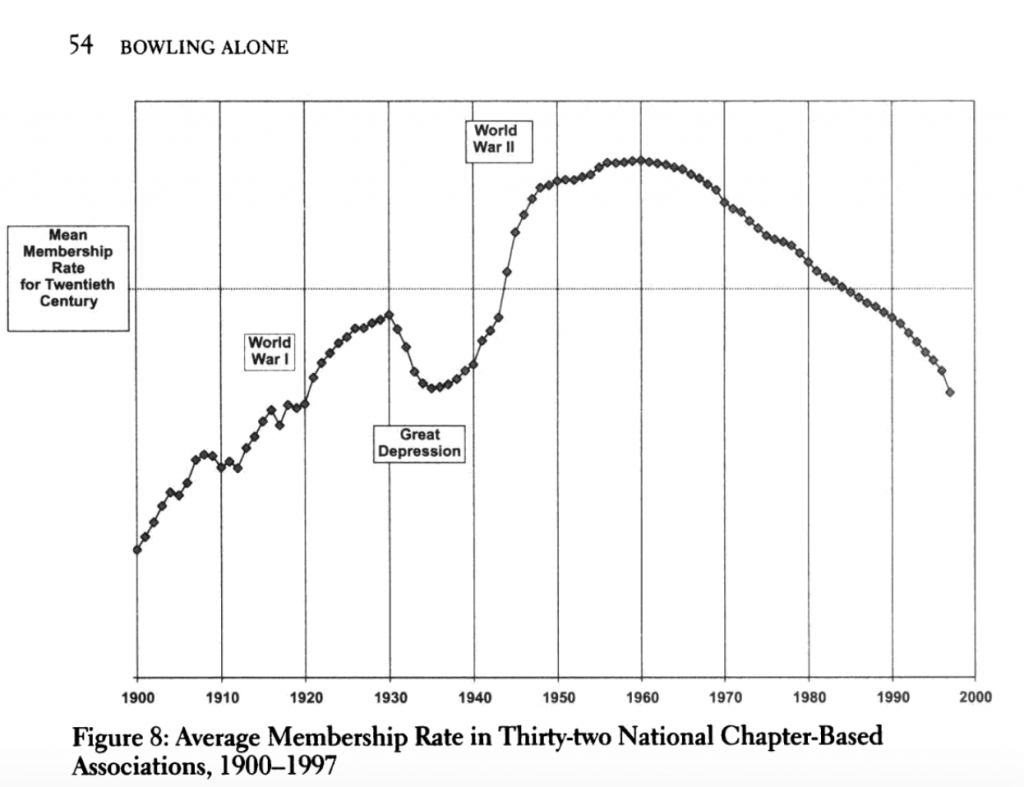
Putnam also presents trends for membership in professional associations and unions, the rate of playing card games, the number of police officers per capita, and telephone ownership. These rates do not all smoothly rise in the early 1900s, but none seems to bend around 1918.

One possible exception is the rate of founding of major membership organizations, which was lower in the 1920s than in the 1910s:
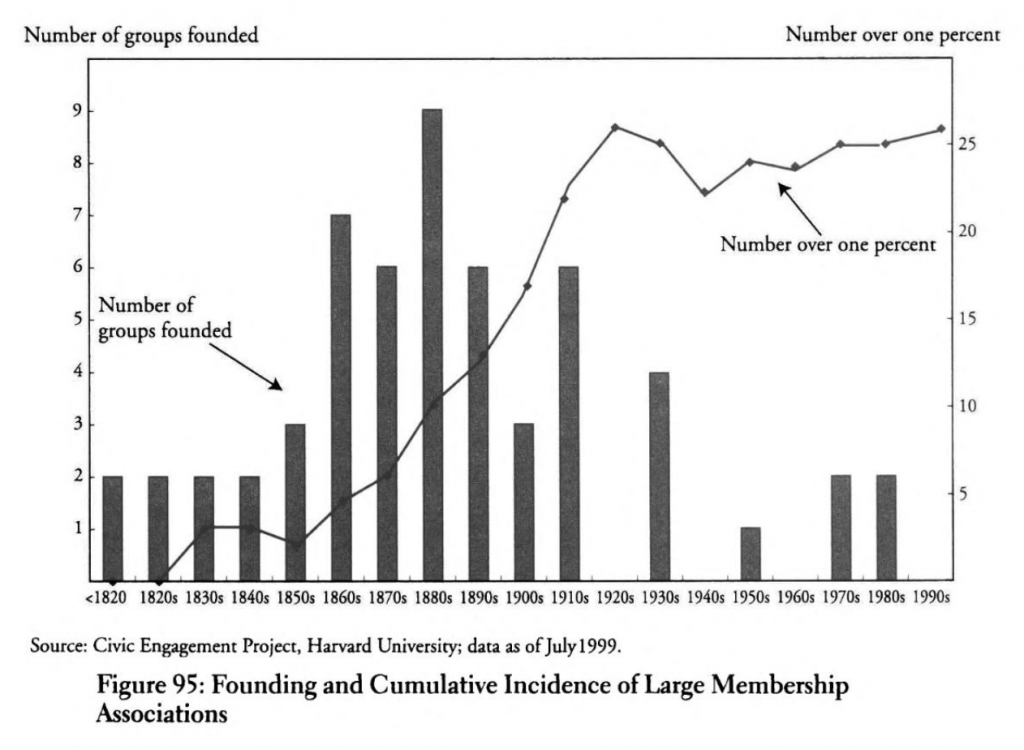
Putnam lists the actual associations by their date of founding. None were launched in 1918, but three came into being in 1919. I see little evidence that the pandemic affected associations, unless it caused a delay in foundings during the actual year of the flu. In 1920, Warren Harding won election on the promise of a “return to normalcy”–poor grammar but a pretty accurate prediction.

However, the civic life that Americans built in the early 1900s depended on small contributions, dues, or subscriptions (in the case of newspapers) from many ordinary people. As long as they had jobs, they could support the associations. Organizations seemed to have weathered any short-term loss of income.

In contrast, today’s civil society is heavily dependent on philanthropy from foundations and wealthy individuals and contracts with governments. Many 21st century nonprofits basically run as businesses with a small number of investors and lots of constituents who do not pay for their services. A market meltdown could easily kill them off. In an international survey conducted from March 24-26, 68% of nonprofits already report a decline in contributions.

I worry especially about the metropolitan daily newspaper, because I believe it was an interesting hybrid invented between 1890 and 1920. Newspapers were often very profitable thanks to advertising and wide reach. At their peak, they attracted more than 80% of households by providing a basket of goods–sports, classified ads, comics. Meanwhile, they served a civic function by presenting important news on the front page. They did not invest in reporting because it maximized their profits but because professional reporters and editors–“the press”–exercised some influence over the owners of newspapers. The resulting combination was valuable but vulnerable and already in steep decline by 2010. If the recession now kills the last surviving metropolitan daily newspapers, there is no reason to think that any functional equivalent will replace them.

See also: new research on “civic deserts”; The “civic state of the union”; Bowling Alone after (almost) 20 years; and the hollowing out of US democracy.

debating equity

In my public policy course today, my students took a short opinion survey that I created for them, with questions about the justice or injustice of a variety of circumstances. For instance:

  • Bob Iger, the CEO of Disney, was paid about $45 million last year. A customer service representative at Disney starts at $10.43/hour. Is this unjust?
  • A child raised in Lexington, MA can expect a much better education than a child raised in Lowell, MA, who can expect a much better education than a counterpart born in Jackson, MS, who (in turn) is likely to get much more schooling than a child born in Malawi. Are those gaps unjust?
  • Who has the responsibility to fix the Lexington/Jackson gap? If the gap between Lexington and Lowell persists, does that imply that Massachusetts voters hold unjust values or attitudes?
  • Most Amish or [Haredi] Orthodox Jewish children will grow up to have lower incomes and less advanced health-care than average Americans. Is this unjust? Are the Amish or Orthodox parents responsible for an injustice toward their children?
  • Was this (below) a bad thing to express?
  • Are people who object to David Geffen’s Tweet demonstrating the vice of envy?
  • If David Geffen self-isolated on his yacht but didn’t Tweet about it, would it be OK?

Many of the examples in my survey are derived from Tim Scanlon’s very useful article, “When Does Equality Matter?” ?

The survey’s forced choices generated a range of responses. In discussion, students offered more nuance.

You can take the survey yourself and then look at the aggregate responses.

See also defining equity and equality; sorting out human welfare, equity and mobility; college and mobility.

a different explanation of dispiriting political news coverage and debate

We are used to political news that is almost all about politicians criticizing each other, battling in the trenches over budgets and appointments, responding to crises, and positioning themselves for election or re-election.

These forms of politics are inevitable, but I don’t think it’s widely recognized how little governance actually takes place in our time. In some ways, petty debate has filled a vacuum left by a lack of real law-making, if that means getting elected with compelling platforms and then turning them into legislation.

Teaching a (virtual) classroom of undergrads this week, I realized that I could only think of four bills passed during my students’ two decades of life that have really altered the social contract. The Authorization for Use of Military Force (2001) launched 19 years of war. The USA PATRIOT Act (also 2001) changed law enforcement and surveillance. No Child Left Behind (2002) made measurement and testing more important in k-12 education, although it was actually a set of amendments to the basic framework of the 1965 Elementary and Secondary Education Act, some of which were relaxed again in 2015. And the Affordable Care Act of 2010 extended access to health insurance, albeit less dramatically than Medicare or Medicaid (1965).

Compare that list with what Congress passed (and the president signed) during the year 1965.

For the first few months of that year, Congress was presumably busy with committee work and markups. In April, it passed the Elementary and Secondary Education Act, for the first time getting the federal government involved with funding education and regulating schools in return for those funds. In July, Congress began requiring health labels on cigarette packages and regulating tobacco ads. Three days later, Congress established Medicare and Medicaid and entitled millions of people to government-funded healthcare.

August started with the Voting Rights Act, which arguably made the US into a democracy at last. Four days later, Congress established HUD and got heavily involved with urban development. Under the Public Works and Economic Development Act, also passed in August, Congress appropriated money for urban development.

September saw the founding of the National Endowment for the Humanities and National Endowment for the Arts, meaning regular federal involvement in culture. (The NEH also created the important national network of state humanities councils.)

October 1965 started with a law (the Hart-Celler Act) that permanently transformed the demographics of the United States by opening the country to mass immigration without the national quotas that had favored Europe. That was a big deal, but Congress also spent October passing major legislation against heart disease, cancer, and stroke; began to regulate automotive emissions; and passed the Highway Beautification Act, which is one reason our public roads are no longer lined with litter.

The year 1965 ended with the passage of the Higher Education Act, still the framework for federal involvement in college education; and the Vocational Rehabilitation Act.

I have chosen 1965 because it was a banner year, but I was tempted to mention 1964 instead. That was the year of the Civil Rights Act, the War on Poverty, Food Stamps, and the congressional authorization for Vietnam, among other bills. Imagine the TV news or newspaper headlines when every few weeks brought a transformative law.

The point is not that these laws were all good–their record is mixed and debatable. Nor that they were liberal; 1981-4 saw significant lawmaking in a conservative direction. The point is that they were highly consequential acts of governance, enacting new visions of how our country should function. No wonder reporters and voters often focused on substance.

To put it the other way, no wonder that reporters and voters rarely debate substance today. As many important bills have passed in 20 years as used to pass in a single month in the 1960s.

You could argue that we don’t need that pace of change any more, because our social contract is much closer to perfect than it was in 1960. You could argue that the reforms of that era created an administrative behemoth, and the best we can do now is to administer it competently. You could oppose the arrogant social engineering of the Sixties. Or you can decry today’s gridlock and blame it on partisan polarization, inequality, corruption, special interests, incompetence, propaganda, or a lack of civic virtue.

Regardless, I think you would expect an era marked by a lack of landmark legislation to be an era of tawdry politics. The tawdriness may be one reason for the stasis, but I suspect the causal arrow points the other way as well.

COVID-19 is not a metaphor

A quick search reveals scores of articles by people who, like me, have recently read or re-read Susan Sontag’s Illness as Metaphor (New York: Farrar, Straus and Giroux, 1977).

Sontag’s thesis is simple: “illness is not a metaphor, and … the most truthful way of regarding illness—and the healthiest way of being ill—is one most purified of, most resistant to, metaphoric thinking” (3). She adds, “The people who have the real disease are also hardly helped by hearing their disease’s name constantly being dropped as the epitome of evil” (85).

I would say: It is wrong to use sick people as assets in arguments, as new reasons for conclusions you already held. If you want to use a disease as a metaphor, ask yourself whether you would make that argument in a sick person’s hearing. If that would be cruel, don’t say it anywhere.

There is no such thing as a fact that is innocent of comparison and evaluation, no “writing degree zero” that lacks metaphor. But we can adopt an ethic of very close attention to known details about our actual fellow human beings, or we can venture into broader speculation

Sontag explores how “Illnesses have always been used as metaphors to enliven charges that a society [is] corrupt or unjust.” She shows that “to liken a political event or situation to an illness is to impute guilt, to prescribe punishment.” (72) But little actual insight comes from likening a moral or social problem to a disease, or vice versa. “Traditional disease metaphors are principally a way of being vehement” (83).

This is a warning against using the pandemic for rhetorical purposes. I am collecting examples for a short commissioned article of political theory that is mostly an argument against theorizing casually while people are suffering.

Sontag’s main examples are cancer and tuberculosis. She argues that they provided rich (but problematic) material for metaphor because their causes were unknown. Their mysterious etiology gave them rhetorical power. In contrast, everyone always understood that syphilis was an infection transmitted through sex, so it never worked as anything but a crude and direct trope. Since we basically understand COVID-19 already, maybe its rhetorical uses will be limited.

See also: on the moral dangers of cliché; on the proper use of moral clichés; and on the moral peril of cliché and what to do about it.


Massachusetts tax shortfall: up to $750 million this fiscal year

Declining tax revenues will likely cost our state about $500-$750 million during the current fiscal year, which ends on June 30. Over the next five quarters, the loss may reach $3 billion. I believe the total budget for the state is $43 billion, so that would be a 7% reduction–at a time of intense need.

The scale of this problem may not surprise anyone, but it’s important to be able to quantify it as a basis for smart policy. These estimates come from a new brief entitled “Estimating the Shortfall in Massachusetts Tax Revenues,” from the new Center for State Policy Analysis (cSPA) at Tufts University’s Jonathan M. Tisch College of Civic Life, where I work.

Trump’s polling bump in perspective

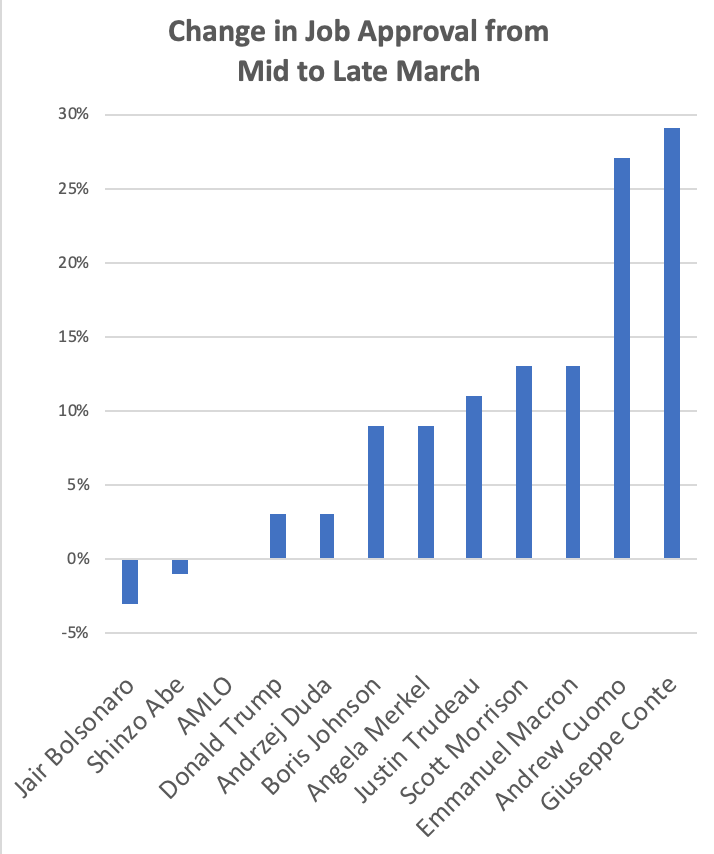
I’ve collected polls of France’s Emmanuel Macron (but this site shows less improvement for him); Italy’s Giuseppe Conte; New York’s Andrew Cuomo; Poland’s Andrzej Duda; and the UK’s Boris Johnson (the Tories now have their best support in the history of British polling). For Australia, Brazil, Canada, Germany, and Mexico, I am using Morning Consult polls from here. I take Trump’s approval rating from FiveThirtyEight. Countries with strong parliaments and weak executive branch leaders typically do not poll their national leaders often.

The graph below shows how various national populations rate their own leaders’ handling of the pandemic. (It is from the Canadian Broadcasting Corporation, hence the three Canadian leaders.) Note that Macron is rated worse than Trump on handling the virus but still gets a bigger bounce in approval polls.

a Green recovery

“We have a responsibility to recover better” than after the financial crisis in 2008, UN secretary general António Guterres warned. “We have a framework for action – the 2030 Agenda for Sustainable Development and the Paris Agreement on Climate Change. We must keep our promises for people and planet,” he added.

On this topic, I would yield to people who understand economics and the environment better than I do. I also recognize obstacles to making sure the recovery benefits the environment. (Will we have a recovery at all within a reasonable amount of time? Will the political elites in any important country allocate resources well?) But it seems worth discussing principles, because a decent outcome will depend on public pressure. We should decide what to demand.

I would propose four principles:

  1. The fiscal stimulus should be large and carbon-negative. Governments can and should spend heavily, because borrowing costs are extraordinarily low and social needs are critical. Once the pandemic ends, to the maximum extent possible, unemployed people should be paid to build and install renewable energy sources, to improve the power grid, to enhance public transportation (which will face a crisis of confidence in response to the pandemic), to restore natural resources, and to change agriculture.
  2. Bailouts should be carbon-neutral. I am not callous about people whose livelihoods depend on mining or drilling for carbon. But nowhere is it written that oil, gas, and coal companies deserve public subsidies, especially given the massive negative externalities of their industries. There is an immense amount of carbon underground and enormous incentives to extract and burn it. Our best hope is to cut the supply in the short term so that alternatives can become more affordable. Turmoil in carbon markets will have human costs, but also benefits. Thus: no bailouts for carbon.
  3. Financing should be equitable and carbon-neutral. I think the wisest macroeconomic policy is to borrow in the short term and pay it back with new taxes only later on–that’s the most stimulative approach. But we could negotiate an agreement now to pay it back later in a good way. That could mean phasing in carbon taxes along with highly progressive wealth taxes while permanently holding down income and payroll taxes for households with lower incomes.
  4. Spending should be planned and allocated in a participatory and deliberative way. This is not just a matter of justice or a way of generating civic benefits from the pandemic crisis. It is also an urgent practical need. Let’s say you want to build a new transit line to reduce carbon use. If a community organizes against it, it won’t go through. Also, people won’t ride the line unless it meets their needs, and transit without many passengers does no good for the environment. Therefore, effective spending depends on genuine support, which can be earned by creating opportunities for people to discuss and decide. Ideally, such discussions will also influence individuals’ decisions as workers, consumers, and investors, giving many people a justified sense that we are rebuilding the economy, and saving nature, together.

unveiling CIRCLE’s data tool

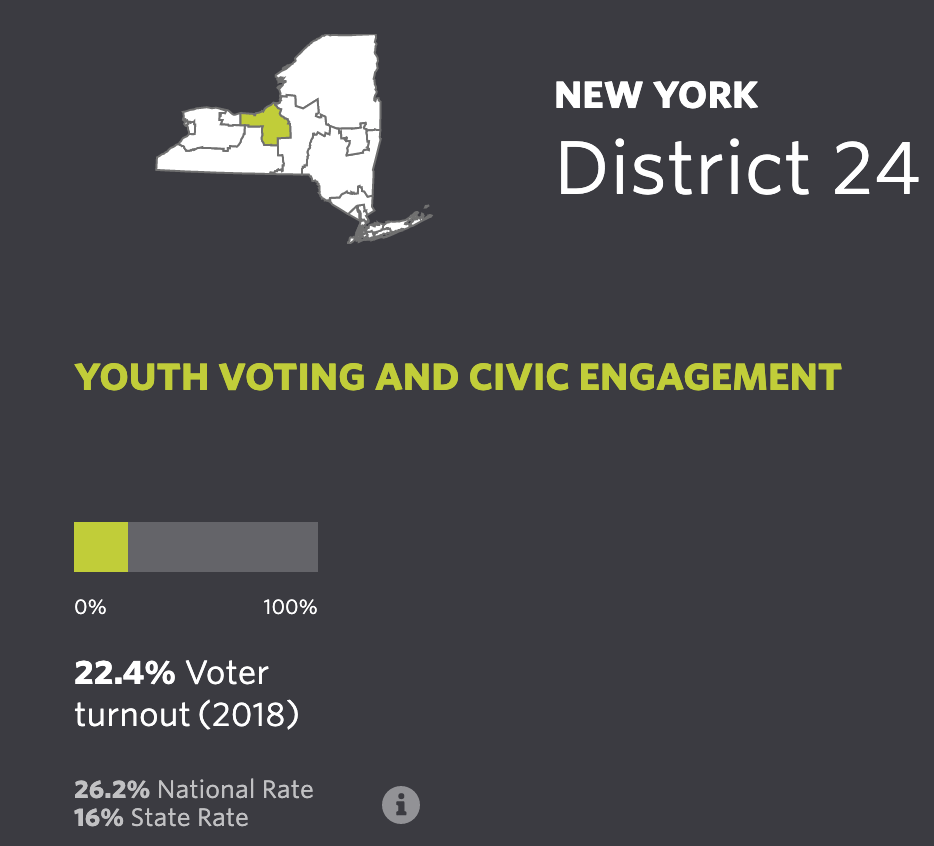
Although it’s hard to concentrate on politics right now, a massively consequential election is coming up, and today CIRCLE unveils a data tool that can help nonpartisan groups, partisan outfits, campaigns, and the media make smart decisions regarding young voters.

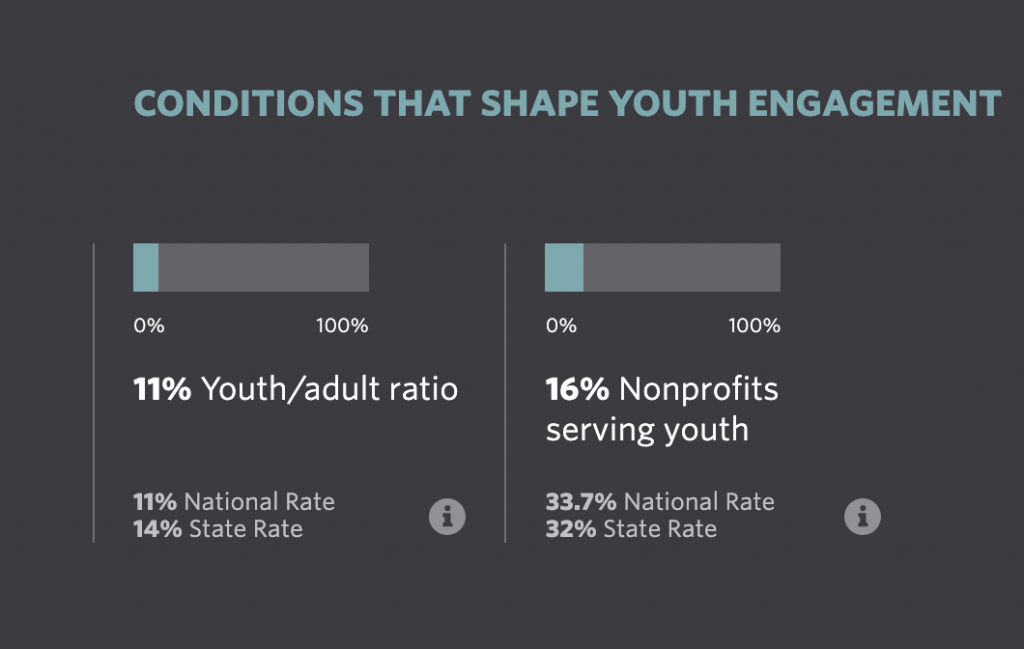
If you head to youthdata.circle.tufts.edu, you can explore youth registration and turnout, youth demographics, and an array of relevant civic factors for states and congressional districts over time–setting your own queries and seeing the results.

For instance, here is youth turnout in my hometown’s congressional district:

I also explored various underlying factors that might affect youth engagement in that district.

(The team has come a long way since the days when we’d generate a few charts and put them in a document that we expected people to print.)

mobilizing higher education against COVID-19

Tufts’ president, Anthony Monaco (an MD/PhD) has an op-ed in the Boston Globe calling on colleges and universities to deploy their resources to fight the public health emergency. He is not only talking about closing our campuses to reduce contagion or providing research and education for the public–although those are important contributions–but also about turning our dorms into quarantine centers and our college parking lots into “drive-through triage centers.” A longer list of highly tangible ideas is in his op-ed.

the virus, the election, and democratic theory

[It] seems to have been reserved to the people of this country, by their conduct and example, to decide the important question, whether societies of men are really capable or not of establishing good government from reflection and choice, or whether they are forever destined to depend for their political constitutions on accident and force.

Alexander Hamilton, Federalist 1

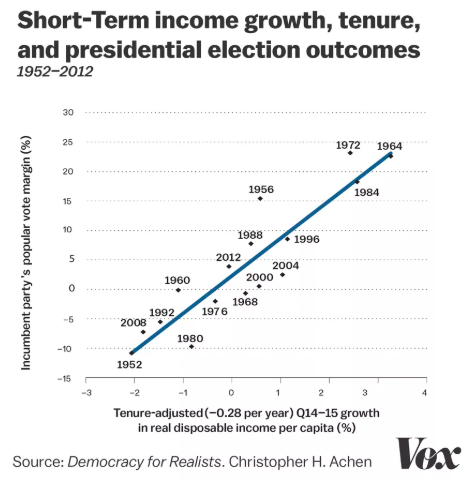
The answer may be “accident and force.” This graph, derived from Christopher Achen, shows an almost perfect correlation between presidential election results and economic growth during two quarters before the election, adjusted for how many years the incumbent party has held office. It implies that who wins the White House in November will depend almost entirely on what the COVID-19 virus does to GDP during this quarter and next. If the US economy manages 1.5% positive growth despite COVID-19, Trump should win. If it declines, he will probably be done, regardless of the Democratic nominee.

One should always be careful about correlation graphs with relatively small numbers of data points and carefully contrived axes. You can fish for combinations of variables that generate uncannily neat pictures. However, this graph shows the result that you would predict if you hold a theory of electoral politics that goes back at least to Joseph Schumpeter in 1942:

  • People have better things to do than follow politics closely, let alone form and test careful hypotheses about the impact of political positions on outcomes (holding other factors constant). Voters are not going to be rigorous social scientists.
  • Instead, voters will assess the most prominent political leaders of the moment by evaluating their own circumstances. They won’t only think about economics, and certainly not only about the nation’s GDP. However, GDP growth is a decent proxy for how well a whole population is faring in their everyday lives compared to last year.
  • People will judge politicians using other heuristics, such as partisanship, demographics, and ideological labels. These factors also determine what we hear or read about the world beyond our doors. (Watching the Fox News homepage during the COVID-19 crisis, as I have done, is an object lesson in ideological framing.) However, in a system like ours, two closely equal voting blocs with their own media networks will emerge as an equilibrium. Who actually wins any given election depends on the main variable that changes from month to month: GDP growth.

This is bad news for any theory of democracy that envisions millions of people deliberating about ideas and making choices. With Schumpeter, we might at least hope that a national election functions as a test of performance, rotating failures out of office. We would expect Trump to lose in November because things will go badly between now and then, and that will serve as a vivid test of his fitness for office, his allies in the media and Congress, and his ideology (nationalism), which has guided his response to the epidemic. The voters would demonstrate collective rationality by throwing him out.

The problem with that theory is the massive element of randomness. The signal can easily be lost in noise. If COVID-19 hadn’t hit now, Trump wouldn’t be seriously tested. If Hillary Clinton or Bernie Sanders were president now, the government’s public health policy would be better than Trump’s, but we would still face a global pandemic and probable recession. Then the signal would convey that neoliberalism or democratic socialism–not nationalism–was the failed ideology.

To make matters worse, politicians are systematically rewarded for the wrong things. Andrew Healy and Neil Malhorta show that spending (or not spending) money on prevention has no effect on electoral outcomes. However, relief spending is a big boost to an incumbent. This means that Trump may benefit from COVID-19 if things play out fortuitously for him. If we are in recovery by November and Trump is handing out stimulus relief, the crisis may carry him to reelection. In that case, not only would the public receive a false signal about his competence and ideology, but his policy of doing nothing to prevent a crisis would have been rewarded.

Should we therefore give up on democracy? I definitely think not, for these reasons (and I leave aside the tired argument that it is better than the alternatives):

First, all the models discussed above are based on political leaders who are plausibly competent and whose stances and worldviews put them in sync with close to 50% of voters. Trump has always risked not quite meeting those criteria. Up to now, his approval ratings have been well below what you would expect for an incumbent presiding over historically low unemployment. If he were to lose because his statements and policy choices have alienated a significant minority of voters who would have voted for him otherwise, then we’ll learn that national elections at least serve to weed out true losers. Four years too late, but better now than never.

Second, it matters which groups coalesce into the two large blocs of active voters. Those groups are better served when their side wins. Therefore, it matters which citizens we engage and motivate to vote.

Third, a national election, although important, is an outlier among all forms of politics. It is episodic and short-term. Millions of people participate, each having a microscopic impact. It is entirely mediated, since only a tiny proportion of us actually know the candidates. Given our electoral system, it is filtered through a party duopoly.

Local politics can be much better. So can national politics, over a longer time-span. Consider the improvement in mainstream attitudes toward sexual minorities in the US, which affects the stances of presidential candidates as well as many other aspects of our society. That, too, is politics: the result of advocacy, organizing, discussion, and learning. Our expectations for self-governance should be much higher than our expectations for presidential elections, where we must hope that Alexander Hamilton’s “accident” is benign.