Navigating the Pandemic webinar series

Tisch College of Civic Life is launching an eight-part weekly webinar series this summer aimed at supporting students, including the Class of 2020—and the Tufts community generally—during the COVID-19 pandemic.

Navigating the Pandemic: Knowledge, Resilience, Civic Purpose and Engagement will be offered on Wednesdays, 11 a.m. to 12:30 p.m. ET, starting June 10. It draws on the expertise of Tisch College faculty and staff, Tufts faculty in a variety of academic disciplines, and experts from Boston-area universities, hospitals, and community nonprofit organizations.

“We have developed this webinar series to help mitigate the sense of isolation and unsettledness many students are experiencing,” said Deborah Donahue-Keegan, Tisch College senior fellow and Department of Education faculty member. She is leading the effort with Tisch associate dean Peter Levine.

“We are offering a way for students to stay connected to the university community and to each other over the summer,” she said. “We also want to help students acquire more knowledge and skills in order to navigate conflicting information and misinformation regarding COVID-19.”

“The pandemic is confusing and unpredictable,” said Levine. “For some, it can be isolating, damaging, and even tragic. As a major research university, Tufts offers a wealth of resources to learn about the disease and its social impact and how to take care of ourselves, help others, and be civically engaged during the pandemic.”

Webinar topics will include:

  • emotional resilience in the face of trauma and uncertainty
  • civic engagement and voting
  • dispelling COVID-19 misinformation with science
  • the public policy and economic implications of the pandemic
  • physical health and nutrition
  • building and maintaining connections

The weekly seminars for undergraduate and graduate students are free. Those who attend at least six of the sessions and submit responses to questions at the end of each session attended will qualify for a certificate of completion. The panel discussions will be broadcast via Tisch College’s YouTube channel and will be recorded to ensure access for the entire Tufts community.

“This effort reflects Tufts’ commitment to promote social emotional resilience and well-being skills across the university,” said Donahue-Keegan. “This webinar series is one of many ways we strive to foster the development of such skills in service of fostering civic purpose, agency, and ethical civic engagement.”

For more information and to sign up, go to https://tischcollege.tufts.edu/navigating-pandemic-knowledge-resilience-civic-purpose-and-engagement.

the pivotal significance of reparations for the American left

About one in four Americans supports reparations for slavery. There is a racial split on that question, with up to three in four African Americans–but only 15% of whites–in favor.

If you think that justice demands reparations, you should support them. You might not make reparations your main criterion for choosing candidates in a given political contest, because you might vote on other grounds, but you should endorse proposals that you believe are just.

Here I want to address a different issue. I’ll offer an explanation (not a justification or a critique) of the importance of reparations in the mentality of left-leaning Americans.

I think that many Americans on the left are torn between two political positions, each coherent on its own but in tension with the other:

1. A strong version of New Deal/Great Society liberalism and/or social democracy, in which the nation-state intervenes assertively in the economy to promote equity and environmental sustainability. This stance is compatible with enthusiastic support for voting and democratic processes. It requires a lot of trust in the state and a willingness to entrust state actors with the ability to, for example, investigate how much wealth (not just annual income) you have, which schools your kids will attend, and which health treatments will be paid for, given data about your body.

Martin Luther King, Jr., provides a classic statement of this view when he recalls the launch of the Great Society: “A few years ago there was a shining moment in that struggle. It seemed as if there was a real promise of hope for the poor — both black and white — through the poverty program. There were experiments, hopes, new beginnings.”

2. A deep suspicion of the United States government as white-supremacist, patriarchal, and colonialist: as a continuous entity that has played a leading role in genocide, enslavement, and apartheid, in part because those policies have sometimes been popular among the white majority of the country.

It’s debatable what positive program follows from the second position, but in practice, it can mean support for local initiatives, nonprofits, women- and minority-owned businesses, and autonomy at the neighborhood level. Malcolm X provides a classic text for this view:

The white man, the white man is too intelligent to let someone else come and gain control of the economy of his community. But you will let anybody come in and control the economy of your community, control the housing, control the education, control the jobs, control the businesses, under the pretext that you want to integrate. 

… we haven’t had sense enough to set up stores and control the businesses of our community. … But the political and economic philosophy of black nationalism…the economic philosophy of black nationalism shows our people the importance of setting up these little stores, and developing them and expanding them into larger operations. Woolworth didn’t start out big like they are today; they started out with a dime store, and expanded, and expanded, and expanded until today they are all over the country and all over the world and they getting some of everybody’s money. …

So our people not only have to be reeducated to the importance of supporting black business, but the black man himself has to be made aware of the importance of going into business. And once you and I go into business, we own and operate at least the businesses in our community. 

Note that this position is compatible with certain forms of libertarian thought but not with social democracy.

It is not embarrassing to be drawn to two incompatible views. The social world is complicated, and there are good reasons in favor of many positions. However, when you feel the pull of two incompatible ideas, a deciding factor becomes very important.

Reparations play that role for the American left. If the United States government were to pay reparations, that would tilt many left-leaning people from the second position to the first: from Malcolm to Martin, if those labels are helpful. The impact would be especially strong if Congress and the president decided to pay reparations of their own volition–not by grudgingly negotiating with a social movement–and if the payment were substantial.

The underlying theory here is similar to Homer-Dixon et al (2020). An ideology is a complex system that consists of numerous ideas with logical links among them. It cannot be described adequately by placing it on one left/right spectrum, nor even several such continua at once. It is not a point in logical space but a structure of ideas.

In complex systems, we frequently see multiple equilibria, and specific nodes have surprisingly large impact because of their location. A single node can tilt the system from one equilibrium to another.

My conjecture is that reparations plays such a role in the system of the ideology of the American left. Left-leaning people may not rate it as the most important issue. They may not even endorse it whole-heartedly. But it (perhaps uniquely) can tilt them from a libertarian equilibrium to a social-democratic equilibrium.

This is an empirical conjecture for which I do not have data. To test it, we would have to explore the epistemic network of left-leaning Americans, either by analyzing large bodies of text or by surveying individuals about their ideas and perceived connections among their ideas.

See also: on Hillary Clinton and Julius Jones of #blacklivesmatter; ideologies and complex systems; and unveiling a systems map for k-12 civic education (for a methodological analog).

the Biden-Trump polling gap

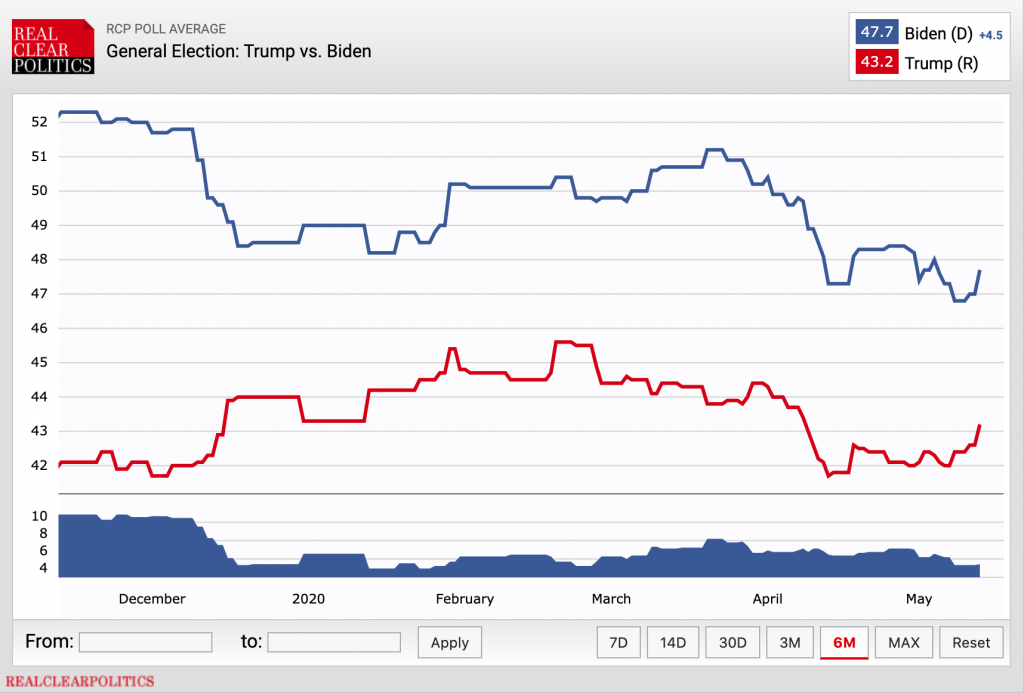
I have been watching these lines for months:

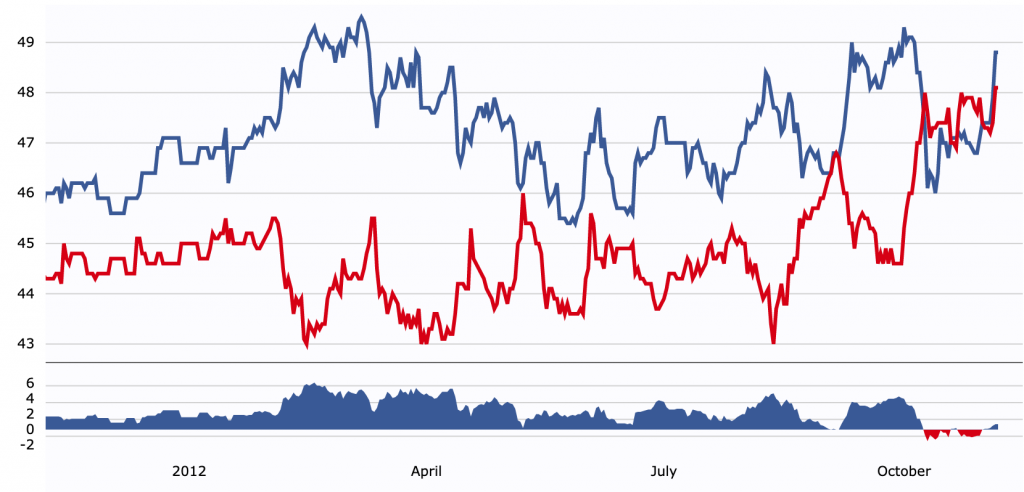
The gap is very steady, which means that every time Trump moves up, so does Biden–at the expense of undecideds–and vice-versa. By way of contrast, this is how the 2012 election looked:

Granted, the scale is even tighter in the 2012 graph than in 2020, and the length of the trend is longer. Still, we saw points when the lines converged, crossed, or moved apart.

Likewise in 2016:

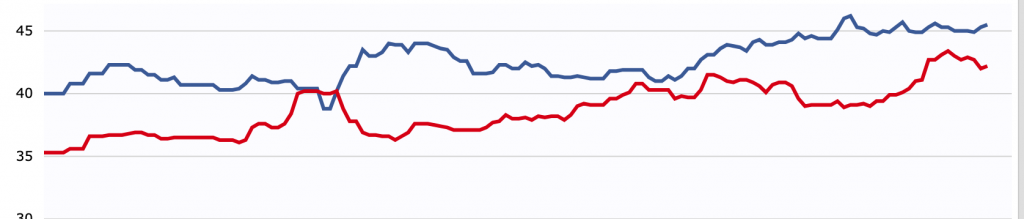
Or 2008, according to Gallup’s polling:

Henry Enten does better and compares Biden/Trump 2020 polling to historical trends going back to the beginning of polling. He says, “The steadiness in the polls is record breaking. Biden’s advantage is the steadiest in a race with an incumbent running since at least 1944.” Enten adds: “all the [national] polls taken since the beginning of 2019 have [Biden] up 6 points.” He means an average of six points, but that has a small standard deviation. The Real Clear Politics chart, reproduced above, suggests that the full range has been 4-10 points.

The consistency of this gap is noteworthy in an extraordinarily tumultuous period, marked by impeachment, a competitive Democratic primary campaign, a global pandemic, and the worst economic decline since 1929. Donald Trump’s own support has risen and fallen–although only within a five-point range. Biden has had his own ups and downs: near defeat in the primary, a serious accusation of sexual impropriety. Yet the gap between the candidates has been virtually unchanged since December.

Polls this far out are not necessarily very predictive. National polls don’t map exactly onto Electoral College outcomes. Polls conducted now include all adults or self-described “registered voters”; actual voters will be a subset of those. Turnout in 2020 is particularly hard to predict given the practicalities of voting in what may still be a pandemic.

But all these caveats are about whether the graph foretells the result in November 2020. Even if it doesn’t, it tells a very interesting story about now. As Matthew Continetti writes

It is not foolish to suppose that these world-shaking events would affect the presidential election. On the contrary: One would expect a dramatic swing toward either the incumbent or the challenger. But look at the polls. Not only has there been no big shift. There has been no shift. … Neither good nor bad news has an effect.

I think that almost all Americans have formed such firm and well-anchored beliefs about both Trump and Biden that even epoch-making events don’t shift us. We already have enough information to judge these men, whatever the news throws at us. By six percentage points, we like Biden more than Trump.

(By the way, Biden also leads in battleground states’ averages: by 3 points in WI and NC, by 4 in NV and FL, by 7 in PA and NH, and by 8 in Michigan. That would bode well for an Electoral College win, if we want to get into forecasting November.)

the neo-feudalism thesis

A little knowledge is a dangerous thing. I’ve superficially encountered the terms “neo-feudalism” and “refeudalization” and read a few relevant works, e.g., Jodi Dean’s “Neofeudalism: The End of Capitalism?” in the May 12 edition of the LA Review of Books and Robert Kuttner’s “The Rise of Neo-Feudalism” in the March/April American Prospect. I know my Habermas (who proposed a thesis about neo-feudalism in 1962 that still attracts attention). Years ago, I made a somewhat serious study of actual feudalism as I tried to understand and assess Karl Polanyi’s The Great Transformation. But I have missed everything else in this debate–so caveat emptor.

The basic idea is that capitalism has not continued as such, nor has it transformed into socialism, as the Marxian left predicted. Instead, it has morphed into a new system that resembles feudalism in important respects. If this is true, it means that the left should stop opposing neoliberalism or late capitalism, because those are not the reigning systems of the day. And the center-right should stop defending capitalism, because it’s gone.

Definitions would be helpful. I start with these:

A market is any venue in which individuals choose whether or not to exchange goods or services that they own for things that other people own. Markets seems almost ubiquitous–for example, they are found in communist states, inside bureaucracies, and in a huge range of cultures. Market choices are never without constraint and necessity. Nevertheless, it is a mistake to doubt the genuine experience of choosing whether or not to exchange what you own for something you want.

Feudalism–at least in its European medieval version–was a political/economic system in which land represented the vast majority of wealth and was not actually understood as marketable. Although people sometimes traded land for land or land for goods, such exchanges were frowned upon and made difficult. Most people were born with an inalienable link to a specific place. Whether you were a peasant, a lord of a manor, a higher lord, or a sovereign, you had both obligations and rights with respect to particular acres. Your name even incorporated that place: you were from it if you were a commoner, and of it if you were gentry. The gentry did not own demesnes as they owned carpets and tables; they held their places as their “seats.”

Rights and obligations were massively unequal; feudalism was hierarchical. However, a peasant had inalienable rights (e.g., to take firewood from the manor’s commons); and even the king had many feudal obligations. Status came in shades and degrees.

Meanwhile, government in the Weberian sense–the legitimate use of violence–was profoundly decentralized. The lord of the manor was a landlord but also the law. The king was a higher law but had very little capacity for governing anyone outside the royal court itself, unless assisted by feudal vassals who had interests of their own. Parliaments emerged as places where sovereigns bargained with local leaders (lords, bishops, and towns) because they could not govern on their own.

Capitalism is a system in which the most important assets are heavily “capitalized”: subject to investments that make them highly productive. Although farms can be capitalized, the classic example is a factory or manufacturing plant. Thanks to concentrated physical, intellectual, human, and social capital, a factory produces an impressive flow of goods. Because it is complex, it requires a bureaucracy to operate. Therefore, a capitalist economy requires firms, not just individuals coming to market with things they privately own.

As a matter of definition, capitalism involves investment in these productive assets. Some people can live from the proceeds of such investments. Other people are paid to work in a capitalized industry. That distinction produces two classes (at least in Marxian theory–in reality, lines may blur).

Capitalism is incompatible with feudalism because feudalism’s refusal to allow a market for land and agricultural labor prevents investment. Also, capitalism cannot operate efficiently when governance is decentralized in the way we see under feudalism, with many independent rulers wielding legitimate force and making discretionary decisions in their various domains.

Capitalism is, however, compatible with a range of political institutions. The US republic, the Austro-Hungarian Empire, and today’s one-party People’s Republic of China have all been capitalistic. Capitalism can certainly co-exist with political systems that involve equal legal rights, democratic elected governments, and even social welfare systems. In fact, some people think that the most robust and sustainable capitalist systems (for better or for worse) are also democratic, liberal, and at least mildly socialistic.

It would appear that a world dominated by Google, Facebook, Apple, Airbnb, Uber, and the like is still capitalistic. It certainly isn’t feudal in the classical sense, with barriers preventing people from exchanging the most important goods and with inherited status prevailing over contracts. But it might have certain features that make it different from high capitalism and might dimly resemble feudalism.

First, the capitalism that Marx and Engels observed involved great masses of people working in the most productive firms. These workers constituted the proletariat. Today, the most powerful companies in the world don’t employ many people. Google has 118,000 employees and about $1 trillion in market capitalization (measured before the current downturn). That approaches $10 million in capital per employee.

Imagine that Manchester, England, had become the powerhouse of the British Empire with cotton mills that employed … a few hundred workers in total. Engels would have needed a different theory.

To put it a different way, in 1850 it seemed as if most people were being recruited into the “armies” of workers who labored for the most important firms in the world. In 2020, a minuscule proportion of the world’s labor force is employed by the biggest companies.

Second, we are “governed” (in the full sense of that word) by a whole set of overlapping and decentralized rule-makers. Nation-states make rules, but so do companies. They establish and enforce elaborate terms that regulate their employees, contractors, and customers. Kuttner provides examples:

Gated residential communities, such as Disney’s Celebration, are privately controlled municipalities that make and enforce their own laws. Private mercenary armies, such as Blackwater (now rebranded as Academi), are hired by the Pentagon so that their “soldiers” will be less accountable for what might otherwise be war crimes. Eminent domain, the inherent public prerogative to claim private property for a public purpose, has been commandeered by private developers. And courts—the ultimate embodiment of law in a democracy—have been privatized by the vast expansion of compulsory arbitration.

Speaking for myself: I am OK with polycentrism, with layers and overlapping Venn diagrams of power. I believe very strongly in pluralism or a mixed economy, in the sense of a society that incorporates different kinds of institutions, with different logics and incentives. I am not a statist socialist, because I observe that systems in which the nation-state monopolizes power simply enrich the rulers and their families; they do not deliver the equity they promise. It is no coincidence that the sons of Chinese revolutionaries are now capitalist princelings.

Therefore, the very fact that centers of governance have proliferated doesn’t bother me. But one question is whether centers of governance have actually consolidated instead of ramifying. Whereas millions of firms previously established law-like rules within their own domains, now Google makes rules for billions of people. From a global perspective, the fact that most of the world’s most powerful organizations have headquarters on the coast of the USA between San Jose and Seattle is also a worrying sign of concentration. These firms may compete, but their cultural capital, norms, and social networks overlap.

Another question is whether we have preserved robust forums in which to debate whether power has been allocated appropriately. (Surely not.)

A world with consolidating centers of power and a weak public sphere doesn’t sound to me like feudalism, but like something new and bad.

See also: the oscillation between dictatorship and parliamentary institutions (a game theory model); why is oligarchy everywhere? and why is oligarchy everywhere? (part 2); Thomas Jefferson and Thomas Picketty; the gentry as caste and class; when chivalry died; China teaches the value of political pluralism; and how a mixed economy shapes our mentalities

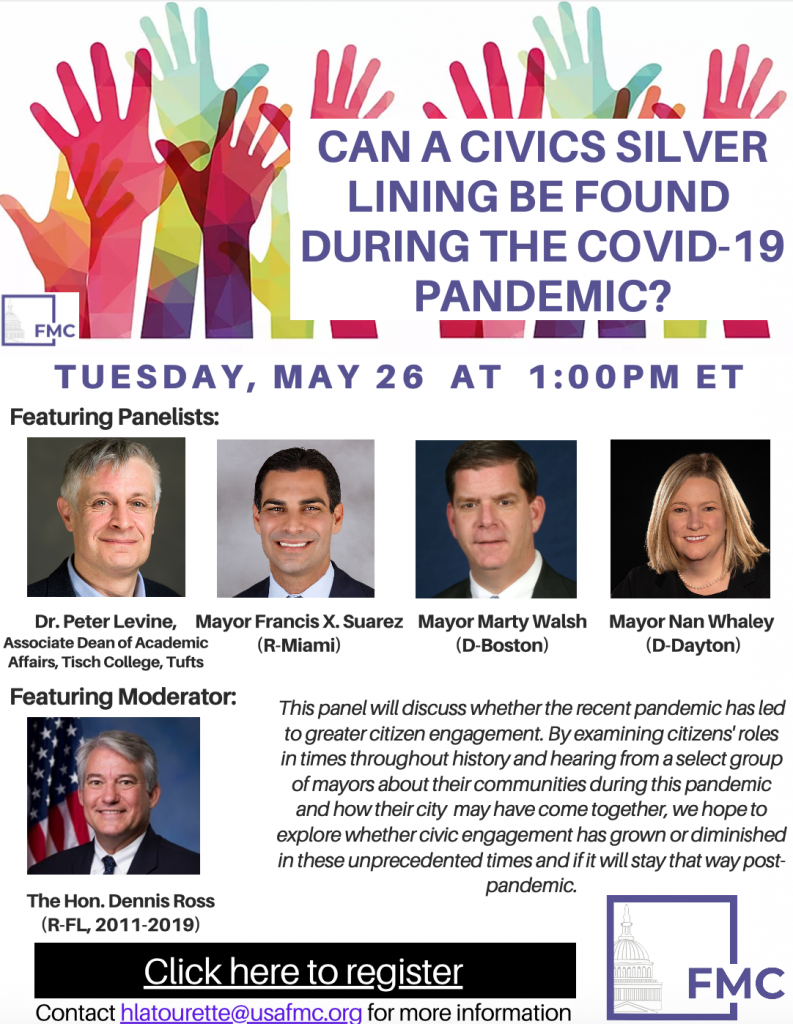
Educational Equity During a Pandemic

In lieu of a post here today, I have an article up on the American Federation of Teachers’ Shanker Institute blog, entitled “Educational Equity During A Pandemic.” It begins:

My wife and I have each spent many hours teaching by video this spring. While sitting in the same house, I meet online with college students who attend a selective private university; she meets with 5-to-9-year olds in an urban public school system, helping them learn to read. 

Both of us think and worry about equity: how to treat all students fairly within our respective institutions and across the whole country (even the world). And both of us discuss these issues with our respective colleagues. I suspect that many other educators are similarly wrestling with the challenges of teaching equitably while schools are closed. 


I hope it may have some value for people currently teaching remotely (at any level) or for parents and other adults concerned about education while schools are shut.

where the youth vote will matter the most in 2020

CIRCLE is out with the 2020 YESI (Youth Electoral Significance Index). It identifies the House and Senate races and states where the youth vote will make the most difference to the 2020 election.

For instance, the graphic shows the top-10 House races in the YESI.

The YESI page also explains why these states and districts will matter, which can be useful guidance for analysts, observers, and political actors.

Every young person should vote. Parties, candidates, interest groups, and election officials should encourage youth voting everywhere. Reporters should cover the youth vote as a news story everywhere.

That said, political realism dictates that all these players will concentrate their attention and resources where it matters most to electoral outcomes. Informing them can increase their net investment in youth voting, with benefits for democracy. Hence the YESI, which proved influential in 2018.

science, UFOs, and the diminishment of humankind

The apparently intentional release of Navy videos showing strange flying objects has prompted discussion of UFOs in respectable places like Vox and Bloomberg. I don’t take the news very seriously, although I do agree that the videos are interesting artifacts and people should be able to explore all intelligible hypotheses about them, including ones that involve visitors from other planets. There should be no UFO taboo.

I’m thinking instead about the moral significance of the hypothesis of alien visitors and how that fits into the history of science. What aliens think about us would be entirely contingent on them. They might admire us, condescend kindly to us, ignore us, or view us as food. From our perspective, their stance would be entirely random. Even if the first group of alien visitors happened to be disarmingly appreciative, the next batch might decide to spray us like a nest of termites. Whatever we happen to think of ourselves as a species would have no relationship to what they think of us. Their attitude would depend entirely on what kind of creatures they were. Arrogant technocrats? Intergalactic manatees, browsing peacefully through space without a hint of aggression? Simply hungry?

Most human beings have believed in gods or a god of some kind. Our theories of the divine have varied; by no means all divinities have been seen as perfect or even as particularly good. But a common thread is their interest in us. Whether they are prone to fall in love with some of us, or give us laws, or sacrifice their only-begotten Son to save us, they seem to care about people. Although one style of religious rhetoric reminds us to be humble, trembling in the sight of a just God, a simultaneous implication is that the divine has turned its face to us and cares what we do. Therefore, most religions–Buddhism perhaps offering an important exception–have emphasized the importance of human beings even as they have compared us to something better.

Many scientists are also religious, yet science can be seen as a break with the elements of religion that tend to build us up. It investigates nature as a domain without purpose, in which each event occurs because of the events before it–not in order to accomplish any independent end. Facts are distinct from values, and only hypotheses about facts are testable. We are part of nature, determined by efficient causes that could be understood without any reference to values. Science presumes that nature exists independent of our intelligence and seeks to purge human subjectivity from our understanding of nature.

In all these ways, science tends to diminish the human. In 1963, Hannah Arendt wrote: “To understand physical reality seems to demand not only the renunciation of an anthropocentric or geocentric world view, but also a radical elimination of all anthropomorphic elements and principles.” It therefore undermines the idea “that man [sic] is the highest being we know of.” The idea of superiority is “alien to the scientist, to whom man is no more than a special case of organic life and to whom man’s habitat — the earth, together with earthbound laws — is no more than a special borderline case of absolute, universal laws, that is, laws that rule the immensity of the universe.”

She had in mind at least several epochal events that were recent when she wrote. Physicists had discovered laws and processes that allowed them to build weapons that could destroy human life on earth. Computers had begun to “supplant and enlarge human brain power.” And human beings had left the earth and taken pictures of it.

She was also concerned that physics had revealed truths about nature that were deeply counterintuitive, thus severing the traditional link between ordinary experience and the refined experiences achieved with scientific instruments and methods. However, the “the lost contact between the world of the senses and appearances and the physical world” had been restored in the most horrible way, when the insights of theoretical physics had enabled massive terrestrial explosions.

Arendt doesn’t mention the Shoah in this essay. For her teacher, Heidegger, Auschwitz demonstrated the evil of technology and what we might call a scientific view of the world. But that was itself an evil theory, since the cause of the Holocaust was actually Nazism, with which Heidegger was complicit. Arendt carries forward some of his deepest ideas about science and nature but avoids or evades this particular application of his theory.

She considers the idea that our quest for truth dignifies us–that science boosts our stature by making us the great discoverers. However, she says,

man, insofar as he is a scientist, does not care about his own stature in the universe or about his position on the evolutionary ladder of animal life; this ‘carelessness’ is his pride and his glory. The simple fact that physicists split the atom without any hesitations the very moment they knew how to do it, although they realized full well the enormous destructive potentialities of their operation, demonstrates that the scientist qua scientist does not even care about the survival of the human race on earth or, for that matter, about the survival of the planet itself. 

For her, space travel does not show that human beings can expand our knowledge and escape our limitations. It rather exemplifies the way we have turned everything we experience into products of our science:

The astronaut, shot into outer space and imprisoned in his instrument-ridden capsule where each actual physical encounter with his surroundings would spell immediate death, might well be taken as the symbolic incarnation of Heisenberg’s man — the man who will be the less likely ever to meet anything but himself and man-made things the more ardently he wishes to eliminate all anthropocentric considerations from his encounter with the non-human world around him.

It can certainly be argued that the progress of science makes us humble in a good way. We are part of nature, not uniquely valuable but deeply integrated and interdependent. Therefore, we should start treating our natural environment with more respect. The problem, however, is that science demonstrates its success even as it avoids any intrinsic values, including the value of nature or human beings. The “should” in the sentence, “We should start treating …” makes no sense for science.

Arendt thought that space travel would bring the end of our respect for ourselves, because we would be able to view ourselves explicitly and literally as science has always implicitly understood us.  “If we look down from this point upon what is going on on earth and upon the various activities of men …, then these activities will indeed appear to ourselves as no more than ‘overt behavior,’ which we can study with the same methods we use to study the behavior of rats.” Technology will no longer appear “as the result of a conscious human effort to extend man’s material powers, but rather as a large-scale biological process” (quoting Bohr). If our technology is destroying the environment that sustains us, science will explain why that outcome is biologically determined without supplying any reason for us to stop it.

I would suggest that space travel did not reorient us as much as Arendt expected, partly because it has proven rather disappointing. No colonies on Mars 57 years after her essay. But the thought-experiment that aliens are flying around our earth–and the argument that we ought to study them scientifically–this captures the moment when “the stature of man would not simply be lowered by all standards we know of, but have been destroyed.”

See also: notes on the social role of science: 1. the example of fetal ultrasounds; is science republican (with a little r)?nature includes our inner livessome thoughts on natural lawis all truth scientific truth?; and the laughter of the gods.

New Report: Massachusetts elections in the shadow of COVID-19

MEDFORD/SOMERVILLEMass. (May 6, 2020)—To bolster participation and keep voters safe in 2020, Massachusetts needs to quickly redesign its voting system, according to a new policy report from the Center for State Policy Analysis (cSPA) at Tufts University’s Jonathan M. Tisch College of Civic Life. The report, titled “Preparing for elections in the shadow of COVID-19,” details the essential decisions and difficult choices facing the Commonwealth as it responds to the challenge of holding elections during a pandemic.

Key findings:

  • Demand for absentee voting and vote-by-mail will likely be enormous, requiring dramatic upgrades to state and municipal capacity. Centralizing parts of this process could help alleviate the burden on cities and towns and reduce the risk of local bottlenecks.
  • There is no definitive answer to the question of whether Massachusetts should automatically send absentee ballots to all registered voters, only a complex balance between expanded opportunity and election security.
  • Keeping the voter registration period open longer—or allowing election day registration—would help offset the disruptions COVID-19 will have on field operations and traditional registration drives.
  • Polling places need to remain open as an option for all voters, including those with unstable housing, individuals with serious disabilities, and black and Hispanic voters, who have historically shown a preference for in-person voting. Allowing early voting for the September primary could also improve access.
  • The cost of necessary changes could be substantial, particularly for cities and towns. However, Massachusetts has access to significant federal funding for voting access, including a large amount of unused money from the 2002 Help America Vote Act.
  • Keeping voters informed of these changes will require a concerted communications campaign.  Young voters, including college students, may benefit from robust partnerships connecting election officials with universities, educators and youth-serving organizations.
  • The COVID-19 crisis makes Massachusetts susceptible to other risks, and contingency planning needs to account for the threats of voter suppression, disinformation and more.

Read the full report here.

“We have four months until the September primary,” said Evan Horowitz, executive director of cSPA. “These kinds of system-wide changes take time—whether it’s recruiting poll workers from less vulnerable populations or reorganizing operations to accommodate the projected spike in absentee voting.”

”Now is the time to closely consider and enact changes to the Commonwealth’s election procedures to ensure that all voters, including young people voting for the first time, can safely and securely participate in the 2020 primary and general elections,” said Alan Solomont, dean of the Tisch College of Civic Life. “While there are many legislative, regulatory and financial considerations, we also must be ready to deploy innovative partnerships—between state and local officials, universities, schools, non-profit organizations, and the media—to ensure that Massachusetts’ voters have access to clear and reliable information about voting.”

In developing this report, cSPA was aided by a number of election experts, including Kei Kawashima-Ginsberg, Director of the Center for Information and Research on Civic Learning and Engagement at Tisch College, and Brian Schaffner, Newhouse Professor of Civic Studies at Tufts.

In the coming months, cSPA plans to release:

  • An analysis of the Transportation Climate Initiative, which would establish a regional cap-and-trade system covering emissions from cars and trucks; and,
  • Research on the projected impact of the fall 2020 ballot questions, potentially including right to repair, nursing home reimbursement rates, expanded sales of beer and wine in food stores and ranked-choice voting.

A Civic Green New Deal

In a new paper from Tisch College entitled “The Civics of a Green New Deal,” Carmen Sirianni proposes civic strategies to address the climate crisis. A “civic” approach means engaging citizens and a wide range of organizations in planning, negotiation, and coordinated action.

Below is a preface that I wrote. The whole document is on the Tisch College site.

Command-and-control regulation and taxing-and-spending will not suffice [to address the climate crisis]. To see why, consider the example of public transportation. If more people made more use of trains, we would burn less carbon and could mitigate local effects of climate change by shifting commuting and development patterns to better locations. Public spending is necessary for this purpose, but it is insufficient. To help the climate, large numbers of people must actually use new public transportation options. If many residents oppose construction, they will block or delay public works projects in their own backyards. On the other hand, if people have a say in where and how the money is spent, their input will help to ensure that new transportation is genuinely popular and heavily used. People who are involved in the public effort are also more likely to adjust their purchases, business decisions, and volunteering to benefit the environment.

Addressing the climate crisis is all the reason we need to make a Green New Deal civic. Sirianni offers much advice, based on decades of experience and research, about how to incorporate public involvement in such large-scale efforts. For readers who are primarily concerned about the environment, his paper speaks for itself.

I will, however, add another reason to support a civic version of the Green New Deal. Like the environment, democracy faces deep challenges globally, arguably amounting to a second crisis. Freedom House has “recorded global declines in political rights and civil liberties for an alarming 13 consecutive years, from 2005 to 2018. The global average score has declined each year, and countries with net score declines have consistently outnumbered those with net improvements.”[1] Many powerful and influential countries are authoritarian (e.g., China) or have moved from democracy toward authoritarianism (e.g., Brazil and India). Public opinion data from many countries, including the United States, reveals disaffection with liberal and democratic values and growing support for authoritarianism.[2]

Two responses are widely considered and promoted. One is to reform the processes or systems of democracy in a given country: how elections are financed, how electoral districts are drawn, how rights are defined and enforced, how corruption is investigated and punished, and related topics. The other response is to support political movements, parties, and candidates who honor democratic principles while they also effectively address concrete problems that matter to large constituencies, such as recessions, inequality, violence—or, indeed, climate change.

Both responses are appropriate and worthy, although the details vary in each country (and each US state). But there is also another way to strengthen democracies. Citizens need opportunities to address crucial problems together. They need the skills, encouragement, and support to be part of improving their own communities. They must work together across demographic and partisan divides and with various kinds of institutions and professions. Such opportunities generate support for democratic political systems. In their absence, we can expect alienation and polarization that weaken democracy.

The original New Deal was designed to address an economic crisis. The unemployment rate reached 24.9% in 1933. That was the main—and perhaps a sufficient—rationale to launch massive public works programs, just as the climate crisis is the main reason for environmental programs today. But the original New Deal also helped to save democracy at a time when most of the world was governed by dictators or foreign empires. Americans gained a sense of agency, optimism, confidence, loyalty to democratic institutions, appreciation for differences, and public purpose by serving in or cooperating with New Deal programs like the Works Progress Administration (WPA). Many WPA projects explicitly extolled democracy in innovative and compelling ways that still resonate today.[3] The Civilian Conservation Corps (CCC) not only gave productive employment to the same demographic group that was a bulwark of fascism in Europe—unemployed young men without college educations—but also offered a nonpartisan curriculum in support of democracy.[4]

The New Deal did not adequately confront racial injustice. It largely preserved gender hierarchies. For these reasons and others, it left the project of building democracy badly incomplete. But it arguably did more to preserve and improve democratic institutions than any of the political reforms that occurred in the same era. The change was cultural and proved lasting. The New Deal shifted behaviors, values, and expectations—including expectations for racial justice, which bore fruit in the next generation.[5]

If the United States and other advanced economies attempt to address the climate crisis through substantial public spending (which is the heart of the Green New Deal), they must again take the opportunity to preserve and strengthen democracy. That means applying the detailed advice in Carmen Sirianni’s paper.


[1] Freedom House, Freedom in the World, https://freedomhouse.org/report/freedom-world/freedom-world-2019.

[2] Roberto Stefan Foa and Yascha Mounk, “The Signs of Deconsolidation,” Journal of Democracy, no. 1 (2017): 5-16.

[3] Jane De Hart Mathews, “Arts and the People: The New Deal Quest for a Cultural Democracy,” The Journal of American History (1975): 316-339.

[4] Melissa Bass, The Politics and Civics of National Service: Lessons from the Civilian Conservation Corps, VISTA, and AmeriCorps (Washington: Brookings Institution Press, 2013).

[5] Patricia Sullivan, Days of Hope: Race and Democracy in the New Deal Era (Chapel Hill: University of North Carolina Press, 2014).