there has been no decrease in toleration of differences

The Harper’s Letter decries “A new set of moral attitudes and political commitments that tend to weaken our norms of open debate and toleration of differences in favor of ideological conformity.”

If the Letter is reasonable at all, such claims must be testable. I think that someone who fully endorses the Letter should hypothesize that Americans have–for better or worse–grown less likely to tolerate hateful speech, such as explicit expressions of anti-Black racism.

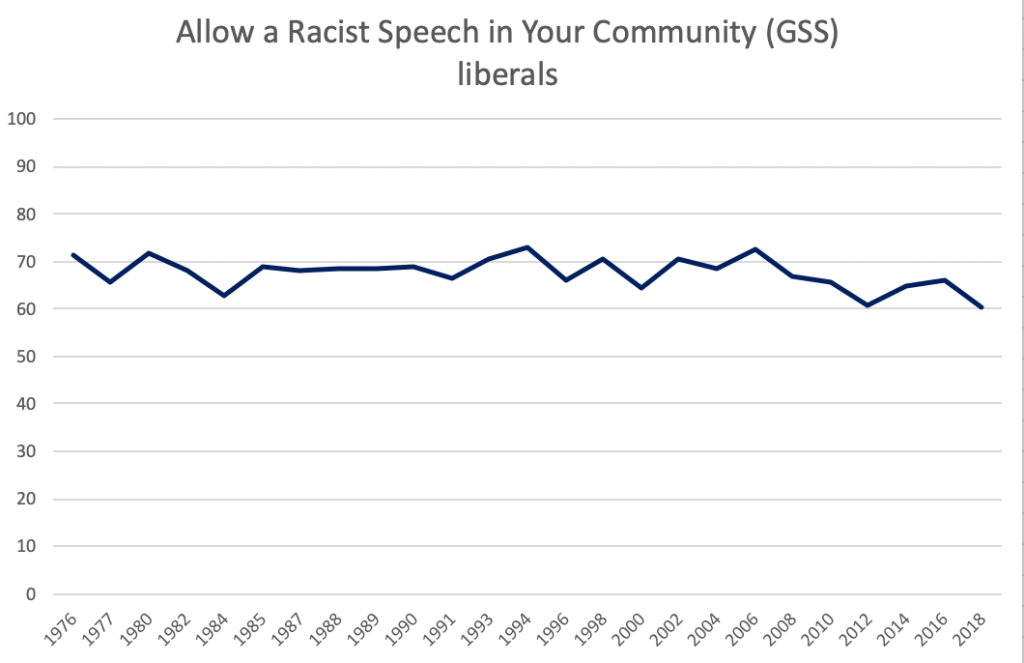
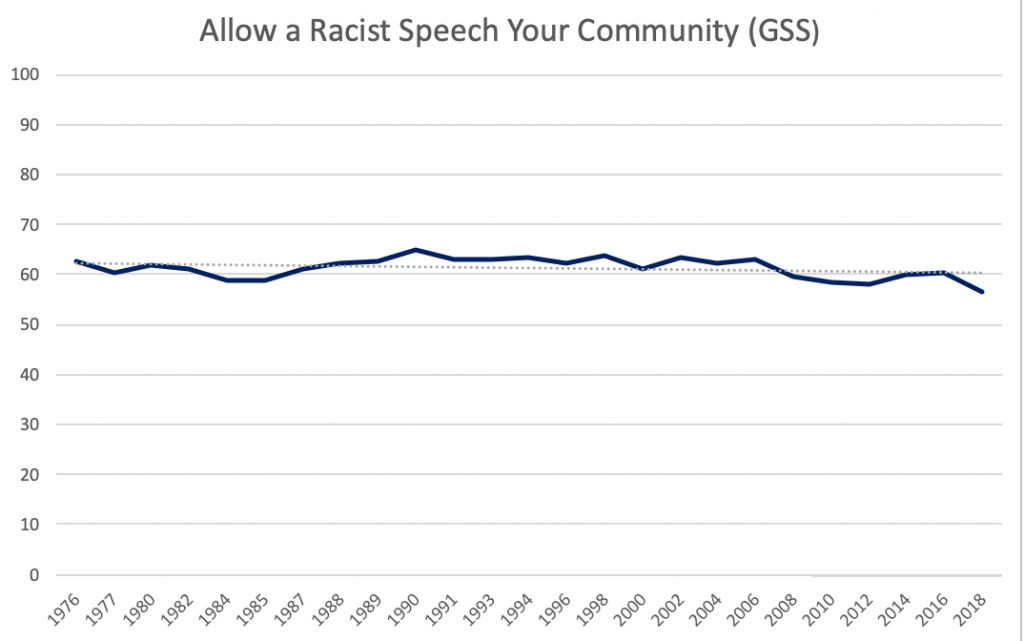
Have they? Since 1976, the General Social Survey has asked Americans whether someone should be allowed to give an anti-Black racist speech in their community. There is no significant change in responses to this item. It is true that the lowest rate was measured in the most recent year: 2018. But the difference between 2018 and the average year was within the margin of error (+/- 2.6 points), and the line has long wobbled around the mean.

Maybe the left has forgotten about the First Amendment? Here is the trend for people who identify on the left end (1 or 2) of a 7-point ideology scale:

Liberals (as the survey names this group) have been a bit more likely than the population as a whole to think that a racist speech should be allowed (mean = 67.6% vs 61.3% for the whole sample). The only reason this second line wiggles more than the first is that the sample is smaller. The trend is again essentially flat.

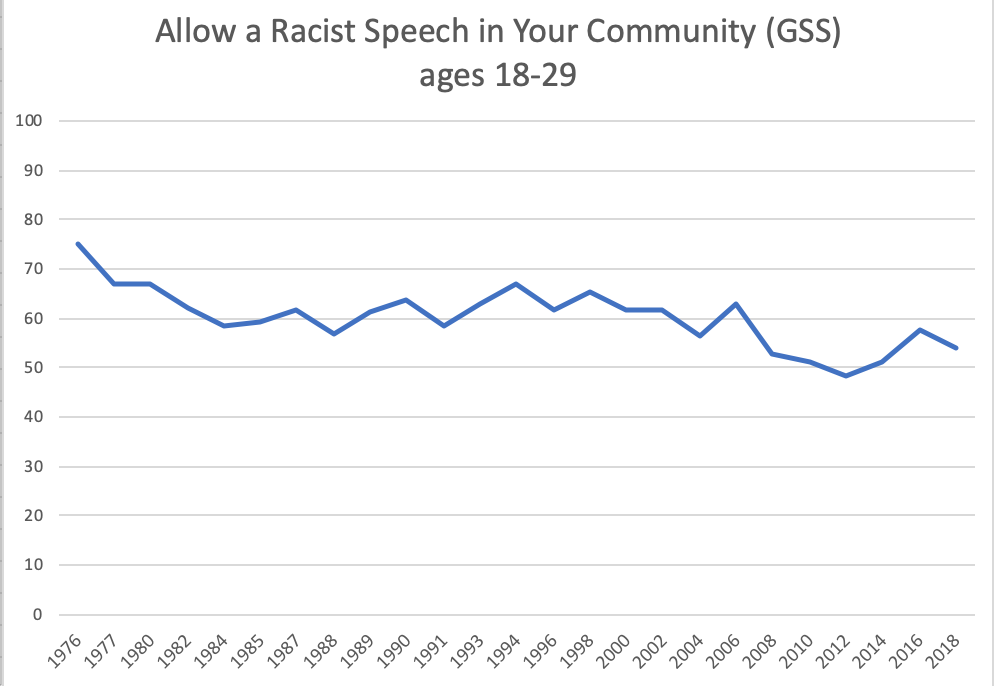
Or perhaps it is “the young” who have forgotten the First Amendment?

Maybe, to a limited extent. The third graph shows the trend for people who were 18-29 at the time of each survey. There has not been much change since 1982, but the 2018 result is well below the 1976 number.

By the way, I am not sure that I believe a racist speech should be allowed in my community. The First Amendment applies–there should be no state censorship–but if my “community” is something like my school, religious congregation, university, or town council, I’m against a sanctioned, formal speech “claiming that Blacks are inferior” (which is how the GSS phrases the question).

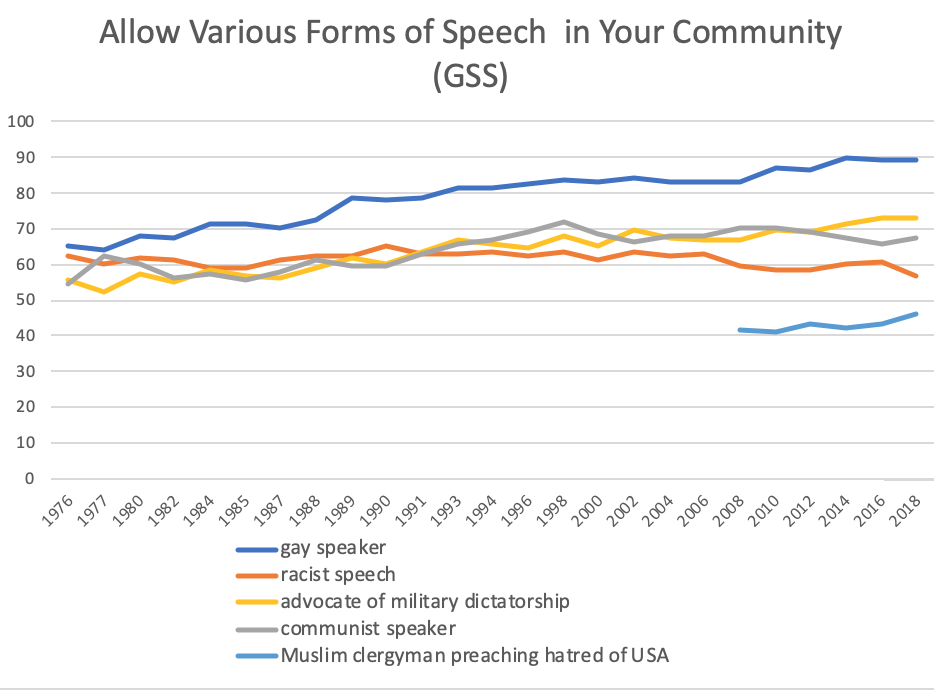
The GSS has also asked about other forms of speech or speakers: a speaker who is gay, a speech advocating military dictatorship in the USA, a communist speaker, or a Muslim clergyman preaching hatred of the USA.

Generally, the trends are up. I find it troubling that ten percent still don’t want to permit a person who is gay to speak in their community. I also find the level of tolerance for the Muslim clergy-person worrying, although the question is worded in a particular way that’s arguably Islamaphobic itself. But overall, the trend is that more people would tolerate more differences.

Of course, another trend is taking place–albeit harder to quantify. Nowadays, an incident that reinforces the beliefs or concerns of a given group can easily “go viral.” Given our tendency to confirmation bias, we can select and share news items that confirm almost any belief. Incidents that are widely shared represent severe selection bias. I have read about true stories of problematic (or even scandalous) intolerance on the left. I see no evidence that these stories are common or becoming more so. Absent empirical evidence, can we avoid making sweeping empirical claims?

See also: the Harper’s letter is fatally vague; a civic approach to free speech; what sustains free speech?

the Harper’s letter is fatally vague

This is the text of the letter that is working as a national Rorschach Test, appearing self-evident and overdue to some, offensive to others.

It is remarkably and intentionally vague. Trends are described, but without any data, timeframes, or evidence. For instance, “a new set of moral attitudes and political commitments” is “weaken[ening] our norms of open debate and toleration of differences in favor of ideological conformity.” Is that true? Which moral attitudes? Are they new (since when)? What is the degree to which disagreements are tolerated today? How does that vary by institution and community? How has it changed?

No proper names are used, but specific cases are surely being alluded to. For instance, “a researcher is fired for circulating a peer-reviewed academic study.” That must be David Shor, fired from Civis Analytics for tweeting a summary of research by Omar Wasow. That sounded like an injustice to me and a way of blocking an important topic, but does it generalize? Why exactly did it happen? (I am guessing it was a business judgment, which doesn’t make it fair but does suggest that it wouldn’t happen in many other organizations.) Are there other cases like it?

“Journalists are barred from writing on certain topics.” That has happened since the dawn of journalism: reporters constantly negotiate their story ideas with editors. I presume the concern is about journalists who want to write on topics uncomfortable to the left, but that isn’t specified. How common are such cases? After all, a vast amount of journalism is uncomfortable–if not downright hostile–to the left.

The vagueness is fatal because the issues at stake are complex and subtle. I think all these points are valid but in tension:

  1. It pays to wrestle constantly with diverse and conflicting ideas. That keeps you sharp, tough-minded, and creative.
  2. Social movements are often essential to positive change. They work to create unity because it’s an asset for them (along with worthiness, numbers, and commitment–Charles Tilly’s WUNC acronym). They therefore tend to discourage internal disagreement.
  3. It is much harder to face an open discussion if you are the topic of it. If people are talking about why you are socially disadvantaged, that can be (at best) deeply uncomfortable. Oppressed people are usually familiar with a wide range of opinions, including ones that are explicitly hostile to them. They may need a break rather than more exposure to challenging opinions.
  4. Regardless of their social position, people tend to prefer ideas that confirm their own prior beliefs and avoid or minimize conflicting beliefs in ways that distort their thinking.
  5. Strongly criticizing people is an act of free speech. Preventing or decrying strong criticism is not a way of supporting free speech.
  6. Being criticized can have tangible costs, including losing your job.
  7. Marginalizing odious views can be an appropriate way for communities to uphold norms. All decent communities marginalize some opinions.
  8. We navigate a world of massively disaggregated media by making constant individual choices about what to read, watch, and share. Much more of our speech is now visible, searchable, and sharable compared to pre-Internet days. What is odious in one space is an assumed truth in another. Anyone can be perceived as an outlier and a threat somewhere.
  9. Impartiality is a worthy goal for some people, such as public school teachers and editorial-page editors. Impartiality is not an empty concept, as you can tell by actually trying to act impartially.
  10. No institution is a free-speech zone, because it must decide whom to admit, hire, promote, publish, reward, etc. These are inevitably value-judgments and they cannot and should not be content-neutral.

If we interpret the Harper’s letter charitably, it’s saying that people are forgetting #1 because they are only concerned about #2 and #3. I’m sure this is the case for some people, but how many? Is there any basis for thinking that “censoriousness is … spreading more widely in our culture”? In my experience, a lot of people actually see merit in many of the ten points listed above and struggle to find the right balance.

If the question is whether the government should censor speech, the answer should almost always be no. That case is worth defending and propagating. I would welcome a letter from diverse and distinguished thinkers that made the positive case for intellectual diversity and individual rights against the state.

If the question is whether you should join with other people on Twitter to criticize an individual in strong terms for saying something, that’s a much more complicated matter. It’s highly context-specific. It may depend how bad you think the targeted opinion was, how many other people have already piled on, and what consequences you expect to follow from the critique. If, for example, the target is the President of the United States, go for it. If it’s an untenured professor whose claim was subtly problematic, maybe you should back off. Your criticism is itself protected by the First Amendment, but that doesn’t mean it is justified or helpful–or effective.

I have no more right to generalize than the authors of the Harper’s letter, but if I dared to describe the American left in broad strokes, I would begin by observing that a lot of people are wrestling with versions of the ten points above and trying to land in the right place. Any given controversy provokes diverse and often conflicted reactions.

People are more aware of #3 (the negative impact of a diverse debate on the people being discussed) than they were in the ’60s or the ’80s, presumably because of the growing diversity of our population and leaders. We should be concerned about #3, but it doesn’t erase the importance of robust debate or the need to counter confirmation bias. A balance is required.

All of this is playing out in a very problematic institutional context. Twitter allows just a few words and makes it easy to amplify an attack without even reading the original text. Most professors hold precarious (non-tenured) jobs that can vanish if they become targets of controversy. More than half of reporters have been laid off, creating a massive shortage of paid positions for journalists and an unprecedented concentration of those jobs in a few newsrooms. Malicious actors love to stir the pot.

It would be hard to navigate this context even if we all radiated wisdom and beneficence. Considering that everyone is fallible and biased–and some of us are actually Russian bots–I would like to celebrate the many among us who are doing their best.

See also: marginalizing odious views: a strategy; marginalizing views in a time of polarization; trying to keep myself honest; we need SPUD (scale, pluralism, unity, depth); the value of diversity and discussion within social movements; diversity, humility, curiosity; and Francis Bacon on confirmation bias.

only 57 percent of Americans say they would get COVID-19 vaccine

Vaccine interest higher among Whites and Hispanics, wealthier households, and Democrats

This is the latest product from the Tufts Research Group on Equity in Health, Wealth, and Civic Engagement, which I co-lead; and I did some of this analysis.

MEDFORD/SOMERVILLE, Mass. (July 9, 2020)—Despite widespread agreement among experts that having a prophylactic COVID-19 vaccine will be critical to the nation’s ability to safely return to some form of normalcy, only 57% of Americans say they would get a COVID-19 vaccine if it were available today, according to a national survey designed and analyzed by Tufts University’s Research Group on Equity in Health, Wealth and Civic Engagement.

The nationally representative survey also uncovered significant variations in vaccination acceptance by race/ethnicity, household income, educational background and party affiliation. Whites and Hispanics, Democrats, those with more formal education, and those with higher incomes reported being more likely to get vaccinated than Blacks, Republicans, those with less education, and those with lower incomes. Fully one-quarter of respondents said they didn’t know if they would get the vaccine, possibly indicating the need for more public health education and information.

 “It’s really concerning that only 57% of our respondents said they would get vaccinated. It’s evident that we need to begin working on a national vaccine strategy and education campaign right now– even before we have the vaccine in hand,” said Jennifer Allen, professor of community health in Tufts University’s School of Arts and Sciences and co-leader of the study. “There is still some uncertainty, but some studies show that we need between 60 and 70% of the population to be vaccinated in order to confer herd immunity.”

There has been growing resistance to all vaccines in the U.S. over the past decade, which has led to reduced compliance with vaccine recommendations and the re-emergence of diseases like measles and mumps, which were previously well-controlled. Growing anti-vaccination sentiment has been fueled by misinformation about vaccines, including the widely de-bunked theory that vaccines could cause autism.

Whites and Hispanics more likely to vaccinate

The study also revealed marked differences of opinion toward vaccination across racial groups, with 58% of non-Hispanic whites and Hispanics reporting they would get the vaccine as compared with 48% of non-Hispanic Blacks.

“The pandemic has disproportionately affected Black individuals,” said Allen. “The lower level of vaccine acceptance within this population is worrisome, as it suggests the vaccine could further exacerbate COVID-19 racial/ethnic disparities. Given the legacy of medical experimentation on African Americans, there is understandable mistrust in medical science and in government.

“The accelerated time-frame for vaccine development and testing could further raise concerns about the safety and efficacy of an eventual vaccine,” Allen continued. “Targeted efforts will be needed to make sure that a vaccine doesn’t further widen the gap in health outcomes.”

Income and education plays factor

Surprisingly, those with higher levels of income and education were more likely to report that they would get the COVID-19 vaccine. “Historically, those most likely to refuse vaccines have been those with higher levels of income and education,” said Allen.

Among those with incomes less than $20,000, only 41% said they would get the vaccine, compared with 72% among those with incomes of $150,000 or more. Less than half of those with a high school education or below said they would get the vaccine, compared with 74% among those who had a college education.

Differences across political parties

Sharp polarization by political party affiliation also emerged in the responses. Willingness to be vaccinated was highest among Democrats (71%) compared with Independents (61%) and Republicans (47%).

“Differences between political parties are striking. As with many aspects of the pandemic, vaccination is a highly partisan issue,” said Peter Levine, an associate dean at Tufts’ Tisch College of Civic Life. “The partisan gap may pose an obstacle to widespread vaccination.”

While public health officials, clinicians and pharmaceutical companies race to develop a COVID-19 vaccine, it is evident that, should a successful vaccine become available, distribution and administration will need to be accompanied by health communication, promotion and education campaigns,” said Tom Stopka, an infectious disease epidemiologist and associate professor with the Tufts University School of Medicine, and a co-leader of the study. “Such campaigns can help to increase understanding of how the vaccine will work, decrease doubts and mistrust of local, state, and federal officials, and potentially demonstrate that the benefits of the vaccine far outweigh the risks.

“The U.S. population has been overwhelmed with COVID-19 information and stress, as well as massive changes to their day-to-day lives,” added Stopka. “When and if a vaccine becomes available, and has been thoroughly tested in human populations, it will be necessary to also develop a massive public health communication campaign to provide community members with the information they need to make an informed decision to protect themselves, and to protect their families and local communities.”

The survey was fielded online by Ipsos using its KnowledgePanel. The sample was nationally representative, and the number of complete responses was 1,267. More technical information about the survey is at https://equityresearch.tufts.edu/the-survey/.

Tufts University’s Research Group on Equity in Health, Wealth and Civic Engagement was established in 2019 as part of a strategic effort to use resources and expertise of Tufts campuses and schools to address major global issues. It brings together researchers from across the university to discuss and investigate aspects of equity and inequity in the United States and the world. The research has been funded by Tufts University’s Office of the Vice Provost for Research as one of several such initiatives

The group’s principal investigators are Allen, Levine and Stopka. Other members of the group can be found here

By September 2020, the Research Group will launch a website at https://equityresearch.tufts.edu that will allow anyone to explore numerous dimensions of equity and inequity with an interactive data-visualization tool. Tufts’ Jonathan M. Tisch College of Civic Life is funding the data-visualization tool.

###

About Tufts University

Tufts University, located on campuses in Boston, Medford/Somerville and Grafton, Massachusetts, and in Talloires, France, is recognized among the premier research universities in the United States. Tufts enjoys a global reputation for academic excellence and for the preparation of students as leaders in a wide range of professions. A growing number of innovative teaching and research initiatives span all Tufts campuses, and collaboration among the faculty and students in the undergraduate, graduate and professional programs across the university’s schools is widely encouraged.

some notes upon watching Hamilton

I’m one of those who already knew the music and lyrics of Hamilton extremely well but watched a performance of it for the first time this weekend on video.

I hadn’t realized how consistently Aaron Burr (Leslie Odom Jr.) appears on stage or even dominates it. I understood the plot but didn’t appreciate the strength of Burr’s presence. Specifically, I had missed scenes that emphasize his parallels with Hamilton, such as when the two men split the stage to sing love songs to their infants.

The musical as a whole is about who gets to tell the story. At the end, George Washington and the company sing, “Who lives / Who dies / Who tells your story?” Burr asks, “But when you’re gone, who remembers your name? / Who keeps your flame?” Angelica and the women of the company echo his question: “Who tells your story?” The women say, “Eliza,” and she begins, “I put myself back in the narrative.”

Washington has skillfully controlled his own story by exiting voluntarily and leaving a farewell address (written by Hamilton). Burr is the one who narrates Hamilton’s story for us, but he plays his cards so badly that he makes himself into the villain. Hamilton is obsessed with his own reputation; his efforts to safeguard it are one source of his own destruction. Eliza takes herself out of the narrative and then puts herself back in, using her 50 remaining years after Hamilton’s death to become a public historian. And Lin-Manuel Miranda turns Hamilton’s life into the material for his own art, thus becoming the one who really tells the story.

One general implication is that politics generates the noblest stories. We should want to be in the Room Where it Happens because then we can engage with other people, not as friends but as equals, and make something public and lasting together. This is high drama. It is possible only in a republic or in a revolutionary struggle to make a republic. Of course, Burr’s tragedy is that he can’t get in.

I think that Hamilton is the best fictional evocation of the intrinsic value of politics–politics not as a necessary means to some end but as a venue for drama and excellence. It also rescues the American story by treating our republic as an ongoing project to which anyone can contribute.

[HAMILTON]

Legacy. What is a legacy?
It’s planting seeds in a garden you never get to see
I wrote some notes at the beginning of a song someone will sing for me
America, you great unfinished symphony, you sent for me
You let me make a difference

Another general point is that Miranda has appropriated the founding history. He has taken it as his material and turned it into something original that exemplifies his own culture. To be sure, any culture is layered, internally diverse, and vaguely bounded. Lin-Manuel Miranda and the original Alexander Hamilton actually share some aspects of culture as their common birthright. But the musical (lyrics, plot, music and cast) surely reflect a racially diverse 21st century New York City and a base in hip hop that are distant from Hamilton.

In this case, cultural appropriation is great. It is an impressive power move and a creative act. That reinforces my view that cultural appropriation is not an intrinsic problem at all. It simply depends on who appropriates whom for what. Appropriation is a political act, and politics can be noble.

See also Hannah Arendt and Lin-Manuel Miranda; ambition: pro or con?; Arendt, freedom, Trump; taking satisfaction from politics in the face of injustice; a welcome talk for college interns newly arrived in Washington; what is cultural appropriation?; and diversity, humility, curiosity

Foucault’s spiritual exercises

Here is Michel Foucault’s definition of “spirituality”:

… I think we could call “spirituality” the search, practice, and experience through which the subject carries out the necessary transformations on himself in order to have access to the truth. We will call “spirituality” then the set of these researches, practices, and experiences, which may be purifications, ascetic exercises, renunciations, conversions of looking, modifications of existence, etc., which are, not for knowledge but for the subject, for the subject’s very being, the price to be paid for access to the truth. Let’s say that spirituality, as it appears in the West at least, has three characteristics.

[1] Spirituality postulates that the truth is never given to the subject by right. … It postulates that for the subject to have right of access to the truth he must be changed, transformed, shifted, and become, to some extent and up to a certain point, other than himself. … It follows that from this point of view there can be no truth without a conversion or a transformation of the subject.

[2] Eros [the subject’s attraction to the truth, or the truth’s movement to the subject] and askesis [labor] are, I think, the two major forms in Western spirituality for conceptualizing the modalities by which the subject must be transformed in order finally to become capable of truth.

[3] The truth enlightens the subject; the truth gives beatitude to the subject; the truth gives the subject tranquility of the soul. In short, in the truth and in access to the truth, there is something that fulfills the subject himself, which fulfills or transfigures his very being.

Foucault, The Hermeneutics of the Subject, Lectures at the College de France 1981-2, translated by Graham Burchell (Palgrave, 2005), pp. 15-16

Foucault distinguishes spirituality from philosophy: “the form of thought that asks what it is that enables the subject to have access to the truth and which attempts to determine the conditions and limits of the subject’s access to the truth” (p. 15).

Although philosophy and spirituality are different, all the Greek and Roman philosophers–except (Foucault thinks) Aristotle–believed that a person could not have access to the truth without first being transformed into a better self. Therefore, all the classical philosophers argued for spirituality, as defined above. More than that, they combined their philosophical arguments with spiritual instruction, because they saw the two as inseparable.

One of the main topics that a self was supposed to understand was justice. To understand justice required improving oneself. In turn, learning about justice made a person better. “Consequently, taking care of oneself and being concerned with justice amount to the same thing” (p. 72, here interpreting Plato).

These presuppositions of ancient philosophy and spirituality contrast with two prevalent modern traditions. First:

  • Science is that set of methods and institutions (such as labs, PhD programs, and peer-review) that allow us to know nature without having to improve the self first. A scientist “can recognize the truth and have access to it in himself and solely through his activity of knowing, without anything else being demanded of him and without him having to change or alter his being as subject” (p. 17). In turn, science generates knowledge that may not improve anyone spiritually. Nature is precisely the realm that is independent of our spiritual condition. If some scientists prepare themselves mentally to do their jobs or gain tranquility from what they discover about nature, those are incidental facts about them as people. Spiritual preparation may not be necessary, and it certainly isn’t sufficient. Science is about methods, techniques, instruments, rules, and norms that prevent the self from influencing knowledge. And science pursues truth without flinching even when the results are morally problematic.

I would add another tradition as a contrast with ancient spirituality, although I am not sure Foucault would agree:

  • Liberalism is the political tradition that seeks to base good government on well-designed institutions (rights, checks-and-balances, elections and other mechanisms of accountability) so that good government need not depend on the moral excellence of either leaders or the people. Good institutional design is a more secure basis for justice than human excellence. Further, in a well-designed polity, we can leave people alone in their private lives instead of badgering them to transform themselves. Thus liberalism is compatible with freedom as autonomy and with diverse understandings of the good life.

According to Foucault, classical spiritual traditions lived on in Christianity. Spirituality ran into trouble with the rise of scholasticism, which made the study of God into a kind of science. Drawing on Aristotle, medieval scholastics provided methods for understanding God and nature that did not depend upon spiritual self-improvement. They left methods of self-improvement to non-scholars, a division that continues today.

I struggle to decide where Foucault stands himself. Does he give detailed lectures about Greco-Roman spiritual traditions because he believes that modern science and governance are bad and he wants us to return to a better way? Does he describe these Hellenistic traditions dispassionately, as a contribution to truth that may not improve us or himself? (In other words, is he a scientist of the past?) Or does he seek to liberate us from spirituality and science by demonstrating the historical contingency of both? If we shed spirituality and science, what are we left with?

I don’t know, but I enjoy the moments in the lectures when Foucault interacts with his audience. For instance, here he demonstrates concern:

[Is there] another room you can use? Yes? And are those people there because they cannot get into the other room or because they prefer to be there? I am sorry that the conditions are so bad, I can do nothing about it and as far as possible I would like to avoid you suffering too much. Okay, earlier, while talking about these techniques of the self and their existence prior to Platonic reflection on the epimeleia heautou [care of oneself], it came to mind, and I forgot to mention it to you, that there is a text … (p. 65)

And here he is playing with his audience:

I was saying that it seemed to me that at a certain moment … the link was broken, definitively I think, between access to the truth, which becomes the autonomous development of knowledge (connaissance), and the requirement of the subject’s trans- formation of himself and of his being. When I say “I think it was definitively broken,” I don’t need to tell you that I don’t believe any such thing, and that what is interesting is precisely that the links were not broken abruptly as if by the slice of a knife (pp. 25-6).

Foucault respected and learned from his colleague Pierre Hadot, a great scholar of Hellenistic thought. Hadot emphasized that the Hellenistic thinkers did not write systematic treatises. They were teachers who worked with students or other audiences in concrete circumstances.

Philosophy in antiquity was a spiritual exercise. … Whether we have to do with dialogues as in the case of Plato, class notes as in the case of Aristotle, treatises like those of Plotinus, or commentaries like those of Proclus, a philosopher’s works cannot be interpreted without taking into consideration the concrete situation which gave birth to them. They are the products of a philosophical school, in the most concrete sense of the term, in which a master forms his disciples, trying to guide them to self-transformation and -realization. Thus, the written work is a reflection of pedagogical, pyschagogic, and methodological preoccupations.

Although every written work is a monologue, the philosophical work is always implicitly a dialogue. The dimension of the possible interlocutor is always present within it. This explains the incoherencies and contradictions which modern historians discover with astonishment in the works of ancient philosophers.

Hadot, Philosophy as a Way of Life, translated by Michael Chase (Blackwell 1995), pp. 104-5

Foucault’s concrete situation was rather unusual. As a holder of a chair in the College de France, he was required only to conduct his own research and report the results annually in a series of lectures–free, public, and uncredited. Because he was an academic superstar, he gave these lectures to a packed lecture hall and overflow areas, with ranks of tape-recorders piled on the desk before him. The audience could not literally discuss with him, but he could address them in a dialogic way.

Here is Foucault’s description of Epictetus:

unlike Seneca, [Epictetus] is a teacher by profession [and] he really does have a school. He opens a school which is called “school” and in which he has students. And, of course, among his students there are a number, no doubt a considerable number, of young people who come to be trained. … It should not be thought that the care of the self, as principal axis of the art of life, was reserved for adults. But alongside this, intertwined with this training of young people, we can say that in Epictetus’s school there is also what could be called, employing an unjust metaphor no doubt, an open shop: an open shop for adults. And in fact adults come to his school to hear his teaching for one day, for a few days or for some time. Here also, in the social world evoked in the Discourses, you see, for example, a town inspector passing through, a sort of tax procurer if you like. He is an Epicurean who comes to consult Epictetus and ask him questions. There is a man sent to Rome by his town who, passing through Asia Minor to Rome, stops to ask Epictetus questions and get advice on how he can best accomplish his mission. Moreover, Epictetus by no means disregards this clientele, or these adult interlocutors, since he advises his own students, young people therefore, to find prominent people in their town and to shake them up a bit by saying: Tell me then, how do you live? Do you really take proper care of yourselves? (p. 90)

I think Foucault’s own role is similar. And that makes him–not a scientist of history–but a practitioner and provider of spiritual exercises.

See also Philosophy as a Way of Life (on Pierre Hadot); does focusing philosophy on how to live broaden or narrow it?;  Hannah Arendt and philosophy as a way of life; Kieran Setiya on midlife: reviving philosophy as a way of life; science, UFOs, and the diminishment of humankind; notes on the social role of science: 1. the example of fetal ultrasounds.

Putting the US Constitution in its Place: A Broader Agenda for Civic Education

I put a draft chapter on Academia.edu in case anyone is interested in commenting. It is for a forthcoming volume edited by Carol McNamara about American citizenship.

The abstract:

Almost all American students are required to study the formal structure of the US government, and most perform fairly well on concrete, factual questions about the Constitution. But there is much more for competent citizens to learn. After I explore some valid reasons to include the Constitution in required curricula, I argue that the document provides a poor framework for civics as a whole, giving students a distorted view of the social world and failing to motivate them for ethical civic engagement. I conclude with a sketch of a curriculum in which the US Constitution has a place, but a fairly modest one.

Here is an excerpt:

… the Constitution is a distorting lens through which to view the social and political world. It is, after all, a charter for the federal government of the United States, albeit one that protects the rights of the states, associations, and individuals. It has much to say about the three official branches of the national government. It also mentions certain other institutions that seemed important to its 18th-century authors, such as the armed forces, militias, and privateers (“letters of marque”); religion and the press; lawyers (“Assistance of Counsel”); and associations and public assemblies. It does not mention any of the following components of our 21st-century system: political parties and lobbies; unions and organized professions (other than the law); permanent regulatory and national security agencies and the civil service; for-profit and nonprofit corporations and capital markets; or broadcast and digital media and the Internet.

Courts strive to apply constitutional principles to these modern institutions by expanding 18th-century categories. For instance, publicly traded, general-purpose corporations—which became common in the 19th century—are treated as examples of “associations” under the First Amendment.* I lack the competence to assess such rulings, but I think that the Constitution is problematic as a curricular framework. A curriculum based on that text will leave scarce time for analyzing most of the institutions that actually structure our lives, because they are unmentioned in the document.

While studying the First Amendment, students might be invited to think about the types of associations, religions, and equivalents of “the press” that exist in our time. But that is an odd and constraining way to investigate the structure and functions of Facebook, the Democratic Party, Sunni Islam, The Washington Post and its parent holding company, Black Lives Matter, the National Rifle Association, the American Federation of Teachers, and General Motors, to name just a few “associations.” A course on how our society works would go deeply into those organizations and give much less time to the question of how the US Constitution applies to them.

And another:

A heavy emphasis on the Constitution also implies a causal theory that is sometimes made explicit in k-12 classrooms. Students may take away the thesis that our society can be explained by the Constitution and the founders’ vision. The world we observe around is the one the founders “framed” for us.

That thesis is, at best, contestable. The organizations, norms, and systems of the United Kingdom and the United States today are in many ways similar, despite the fact that the USA has an idiosyncratic (some would say, “exceptional”) written constitution, whereas the British constitution is unwritten and has very different components: a monarch, an established church, a cabinet that is part of Parliament, and parliamentary sovereignty. Meanwhile, both the USA and the UK function very differently from the same countries a century ago. The reason is not that they have changed their constitutions profoundly but rather that urbanization and then suburbanization, industrialization and then deindustrialization, capitalism and then the welfare state, immigration and internal migrations, technology and global capital markets have transformed these two societies—more or less in parallel. The causal impact of the US Constitution on the USA seems limited.


*“Corporations and other associations, like individuals, contribute to the ‘discussion, debate, and the dissemination of information and ideas’ that the First Amendment seeks to foster.” Citizens United v. Federal Election Commission, 558 U. S. 1 (2010), quoting Bellotti, 435 U. S., at 783. See also: on teaching the US Constitution; the Citizens United decision and the inadequate sociology of the US Constitution; liberals, conservatives, and love of the Constitution; is our constitutional order doomed?; and how to teach the constitution of cyberspace.

some highlights from the new CIRCLE survey

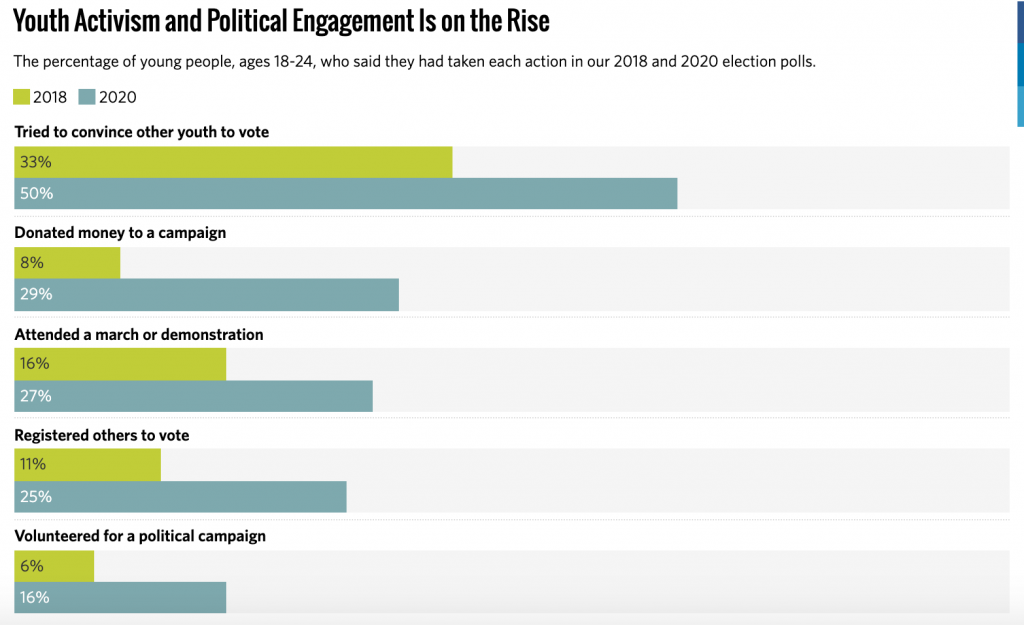
CIRCLE’s new survey of 2,232 young citizens (ages 18-29) is out. Among the findings:

  • “83% say they believe young people have the power to change the country, 60% feel like they’re part of a movement that will vote to express its views, and 79% of young people say the COVID-19 pandemic has helped them realize that politics impact their everyday lives.”
  • They support Biden over Trump by 58%-24%, “a staggering 34-point margin. But 18% of youth say they would like to vote for another candidate. Asian youth (78%) and Black youth (73%) are the most likely to support Biden. Meanwhile, almost three quarters of youth who support Trump (72%) are White.”
  • 27% of young people (ages 18-24) say they have attended a march or demonstration, a remarkable increase from when we asked the question [of] the same age group before the 2016 and 2018 elections (5% and 16%, respectively).”
  • For all youth, the top issues are environment and climate change (13%), racism (12%) and healthcare (12%). For Black youth, the priorities are racism (22%), policing of communities of color (15%), and healthcare (11%).
  • All measured forms of political engagement are up compared to 2018 (admittedly, not a presidential year). For instance, half say that they have tried to convince someone else to vote–which is a lot of viral marketing for the election.

Much more information is on the CIRCLE page.

diversity, humility, curiosity

I recently heard about a conversation in which someone invoked the idea of a “voodoo doll,” and another in which someone said that the Chinese character for crisis also means “opportunity.”

These phrases rest on falsehoods. Sticking needles into effigies to harm real enemies derives from Western European folklore. A widow was “accused, tried and drowned at London Bridge, England, for piercing a puppet, made in the victim’s likeness, with nails, towards the end of the 10th century” (Armitage 2015, p. 88). In white popular culture in the early 1900s, such practices were attributed to Haitian religion as part of a fearful, contemptuous, and hateful depiction of Haiti–the only country with a successful slave revolt–and of Black people in general.

John F. Kennedy popularized the idea that the Chinese character for crisis also means opportunity. This is false and may perpetuate stereotypes of Asian “wisdom” as paradoxical, antique, and unscientific. A similar example is the remark attributed to Zhou Enlai that it was too early to tell whether the French Revolution was a good thing. That sounds sagacious and mysterious until you find out that he was referring to the French uprisings of 1968, less than a decade before he spoke. It actually was too early to tell.

We shouldn’t say these things, because they are wrong and they reinforce harmful stereotypes. In fact, if anything is racist, it is to depict a religion constructed by enslaved and self-liberated people under immense duress as a malevolent form of magic, characterized by enchanted dolls and walking undead that are familiar tropes in European folklore.

Yet I do not think that the best outcome is to erect warning signs around such topics. We don’t want someone to use these phrases, get corrected, and resolve never to talk about Haiti or about Chinese characters again.

Instead, we should strive for a combination of humility (knowing what we don’t know) and curiosity (striving to learn more).

For instance, the family of syncretic religions that includes Vodou, Santeria, Candomble Jeje, and others is an important topic of study. These religions are components of our social world, interesting in their own right and significant in the history of the African diaspora. To understand a phenomenon like the astounding growth of Pentecostalism in Brazil, it might be important to have some awareness of Brazilian syncretism, which Pentecostals depict as their main enemy. Fear of Haiti and its successful revolution has been important in American politics–and that, too, is valuable to understand.

To study syncretism raises general issues that might have existential significance for people from other religious backgrounds. For instance, the question “What is a religion?” is pressing for all human beings. One answer is: a system of belief defined by certain abstract tenets that are matters of faith rather than reason and that are incompatible with other systems. That definition does not apply to Vodou or explain how someone can be both Catholic and syncretic, as many people are. So maybe we should rethink what a religion is, in general.

Likewise, it is worthwhile to understand more about Chinese writing. In addition to its intrinsic significance, this topic also raises questions that generalize to other contexts. For example, the word ji, misleadingly translated as “opportunity,” is polysemous: it has a whole family of loosely related meanings. Many English words are polysemous, too. What should we make of polysemy in general?

Also, the claim that the Chinese character for crisis means opportunity is an example–in this case, a spurious example–of arguing from etymology. People make etymological arguments all the time. I, for example, have noted that the roots of “citizen” and “political” are Latin and Greek words related to the city (civitas and polis). They share a history with the words “urbane” and “civilized,” which also distinguish cities from the inferior countryside. But do we get any guidance for today by understanding what ancient Greeks and Romans meant by these words? How, in general, should we think about original meanings, given that languages and societies change?

In short, let us turn mistakes into quests for more and better knowledge. That means encouraging further forays into fraught topics instead of warning people away from them. When we err, as we all do, we should respond by learning, not by apologizing and turning away. Incidentally, this means keeping the focus on the original topic of conversation (e.g., Haitian religion), not on our feelings about being corrected. I take the main problem with “white fragility” to be a tendency to distort conversations by directing attention to the question of how the white person feels.

My thesis is that cultural diversity requires humility plus curiosity. I would acknowledge two challenges to this thesis–not to discourage curiosity but to remind us what to be careful of.

First, by digging more deeply into fraught topics, we may make additional mistakes. I wrote above that the Haitian Revolution was the only successful revolt of enslaved people. Arguably, that is a false statement. In an earlier draft, I wrote that white people depicted Vodou as “black magic,” thereby repeating a racist trope in my own voice. It can be safer to erect warning signs around such issues than to compound our initial mistakes with more. I think we should take this risk but be appropriately careful about it. Humility should not diminish with added knowledge.

Second, knowledge confers power. To understand more about other peoples and cultures can allow you to profit from them or even dominate them. Often in durable cases of imperialism, the conquerors learned about, and even admired, the people whom they controlled.

For instance, I am not sure that Britain would have been motivated to dominate India, or capable of doing so, if some British people had not become learned and appreciative about India. A classic case is Rudyard Kipling. His first language was Hindi, he knew a lot about India, he disparaged racist stereotypes about Indians, and he believed that Britain should rule India just because it was a magnificent civilization. In stark contrast, Donald Trump displays ignorance and contempt for almost the whole world. One result is a reluctance to use US military power overseas. Trump has arguably been less imperialistic than his predecessors because he is more ignorant. This is a warning about curiosity.

Leaving aside literal imperialism, we might also worry about profiting from knowledge about other cultures. One could imagine a privileged American who starts with an idea about voodoo dolls, is corrected, learns more about Haitian syncretism, and makes money by writing about it or by importing and selling real Haitian art. Although I would defend cultural appropriation in many circumstances (and I disagree that profit is a mark of sin), one should at least be mindful about monetizing other people’s experiences.

These are caveats, but I don’t think they rebut the basic presumption that we should address ignorance by learning more–with curiosity born of humility and guided by ethics.

Source: Armitage, Natalie, “European and African Figural Ritual Magic: The Beginnings of the Voodoo Doll Myth,” in Armitage & Ceri Houlbrook, editors, The Materiality of Magic: An Artifactual Investigation into Ritual Practices and Popular Beliefs, Oxbow Books, 2015, pp. 85–102.) See also: is everyone religious?; Kipling: understanding and control; what is cultural appropriation?; and when is cultural appropriation good or bad?.

the significance of the progressive primary victories

Representative Eliot L. Engel, chairman of the House Foreign Affairs Committee, appears to have lost a primary to Jamaal Bowman, a middle school principal:

This is part of a significant trend: relatively conservative incumbent Democrats in relatively safe Democratic states and districts are falling to more progressive newcomers, such as Alexandria Ocasio-Cortez (N.Y.-14), Ayanna Pressley (Mass.-07), and Marie Newman (IL-3). These insurgents are more diverse and younger than the incumbents. To be sure, a majority of progressive primary challengers have lost, but the net shift is toward a larger bloc within the Democratic caucus.

We should now see assertive progressive caucuses grow in the US House and in many city councils and state legislatures–mirror-images of the House Freedom Caucus on the right. They should and will help to maintain and expand Democratic Party control of as many legislative chambers as possible, while acting as the sharp, leading edge of Democratic majorities. (Jamelle Bouie made this argument in the New York Times.)

The country is becoming more diverse, and people of color tilt heavily toward the Democratic Party. As a result, the Democrats are about to cease being a white-majority party, although many of their national leaders still are white, especially in the Senate.

In 2016, half of the voting delegates at the Democratic National Convention were people of color. These delegates were not appointed as a gesture to symbolic representation or diversity. They were elected by their own power bases. When a party that elects these delegates wins national elections, white dominance is at risk. That is potentially a shift of global significance, bookending 1492 and 1619.

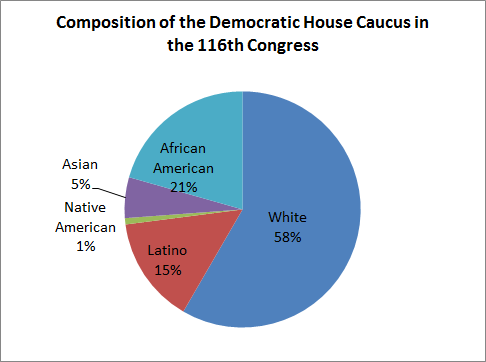
But the party’s leadership must represent its own electorate better. A 58% white Democratic House caucus is a bit too white for a 54% white party, and the party is getting more diverse. The main opportunities to diversify the caucus are districts with Black or Latino majorities. (The Senate represents a bigger problem.)

If you’re not as far as left some of the progressive insurgents, I still think you should welcome their voices in government. The national deliberation is enriched by their ideas, experiences, and agendas. A legislature that excludes such perspectives lacks legitimacy.

What if you were a Bernie voter in 2020? Do a few primary victories offer a disappointing consolation prize? I think not. Electing progressive Democrats in left-leaning districts was always a more promising strategy.

I’ll acknowledge that if you are a democratic socialist, you should have voted for Bernie Sanders in the Democratic primary. He is, after all, a socialist. I didn’t vote for him because my political philosophy–for whatever that’s worth–does not fully align with his. At the same time, if you are a democratic socialist, you would have fundamental reasons not to expect the Sanders campaign to carry your agenda forward. You should be primarily interested in the path that AOC, Jamaal Bowman, and others represent.

Although socialist thought is vast and varied and mostly beyond my personal knowledge, I have never heard of a socialist theorist or strategist who believed that capitalists would back down in response to an individual politician who won a majority vote in a national election. Just because actual socialism would cost the ruling class trillions of dollars, they would be expected to resist it with all their power. That is why socialist strategists have often emphasized strong unions linked to a broad-based left party with internal democracy and ideological discipline (a hard pair of principles to combine), plus a left version of the mass media. Once you build that combination, you have a chance at a more-than-symbolic political campaign.

Michael Walzer writes:

Socialist politicians usually emerge from powerful social movements like the old labor movement or from political parties like the Labour Party in the United Kingdom or the Social Democrats in Germany. Sanders does not come out of, nor has he done anything to build, a significant social movement. That wouldn’t be an easy task in the United States today; in any case, it hasn’t been his task. He has, moreover, never been a member of a political party—not even of the Democratic Party whose nomination he is now seeking. He has never attempted to create a democratic socialist caucus within the party. For all the enthusiasm he has generated, he has no organized, cohesive social or political force behind his candidacy. If he were elected, it is hard to see how he could enact any part of his announced program.

One response is that Sanders is not a socialist in a significant sense, and therefore socialist theory would accept that he could have won the election. He just needed to play his cards a bit differently and receive more help from people like me (and millions of others) who resisted him.

As I once noted, Sanders’ platform is less radical than Harry Truman’s was in 1948. In that sense, Sanders stands in the mainstream of the 20th century Democratic Party. Richard Wright puts Bernie Sanders in the tradition of Victorian moralizing socialists, like William Dean Howells (who voted Republican) or Frances Willard. This is a highly mainstream American tradition, and Bernie’s only difference is the “socialist” brand. To explain socialism, Sanders sometimes cites Denmark, which the Heritage Foundation ranks very high on measures of business freedom, investment freedom, and property rights. I like Denmark’s social contract but would describe it as liberal.

Sanders has never passed any socialist legislation but is part of Chuck Schumer’s leadership team in the Senate. In the 115th Congress, Sanders and, e.g, Senator Jeff Merkley (D-OR) agreed on 90% of their votes–all their rare divergences relating to Trump’s executive branch appointments, plus H.R. 2430, “a bill to amend the Federal Food, Drug, and Cosmetic Act,” and H.R. 3364; “A bill to … counter aggression by the Governments of Iran, the Russian Federation, and North Korea.” You could argue that if Sanders is a socialist, so is Merkley and most of the Democratic caucus.

Although Sanders made major economic proposals, they had little chance of passage, which made him sort of a notional or symbolic socialist. Yes, if Bernie had won in a landslide–carried to the White House by a wave of grassroots enthusiasm and activism for the substance of his agenda–he could have passed his bills. But the primary campaign showed no evidence of a dramatically new electorate. A capable Democratic administration pressured skillfully from a growing leftwing caucus can do much more.

See also three views of the Democratic Party when democracy is at risk; Bernie Sanders runs on the 1948 Democratic Party Platform; and democracy is coming to the USA

more data on police interactions by race

We reported on June 17:

Sixty-eight percent of African Americans say they know someone who has been unfairly stopped, searched, questioned, physically threatened or abused by the police, and 43 percent say they personally have had this experience—with 22 percent saying the mistreatment occurred within the past year alone, according to survey results from Tufts University’s Research Group on Equity in Health, Wealth and Civic Engagement.

According to the KFF Health Tracking Poll for June, 2020, about 30% of Black adults say they have “experienced unfair treatment in interactions with police” within the past year. Forty-one percent of Black adults “say they have been stopped or detained by police because of their racial or ethnic background,” and “about one in five Black adults (21%)–including 30% of Black men–say they have been a victim of police violence due to their racial background.”

According to the Bureau of Justice Statistics’ most recent (2015) Police-Public Contact Survey, 19.8% of African Americans age 16+ had some contact with the police in the past year. This number is the total of several specific types of contact that are asked in the survey, such as riding in a car that was stopped by the police or reporting a crime, among others. The total rate of contact was down by six percentage points compared to 2011.

In the BJS survey, whites were three percentage points more likely than African Americans to report any contact with the police but were also more likely to initiate the contact. Of those who reported that they had been stopped on the street by police, two thirds of whites (67.8%) but only half of Blacks (50.1%) said that the reason for the stop was legitimate.

Of Blacks who said that they had contacted the police, 90.7% said the police behaved properly and 83.6% said they were satisfied by the outcome–very similar rates to whites. The survey implies that 2.7 million African Americans initiated contact with the police in 2015, of whom about 2.3 million were satisfied. This is a fact with some political significance in discussions of defunding the police. At the same time, 3.3% of Blacks and 1.3% of whites reported that the police had used force against them in 2015.

A significant limitation involves the samples of all these surveys. Our survey excludes people in prisons or jails. So does the BJS survey, which also excludes “homeless persons.” I am not sure about the sample of the KFF survey, but it is conducted predominantly by random-digit dialing, which would miss institutionalized people and homeless people. Rates of discriminatory contact would likely be higher if institutionalized and homeless people were included.

The statistics from these three surveys are not strictly comparable. The populations, samples, dates, and questions vary. Still, careful comparisons are interesting. BJS finds that 19.8% of Blacks reported any contact with the police in 2015, and many of those contacts were perceived as legitimate. We find that 22% of Blacks experienced discriminatory treatment by the police in 2020. There could certainly be measurement errors or biases in either survey. Or the rate of discriminatory treatment could have risen in 2020 as a result of mass protests. I would also suspect that some forms of discriminatory treatment do not occur during events that people identify as “contacts.” If a police officer yells at you while driving by but doesn’t stop, that could be an act of discrimination but not a contact.

See also: Two-thirds of African Americans know someone mistreated by police, and 22% report mistreatment in past year; on the phrase: Abolish the police!; insights on police reform from Elinor Ostrom and social choice theory; and science, law, and microagressions.