
some remarks on Elinor Ostrom and police reform

[Given today at Governing the Commons: 30 Years Later, a Virtual Symposium hosted by The Ostrom Workshop.]

We are having a national debate about defunding the police or otherwise deeply restructuring criminal justice. The reasons are Eric Garner, Michael Brown, Tamir Rice, Breonna Taylor, and all the other unarmed African American civilians who have been killed by police. Their homicides are symptoms of broader injustice. For example, I find that being Black raises one’s chance of being treated in a discriminatory way by the police almost five-fold, and that 42% of African Americans have been mistreated by the police at some point in their lives.

Elinor Ostrom did not contribute to analyzing the roots of racial injustice. She didn’t focus, in general, on differences of identity. I would not recommend her as a source on those topics, although they are integral to any discussion of police reform.

She did, however, conduct pioneering empirical research on policing in America, focusing specifically on disparate results by race. Her findings and her broader theoretical framework offer valuable insights–less about the roots of structural racism than about possible solutions.

Concretely, she and colleagues found that police served all citizens, and especially Black citizens, best when police departments were small, when their jurisdictions overlapped, and when various aspects of law enforcement were disaggregated and assigned to distinct agencies in a polycentric manner. She opposed the powerful trend to centralize and consolidate bureaucracies and to apply crude outcome measures, such as numbers of arrests.

More broadly, Ostrom understood public safety as a common pool resource in a polycentric world. Public safety is a common pool resource because it is subtractable (individuals can undermine public safety) but non-excludable (individuals cannot be prevented from benefitting from the resource). She argued that common-pool resources are challenging but not impossible to create and preserve. They are not doomed to the tragedy of the commons. Moreover, both of the dominant modern ways of preventing tragedies of the commons–states and markets–are frequently flawed and do not exhaust our options.

The police epitomize a state solution to crime. The government requires citizens to contribute taxes to pay for a distinct and specialized service-provider that has the capacity to enforce laws, including the requirement to pay taxes. This is a stable institution. The overall problem is trustworthiness: why should we trust the police to act in everyone’s interests?

Market solutions include private security services, walls and locks, and insurance against kidnapping, among many other tools. The drawbacks include inequitable outcomes and a tendency to shift danger from one household to others.

But we can generate public safety in other ways. For instance, the voluntary associations that people create and run reduce crime in their communities. Sharkey, Torrats-Espinosa, and Takyar find that “every 10 additional organizations focusing on crime and community life in a city with 100,000 residents leads to a 9 percent reduction in the murder rate, a 6 percent reduction in the violent crime rate, and a 4 percent reduction in the property crime rate.” That finding fits very nicely with the Ostroms’ theory. Vincent Ostrom told Paul Aligica:

We do not think of ‘government’ or ‘governance’ as something provided by states alone. Families, voluntary associations, villages, and other forms of human association all involve some form of self-government. Rather than looking only to states, we need to give much more attention to building the kinds of basic institutional structures that enable people to find ways of relating constructively to one another and of resolving problems in their daily lives.

The Ostroms’ ideas are congruent with some current reform proposals. For instance, Black Lives Matter says:

We demand a world where those most impacted in our communities control the laws, institutions, and policies that are meant to serve us – from our schools to our local budgets, economies, police departments, and our land …. This includes: Direct democratic community control of local, state, and federal law enforcement agencies, ensuring that communities most harmed by destructive policing have the power to hire and fire officers, determine disciplinary action, control budgets and policies, and subpoena relevant agency information.

This past summer, predominantly nonviolent mass protests, forced police reform onto the policy agenda. The momentum is palpably fading. Astead W. Herndon reports in the New York Times:

Over three months ago, a majority of the Minneapolis City Council pledged to defund the city’s police department, making a powerful statement that reverberated across the country. It shook up Capitol Hill and the presidential race, shocked residents, delighted activists and changed the trajectory of efforts to overhaul the police during a crucial window of tumult and political opportunity.

Now some council members would like a do-over.

Councilor Andrew Johnson, one of the nine members who supported the pledge in June, said in an interview that he meant the words “in spirit,” not by the letter. … Lisa Bender, the council president, paused for 16 seconds when asked if the council’s statement had led to uncertainty at a pivotal moment for the city.

“I think our pledge created confusion in the community and in our wards,” she said.

The regrets formalize a retreat that has quietly played out in Minneapolis in the months since George Floyd was killed by the police

You could explain this retreat as ordinary politics: mass protests pushed the pendulum one way; now it is swinging back, and politicians are just riding along. But I would add another explanation. I think that only relatively small and specialized circles–including people inspired by Elinor Ostrom as well as some left-radicals–have seriously considered concrete ideas for providing public safety with much less reliance on police. The public as a whole is not aware of these alternatives. That is a reason to continue to apply and to publicize the work of Elinor Ostrom and the Workshop.

I also believe that the Ostrom tradition should pay more attention to issues of difference and exclusion that relate directly to Lin Ostrom’s model. One of her design principles for managing a common pool resource is to establish clear boundaries around the community that owns the resource. In the case of policing, geographical boundaries can help. But another boundary is available: race.

Although public safety is non-excludable, in the sense that an individual cannot easily be excluded from its benefits, whole groups can be excluded from the boundaries of a community. When being Black raises your odds of being mistreated by the police five-fold, it appears that a salient boundary is race. A majority-white jurisdiction can provide public safety for white people but not for others. In fact, the police not only serve and protect those inside the boundary but also play a major role in maintaining the color line.

It’s obviously not enough to say that clear borders are assets for communities, although they are. We must also distinguish between good, bad, and evil borders. At this point, I think we need resources other than those provided by Lin Ostrom’s own work, although I suspect she would agree with that point.

Sources: Patrick Sharkey, Gerard Torrats-Espinosa, Delaram Takyar, “Community and the Crime Decline: The Causal Effect of Local Nonprofits on Violent Crime,” American Sociological Review, vol. 82 issue 6, pp. 1214-1240; V. Ostrom to P. Aligica, 2003, in Tarko, Elinor Ostrom: An Intellectual Biography, p. 49. See also: insights on police reform from Elinor Ostrom and social choice theory; police discrimination, race, and community poverty; police discrimination, race, and community poverty; more data on police interactions by race; on the phrase: Abolish the police!
how Trump and Biden supporters think about their identities

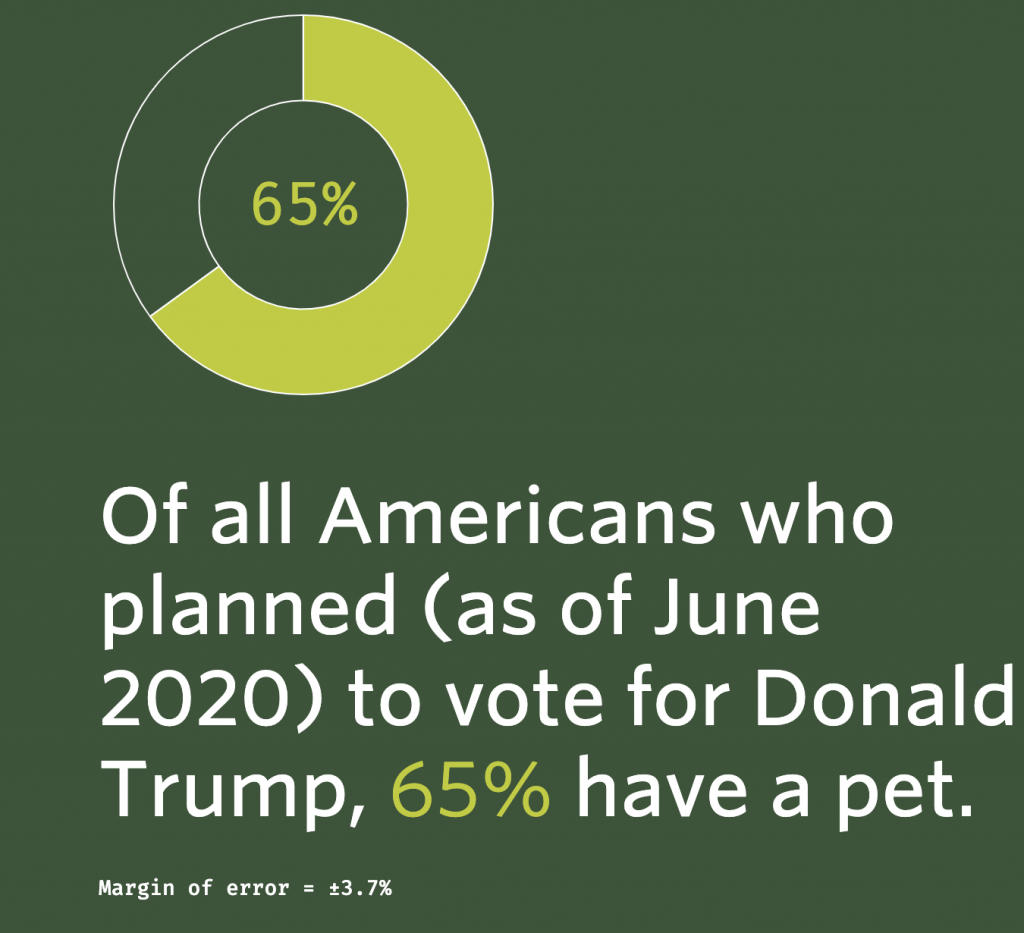
We surveyed a nationally representative sample of 1,267 Americans from May 29-June 10, 2020. Biden led by 50.5%-37%. That result is now far out of date. However, respondents answered more than 350 questions either in this survey or in surveys that they had taken previously. As a result, we are able to look at many more attributes of the electorate than in a typical political poll: matters like which chronic diseases Biden and Trump supporters have, whether they donate money to colleges, how they define their identity, and whether they have pets. (In case you’re wondering, Trump voters are 8 points more likely to have pets.) Given the remarkable stability of the race, I am confident these patterns still apply.

This new article on the Equity Research website provides a lot of detail. Here I’ll just share the portion about identity. All the statistics reported here are for likely voters: those who rated their own chances of voting in November 2020 as seven or higher on a 10-point scale.

Only 10% of whites said that race was important to their own identity (or “salient”). Among that group, Trump led by 61.5%-31%, whereas Trump’s lead among other whites was just 5 points (47%-42%–less than a majority).

More than half of African Americans (57%) said that their race was salient, and those African Americans supported Biden over Trump by 96%-3%. The margin was somewhat closer (80%-10%) among African Americans who did not report that race was salient

About one third (31%) of Latinos said that race was salient, and they favored Biden by 67%-23%. Among the majority of Latinos who said that race was not salient, Biden’s margin was somewhat narrower (60%-19%).

Biden led narrowly (48%-42%) among women who see gender as salient, but by a wide margin (52%-30%) among those who do not. Women who see gender as salient were also more likely to identify as conservative compared to women who do not see gender as important to their own identity (26% versus 18%). It appears that women who see gender as salient are more often expressing traditionalist views of gender rather than feminist views. Biden also performed better among men if they did not see gender as important to their identities.

Twenty-eight percent of voters reported that religion was important to their identity. Trump led 58%-31% among those voters, whereas Biden led by a similar margin, 58%-29.5%, among voters who did not see religion as salient.

As shown in Fig. 1, Biden led among all categories of people who felt that class was not important to their own identities, and especially among those in the lowest and highest income categories who felt that way. Trump led by substantial majorities among people who felt that class was important to their identities and were in either the low- or high-income brackets. In other words, Trump led among working-class people who identified with their class and among wealthy people who identified with their class.

More on the Equity Research website.

the debate shows why we need civic education

Imagine young Americans watching last night’s debate. Try telling yourself that we have a special problem with youth. Try telling yourself that young people’s understanding of the system, commitment to democracy, or civic and personal virtues represent particular deficits.

Young Americans do urgently need and deserve more and better civic education–meaning not only courses and curricula by that name, but a whole k-12 education that prepares them to be active and responsible citizens. This need is critical.

But the reason is not a decline in civic education since Donald Trump’s youth (or mine), nor a decline in young people’s knowledge, skills, and virtues. The evidence about how courses and requirements have changed over time is mixed and ambiguous, but we never offered much civic education. Outcome measures such as the NAEP Civics Assessment are remarkably flat. Certainly, American history is presented much better now than in my day, in part due to mountains of valuable scholarship.

Improving civics is an urgent need not because it used to be better but because older people have handed today’s youth a republic in disastrous condition. The fiasco of the debate serves as an apt metaphor for the whole system. One can assign most, or even almost all, of the blame for last night to Donald J. Trump; nevertheless, the debate encapsulates our whole era.

Civic education is not well positioned to address some aspects of the problem. For instance, presidential overreach is on Suzanne Mettler’s and Robert C. Lieberman’s list of Four Threats, but it is not something that civics can directly fix; nor is gerrymandering; nor is income inequality. Trump himself is a threat (according to me), and he must be dealt with at the polls and then perhaps in the courtroom, not in the classroom.

However, on their list are two problems that civic education can address: hyper-polarization and conflicts over who belongs in the citizenry. Students can learn to deliberate with people who disagree and can learn to understand, appreciate and include all their fellow Americans. Some would add misinformation as yet another threat, and it is also something that civics addresses.

Saving the republic is not the only reason to teach American history, government, and civics. These are intrinsically interesting and worthy topics. Learning about them enriches the mind and soul. And teaching social studies demonstrably improves reading scores. But saving the republic is a pretty good reason to focus on civics, now.

welcome to CivicGreen

Please check out CivicGreen, a project (and website) hosted at the Tisch College of Civic Life. Carmen Sirianni is the editor-in-chief; I’m the executive editor; and Ann Ward is the managing editor. The 15 or so other key people are listed here.

Per the website:

CivicGreen is a collaborative project among scholars and practitioners to enrich our democratic imagination and to expand our policy options for sustainable, resilient, and just responses to climate crisis in the United States in the coming decades. Our perspective is to locate civic engagement at the heart of work that needs to occur in communities of all kinds, across cities and regions, and among professional and other institutional partners that are key to solving problems for the long run.

CivicGreen is fundamentally about civic democracy at the intersection of green strategies to address our ecological and climate crises and to build healthy and sustainable communities for all.

I would add that the project is all about practical environmental solutions that engage the public. It’s less about public pressure to accomplish environmental policies (although pressure is essential) than about public engagement in the work of saving the climate.

what if the traditional and student-centered pedagogies go together?

I’m helping with the evaluation of a civic education curriculum. I don’t want to go into details because this is an unpublished evaluation for a specific organization in a particular context. However, I have observed an interesting pattern and wonder what explains it and whether it generalizes.

We asked both the students and the teachers about various pedagogies. For instance, the students were asked to evaluate statements like these (among others):

  • Memorizing facts was the best way to get a good grade from teachers my classes.
  • Teachers lectured, and the students took notes.
  • Students were encouraged to make up their own minds about issues.
  • Teachers encouraged students to express their opinions during class.

Their teachers were asked about the same list of pedagogies, but the questions for them were phrased in terms of how much they used each approach.

The goal was to distinguish various approaches and then correlate them with things like the number of correct answers to factual questions, students’ skills, and their beliefs about democracy. Then we could see whether, for example, students who discussed issues more in class were more confident about their skills for discussion. The findings wouldn’t be causal, but they would be suggestive.

In the actual data, the most teacher-centric and the most student-centric approaches (if you can accept those descriptions) correlated. For instance, there was a positive correlation (0.29) between “Teachers encouraged students to discuss political or social issues about which people have different opinions” and “Memorizing facts was the best way to get a good grade from teachers in my classes.” Likewise, there was positive correlation (0.28) between “Most students felt free to express opinions in class even when their opinions were different from most of the other students” and “Teachers required students to memorize facts or definitions.” The correlations were even larger in the teacher data.

Most of the student outcomes–especially their ability to answer factual questions–correlated positively with all of the pedagogies. Students were more likely to know the facts if their teachers lectured and if they discussed issues–not surprisingly, since these two pedagogies correlated with each other.

One interpretation is that some students just got more of everything than the others–their “dosage” was higher. But I don’t think so, based on what I know about the intervention. Besides, the questions weren’t phrased in a way that should measure dosage.

Another interpretation is that these approaches should and do complement each other. I can certainly see why good teachers might say both “I encouraged students to express their opinions during class” and “I placed great importance on students learning facts.” (These responses were correlated at 0.8).

A third interpretation is that these questions don’t yield valid data, because teachers and students are not very aware of the pedagogies they experience, and are especially unaware of how their experiences compare to others’.

I’m wondering whether the positive correlation between apparently contrasting teaching styles is commonly observed.

Four Threats to American Democracy

On Friday, September 25, from 12–12:45 p.m., I’ll be moderating a Zoom conversation with Suzanne Mettler and Robert C. Lieberman about their new book, Four Threats: The Recurring Crises of American Democracy. You can join us online.

The four threats are: partisan polarization, efforts to exclude some people from the polity, economic inequality, and executive aggrandizement. Mettler and Lieberman provide vivid historical narratives of five previous moments in US history when one or more of these threats almost brought us down. These narratives are compelling: well-told, full of overlooked but relevant characters and details, and suspenseful. They show that our republic has often hung by a thread. Worse, the solution to the threat of polarization has often been to forge an elite bipartisan consensus at the expense of society’s least advantaged, who have always included people of African descent. For instance, the truly dangerous partisan conflict of 1800 yielded to the “Era of Good Feelings” because of a bipartisan consensus to uphold slavery.

Mettler and Lieberman argue that although we have faced one or more of these threats before, now is the first time all four have come together.

We’ll discuss their argument, consider some of the historical cases, and focus especially on what we should do now.

make the Supreme Court much bigger

The Supreme Court of Spain has 79 judges. The Federal Constitutional Court of Germany has 16 members. The Constitutional Court of Italy has 15, but Italy is like many countries that also has a final appeals court for regular cases, and that tribunal is staffed by 350 judges.

I mention these examples in the context of arguments for “packing” our Supreme Court. Franklin Roosevelt’s effort to expand the court is usually presented as an example of executive overreach and a partisan ploy that backfired. But the problem with the current court is now critical.

Who would imagine that the following system could work? 1) One court has final jurisdiction over many fundamental issues that confront the society. 2) The public is divided over those issues. 3) There are two political parties, which hold incompatible views on those issues. 4) Justices appointed by each party regularly and predictably vote to decide cases in line with their respective party’s position. 5) Justices serve for life terms. 6) The president can nominate anyone he wants to be a justice. 7) A majority of the Senate must confirm. 8) The president and the Senate may be controlled by the same or by different parties.

Once those eight conditions are in place, it’s more or less inevitable that presidents will be unable to replace Supreme Court vacancies unless their party controls the Senate, but when it does, they will be able to confirm virtually anyone they like to a life term. The defeats of Bork and Garland simply reflected opposition parties making rational decisions in the system they were given, and we should expect tit-for-tat from now on.

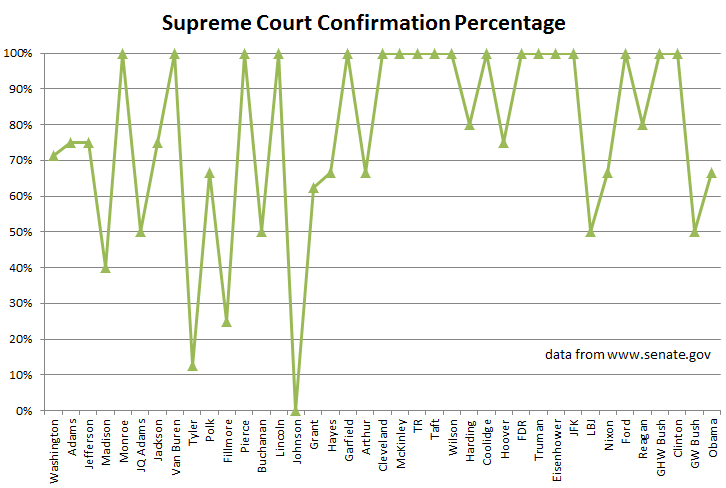
As I showed in a previous post, there have been periods when Supreme Court nominations have been uncontroversial. Those have been times of bipartisan elite consensus about constitutional questions. When that consensus has broken down, confirmations have been deeply contentious and the outcomes have been determined, to a large extent, by the luck of who controls which branch at which time.

If I could wave a magic wand, I would establish staggered terms for Supreme Court justices so that replacements become frequent. The stakes of each nomination would fall, and every president would be expected to have a strong but temporary impact on the court–as presidents influence the FCC. But this reform would require a constitutional amendment, since Article III, Sec. 1 decrees life terms.

An alternative is to change the number of justices. That is constitutional, since the number is set by a statute. But I’d change it a lot–to something like 25. Then turnover would be frequent, and the stakes of each appointment would be fairly low. I’d complement that change with a Senate rule that allows nominations to go through unless blocked by a super-majority.

In a large court, most cases are assigned to smaller panels–sometimes by lottery. There are reasonable processes for doing that. A larger court also has a much better chance of representing the diversity of the American people.

Letting the next president name 16 new justices seems a bit much (even if that president’s name turns out to be Joe), so I’d increase the size of the court by one seat every year for the next 16 years.

See also: reforms for a broken Supreme Court;  is our constitutional order doomed?are we seeing the fatal flaw of a presidential constitution?,  two perspectives on our political paralysis,  and the changing norms for Supreme Court nominations.

game theory games meant to play well on Zoom

It makes sense to introduce game theory by playing some games. Many online and in-person games are available for that purpose. A useful list of reviews is here. I could not, however, find games that would play well in a large virtual course, especially without a significant registration fee. So I made some up, and they seemed to work well in a class of 62 students yesterday. I am making them available here.

The games simulate:

  1. A pandemic at a university. (How much does each student comply with social distancing?)
  2. Carbon policy. (How much does each country reduce its emissions?)
  3. Carbon policy with negotiations; and
  4. An iterated commons game involving fishing.

Instructions are provided in the first sheet. In brief, an instructor should …

  1. Show students each sheet of the spreadsheet in turn.
  2. Read or briefly explain the scenario at the top. Do not answer questions about what the students’ objectives should be or what defines winning. Let them just play.
  3. Field a survey–using Zoom or another platform–with the choices that are presented in each scenario. E.g., The response options for the first scenario (the college pandemic) should be 0, 1, 2, 3, or 4.
  4. Enter the data from the survey in the grey cells of the sheet (e.g., cells B14-B18 in the college pandemic scenario). The other cells are all locked.

(In the second climate game, students should talk in breakout groups before they take the survey individually. In the fishing game, there are three rounds.)

  1. Discuss the results shown in the rest of each table once the data are entered.

Here are some questions for discussion:

  • A game has parameters–for example, the number of players, the choices they can make, and whether players can talk. What other parameters can you think of that go into a game? How do you know whether the parameters are right for the situation?
  • What assumptions do we make by using a game to model/represent/explain the real world?
  • What kinds of situations–if any–can game theory help to explain? (You might think of other examples or general categories of situations that games seem useful for.)
  • What kinds of questions can game theory probably not answer?
  • When introducing his idea of the “Tragedy of the Commons,” Garrett Hardin talks about the “solemnity of the relentless working of things,” “the inevitableness of destiny,” and “the futility of escape.” Did we see evidence today that disaster is inevitable when people try to coordinate their behavior? If not, is there anything valuable in Hardin’s idea?

You’re likely to get some intriguing specific results. For instance, when my students played the carbon-policy game, the global results were pretty good. (They’re a bunch of environmentalists.) I then put them in small groups to simulate negotiations before surveying them again. After their discussions, the global impact on carbon worsened. It appears that some of the groups became small conspiracies against the common good. Specifically, some students persuaded each other that they could get away with emitting more carbon.

To test whether this result generalizes, you would have to repeat it with controls. Maybe the result worsened just because it was the second try. In any case, it is fun to discuss the concrete results, form hypotheses, and connect the games to the real world.

See also: why learn game theory? (a lesson plan that includes a game) and these posts about game theory.

theorizing democracy in a pandemic

This is newly published: Peter Levine, “Theorizing Democracy in a Pandemic,” Democratic Theory, vol. 2, issue 2 (Winter 2020), pp. 134-142 https://doi.org/10.3167/dt.2020.070216. Abstract:

The COVID-19 pandemic raises questions about the future of democracy and civil society. Some recent predictions seem to use the suffering to score points in ongoing political arguments. As a better example of how to describe the future during a crisis, I cite the prophetic voice of Martin Luther King, Jr. King does not merely predict: he calls for action, joins the action, and makes himself responsible for its success or failure. With these cautions about prediction in mind, I venture two that may guide immediate responses. First, communities may erect or strengthen unjustifiable barriers to outsiders, because boundaries enhance collective action. Second, although the pandemic may not directly change civic behavior, an economic recession will bankrupt some organizations through which people engage.

The whole special issue on Democracy in the Time of COVID-19 looks interesting and is currently available for free.