CIRCLE has released a national survey of 2,645 eligible voters under 30 conducted between Nov. 3 and Dec. 2, 2020. Their release emphasizes that young people–especially those who supported Joe Biden–were highly engaged in the campaign, with nearly half talking to others about voting.
CIRCLE also notes the salience of anti-racism: “68% said they saw voting as a way to stop violence against people of color, 56% talked to peers about how racism affects society, and 57% say they took action for racial justice in their communities.“
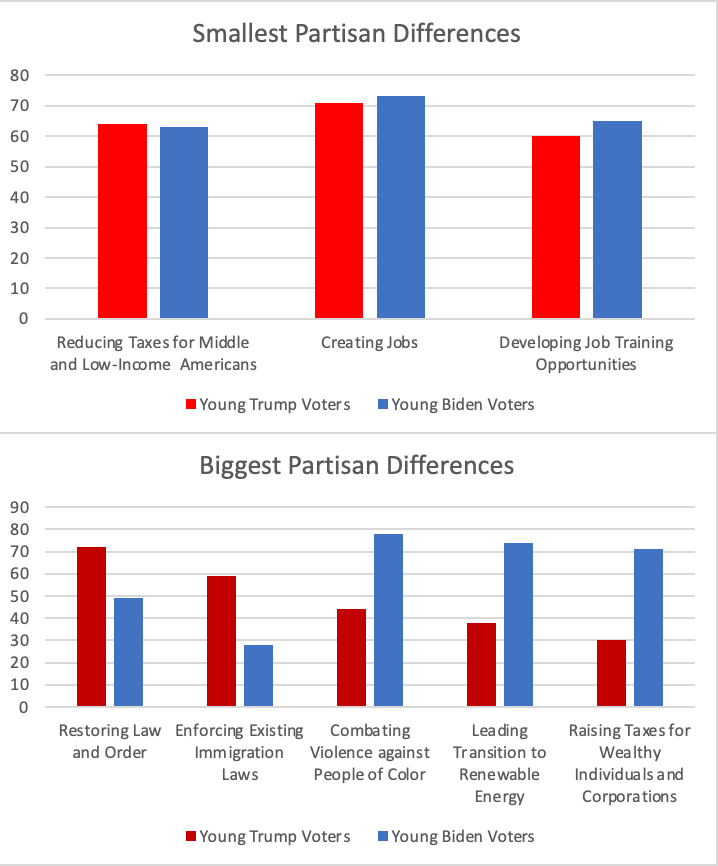
I was interested in the differences and similarities between young people who supported Trump and Biden (the latter being much more numerous). As shown below, they are indistinguishable on some economic issues. They differ a lot on “law and order,” immigration, racist violence, climate, and taxing the rich. However, it’s worth noting that 44% of young Trump voters favor reducing violence against people of color and more than a third want to move to renewable energy.
Hypothesis: People not only hold opinions about parties and specific issues; they also explicitly connect their various beliefs together to create more-or-less coherent logical structures. Understanding these structures yields insights about individuals that we would miss if we only knew a list of their opinions.
This thesis challenges a common assumption in political and moral psychology. Although scholars meticulously analyze the structure of the arguments in books, essays, and speeches, several streams of research suggest that ordinary people have no such structures–their political preferences are random, or chosen by elites, or driven by latent variables of which they are unconscious. I think that we won’t find the conscious structure in average people’s thinking unless we develop tools that can detect it.
Looking at some individuals
To that end, last summer I collected data from 100 Amazon Turk participants. I restricted the sample to liberal residents of the USA, in order to control the range of issues that would appeal to them so that I could analyze the small dataset effectively.
I showed each person a list of 30 ideas they might favor, about half of which leaned left. I simply asked, “Which of these would you like to see happen?” and encouraged them to be selective. Consistent with my effort to recruit liberals, they chose almost exclusively liberal items. For instance, 80% chose “health insurance for all” and zero chose “a return to traditional values.”*
After subjecting respondents to a bit of explanation and training, I showed them their own chosen items in pairs (in random order). For each pair, I asked, “Are you in favor of X because you are in favor of Y?” Each time they said yes, that created a link between two nodes (or an edge between two vertices, if you prefer the technical language). From these responses, I was able to generate network maps for each person and for groups.
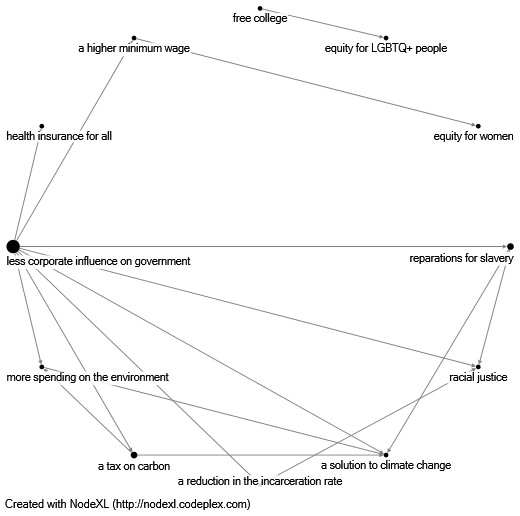
Here is one such map. This person is a white man, age 32. He places himself as far as possible to the left on a unidimensional ideology scale and he says that he agrees with AOC most often, followed by Bernie, then Warren, then Obama, and finally, Biden. He believes that eight things that he would like to see happen (e.g., health insurance for all) provide reasons to reduce corporate influence on government. He also sees an indirect link between reducing corporate influence and racial justice (by way of reducing incarceration) and an indirect link to the environment (by way of enabling a tax on carbon). However, he doesn’t connect political reform to free college or LGBTQ+ issues, although he cares about those issues and connects them.
In short, his network is highly centralized around reducing corporate influence. This seems like an important fact about how he thinks.
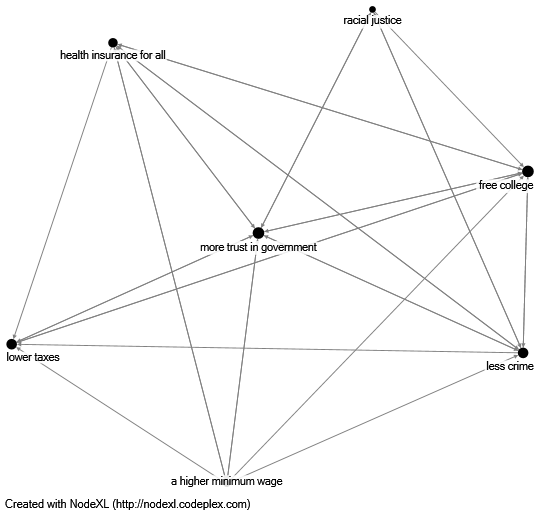
Below is another map, this time for a white woman, age 30, who ranks the Democratic politicians in precisely the opposite order as the man did (Biden first; OAC last). However, she ranks herself as a one on a 0-10 ideology scale, i.e., very liberal.
Her graph is more complex than the man’s. She is 3.6 times more likely than he was to see any given pair of ideas as a connection. Two-thirds of her arrows are double-headed. (She favors less crime because she favors more trust in government, and vice-versa.) You can move around her graph from one item to the next, and then onward. It is not centralized around any single node.
As noted, I first asked respondents whether each of their goals provided a reason for another goal. It was up to them what counted as a “reason.” I believe, however, that we can put ideas together in numerous ways, with a range of logical connectors. A justification is one link; a cause is another.
Therefore, I next showed respondents pairs of outcomes and asked whether each one would cause the other one. I included outcomes that they had not selected in the first place, because you might not select something as a high value even though it causes an outcome that you do value highly.
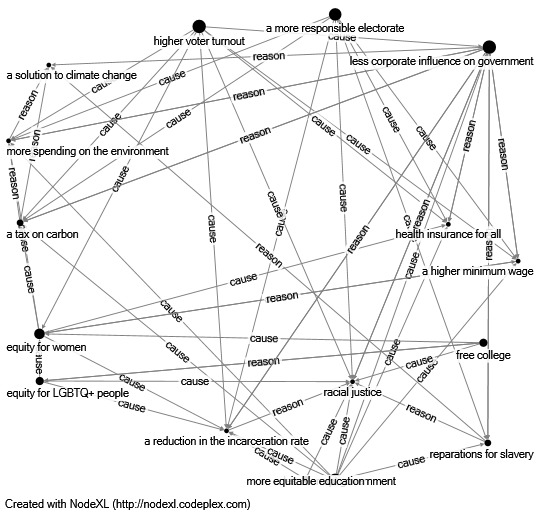
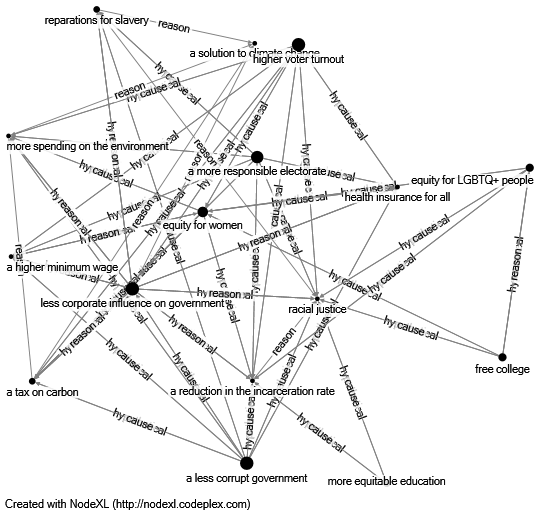
Here is the first respondent’s map with the causal connections added in:
It becomes complicated–perhaps too complicated to understand visually. But it’s clear that he believes higher voter turnout and a more responsible electorate are “upstream” factors–they cause many desirable outcomes–even though he did not initially choose them as his priorities. It makes sense to me that they are means to the ends he favors.
Finally, I showed respondents random pairs of items and asked, “Imagine x happened. Would that change your opinion by making you more supportive of y?” This produced another kind of connection (hypotheticals), which I can add to the first respondent’s map along with the causes and reasons:
Metrics suggest that this addition doesn’t actually change this person’s map very much, although it adds a few ideas at the end of arrows.
An example: the role of reparations in the mentality of the left
Months ago, I hypothesized that reparations for slavery play an important role in the thinking of left-liberal Americans. Progressives oscillate between hostility to the US government and desire to expand federal economic action. If the government paid reparations, progressives would trust it more and would therefore tilt to democratic socialism.
I can identify some individuals who may exhibit this logic. For instance, here is a 40-year-old white woman who favors a set of progressive outcomes and sees all of them as reasons to reduce corporate power over government (rather like the first man discussed earlier):
She did not select reparations as one of her original priorities, but she was asked whether actually seeing reparations happen in the world would make her more favorable toward other outcomes. She said it would make her more supportive of 10 things, including trust in government and civility. One can imagine that she thinks: if the government paid reparations, I would want people to trust it and would want citizens to be civil to each other, because the regime would be more legitimate. However, this is largely my inference about her responses, and it’s not a common pattern in the data.
These are three examples from the 100 cases that I collected. I have many more to look at, and I have IRB permission to interview selected respondents about their reasoning.
Aggregate results
I am also interested in examining the aggregate data. One evident finding is that people’s top priorities for how they would like to see the world change are not the same as the factors they see as most influential.
In my sample, the most frequently chosen goals are:
health insurance for all
a solution to climate change
a higher minimum wage
racial justice
more school choice
The items that are seen as having the most direct effects on other items are:
health insurance for all
a less corrupt government
less corporate influence on government
a more responsible electorate
more equitable education
And the items that have the most links of any kind to other items are:
health insurance for all
a less corrupt government
racial justice
more trust in government
economic growth
Healthcare hangs in there as the top priority however you slice it. However, better government and economic growth–which are not chosen as high priorities from a simple list–emerge when people think about various kinds of premises or causes for the things they do value.
Another method would be to measure the relationships between people’s networks of ideas and a different variable of interest. I was planning to look at self-placement on an ideological scale, but my sample clusters together too closely. Seventy-four percent rate themselves between 0 and 2 on a 0-10 scale.
Instead, I am using as the dependent variable how people rank AOC compared to other Democratic politicians. I chose that outcome because her ranking correlates most strongly with ideological placement, and also because the biggest negative correlation in the whole matrix is between her rankings and Joe Biden’s (-0.67). Plus, her rankings have a nice distribution: the median is 3 on a 1-5 scale. So I take her strong supporters and opponents to mark the ends of a meaningful spectrum within the US left.
If we simply correlate the priorities that people choose (or don’t choose) with their rankings of AOC, then the correlations that are significant are:
more school choice and racial justice (which were chosen by identical people*)
equity for LGBTQ+ people
(not choosing) economic growth
(not choosing) less crime
(not choosing) a reduction in government debt
These correlations make intuitive sense to me. Among liberals, those who care less about crime, deficits, and growth would like OAC best.
If you put all the choices together with the demographics and ideology in one linear regression model to predict support for OAC, it does a decent job (r-squared = 0.488).** However, none of the individual items (including ideology) are statistically significant. One could conclude that knowing which items people pick helps you to predict their opinion of AOC, but you need to know most of the items.
If, instead, you look at which items people thought were reasons for other items, the model is more predictive (r-squared = .608 with the same number of variables) and ten items become stat. sig. on their own (p <.05). Knowing that an individual sees one of these items as a reason for other items gives a basis to predict that this same individual likes (or dislikes) AOC.
That seems like confirmation of my original hypothesis. The structure of people’s beliefs–more than the things they support–predicts a consequential opinion. However, I am still working on the regression and other aggregate methods; suggestions are welcome.
YouGov reports: “One in five voters – including 45% of Republicans – approve of the storming of the Capitol building.” This is important and bad news. I do not want to minimize it, but I would put it in context.
A bit under half of Republicans support the riot in DC. Republicans represent about 29% of registered voters. Registered voters represent about two-thirds of adults. Adults represent about three-quarters of Americans. By the time you isolate Republican registered voters who support the riot, it’s down to about 6.6% of the population.
To be sure, some of the people in the other pie slices are also part of the problem. For instance, within the “other” slice are 2% of the registered Democrats and 21% of the registered Independents who support the riot. (A total of 10.1% of all Americans support the storming.) Most of that slice consists of people who don’t have an opinion, which is a problem in itself. And among the under-18s and the non-registered people, some probably hold views aligned with Trump.
Still, it is worth putting the hard-core problem in some degree of perspective. My guess is that the images from yesterday will basically become the capsule summary of the Trump years, except for a smallish and dwindling proportion of Americans.
(Survey data from YouGov. Registration percentages from Pew, 2018. Age distribution from Census, 2010.)
The SNF Agora Institute at Johns Hopkins University has published three cases about the choices and dilemmas that confront groups of people who strive to make social change. These are like business-school cases: they are factual narratives that conclude with moments of choice that are meant to be discussed in groups, whether in high school, college, or in movements and organizations.
I am proud to have played a role in the project from the start. We felt that cases are really useful for teaching and professional development, but most actual cases provided by business schools, schools of public policy, and wonderful initiatives like The Pluralism Project and Justice in Schools focus on individual protagonists. We were interested in voluntary groups that must deliberate before they can choose. David Moss’s excellent Case Method Project does some of what we intended, but its focus is on high schools and American history, whereas we wanted to serve social movements with some current examples.
These are free, and we would love to know how they work in various settings.
What objectives, targets, strategies, demands, and rhetoric should a nascent social movement choose as it confronts an entrenched system of white supremacy? How should it make decisions?
The Montgomery, Alabama, Bus Boycott of 1955–1956 is a classic example of a social movement episode that accomplished its immediate goals despite severe obstacles. It catapulted the 26-year-old Rev. Martin Luther King Jr. into international prominence and launched similar episodes in many American cities across the South and then also the North. By investigating their situation and choices, you can develop skills and insights to use as activists today.
Should a faith-based organization take on an issue not of its choosing? Can relational organizing help its leadership support a new mayor while also engaging their base and holding their coalition together?
This is a case study about an organization in Minnesota called ISAIAH, a faith-based organization that works to expand the power and influence of people who have often been overlooked, especially poor people and people of color.
This case examines what happened when, to support a new mayor with whom the organization wanted to work, ISAIAH became involved in a divisive issue—not of its own choosing—that revolved around garbage. ISAIAH faced at least three choices: 1) stay out of the fight over garbage; 2) use mobilizing techniques to help the mayor win the garbage issue; or 3) use relational organizing to enter into a power relationship with the mayor in the garbage fight—even though most of the people in ISAIAH’s networks didn’t care much about the issue.
Can faith-based organizers garner enough support to win universal preschool in a racially divided city? How should a grassroots group manage a disagreement with its own powerful coalition partners?
This case study is about the AMOS Project, an organization in Cincinnati, Ohio, and its grassroots efforts to pass legislation that would provide preschool education for most of the city’s children. AMOS’s grassroots efforts increased the political pressure to pay for the program, but at one point, the whole effort seemed likely to fall apart. How could a grassroots network of congregations manage a disagreement with allies in the business community and achieve its goals?
Below is an excerpt from a new article of mine in a special issue of The Bridge on “complex unifiable systems.” The Bridge is a quarterly journal of the National Academy of Engineering. The article and the whole special issue are available free. Several other contributions may also be interesting to civic and political people. I would cite this piece as: Peter Levine, “The Complexity of Civic Life,” The Bridge, vol. 50, no. 4 (Winter 2020), pp. 34-6
Imagine that some college students have volunteered to serve meals at a homeless shelter. They love the experience because they are helping others. During the reflection session after the meal, one student remarks, “Serving the homeless was so great! I hope this shelter will still be open 50 years from now so that my grandchildren can also serve here.”
The progressive educator who has organized this experience is horrified and says, “No! Our goal must be to end homelessness. You must think about root causes, not treat the most superficial symptoms. What are the fundamental causes of homelessness?”
Chastened, the students debate the root causes. Some argue that homelessness results from poverty, which, in turn, is a byproduct of capitalism. Others counter that the root cause is the cost of real estate, which is inflated by -zoning laws. They are deep into a discussion of capitalism and the state when the Brazilian legal theorist and former cabinet minister Roberto Mangabeira Unger happens to walk by.
“Stop this!” cries Unger. “You are looking for fixed, simple, law-like causal relationships. We human beings have made the social world. What we have made, we can also change—not just the components, but also the many ways they fit together and affect each other.”
Unger (who is famous for long speeches) continues, “By looking for root causes, you are limiting your imaginations, assuming that the only important changes are the hardest ones to accomplish. Be more creative. What if we got rid of all zoning and rent control but also gave everyone a voucher for free rent? What if public buildings were retrofitted to allow people to sleep comfortably in them at night? What if houses were shared, and homeless people occupied the temporarily empty ones? What if…?”
The Myth of the Root Cause
I have invented this fable and Unger’s words, but I am paraphrasing portions of his False Necessity (2004) to support a serious point.
A rootcause is a metaphor. The root is literally the vital part of a plant that is hidden from sight; digging it up will kill the whole organism. The word radical derives from the Latin word for root. The educator in my fable thinks he is radical because he directs his students to the deepest, least visible, and least tractable aspect of the problem, assuming that attacking a root is the way to a permanent solution.
But a social problem rarely has one root cause or leverage point. Many factors combine to determine results. The same variables that are outcomes are also inputs or causes. Virtuous and vicious circles and feedback loops are common phenomena that illustrate a broader point: any society is a complex network of causes and effects. Interventions are possible at multiple points.
Strategies and Skills for Networks of Causes
Like a root, a network is a metaphor (or mental model) for describing reality, but the difference is important. To improve a society viewed as a complex network requires particular skills and strategies—not those favored by would-be “radicals” who insist on focusing only on “the root.”
First, strategies should be tailored to an individual’s or organization’s location in the network. Management scholar Alnoor Ebrahim (2019) argues that organizations differ in how reliably they can predict outcomes in a system as a whole. They also differ in how much control they can exercise over their portions of the system.
These are two distinct dimensions. With low control but the ability to make reliable causal predictions, a wise strategy may be to identify a specific niche where the organization can operate effectively. …
“We are unique among militaries,” [Acting defense secretary Christopher] Milley said in a Nov. 12 speech at the new National Museum of the United States Army. “We do not take an oath to a king or a queen, a tyrant or a dictator. We do not take an oath to an individual. No, we do not take an oath to a country, a tribe or a religion. We take an oath to the Constitution.”
This claim is very easy to fact-check. It takes seconds to find these examples:
Germany: “I swear to loyally serve the Federal Republic of Germany and to courageously defend the right and the liberty of the German people, so help me God.”
France: “I swear to fulfill my duties well and faithfully, to observe the duties and the reserve they impose on me. I will strictly comply with the orders received with respect for the human person and the law. I promise to demonstrate dedication to the public good, righteousness, dignity, prudence and impartiality. I undertake to make only legitimate use of the force and powers entrusted to me and not to reveal or use anything that will be brought to my attention during the exercise of my functions” (for reservists).
Israel: “I swear and obligate myself on my word of honor to remain loyal to the State of Israel, its laws and its legitimate administration and to devote all of my strength, and even to sacrifice my life, in the defence of the homeland and the freedom of Israel.”
Finland: “Everywhere and in every situation, whether in peace or war, I will defend the inviolability of my fatherland, its legal system of government and the legal authority of the realm. If I perceive or gain knowledge of activity to overthrow the legal authority or to subvert the system of government of the country, I will report it to the authorities without delay.” (excerpt)
Switzerland: “I swear to serve the Swiss Confederation with all my might; to courageously defend the rights and freedom of the Swiss people; to fulfill my duty, at the cost of my life if necessary; to remain faithful to my troops and to my comrades; to respect the rules of the law of nations in time of war.”
China: “I pledge to be loyal to the Constitution of the People’s Republic of China, safeguard the authority of the Constitution, fulfill the legal responsibilities of my position, be loyal to the Motherland, be loyal to the people, show the utmost respect for my duty, pursue public affairs with integrity, accept the supervision of the people, and to work for a great modern socialist country that is prosperous, strong, democratic, culturally advanced, harmonious, and beautiful!” (This is for the Central Military Commission, not for regular officers, to my knowledge).
I am fascinated by the tendency to assume that good things about the USA are unique in the world. My favorite example was when a judge told me and my peers on a jury pool that we should be proud to live in the only country that provides a right to trial-by-jury (overlooking about 50 others).
One interpretation is that this is just harmless enthusiasm. Instead of saying, “Yay, America!” people say, “Only in America!”, meaning the same thing.
Another interpretation is xenophobia. To assume that all other other militaries of the world (including our NATO partners) swear oaths to a “king or a queen, a tyrant or a dictator” is to hold a very dark view of the world beyond our borders.
I suppose Mr. Milley’s claim could be partially defended on technical grounds. Many oaths mention the country or law, not the constitution, per se. Canadian and British officers swear oaths to the Queen, although that’s a way of expressing loyalty to a constitutional democracy. The oath to uphold the constitution of the PRC is a bit hollow, given one-party control. Then again, what about Germany, Israel, France, etc., etc.?
My own theory is anxiety. If Americans do something wise (like requiring our soldiers to swear to uphold our constitution)–and so do many other countries–then comparative questions naturally arise. How do various countries manage their civilian-military relations? How seriously do their commanders-in-chief take their oaths? Sometimes, the USA looks good in comparative perspective; but sometimes it does not look good at all. And deep down, I think a lot of Americans are conscious of relative decline compared to the competition. One way to avoid facing that anxiety is to proclaim, “Only in America!” and refrain from looking overseas at all.
I’d like to see the question of American exceptionalism become more empirical and less ideological. In what respects is the USA unique? That is a question that can be answered. Students, civil servants, judges, and all Americans should have the courage to ask it seriously and see what they find.
Here is a recording of “The Promise of Civic Renewal to Revive our Democracy” on Dec. 10, 2020. It was the final event in the “Let’s Talk about Our Democracy” series, hosted by Mass Humanities. I talked with Program Officer Jennifer Hall-Witt about reviving our democracy, focusing on the role that ordinary citizens can play in fostering more deliberative, collaborative, and engaged communities. This conversation was based on We Are the Ones We have been Waiting For: The Promise of Civic Renewal in America, but we discussed ways in which the situation and my views have changed since that 2013 book.
(Incidentally, I will deliver the final manuscript of my next book, What Should We Do? at the end of this month. It is meant to complement, not replace, We Are the Ones–adopting a more theoretical and global perspective, whereas We Are the One applies the framework specifically to the USA in our time. But that means that the specific strategies of We Are the Ones need to evolve.)
One of the things people do in meetings and other discussions is to express dissenting opinions even though they know they will not be persuasive. They say some version of, “For the record, I think …”
For the purpose of this post, I’ll exclude situations in which these statements are really meant for an external audience, such as the broader public or future members of the same group. Chief Justice Charles Evans Hughes once wrote that a judicial dissent is “an appeal … to the intelligence of a future day, when a later decision may possibly correct the error into which the dissenting judge believes the court to have been betrayed.” Here I will focus on statements that are only heard by the rest of the group in real time, when there is no chance of persuading the others–for instance, after the decision has been made.
As it happens, I almost never make such statements. Perhaps because of the privileged or comfortable role I usually play in discussions, I usually feel it would be unhelpful to express dissents unless I can persuade. Otherwise, I keep any concerns to myself. And I think that is right.
However, I would sometimes defend the expression of dissent even when it’s not pragmatically effective–even when it cannot change opinions. I think it navigates usefully among the three options that Albert O. Hirschman identified for people who disagree with a group to which they belong: “exit,” “voice,” or “loyalty.“
In Hirschman’s great book, “exit” means leaving the group or the institution, thus preserving your freedom and possibly disciplining the group by removing your contributions to it. “Voice” means trying to persuade the group to change. And “loyalty” means going along with the group because it has sufficient value to you.
To express a dissent is a little different from all three. It’s a version of loyalty, but with a dollop of resistance. It’s a use of one’s voice, but not “voice” in the sense of attempting to persuade. And it involves exiting–not from the group, but from the decision.
I would compare what Tommie Shelby has called “impure dissent.” He interprets rap artists who write intentionally offensive lyrics (including violent and misogynistic ideas) as saying: I do not endorse the racist society that I must belong to. I have no hope for revolutionary change. I cannot exit. My voice will not persuade white people (or perhaps anyone) to reform this society. I am going to do what the system allows, such as selling my music for money. Yet my lyrics express my dissent. They express that I do not endorse what I am part of.
Shelby contrasts “voice as influence, which is aimed at altering the status quo, with voice as symbolic expression, which is not primarily concerned with its impact on those in power.” For him, objective injustice provides an ethical justification for the symbolic expression in rap. Rappers’ impure dissent is justified because they are oppressed.
I agree with his argument and would generalize it to some people who are not oppressed. Expressing symbolic dissent without exiting may be appropriate for anyone who is simply outvoted. Of course, you can do this in a polite way if you are not oppressed. You can avoid burning bridges. In essence, you are making a contribution to the group by not leaving it, but you are asking for that contribution to be recognized. And you are retaining self-respect by clarifying that your will is not reflected in this particular collective decision.
To do this too much or too easily can be self-indulgent and can put unreasonable burdens on the group. But sometimes symbolic dissent enriches the group by clarifying that its members are demonstrating loyalty despite disagreements, by setting a precedent for other people to disagree and differ, or by simply informing everyone that some members are unhappy.
More generally, I believe that we do many productive and appropriate things when we talk in groups, and making proposals with reasons is only one of those things. Many of our speech-acts are ways of keeping the group together so that it has enough social capital to act, thereby making the discussion worthwhile in the first place. I would classify symbolic dissent as one kind of speech that may–when used appropriately–contribute to the maintenance of a group that can then do what its members decide.
In a famous paper,* Harry Frankfurt argued that we have freedom of action if our desires match our behavior. I want a chocolate chip cookie; I eat the cookie; thus I demonstrate free action.
But we have freedom of the will insofar as we can control the desires we have. I want the chocolate chip cookie, but I wish that I did not. If I can influence my own desire for cookies, I demonstrate freedom of the will.
Thus the ability to have second-order volitions (desires about desires) is the trait that we value as moral freedom–it is what people have tried to express by describing human beings as metaphysically free. “A person enjoys freedom of the will [if] he is free to want what he wants to want.”
For Frankfurt, the difference between free, morally responsible agents (“persons”) and all other actors (“wantons”) is not that persons can control their desires; it is that they can form desires about those desires. In contrast, “The essential characteristic of a wanton is that he does not care about his will.”
Although Frankfurt does not use the language of identity in this paper, he offers an implicit theory of it. We are the coherent structure of our own desires, and if our desires fail to cohere, our identity is at risk. He imagines a person who has conflicting second-order desires that prevent him from preferring some of his first-order desires over others. Frankfurt doesn’t offer a concrete example, but perhaps this person wishes that he were more conservative and also wishes that he were more radical, and he cannot resolve that difference. In that case, the person would be torn every time he saw a tweet by AOC. “This condition, if it is so severe that it prevents him from identifying himself in a sufficiently decisive way with any of his conflicting first-order desires, destroys him as a person.” He becomes a “helpless bystander to the forces that move him.”
This is strong language, and I’m inclined to interpret Frankfurt’s theory as a matter of degree. We are more or less free to the degree that our first-, second- (and even third- and fourth-) degree volitions cohere and are consistent with our actions. Nobody has 100% freedom of the will.
Frankfurt says his position is compatible with determinism. That is, even if our minds are caused in the same way that other complex objects (computers, forests, stock market prices) are caused, we have free will to the extent that we form effective second-order desires. He even entertains the possibility that whether we have free will or not is determined. For instance, some kinds of parenting develop a capacity for second-order volitions and some don’t, but we don’t chose our parents. (This is my illustration, not his).
Now consider a certain tradition in Buddhism, which I derive mainly from US academics like Owen Flanagan, Mark Siderits, Bryan Van Norden, and Emily McRae and the classical Asian texts they quote.
Buddhism is a deterministic philosophy: all of our thoughts result from ordinary causes, just like the causes of the weather. (That is the doctrine of Dependent Origination.) We have desires without wanting them. Some of these desires are undesirable, and we can use mental techniques to marginalize or neutralize them.
So far, the view seems similar to Frankfurt’s. But in Buddhism, all desire is problematic. It has an intrinsic connection to suffering. That means that even if some desires are worse than others, we are wise to reduce desire per se.
Furthermore, we have no identity. (That is the doctrine of No Self). We are only a stream of specific feelings and beliefs. Wisdom comes from recognizing that there is no stable entity beneath that stream, and certainly nothing there that should concern us.
Frankfurt does not spell out practical or spiritual implications. To apply a distinction from Pierre Hadot, he is an academic or a scholastic philosopher, not a practitioner of Philosophy as a Way of Life. But his theory could imply that we should reflect as self-consciously as we can about our own desires. When we experience a bad desire, we should acknowledge that it partly defines our identity, so we had better get rid of it. A good way to counter bad desires is to give oneself reasons against them. Reasoning is also our way of knowing which desires are bad in the first place. For instance, if you feel a sexual desire, that partly defines you unless you decide that it is immoral and renounce it. A moral exemplar is someone who looks deeply and uncompromisingly into herself for the purpose of self-improvement.
In contrast, the advice from Buddhism is not to dwell on the desires that arise for us. Do not embrace them or cling to them, but also do invest emotion in denouncing or shunning them. Name them, acknowledge them, and try to set them aside, recognizing that their origins are natural (for everything that happens = nature), and we are not responsible for them (because we don’t cause anything), but we are better off without them.
Compassion functions differently from other first-order volitions in Buddhism. Because compassion is the desire for others to suffer less, it is not strictly a form of will. Spending more time and affect on compassion thus reduces our will, overall.
You could say that Buddhism recommends a second-order volition to be a more compassionate person. But Buddhism does not see us as persons. Therefore, an alternative interpretation is that Buddhism simply recommends compassion. Buddhism encourages you to practice or habituate yourself to compassion rather than reflecting abstractly on whether your identity is compassionate.
As long as we consider examples like wanting to eat chocolate chip cookies, this issue feels harmless or even amusing. But once we start thinking about serious personal vices, like envy and lust–or real social injustices, like sexism or racism–the stakes rise. Then it becomes a compelling question whether we should exercise freedom of the will by relentlessly critiquing our own desires or else freedom from the will by putting all our desires (apart from compassion) to the side.
I got a question recently about whether the purpose of deliberating is to reach consensus. (Here we can define a “deliberation” as any conversation that is at least partly about what the group should do and why.) A related question is whether making a proposal or a claim in such a discussion is tantamount to requesting consensus. One view is that consensus-seeking speech is desirable because it forces us to give good reasons that are acceptable to all.
I think that people do a range of things in deliberative conversations, and all of the following can be appropriate:
Seeking the other participants’ sincere agreement about both reasons and conclusions. (This is seeking consensus)
Signaling one’s own goals and hearing other people’s goals in order to ascertain what might work for a negotiated settlement or modus vivendi.
Using speech to build positive emotions and group ties so that members come to value the maintenance and the harmony of the group, thus modifying their goals. This is one purpose of light humor, exchanges of news, expressions of concern, etc.
Ascertaining what each individual is renouncing in order to go along with the group and acknowledging those sacrifices.
Making commitments.
Giving reasons or challenging other people’s reasons with the intention of expressing and recording important points, without really expecting them to change the outcome. (“Just for the record, I want to note …”)
People also do these things:
Misleading people or tricking them into adopting conclusions that they wouldn’t accept if they could think more clearly.
Maintaining a group’s orthodoxy and marginalizing ideas that might upset it.
Using a superior bargaining position (e.g., more-than-average wealth, or the ability to withdraw a valuable resource) to get what they want.
Using time for tactical purposes. This can mean filibustering (using up time because they are satisfied with the status quo) or ending the discussion because they fear it will go the wrong way.
Agreeing with other people out of insecurity, subservience, passive-aggressiveness, etc.
Demonstrating loyalty or partiality toward specific individuals in the group by agreeing with what they say or would say.
Asserting dominance, threatening, bullying, settling scores, targeting people to be excluded
Enjoying listening to themselves speak.
On the whole, and with some exceptions, the acts on the first list are good and the ones on the second list are bad. However, assessment requires knowing more about the composition and purpose of the group. A fascist council could deliberate, whereas a benign group could display some of the less-valuable forms of discourse.
In fact, consider these excerpts from a Wikipedia entry. In square brackets, I have put references to the list above. I have added negative numbers where the text suggests that the particular form of discourse was excluded.
At 17:00 on 24 July 1943, the 28 members of the Grand Council [of Fascism] met in the parrot room (the anteroom of the globe saloon, the office of Mussolini) in Palazzo Venezia.
For the first time in the history of the Grand Council, neither the bodyguard of Mussolini, known as the Duce’s musketeers, nor a detachment of the “M” battalions were present in the Renaissance palace. [- 13] …Grandi brought two hidden Breda hand grenades with him, in addition to revising his will and going to confession before the meeting, because he was under the impression that he may not leave the palace alive. [-11]
Mussolini began the meeting by summarizing the history of the supreme command, trying to show that the attribution to him had been sponsored by Badoglio. He summarized the war events in the previous months, saying that he was ready to move the government to the Po valley. He concluded by asking the participants to give their personal opinion about what he called “il dilemma”: the choice between war or peace [1]. The Duce knew that, except for the three or four men against him, the “swamp” was undecided. He hoped that he could convince them to vote for [resolution] which gave only the military powers back to the King. …[1]
[After various speeches,] Farinacci said that in order to win the war it was necessary to wipe out the democrats and liberals still nested in the Party, as well as the generals. He wanted to give the supreme command of the armed forces back to the King and unify the war direction with Germany, all of which would strengthen the Party [1]. After some minor interventions, Bottai, the Fascist intellectual, made a purely political speech defending the [resolution] [14] …
At 23:30, the Duce announced that, due to the length of the meeting, some comrades had asked for a postponement to the next day [10]. At this point, Grandi called for a vote on his [resolution], saying that it was shameful to go to sleep when Italian soldiers were dying for their fatherland [10].
Never before in the 20-year history of the assembly had anyone asked for a vote. Since fascism was strongly anti-parliamentary, in all previous meetings only discussions summarized by the Duce had taken place [-2]. Mussolini unwillingly agreed, and at midnight the meeting was suspended for 10 minutes [10]. In the meantime, Grandi collected the signatures to his [resolution].
After other interventions for and against the [resolution], Mussolini told the participants to reflect on their decision since the approval of Grandi’s [resolution] would imply the end of Fascism [3 and/or 8]. … He said this was not about him, but he was sure that the war could be won [1]. …
Grandi said that the Duce was blackmailing all of them, and if one must choose between fidelity to him and loyalty to the homeland, the choice was clear [1, -12].
At this point, Scorza caught everyone by surprise by presenting his own [resolution]. This proposed the nomination of the three war and interior ministers, all under Mussolini, and the concentration of power in the hands of the Fascist Party [11, 13]. His speech hurt the Duce’s hopes of defeating Grandi since the Party was discredited among almost all the high-ranking Fascists. …
After other interventions and nine hours of discussion, Mussolini declared the meeting closed at two o’clock in the morning and ordered Scorza to proceed with the vote. [10] … In the end, … Grandi obtained 19 votes for [his view], with 8 against. Mussolini declared the document approved and asked who should bring the result to the King. Grandi answered: “You”. The Duce concluded: “You provoked the regime crisis”. After that, Scorza tried to call the “saluto al duce“, but Mussolini stopped him [11]. …
After that, before reaching his wife in Villa Torlonia, Mussolini telephoned his mistress, Claretta Petacci. During his conversation, which was bugged, he told her in desperation: “We arrived to the epilogue, the greatest watershed in history”; “The star darkened”; “It’s all over now.”
These people were thugs and warmongers. They deserved the grisly ends that several of them soon met. Nevertheless, they displayed a characteristic mix of communicative actions while making a collective decision. Some of their moves–such as trying to resist a vote in the name of unity–are especially common in benign groups.
The bottom line is that we do many things with words while we are trying to make decisions. There is value in assessing speech-acts generically, but a great deal depends on the overall purpose and composition of the group.