syllabus of a course on the Philosophy of Martin Luther King, Jr.

Summary

In this seminar, we will study Martin Luther King Jr. as a political thinker. The whole class will read major works by King and excerpts from biographies and historical documents. Additional readings will be distributed among students, who will contribute insights from their assigned texts to the seminar discussions. The additional readings will include works that influenced King, writings by some of his contemporaries, and recent interpretations. We will investigate King’s understanding of the Civil Rights Movement—why it was necessary and what it aimed to achieve. Specifically, we will study his ideas about the political and economic organization of white supremacy, the impact of racial ideologies, and the importance of racial integration and the right to vote. We will investigate King’s philosophy of civil disobedience and nonviolence as well as a set of values he relates to that philosophy: dignity, sacrifice, self-reflection, self-improvement, love, faith, and freedom. We will relate these values to King’s understanding of justice. Criticisms of King will also be considered. Studying King and his critics will provide a window into post-WWII American political thought. (This course is the Capstone for the Civic Studies Major and open to other majors.)

Grading rubric:

  • Regular participation in Canvas discussion threads about the readings: 40%. I will post a prompt one week before each class session, and you will reply to my prompt before class. Reading and responding to other students’ comments will be appreciated but not graded.
  • 5-page paper, due at the end of the semester: 30%
  • class participation: 30%

Criteria for assessing class participation:

  1. Attendance. 
  2. Engaging in a discussion that is informed by the assigned texts. 
  3. Focusing on the topic and the texts, which does not preclude drawing connections beyond them.
  4. Being responsive to other students. Responsiveness needn’t always be immediate, verbal, or occur within the class discussion itself.
  5. Building on others’ contributions, and sometimes making links among different people’s contributions or between what they have said and the text.
  6. Demonstrating genuine respect for the others, where respect does not require agreement. In fact, sometimes respect requires explicit disagreement because you take the other person’s ideas seriously.
  7. Taking risks, trying out ideas that you don’t necessarily endorse, and asking questions that might be perceived as naive or uninformed.
  8. Seeking truth or clarity or insight (instead of other objectives).
  9. Exercising freedom of speech along with a degree of tact and concern for the other people.
  10. Demonstrating responsibility for the other students’ learning in what you say (and occasionally by a decision not to speak).

Syllabus

Introduction

Monday, Feb 1: Introduction

Wednesday, Feb 3:  In lieu of class, please attend Tufts University’s Rev. Dr. Martin Luther King Jr. Symposium, “Cashing Our Promissory Note: Race, Justice, and Reparation” with Jelani Cobb. The time is 5:00-6:30. Once registered, you get a Zoom link.

1. Predecessors and Early Influences

Monday, Feb 8: Major African American political thinkers, 1885-1940

Students choose one of these authors and be prepared to discuss the author as well as the readings. 

  1. Booker T. Washington, “Letter to the Editor” (1885); ”Atlanta Exposition Address” (1895); ”Speech to the National Afro-American Council” (1895); ”Letter to President Roosevelt” (1904); ”Speech to the National Negro Business League” (1915);”My View of Segregation Laws” (1915)
  2. W.E.B. DuBois, “The Evolution of Negro Leadership” (1901);” Declaration of Principles” (1905); ”The Crisis” and” Agitation” (1909); ”Race Relations in the United States” (1928);”Marxism and the Negro Problem” (1933); ”Pan -African and New Racial Philosophy” (1933);” The [NAACP] Board of Directors on Segregation” (1934); ”A Negro Within the Nation” (1935). Plus ”The Talented Tenth” (1903).
  3. A. Phillip Randolph: ”Lynching: Capitalism Its Cause; Socialism its Cure”; editorials on” Racial Equality” and ”The Failure of the Negro Church,“ “The Negro Radicals, “ “Segregation in the Public Schools: A Promise or a Menace, “Negroes and the Labor Movement, “ “The Negro and Economic Radicalism, “ and ”The New Pullman Porter.”
  4. Marcus Garvey, “Address to the Second UNIA Convention” (1921) plus the entry on Garvey  in BlackPast
  5. Anna Julia Cooper, as discussed in Christopher J. Lebron, The Making of Black Lives Matter: A Brief History of an Idea (New York: Oxford University Press, 2017), pp. 67-84

(Unless otherwise noted in the PDFs, these readings are scanned from Gary D. Wintz, ed., African American Political Thought 1890-1930 (M.E. Sharpe, 1996).)

Wednesday, Feb 10: Theological Influences

Students choose one of these authors and be prepared to discuss the author as well as the readings

  1. Howard Thurman, Jesus and the Disinherited, pp. 7-35.
  2. Reinhold Niebuhr, Moral Man and Immoral Society,  pp.  257-77 
  3. Walter Raushenbush, A Theology for the Social Gospel, pp. 57-78 and 95-109
  4. Martin Buber, I and Thou, translated by Walter Kaufmann, pp. 53-69, 96-110, and 160-68

Monday, Feb 15 – Presidents’ Day, no classes

Wednesday, Feb 17: Biblical echoes

Students will choose one of these, read it, and also read a bit online about the context:

  1. Book of Exodus, Chapters 1-3, in the King James Version   
  2. Book of Amos, Chapter 2, in the King James Version 
  3. Book of Micah, in the King James Version 
  4. Book of Matthew, Chapter 26, in the King James Version 

Monday, Feb 22: Precursors–Gandhi

Everyone will read:

  • Ramachandra Guha, Gandhi: The Years that Changed the World (2018), chapter 16 (“The March to the Sea”)

Choose one of these:

  1. Bikhu Parekh, Gandhi, Chapter 4 (“Satyagraha”), pp. 51-62;
  2. Gandhi, Satyagraha (Ahmedabad: Navajivan Publishing Co., 1951), excerpts; and Gandhi, Notes, May 22, 1924 – August 15, 1924, in The Collected Works of Mahatma Gandhi (Electronic Book), New Delhi, Publications Division Government of India, 1999, 98 volumes, vol. 28, pp. 307-310
  3. Karuna Mantena, “Showdown for Nonviolence: The Theory and Practice of Nonviolent Politics, “ in Shelby and Terry, pp. 78-101
  4. Martha Nussbaum.”From Anger to Love: Self-Purification and Political Resistance, “ in Shelby and Terry, pp. 105-126
  5. Reinhold Niebhuhr, Moral Man and Immoral Society, pp. 231-256

Wednesday, Feb 24:  Precursors–African American campaigners against segregation

  • Everyone watches Episode 1 of Eyes on the Prize, “Awakenings, 1954-1956″

Choose among:

  1. Charles Payne, “Ella Baker and Models of Social Change”; and Ella Baker, “Developing Community Leadership”
  2. Danielle McGuire, At The Dark End of the Street: Black Women, Rape, and Resistance–A New History of the Civil Rights Movement from Rosa Parks to the Rise of Black Power (excerpts)
  3. James L. Farmer Jr., Lay Bare the Heart: An Autobiography of the Civil Rights Movement (excerpts)

2. Montgomery

Monday, March 1: What Happened?

Choose between:

  1. David Garrow, Bearing the Cross: Martin Luther King, Jr., and the Southern Christian Leadership Conference (1986), pp. 11-82.
  2. Taylor Branch, Parting the Waters: America in the King Years, 1954-63, pp. 105-205.

Wednesday, March 3: How Does King Present What Happened?

  • Martin Luther King, Stride Toward Freedom, chapters 3, 4, and 5.
  • Speech   at Holt Street Baptist Church, Dec. 5, 1955.

Monday, March 8: Why did it turn out as it did?

  • Charles Tilly, “Social Movements, 1768-2004″
  • Marshall Ganz, “Why David Sometimes Wins: Strategic Capacity in Social Movements, “ in Jeff Goodwin and James M. Jasper, Rethinking Social Movements: Structure, Meaning, and Emotion (Lanham, MD: Rowman and Littlefield, 2004) pp.177-98.

Wednesday, March 10: Deliberating What to Do

  • Reading: Peter Levine, “The Montgomery Bus Boycott: An SNF Agora Case Study.”  In class, students discuss the questions in this case.

3. Albany and Birmingham

Monday, March 15: What Happened?

Please watch: Episode 4 of Eyes on the Prize, “No Easy Walk: 1961-1963″

Optional, for background:

  1. David Garrow, Bearing the Cross: Martin Luther King, Jr., and the Southern Christian Leadership Conference (1986), 173-286.
  2. Taylor Branch, Parting the Waters: America in the King Years, 1954-63 , pp. 524-561 and 673-802.

Wednesday, March 17: How Does King Present What is Happening?

  • Martin Luther King, Jr., Letter from Birmingham Jail 

Monday, March 22: More Analysis of the Letter

  • Martin Luther King, Jr., Letter from Birmingham Jail 

Wednesday, March 24: King’s version versus the Supreme Court’s

  • David Luban, “Difference Made Legal: The Court and Dr. King” (start at p. 2156)
  • Walker v. City of Birmingham, 388 U.S. 307 (1967) 

(March 26-28, spring break)

4. March on Washington, Selma

Monday, March 29: Protest and Politics

Everyone reads:

  • Rustin, From Protest to Politics: Future of the civil Rights Movement.   1965.
  • Proposed Plans for March   (perhaps by Rustin) 
  • Everyone reads or listens to the speech   and other documents from that day: 
    • Program 
    • Instructions for March Ushers 
    • Original Speech of John Lewis 
    • Speech of John Lewis as Given 

Wednesday, March 31: Selma

Everyone listens and/or reads the text of:

  • “Address at the Conclusion of the Selma to Montgomery March”   (March 25, 1965)

Please also choose between:

  • Episode 6 of Eyes on the Prize, Bridge to Freedom: 1965″
  • David Garrow, Bearing the Cross: Martin Luther King, Jr., and the Southern Christian Leadership Conference (1986), pp. 357-430

5. Issues During the”Heroic Moment” of the Civil Rights Movement

Monday, April 5: What Should be the Goal? 

Please read both:

  1. Martin Luther King, “The Ethical Demands for Integration ” (1962)  AND
  2. Stokely Carmichael, “Toward Black Liberation, “ The Massachusetts Review, Autumn 1966

Optional readings (valuable interpretations of King’s view):  Danielle Allen, “Integration, Freedom, and the Affirmation of Life, “ in Shelby and Terry, pp. 155-169.   and Derrick Darby, “A Vindication of Voting Rights, “ in Shelby and Terry, pp. 170-83.    [Because of the pandemic, I cannot get access to this book to scan it. The Google book version of these chapters skips some pages; just read what you can.]

Wednesday, April 7: Change from Below or from Above?

  • Patrick Healy and Jeff Zeleny, “Clinton and Obama Spar Over Remark About Dr. King – The New York Times.pdf Jan 13, 2008
  • Garth E. Pauley, “Presidential rhetoric and interest group politics: Lyndon B. Johnson and the civil rights act of 1964, “ Southern Communication Journal, vol. 63, no 1 (1997), pp. 1-19
  • Original text   of the Civil Rights Act of 1964

Monday, April 12: Martin Luther King and Malcolm X

Everyone reads these primary texts:

  • King’s remarks   on Malcolm X in 1965 (from a Playboy Magazine interview)
  • Malcolm X., “Message to the Grass Roots ” (Nov 9-10, 1963) 
  • Malcolm X, “The Ballot or the Bullet  , “ 1964 (audio and/or text)

Choose among:

  1. Episode 7 of Eyes on the Prize, “The Time Has Come: 1964-66 ”
  2. August H. Nimtz, “Violence and/or Nonviolence in the Success of the Civil Rights Movement: The Malcolm X–Martin Luther King, Jr. Nexus,” New Political Science 38.1 (2016): 1-22. 
  3. Clayborn Carson, “The Unfinished Dialogue of Martin Luther King and Malcolm X ” (1998)
  4. Peniel Joseph, The Sword and the Shield (excerpts TBA)

6. Later Writings and Issues

Wednesday, April 15: The North and Poverty

Everyone watches:

Episode 8 of Eyes on the Prize, “Two Societies:  1965-68 “

King’s 1967 article in response to the Detroit riots: ”The Crisis in American Cities.”

Choose from:

  1. Enrico Beltramini, ”Operation breadbasket in Chicago: Between civil rights and black capitalism.” The Economic Civil Rights Movement (Routledge, 2013), pp. 131-142.
  2. Jesse L. Jackson, “The Movement Didn’t Stop, “ in Mary Lou Finley, Bernard LaFayette Jr., James R. Ralph
    Jr. and Pam Smith (eds)., The Chicago Freedom Movement: Martin Luther King Jr. and Civil Rights Activism in the North (University Press of Kentucky 2016), pp. 236-254.

Monday,  April 19:  Patriots’ Day observed (University Holiday) No Classes

Wednesday, April 21: The War

Listen to audio and/or read the text:

  • “Beyond Vietnam — A Time to Break Silence” (1967)

Monday, April 26: The end

Everyone watches/listens to:

  • Episode 10 of Eyes on the Prize, “The Promised Land:  1967-68 ”
  • Martin Luther King, “I’ve Been to the Mountaintop”   (April 3, 1968)

21st-Century Appraisals

Wednesday, April 28: Major interpretive questions

  • Peniel E. Joseph, “Waiting till the midnight hour: Reconceptualizing the heroic period of the civil rights movement, 1954–1965 ”

Monday, May 3: The Civil Rights Movement from the perspective of Black Lives Matter

  • The Combahee River Collective, “The Combahee River Collective Statement  , “ BlackPast 
  • Fredrick C. Harris, “The next civil rights movement?” Dissent   62, no. 3 (2015): 34-40

Wednesday, May 5: Summing Up

setting a higher standard for success in civic education

Sarah Garland has a good piece in The Hechinger Report on whether schools–and specifically, civic educators–can combat political extremism. She presents the evidence as mixed, and no one thinks that schools are equipped to solve that problem all by themselves.

Meanwhile Weinschenk & Dawes have a new article that re-analyzes longitudinal data from US students and finds that civic education does not boost voter turnout, once other factors are considered.*

My response is the same in both cases. Thousands of dedicated civic educators are doing their best in classrooms and community settings. However, as a society, we have not invested in civics. We have not put much public or private money into it, or built it into policy reforms, or required kids to spend much time on it, or emphasized it when educating future teachers, or even conveyed its importance to most of our youth.

As a result, the aggregate effects from taking a civics course are not likely to be large. Program evaluations and studies of specific classrooms sometimes find big impacts (albeit in the short term, since few evaluations involve long-term follow-up), but the effects of typical courses are limited.

If people take away the conclusion that civics doesn’t work, that will be a self-fulfilling prophesy. (And it would reflect a misunderstanding of the relationship between data–which always describes the past–and envisioning the future.) But it is true that we must invest considerably more in civics to get the results we need.

*Weinschenk, A., & Dawes, C. (2021). Civic Education in High School and Voter Turnout in Adulthood. British Journal of Political Science, 1-15. doi:10.1017/S0007123420000435. See also The Educating for Democracy Act of 2020.

Amanda Gorman rose to the occasion

Occasional poetry is verse written to be read or declaimed aloud: for instance, at a wedding, a funeral, a graduation, a coronation–or an inauguration.

Several genres won’t work for these purposes. For instance, the audience probably doesn’t have time for an epic or a ballad. Satire is not what the patron expects, at least not at a funeral or an inauguration.

Lyric verse is also problematic. Lyric poetry since the Romantic period has often aspired to authenticity: the author’s distinctive personality becomes concrete in words. But an occasion is not about the poet. If the poet’s sincere emotion happens to be completely aligned with the event, lyric can work. That can happen at a wedding or a funeral if the poet is a dear friend. But politics is less personal. How many poets are fully committed, to the bottom of their souls, to the presidency of Joseph R. Biden Jr.?

Another major direction has been irony and indirection. A lyric poem doesn’t plainly say what the author thinks; it demands intense interpretive work from the audience. But that won’t work for an occasion, especially a mass event dominated by speeches. The last thing we want at an inauguration is any text that is easy to misinterpret by careless or hostile listeners. Clarity is essential. Although lyric verse can be impressively clear about the concrete objects that it describes, it is rarely clear about the implications.

Some styles of lyric poetry do work well for occasional purposes. For example, in the era of Dryden and Pope, English lyric poetry did not usually aim for authenticity, originality, or ambiguity. Poetry was more often an art of elegant expression. Many poems stated conventional opinions, but with excellent use of formal properties that listeners were prepared to appreciate–clever rhymes and classical rhetorical devices.

Thus (Royall Sir,) to see you landed here
Was cause enough of triumph for a year:
Nor would your care those glorious joyes repeat
Till they at once might be sure and great...

Dryden, "To His Sacred Majesty: A Panegyric on his Coronation" (1662)

According to Elliott Colla, “Occasional poetry remains … more central in non-Western traditions such as Arabic, Persian, Urdu, Japanese, Korean and Chinese.” But in English, the neoclassicism of Dryden and Pope has been little admired. Some astute critics recognize its quality, but very few active poets aspire to write in that vein.

In fact, Romantic and modern lyric poetry is anti-occasional, in the sense that it is written by an autonomous individual for the private consumption of other private individuals, dispersed in time and place. When it seems occasional, it fails (except if that appearance is ironic.)

Most of the previous poems at US presidential inaugurations have dissatisfied me in one of two ways. Some have been genuine lyric poems that fell flat when delivered through a microphone to a mass audience. Robert Frost prepared a somewhat wry commentary in verse about occasional poetry but couldn’t see his text in the bright sunlight and declaimed a lyric instead. Others have essentially been speeches with irregular line breaks. But it is not clear why a poet is qualified to give a speech at a major political event. The poet is a formal craftsperson, not an expert on policy.

One exception was Maya Angelou, who spoke as a leading public intellectual as much as a poet. I thought her poem was basically a speech, albeit with more of a fictional narrative spine. In any case, she enriched the 1993 inauguration.

Amanda Gorman has the advantage of working in the tradition of spoken word poetry: verse written for public performance and usually drawing on oral genres, from folk stories to hip hop. Spoken word is occasional verse; it is written to be performed at events.

Gorman didn’t give a prose speech, because her words were carefully chosen for rhythm, rhyme, alliteration, and assonance:

This is the era of just redemption
We feared at its inception
We did not feel prepared to be the heirs
of such a terrifying hour
but within it we found the power

She accentuated those formal properties in her performance. Indeed, her performance was much better than the words on the page, and that is intrinsic to the genre. (In contrast, T.S. Eliot does a poor job reciting his poems.)

Gorman wrote for the occasion–words that would be useful for Biden and Harris and for Americans of good will who were watching the event. She didn’t necessarily disclose all that she believes about the new administration or the country. (I have no basis to speculate about her full beliefs.) Nevertheless, she was authentic as a performer, much as Lady Gaga gave an authentic performance of the “Star Spangled Banner” or Anya Taylor-Joy poured herself into the role of Beth Harmon in The Queen’s Gambit. Each of these people chose to support the event at which they starred.

This is not to doubt Gorman’s words, but to take them as “occasional” in the best sense of the word. What the nation needed on this occasion was to hear this particular person reassure us that:

Somehow we do it
 Somehow we've weathered and witnessed
 a nation that isn't broken
 but simply unfinished ...

dealing with the big tech platforms

We can hold several ideas in our minds, even though they’re in tension, and try to work through to a better solution.

One one hand …

  • Any platform for discussion and communication needs rules. It won’t work if it’s wide open.
  • A privately owned platform is free to make up its own rules, and even to enforce them at will (except as governed by contracts that it has freely entered). A private actor is not bound to permit speech it dislikes or to use due process to regulate speech. It enjoys freedom of the press.
  • Donald Trump was doing great damage on Twitter and Facebook. It’s good that he’s gone.

Yet …

  • It is highly problematic that a few companies own vastly influential global platforms for communication without being accountable to any public. The First Amendment is a dead letter if the public sphere is a small set of forums owned by private companies.
  • Twitter’s reasons for banning Trump seem pretty arbitrary. The company refers to how Trump’s tweets were “received” by unnamed “followers” and invokes the broad “context” of his comments. But speakers don’t control the reception of their words or the contexts of their speech. A well-designed public forum would have rules, but probably not these rules.
  • If a US-based company can ban a political leader in any given country (including any competitive democracy), then democratic governance is threatened.
  • Facebook, Twitter, and Google profit from news consumption, denying profits to the companies that provide shoe-leather reporting. Fewer than half as many people are employed as journalists today, compared to 10 years ago. This is at the heart of the current, very interesting battle between the Australian government and the big tech. companies.
  • These companies deploy algorithms and other design features to maximize people’s time on their platforms, which encourages addictiveness, outrageous content, and filter bubbles and polarization.

Regulation is certainly one option, but it must overcome these challenges: 1) private communications companies have genuine free speech rights. 2) Forcing a powerful company to make really good choices is hard; externally imposed rules can be ignored or distorted. 3) The fact that there are 193 countries creates major coordination problems. (I wouldn’t mind if a patchwork of inconsistent rules hurt the big companies–I think these firms do more net harm than good. But it’s not clear that the resulting mix of rules would be good for the various countries themselves.) 4) The major companies are very powerful and may be able to defeat attempts to regulate them. For instance, they are simply threatening to withdraw from Australia. 5) There is a high potential for regulatory capture–major incumbent businesses influencing the regulators and even using complicated regulatory regimes to create barriers to entry for new competitors. Imagine, for example, that laws require content-moderation. Who would be able to hire enough moderators to compete with Facebook?

Antitrust is worth considering. If the big companies were broken up, there might be more competitors. But you must believe very strongly in the advantages of a competitive marketplace to assume that the results would be better instead of worse than the status quo. Metcalfe’s Law also tends to concentrate communication networks, whatever we do with antitrust.

Another approach is to try to build new platforms with better rules and designs. The economic challenge–not having enough capital to compete with Google and Facebook–could be addressed. Governments could fund these platforms, on the model of the BBC. I think the bigger problem is that the platforms would have to draw lots of avid users, or else they would be irrelevant. They would have to be attractive without being addictive, compelling without hyping sensational content, trustworthy yet also free and diverse.

Those are tough design challenges–but surely worth trying.

See also: why didn’t the internet save democracy?; the online world looks dark; democracy in the digital age; what sustains free speech?; a civic approach to free speech, etc.

why protect civil liberties in a pandemic?

This article is now in print: Levine, P. Why protect civil liberties during a pandemic? Journal of Public Health Policy (2021). https://doi.org/10.1057/s41271-020-00263-w. Springer is making the full text available here. The abstract follows:

During a public health emergency, a government must balance public welfare, equity, individual rights, and democratic processes and norms. These goods may conflict. Although science has a role in informing wise policy, no empirical evidence or algorithm can determine how to balance competing goods under conditions of uncertainty. Especially in a crisis, it is crucial to have a broad and free conversation about public policy. Many countries are moving in the opposite direction. Sixty one percent of governments have imposed at least some problematic restrictions on individual rights or democratic processes during the COVID-19 pandemic, and 17 have made substantial negative changes. The policies of Poland and Hungary reflect these global trends and continue these countries’ recent histories of democratic erosion. The expertise of public health should be deployed in defense of civil liberties.

Martin Luther King’s philosophy of time

Dr. Martin Luther King, Jr. set himself against two false conceptions of time and offered a profoundly original alternative.

One false idea was what he called in the Letter from a Birmingham Jail the “tragic misconception” that time flows inevitably toward justice. This is a linear, progressive theory. It has always been popular in the United States, where the white majority has tilted toward optimism and self-satisfaction. We tell ourselves that although we have faults, “the current has set steadily in one direction: toward democratic forms” (John Dewey). This kind of optimism has also been influential in liberal Protestantism and can even have a metaphysical underpinning: since God is omnipotent and good, things will work out, both in this life and the next.

It can imply that people should calm down and wait for justice. The “Letter from a Birmingham Jail” is King’s response to messages like this one, which he says he received “from a white brother in Texas”: “All Christians know that the colored people will receive equal rights eventually, but it is possible that you are in too great a religious hurry. It has taken Christianity almost two thousand years to accomplish what it has. The teachings of Christ take time to come to earth.”

Rev. King answers, “For years now I have heard the word ‘Wait!’ It rings in the ear of every Negro with piercing familiarity. This ‘Wait’ has almost always meant ‘Never. We must come to see … that ‘justice too long delayed is justice denied.'”

King was equally opposed to the idea that time is static, that a society cannot fundamentally change. One version of this idea says that White supremacy is evil but also foundational and highly unlikely ever to yield. A different version is held by white supremacists. George Wallace, for instance, emphasized that history was, and must remain, static. When he cried, “Segregation today . . . segregation tomorrow . . . segregation forever,” Wallace was denying the passage of time. And he presented this stance as nothing new: “we sound the drum … as have our generations of forebears before us done, time and time again through history.”

King’s alternative view had three features.

First, the flow of time is up to us. History is neither a tragedy–with a foreordained evil conclusion–nor a comedy, inevitably moving toward a happen end. Nor are we stuck in a changeless present. “Human progress never rolls in on wheels of inevitability; it comes through the tireless efforts of men willing to be co workers with God, and without this hard work, time itself becomes an ally of the forces of social stagnation. We must use time creatively, in the knowledge that the time is always ripe to do right.”

Second, the past is always present. It infuses our own time. In the “I Have a Dream Speech,” King says, “When the architects of our republic wrote the magnificent words of the Constitution and the Declaration of Independence, they were signing a promissory note to which every American was to fall heir. . … It is obvious today that America has defaulted on this promissory note insofar as her citizens of color are concerned. But we refuse to believe that the bank of justice is bankrupt. We refuse to believe that there are insufficient funds in the great vaults of opportunity of this nation. And so we’ve come to cash this check.”

The founding of the republic was almost two centuries in the past, yet the promissory note was still on the books. (And still is today.) That was not quite a metaphor, because King was quite literal about the need for repayment, for reparations. But the idea that the debts of the past are still carried on the nation’s books was one of many tropes he used to convey the continued existence of the past.

Third, we can make the future present. We can envision a better conclusion and pull that vision into our own time. For instance, we can imagine a future when the government founded by Jefferson and Madison pays its debts to the descendants of the people they had enslaved, thus changing the relationship between the past and the present. Once we imagine that moment, we can work to accomplish it.

King’s “Dream” that Black and white Georgians will “sit down together at the table of brotherhood”–while Mississippi is “transformed into an oasis of freedom and justice”–is not a prediction or a forecast. It is an invention whose purpose is to motivate the quarter of a million people who gathered on the National Mall on August 28, 1963.

And it was remarkable that they had gathered there. Popular movements–and especially nonviolent popular movements with idealistic causes–defy realistic predictions. Individuals usually calculate the costs and risks for themselves against the benefits for themselves. To join a social movement, especially in the face of vicious opposition, is costly and dangerous. Any benefits are speculative. It is rational to stand aside and see if other people struggle for justice. If they do, the problem may be solved without an individual’s having to take the risk. And if they don’t, the individual’s sacrifice would have been pointless anyway.

Yet people occasionally defy this logic and rise up together in large numbers in the same time and place. Montgomery in 1955, Birmingham in 1963, the Washington Mall later in 1963, and Selma in 1965 were moments when the future suddenly broke into the present. To delay them would have destroyed them.

In his last speech, “I Have Been to the Mountaintop,” King diagnoses the challenge (oppressed people calculate their individual interests and fail to congeal as a movement) and reminds his audience of the power of acting in concert:

Now what does all this mean in this great period of history? It means that we’ve got to stay together. (Yeah) We’ve got to stay together and maintain unity. You know, whenever Pharaoh wanted to prolong the period of slavery in Egypt, he had a favorite, favorite formula of doing it. What was that? He kept the slaves fighting among themselves. [Applause] But whenever the slaves get together, something happens in Pharaoh’s court, and he cannot hold the slaves in slavery. When the slaves get together, that’s the beginning of getting out of slavery. [Applause] Now let us maintain unity.

Note again the analysis of time. Pharoah wants to keep things static, to “prolong the period of slavery.” As soon as the slaves “get together,” the future comes into view.

People sometimes quote King’s line that “the arc of the moral universe is long, but it bends toward justice” to suggest that progress is inevitable–perhaps because of divine providence. He said those words at the conclusion of the Selma to Montgomery march, which had been fraught, controversial even within the movement, and very nearly a failure. That day, a tragic conclusion was all too easy to imagine. After envisioning a future when “society [is] at peace with itself” and “can live with its conscience,” King says, “I know you are asking today, ‘How long will it take?'” He gives a series of calls and responses, each beginning “How long? Not long, because …” This is the context in which he mentions the arc of the universe. He does not mean that it will surely carry us to justice and that we can confidently wait for that day. No one who had marched with him to Montgomery would have imagined that. He is telling his audience that they can bend the arc, that they can move the future closer.

In short, the past is always still present, the future can break into today, we can move our vision across time, and we can determine how things end.

Wallace had imagined waves of white supremacists standing in the way of justice, one generation after another. King instead invoked a series of prophets, “extremists for justice,” who were able to envision history’s conclusion and thus speak to us from their own times. In the “Letter,” King names five religious prophets–Amos, Jesus, Paul, Martin Luther, and John Bunyan–and two secular democratic ones, Jefferson and Lincoln. He also credits six contemporary white men and women (most of whose names I do not recognize) for writing “about our struggle in eloquent and prophetic terms.”

Prophesy means transcending the present to affect the future. In Stride to Freedom, King had written, “Any discussion of the Christian minister today must ultimately emphasize the need for prophecy. … May the problem of race in America soon make hearts burn so that prophets will rise up, saying, ‘Thus saith the Lord,’ and cry out as Amos did, ‘. . . let justice roll down as waters, and righteousness like an ever-flowing stream.'” As his career progressed, he constantly returned to the nineteen biblical books traditionally called Nevi’im, prophecies. For instance, in the “I Have a Dream Speech,” King again quoted Amos 5:24 along with Isaiah 40:4 (“Every valley shall be exalted, and every mountain and hill shall be made low: and the crooked shall be made straight, and the rough places plain”).

This genre of prophecy typically begins with a moral condemnation of the present, often directed explicitly at the most powerful people: the kings, priests, and rich men:

Forasmuch therefore as your treading is upon the poor, and ye take from him burdens of wheat: ye have built houses of hewn stone, but ye shall not dwell in them; ye have planted pleasant vineyards, but ye shall not drink wine of them.

For I know your manifold transgressions and your mighty sins: they afflict the just, they take a bribe, and they turn aside the poor in the gate from their right.

(Amos 5:11-12)

The prophecy may forecast the punishment and fall of these wicked men. “Woe unto you,” says the Lord, through Amos, six verses later. The prophet then envisions a better time, a time of justice. This is not a forecast based on continuing the current trends into the future. Rather, it is moral and hortatory. If the people begin to act righteously, then God will help them make the world better. “Hate the evil, and love the good, and establish judgment in the gate: it may be that the Lord God of hosts will be gracious unto the remnant of Joseph” (Amos 5:15).

King’s last–and arguably greatest–speech was also his most explicitly prophetic. He had come to Memphis to support striking sanitation workers. A mass march had gone badly from his perspective. It had turned violent, at least around the edges. Film of the event strongly suggests that police instigated the violence. King blamed the press for focusing on some “window breaking” instead of the structural violence against Black workers. Yet he was shaken by his own inability to preserve nonviolent discipline. This was the first time he had joined or led a march in which the protesters had failed to turn the other cheek. He was also exhausted and ill, unwilling to speak or even to travel to the venue in the midst of a thunderstorm. He forced himself to go anyway.

We know that he had one less than day left to live, and we must read the speech with that hindsight.

He starts with the now. He says, “something is happening in Memphis, something is happening in our world.” From there, he moves immediately out of the linear flow of time. He asks us to imagine him “standing at the beginning of time with the possibility of taking a kind of general and panoramic view of the whole of human history up to now” and conversing with the immortal Almighty. He traverses history, mentioning some of the high points, and concludes that the time when he would most like to live is the present. Things certainly seem bad, “but I know, somehow, that only when it is dark enough can you see the stars.”

Once again, he sees the future in the present, taking the form of a voluntary popular movement. “Something is happening in our world. The masses of people are rising up.” At the beginning of his career, he would have emphasized the protesters in his immediate surroundings, but now he sees that the uprising is global. People are “assembled today” in Johannesburg, Nairobi, Accra, New York City, Atlanta, Jackson, and where he stands, Memphis. “The cry is always the same: ‘We want to be free.'”

He rehearses the glorious moments of the movement so far, emphasizing the mightiness of a unified nonviolent struggle. He commends the preachers in attendance for their prophetic voices and quotes Amos as the exemplary prophet. He makes the case for economic pressure. He acknowledges people’s fear and exhorts them not to stop when the time is so critical. He recalls when he was nearly assassinated and gives thanks that he survived, because then he could witness the moments when unified people overcame oppression: sit-ins, freedom rides, Albany, Birmingham, Selma. Interestingly, he includes tactical failures, like Albany, and moments when he was not personally involved.

And then he turns to the future, which we know and which he seems uncannily to foresee with less than 24 hours left to live:

Well, I don’t know what will happen now; we’ve got some difficult days ahead. (Amen) But it really doesn’t matter with me now, because I’ve been to the mountaintop. (Yeah) [Applause] And I don’t mind. [Applause continues] Like anybody, I would like to live a long life—longevity has its place. But I’m not concerned about that now. I just want to do God’s will. (Yeah) And He’s allowed me to go up to the mountain. (Go ahead) And I’ve looked over (Yes sir), and I’ve seen the Promised Land. (Go ahead) I may not get there with you. (Go ahead) But I want you to know tonight (Yes), that we, as a people, will get to the Promised Land. [Applause] (Go ahead, Go ahead) And so I’m happy tonight; I’m not worried about anything; I’m not fearing any man. Mine eyes have seen the glory of the coming of the Lord. [Applause]

I am influenced here by David Luban, “Difference Made Legal: The Court and Dr. King.” Michigan Law Review 87, no. 8 (1989): 2152-2224. Luban insightfully compares King to Walter Benjamin. See also:  the I and the we: civic insights from Christian theologynotes on the metaphysics of Gandhi and King; Martin Luther and Martin Luther King; no justice, no peace? (on the relationship between these concepts); Martin Luther King as a philosopher; learning from Memphis, 1968; against inevitability; “Another Time for Freedom? Lessons from the Civil Rights Era,” etc.

CIRCLE survey of young voters

CIRCLE has released a national survey of 2,645 eligible voters under 30 conducted between Nov. 3 and Dec. 2, 2020. Their release emphasizes that young people–especially those who supported Joe Biden–were highly engaged in the campaign, with nearly half talking to others about voting.

CIRCLE also notes the salience of anti-racism: “68% said they saw voting as a way to stop violence against people of color, 56% talked to peers about how racism affects society, and 57% say they took action for racial justice in their communities.

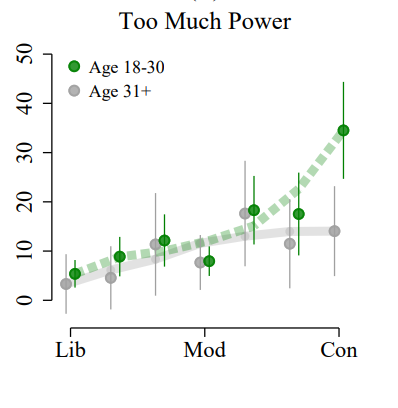
I was interested in the differences and similarities between young people who supported Trump and Biden (the latter being much more numerous). As shown below, they are indistinguishable on some economic issues. They differ a lot on “law and order,” immigration, racist violence, climate, and taxing the rich. However, it’s worth noting that 44% of young Trump voters favor reducing violence against people of color and more than a third want to move to renewable energy.

individuals’ ideologies as networks

Hypothesis: People not only hold opinions about parties and specific issues; they also explicitly connect their various beliefs together to create more-or-less coherent logical structures. Understanding these structures yields insights about individuals that we would miss if we only knew a list of their opinions.

This thesis challenges a common assumption in political and moral psychology. Although scholars meticulously analyze the structure of the arguments in books, essays, and speeches, several streams of research suggest that ordinary people have no such structures–their political preferences are random, or chosen by elites, or driven by latent variables of which they are unconscious. I think that we won’t find the conscious structure in average people’s thinking unless we develop tools that can detect it.

Looking at some individuals

To that end, last summer I collected data from 100 Amazon Turk participants. I restricted the sample to liberal residents of the USA, in order to control the range of issues that would appeal to them so that I could analyze the small dataset effectively.

I showed each person a list of 30 ideas they might favor, about half of which leaned left. I simply asked, “Which of these would you like to see happen?” and encouraged them to be selective. Consistent with my effort to recruit liberals, they chose almost exclusively liberal items. For instance, 80% chose “health insurance for all” and zero chose “a return to traditional values.”*

After subjecting respondents to a bit of explanation and training, I showed them their own chosen items in pairs (in random order). For each pair, I asked, “Are you in favor of X because you are in favor of Y?” Each time they said yes, that created a link between two nodes (or an edge between two vertices, if you prefer the technical language). From these responses, I was able to generate network maps for each person and for groups.

Here is one such map. This person is a white man, age 32. He places himself as far as possible to the left on a unidimensional ideology scale and he says that he agrees with AOC most often, followed by Bernie, then Warren, then Obama, and finally, Biden. He believes that eight things that he would like to see happen (e.g., health insurance for all) provide reasons to reduce corporate influence on government. He also sees an indirect link between reducing corporate influence and racial justice (by way of reducing incarceration) and an indirect link to the environment (by way of enabling a tax on carbon). However, he doesn’t connect political reform to free college or LGBTQ+ issues, although he cares about those issues and connects them.

In short, his network is highly centralized around reducing corporate influence. This seems like an important fact about how he thinks.

Below is another map, this time for a white woman, age 30, who ranks the Democratic politicians in precisely the opposite order as the man did (Biden first; OAC last). However, she ranks herself as a one on a 0-10 ideology scale, i.e., very liberal.

Her graph is more complex than the man’s. She is 3.6 times more likely than he was to see any given pair of ideas as a connection. Two-thirds of her arrows are double-headed. (She favors less crime because she favors more trust in government, and vice-versa.) You can move around her graph from one item to the next, and then onward. It is not centralized around any single node.

As noted, I first asked respondents whether each of their goals provided a reason for another goal. It was up to them what counted as a “reason.” I believe, however, that we can put ideas together in numerous ways, with a range of logical connectors. A justification is one link; a cause is another.

Therefore, I next showed respondents pairs of outcomes and asked whether each one would cause the other one. I included outcomes that they had not selected in the first place, because you might not select something as a high value even though it causes an outcome that you do value highly.

Here is the first respondent’s map with the causal connections added in:

It becomes complicated–perhaps too complicated to understand visually. But it’s clear that he believes higher voter turnout and a more responsible electorate are “upstream” factors–they cause many desirable outcomes–even though he did not initially choose them as his priorities. It makes sense to me that they are means to the ends he favors.

Finally, I showed respondents random pairs of items and asked, “Imagine x happened. Would that change your opinion by making you more supportive of y?” This produced another kind of connection (hypotheticals), which I can add to the first respondent’s map along with the causes and reasons:

Metrics suggest that this addition doesn’t actually change this person’s map very much, although it adds a few ideas at the end of arrows.

An example: the role of reparations in the mentality of the left

Months ago, I hypothesized that reparations for slavery play an important role in the thinking of left-liberal Americans. Progressives oscillate between hostility to the US government and desire to expand federal economic action. If the government paid reparations, progressives would trust it more and would therefore tilt to democratic socialism.

I can identify some individuals who may exhibit this logic. For instance, here is a 40-year-old white woman who favors a set of progressive outcomes and sees all of them as reasons to reduce corporate power over government (rather like the first man discussed earlier):

She did not select reparations as one of her original priorities, but she was asked whether actually seeing reparations happen in the world would make her more favorable toward other outcomes. She said it would make her more supportive of 10 things, including trust in government and civility. One can imagine that she thinks: if the government paid reparations, I would want people to trust it and would want citizens to be civil to each other, because the regime would be more legitimate. However, this is largely my inference about her responses, and it’s not a common pattern in the data.

These are three examples from the 100 cases that I collected. I have many more to look at, and I have IRB permission to interview selected respondents about their reasoning.

Aggregate results

I am also interested in examining the aggregate data. One evident finding is that people’s top priorities for how they would like to see the world change are not the same as the factors they see as most influential.

In my sample, the most frequently chosen goals are:

  1. health insurance for all
  2. a solution to climate change
  3. a higher minimum wage
  4. racial justice
  5. more school choice

The items that are seen as having the most direct effects on other items are:

  1. health insurance for all
  2. a less corrupt government
  3. less corporate influence on government
  4. a more responsible electorate
  5. more equitable education

And the items that have the most links of any kind to other items are:

  1. health insurance for all
  2. a less corrupt government
  3. racial justice
  4. more trust in government
  5. economic growth

Healthcare hangs in there as the top priority however you slice it. However, better government and economic growth–which are not chosen as high priorities from a simple list–emerge when people think about various kinds of premises or causes for the things they do value.

Another method would be to measure the relationships between people’s networks of ideas and a different variable of interest. I was planning to look at self-placement on an ideological scale, but my sample clusters together too closely. Seventy-four percent rate themselves between 0 and 2 on a 0-10 scale.

Instead, I am using as the dependent variable how people rank AOC compared to other Democratic politicians. I chose that outcome because her ranking correlates most strongly with ideological placement, and also because the biggest negative correlation in the whole matrix is between her rankings and Joe Biden’s (-0.67). Plus, her rankings have a nice distribution: the median is 3 on a 1-5 scale. So I take her strong supporters and opponents to mark the ends of a meaningful spectrum within the US left.

If we simply correlate the priorities that people choose (or don’t choose) with their rankings of AOC, then the correlations that are significant are:

  • more school choice and racial justice (which were chosen by identical people*)
  • equity for LGBTQ+ people
  • (not choosing) economic growth
  • (not choosing) less crime
  • (not choosing) a reduction in government debt

These correlations make intuitive sense to me. Among liberals, those who care less about crime, deficits, and growth would like OAC best.

If you put all the choices together with the demographics and ideology in one linear regression model to predict support for OAC, it does a decent job (r-squared = 0.488).** However, none of the individual items (including ideology) are statistically significant. One could conclude that knowing which items people pick helps you to predict their opinion of AOC, but you need to know most of the items.

If, instead, you look at which items people thought were reasons for other items, the model is more predictive (r-squared = .608 with the same number of variables) and ten items become stat. sig. on their own (p <.05). Knowing that an individual sees one of these items as a reason for other items gives a basis to predict that this same individual likes (or dislikes) AOC.

That seems like confirmation of my original hypothesis. The structure of people’s beliefs–more than the things they support–predicts a consequential opinion. However, I am still working on the regression and other aggregate methods; suggestions are welcome.

*Increasing school choice was also popular. I am not surprised to see support for that idea among liberals. One thing that may be surprising is a perfect correlation between racial justice and school choice: the same 49 people chose both of those items. **For this model, I omitted the people who placed themselves in the right half of the ideology scale, who looked to me like outliers. See also: ideologies and complex systems;  it’s not just what you think, but how your thoughts are organizedthe pivotal significance of reparations for the American left; etc.

7% of Americans are the hard core problem

YouGov reports: “One in five voters – including 45% of Republicans – approve of the storming of the Capitol building.” This is important and bad news. I do not want to minimize it, but I would put it in context.

A bit under half of Republicans support the riot in DC. Republicans represent about 29% of registered voters. Registered voters represent about two-thirds of adults. Adults represent about three-quarters of Americans. By the time you isolate Republican registered voters who support the riot, it’s down to about 6.6% of the population.

To be sure, some of the people in the other pie slices are also part of the problem. For instance, within the “other” slice are 2% of the registered Democrats and 21% of the registered Independents who support the riot. (A total of 10.1% of all Americans support the storming.) Most of that slice consists of people who don’t have an opinion, which is a problem in itself. And among the under-18s and the non-registered people, some probably hold views aligned with Trump.

Still, it is worth putting the hard-core problem in some degree of perspective. My guess is that the images from yesterday will basically become the capsule summary of the Trump years, except for a smallish and dwindling proportion of Americans.

(Survey data from YouGov. Registration percentages from Pew, 2018. Age distribution from Census, 2010.)

three new cases for learning how to organize and make collective change

The SNF Agora Institute at Johns Hopkins University has published three cases about the choices and dilemmas that confront groups of people who strive to make social change. These are like business-school cases: they are factual narratives that conclude with moments of choice that are meant to be discussed in groups, whether in high school, college, or in movements and organizations.

I am proud to have played a role in the project from the start. We felt that cases are really useful for teaching and professional development, but most actual cases provided by business schools, schools of public policy, and wonderful initiatives like The Pluralism Project and Justice in Schools focus on individual protagonists. We were interested in voluntary groups that must deliberate before they can choose. David Moss’s excellent Case Method Project does some of what we intended, but its focus is on high schools and American history, whereas we wanted to serve social movements with some current examples.

These are free, and we would love to know how they work in various settings.

The Montgomery Bus Boycott

What objectives, targets, strategies, demands, and rhetoric should a nascent social movement choose as it confronts an entrenched system of white supremacy? How should it make decisions?

The Montgomery, Alabama, Bus Boycott of 1955–1956 is a classic example of a social movement episode that accomplished its immediate goals despite severe obstacles. It catapulted the 26-year-old Rev. Martin Luther King Jr. into international prominence and launched similar episodes in many American cities across the South and then also the North. By investigating their situation and choices, you can develop skills and insights to use as activists today.

The ISAIAH Trash Referendum

Should a faith-based organization take on an issue not of its choosing? Can relational organizing help its leadership support a new mayor while also engaging their base and holding their coalition together?

This is a case study about an organization in Minnesota called ISAIAH, a faith-based organization that works to expand the power and influence of people who have often been overlooked, especially poor people and people of color.

This case examines what happened when, to support a new mayor with whom the organization wanted to work,  ISAIAH became involved in a divisive issue—not of its own choosing—that revolved around garbage. ISAIAH faced at least three choices: 1) stay out of the fight over garbage; 2) use mobilizing techniques to help the mayor win the garbage issue; or 3) use relational organizing to enter into a power relationship with the mayor in the garbage fight—even though most of the people in ISAIAH’s networks didn’t care much about the issue.

The AMOS Project and the Campaign for Universal Preschool

Can faith-based organizers garner enough support to win universal preschool in a racially divided city? How should a grassroots group manage a disagreement with its own powerful coalition partners?

This case study is about the AMOS Project, an organization in Cincinnati, Ohio, and its grassroots efforts to pass legislation that would provide preschool education for most of the city’s children. AMOS’s grassroots efforts increased the political pressure to pay for the program, but at one point, the whole effort seemed likely to fall apart. How could a grassroots network of congregations manage a disagreement with allies in the business community and achieve its goals?