


Early in 2021, I thought …
I now think that a combination of partisan self-interest and genuine support for Trump among some GOP politicians has prevented any serious reckoning. Also, for most Americans, this whole issue is not salient; only strong partisans on either side follow it. For instance, right now, the broadcast networks are barely covering the breaking news about Trump’s behavior after the election. In the absence of public attention, there is no incentive for Republican politicians to antagonize Trump, nor even for most Democrats to try to fix the problem.
That would be good for Democrats and for the general idea that the government can be helpful. However, there is no sign that the funds were popular. It is possible that a core assumption of left-of-center politics is wrong: people don’t want this kind of help. But I suspect inflation simply ate it up, and voters blame the Biden administration for higher prices. The median household will spend about $4,500 more this year than last year to buy the same basket of goods, while the stimulus offered $1,400 per individual.
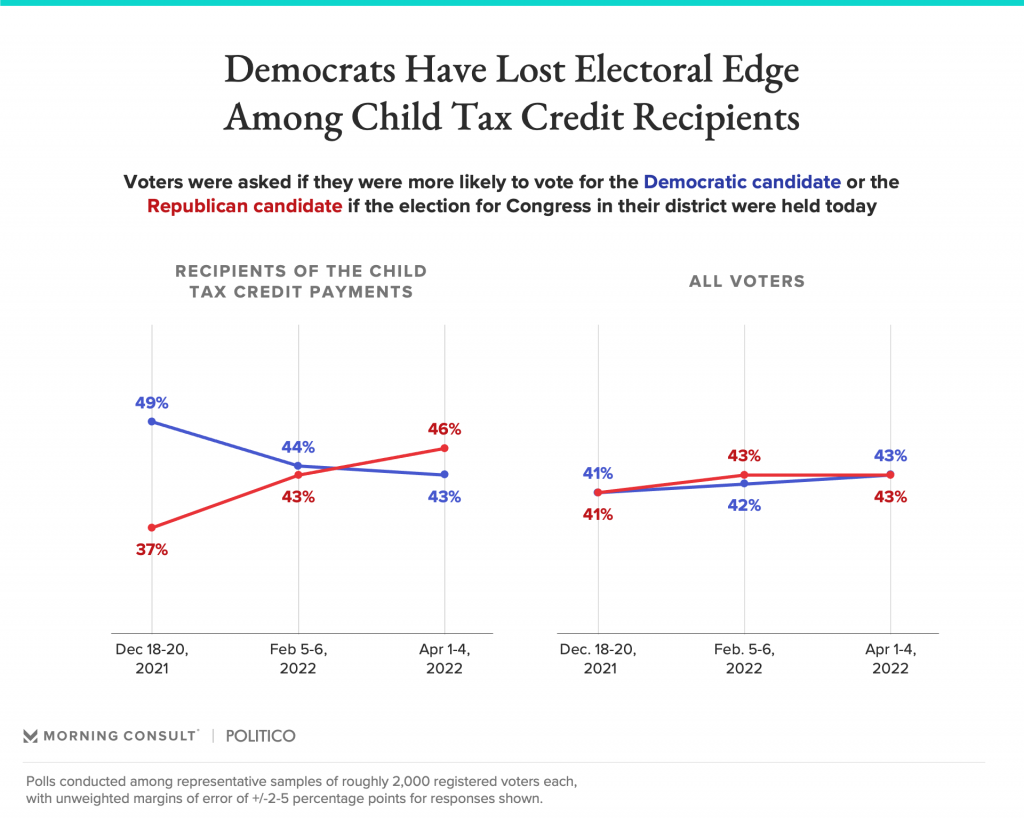
Speaking of inflation, I have no expertise on such matters, but I presumed the commentators were correct who blamed COVID-19 for temporarily disrupting supply and causing price spikes. Now it seems at least plausible that inflation is a major problem that will not abate without a recession.
Most importantly, such measures would save lives while allowing the economy to reopen safely. Meanwhile, they would pay dividends for the blue-state governors (including moderate Republicans) who closed schools and required masks, while embarrassing the most science-skeptical governors. However, Texas has had 2.9 cumulative deaths per thousand people from COVID-19 (basically at the national average); Florida has had 3.2; New York, 3.5; and New Jersey, 3.7. It is not clear which policies “worked” or how to weigh the significant costs against the possible benefits of policies like school closures. There is certainly no reason to think that governors like DeSantis will pay a political price (regardless of whether they should).
I never counted on a major social reform bill like Build Back Better to pass, since I doubted the Democrats had enough votes. I did harbor some hopes for the bill, based on the idea that the Trump fiasco, the COVID stimulus, and success in containing the pandemic would give Democrats momentum. Clearly, the opposite has happened. Although I strongly disagree with Democrats like Sen. Mark Kelly who are now running away from the bill, the psychology is clear enough. Recent events have undermined morale.
We have also experienced the exogenous shocks of Delta and Omicron plus Russia’s invasion of Ukraine (and Western sanctions). Selected experts predicted each of these events, but none was widely anticipated. Now the elections in Hungary and Serbia and the polling trend in France (where Le Pen is within the margin of error of Macron) add grounds for alarm.
There is plenty of work for all of us to do–assisting people affected by current crises and preventing future ones by educating and organizing. But I am not sure there is much anyone can do to change the immediate trajectory of global events. I can only hope that I will prove as mistakenly pessimistic in 2022 as I was naively optimistic a year ago.
This just needs dialogue, lyrics, and original music (presumably folk). It’s based on a bit of history plus plenty of invention.
Act 1, Scene 1: Silver King Mine, Utah (1914)
Striking miners sing of their suffering and despair. They are buoyed to see Joe Hill, a Swedish immigrant and union organizer, arrive. He leads them in a chorus of his song, “There is Power in the Union,” which raises their spirits. Hilda Erickson, age 20, a fellow Swede, approaches him and expresses her admiration for his courage.
Act 1, Scene 2: the same
Joe pulls fellow workers Sven Andersson and John G. Morrison aside to discuss what to do when hired guns come to break the strike. Morrison suggests they blow up the only bridge to the mine so that the goons can’t bring their heavy weapons with them. Andersson says he knows where they can steal some dynamite.
Act 1, Scene 3: Hilda’s family home, a humble homestead near Park City.
Joe arrives with flowers and asks Hilda out on a date the next weekend. After he leaves, she sings ambivalently. Maybe Joe would come to love her in time, but he seems to love the movement more–and death more than all.
Act 1: Scene 4: The sheriff’s office
The local sheriff meets with Morrison, who turns out to be a former police officer and now an undercover deputy. Morrison tells him that the Wobblies are planning acts of terror using dynamite. The sheriff orders Morrison to let them steal the explosives and then arrest them on the spot. Morrison sings of his anger that communist foreigners would try to subvert his community.
Act 2: Scene 1: Hilda’s home
Otto Appelquist, another Swedish immigrant, knocks on Hilda’s door, also bearing flowers. He sings of the life they could have together as his store thrives in the growing American West, the land of dreams. This song turns into a duet, with Hilda confessing the appeal of his vision even as she also admires Joe. She agrees to go on a date with Otto.
Act 2: Scene 2: A warehouse by night
Andersson and Morrison steal dynamite. Once Andersson has it in his hands, Morrison draws a pistol and tells him he’s under arrest. Andersson draws and fires, killing Morrison. Standing over the dead body, Andersson sings of his fear and announces that he will flee town immediately.
Act 2: Scene 3: Outside Hilda’s home, the same night.
Appelquist drops Hilda off at her door and sings of his love for her as he walks away. Joe Hill suddenly appears and demands that Appelquist leave Hilda alone. They argue heatedly. Joe picks up a shovel and brandishes it threateningly. Appelquist draws a pistol and shoots Joe in the chest; Joe staggers away.
Act 2: Scene 4: The same
Appelquist returns to Hilda and confesses in shame what he has done. She sings of her frustration with all violent, possessive men. She hopes that Joe survives and chooses not to turn Otto into the police.
Act 2: Scene 4: The sheriff’s office
The sheriff receives word by telephone that his deputy, John Morrison, has been killed. The phone rings again to let him know that the anarchist Joe Hill has staggered into a doctor’s office with a bullet wound to his lungs. He sings of his rage at Hill and expresses bitter satisfaction that the radical will now die for murder.
Act 3: Scene 1: The Utah Territorial Penitentiary, Salt Lake City
Orrin Hilton, a slick city lawyer, urges Joe to tell the jury who really shot him. Joe says he would never snitch, and besides, he doesn’t want to take the stand in his own trial. He sings that he will serve the revolution best as a martyr. What is one man’s life worth when millions starve with rags on their backs?
Act 3: Scene 2: A field outside of town
Otto admits that he is no hero, but he sings eloquent memories of the old country, Sweden, in summertime. Can’t they ever enjoy wild strawberries again? Meanwhile, Hilda sings a lament for Joe and commits to living a decent life with Otto.
Act 3: Scene 3: The Utah Territorial Penitentiary
Joe reads his last letter to “Big Bill” Haywood (“Don’t mourn–organize”) and sings his final testament: “My will is easy to decide / For there is nothing to divide. …” Men come and take him to be shot. As the commander counts, “Ready, aim …” Hill shouts, “Fire — go on and fire!” A ghostly chorus of workers sings Hill’s “The Preacher and the Slave” while Hilda and Otto watch, hand-in-hand.
We are fortunate to live near the Harvard Art Museums, and while visiting recently, I pulled open a drawer and saw one object inside: Joan Miro’s 1937 design for a fundraising stamp entitled “Help Spain” (Aidez L’Espagne). Miro’s handwritten text says, “In the current struggle, I see expired forces on the fascist side; on the other side, the people whose immense creative resources will give Spain a momentum that will astonish the world” (my translation).
Two years after this print was made, the Spanish fascists had won. For that reason, the image caught me short. I had to remind myself: sometimes the people do win; sometimes the creative forces prevail.
On March 25, Vladimir Putin gave a speech to Russian writers and artists that was widely covered because he mentioned Western “cancel culture”–thereby demonstrating a familiarity with US talking points. His speech also reflected a widespread but problematic view of the relationship between nations (or peoples) and cultures. This theory is basic to various forms of nationalism that we would classify as right-wing, such as Hindutva in India, but it also permeates some left-wing discussions of indigenous cultures.
According to this theory, each artists or thinker belongs to one people, and each people can therefore claim a list of cultural figures as primarily its own. The great figures of any nation share definitive characteristics with each other and with their ordinary compatriots; these make them members of the same national culture. Foreigners can enjoy and benefit from the creations of any national culture–but only indirectly and imperfectly, for it is the birthright of the originating culture alone. On the other hand, all ordinary people gain refracted glory from the list of great figures of their own national history.
The world recognizes (or should recognize) cultural excellence, just as it recognizes success in athletics or business. One can therefore compare nations by ranking their great cultural figures. To do this, you don’t need to know much about the content of their thought.
Maya Asha McDonald, a Canadian art historian, dined with Putin in the Kremlin in 2019. “’The President would like to know about your study of Christian art,’” a woman to my left said with an icy smile. “’And what you think of Russia’s rich artistic history.’” Putin proceeded to list famous works in Russian museums. When McDonald ventured an informed remark, Putin acknowledged that she seemed to know “quite a bit for ‘someone from Canada.'” This turned out to be a compliment, because Putin “views North America as having a lesser artistic legacy.” He “fundamentally views the wonders of Russian museums as indisputable evidence of his nation’s superiority.”
In the speech last week, Putin said:
Russian culture has made an invaluable contribution to the development of world civilisation. For centuries, Russian masters of literature, music and fine arts have given humankind new aesthetic traditions and, more importantly, ideals and meanings that have become moral and spiritual guidelines for millions of people and entire generations.
Russian culture is human-centric. The best classical works are focused on the inner life, personal quests and emotional experiences of human beings. They ask relevant questions, help people to think, understand and draw conclusions.
It is not surprising that the Russian mentality is known for taking things to heart. We feel very strongly about other people’s pain and injustice. We are capable of feeling sincere joy about others’ success and helping those who truly need our help.
Russian culture always protected Russia’s national identity. While readily taking in all the best and constructive, it patently rejected anything false or momentary, anything that would disrupt the continuity of our spiritual values, moral principles, and historical memory.
This unique quality reliably protects the Russian people even today, when seemingly eternal concepts and norms are being eroded and undermined in different countries, history is being distorted, and the laws of nature itself are being violated. …
Friends, you belong to different generations and serve in different areas of Russian culture and education. Yet, you are equally loyal to them. You are striving to multiply their rich traditions and bring up new generations of thinking and spiritually rich people who are able to perceive and pass on traditional values, who know and respect the past and present of their homeland, who are the true citizens of Russia.
(I quote Putin from the official English translation on the Kremlin.ru website.)
In my view, most artists (with interesting exceptions) belong uncomfortably to any given national tradition and take inspiration from diverse sources. There is no necessary correlation between the core values of specific artists and the dominant values of the nation at their time or later, nor do artists who are associated with the same nation typically agree with each other.
An individual gains little from just belonging to the same nation as a major thinker. For instance, I have learned virtually nothing from Herman Melville, since I have (unfortunately) not read Moby Dick. It would be foolish for me to feel pride that Melville was American; if anything, I should be mildly embarrassed that I have not read such a major novel. However, we can profit from any works with which we seriously wrestle. In my case, those include some works by Turgenev, Tolstoy, Dostoyevsky, Shostakovich, Nabokov, Akhmatova, and some other Russians.
In that sense, Putin is right that Russians have “given ideals and meanings” to people like me, who are far away. But I did not gain from these authors and composers a glimpse into some ineffable and indestructible Russian soul. I gained a whole range of divergent thoughts from diverse and unruly thinkers. As Putin says, these authors “ask relevant questions, help people to think, understand and draw conclusions.”
But there is no sign that Vladimir Putin has learned to think from the canon of Russian literature. He might align with Solzhenitsyn and with some aspects of Dostoyevsky, but many of the great Russians would hold him in the deepest contempt. Among those would be Shostakovich (a lifelong victim of the KGB), whom Putin mentions as a target of Western cancellations.
(Please pause to consider the irony that former KGB officer Putin is angry that Shostakovich might be “canceled,” when the Soviet state imprisoned and/or shot Shostakovich’s “patron Marshal Tukhachevsky; his brother-in-law, the distinguished physicist Vsevolod Frederiks; his great friend the musicologist Nikolai Zhilyayev; his mother-in-law, the astronomer Sofiya Mikhaylovna Varzar; his uncle Maxim Kostrykin; and his colleagues Boris Kornilov and Adrian Piotrovsky” and came within a hair’s breadth of purging the composer himself.)
Putin’s theory of culture is vary far from the worst thing about him. I would not claim that it explains or motivates his decision to invade Ukraine, which can be better explained in terms of raw power. But it is a bad theory that is widely shared. I would guess that many Americans–when told that Putin ranks Russian culture above theirs–would counter with the names of distinguished American thinkers whom they have never actually read, some of whom are deeply critical of the USA.
That is the wrong path. Culture is not the Olympic Games, with a medal count. Cultured people don’t brag about the number of their countrymen who have won global repute. Cultured people challenge themselves with uncomfortable ideas from diverse sources and treat all other human beings as their fellow citizens of the earth.
See also: for Irina; Tolstoy, Shakespeare, Orwell; what is cultural appropriation?; the generational politics of Turgenev’s Fathers and Sons; a richer sense of cultural interchange; the ethical meanings of indigeneity; etc.
Here is what I will call a “top-down” theory of public opinion: Everyone should assess the most important issues of the day. An example might be the federal budget. Individuals are entitled to their personal beliefs or preferences about taxation, spending, and deficits; nevertheless, these three topics have an objective logical structure. If you want lower taxes and no deficits, you must favor spending cuts. If you want more spending, you must support either tax increases or bigger deficits. It is a civic obligation to think through your own complete view of these issues.
Analyzing a nationally representative survey of such matters should reveal that: a) most citizens hold opinions about them, and b) everyone recognizes the same underlying logic, even as they disagree about priorities. Citizens should vote according to their priorities, and the majority should prevail.
If, however, a) and b) are false, then democracy is flawed. Perhaps people should learn more and pay more attention, or the political system should offer greater clarity, or perhaps democracy is simply a false ideal.
Philip Converse’s “The Nature of Belief Systems in Mass Publics” (1964) has been enormously influential (cited more that 11,000 times). He does not employ exactly the framework with which I began this post, but his analysis suggests that democracy is a flawed ideal.
Analyzing surveys of political specialists, such as congressional candidates, Converse finds that these respondents meet both tests mentioned above. Professional politicians and other experts hold opinions on the great issues of the day that fit together in similar ways, even as they debate the contested questions. However, according to Converse, surveys of representative Americans reveal scant opinions and no consistent structure among opinions. Ordinary people are not, therefore, in a position to weigh in on the debates of the day.
Converse doesn’t use network analysis, but I can convert his core findings into network maps. (For those interested, I turned every tau-gamma coefficient above .05 in Converse’s Table 7 into an edge in these graphs.)
Congressional candidates share the following model of the political debate ca. 1962.
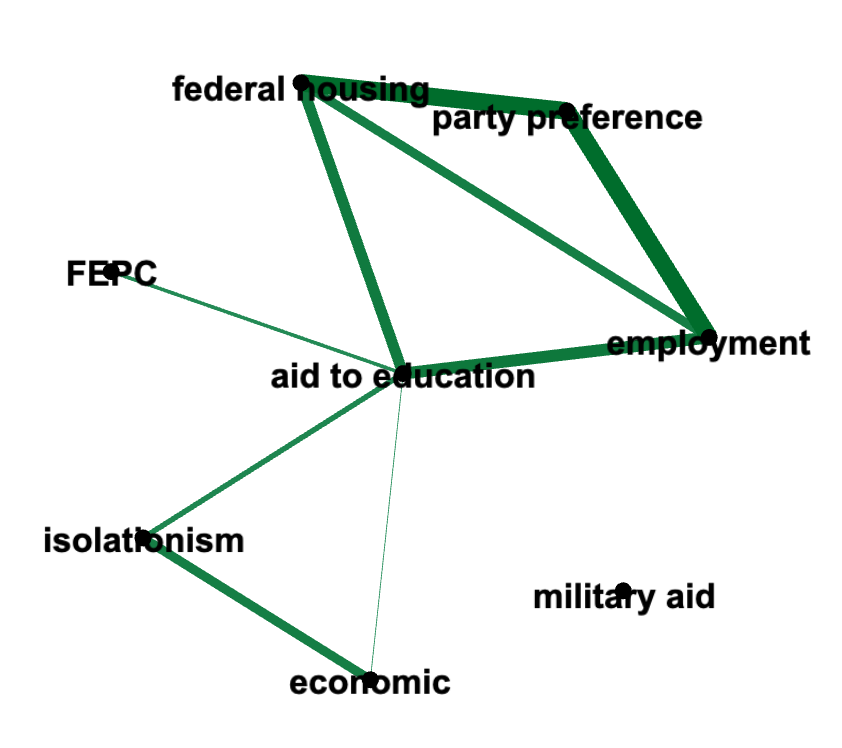
Whether candidates are Democrats or Republicans is strongly related to their views of federal interventions on education, housing, and employment, and those issues are linked together. Military aid to foreign countries is not connected–it stands alone as a topic. (“FEPC” means the proposed Fair Employment Practices Commission.)
Meanwhile, this is the result of using the same method with Converse’s data from representative adults at the same time:
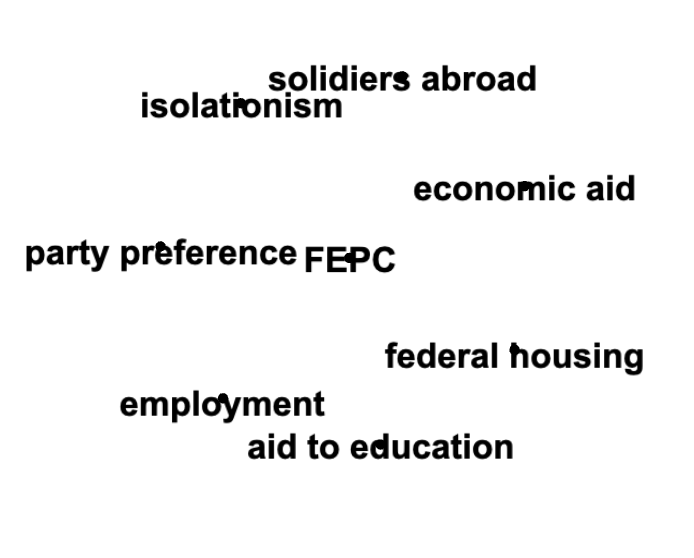
There are no links at at all among the ideas (meaning no coefficients > .5). Converse suggests that people are not in a position to play the role expected in a “civics class” theory of democracy, assessing and voting on the issues of the day.
Now here is a rival, “bottom up” theory: The social world is enormously complex. Responsible people may hold opinions on myriad issues, and no one can have a view about everything. Even if we focus on a single domain, such as the federal budget, it is highly complex. Federal spending includes funds for many different purposes. Each federal program has a financial cost, but it also has moral significance, behavioral impact, symbolic meaning, likelihood of success, etc. If people are diverse and free, they will naturally form many different structures of opinions about the range of topics that they have considered so far.
Imagine a sample of people, each of whom holds a thoughtful and carefully considered view of public issues and connects each opinion to other opinions in rigorous ways. However, each person holds a unique structure. Then, if researchers contact each person and ask a short list of survey questions (out of the innumerable questions that they could ask), and the aggregate survey data is analyzed using the methods pioneered by Converse, it will reveal no significant links at all. The heterogeneity of individuals’ beliefs will yield very low coefficients at the group level. Their graph will look just like the second graph above–not because they are tuned out of politics or undisciplined in their thinking, but because they differ.
Converse (p. 44) explicitly acknowledges this possibility. He notes that if people’s opinions become “increasingly idiosyncratic” as they move away from the elite, we will find “little aggregative patterning of belief combinations” in their data, because they will not know “what goes with what” (presumably, according to the elites) and will “therefore put belief elements together in a great variety of ways.”
However, Converse counters with a different kind of evidence. According to his analysis of longitudinal data from the American National Election Studies from 1958-60, most people’s opinions on most issues change as if by sheer chance as time passed. This implies that they do not hold “well knit but highly idiosyncratic belief systems” (p. 47). Instead, they have no “meaningful beliefs” at all (p. 51). The exceptions are various small and specialized “issue publics” who hold stable opinions about specific concerns, including many Blacks and some White Southerners on questions of race.
On this point, I would only note that an enormous number of longitudinal studies have been conducted since 1962, and some find stability over time (e.g., Kustov, Laaker & Reller 2021), unexplained–and perhaps random–change (Jaeger, M. M. 2006), or a mix of the two, depending on this issue (Kiley & Vaisey 2020). For instance, according to the last of those studies, the proportion of individuals who change their opinions about abortion is extraordinarily low. Converse’s blanket claim that most people’s opinions on most issues change randomly seems overstated.
I do not assume that all of my fellow Americans (or anyone else) holds complex and rigorous mental models of politics. Some people hardly hold any opinions, or cannot connect their opinions together, or do so in illogical ways. My point is that we cannot tell from aggregate data what proportion of people hold thoughtful views unless we assume that all worthy views must manifest the same structure. Converse uses scare quotes around the word “proper” when he mentions “the sophisticated observer’s assumption of what beliefs go with other beliefs,” but if we seriously doubt that elites understand the “proper” arrangement, then we should expect regular people to exhibit great diversity.
In that case, we should seek to understand the heterogeneous structures of ordinary people’s views. This kind of research has three important purposes:
See also: Moral and Political Discussion and Epistemic Networks; modeling a political discussion; individuals in cultures: the concept of an idiodictuon; ideologies and complex systems; don’t let the behavioral revolution make you fatalistic, polycentricity: the case for a (very) mixed economy, etc. I also acknowledge Jon Green, Nic Fishman, Sarah Shugars, and others who are working in this general domain today.
Newly in print: Peter Levine, “Putting the US Constitution in Its Place,” in Citizenship and Civic Leadership in America, edited by Carol McNamara and Trevor Shelly (Lanham, MD: Lexington Books, 2022), pp. 281-292.
Abstract:
Almost all American students are required to study the formal structure of the US government, and most perform fairly well on concrete, factual questions about the Constitution. But there is much more for competent citizens to learn. After I explore some valid reasons to include the Constitution in required curricula, I argue that the document provides a poor framework for civics as a whole, giving students a distorted view of the social world and failing to motivate them for ethical civic engagement. I conclude with a sketch of a curriculum in which the US Constitution has a place, but a fairly modest one.
See also: on teaching the US Constitution; the Citizens United decision and the inadequate sociology of the US Constitution; liberals, conservatives, and love of the Constitution; is our constitutional order doomed?; constitutional piety, etc.
Yesterday, I got to give an International Society for Quantitative Ethnography (ISQE) Webinar on “Moral and Political Discussion and Epistemic Networks.” I really enjoyed the questions and conversation. This is the video of the whole event:
Abstract: An individual holds linked beliefs about political or moral issues, which we can model as a network. How these ideas are linked together influences the person’s actions and opinions. When individuals discuss, they share some portions of their respective networks of which they are conscious at the time. Some network structures are better than others for discussion: overly centralized or scattered networks are problematic. Individuals tend to demonstrate similar network structures on different issues. Thus, relying on certain kinds of networks is a character trait. People, with their respective networks of ideas, are also embedded in social networks. An idea is more likely to spread depending on features of both the social network and the idea networks of the people who interact. As a whole, a population may develop a shared network structure. An idea that is widely shared and frequently central in individuals’ networks becomes a norm. Institutions are partly composed of such norms. A community or a culture is a single network with disagreement. Ultimately, all such networks interconnect. This theory has implications for politics, ethics, and research methodologies.
Additional ISQE webinars are listed here.
In The Fall of Robespierre, Colin Jones narrates the dramatic events of July 27, 1794 (9th of Thermidor in Year II, according to the revolutionary calendar) within the city of Paris. He tells the story hour by hour and then by fifteen-minute intervals for portions of the day.
The Ninth of Thermidor was not only a pivotal episode but also probably the best documented 24 hours in human history up to that point, because several security agencies were required to file regular reports, and a huge number of Parisians kept diaries and other records of the event.
In our time, we are obsessed with communications and media technologies, to the extent that we might overestimate their importance. There is more to politics than communications. Nevertheless, Jones’ book reinforces their importance in the French Revolution and suggests certain parallels to the present, when Ukraine and Russia are waging an “information war” alongside their conventional war.
Parisians used a wide range of communications tools to convey ideas about politics. Printing presses produced daily newspapers, posters, proclamations, and even pocket-sized copies of important laws, such as the Law of 14th Frimaire, which had conferred dictatorial power on two committees. Parisians gathered daily in political bodies where they heard speeches. These venues ranged from the National Convention to the two committees that governed each of 48 neighborhood sections, not to mention the Jacobin Club and less formal gatherings. Citizens also frequented theaters, where the performances had political agendas but could be interpreted in many ways. For instance, a play about the tyrannicide Brutus might be intended to celebrate the killing of Louis XVI, yet the audience might think of Robespierre as the tyrant. Trials and daily public executions were also spectacles whose messages were not always interpreted as intended.
The ringing of bells from the buildings formerly known as churches, especially the great bell of the former Notre Dame, as well as the firing of cannons and and the beating of drums all conveyed well-known messages. Riders and pedestrian parties criss-crossed the city with handwritten documents or orders to tell people specific things. Hawkers announced the headlines of newly printed newspapers as they walked about selling them. Even the sashes, cockades, and uniforms that people wore as they moved around with such messages were communicative. For example, 9th Thermidor was first day when members of the National Convention wore elaborate prototype costumes that Jacques-Louis David had designed for them.
Parisians also found creative ways to communicate what they believed despite official censorship. My favorite tool was the fake newspaper correction, a genre of the time. One paper regretted having quoted Robespierre as saying, “It was we who made false denunciations.” According to the correction, this was just a typo, for Robespierre had really said, “It was we who silenced false denunciations.” But the journal had never published the mistake in the first place. The erratum was a way of airing the idea that Robespierre’s denunciations were false.
The events of 9th Thermidor are complex, with many independent actors. The situation crystallizes, however, by the afternoon, once the entire National Convention has voted to condemn Robespierre and his closest associates, while the Parisian city government, the Commune, has declared for Robespierre and even managed to liberate him and bring him to their building, the Hotel de Ville. Paris is essentially in a state of civil war between the national elected legislature and the municipal legislature, with both sides competing for the loyalty of a heavily armed and mobilized population.
The conflict is not ideological in a simple sense, since Robespierre’s allies and enemies alike hold heterogeneous views. In fact, Robespierre has been planning to make a sharp turn from the left to the center and right on this very day. Nor is the conflict defined by social class or other kinds of social background. Mainly, it is a matter of how people assess individuals–which ones are actually traitors?–and where they see their own interests. To turn on Robespierre if he retains power is suicidal, but to stand with him if he falls is just as dangerous.
Basically, the Convention prevails because they win the race to communicate with the most people. One key advantage is access to a large printing press; no press is located near their opponents’ HQ in the Hotel de Ville. The Commune is also frustrated in other ways. They give orders that Notre Dame’s great bell be rung in their cause, but the local assembly that controls the bell tower refuses. Meanwhile–contrary to law–some of the Parisian sections begin sending messages to the 47 other sections, creating a horizontal communications network. The same phrases begin to recur in messages from different sections, indicating that the spread is “viral.”
After the chaotic and unplanned events of the day, the question becomes how to interpret what happened. This, too, is determined by the effective use of communications media. At first, the prevailing interpretation is that Robespierre and a few confederates were caught plotting against the regime. The elected Convention plus the people of Paris stopped this threat. Policies should thus continue as before. Gradually, over the course of the year, the opposite interpretation overtakes this one. According to the new theory, the revolutionary government and the masses of Paris went off the rails until 9th Thermidor. That period is now retrospectively named “The Terror” and regarded as a tragic mistake. Robespierre’s fall along with the destruction of the Parisian Commune is seen as the beginning of a new reactionary phase, in which France must become much less radical and the people must be kept in check.
In many ways, this interpretative victory is what makes 9th Thermidor a pivotal event in French and world history–or so Jones persuasively argues.
Newly available: Levine P. (2022) Social Movements and Stakeholder Engagement. In: Lerner D., Palm M.E., Concannon T.W. (eds) Broadly Engaged Team Science in Clinical and Translational Research. Springer. https://doi.org/10.1007/978-3-030-83028-1_8
Abstract:
Social movements are among the most powerful sources of popular energy in our society. Scientists and health professionals should expect to see them burgeoning and shaping our understanding of medicine and population health, both for better and worse. This chapter describes challenges to the traditional way of thinking about social movements and explains why people who hold positions inside institutions—including medical researchers, clinicians, and health administrators—need to react to movements more analytically and more constructively. A model for assessing movements is presented. This model can help scientists and health professionals understand the strengths and weaknesses of social movements so they can better decide whether and how to engage with them.
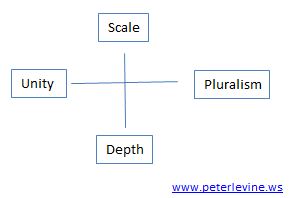
The model is SPUD (scale, pluralism, unity, and depth), which I discuss elsewhere on this blog.