doggerel by a dad

“O aid me ere I err!” bade he.
“Nay, nay, I’ll not,” said she.
“I’ll aid ye not–you’re overwrought,” she sputtered in her tea.
“Avail me, please, I’m on my knees,”
Beseeched the lad, awailing.
“Peace,” said she, “your tears they’ll be completely unavailing.”
“I am,” said he, “a wretched me, with only this petition …”
“Your prayer,” said she, “moves not me, nor will I grant permission
To drip upon my tattered shoe your salty drops o’ woe.”
“I’d only note,” the laddie quote, a-pointing to his toe,
“That you have ta’en seat upon a steamin’ pot ‘o stew.
Underneath that very pot is set a hot fondue
And as you settle in, you see, the one flows in t’other
And both begin to drip upon my only little brother.
As he shakes, our boat it quakes, and o’er the gunnels flow
The last of the drips off the honeyed lips o’ the Bonghi-Donghi-Do.”
“Cease!” cried she. “Prattle not. I care not what you say.
I’ll sit right here and pull yer ear and watch the driplets flow.
I care not a wit for the Bonghi-Do; let him do what ere he may!”

The post doggerel by a dad appeared first on Peter Levine.

a useful definition of civility

(Logan airport, trying to get to Chicago) Because I study civic engagement and civil society, people often expect me to favor civility. My actual view is more complicated; not only civil dialogue but also contentious speech is important in a democracy. Citizens should be able to express righteous anger; parties and candidates should face zero-sum competitions that necessitate sharp debate. Yet there is a reason to care about civility: it helps us to learn from other people. That is why I like the norm that the Civic Commons expects of its online participants: “We’re as interested in each other’s opinions as we are in our own. And we act like it.” That works for me as a definition of civility. For more on the context, see Dan Moulthrop’s remarks at Frontiers of Democracy.

The post a useful definition of civility appeared first on Peter Levine.

taking a break

For me, the last week has meant: the end of the Summer Institute of Civic Studies (6.5 hours of graduate-level teaching every day), the Frontiers of Democracy conference (150 excited guests at my institution), Albuquerque, a day back in Boston, Chicago, and San Francisco. At this point, I feel an urgent need to go offline. I’ll blog again on Tuesday–from Chicago.

The post taking a break appeared first on Peter Levine.

police as community-builders

(San Francisco) The short presentations from Frontiers 2013 are all available in video form here. As an enticing example, I present the police chief of Brooklyn Park, MN, Michael Davis. Brooklyn Park is one of the most diverse communities in Minnesota. Chief Davis argues that police forces must move beyond merely engaging their communities; they must help to build communities. He nicely summarizes the work of Harvard sociologist Robert Sampson, which I have described on this blog before. Sampson has shown that, holding other factors constant, neighborhoods with more “collective efficacy” see considerably less violent crime; and networks of nonprofit associations can boost collective efficacy. Chief Davis argues that police can help them do that.

The post police as community-builders appeared first on Peter Levine.

young people on the Zimmerman verdict

(Chicago) According to the latest Pew poll, a majority of young White people are dissatisfied with the Zimmerman verdict, in contrast to older White people, who approve. Nevertheless, just 32% of Whites between 18 and 29 think that the trial “raised important issues about race that need to be discussed,” whereas a majority (52%) say that “the issue of race is getting too much attention.” Pew doesn’t break out young African Americans’ views of those issues, but overall, 78% of Blacks think the trial raised issues about race that need discussion. (See my recent argument that we should be talking about racism in relation to the case.)

According to previous research, a majority of young White people wrongly believe that discrimination is worse against Whites than against African Americans. The age group as a whole is diverse, but young Whites are pervasively segregated from people of color. Only 15% of white students attend multiracial schools. They don’t have much direct exposure to African Americans or much opportunity to observe inequality.

Jonathan Chait wrote recently, “Obama believes America’s racial problem has not only gotten dramatically better over the course of his life — it will continue to do so. Younger people are less racially biased than older people, and Obama believes that process will continue to rapidly transform America’s approach to race.” I think by some definitions of racial bias, that is true. But young White people seem especially prone to believe that racism is a thing of the past, and that may be barrier to actually doing something about it.

The post young people on the Zimmerman verdict appeared first on Peter Levine.

Posted in Uncategorized

job openings in civic renewal

Here is an up-to-date list of interesting jobs related to civic engagement, civic education, and community organizing. (I post such lists periodically.)

  • Program Administrator for CIRCLE’s National Study of Learning, Voting, and Engagement. NSLVE is an initiative of CIRCLE and Tisch College. It measures college student voting rates and will create a comprehensive national dataset of college and university student registration and voting rates. Reporting directly to the Director of Initiatives for the Study of Higher Education and Public Life, the Program Administrator will perform an important role in the NSLVE initiative. Key responsibilities of this position include: managing communications and information about participating campuses, working with the Director to recruit colleges and universities to participate by responding to inquiries and reaching out to institutional decision makers; working with the Director to develop recruitment strategies; producing and disseminating individual campus reports; working with CIRCLE researchers to ensure accuracy in the national dataset for research purposes;  maintaining a repository of program information to be used by the Director and other CIRCLE colleagues.
  • Network Organizer at Leading Change Network. The Leading Change Network is a global community of practice of some 100 organizers, researchers and educators.Initiated by Marshall Ganz, Harvard Kennedy School, and others, its purpose is to support its participants in developing the leadership, building the organizational capacity, and improving the ability of democratic organizing to meet the critical challenges of our times. At present, for example, participants in 11 countries work on topics that range from immigration reform, human rights, gender equity, and economic justice to climate change, public health, and domestic violence. The demand, however, far exceeds our current capacity to respond, indicated by a growing data base of over 2000 interested persons in more 25 countries who would like to engage with us. The purpose of our search is to find a person who can enable us to respond. We seek a proactive, creative and “well organized” online organizer to work with a diverse leadership team to build the network, grow the network, and manage network infrastructure (database, web site, social media, etc.)
  • Communications Coordinator, Tisch College, Tufts University. Tisch College generates an enduring culture of engagement by collaborating with schools, departments, and student groups to offer extensive programming for every member of the Tufts community. Reporting to the Communications Manager, the Communications Coordinator will be responsible for identifying, writing, and sharing print and web based content which showcases Tisch College’s work, reinforcing strategic communications themes. Assignments may include writing and managing print projects (such as newsletters, annual reports, and brochures) and digital communications (such as email, web content, social media, and video). The Communications Coordinator will assist in performing a range of editorial functions from brainstorming and researching themes to developing and writing feature stories. The position requires a demonstrated ability to write with style, verve, and brevity with an appreciation for engaging a variety of audiences. Additionally, the Communications Coordinator will strengthen the written research products from CIRCLE.
  • Tenure-track professor in public administration, School of Government, The University of North Carolina at Chapel Hill. Desired fields of specialization include collaboration, organization theory and behavior, or human capital management.
  • VP Marketing & Communications at Global Citizen Year. Through strategic marketing, partnerships and PR, the VP of Marketing & Communications will ensure that Global Citizen Year becomes: 1) a household name among America’s emerging leaders, and 2) the national platform to make a global “bridge year” after high school the norm, not the exception in America. The ideal candidate is an entrepreneurial leader, with a track-record building new brands, and driving successful, high-profile communications campaigns.

The post job openings in civic renewal appeared first on Peter Levine.

Posted in Uncategorized

job openings in civic renewal

Here is an up-to-date list of interesting jobs related to civic engagement, civic education, and community organizing. (I post such lists periodically.)

  • Program Administrator for CIRCLE’s National Study of Learning, Voting, and Engagement. NSLVE is an initiative of CIRCLE and Tisch College. It measures college student voting rates and will create a comprehensive national dataset of college and university student registration and voting rates. Reporting directly to the Director of Initiatives for the Study of Higher Education and Public Life, the Program Administrator will perform an important role in the NSLVE initiative. Key responsibilities of this position include: managing communications and information about participating campuses, working with the Director to recruit colleges and universities to participate by responding to inquiries and reaching out to institutional decision makers; working with the Director to develop recruitment strategies; producing and disseminating individual campus reports; working with CIRCLE researchers to ensure accuracy in the national dataset for research purposes;  maintaining a repository of program information to be used by the Director and other CIRCLE colleagues.
  • Network Organizer at Leading Change Network. The Leading Change Network is a global community of practice of some 100 organizers, researchers and educators.Initiated by Marshall Ganz, Harvard Kennedy School, and others, its purpose is to support its participants in developing the leadership, building the organizational capacity, and improving the ability of democratic organizing to meet the critical challenges of our times. At present, for example, participants in 11 countries work on topics that range from immigration reform, human rights, gender equity, and economic justice to climate change, public health, and domestic violence. The demand, however, far exceeds our current capacity to respond, indicated by a growing data base of over 2000 interested persons in more 25 countries who would like to engage with us. The purpose of our search is to find a person who can enable us to respond. We seek a proactive, creative and “well organized” online organizer to work with a diverse leadership team to build the network, grow the network, and manage network infrastructure (database, web site, social media, etc.)
  • Communications Coordinator, Tisch College, Tufts University. Tisch College generates an enduring culture of engagement by collaborating with schools, departments, and student groups to offer extensive programming for every member of the Tufts community. Reporting to the Communications Manager, the Communications Coordinator will be responsible for identifying, writing, and sharing print and web based content which showcases Tisch College’s work, reinforcing strategic communications themes. Assignments may include writing and managing print projects (such as newsletters, annual reports, and brochures) and digital communications (such as email, web content, social media, and video). The Communications Coordinator will assist in performing a range of editorial functions from brainstorming and researching themes to developing and writing feature stories. The position requires a demonstrated ability to write with style, verve, and brevity with an appreciation for engaging a variety of audiences. Additionally, the Communications Coordinator will strengthen the written research products from CIRCLE.
  • Tenure-track professor in public administration, School of Government, The University of North Carolina at Chapel Hill. Desired fields of specialization include collaboration, organization theory and behavior, or human capital management.
  • VP Marketing & Communications at Global Citizen Year. Through strategic marketing, partnerships and PR, the VP of Marketing & Communications will ensure that Global Citizen Year becomes: 1) a household name among America’s emerging leaders, and 2) the national platform to make a global “bridge year” after high school the norm, not the exception in America. The ideal candidate is an entrepreneurial leader, with a track-record building new brands, and driving successful, high-profile communications campaigns.

The post job openings in civic renewal appeared first on Peter Levine.

Posted in Uncategorized

what we should talk about? (notes on Trayvon Martin and the state of national dialogue)

(Albuquerque, NM) After Newtown, President Obama “direct[ed] the Departments of Health and Human Services (HHS) and Education to launch a National Dialogue on Mental Health.” This presidential directive led, in turn, to “community conversations,” including a big meeting here in Albuquerque on Saturday. I am here because I serve on the board of Everyday Democracy, which helped to organize the Albuquerque deliberation.

Note that the whole effort began in response to the Newtown shooting, but the focus shifted—for understandable, if debatable reasons—from guns to mental illness. Now, several months later, it is very hard to talk about gun violence without thinking about George Zimmerman and Trayvon Martin. And the president has called for a national dialogue on race.

These shifts of topic raise a general and urgent question about framing, or, in blunter terms, What should we talk about?

For instance, if you are concerned about the Trayvon Martin killing, it may be because you despise anti-black racism and oppose “stand your ground” laws. If you are still thinking about the Newtown murders today, you probably want to regulate or ban assault weapons. On the other hand, if you oppose gun control and think (as most white Americans say they do) that anti-black racism is overemphasized, then you may want to change the focus away from Trayvon Martin and away from Newtown. You may find urban crime a more congenial topic, because the accused are disproportionately Black, and gun control has been used locally without seeming to work. See, for example, Pat Buchanan.

Incidentally, people like Buchanan have helped to make the Martin case a major news story by talking about how “the media” is overplaying it. Within their own circles, they want to talk about the Zimmerman trial, which reinforces their views about race and guns. (It allows them to remind everyone that men who look like them can act as the law.) The debate about whether we should be talking about the Trayvon Martin case actually increases attention to the case and serves the interest of the hard right as well as civil rights groups.

As a participant in political debates, you are entitled to try to shift the focus. Each framing pushes the conversation in certain directions instead of others. So it is not intrinsically wrong to say, in response to the Trayvon Martin case, “Let’s talk about the 500 murders committed in Chicago last year.”

In fact, I also want to talk about urban crime, including the crimes committed by young Black men, which produce many victims and also partially explain why nearly 1 million African American men are incarcerated today. Not only Pat Buchanan but also the NAACP want people to know that African Americans are disproportionately convicted of crimes.

So what is the right conversation for us to be having in this situation? I would say we need to be able to talk both about urban violent crime–in which Black people are disproportionately perpetrators and victims–and racially motivated violence against African Americans. One of those topics must not be eclipsed or trivialized by invoking the other one. If the phrase “comparisons are odious” means anything, its wisdom emerges in cases like this. It would be true but odious to say that almost as many German gentiles died in WWII as Jews died in the Holocaust. It’s not that the German lives were valueless and we shouldn’t care, but the comparison trivializes. Likewise, a person who cared about all these victims would not casually juxtapose 500 homicides in Chicago against 27 in Newtown and one in Sanford, FL.

Although no one should try to eclipse one topic with the other, they may be related in various important ways. For instance, maybe we teach most Americans (Black as well as White) to think that Black people’s lives are cheap. Then Zimmerman’s decision to shoot had something in common with decisions that are taken nearly every day in cities like Chicago. It is also true that many people are sincerely afraid of crime, and their fear is legitimately part of the conversation.

One place where both police (or vigilante) violence against Black people and crime committed by Black people are extensively and continually discussed is within the African American community itself. At “Frontiers of Democracy,” Peter Pihos gave a great historical talk about Chicago around 1970, when crime was rising rapidly and mass incarceration was just around the corner. He focused on several African American leaders who very explicitly opposed both “genocide” (by the white government) and “suicide” (by the Black community) and connected them to each other. That was an important moment, but similar discourse has been constant and vibrant. After all, compared to the national population, African Americans are disproportionately represented in urban police forces, corrections departments, and among the citizens who call the police and sometimes complain about slow and inadequate responses. So this is a subgroup of Americans on both sides of the prison industry and well aware of that.

A right-wing trope holds that we don’t pay enough attention to crimes committed by Black people because that discussion would violate political correctness. We may indeed not talk very well about race and racism, but our actions speak loudly. We spend about $27 billion a year simply incarcerating African Americans,* to say nothing of the costs of policing and the judicial process. Michigan, whose great city is bankrupt, spends one fifth of its general fund on prisons. California spends more on prisons than on its once-vaunted system of public higher education. The relative silence on this topic in venues like the US Congress is indeed problematic, but we can’t let that silence be filled by the kind of words one sees on open comment forums about the Zimmerman trial. It must be a conversation about how to treasure and protect all human lives.

*I extrapolate from the total cost of prisons ($68 billion) and the proportion of all prisoners who are Black (roughly 40%).

The post what we should talk about? (notes on Trayvon Martin and the state of national dialogue) appeared first on Peter Levine.

mass incarceration, the jury, and civic studies

Alumni of the Summer Institute of Civic Studies have designed a series of discussions at Frontiers of Democracy about mass incarceration, juries, and citizenship. The discussants include Andrew Nurkin (Executive Director of Princeton AlumniCorps, Princeton), Peter Pihos (doctoral candidate, University of Pennsylvania) and Joshua Miller (Philosophy professor at Morgan State)–all of whom teach in prisons. I will try to write more about their impressive and troubling thoughts after the conference ends. Meanwhile, we were treated to a virtual discussion among three of my friends on the topic of the jury. The discussants are Josh Miller, Albert Dzur (Bowling Green), and John Gastil (Penn State). The whole thing is worth watching, but if you are pressed for time, listen to and think about the questions they pose at the very end (minute 20).

The post mass incarceration, the jury, and civic studies appeared first on Peter Levine.

remarks at the opening of Frontiers of Democracy 2013

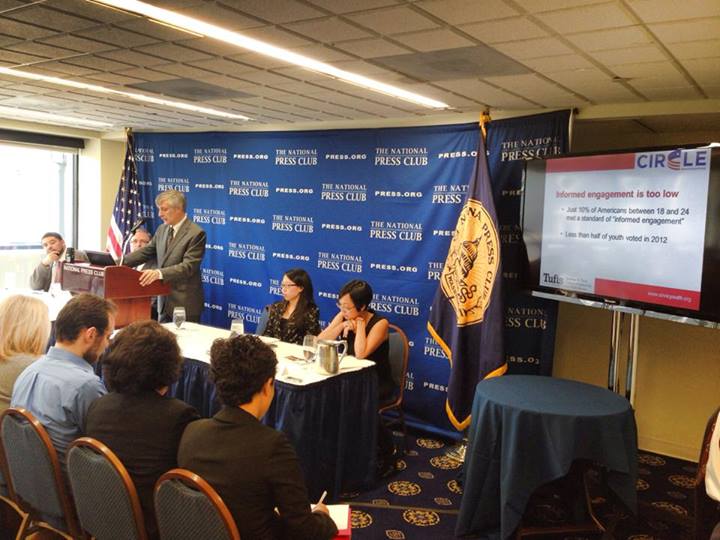
About 150 people are gathering at Tufts for Frontiers of Democracy 2013: Innovations in Civic Practice, Theory, and Education.

In my introductory remarks (below the fold), I will explain how the conference draws together separate streams of discussion and organizing, and I will propose a conceptual framework for our common work.


As organizers of this conference, we generally try to avoid doing a lot of talking, but my colleagues have prevailed on me—or indulged me—to make some introductory remarks about who has gathered here this weekend and for what purpose.

I’d ask you to consider the conference as a tree. That’s not the most original metaphor, but it will work.

Its deepest roots are the individual stories of the 150 participants, every one different, but each one planted in its own rich soil of community, of personal and collective history and memory, and of civic practice and experience.

For instance, people have been meeting to talk about their common problems and aspirations for thousands of years in every inhabited continent. Since the 1960s, there has been something of a boom of explicit, organized, deliberative processes and experiments—deliberation that you can see and name; deliberation at a human scale. In 2002, many of the groups that had been helping to organize these citizen deliberations, both in the US and overseas, came together at Airlie House in Virginia and launched the Deliberative Democracy Consortium to promote research and learning, networking, and advocacy. Matt Leighninger directs the DDC today.

People have also been teaching the next generation to be good citizens for thousands of years, and universities have been operating in our societies for more than a millennium. But since the 1980s, there has been something of a renaissance of explicit efforts to strengthen the civic role of higher education. In 2006 and 2007, a group of highly experienced academics and civic leaders from outside academia met to share their work and discuss the potential of higher education to enhance American democracy as a whole. They launched a consortium called The Democracy Imperative, or TDI for short, to connect practitioners to academics and convene people who approach “educating for democracy” in diverse ways: intergroup dialogue, interdisciplinary problem-based learning, social justice, Sustained Dialogue, conflict resolution, community organizing, community-based participatory research, and so on. TDI was formed to bring these (and others) together so that they would not feel alone on their campuses. Today, Nancy Thomas directs that effort.

In 2012, Nancy came to CIRCLE and Tisch College at Tufts. CIRCLE, which I direct, studies the civic learning and engagement of young Americans and tries to focus on those not in college or on a path to college. The forms of practice that we tend to study include civic education in middle schools and high schools and in community-based organizations that serve working-class young people.

Meanwhile, Tisch College aims to prepare all Tufts students be lifelong active citizens and creates an enduring culture of active citizenship on this campus. CIRCLE and Tisch College are your hosts today, and Tisch College supports this conference generously. Kathy O’Connor and Charlotte Ringle, who work for Tisch, are the dedicated and talented logistical leaders of the conference.

In 2008, DDC and TDI teamed up to organize a conference called “No Better Time” at the University of New Hampshire. I was just a participant, so I can say it was a great success—perhaps in part because the political moment was optimistic and propitious in 2008, but No Better Time also drew a great group of people for an engaging format.

Just months before “No Better Time,” seven scholars from a variety of disciplines had met at the University of Maryland. They all shared the view that mainstream scholarship is not useful to citizens—people who want to improve or even co-create their worlds. It’s not only that theory is disconnected from practice, but the prevailing theories themselves are misguided. Mainstream scholarship ignores human agency and creativity. It separates fact from value in harmful ways. It can tell you, for example, that the odds of starting a social movement are low—but not what you should do if you want to start a good one.

The scholars who gathered at Maryland included the late Elinor Ostrom, the first woman to win the Nobel Prize in Economics, Jane Mansbridge, the current president of the American Political Science Association, and our friend Harry Boyte, who is following this conference from South Africa. The whole group wrote a manifesto entitled The New Civic Politics: Civic Theory and Practice for the Future.

This manifesto led to a concrete experiment. Since 2008, Karol Soltan from the University of Maryland and I—both co-authors of the original statement—have been trying to practice the new civic politics by co-teaching an annual Summer Institute of Civic Studies at Tufts. It is an intense, theoretically rich academic exercise that has now involved about 100 people who have come from Bhutan, Singapore, China, Mexico, South Africa, and numerous other countries and backgrounds to debate civic renewal. Many are here today, and some have organized the “track” on Civic Theory, which has a focus on prisons and crime.

In 2008, the Summer Institute culminated in a public panel that C-SPAN covered on cable. The next year, we decided to join forces with DDC and TDI to repeat the “No Better Time” conference but at Tisch College instead of UNH. And we have held some version of a public conference each year. It has gradually turned into Frontiers.

Meanwhile, The Center for Engaged Democracy has been holding summer institutes for four years. Based at Merrimack College, the Center acts as a hub for people who run or want to start certificates, minors, and majors focused on civic and community engagement, broadly defined. The Center’s 2013 annual meeting has been taking place here, and many participants are sticking around for Frontiers. Dan Butin leads the Center.

The National Coalition for Dialogue and Deliberation is an association of more than 2,000 members who practice and promote deliberative democracy. Sandy Heierbacher leads that effort. One of their signature methods is to hold meet-ups or regional gatherings, one of which has been happening here, as part of Frontiers 2013, so NCDD is another root of our tree.

Earlier this year federal program, the United States Institute on Civic Engagement, selected The Center for Civic Engagement at Miami University Hamilton to host student leaders from the countries of Botswana, Kenya, Uganda, and Zambia. They are here today and represent yet another root.

These roots have come together to support a pretty impressive trunk. But we could certainly ask what else should be included.

We could press for more demographic diversity and representativeness—we do not necessarily reflect our communities. This year, Frontiers focuses especially on women and gender inequality in politics.

We could also ask about strategies and forms of work that may be missing. Civic education, broadly defined; deliberative democracy and dialogue; and civic scholarship are all well represented here. If you think those are all the most important and relevant forms of civic work, you can be satisfied. I personally believe that a many other forms are also important—and some are also represented here even though I haven’t named them yet.

For example, many people collaborate to manage and strengthen public resources: watersheds and forests, public libraries, cyberspace. They may talk and deliberate, but that isn’t really the heart of their work, which is more about management and co-production.

Many people are building alternative economic institutions—land trusts, community development corporations and social enterprises—that are more governable and accountable than transnational firms.

Many people struggle for political reforms and rights, not only in Egypt and the Palestinian Territories but also right here in the US.

Many people are involved in strengthening the civic health or capacity of communities by organizing citizens into effective groups and networks. These may not be primarily spaces for discussion. Service, belonging, and advocacy may be more central to their work.

Many people are trying to improve the media environment and serve what the Knight Foundation calls “the information needs of communities.” They are creating innovative software, formats, and organizations, some of them for-profit. Again, those people may deliberate and may educate, but the heart of their work is elsewhere.

I have begun to offer a list, and I could go on. Any list requires some kind of conceptual framework. You should be able to explain what deep principles define your list and encourage you to include some things and omit others. I do not expect my own conceptual framework to be shared by everyone who has gathered here today. On the contrary, debate about our frameworks is essential and exciting. One of the reasons that we need theory as well as practice is that we must be able to define what we are for. I’ll tell you my own framework in about one minute, not to settle the matter, but to provoke discussion.

I think that good citizens deliberate. By talking and listening to people who are different from themselves, they enlarge their understanding, make themselves accountable to their fellow citizens, and build a degree of consensus.

But deliberation is not enough. People who merely listen and talk lack sufficient knowledge and experience to add much insight to their conversations; and talk alone rarely improves the world. Deliberation is most valuable when it is connected to work—when citizens bring their experience of making things into their discussions, and when they take ideas and values from deliberation back into their work. Work is especially valuable when it is collaborative, when people make things of public value together. They are typically motivated to do so because they seek civic relationships with their fellow citizens, relationships marked by a degree of loyalty, trust, and hope. In turn, working and talking with fellow citizens builds and strengthens civic relationships, which are scarce but renewable sources of energy and power.

A combination of deliberation, collaboration, and civic relationships is the core of citizenship—in my personal view. If we had much more of this kind of civic engagement, we could address our most serious problems. Indeed, more and better civic engagement is a necessary condition of success; none of the available ideologies or bodies of expertise offers satisfactory solutions, which must emerge instead from a continuous cycle of talking, working, and building relationships.

Unfortunately, genuine civic engagement is in decline in the US and in many other countries, neglected or deliberately suppressed by major institutions and ideologies and by the prevailing culture. Our motivation to engage has not weakened, but we have lost institutionalized structures that recruit, educate, and permit us to engage effectively.

In fact, we face serious obstacles or deficits:

  • Our political system is organized to favor professionally-led, well-funded interests instead of creative, deliberating communities and grassroots movements.
  • Our major social policies are hostile to active civic participation. (For example, education is driven by standardized tests that experts write; public health depends on insurance companies and state bureaucracies rather than co-ops and community-based organizations.)
  • Our voluntary associations no longer have the means to recruit millions of Americans and develop the skills and motivations to participate as active citizens.
  • Our companies, because of their ability to withdraw investment, are virtually ungovernable by local authorities and communities.
  • Our culture lacks positive and plausible descriptions of collective agency, although it provides many depictions of lone heroes and of apolitical groups of friends.
  • Our news media generally overlook examples of deliberation and public work but relentlessly cover competition among professional politicians.
  • Despite their commitments to political rights and their heritage of experiments with participatory democracy, liberals and progressives are enamored of expertise, command-and-control regulation, and redistributive politics to the exclusion of active citizenship.
  • Despite their resistance to technocratic elites and their heritage of experiments with decentralization, conservatives are enamored of markets and negative liberties to the exclusion of active citizenship.
  • Our schools and colleges offer inadequate civic education, distributed unjustly to favor the most advantaged students, with an emphasis on factual knowledge instead of civic skills.
  • Our scholars in the social sciences and humanities produce an inadequate supply of knowledge relevant to active citizens (people who make moral and strategic judgments about how to improve the world directly).
  • Our funders—in both the state and philanthropic sectors—provide negligible streams of money for participatory processes, as compared to the funds available for concrete services.

On the other hand (sooner or later, there had to be another hand), we live in period of civic innovation, when, against the odds, people are at work on demanding, sophisticated, and locally effective forms of civic engagement. I estimate that 1 million Americans are involved in such work each year. Certainly they have many kindred spirits in other countries. These people see the need for citizenship and are building impressive practices and models. Their work remains scattered and local because it is contrary to the mainstream of national policy. Civic engagement cannot achieve sufficient scale and power without reforms in our most powerful institutions. The way to achieve such reforms is to organize the most active citizens into a self-conscious movement for civic renewal.

We are not 1 million Americans. We are about 150 international people out of the 7 billion human beings on earth. But we are deeply rooted in networks and communities that reach many more. That is why our gathering is so important. Of course, neither the root nor the trunk of a tree reflects its whole value. Its value is manifest in what it produces, its branches, leaves, and fruits. So, having come together, we must now branch out and produce a new harvest of civic theory and civic practice.

The post remarks at the opening of Frontiers of Democracy 2013 appeared first on Peter Levine.
