spring courses on civic engagement

Tufts University offers many courses relevant to civic engagement. The Tisch College of Civic Life makes some of these courses possible each semester, thus contributing to the available opportunities for Tufts students. Here is the list of our supported courses for spring 2018. The topics also indicate some of our research interests. More details are here.

Public Amnesias and Their Discontents
Instructor: Diane O’Donoghue, Tisch College Senior Fellow for the Humanities

Organizing for Social Change
Instructor: Danny LeBlanc, CEO, Somerville Community Corporation
Co-Instructor: Kenneth Galdston, Director, InterValley Project

Massachusetts State Government – Learning While Doing
Instructor: Ben Downing, Former Massachusetts State Senator

New Media, New Politics
Instructor: Robin Liss, Lecturer

The People, Revolution, and Popular Constitution-Making
Instructor: Joshua Braver, Postdoctoral Fellow

Creating Children’s Media
Instructor: Julie Dobrow, Tisch College Senior Fellow for Media and Civic Engagement

Children and Mass Media
Instructor: Julie Dobrow, Tisch College Senior Fellow for Media and Civic Engagement

Social Entrepreneurship, Policy, and Systems Change
Instructor: Scott Warren, CEO, Generation Citizen

Innovative Social Enterprises
Instructor: Julianne Zimmerman, Lecturer, Gordon Institute

Special Topics: Science & the Human Experience
Instructor: Jonathan Garlick, Tisch College Senior Fellow for Civic Science

Dialogue, Identity & Civic Action
Instructor: Jonathan Garlick, Tisch College Senior Fellow for Civic Science

Community Development, Planning, and Politics
Instructor: Lorlene Hoyt, Associate Research Professor, Urban and Environmental Policy and Planning

Technology, Media, and the City
Instructor: Aditi Mehta, PhD Candidate, MIT Department of Urban Studies and Planning

Mass Incarceration & The Literature of Confinement
Instructor: Hilary Binda, Senior Lecturer in Visual and Critical Studies and Director of Women’s, Gender, and Sexuality Studies Program (an Inside-Out™ class composed of Tufts students and incarcerated students in equal numbers)

past scholarship on government shutdowns

The probability seems fairly high that the federal government will shut down in December or January when Congress fails to pass appropriations bills or a continuing resolution. Previous research suggests:

GDP growth might lose .1 percentage point per week, up to about .6 points in a quarter. Of course, that prediction is very uncertain and leaves aside the possibility of shocks. (Labonte, Marc. “The FY2014 Government Shutdown: Economic Effects.” Library of Congress, CRS, 2013)

Certain communities that are dependent on relevant discretionary behavior (e.g., tourism in national parks) may see substantial economic losses. Gabe, Todd. “Effects of the October 2013 US Federal government shutdown on National Park gateway communities: the case of Acadia National Park and Bar Harbor, Maine.” Applied Economics Letters 23.5 (2016): 313-317.

In most state and federal shutdown examples, both parties lose popularity. However, popularity is usually more valuable to the incumbent party than to the minority party, and that gives the minority an incentive to force the shutdown. Also, in the 2013 shutdown, Republicans lost much more popularity than President Obama did, although he did see some decline. Gamage, David, and David Scott Louk. “Preventing Government Shutdowns: Designing Default Rules for Budgets.” 86 Colorado Law Review 181 (2015) (2015).

In general, a budget impasse is best modeled as a Chicken game (Gamage & Louk). In “Chicken,” the best strategy is to pre-commit: to take a position that you can’t back off of. The Democratic leaders may have been signalling a pre-commitment when they canceled yesterday’s meeting with Donald Trump. From a PR perspective, I’m skeptical that canceling was a smart statement, but as a move in a Chicken game, it may have been very smart.

During the 1996 shutdown, reporters chose among the following “frames” for describing the unfolding events: “talk,” “fight,” “impasse” and “crisis.” They also increased the amount of attention that they devoted to the budget negotiations. The amount of coverage plus the predominant frame affected public opinion. Jasperson, A. E., Shah, D. V., Watts, M., Faber, R. J., & Fan, D. P. (1998). Framing and the public agenda: Media effects on the importance of the federal budget deficit. Political Communication, 15(2), 205-224.

State budget shutdowns were traditionally rare but have become quite frequent. Rubin, Irene S. The politics of public budgeting: Getting and spending, borrowing and balancing. CQ Press, 2016. I suppose this context may affect the public’s response to a federal shutdown.

Observers tend to interpret a government shutdown in identity terms: as our side versus their side. Observers’ tolerance for compromise depends on whether they perceive the other side as respecting their identity. Thus allowing the other side to “save face” can promote compromise. Bendersky, Corinne. “Resolving ideological conflicts by affirming opponents’ status: The Tea Party, Obamacare and the 2013 government shutdown.” Journal of Experimental Social Psychology 53 (2014): 163-168. Implication: the Democrats should hold fast to important policy goals but look to give symbolic victories to GOP base voters if they want to win on the policy. On the other hand, if their goal is for Republicans to lose face, they may need to sacrifice on policy to extract more symbolic concessions. This is not as simple a choice as it may seem, because costing Trump a lot of face could help the Democrats win the Congress in 2018, giving them more policy leverage.

effects of school climate on civic engagement

Sarah K. Bruch (Iowa) and Joe Soss (Minnesota) are conducting important research on the relationships between school climate and young people’s civic engagement. They have more research in the pipeline, but their working paper entitled “Learning where we stand: How school experiences matter for civic marginalization and political inequality” is already available.

Bruch and Soss challenge the idea that schools prepare students for democracy by transmitting a set of skills and knowledge that make people better citizens. If that were the whole picture, then more–and more equal–civic education would yield a better and more equal democracy. But Bruch and Soss note that schools are also institutions and communities that can encourage–or discourage–participation by demonstrating how the larger society works. Bruch and Soss did not invent this framework–it has a scholarly heritage, which they summarize, and it is being forcefully advocated by young people today–but they contribute important empirical findings.

Bruch and Soss use nationally representative surveys of students and administrators to measure the strictness of the school’s disciplinary policies, the perceived negativity of the school’s culture, individual students’ reported personal experiences with punishments, perceptions of unfair treatment by the school, rates of membership in school groups, and reports of feeling included or marginal in the school community. Some of these factors are about perceptions of the whole school, and others about perceived personal experiences. Some are about treatment by adults, while others involve treatment by fellow students. Some come from student data; others, from administrators.

To a large extent, these factors are related to race, class, and gender. To illustrate with a strong example, African American boys whose parents have little education are more than ten times more likely to be punished by a school than White girls with well-educated parents.

In a multivariate model that includes many other factors, most of these school climate variables are related to civic engagement, with harsher and less inclusive climates depressing graduates’ community engagement, voter turnout, and trust in government. But there are important differences among these relationships.

Perceptions of unfair treatment are related directly to lower civic and political engagement and trust in government. Not being involved in school activities is a strong predictor of being disengaged from community after graduation, but half of that relationship is indirect: students who miss out on school activities go on to have adult experiences with criminal justice, welfare, etc., that are related to disengagement from civic life.

Authoritative disciplinary climates are related directly to more civic engagement, more voting, and higher trust in government, but such climates also predict adult roles that tend to depress these outcomes. The net impact is insignificant for voting and civic engagement and comes out as positive for trust in government. This finding begins to suggest that the problem is not school discipline per se: in fact, a well-ordered school may be a good place to learn to be a citizen. The main problem is unfairness. In political philosophers’ terms, a school can restrict freedom (defined as individual choice) by establishing and enforcing rules, but it should avoid “domination” in the sense of arbitrary power.

See also: school discipline in a democracyavoiding arbitrary command.

timely quotes from Bayard Rustin (1965)

Two years after organizing the March on Washington, Bayard Rustin made the following arguments in “From Protest to Politics: The Future of the Civil Rights Movement” (Commentary, 2/39, Feb. 1965). By calling these points “timely,” I don’t mean that they are necessarily correct; I mean that they are usefully provocative in our moment.

1. Racial justice is impossible without a new economy, because the current economy is too unequal and too limited to accommodate many newly enfranchised people. For example, there are too few decent jobs, and the people who have them will hold onto them unless the supply is expanded.

My quarrel with … moderates is that they do not even envision radical changes; their admonitions of moderation are, for all practical purposes, admonitions to the Negro to adjust to the status quo, and are therefore immoral.

2. The goal is not to confront racist attitudes (which would assume that, deep down, racists and hypocrites can have benign motives). The goal is to change institutions; attitudinal change will follow from that.

[Meanwhile, a second group] pursues what I call a ‘no-win’ policy. Sharing with many moderates a recognition of the magnitude of the obstacles to freedom, spokesmen for this tendency survey the American scene and find no forces prepared to move toward radical solutions. From this they conclude that the only viable strategy is shock; above all, the hypocrisy of white liberals must be exposed. These spokesmen are often described as the radicals of the movement, but they are really its moralists. They seek to change white hearts–by traumatizing them. Frequently abetted by white self-flaggelants, they may gleefully applaud (though not really agreeing with) Malcolm X because, while they admit he has no program, they think he can frighten white people into doing the right thing. To believe this, of course, you must be convinced, even unconsciously, that at the core of the white man’s heart lies a buried affection for Negroes–a proposition one may be permitted to doubt. But in any case, hearts are not relevant to the issue; neither racial affinities nor racial hostilities are rooted there. It is institutions–social, political, and economic institutions–which are the ultimate molders of collective sentiments. Let those institutions be reconstructed today, and let the ineluctable gradualism of history govern the formation of a new psychology.

3. Radical change does not require violence.

[The] term revolutionary, as I have been using it, does not connote violence; it refers to the qualitative transformation of fundamental institutions, more or less rapidly, to the point where the social and political structure which they comprised can no longer be said to be the same.

4. But to change institutions does require power.

There is a strong moralistic strain in the civil rights movement which would remind us that power corrupts, forgetting that the absence of power also corrupts.

5. In a democracy, power requires numbers–indeed, a majority of the whole electorate.

A handful of Negroes, acting alone, could integrate a lunch counter by strategically locating their bodies so as directly to interrupt the operation of a proprietor’s will; their numbers were relatively unimportant. … But in arriving at a political decision, numbers and organizations are crucial, especially for the economically disenfranchised.

6. Coalition politics is inevitable, and it implies the right kind of compromise.

[The] effectiveness of a swing vote depends solely on ‘other’ votes. It derives its power from them. … Thus coalitions are inescapable, no matter how tentative they may be. … The issue is which coalition to join and how to make it responsive to your program. Necessarily there will be compromise. But the difference between expediency and morality in politics is the difference between selling out a principle and making smaller concessions to win larger ones. The leader who shrinks from this task reveals not his purity but his lack of political sense.

7. The coalition must include everyone with reasonably aligned interests so that they can marginalize their real opponents, the Donald Trumps of the day.

It has become fashionable in some no-win Negro circles to decry the white liberal as the main enemy (his hypocrisy is what sustains racism). [Thus] the Negro is left in majestic isolation, except for a tiny band of fervent white initiates. But the objective fact is that [Dixecrat Mississippi Senator James] Eastland and [GOP Presidential nominee Barry] Goldwater are the main enemies–they and opponents of civil rights, of the war on poverty, of medicare, of social security, of federal aid to education, of unions, and so forth.

people trust authoritarian governments most

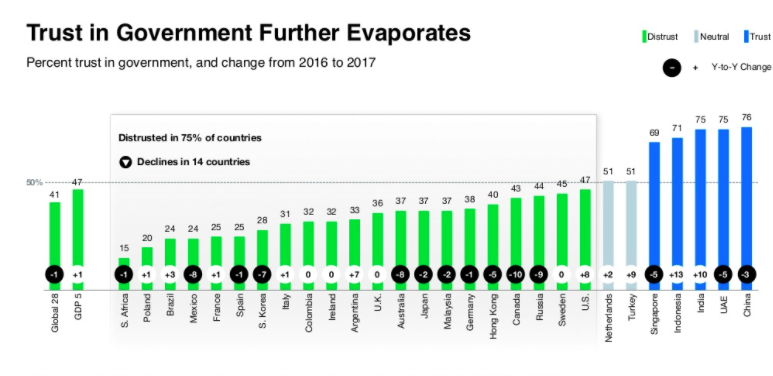
(Philadelphia) This Edelman international poll shows that trust in government is low in most countries and declining almost everywhere. But five important countries stand out as exceptions. People trust the world’s largest single-party state, an absolute monarchy, a country in which one party has governed since 1959, a democracy with a very strong elected leader whom critics call authoritarian–and Indonesia, where a government chosen recently in a competitive election actually seems to be trusted.

I arrived at this graph from a piece by Ethan Zuckerman, who notes, “Depressingly, there is a discernible, if weak, correlation (R2=0.162) between more open societies and low scores on Edelman’s trust metric.”

I don’t think we have long-term historical data on this question, but the pattern that Ethan notes is what I would imagine for the 1930s, when the European democracies were fraying and authoritarianism was on the rise. I didn’t expect to see it in my lifetime.

Note also that the US actually scores above the OECD democracies on trust in government, surpassing states that (in my opinion) are governed in a more trustworthy fashion. This chart indicates that we can’t explain distrust in the USA by focusing on specifically American traits, events, or leaders: the pattern is global.

a college class on equality

This is an outline of a class discussion that seemed to work pretty well this morning. The reading is T.M. Scanlon’s “When Does Equality Matter?” Scanlon offers five reasons that a given difference among people may be unjust, and I add a sixth:

  1. The difference reflects suffering by the less advantaged–suffering that could be remedied.
  2. It is humiliating, conveying disrespect.
  3. It allows, or reflects, “dominance”: one person’s being able to control the other without giving reasons or being accountable.
  4. It shows that people lack equal opportunity.
  5. An institution is violating an implicit or explicit promise to treat its members alike.
  6. The difference reflects a past injustice that must be remedied.

For each of the following differences among people, debate: 1) Is it an injustice? 2) If so, for which of the six reasons listed above, or for other reasons? 3) What is unequal? (For instance, a measured outcome, a good, a right?) Who or what is responsible for remedying the injustice?

  • Men in the US live 37 years longer than men in Malawi (from Scanlon).
  • White men in the healthiest US counties live 15 years longer longer than African American men in the least healthy counties (from Scanlon).
  • American CEOs are paid 341 times more than average workers (Scanlon example; updated stats).
  • Kids from households in the 99th income percentile have a 94% chance of completing college. Kids in the lowest percentile have a 22% chance (Raj Chetty).
  • Amish kids are much less likely to go to college (from Scanlon).
  • Tufts faculty are 2.7% African American; 12.1% of the US population are Black.
  • Ninety percent of Tufts students come from the USA. Four percent of the world population is American.
  • A (hypothetical) teacher treats one of his students better than others.
  • A (hypothetical) teacher treats all of his students better than people not in his class.
  • In a doctor’s office, everyone calls the physician “doctor”; the nurses are called by their first names.
  • Among young Americans, roughly 75% of those with BAs vote, versus 25% of those without high school diplomas (CIRCLE).
  • One in four Americans say they have no one with whom they can discuss “important matters” (GSS). They are lonelier than the other 75% of Americans.
  • There aren’t enough good jobs for all the people. Today 62.7% of Americans are in the labor force (BLS); that could fall with automation and AI.

Menemsha, Nov. 2017

The green belly of a wave stretches, tautens
Under its own mass–filaments or nerves
Of paler green stretching to their limits
As the body, relentless, falls forward.
But the wave is a hybrid creature, its
Sober underside carrying a head
That’s white and airy, that boils steadily,
And the head grows as the belly slides under,
And the whole thing gives up, flopping itself
On the rattling shingle, tossing froth,
While behind, what had seemed a mere bulge
Is the new wave, its skin stretched to breaking.

[Posted in Philadelphia. See also: seascape and Martha’s Vineyard, August 2009]

tools for the #resistance

I was in Eau Claire, WI, on Sunday and honored to present to a large group of active citizens convened by a local Indivisible chapter and other parts of the #resistance. I offered five tools for thinking about political movements. My presentation went into somewhat more detail, but this is the gist.
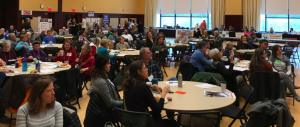
First, the question for citizens is “What we should do?” — where “we” means a concrete group of people like the folks convened in a room in Eau Claire on Sunday.
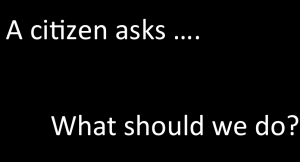
The hard part is to avoid a shift into “What should be done?” or “How should things be?” Those questions evade responsibility. They are also excessively easy. Carbon should be taxed; Trump should resign. Those points may be correct but they don’t tell us what we should do.

Second, any functioning political group, network, or movement should combine deliberation, collaboration, and civic relationships. Deliberation means discussing what to do in diverse groups. That makes us wiser. Collaboration means actually getting work done together, coordinating voluntary action. And civic relationships are the reasons that people participate.
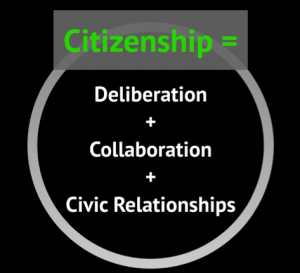
That framework is central to my book We Are the Ones We Have Been Waiting For, which I wrote while Barack Obama was president. I have considered whether this framework is obsolete when a man who threatens the republic occupies the White House. I still believe it applies. For one thing, people learn to value deliberative and collaborative styles of leadership by participating personally in decent groups. When only 28 percent of Americans report belonging to any group that is inclusive and accountable, no wonder many tolerate Trump’s style of leadership. Besides, every large-scale social movement, no matter how adversarial, needs deliberation, collaboration, and civic relationships to move forward. These are scarce but renewable sources of power.

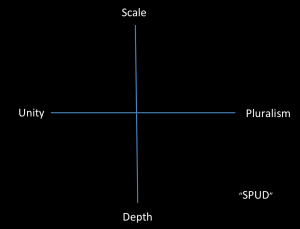
Third, try to maximize four goods that are often in tension. “Scale” means involving a lot of people. You can’t win without numbers. “Depth” means transforming people, building their skills, confidence, wisdom, and leadership. That’s necessary because we must all grow to be effective. “Pluralism” means encompassing a diversity of ideas and identities. Groups that fail to be pluralist get stupid and are unable to appeal to outsiders. “Unity” means coming together for one cause. Together they spell “SPUD,” which is a handy acronym. The challenge is that Depth trades off against Scale, and Pluralism against Unity. But the best movements achieve a bit of all four.
Fourth, work at several levels of power. The discussion of  “faces” or “levels” of power goes back at least to Stephen Lukes and John Gaventa in the 1970s; I borrow from the recent version by Archon Fung. The basic idea is that you can challenge a particular wrong, or a rule or policy, or who makes the rules and policies, or what’s on the public’s agenda. For instance, you could help an individual vote, change voting laws, change who makes the voting laws (e.g., who draws district boundaries), or change how the public thinks about voting.
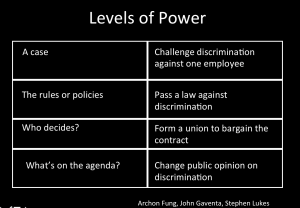
I venture the generalization that right-wing leaders are much better than the left at the third level of power. For example, Wisconsin Governor Scott Walker has relentlessly attacked public sector unions (except police) so that union leaders can’t help determine policies; and he has passed restrictive voters to change who participates in elections. The left is better at the first and second levels of power, but those levels have limits.

Finally, I reposted my “How to Respond?” chart, which I first released on this blog a couple of days after the November election. (Click to expand it.) It offers a set of strategies for activists in the current moment.
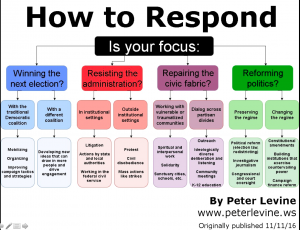
You can do more than one of these things. Probably some people should be doing each of them. But the eight options in the bottom row are too many for any one person or group to undertake, and they are in some tension. It’s hard for a group devoted to winning the 2018 election also to convene ideologically diverse conversations to bridge the gap between right and left. So most of us need to choose.

Note that I didn’t write, “How to respond to Trump’s victory.” This diagram doesn’t pretend to be nonpartisan or politically neutral. It offers options like winning the next election with a Democratic coalition and resisting the administration. But it is meant to be somewhat open-ended and subject to various interpretations. Genuine conservatives might take it to mean, “How to take our party back from a big-government chauvinist.” And leftists might interpret is as “How to respond to three centuries of injustice, in which Democrats are complicit.” As always, a plurality of views is an asset.

One way to use these tools might be to brainstorm concrete actions and then ask which cells in the last table you are filling, which levels of power you are addressing, how you are doing in SPUD, and whether you have deliberated and collaborated well. This process will not generate The Right Answer but it may help inform your strategies.

principles for researcher-practitioner collaboration

(Brief remarks at an Ash Center/Kennedy School of Government meeting on redistricting reform) I know less than anyone in this room about districting, but I do have experience with several networks of researchers and practitioners who have worked together on aspects of democracy. I’m talking not about specific projects but about partnerships that persist. Reflecting on those experiences, I’d propose three recommendations for any group of researchers and practitioners who come together to work on a problem:

1. Separate the people from their roles

Academics and practitioners of various sorts have official roles that structure their lives. It’s not because of arrogance or naval-gazing that tenure-track academics strive to publish: that’s a requirement. Publication requires originality, generalizability, and advanced methodological proficiency, none of which necessarily matters to practitioners. Meanwhile, practitioners must hit targets negotiated with funders or members, and they cannot spend scarce resources on research unless it advances their goals. Understanding these parameters allows creative solutions to emerge.

To promote a constructive conversation about how to work together, it helps to break down stereotypes about the human beings in these respective roles. In my experience, they tend not to be all that different. Many practitioners are deeply scholarly, in both their attainments and their dispositions and interests. And many scholars are practical people who work for real-world objectives and know how to get things done. Once academics and practitioners learn that they do not have fundamentally different priorities or values, it’s easier for them to focus on the nitty-gritty of incentives and opportunities.

2. Be diplomatic

This should go without saying, but I have seen plenty of cringe-inducing moments. Imagine professors from fancy institutions saying to grassroots organizers who have sacrificed and put their safety on the line for decades, “You don’t know whether your strategy has any impact because you have not done a randomized experiment.” There may actually be some truth to this claim, but it is no way to treat a fellow human being–nor will it encourage a partnership. I have also seen grizzled political organizers dismiss academics, especially young ones, for being politically naive, thereby missing what these scholars can contribute. We can’t work together well unless we treat each other well.

3. Recognize the three dimensions of complex problems

Redistricting is a good example. It is technically complex: massive data and computational power can be used to draw districts that advantage any side. It is normatively contested: good people would prefer districts that are (1) maximally competitive, (2) maximally representative of the partisan divide in a state, (3) maximally representative of the racial demographics of the state, (4) maximally secure for disadvantaged minority representatives, or (5) maximally compact. They prefer processes that are insulated from political pressure or responsive to political organizing. These are decent values but they conflict. Finally, the issue is riven with power: the technical tools and legal authority to redistrict are held by powerful people who use them for their ends.

These three dimensions also arise for most other 21st-century social and political problems. Progress typically demands empirical/methodological sophistication, normative deliberation, and strategic insight.

My claim is that both researchers and practitioners contribute to all three dimensions. Empirical, normative, and strategic sophistication comes from the academy and from practice. It’s a mistake to see academics as the sole custodians of empirical methods or the practitioners (and the public) as the only ones who can think about values or strategies. Questions of ideals and strategies can be investigated with scholarly rigor; practitioners can create and analyze data. We need everyone working on all three tasks.

See also: the Tisch College initiative on gerrymanderingmini-conference on Facts, Values, and Strategiespolitical science and the public; and twenty-five years of it.

a real surge in youth voting

According to CIRCLE, youth turnout has doubled in Virginia over the past three gubernatorial races, from 17% of eligible young people in 2009 to 34% yesterday. Virginians under the age of 30 also tilted dramatically to the Democratic side. Just over half (54%) of young Virginians had chosen Hillary Clinton one year ago; 69% voted for the Democrat, Ralph Northam, yesterday. Voting in force and tilting to one party is how to have real impact.

In New Jersey, where this year’s gubernatorial race was not particularly competitive, the youth turnout trend was flat.

Closer to home, Boston (like several major cities) held a mayoral election yesterday. We don’t know the youth turnout rate there because the data aren’t available yet. However, in the past two Boston mayoral elections (each conducted in an odd-numbered year), youth turnout did not reach even two percent. In contrast, last November, about 35% of young eligible voters voted in Boston, and 80%-87% of the registered young adults in each ward turned out. Although there’s work to be done to educate and engage young people in local politics–and some excellent organizers are doing that right now in Boston–it’s also bad to hold elections in off years. If you want your city to flourish, you need a youth perspective. You should hold elections on years when one in three–instead of one in fifty–young people turn out.